


 Скачать презентацию Regional Greenhouse Gas Initiative Presentation to American Council
050134d254ae79cd39400ff64f6d511a.ppt
- Количество слайдов: 32
 Regional Greenhouse Gas Initiative Presentation to American Council of Engineering Companies of New Hampshire January 15, 2008 New Hampshire Department of Environmental Services Commissioner Thomas S. Burack
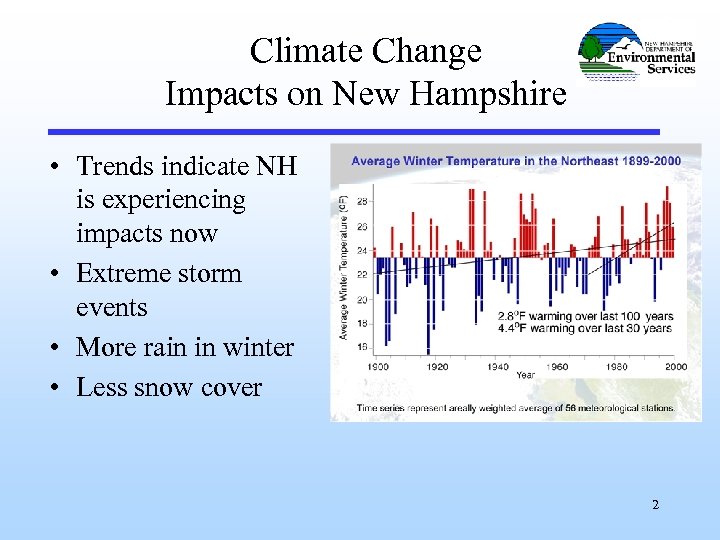 Climate Change Impacts on New Hampshire • Trends indicate NH is experiencing impacts now • Extreme storm events • More rain in winter • Less snow cover 2
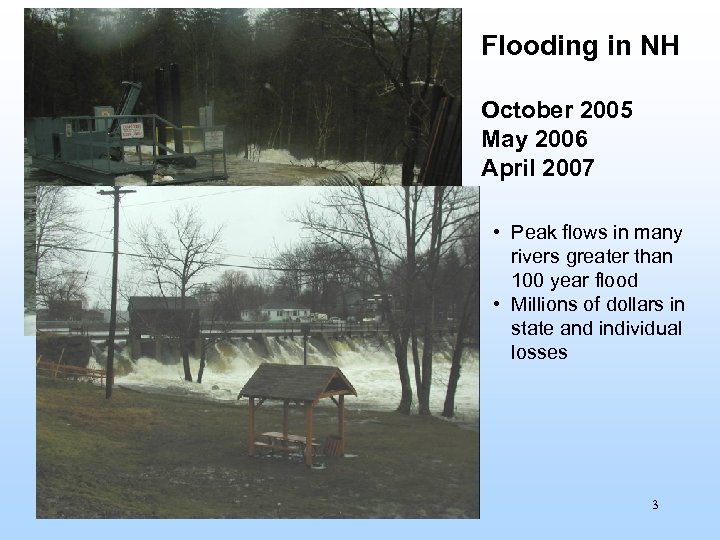 Flooding in NH October 2005 May 2006 April 2007 • Peak flows in many rivers greater than 100 year flood • Millions of dollars in state and individual losses 3
 Future Economic Impacts to New Hampshire Northeast Climate Impacts Assessment (2007) By late in the century (without reducing GHG emissions) • Winter snow season cut in half • Sea-level rise up to nearly three feet • More than 60 days with temperatures over 90°F in most cities • 4 to 28 days with temperatures over 100°F (compared with one or two days per year historically). 4
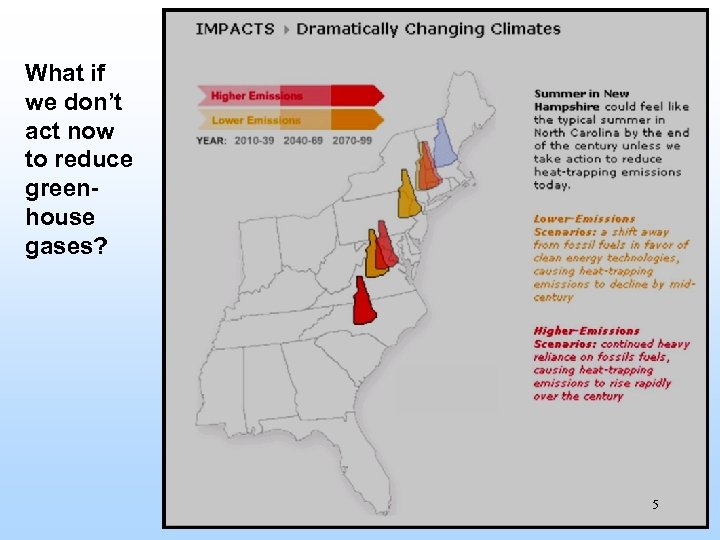 What if we don’t act now to reduce greenhouse gases? 5
 Global Cost of No Action (Stern Review UK Treasury 2006) • Extreme weather alone – 0. 5 -1% world GDP annually • Total cost of taking no action equivalent to reduction in consumption per head of 5 -20% annually • Less costly to take actions now than to delay • Risk to world economy on the order of multi-national world conflict • Insurance market already reacting 6
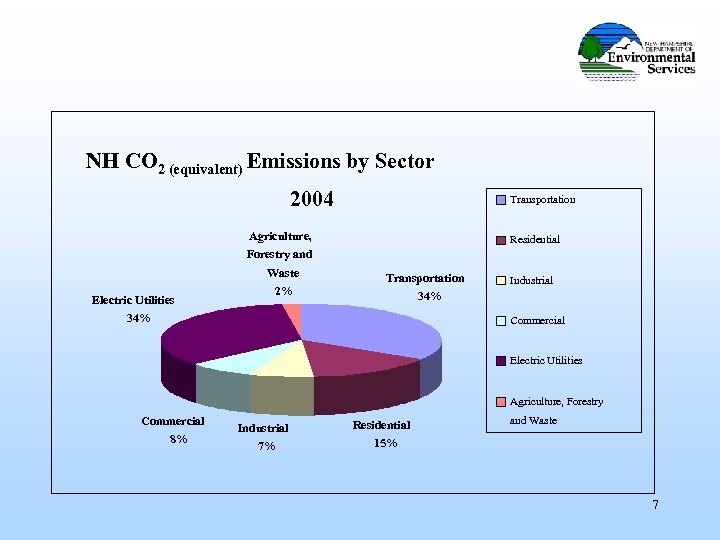 NH CO 2 (equivalent) Emissions by Sector 2004 Transportation Agriculture, Residential Forestry and Waste Electric Utilities 2% Transportation Industrial 34% Commercial Electric Utilities Agriculture, Forestry Commercial 8% Industrial 7% Residential and Waste 15% 7
 RGGI Cap & Trade Program • Regional cap on emissions from fossil fuelfired power plants >25 megawatts • Cap (10 state region) 188 million allowances • 1 allowance = 1 ton • NH Budget 8. 6 million allowances • Majority of allowances will be sold in regional auction 8
 RGGI Cap Levels • 2 -Phase CO 2 Caps (gradual, keeps cost low) – stabilization 2009 – 2014 (no absolute reductions, but reductions from business-asusual) • Phase I Regional Cap = 188, 076, 976 tons • Phase I NH Budget = 8, 620, 460 tons – 10% reduction 2015 - 2018 • (2. 5% per year for 4 years) • Built-in Review of Program in 2012 9
 Compliance • Power plants must have enough allowances to equal their emissions by the end of the three year period • Can buy allowances (regional auction) or offset allowances • Unlimited banking of allowances 10
 RGGI Offset Projects • 1 st set – methane capture, SF 6 (electric insulator), afforestation, end-use efficiency • Initially limited to 3. 3% of each source’s emissions • Offsets may come from RGGI region or from another US state at 1: 1 • Safety valves built in to increase use of offsets for economic relief if necessary 11
 RGGI impact on NH • 9 other states going forward with RGGI • Regional energy prices will be affected by RGGI whether NH participates or not • Only way to mitigate costs is to participate and use auction revenues 12
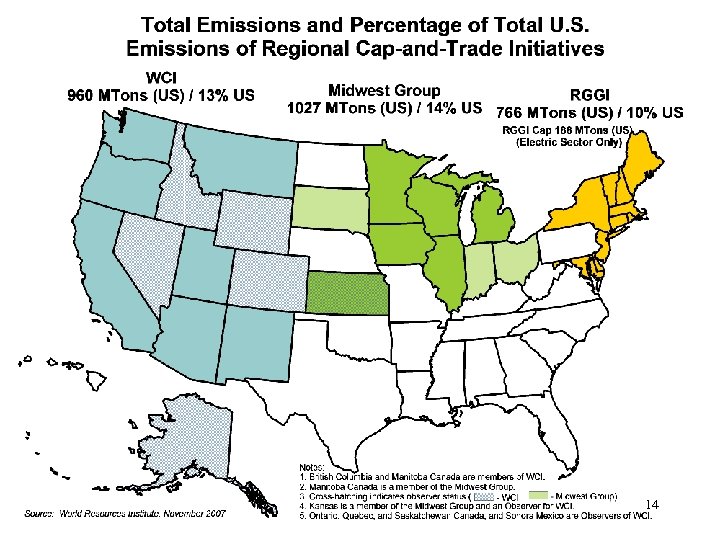
 Regional Leadership • Driving federal action • Western Climate Initiative includes Arizona, California, Montana, New Mexico, Oregon, Utah, Washington, British Columbia, and Manitoba and 10 observers including 3 Canadian provinces and Sonora, Mexico • Midwestern Greenhouse Gas Reduction Accord includes Illinois, Iowa, Kansas, Michigan, Minnesota, Wisconsin, and Manitoba (Indiana, Ohio, and S. Dakota also signed as observers) • Investment in more efficient energy market is positive for NH regardless of climate change 13
 14
14
 Is RGGI Significant? • RGGI would represent the seventh highest emitting developed country • The RGGI cap (188, 076, 976 tons) is similar to the emissions of Australia, France, or Italy • There is no “silver bullet” but RGGI is part of the “silver buckshot” 15
 Benefits of HB 1434 • Helps to mitigate long-term energy costs via greater investment in energy efficiency • Creates a market signal that encourages development of cleaner and, in many cases, more local energy sources • Increases our energy independence with more local energy sources: keeping more dollars local • Starts to mitigate our GHG emissions to avoid the most deleterious projections of climate change impacts 16
 Downside of not joining RGGI • Roughly half of NH’s supply is purchased from the regional market • As a consequence, NH electric prices will be affected by RGGI • No benefit of sale of NH allowances • No seat at table – no influence on program 17
 Estimated Impact to Business Electricity Costs Not joining RGGI Increase to average monthly bill 2006 average monthly bill (UNH estimate from FERC Form 1) 2009 2012 2015 2018 Small $308 (81, 000 accounts) Small $1. 15 $2. 38 $3. 72 $5. 16 Large $38, 000 (350 accounts) Large $142 $292 $458 $636 0. 8% 1. 2% 1. 7% % 0. 4% Change 18
 Potential Mitigation of Monthly Business Electricity Costs Net change from investment in energy efficiency compared to not joining RGGI 2009 2012 2013 2015 2018 Small Business $1. 29 $(0. 20) $(1. 90) $(4. 00) $(9. 78) Large Business $159 $(25) $(234) $(493) $(1, 205) % Change 0. 4% -0. 07% -0. 6% -1. 3% -3. 2% 19
 Energy Efficiency – Regional Priority • Record peak demand in summer >28, 000 MW • Peak demand increase twice as fast as average load growth • Costly new capacity may be needed to meet demand reached for only a few hours or days our of the year • Reducing electricity use by 5% during peak times will save consumers $580 million a year (ISO – NE June 2006) 20
 Major Potential for Energy Efficiency Improvements • • RGGI bill proposing a “fuel-neutral” fund Technology continuing to improve Recognize opportunities vary Increased energy efficiency overall – can avoid costly new capacity – reducing everyone’s energy costs 21
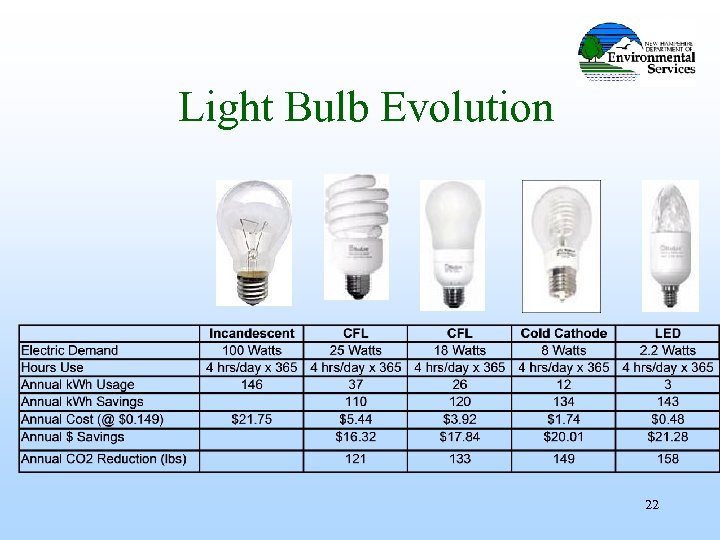 Light Bulb Evolution 22
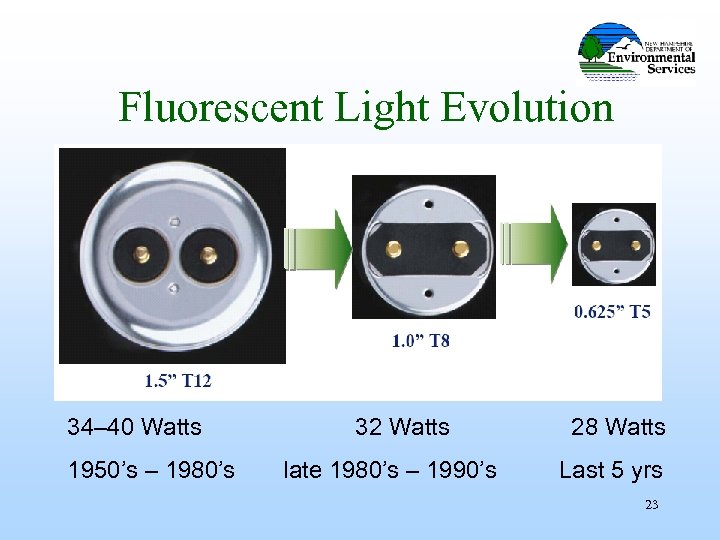 Fluorescent Light Evolution 34– 40 Watts 1950’s – 1980’s 32 Watts late 1980’s – 1990’s 28 Watts Last 5 yrs 23
 UNH Economic Analysis 2007 • NH participation is lower cost overall to NH than not joining • Lowest long-term net utility cost is to auction allowances and put revenues into energy efficiency • Positive impact on employment and the overall NH economy 24
 Opportunity for Economic Development • NH tradition of innovation and leadership • NH needs to foster R&D development of new technologies and related ancillary services • Current examples – Power Span – GT Solar 25
 What’s the Ultimate Source of Greenhouse Gases? ENERGY DEMAND for Electricity, Heating/Cooling and Transportation • Every megawatt-hour of electricity used produces 1, 100 lbs. of CO 2 • Every gallon of gasoline burned produces 20 26 lbs. of CO 2
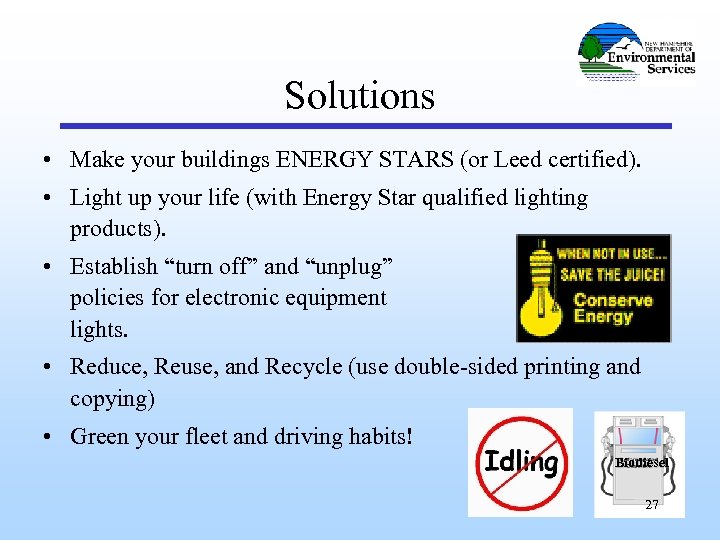 Solutions • Make your buildings ENERGY STARS (or Leed certified). • Light up your life (with Energy Star qualified lighting products). • Establish “turn off” and “unplug” policies for electronic equipment and lights. • Reduce, Reuse, and Recycle (use double-sided printing and copying) • Green your fleet and driving habits! Biodiesel 27
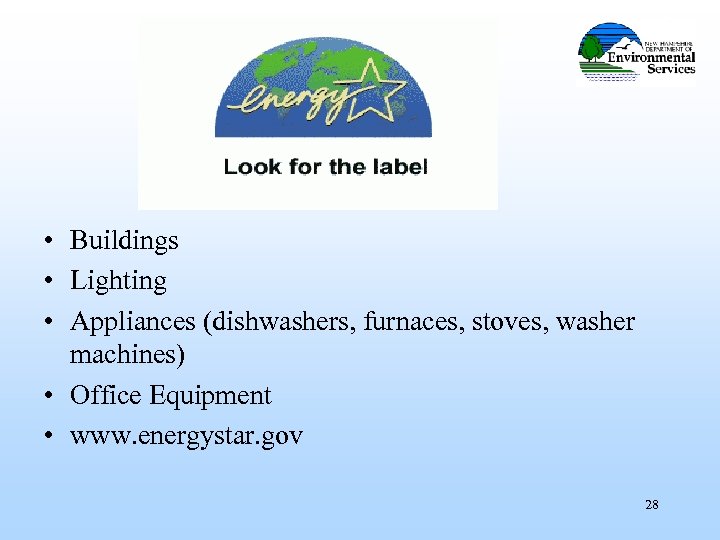 • Buildings • Lighting • Appliances (dishwashers, furnaces, stoves, washer machines) • Office Equipment • www. energystar. gov 28
 Reduce fuel consumption in motor vehicles Establish fuel economy standards for new purchases Establish anti-idling policies Promote carpooling and teleconferencing Less Greenhouse Gases – Less Dependence on Foreign Oil 29
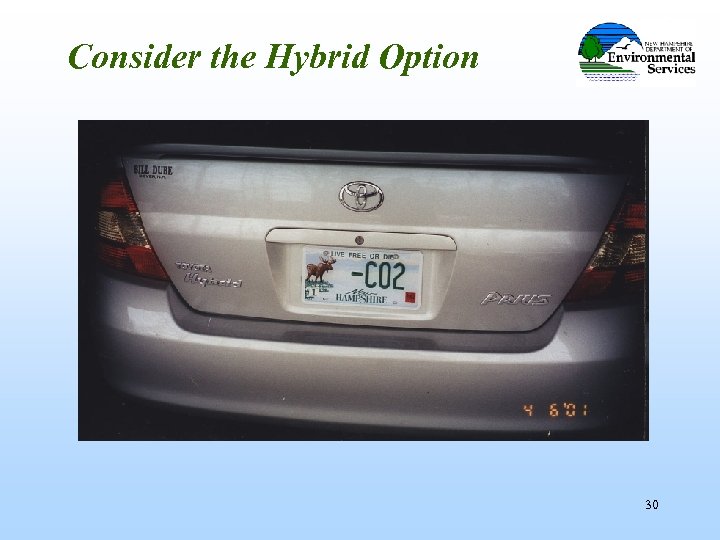 Consider the Hybrid Option 30
 31
31
 Contacts Tom Burack Bob Scott Joanne Morin thomas. burack@des. nh. gov 271 - 2958 robert. scott@des. nh. gov 271 -1088 joanne. morin@des. nh. gov 271 -5552 32