 Скачать презентацию Regional disparities and policy responses Tony Venables DFID
74bc1993b2d6b825c26cc76fb1e81504.ppt
- Количество слайдов: 10




Regional disparities and policy responses. Tony Venables, DFID

• Issues: • What do we know about spatial disparities in developing countries – Kanbur and Venables • Measurement issues and tools • Policy responses • Equity • Efficiency Page 1
Policy responses: Need analysis at several levels. • What is the ‘exogenous’ dynamic? Are disparities just part of a process of change or are they long run? Europe? – long run? Enlarged Europe? – a dynamic has been initiated? Developing? – dartboard development? – persistent asymmetry? • What would the economic response be in a (near) perfect economy? Could involve substantial migration. • What are the market failures? – cumulative processes – Increasing returns & public goods. Page 2
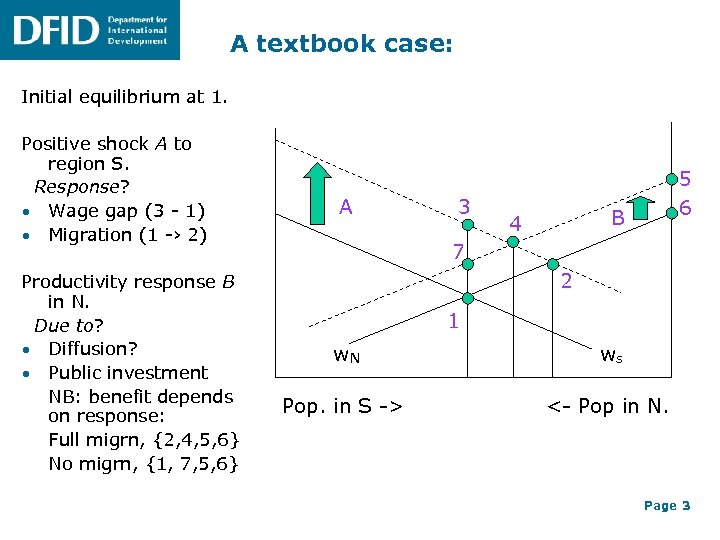
A textbook case: Initial equilibrium at 1. Positive shock A to region S. Response? • Wage gap (3 - 1) • Migration (1 -› 2) Productivity response B in N. Due to? • Diffusion? • Public investment NB: benefit depends on response: Full migrn, {2, 4, 5, 6} No migrn, {1, 7, 5, 6} A 3 5 6 B 4 7 2 1 w. N ws Pop. in S -> <- Pop in N. Page 3
Cumulative causation and increasing returns to scale • Mechanisms: • Thick market effects – labour matching & incentives for skill acquisition. • Linkages between firms • Knowledge spillovers • Public goods & public finance • Within or across sectors? Versus dispersion forces; • Commuting costs • Land rent/ house prices • Congestion externalities • Magnitudes • Doubling city size increases productivity 3 -8% • Narrow spatial range – up to 45 -60 minutes driving time. Page 4
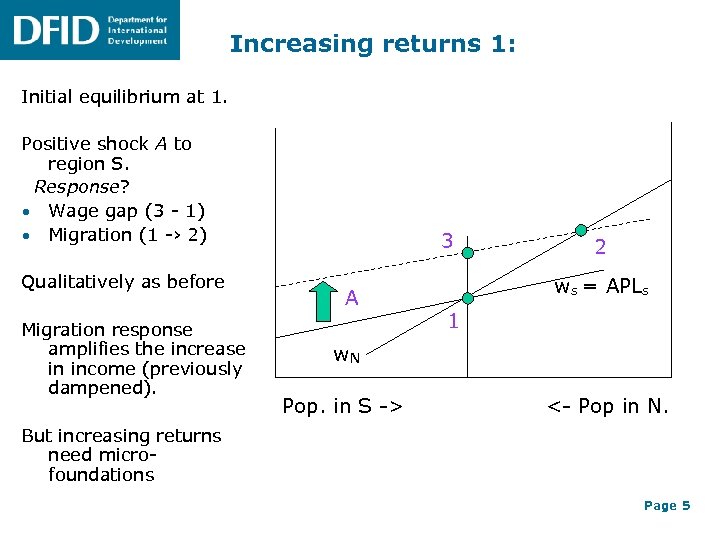
Increasing returns 1: Initial equilibrium at 1. Positive shock A to region S. Response? • Wage gap (3 - 1) • Migration (1 -› 2) Qualitatively as before Migration response amplifies the increase in income (previously dampened). 3 A 2 ws = APLs 1 w. N Pop. in S -> <- Pop in N. But increasing returns need microfoundations Page 5
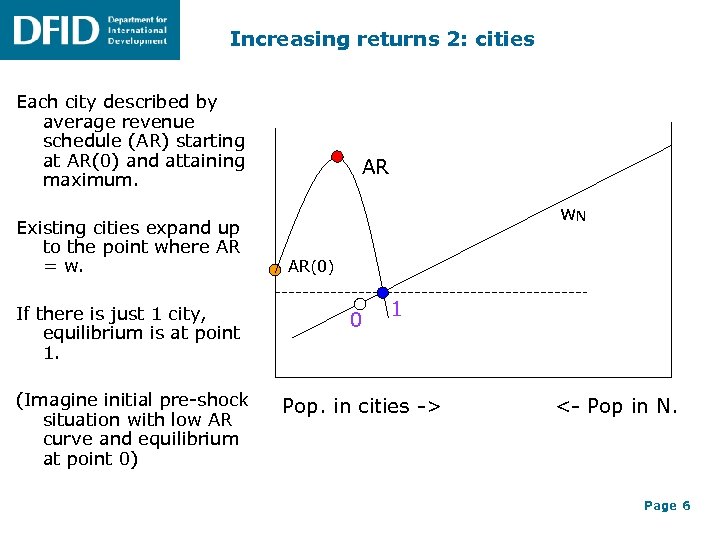
Increasing returns 2: cities Each city described by average revenue schedule (AR) starting at AR(0) and attaining maximum. Existing cities expand up to the point where AR = w. If there is just 1 city, equilibrium is at point 1. (Imagine initial pre-shock situation with low AR curve and equilibrium at point 0) AR w. N AR(0) 0 1 Pop. in cities -> <- Pop in N. Page 6
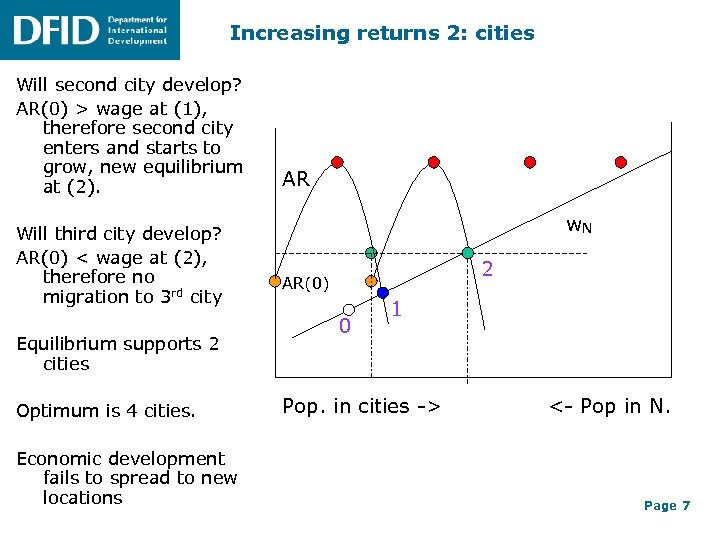
Increasing returns 2: cities Will second city develop? AR(0) > wage at (1), therefore second city enters and starts to grow, new equilibrium at (2). Will third city develop? AR(0) < wage at (2), therefore no migration to 3 rd city Equilibrium supports 2 cities Optimum is 4 cities. Economic development fails to spread to new locations AR w. N 2 AR(0) 0 1 Pop. in cities -> <- Pop in N. Page 7
Policy issues? • Importance of market failures: • Two market failures: Coordination failure/ externality • Externality: suggests Pigovian subsidy, but impossible to target. • Coordination failure: suggests spatially concentrated commitment. • Where do further cities enter? – peri-urban areas or regional secondary/ tertiary cities. Page 8
Messages for PREM • Data • Mechanisms • Analytical framework • Build evidence base on what sort of interventions have worked and what have failed. Page 9
Скачать презентацию Regional disparities and policy responses Tony Venables DFID
74bc1993b2d6b825c26cc76fb1e81504.ppt