


 Скачать презентацию Regional Conference on Strengthening Transport Connectivity and Trade
d663500af902dd0af8144952338a357b.ppt
- Количество слайдов: 22
 Regional Conference on Strengthening Transport Connectivity and Trade Facilitation in South and South-West Asia Lahore, Pakistan, 9 -10 December 2013 UNESCAP Recommendations and Tools for Transport Facilitation Measures Sandeep Raj Jain/Heini Suominen Transport Facilitation & Logistics Section Transport Division
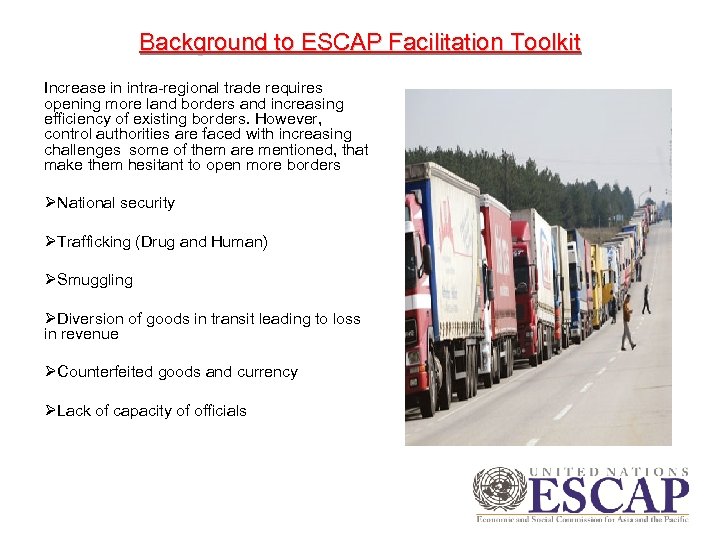 Background to ESCAP Facilitation Toolkit Increase in intra-regional trade requires opening more land borders and increasing efficiency of existing borders. However, control authorities are faced with increasing challenges some of them are mentioned, that make them hesitant to open more borders ØNational security ØTrafficking (Drug and Human) ØSmuggling ØDiversion of goods in transit leading to loss in revenue ØCounterfeited goods and currency ØLack of capacity of officials
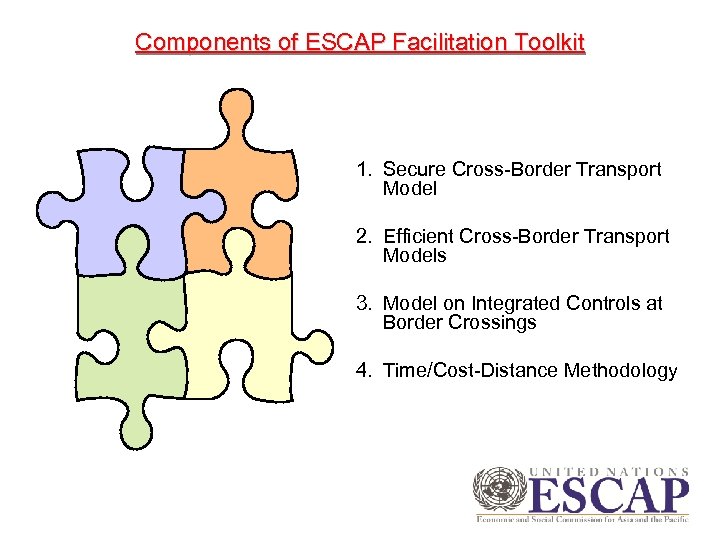 Components of ESCAP Facilitation Toolkit 1. Secure Cross-Border Transport Model 2. Efficient Cross-Border Transport Models 3. Model on Integrated Controls at Border Crossings 4. Time/Cost-Distance Methodology
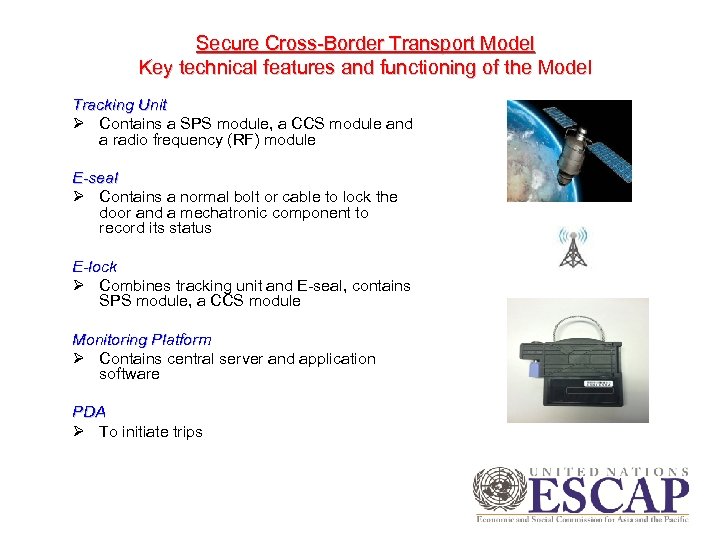 Secure Cross-Border Transport Model Key technical features and functioning of the Model Tracking Unit Ø Contains a SPS module, a CCS module and a radio frequency (RF) module E-seal Ø Contains a normal bolt or cable to lock the door and a mechatronic component to record its status E-lock Ø Combines tracking unit and E-seal, contains SPS module, a CCS module Monitoring Platform Ø Contains central server and application software PDA Ø To initiate trips
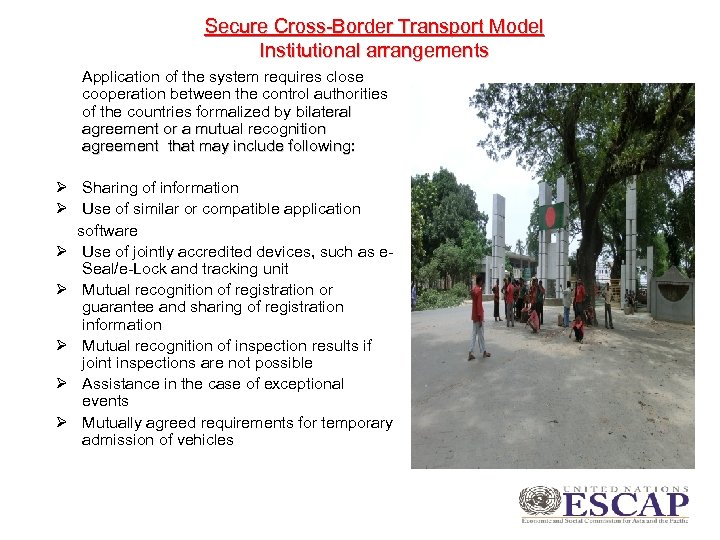 Secure Cross-Border Transport Model Institutional arrangements Application of the system requires close cooperation between the control authorities of the countries formalized by bilateral agreement or a mutual recognition agreement that may include following: Ø Sharing of information Ø Use of similar or compatible application software Ø Use of jointly accredited devices, such as e. Seal/e-Lock and tracking unit Ø Mutual recognition of registration or guarantee and sharing of registration information Ø Mutual recognition of inspection results if joint inspections are not possible Ø Assistance in the case of exceptional events Ø Mutually agreed requirements for temporary admission of vehicles
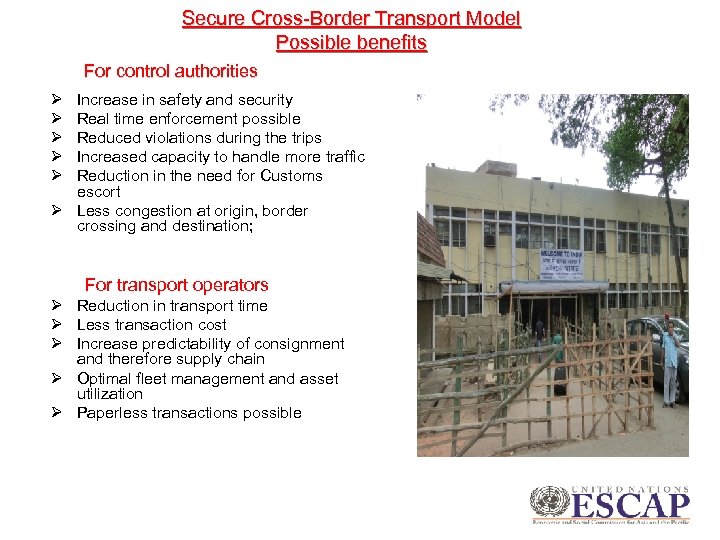 Secure Cross-Border Transport Model Possible benefits For control authorities Ø Ø Ø Increase in safety and security Real time enforcement possible Reduced violations during the trips Increased capacity to handle more traffic Reduction in the need for Customs escort Ø Less congestion at origin, border crossing and destination; For transport operators Ø Reduction in transport time Ø Less transaction cost Ø Increase predictability of consignment and therefore supply chain Ø Optimal fleet management and asset utilization Ø Paperless transactions possible
 Secure Cross-Border Transport Model Conclusion Ø Similar system are already in operation in parts of Africa, Latin America, in Jordan, Thailand, China, Hong Kong, China, Republic of Korea Ø Development of secure trade and transport lanes- mention of such system in transit agreements ( Afghanistan-Pakistan) Ø Use of new technologies in transport can address the pressing concerns of the control authorities while facilitating Ø Ultimately, we have to control ‘the 5’ moving in international trade- people, goods, conveyances, money and information
 Efficient Cross-Border Transport Models Ø Background: Operational environment always unique, with its particular challenges and non-physical barriers Ø Multiple solutions with competing benefits and challenges Ø Ø Different views in private and public sector Benefits and costs of solutions not directly comparable Ø No agreed methodology for assessment of most appropriate approach Ø Ø Ø Often no thorough assessment Waste of resources Continuation of ineffective practices UNESCAP ECBMs can offer: Ø Analytical framework Ø Systematic assessment of specific operating environment Ø Solutions through regional analysis Ø Freight and passenger transport for road and rail
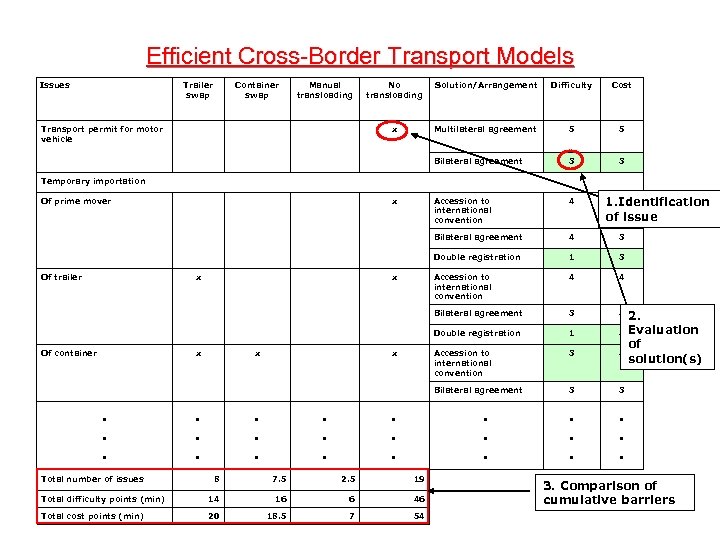 Efficient Cross-Border Transport Models Issues Trailer swap Container swap Manual transloading No transloading Solution/Arrangement Difficulty Cost Transport permit for motor vehicle x Multilateral agreement 5 5 Bilateral agreement 3 3 x Accession to international convention 4 Temporary importation Of prime mover 4 1. Identification of issue Bilateral agreement 4 3 Double registration 1 3 Accession to international convention 4 4 3 Of trailer x x 2. 3 Evaluation of 3 solution(s) Bilateral agreement 3 Double registration 1 Accession to international convention 3 Bilateral agreement 3 3 . . . Of container x x . . . Total number of issues . . . x . . . 8 7. 5 2. 5 19 Total difficulty points (min) 14 16 6 46 Total cost points (min) 20 18. 5 7 54 3. Comparison of cumulative barriers
 Efficient Cross-Border Transport Models
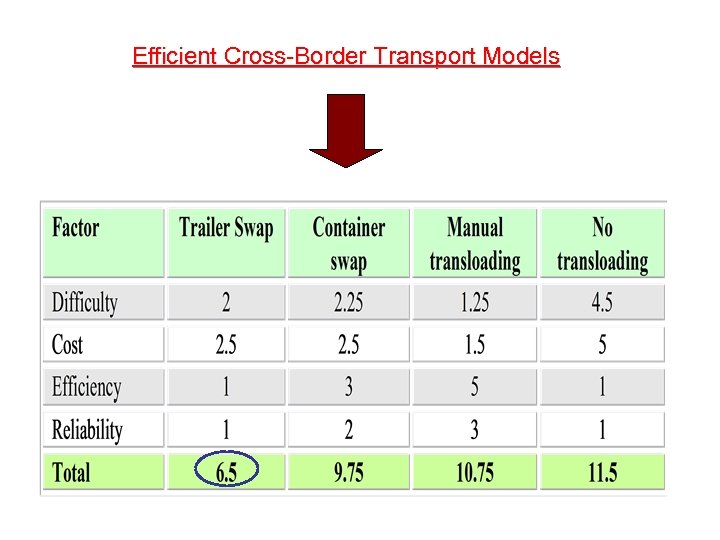
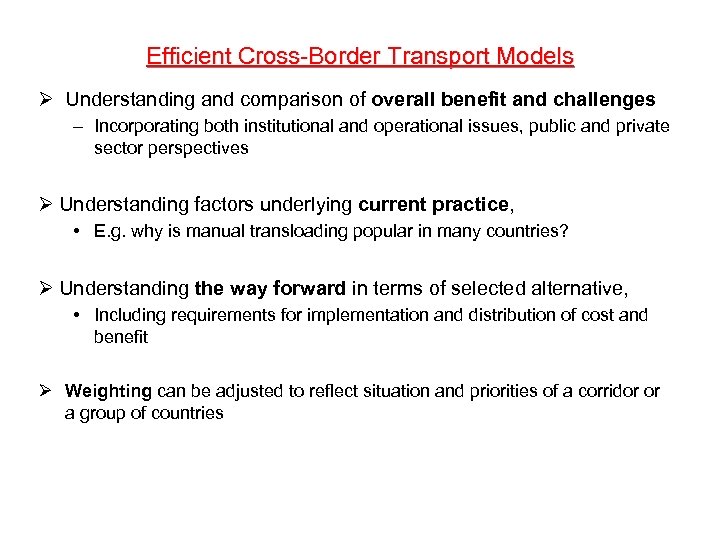 Efficient Cross-Border Transport Models Ø Understanding and comparison of overall benefit and challenges – Incorporating both institutional and operational issues, public and private sector perspectives Ø Understanding factors underlying current practice, • E. g. why is manual transloading popular in many countries? Ø Understanding the way forward in terms of selected alternative, • Including requirements for implementation and distribution of cost and benefit Ø Weighting can be adjusted to reflect situation and priorities of a corridor or a group of countries
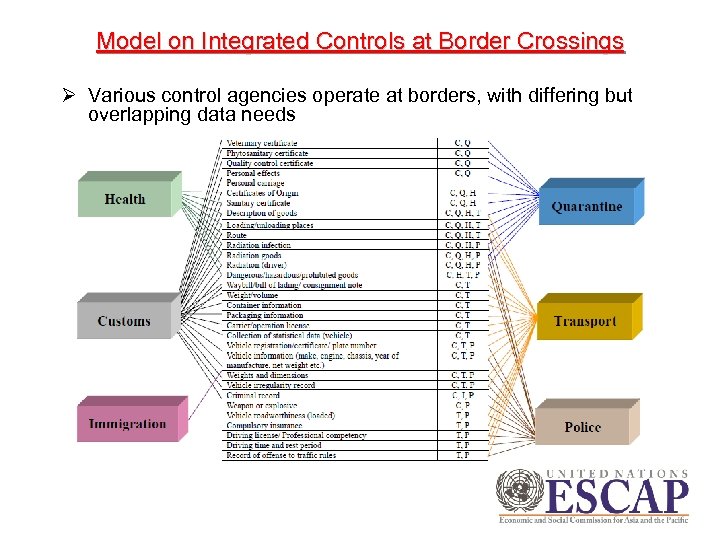 Model on Integrated Controls at Border Crossings Ø Various control agencies operate at borders, with differing but overlapping data needs
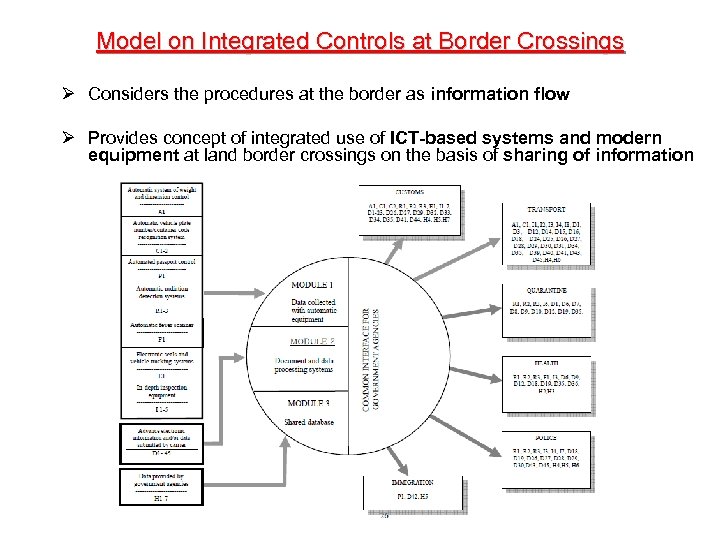 Model on Integrated Controls at Border Crossings Ø Considers the procedures at the border as information flow Ø Provides concept of integrated use of ICT-based systems and modern equipment at land border crossings on the basis of sharing of information
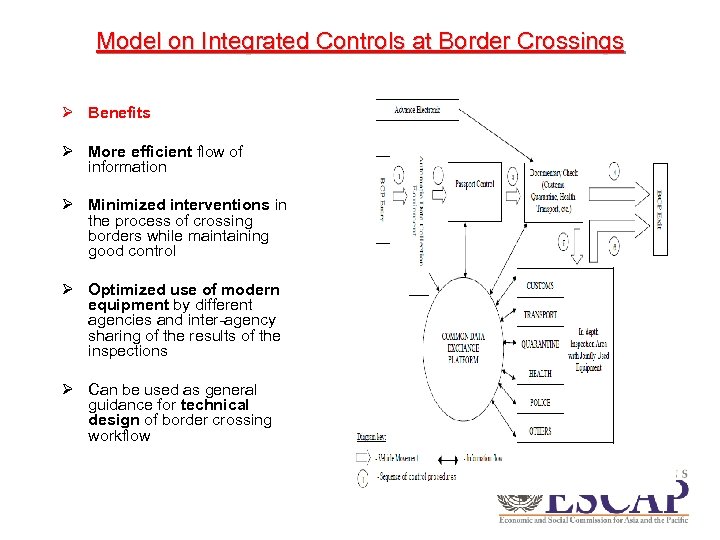 Model on Integrated Controls at Border Crossings Ø Benefits Ø More efficient flow of information Ø Minimized interventions in the process of crossing borders while maintaining good control Ø Optimized use of modern equipment by different agencies and inter-agency sharing of the results of the inspections Ø Can be used as general guidance for technical design of border crossing workflow
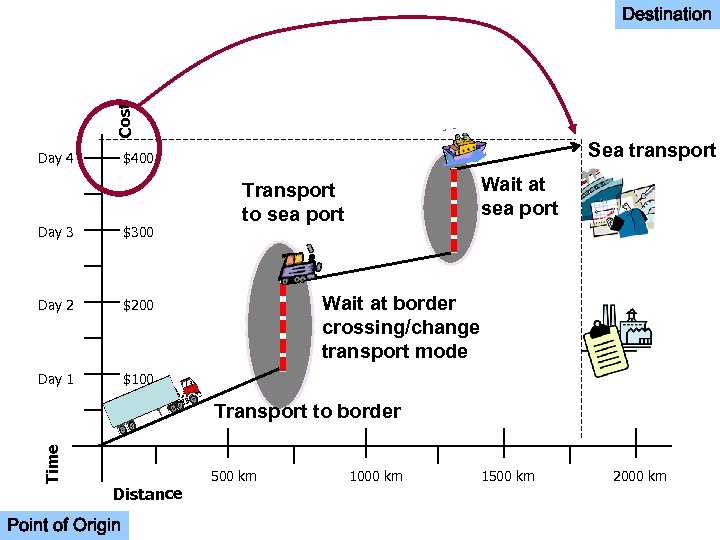
 Time/Cost – Distance Methodology Ø Graphical representation of cost and time data associated with transport processes. Ø The purpose of the model is to identify inefficiencies and isolate bottlenecks along a particular route by looking at the cost and time characteristics of every section along a route. Ø The “UNESCAP Time/Cost – Distance Methodology” enables policy makers to: q compare - over a period of time - the changes of cost and/or time required for transportation on a certain route; q compare and evaluate competing modes of transport operating on the same route; q compare alternative transport routes.
 Time/Cost – Distance Methodology Ø Simple to use Ø Can be understood by all Ø Can be utilised to measure and assess the performance of any transport corridor (unimodal or intermodal) Ø Includes both transport (road, rail, inland waterway, maritime) and intermodal transfer (ports, rail-freight terminals, inland clearance depots) as cost and time components. Ø Provides a ‘snap-shot’ of the present situation or can track changes over time Ø Powerful instrument for international cooperation Ø Minimum information required ü Route from origin to destination, including border crossings ü Mode of transport for each leg (e. g. Road/Rail/Sea/Air) ü Distance for each leg/mode ü Time for each leg/mode ü Cost for each leg/mode
 Cost Destination Day 4 Sea transport $400 Day 3 $300 Day 2 $200 Day 1 Wait at sea port Transport to sea port $100 Wait at border crossing/change transport mode Time Transport to border Distance Point of Origin 500 km 1000 km 1500 km 2000 km
 Regional Strategic Framework for Facilitation of International Road Transport Fundamental issues in facilitation of international road transport i. iii. iv. v. vi. Road transport permits and traffic rights Visa issues Temporary importation of road vehicles Insurance of vehicles Vehicles weight and dimensions Vehicle registration and inspection certificate Key modalities for facilitation international road transport i. iii. iv. Building an effective legal regime Wider application of new technologies Development of professional training Establishment and strengthening of national coordination mechanisms v. Promotion of joint controls at border crossings vi. Promotion of economic zones at border crossings vii. Application of facilitation tools
 Building an effective legal regime for transport Objectives: Regional Network of Legal and Technical Experts for Transport Facilitation Ø Exchange information and share experience Ø Pinpoint areas of legal conflicts while implementing different subregional/bilateral agreements Ø Suggest solutions for legal conflicts where a country is party to two or more agreements Ø Suggest ways to connect countries in different subregions Activities: Ø Information and experience sharing, seminars, expert meetings, professional training, group studies and individual studies
 Inter-agency coordination mechanism for integrated approach to trade and transport facilitation Ø Transport facilitation is challenging due to involvement of numerous stakeholders Ø Each agency has a different mandate regarding goods/vehicles/people crossing the borders Guidelines for Establishing and Strengthening National Coordination Mechanisms for Ø More often, the agencies work is silos Trade and Transport leading to duplication of inspections and Facilitation in the information ESCAP region Ø Interagency coordination mechanisms provide forum for agencies to come together for common purpose Ø While control measures are instituted trade, transport and transit are facilitated
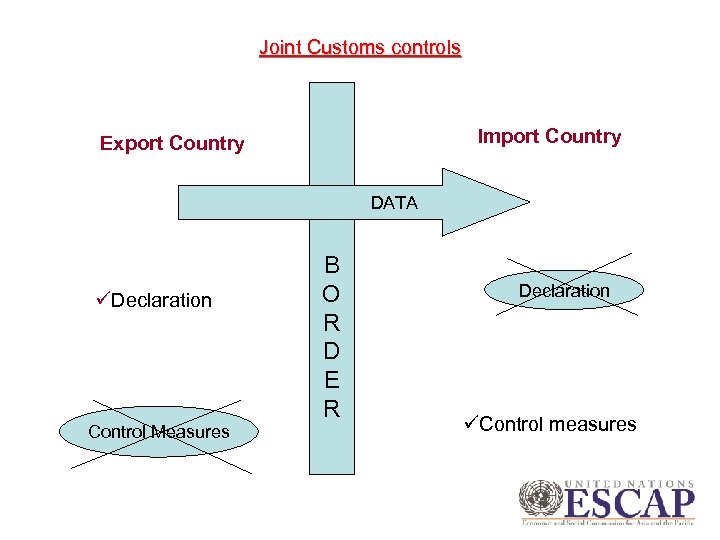 Joint Customs controls Import Country Export Country DATA üDeclaration Control Measures B O R D E R Declaration üControl measures
 Thank you for your Attention http: //www. unescap. org/ttdw/common/T FS/Facilitation. Tools. asp jain@un. org suominenh@un. org