Refutation and Rebuttal
Ø Refutation – an element of dispute, in the course of which opponents argument is attacked, in order to demean its value and effectiveness, in the eyes of the audience i. e. –opposing arguments ØRebuttal – an element of dispute, in the course of which the team recovers their arguments i. e. – the Refutation of Refutation
§ Refutation consists of 1)Attacking the arguments of your opponent 2)Building your own arguments § Rebuttal consists of 1)Attacking the arguments of your opponent 2)Restoring your arguments


Types of Refutations Denial Strategies 2. Acceptance Strategies 1.
- Challenging the definitions and attributes - Challenging the evidence - Demonstrating the opposite - Demonstrating specific fallacies of the opponent
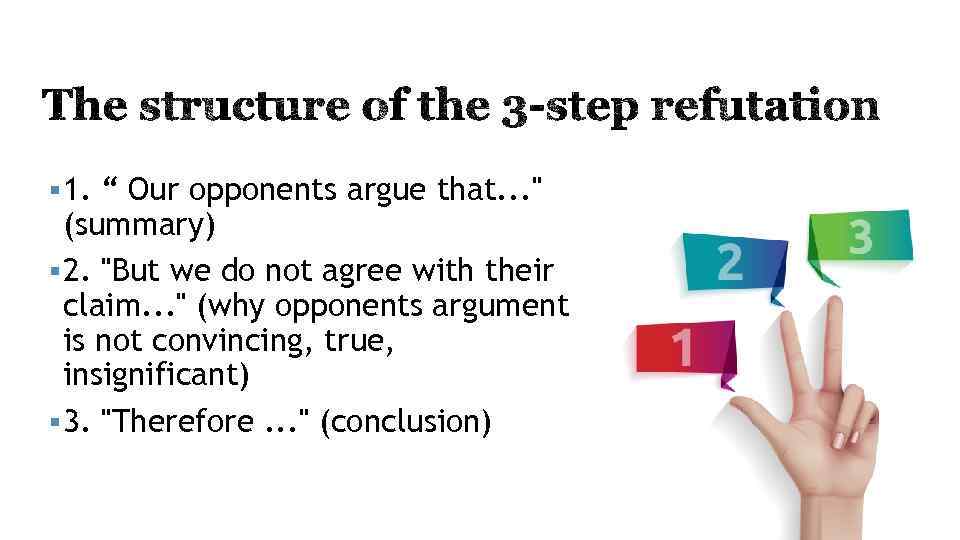
§ 1. “ Our opponents argue that. . . " (summary) § 2. "But we do not agree with their claim. . . " (why opponents argument is not convincing, true, insignificant) § 3. "Therefore. . . " (conclusion)
Prove that definitions: § - Not quite clear to your opponents themselves § - Incorrectly interpreted § - Your opponents introduced ambiguous definitions that mislead your audience Usually, this happens with the definitions of complex the concepts of "communism". "Dictatorship", etc.
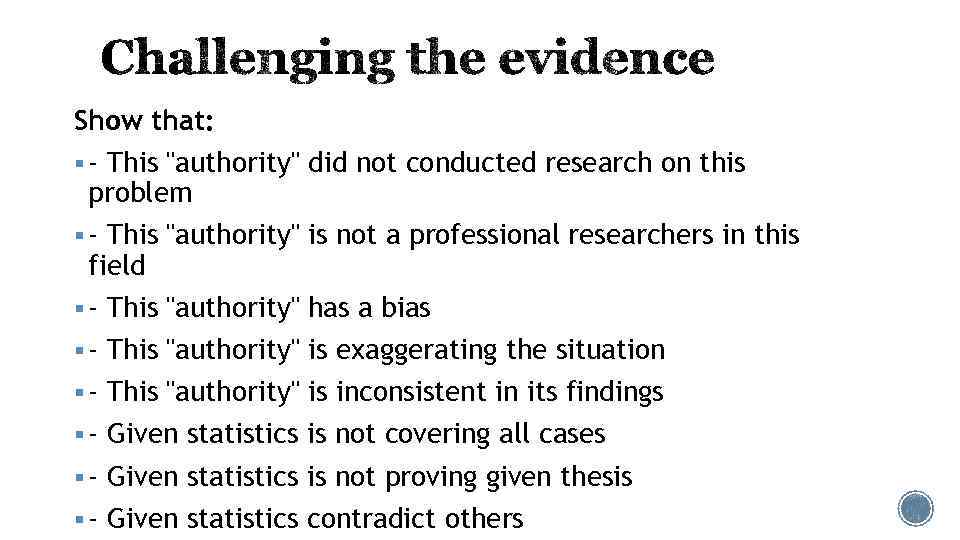
Show that: § - This "authority" did not conducted research on this problem § - This "authority" is not a professional researchers in this field § - This "authority" has a bias § - This "authority" is exaggerating the situation § - This "authority" is inconsistent in its findings § - Given statistics is not covering all cases § - Given statistics is not proving given thesis § - Given statistics contradict others
§ "Other studies say the opposite" § "Our examples prove the opposite. "

Acceptance strategies Minimization Superiority Turn over
Minimization When faced to a logically sound and correct argument, the team can reduce the importance of this argument, by showing its insignificance "The problem, of course, exist, but it is not so. . . great. “ NOT denying the validity and consistence BUT diminishing its importance
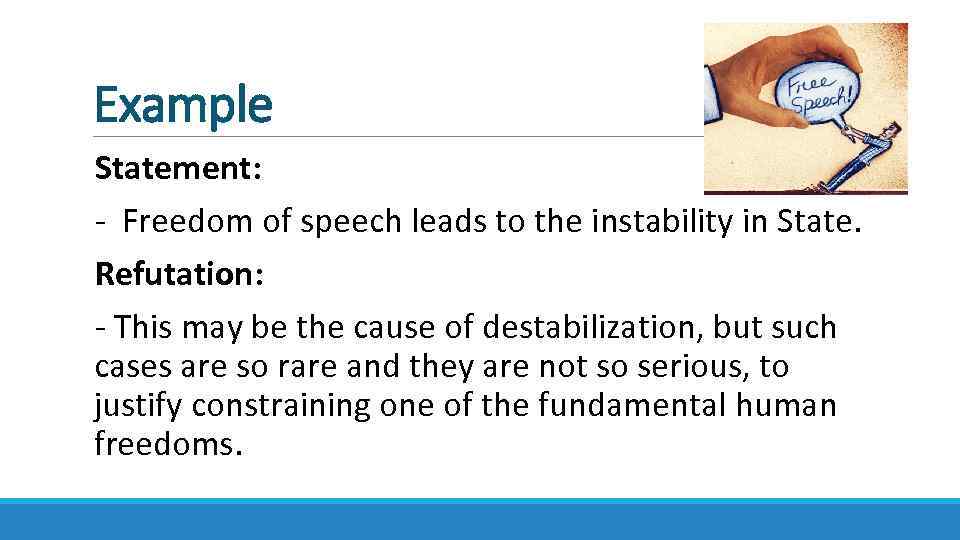
Example Statement: - Freedom of speech leads to the instability in State. Refutation: - This may be the cause of destabilization, but such cases are so rare and they are not so serious, to justify constraining one of the fundamental human freedoms.
Superiority Very effective strategy. When faced to a logically sound and correct argument, the team agrees with their opponents claim, but then points to the more important and expedient points
Example Statement: - Freedom of speech leads to the instability in State. Refutation: - It can cause destabilization in the country, but the freedom of speech protects human rights and their preservation, which is much more important.
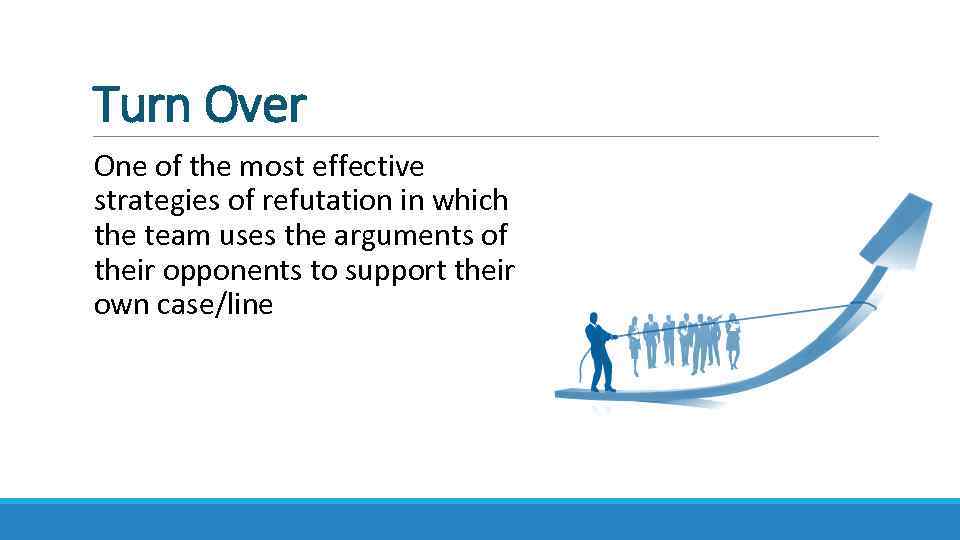
Turn Over One of the most effective strategies of refutation in which the team uses the arguments of their opponents to support their own case/line
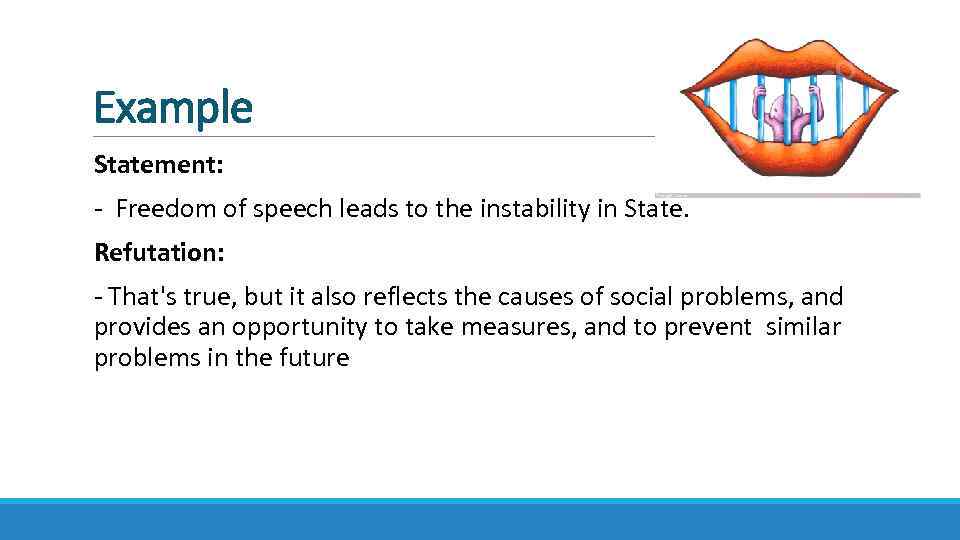
Example Statement: - Freedom of speech leads to the instability in State. Refutation: - That's true, but it also reflects the causes of social problems, and provides an opportunity to take measures, and to prevent similar problems in the future
Questions ◦ Do you have to refute everything that the previous speaker said ? NO
Questions ◦ Can you win without refuting the arguments of opponents? OF COURSE !
Questions ◦ Do you need to make the big emphasize on the refutation in your speech (to pronounce all)? NO