 Скачать презентацию Refugee Health In Minnesota Carol Berg RN MPH
79b42defd69f486cc11a8d0e4a2595c3.ppt
- Количество слайдов: 51



Refugee Health In Minnesota Carol Berg, RN, MPH Public Health Manager, UCare cberg@ucare. org
Presentation Objectives • Describe refugee and immigrant populations in Minnesota. • Explain the MDH Refugee Health Program. • Cite the health needs assessed among new arrivals. • Identify strategies to enhance culturallyspecific health care services for new arrival populations.
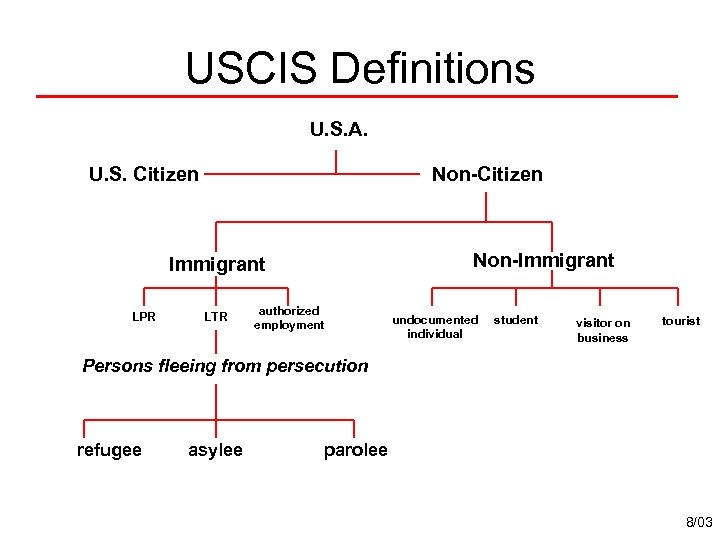
USCIS Definitions U. S. A. U. S. Citizen Non-Immigrant LPR LTR authorized employment undocumented individual student visitor on business tourist Persons fleeing from persecution refugee asylee parolee 8/03
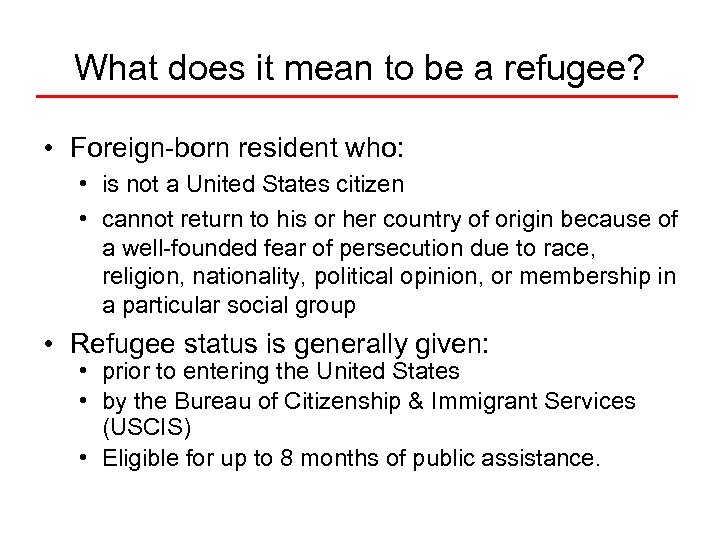
What does it mean to be a refugee? • Foreign-born resident who: • is not a United States citizen • cannot return to his or her country of origin because of a well-founded fear of persecution due to race, religion, nationality, political opinion, or membership in a particular social group • Refugee status is generally given: • prior to entering the United States • by the Bureau of Citizenship & Immigrant Services (USCIS) • Eligible for up to 8 months of public assistance.
What does it mean to be an immigrant? • Foreign-born resident who: • is not a United States citizen • is defined by U. S. immigration law as a person lawfully admitted for permanent residence in the United States • either arrives in the U. S. with an immigrant visa issued abroad, or adjusts their status in the U. S. from temporary to permanent resident • may be subjected to a numerical cap
What does it mean to be an asylee? • Foreign-born resident who: • is not a United States citizen • cannot return to his or her country of origin because of a well-founded fear of persecution • due to race, religion, nationality, political opinion, or membership in a particular social group • Asylee status is generally given: • after entering the United States • by the State Department or USCIS
What does it mean to be a parolee? • Foreign-born resident who: • is not a United States citizen • has been given special permission to enter the United States: - under emergency conditions or - when that person's entry into the U. S. is considered to be in the public's interest
Migrants to Minnesota • Primary Migrants to Minnesota • Foreign-born persons whose primary state of resettlement in the U. S. was Minnesota • Arrival notification from CDC • Secondary Migrants to Minnesota • Significant movement of refugees/ immigrants from state of primary arrival • Health information requested from primary arrival state • If no information is available, baseline health assessment should be done
Refugee Health Program Goal • To control communicable disease among, and resulting from, the arrival of new refugees through: • health assessment • treatment • referral
Functions of MDH Refugee Health Program • Coordinate initial health assessments, • Educate providers regarding screening protocols, • Administer contacts with local health departments for refugee screening, • Collect and disseminate health screening data, • Collaborate with Volags, MAAs, and other community based organizations, • Provide health resources foreignborn populations and their health care providers.
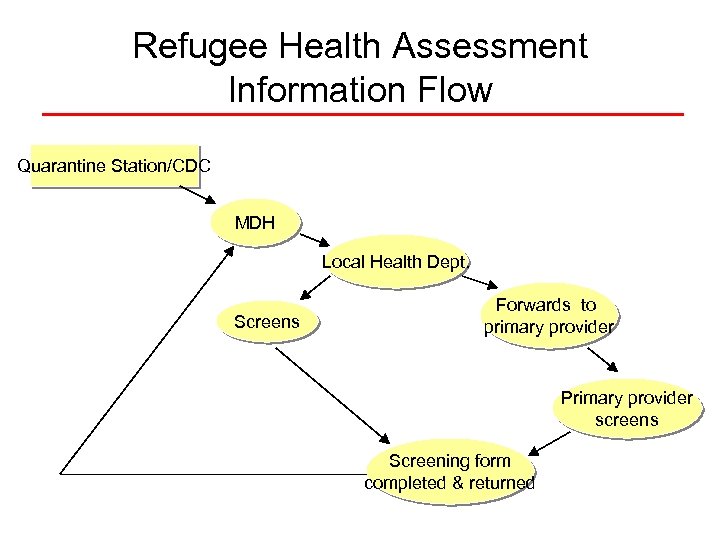
Refugee Health Assessment Information Flow Quarantine Station/CDC MDH Local Health Dept. Screens Forwards to primary provider Primary provider screens Screening form completed & returned
Volags (Volunteer Agencies): Local Organizations or Affiliates • Catholic Charities (CC) • Lutheran Social Services (LSS) • Jewish Family Services or Minneapolis Jewish Family and Children's Services (JFS) • MN Council of Churches (MCC) • International Institute of Minnesota (IIM) • World Relief Minnesota (WRM)
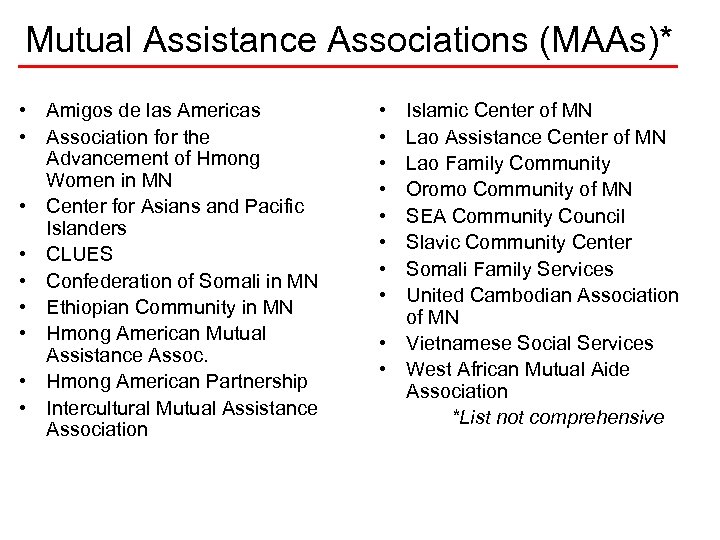
Mutual Assistance Associations (MAAs)* • Amigos de las Americas • Association for the Advancement of Hmong Women in MN • Center for Asians and Pacific Islanders • CLUES • Confederation of Somali in MN • Ethiopian Community in MN • Hmong American Mutual Assistance Assoc. • Hmong American Partnership • Intercultural Mutual Assistance Association • • Islamic Center of MN Lao Assistance Center of MN Lao Family Community Oromo Community of MN SEA Community Council Slavic Community Center Somali Family Services United Cambodian Association of MN • Vietnamese Social Services • West African Mutual Aide Association *List not comprehensive
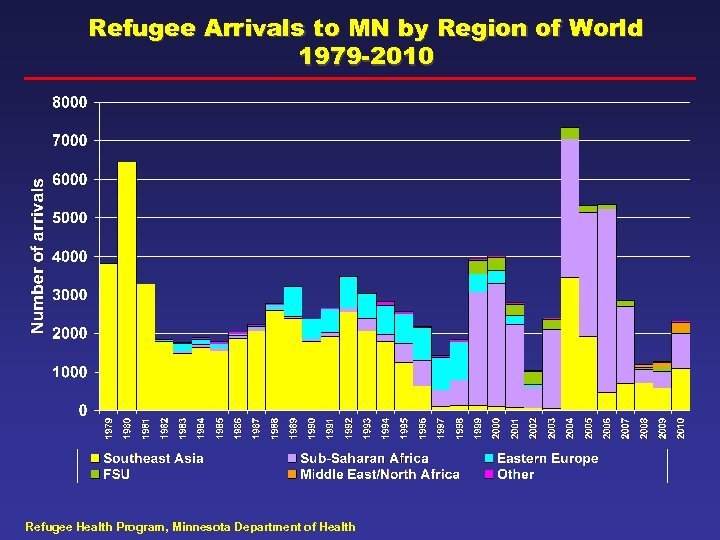
Refugee Arrivals to MN by Region of World 1979 -2010 Refugee Health Program, Minnesota Department of Health
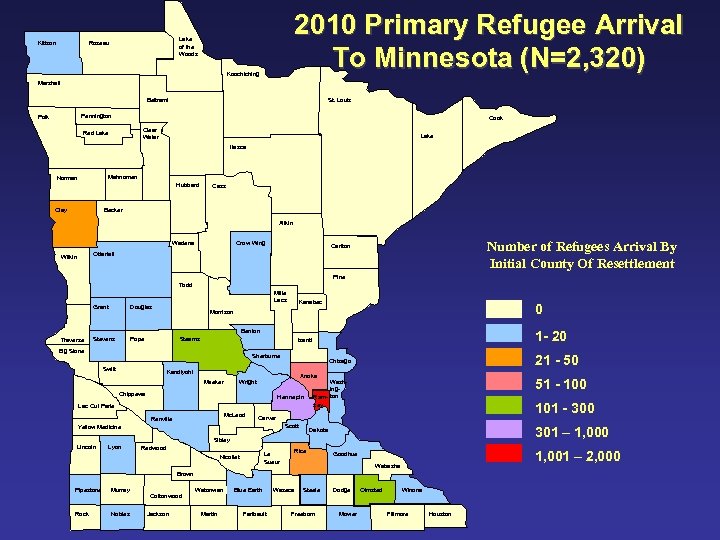
Kittson 2010 Primary Refugee Arrival To Minnesota (N=2, 320) Lake of the Woods Roseau Koochiching Marshall St. Louis Beltrami Pennington Polk Cook Clear Water Red Lake Itasca Mahnomen Norman Hubbard Cass Becker Clay Aitkin Wadena Crow Wing Number of Refugees Arrival By Initial County Of Resettlement Carlton Ottertail Wilkin Pine Todd Mille Lacs Grant Douglas Stevens Pope Kanabec 0 Morrison Benton Traverse Stearns 1 - 20 Isanti Big Stone Sherburne Swift Meeker Anoka 71 Wright Chippewa Hennepin Lac Qui Parle Mc. Leod Renville 21 - 50 Chisago Kandiyohi 51 - 100 Washing. Ram- ton sey 101 - 300 Carver Scott Yellow Medicine 301 – 1, 000 Dakota Sibley Lincoln Lyon Redwood Le Sueur Nicollet Rice 1, 001 – 2, 000 Goodhue Wabasha Brown Pipestone Murray Rock Nobles Cottonwood Jackson Watonwan Martin Blue Earth Faribault Waseca Steele Freeborn Dodge Mower Olmsted Winona Fillmore Houston
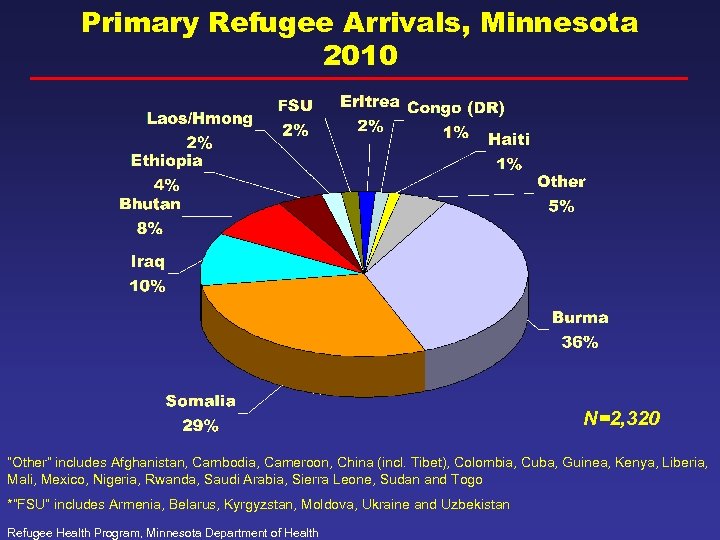
Primary Refugee Arrivals, Minnesota 2010 N=2, 320 “Other” includes Afghanistan, Cambodia, Cameroon, China (incl. Tibet), Colombia, Cuba, Guinea, Kenya, Liberia, Mali, Mexico, Nigeria, Rwanda, Saudi Arabia, Sierra Leone, Sudan and Togo *“FSU” includes Armenia, Belarus, Kyrgyzstan, Moldova, Ukraine and Uzbekistan Refugee Health Program, Minnesota Department of Health
African Refugee Family Reunification Suspended The State Department announced that the U. S. familyreunification program for African refugees has been suspended after DNA testing of applicants revealed widespread fraud. The suspension affects family members seeking to join East Africans, and some Liberians, already in the United States. Minnesota only accepted through the family reunification program (P-3) until June 2008. Source: Voice of America, August 20, 2008
“Free Cases” or “Families without U. S. Ties” Def. -: Refugees who do not have family ties or anchors residing in the U. S. or the resettlement state With the change in resettlement policy, Minnesota started accepting “Free Cases” in July 2008: – From July 2008 – Present: 849 (27%) of 3, 166 arrivals came as “Free Cases” • 2008: 44 (4%) • 2009: 178 (14%) • 2010: 959 (41%) – Top Countries: Somalia, Burma and Iraq
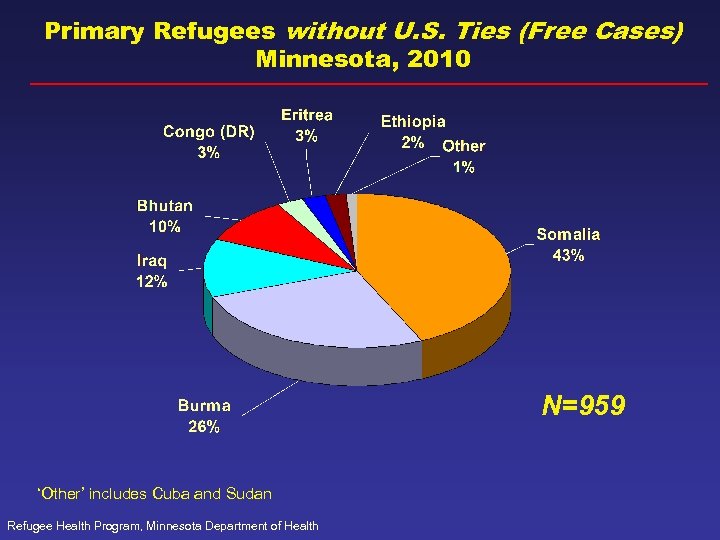
Primary Refugees without U. S. Ties (Free Cases) Minnesota, 2010 N=959 ‘Other’ includes Cuba and Sudan Refugee Health Program, Minnesota Department of Health
“New” Refugee Populations 2008 to Present
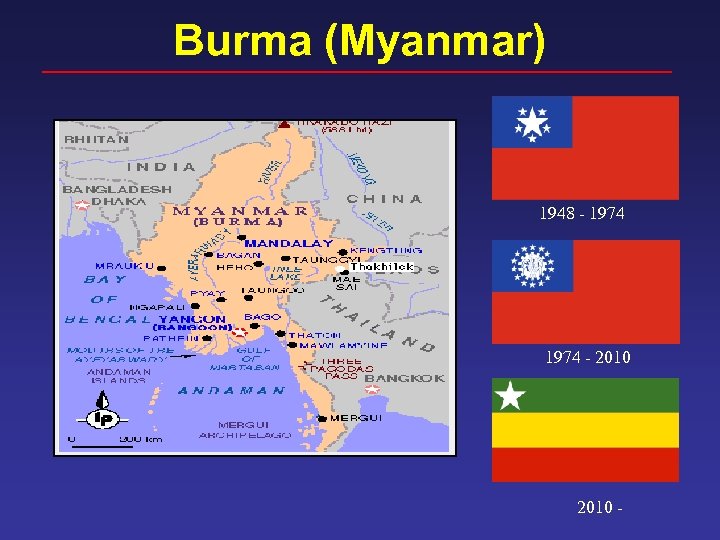
Burma (Myanmar) 1948 - 1974 - 2010 -
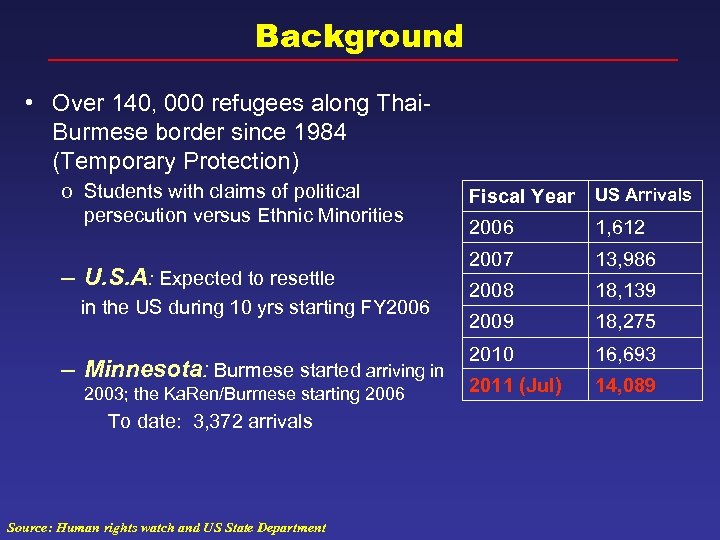
Background • Over 140, 000 refugees along Thai. Burmese border since 1984 (Temporary Protection) o Students with claims of political persecution versus Ethnic Minorities – U. S. A: Expected to resettle in the US during 10 yrs starting FY 2006 – Minnesota: Burmese started arriving in 2003; the Ka. Ren/Burmese starting 2006 To date: 3, 372 arrivals Source: Human rights watch and US State Department Fiscal Year US Arrivals 2006 1, 612 2007 13, 986 2008 18, 139 2009 18, 275 2010 16, 693 2011 (Jul) 14, 089
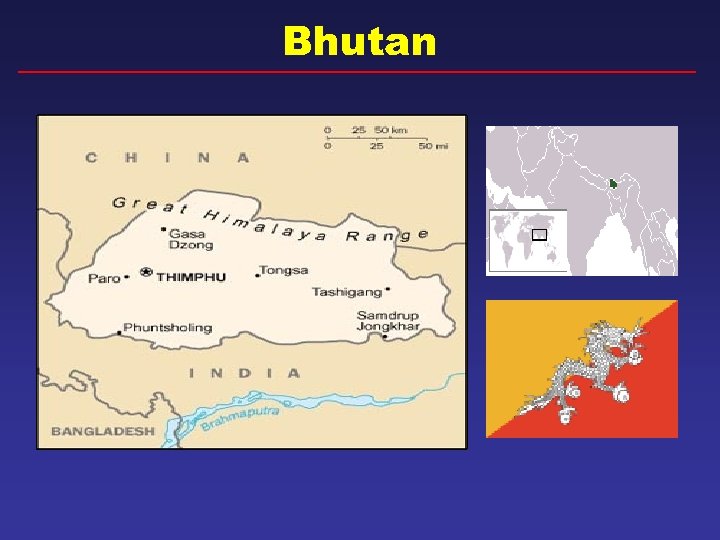
Bhutan
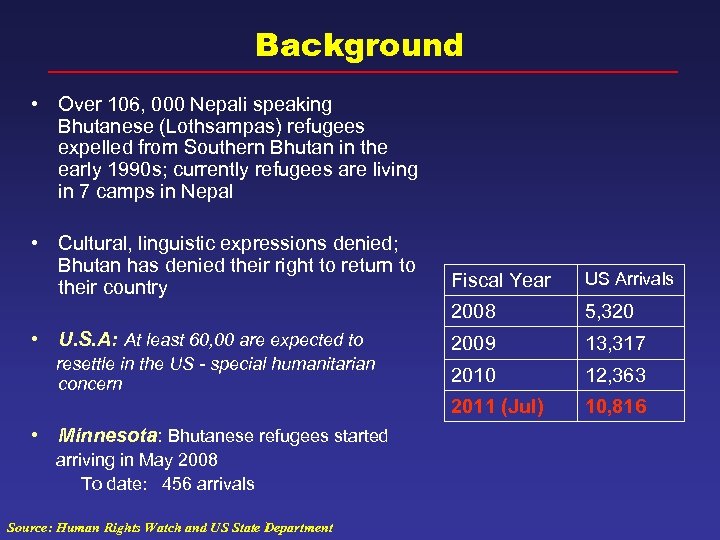
Background • Over 106, 000 Nepali speaking Bhutanese (Lothsampas) refugees expelled from Southern Bhutan in the early 1990 s; currently refugees are living in 7 camps in Nepal • Cultural, linguistic expressions denied; Bhutan has denied their right to return to their country • Minnesota: Bhutanese refugees started arriving in May 2008 To date: 456 arrivals Source: Human Rights Watch and US State Department 5, 320 2009 13, 317 2010 12, 363 2011 (Jul) resettle in the US - special humanitarian concern US Arrivals 2008 • U. S. A: At least 60, 00 are expected to Fiscal Year 10, 816
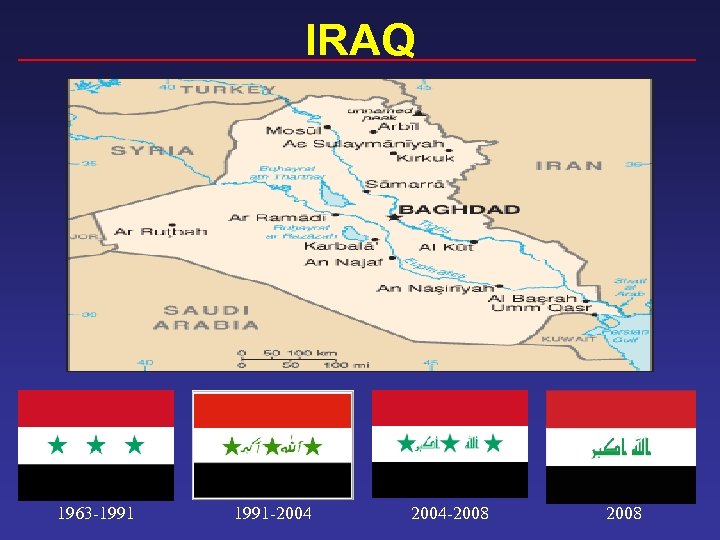
IRAQ 1963 -1991 -2004 -2008
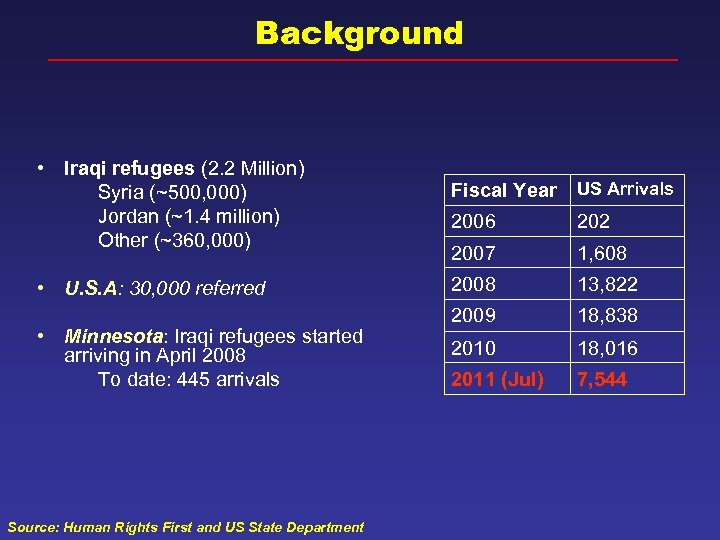
Background • Iraqi refugees (2. 2 Million) Syria (~500, 000) Jordan (~1. 4 million) Other (~360, 000) • U. S. A: 30, 000 referred • Minnesota: Iraqi refugees started arriving in April 2008 To date: 445 arrivals Source: Human Rights First and US State Department Fiscal Year US Arrivals 2006 202 2007 1, 608 2008 13, 822 2009 18, 838 2010 18, 016 2011 (Jul) 7, 544
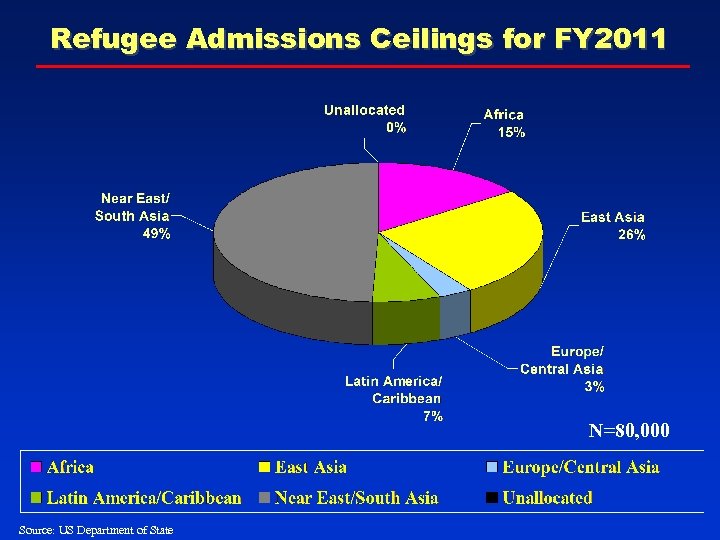
Refugee Admissions Ceilings for FY 2011 N=80, 000 Source: US Department of State
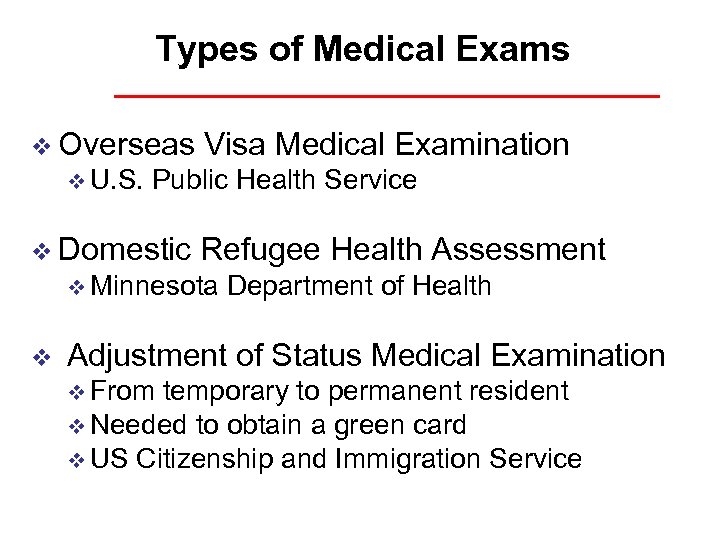
Types of Medical Exams v Overseas v U. S. Visa Medical Examination Public Health Service v Domestic Refugee Health Assessment v Minnesota v Department of Health Adjustment of Status Medical Examination v From temporary to permanent resident v Needed to obtain a green card v US Citizenship and Immigration Service
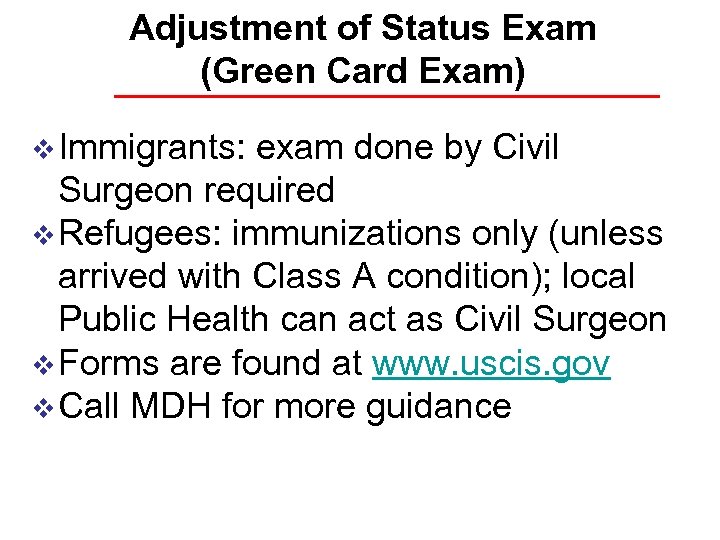
Adjustment of Status Exam (Green Card Exam) v Immigrants: exam done by Civil Surgeon required v Refugees: immunizations only (unless arrived with Class A condition); local Public Health can act as Civil Surgeon v Forms are found at www. uscis. gov v Call MDH for more guidance
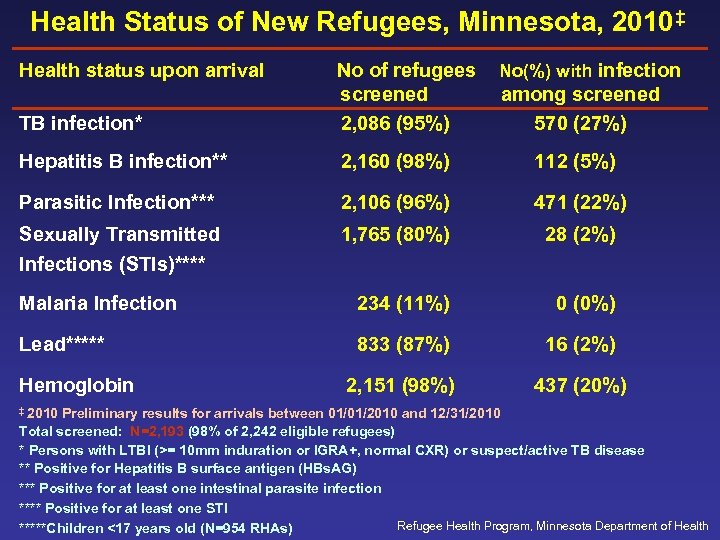
Health Status of New Refugees, Minnesota, 2010‡ Health status upon arrival TB infection* No of refugees screened 2, 086 (95%) Hepatitis B infection** 2, 160 (98%) 112 (5%) Parasitic Infection*** 2, 106 (96%) 471 (22%) Sexually Transmitted Infections (STIs)**** 1, 765 (80%) 28 (2%) Malaria Infection 234 (11%) 0 (0%) Lead***** 833 (87%) 16 (2%) 2, 151 (98%) 437 (20%) Hemoglobin ‡ 2010 No(%) with infection among screened 570 (27%) Preliminary results for arrivals between 01/01/2010 and 12/31/2010 Total screened: N=2, 193 (98% of 2, 242 eligible refugees) * Persons with LTBI (>= 10 mm induration or IGRA+, normal CXR) or suspect/active TB disease ** Positive for Hepatitis B surface antigen (HBs. AG) *** Positive for at least one intestinal parasite infection **** Positive for at least one STI Refugee Health Program, Minnesota Department of Health *****Children <17 years old (N=954 RHAs)
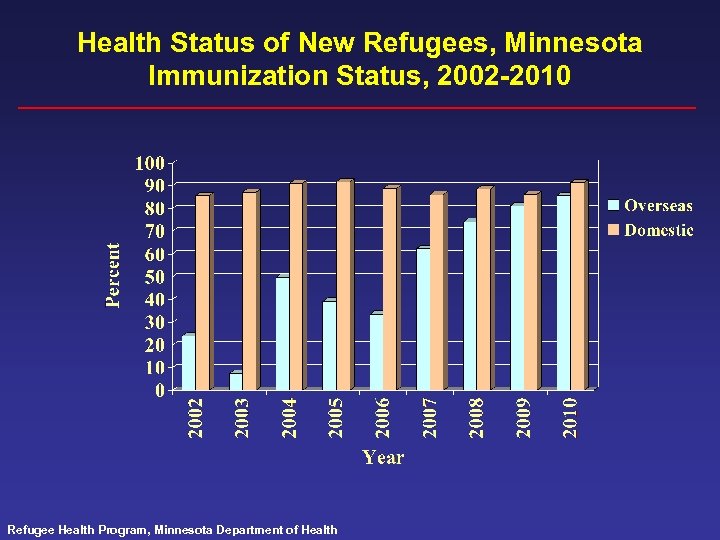
Health Status of New Refugees, Minnesota Immunization Status, 2002 -2010 Refugee Health Program, Minnesota Department of Health
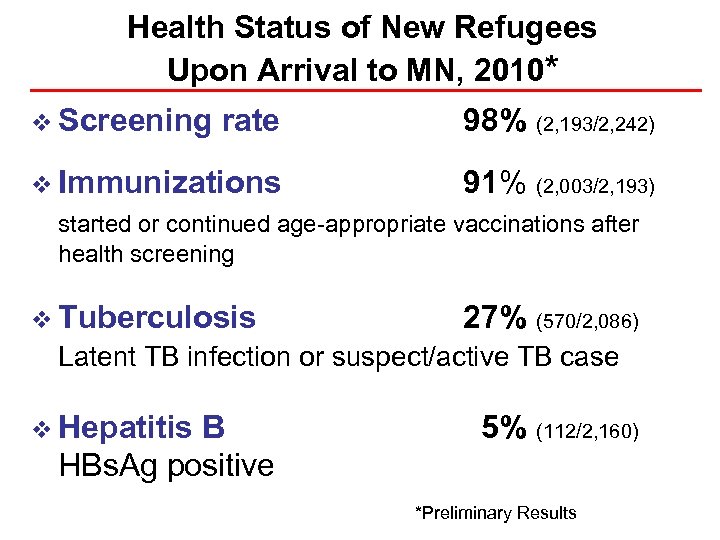
Health Status of New Refugees Upon Arrival to MN, 2010* v Screening rate 98% (2, 193/2, 242) v Immunizations 91% (2, 003/2, 193) started or continued age-appropriate vaccinations after health screening v Tuberculosis 27% (570/2, 086) Latent TB infection or suspect/active TB case v Hepatitis B HBs. Ag positive 5% (112/2, 160) *Preliminary Results
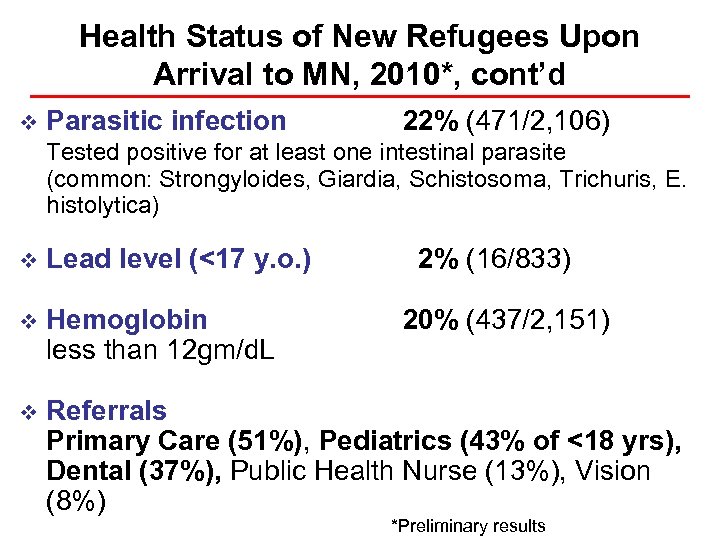
Health Status of New Refugees Upon Arrival to MN, 2010*, cont’d v Parasitic infection 22% (471/2, 106) Tested positive for at least one intestinal parasite (common: Strongyloides, Giardia, Schistosoma, Trichuris, E. histolytica) v Lead level (<17 y. o. ) 2% (16/833) v Hemoglobin less than 12 gm/d. L v Referrals Primary Care (51%), Pediatrics (43% of <18 yrs), Dental (37%), Public Health Nurse (13%), Vision (8%) 20% (437/2, 151) *Preliminary results
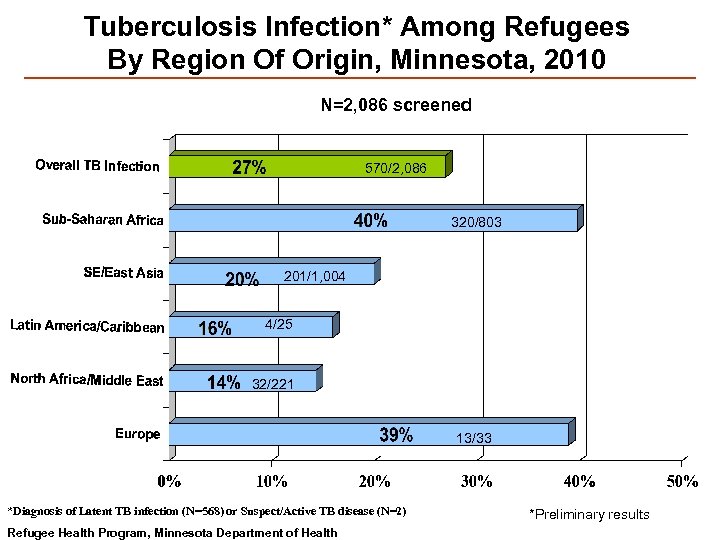
Tuberculosis Infection* Among Refugees By Region Of Origin, Minnesota, 2010 N=2, 086 screened 570/2, 086 320/803 201/1, 004 4/25 32/221 13/33 *Diagnosis of Latent TB infection (N=568) or Suspect/Active TB disease (N=2) Refugee Health Program, Minnesota Department of Health *Preliminary results
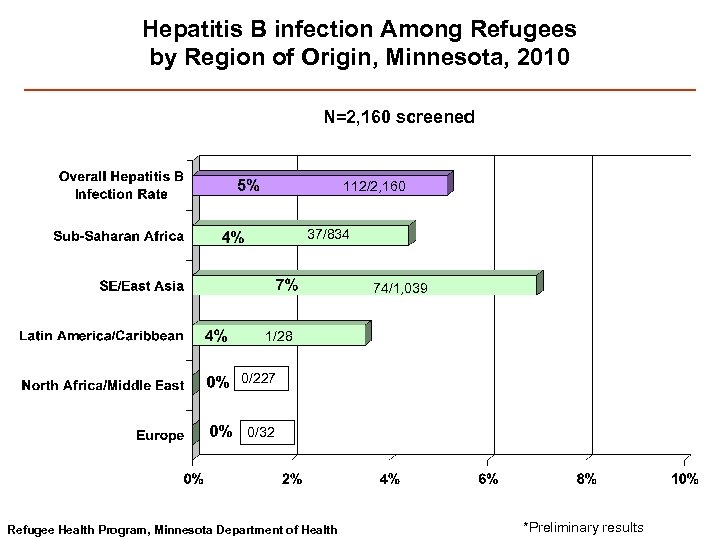
Hepatitis B infection Among Refugees by Region of Origin, Minnesota, 2010 N=2, 160 screened 112/2, 160 37/834 74/1, 039 1/28 0/227 0/32 Refugee Health Program, Minnesota Department of Health *Preliminary results
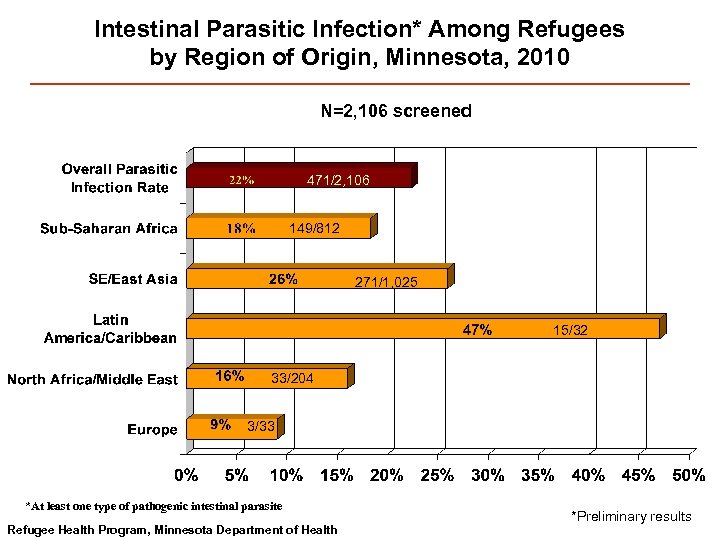
Intestinal Parasitic Infection* Among Refugees by Region of Origin, Minnesota, 2010 N=2, 106 screened 471/2, 106 149/812 271/1, 025 15/32 33/204 3/33 *At least one type of pathogenic intestinal parasite * At least one Program, Minnesota Department of nonpathogenic) Refugee Health stool parasite found (including Health *Preliminary results
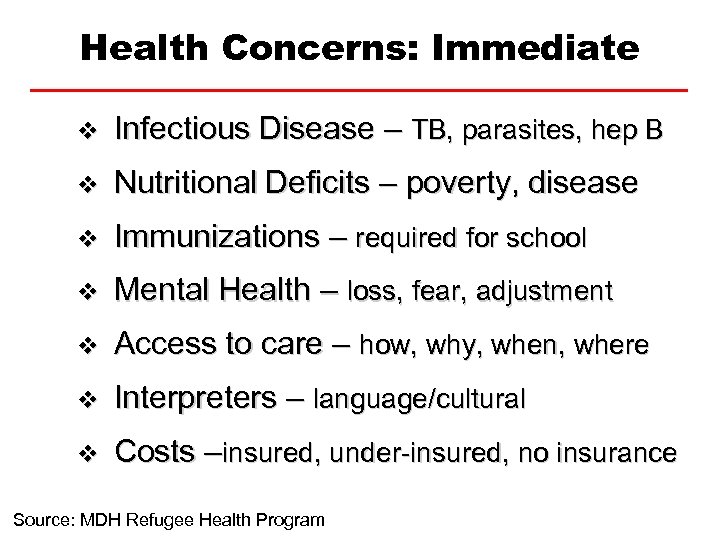
Health Concerns: Immediate v Infectious Disease – TB, parasites, hep B v Nutritional Deficits – poverty, disease v Immunizations – required for school v Mental Health – loss, fear, adjustment v Access to care – how, why, when, where v Interpreters – language/cultural v Costs –insured, under-insured, no insurance Source: MDH Refugee Health Program
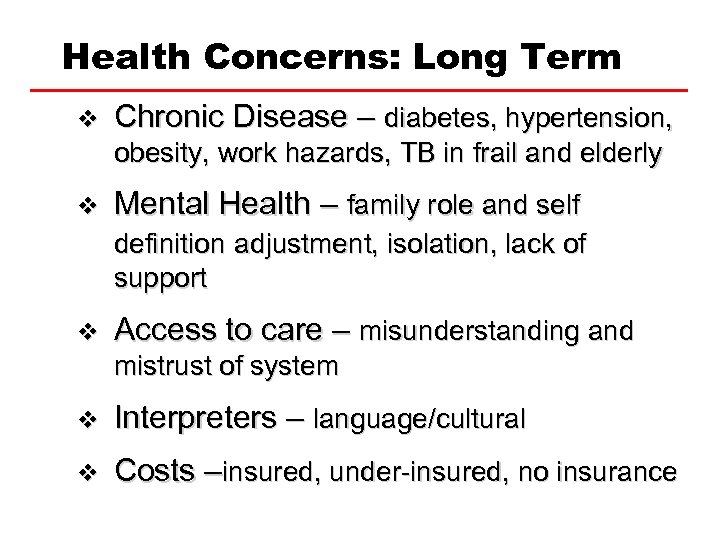
Health Concerns: Long Term v Chronic Disease – diabetes, hypertension, obesity, work hazards, TB in frail and elderly v Mental Health – family role and self definition adjustment, isolation, lack of support v Access to care – misunderstanding and mistrust of system v Interpreters – language/cultural v Costs –insured, under-insured, no insurance
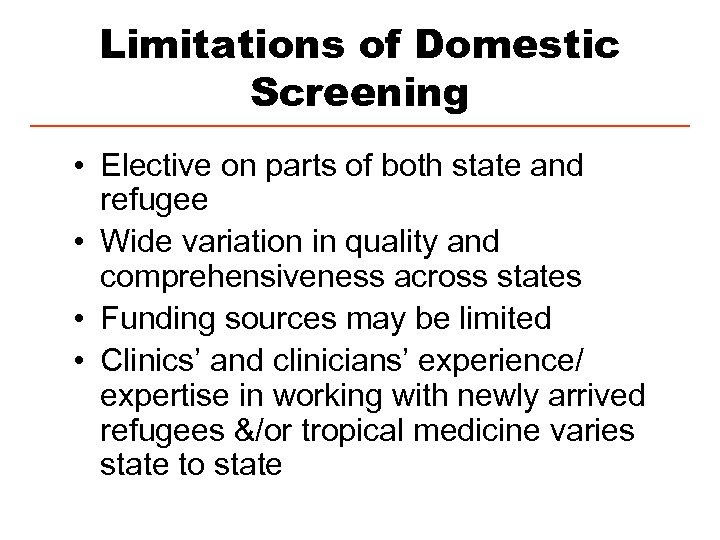
Limitations of Domestic Screening • Elective on parts of both state and refugee • Wide variation in quality and comprehensiveness across states • Funding sources may be limited • Clinics’ and clinicians’ experience/ expertise in working with newly arrived refugees &/or tropical medicine varies state to state
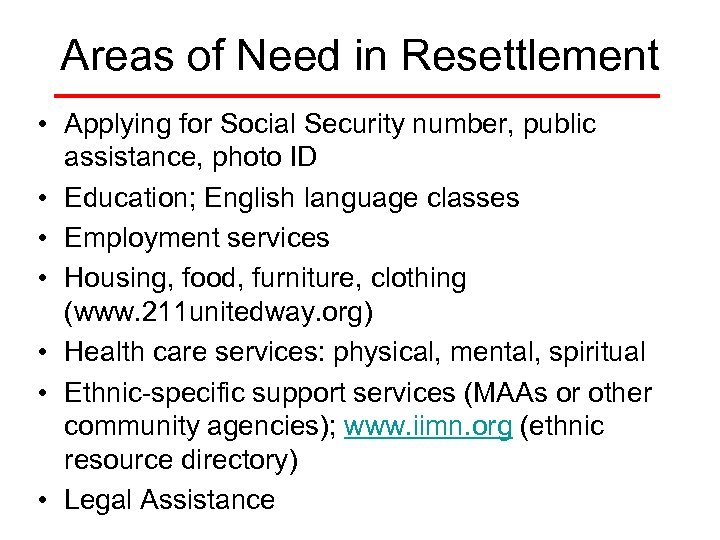
Areas of Need in Resettlement • Applying for Social Security number, public assistance, photo ID • Education; English language classes • Employment services • Housing, food, furniture, clothing (www. 211 unitedway. org) • Health care services: physical, mental, spiritual • Ethnic-specific support services (MAAs or other community agencies); www. iimn. org (ethnic resource directory) • Legal Assistance
Strategies to Enhance Culturally Competent Care • Cultural Assessment (incorporate tool, results in medical record) • Other considerations: – interpreter services (Interpreting Stakeholder Group) – bilingual/bicultural staff – appropriate education resources (www. health -exchange. net) • Appoint staff as cultural resources (www. culturecareconnection. org) • PHN and community-based follow-up
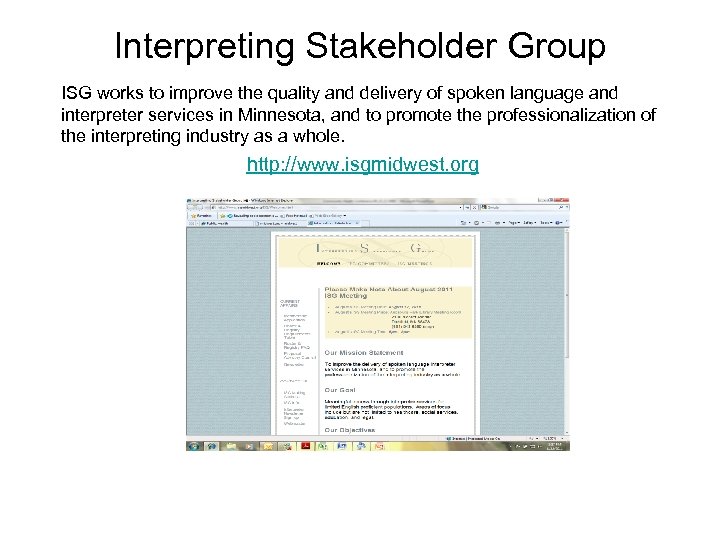
Interpreting Stakeholder Group ISG works to improve the quality and delivery of spoken language and interpreter services in Minnesota, and to promote the professionalization of the interpreting industry as a whole. http: //www. isgmidwest. org
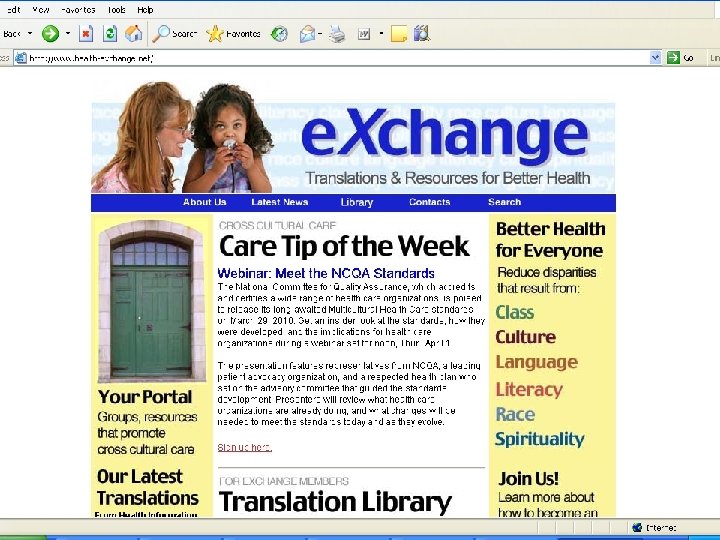
Strategies to Enhance Culturally Competent Care • Cultural Assessment (incorporate tool, results in medical record) • Other considerations: – interpreter services (Interpreting Stakeholder Group) – bilingual/bicultural staff – appropriate education resources (www. healthexchange. net) • Appoint staff as cultural resources • PHN and community-based follow-up
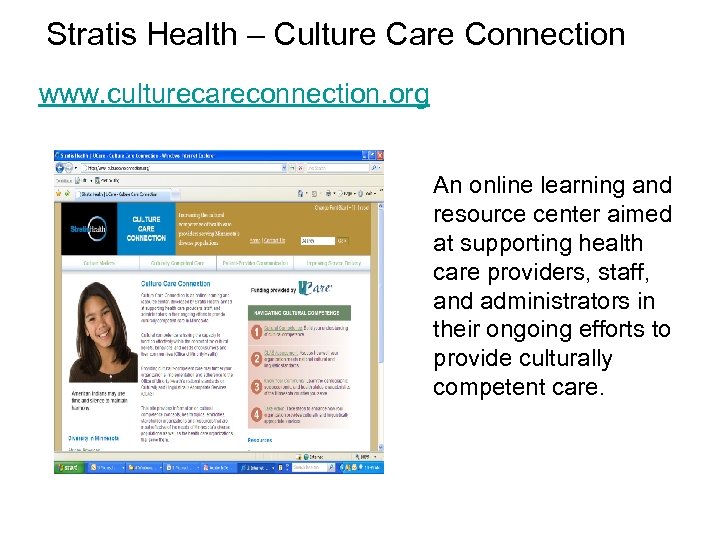
Stratis Health – Culture Care Connection www. culturecareconnection. org An online learning and resource center aimed at supporting health care providers, staff, and administrators in their ongoing efforts to provide culturally competent care.
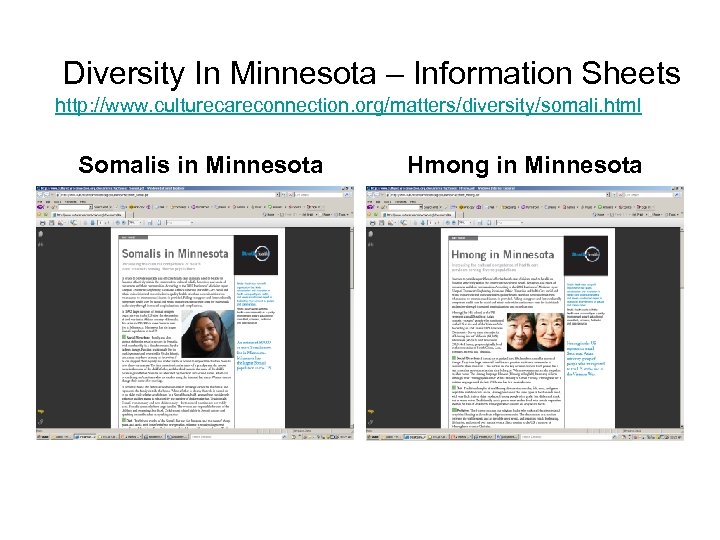
Diversity In Minnesota – Information Sheets http: //www. culturecareconnection. org/matters/diversity/somali. html Somalis in Minnesota Hmong in Minnesota
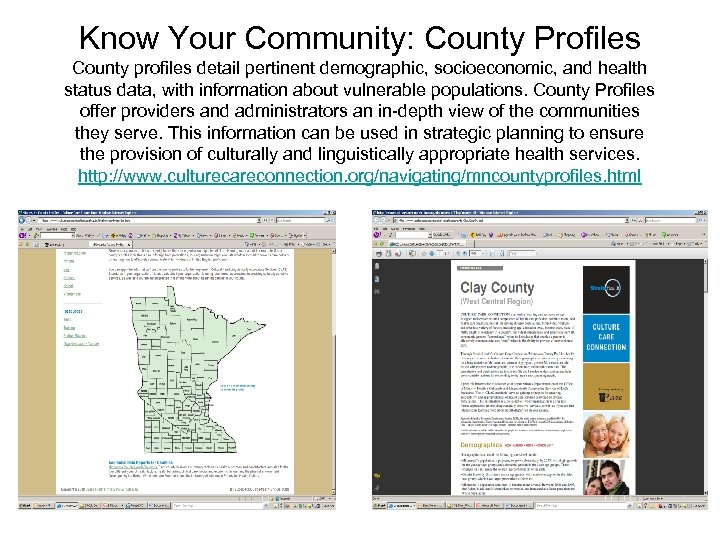
Know Your Community: County Profiles County profiles detail pertinent demographic, socioeconomic, and health status data, with information about vulnerable populations. County Profiles offer providers and administrators an in-depth view of the communities they serve. This information can be used in strategic planning to ensure the provision of culturally and linguistically appropriate health services. http: //www. culturecareconnection. org/navigating/mncountyprofiles. html
Minnesota Health Literacy Partnership MHLP, a program of the Minnesota Health Literacy Council, was formed to help coordinate health literacy efforts across the state. The partnership is comprised of health care organizations, consumers, and literacy groups, as well as the state’s health and social service agencies, and has worked with a number of local organizations to develop health literacy training, patient education materials, and toolkits. www. healthlit. themlc. org
Community Health Education • • Radio shows ESL Ethnic press ECHO TV Global Brown bags (for staff) Metro Refugee Health Task Force Community health forums Etc!
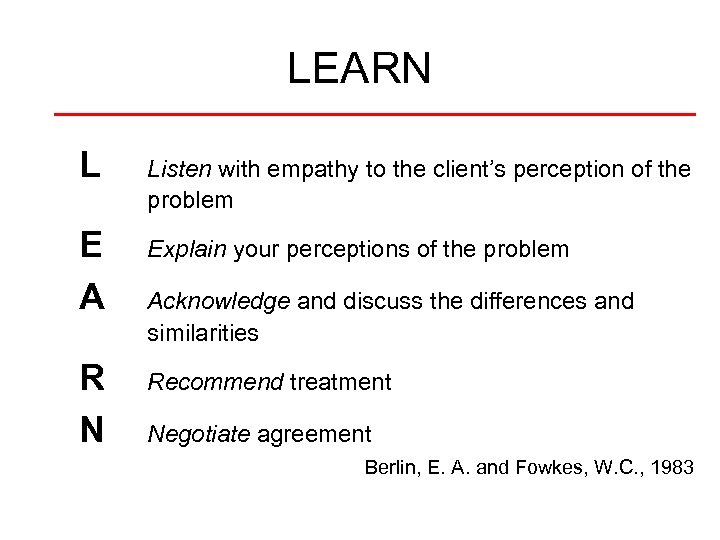
LEARN L Listen with empathy to the client’s perception of the problem E A Explain your perceptions of the problem R N Recommend treatment Acknowledge and discuss the differences and similarities Negotiate agreement Berlin, E. A. and Fowkes, W. C. , 1983
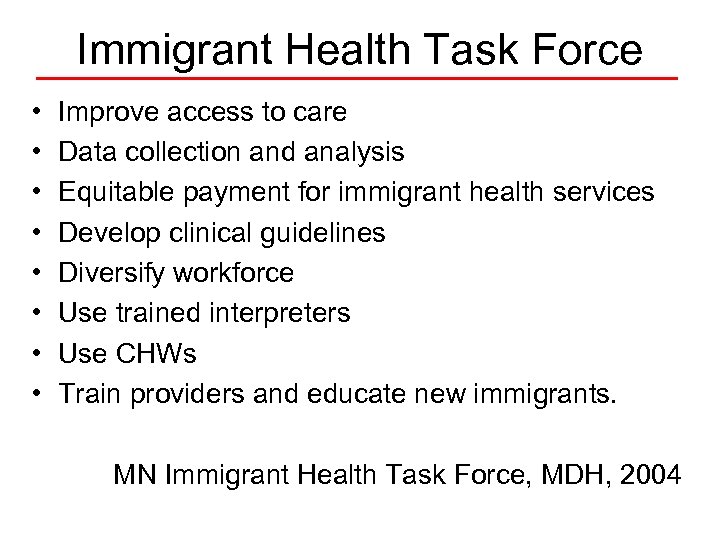
Immigrant Health Task Force • • Improve access to care Data collection and analysis Equitable payment for immigrant health services Develop clinical guidelines Diversify workforce Use trained interpreters Use CHWs Train providers and educate new immigrants. MN Immigrant Health Task Force, MDH, 2004
Contact Information - 2011 • MDH Refugee Health Staff: 651 -201 -5414 • MDH Refugee Health Program: www. health. state. mn. us/refugee • Metro Refugee Health Task Force Sara Chute: sara. chute@state. mn. us
Скачать презентацию Refugee Health In Minnesota Carol Berg RN MPH
79b42defd69f486cc11a8d0e4a2595c3.ppt