 Скачать презентацию REFORMS RECOVERY Kazi Matin Archanun Kohpaiboon Kirida
58ca09e5ee0cf75222f339dd3ca2c1ad.ppt
- Количество слайдов: 34




REFORMS & RECOVERY Kazi Matin Archanun Kohpaiboon Kirida Bhaopichitr
Coverage of Presentation § What are key aspects of recovery § How to reverse private investment slowdown § What accounted for strong export growth & Can it continue § Policy agenda for quality shared high growth
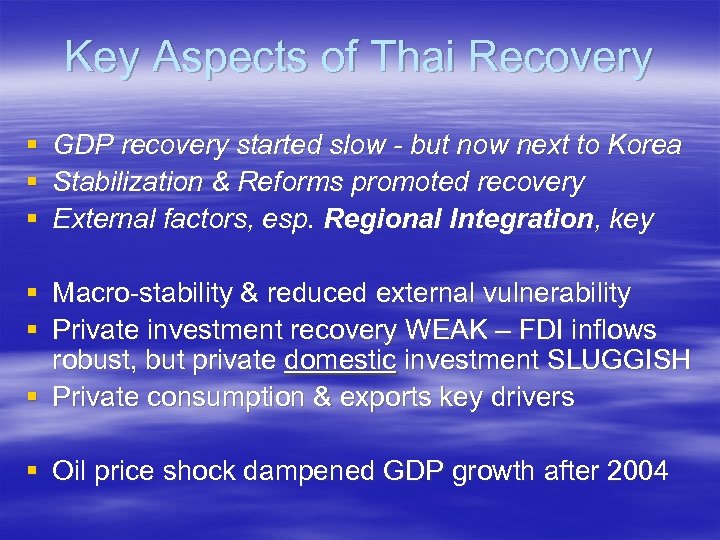
Key Aspects of Thai Recovery § § § GDP recovery started slow - but now next to Korea Stabilization & Reforms promoted recovery External factors, esp. Regional Integration, key § Macro-stability & reduced external vulnerability § Private investment recovery WEAK – FDI inflows robust, but private domestic investment SLUGGISH § Private consumption & exports key drivers § Oil price shock dampened GDP growth after 2004
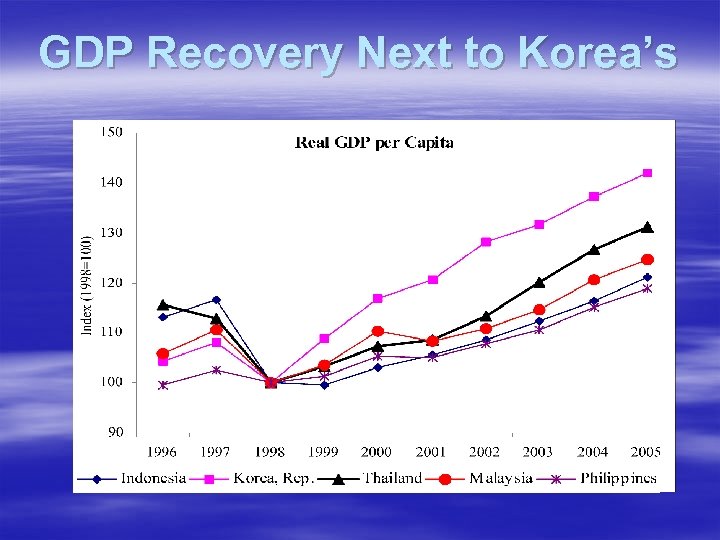
GDP Recovery Next to Korea’s
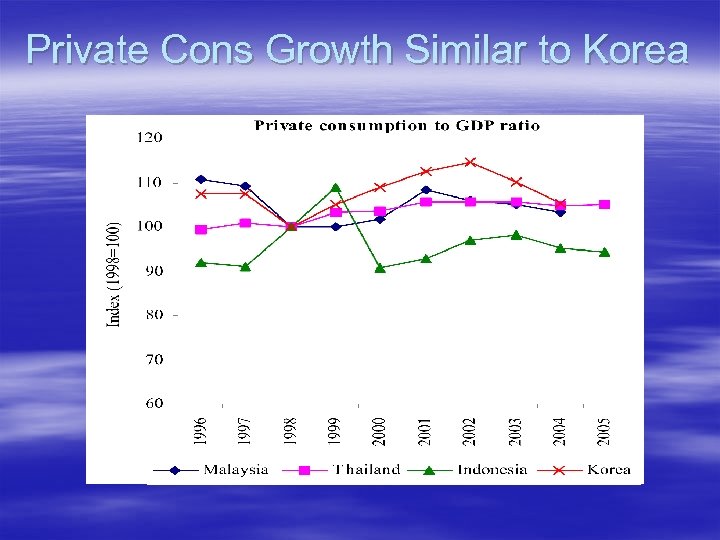
Private Cons Growth Similar to Korea
Reforms effective - but MORE to sustain strong growth, social stability § § § Successful macro-stabilization Real depreciation during recovery Stimulus to consumption & residential inv. § Reforms to promote competitiveness, private investment & exports. § Reforms to strengthen banking & corporates § Reforms for public sector governance
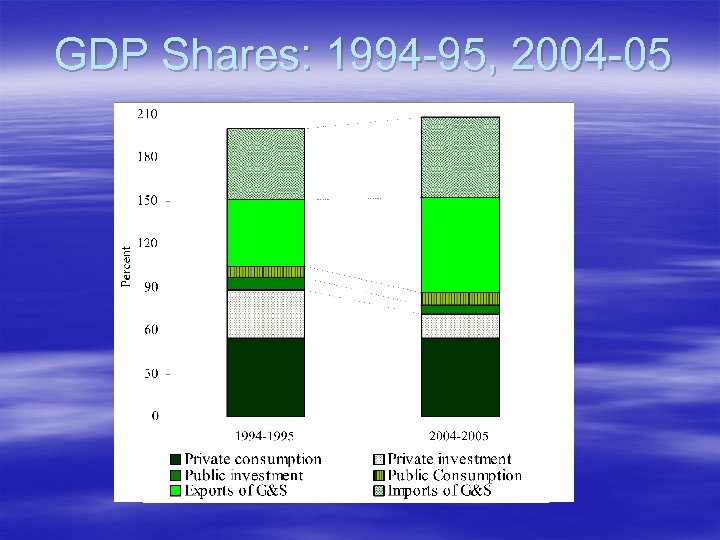
GDP Shares: 1994 -95, 2004 -05

PRIVATE INVESTMENT Can it revive more strongly?
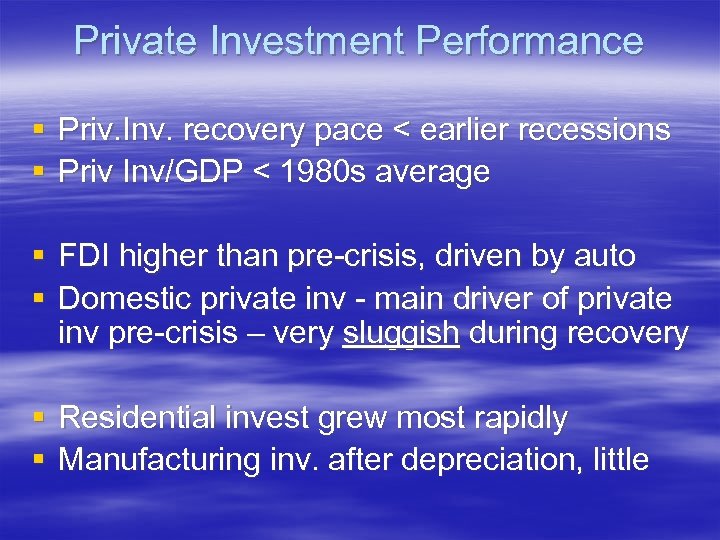
Private Investment Performance § Priv. Inv. recovery pace < earlier recessions § Priv Inv/GDP < 1980 s average § FDI higher than pre-crisis, driven by auto § Domestic private inv - main driver of private inv pre-crisis – very sluggish during recovery § Residential invest grew most rapidly § Manufacturing inv. after depreciation, little
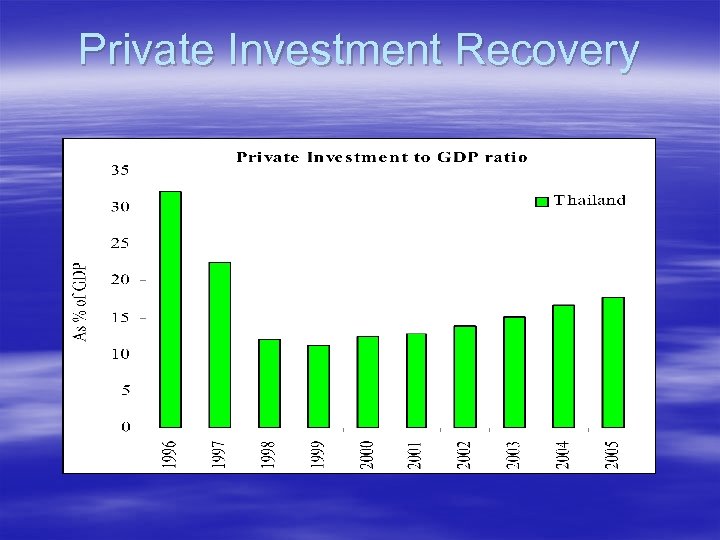
Private Investment Recovery
Private Investment function estimate § Positively, by real GDP growth, real exchange rate depreciation, public investment & availability of credit § But negatively affected, by real cost and excess capacity
Reversing Private Investment Slowdown § Excess capacity is gone § Optimism on supportive policy signals soon § Policies --to continue opening --to lower costs for domestic, FDI firms --to better integrate FDI in domestic economy --to support innovation & knowledge-diffusion
STRONG EXPORT GROWTH DURING RECOVERY Can it Continue?
Export Performance During Recovery § Export/GDP rose – 47% in 1995 to 67% in 2005 § Changing geographic composition of exports with export growth to E. Asia faster than ROW § Changing commodity composition of exports moving up value-chain & technology ladder § Auto/vehicles, electronics, non-electric machinery & parts SHARE in total exports rose 32% to 43% § In autos, all Thai production except design § Other sectors – more fragmented regional networks
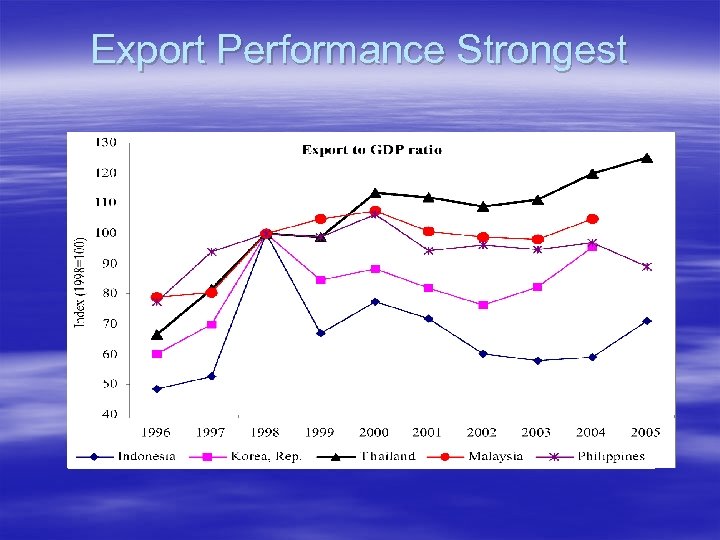
Export Performance Strongest
Reforms Supporting Export Recovery Private Investment Reforms § Amended Alien Business Law to permit foreign ownership up to 49% (1999) § Abolished local content requirement for Auto and several agricultural products (2000) § Eliminated export performance requirements for firms receiving BOI incentives (2000) § Established new Free Zones with duty & tax free access for investors (2002)
Reforms Supporting Export Recovery Tariff Policy Reforms § Established Tariff Restructuring Committee (1998) § Reduced tariffs on electronic, non-electrical machinery & parts to 3%, on all raw materials to 5%, & on fish crustaceans for breeding to zero (Aug 1999) § Implemented AFTA - average AFTA tariff fall to 7. 3% (2000), . . % (2002) & …% (2005) § Reduced tariffs in stages to 3 bands from 2001 -05 lowering average MFN tariffs from 20% to 10% § Tariffs on agriculture reduced
Reforms Supporting Export Recovery Customs & Trade Facilitation Reforms § Reduced steps for customs clearance, and started express document handling (1999) § Introduced UN Electronic Data Interchange to increased automated handling (1999) § Adopted WTO Valuation, 6 -digit HS system, and simplified appeal rules(2000) § Made Gold card holders inspection-exempt § BOI sectors with tariff exemptions expanded § Allowed SMEs internet customs submission
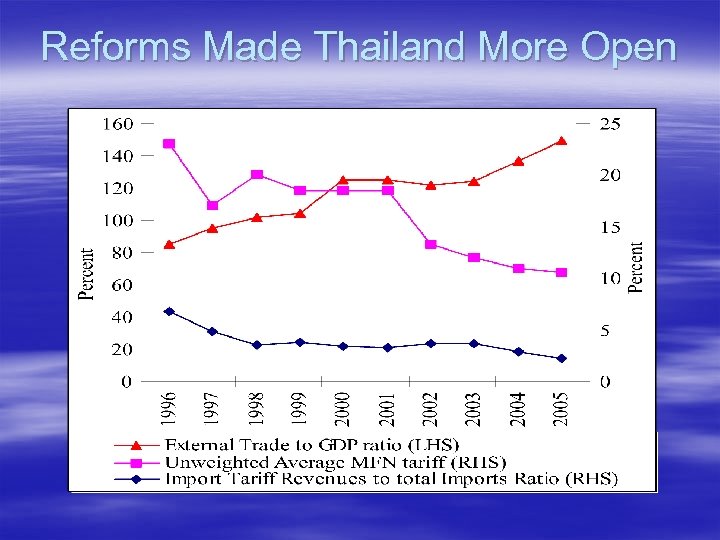
Reforms Made Thailand More Open
External Factors Supported Export Recovery § World output, trade growth strong after 1999; real interest rates<80 s, 90 s; Commodity prices favorable § Regional integration (inv & trade) driving exports thru’ fragmented regional production networks to lower costs § Lower-income-country export competition in labintensive to increasingly skill-intensive goods & services (China, Vietnam, India etc) § Oil price shock a burden for Thailand firms in 2004 onwards
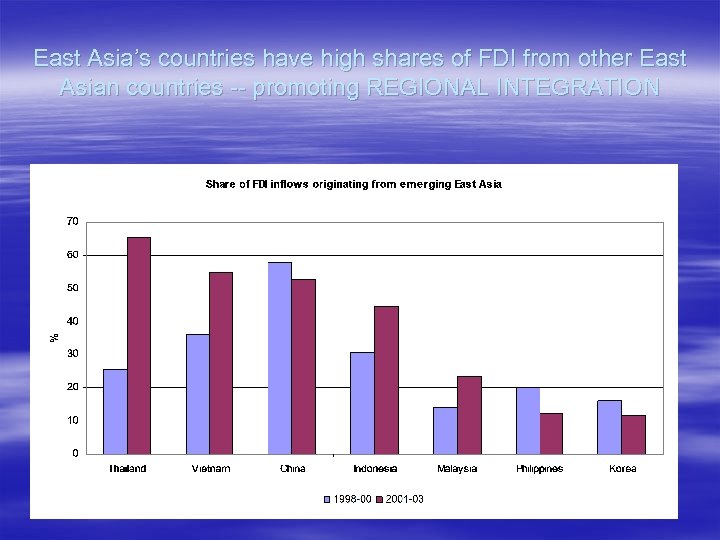
East Asia’s countries have high shares of FDI from other East Asian countries -- promoting REGIONAL INTEGRATION
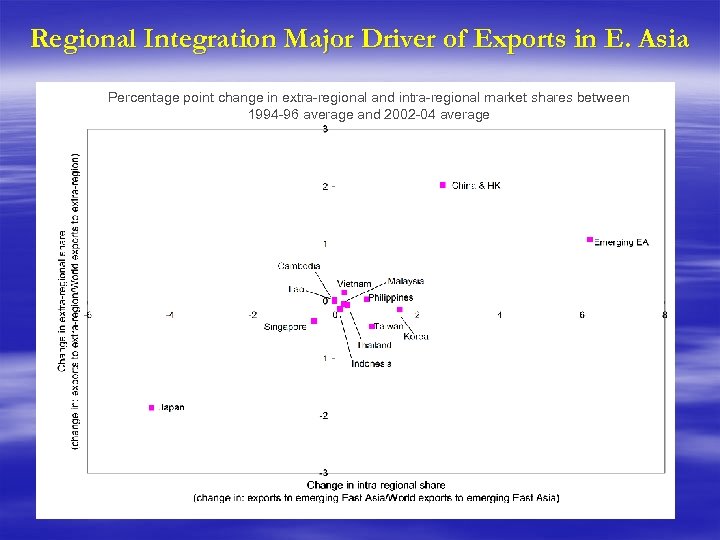
Regional Integration Major Driver of Exports in E. Asia Percentage point change in extra-regional and intra-regional market shares between 1994 -96 average and 2002 -04 average
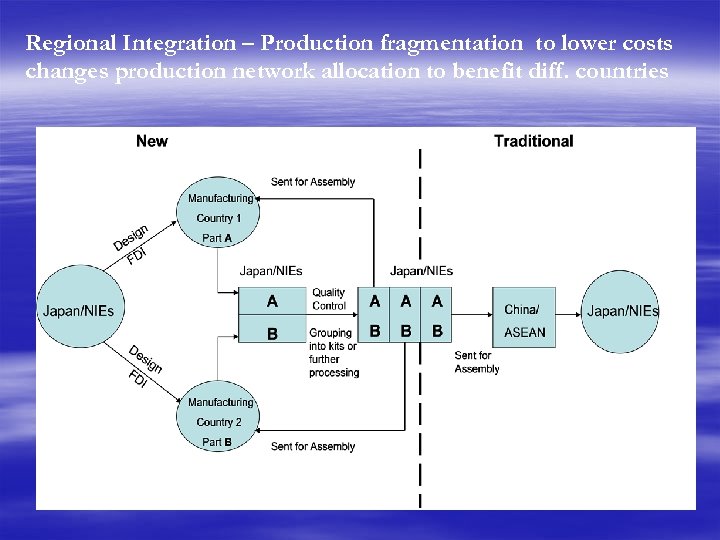
Regional Integration – Production fragmentation to lower costs changes production network allocation to benefit diff. countries

Multinational Corporations Decide Where to Locate Parts of Production within E. Asia & World Whether THAILAND or some other country benefits – depend on their relative costs & on their integration with domestic economy
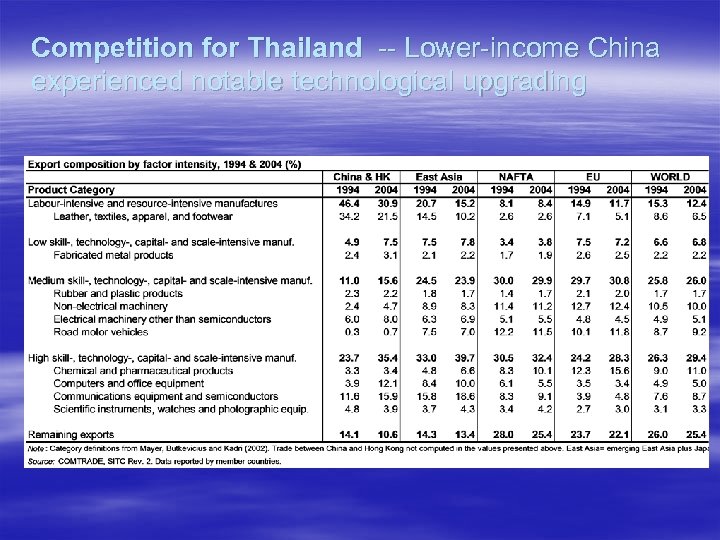
Competition for Thailand -- Lower-income China experienced notable technological upgrading
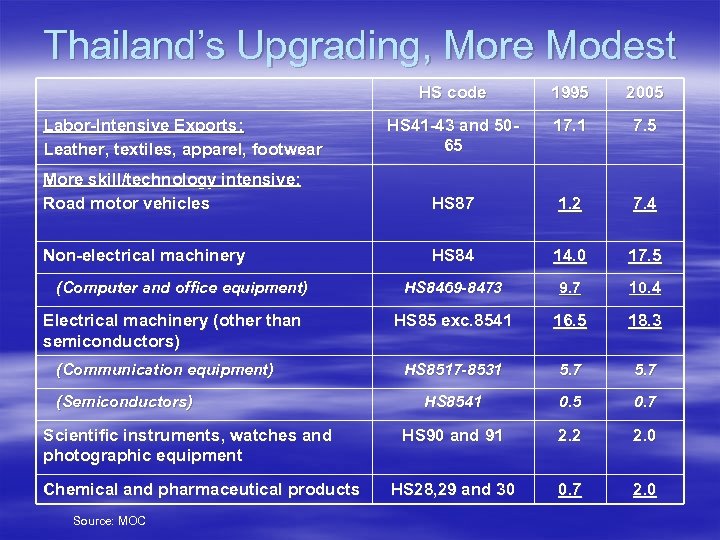
Thailand’s Upgrading, More Modest HS code 1995 2005 HS 41 -43 and 5065 17. 1 7. 5 More skill/technology intensive: Road motor vehicles HS 87 1. 2 7. 4 Non-electrical machinery HS 84 14. 0 17. 5 HS 8469 -8473 9. 7 10. 4 HS 85 exc. 8541 16. 5 18. 3 HS 8517 -8531 5. 7 HS 8541 0. 5 0. 7 HS 90 and 91 2. 2 2. 0 HS 28, 29 and 30 0. 7 2. 0 Labor-Intensive Exports: Leather, textiles, apparel, footwear (Computer and office equipment) Electrical machinery (other than semiconductors) (Communication equipment) (Semiconductors) Scientific instruments, watches and photographic equipment Chemical and pharmaceutical products Source: MOC
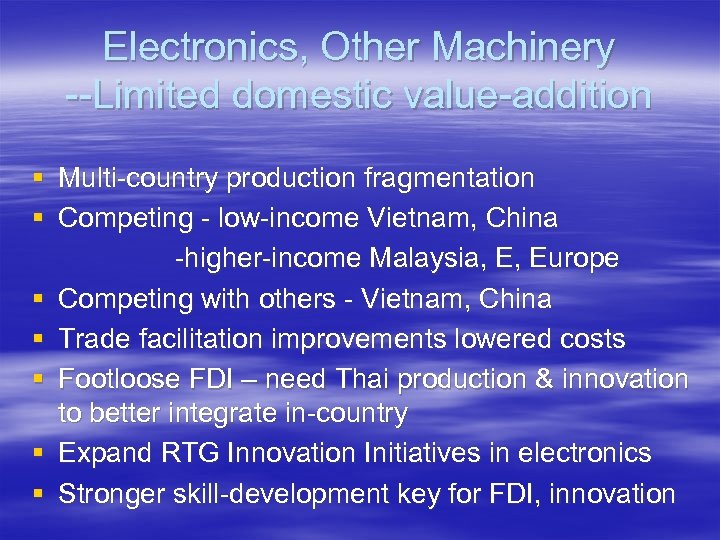
Electronics, Other Machinery --Limited domestic value-addition § Multi-country production fragmentation § Competing - low-income Vietnam, China -higher-income Malaysia, E, Europe § Competing with others - Vietnam, China § Trade facilitation improvements lowered costs § Footloose FDI – need Thai production & innovation to better integrate in-country § Expand RTG Innovation Initiatives in electronics § Stronger skill-development key for FDI, innovation
Most Value-Addition in Auto & parts § Largest market in ASEAN, incl. 1 -ton pickups § Japanese firms looking for relocation advantages Policies supported value-addition § No ‘national car policy’ – level playing field § Tariffs reduced – more competition sought § Reduced foreign ownership restrictions allowed first-tier auto-parts-supplier FDI § Trade, customs facilitation improved to respond to demands of production networks
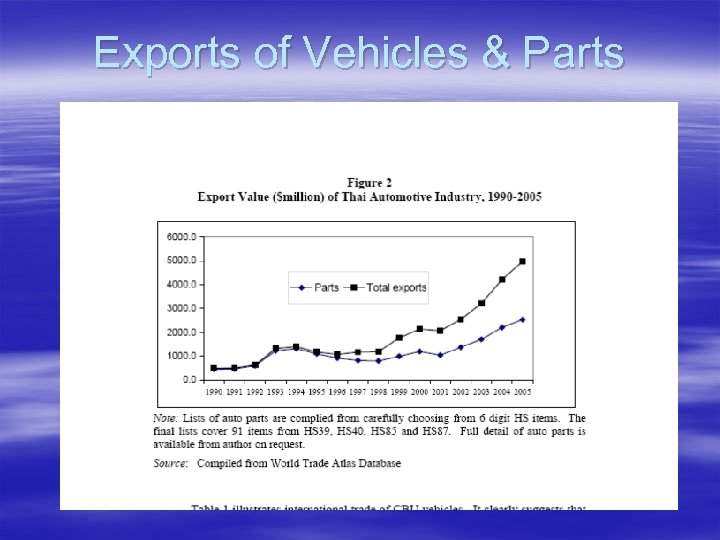
Exports of Vehicles & Parts
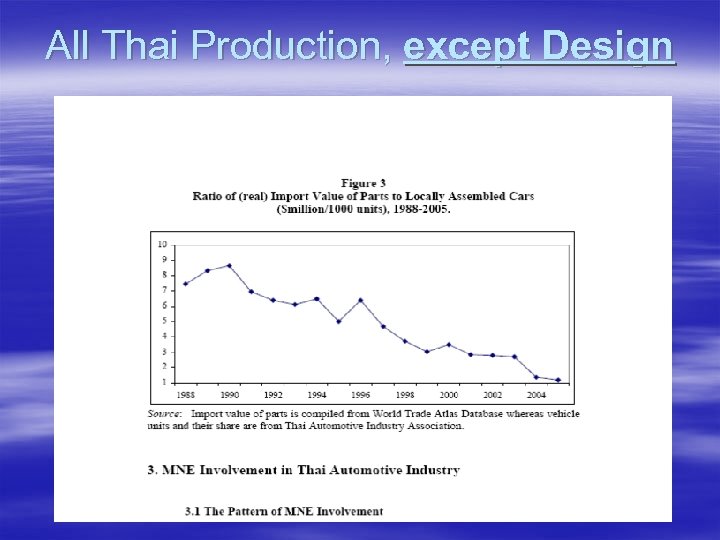
All Thai Production, except Design
Can Strong Export Growth Continue? Yes – if … Costs for production relocation fall here: § Trade facilitation & better investment climate § Ensure more competitive services sectors Integrate FDI through value-addition further: § Skill-Upgrading beyond Thailand income level § RTG support for innovation, knowledge § Balanced financial sector support innovation

Way Forward Policy Reforms
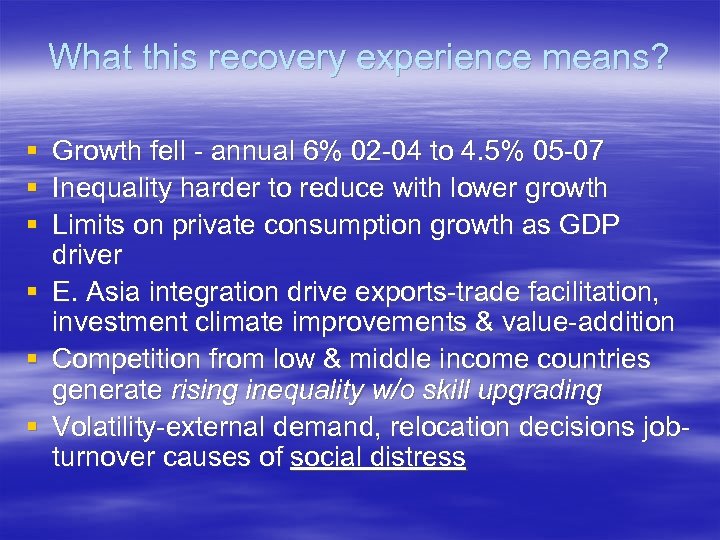
What this recovery experience means? § Growth fell - annual 6% 02 -04 to 4. 5% 05 -07 § Inequality harder to reduce with lower growth § Limits on private consumption growth as GDP driver § E. Asia integration drive exports-trade facilitation, investment climate improvements & value-addition § Competition from low & middle income countries generate rising inequality w/o skill upgrading § Volatility-external demand, relocation decisions jobturnover causes of social distress
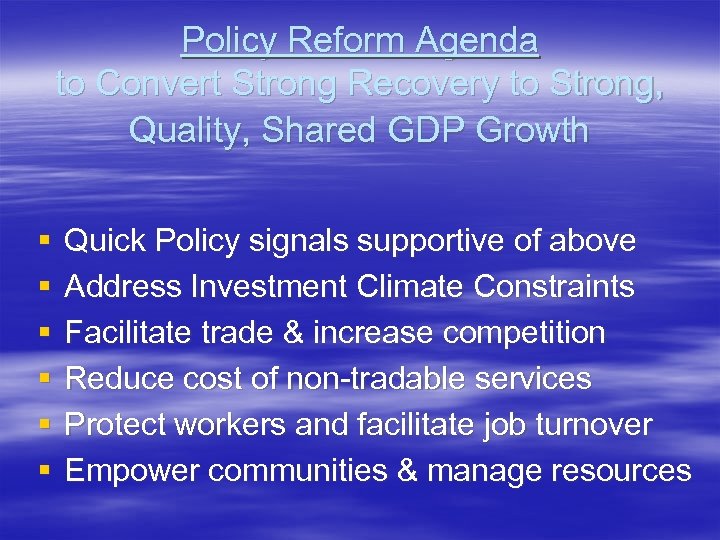
Policy Reform Agenda to Convert Strong Recovery to Strong, Quality, Shared GDP Growth § § § Quick Policy signals supportive of above Address Investment Climate Constraints Facilitate trade & increase competition Reduce cost of non-tradable services Protect workers and facilitate job turnover Empower communities & manage resources
Скачать презентацию REFORMS RECOVERY Kazi Matin Archanun Kohpaiboon Kirida
58ca09e5ee0cf75222f339dd3ca2c1ad.ppt