 Скачать презентацию Reforming pensions in Chile Nicholas Barr and Peter
d3822a9ddc8e96fb6506cc5106d5502e.ppt
- Количество слайдов: 27



Reforming pensions in Chile Nicholas Barr and Peter Diamond London School of Economics Massachusetts Institute of Technology Pension reform in Chile, American Economic Association Annual Meetings Chicago, 6 January 2017
Reforming pensions in Chile 1 Backdrop 2 The 2008 reforms 3 The 2015 Pension Commission (the Bravo Commission) 4 The Global Proposals Nicholas Barr and Peter Diamond, January 2017 1
1 Backdrop Nicholas Barr and Peter Diamond, January 2017 2
Thumbnail history • Chile introduced mandatory funded individual accounts in 1981, provided by specialist firms, Administradoras de Fondos de Pensiones (AFPs) • Widely followed in Latin America and, from the late 1990 s, Central and Eastern Europe and China • Retreat from individual accounts in many countries Nicholas Barr and Peter Diamond, January 2017 3
Objectives of pension systems • The primary objective of pensions is economic security in old age • Achieving that objective requires • Poverty relief • Consumption smoothing across a person’s lifetime • Insurance against low income and wealth in old age • Cannot wholly achieve all the multiple objectives simultaneously; thus policy has to optimise across all, not maximise any particular one Nicholas Barr and Peter Diamond, January 2017 4
Strategic critique of 1981 Chile design • Individual funded accounts are complex to implement • If well implemented they provide consumption smoothing but little risk sharing or poverty relief • Thus 1981 arrangements were not a pension system but only part of a pension system Nicholas Barr and Peter Diamond, January 2017 5
2 The 2008 reforms • Two strategic reforms introduced as a result of the Marcel Commission (2006) Nicholas Barr and Peter Diamond, January 2017 6
Non-contributory solidarity pension • Based on test of age and residence • Targeted on bottom 60% of the pensioner income distribution • Covers urban, rural, formal and informal, employed and self-employed • Turned the system into a genuine strategy by including poverty relief Nicholas Barr and Peter Diamond, January 2017 7
Auction mechanism • To tackle problem of continuing high administrative charges • Accumulation • AFPs bid for all new entrants over a two-year period • Have to stay with winning bidder for at least 18 months • AFP has to offer the same low commission to its existing members and to any new members • Benefits: • Endorsed the Online Pension Consultation and Bidding System (SCOMP) introduced in 2004 • Mandatory to consult SCOMP, which includes insurance companies bidding for individual retirees Nicholas Barr and Peter Diamond, January 2017 8
3 The 2015 Pension Commission (the Bravo Commission) • The 2008 strategy was sound because it addressed the three core objectives of poverty relief, old-age income insurance, and consumption smoothing • But it left unfinished business which the Bravo Commission was set up to address Nicholas Barr and Peter Diamond, January 2017 9
3. 1 Bravo Commission: diagnosis of problems • Known problems of funded individual accounts • Low coverage, largely because of informality • Inadequate pensions, largely because of incomplete contributions records • Continued high charges • Exposure of plan members to risk • Gender inequality: quadruple whammy • Hostility towards the AFP system (though unclear whether the root cause was pension design or the level of benefits) Nicholas Barr and Peter Diamond, January 2017 10
3. 2 Bravo Commission: specific proposals 58 specific proposals, only outlined here • Expanding the solidarity pension system • Increasing contributions, including (for the first time) an employer contribution • Increasing competition within the AFP system • Raising earliest pension age • Improving gender equity • Changing arrangements for drawdown • Removing exemptions, e. g. for the military Nicholas Barr and Peter Diamond, January 2017 11
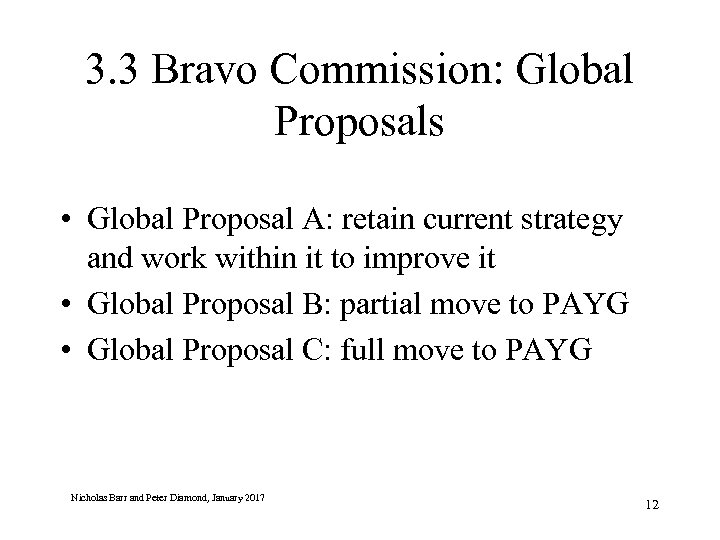
3. 3 Bravo Commission: Global Proposals • Global Proposal A: retain current strategy and work within it to improve it • Global Proposal B: partial move to PAYG • Global Proposal C: full move to PAYG Nicholas Barr and Peter Diamond, January 2017 12
4 The Global Proposals Nicholas Barr and Peter Diamond, January 2017 13
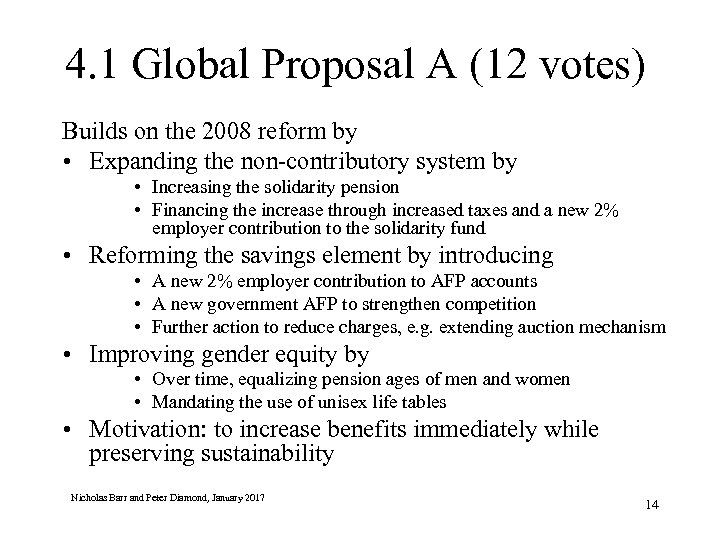
4. 1 Global Proposal A (12 votes) Builds on the 2008 reform by • Expanding the non-contributory system by • Increasing the solidarity pension • Financing the increase through increased taxes and a new 2% employer contribution to the solidarity fund • Reforming the savings element by introducing • A new 2% employer contribution to AFP accounts • A new government AFP to strengthen competition • Further action to reduce charges, e. g. extending auction mechanism • Improving gender equity by • Over time, equalizing pension ages of men and women • Mandating the use of unisex life tables • Motivation: to increase benefits immediately while preserving sustainability Nicholas Barr and Peter Diamond, January 2017 14
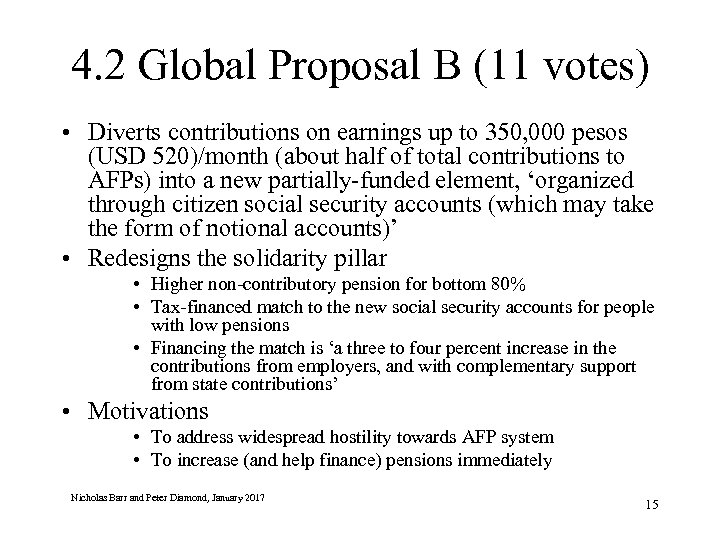
4. 2 Global Proposal B (11 votes) • Diverts contributions on earnings up to 350, 000 pesos (USD 520)/month (about half of total contributions to AFPs) into a new partially-funded element, ‘organized through citizen social security accounts (which may take the form of notional accounts)’ • Redesigns the solidarity pillar • Higher non-contributory pension for bottom 80% • Tax-financed match to the new social security accounts for people with low pensions • Financing the match is ‘a three to four percent increase in the contributions from employers, and with complementary support from state contributions’ • Motivations • To address widespread hostility towards AFP system • To increase (and help finance) pensions immediately Nicholas Barr and Peter Diamond, January 2017 15
4. 3 Global Proposal C (1 vote) • Absorbs both the stock of assets of the AFP system and the flow of contributions into a new DB system • ‘Global Proposal C seeks to respond to the views expressed during the public participation process by transforming the system into one that is purely pay-asyou-go’ • ‘The full amount of contributions will be used as income to pay contributory pensions, with no State subsidies…. On average, retirement benefits would be increased by 75 -100%. Contribution rates will not be raised until 2035’ • Motivations: • Higher benefits • An ideological objection to the AFP system Nicholas Barr and Peter Diamond, January 2017 16
4. 4 Assessment • Proposal A is the best way forward • Proposals B and C are mistaken Nicholas Barr and Peter Diamond, January 2017 17
Why Proposal A • The 2008 strategy is sound • The various parts of the system fit together to achieve the multiple objectives of poverty relief, insurance and consumption smoothing • The solidarity pension provides poverty relief and some insurance • Individual accounts mainly provide consumption smoothing • Long, stable history • Thus very different from, e. g. , Argentina, China, Hungary and Poland Nicholas Barr and Peter Diamond, January 2017 18
Why Proposal A (2) • Good base for expanding the solidarity pillar • Range of flexible options for increasing pensions – Gains formal and informal workers, including women – Option of greatest gains for those with smallest AFP pension • Thus higher pensions within chosen fiscal envelope • Can achieve distributional effects similar to Proposal B • Individual accounts also a sound base for reform • Adequate replacement rate for workers with fairly complete contributions records • Government AFP with default option • Option of central clearing house for record keeping, transferring contributions to funds and policing against evasion (as in Sweden) • Option of move towards a lower cost plan, e. g. the default in the Swedish Premium Pension or the US Thrift Savings Plan • Maintains saving – important for reasons below Nicholas Barr and Peter Diamond, January 2017 19
Problems with Proposal B • Focus mainly on the formal sector • NDC + positive match benefits formal-sector workers • Highest benefits for workers with high contribution densities • Low AFP pensions mainly for people with incomplete contribution records, a particular problem for women; NDC does not address this problem • Lack of specificity, hence • Hard to judge distributional effects, though with strong suspicion of raiding the kitty, i. e. concealed redistribution from future workers and pensioners • Hard to judge finance (presentation is in terms of the system when mature, with no discussion of the transition) • Vulnerability to political pressure to raise $350 K ceiling • Government might not resist such pressures since a further move towards PAYG can create short-term fiscal windfall • Hence risk that Proposal B will approach Proposal C • Insufficient attention to significant additional administrative costs (0. 41% in NDC system in Sweden, very much a lower bound) Nicholas Barr and Peter Diamond, January 2017 20
Problems with Proposal B: Effect on saving • Transferring benefits from future retirees to current ones risks a negative impact on aggregate saving • Declining fertility will lead to a smaller workforce • Rational response is to make each worker more productive through increased investment in human and physical capital • Reforms that reduce saving affect investment and output growth, hence fundamentally the wrong way to go in Chile • For such reasons, three Commissioners (Attanasio, Meghir and Mitchell 2015) wrote: ‘Our objection to Proposal B, which in the short run would provide a level of pensions very similar to that of Proposal A, was about how … pensions would be financed. Proposal B would divert money from workers’ individual accounts and give the cash to current pensioners, rather than building up funding for their own retirement. […] [B]y diverting savings, this plan would undercut investment and future productivity growth. ’ Nicholas Barr and Peter Diamond, January 2017 21
Problems with Proposal C • Rejected by Commission because • Transfers worker’s accumulations to a PAYG system without compensation • Is unsustainable: ‘The proposal requires an abrupt and large increase in … contributions and taxes [once] … the reserves are depleted’ • Puts saving and investment at risk to a greater extent than B Nicholas Barr and Peter Diamond, January 2017 22
Consistency with past positions • Peter Diamond and I have criticised World Bank’s over-promotion of Chile model for over 25 years • Thus our support for Proposal A is not ideological • We support Proposal A because of • Its flexibility over the distribution of benefits • Its virtue in preserving investment levels • We take account of several sets of facts • The system has been in place for 35 years, has improved its design over time and has mostly met the transition costs • Fertility is declining • There are options within the existing strategy for introducing simple and cheaper ways of saving Nicholas Barr and Peter Diamond, January 2017 23
Consistency with past positions (2) • This line of argument does not imply that we regard individual funded accounts elsewhere as necessarily worthwhile – the capacity to implement and/or finance the approach is absent in many countries • For such reasons we opposed individual funded accounts in our 2005 and 2010 reports for the Chinese government (Barr and Diamond 2010 b). • That we take a different position under different circumstances is not inconsistent – if circumstances differ, so does the appropriate policy Nicholas Barr and Peter Diamond, January 2017 24
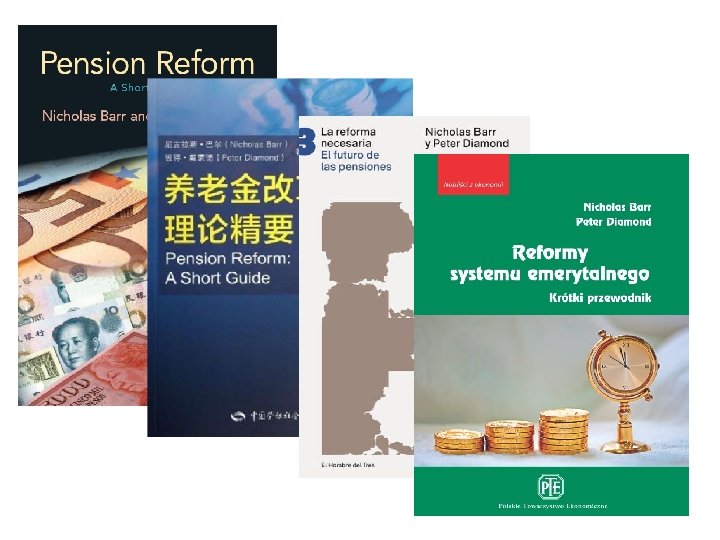
References Barr, Nicholas (2012), The Economics of the Welfare State, OUP, Ch. 7 Barr, Nicholas and Diamond, Peter (2009), ‘Reforming pensions: Principles, analytical errors and policy directions’, International Social Security Review, Vol. 62, No. 2, 2009, pp. 5 -29 (also in French, German and Spanish) Barr, Nicholas and Diamond, Peter (2010 a), Pension reform: A Short Guide, New York and Oxford: OUP, also in Spanish, Chinese and Polish Barr, Nicholas and Diamond, Peter (2010 b), Pension Reform in China: Issues, Options and Recommendations, China Economic Research and Advisory Programme, February 2010, http: //econ. lse. ac. uk/staff/nb/Barr_Diamond_China_Pensions_2010. pdf Barr, Nicholas and Diamond, Peter (2016), ‘Reforming pensions in Chile’, Polityka Społeczna, No. 1, 2016, pp. 4 -9, http: //econ. lse. ac. uk/staff/nb/Barr_and_Diamond_2016_Chile. pdf Executive Summary: Presidential Advisory Commission on the Pension System 2015 (the Bravo Commission) (2015), www. comision-pensiones. cl/Documentos/Get. Resumen. Ingles Nicholas Barr and Peter Diamond, January 2017 25
 Скачать презентацию Reforming pensions in Chile Nicholas Barr and Peter
d3822a9ddc8e96fb6506cc5106d5502e.ppt