


 Скачать презентацию REFORMING LONG-TERM CARE IN GERMANY PRELIMINARY FINDINGS FROM
dd9f81a15fd7193de24a47e795d1cd7a.ppt
- Количество слайдов: 37
 REFORMING LONG-TERM CARE IN GERMANY: PRELIMINARY FINDINGS FROM A SOCIAL EXPERIMENT WITH MATCHING TRANSFERS Melanie Arntz (ZEW) Jochen Michaelis (University of Kassel) Alexander Spermann (ZEW) European Conference on Long-term Care 21 October 2005 1
 Structure 1. LTC in Germany 2. Theoretical Foundation 3. Social Experiment 4. Conclusions 2
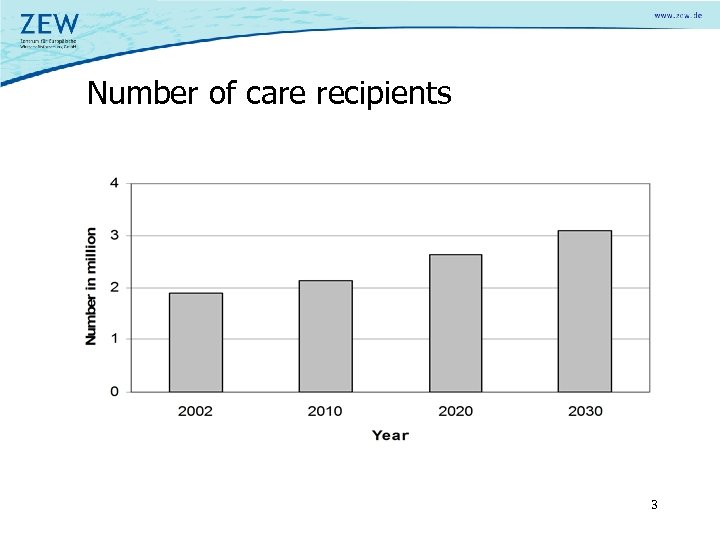 Number of care recipients 3
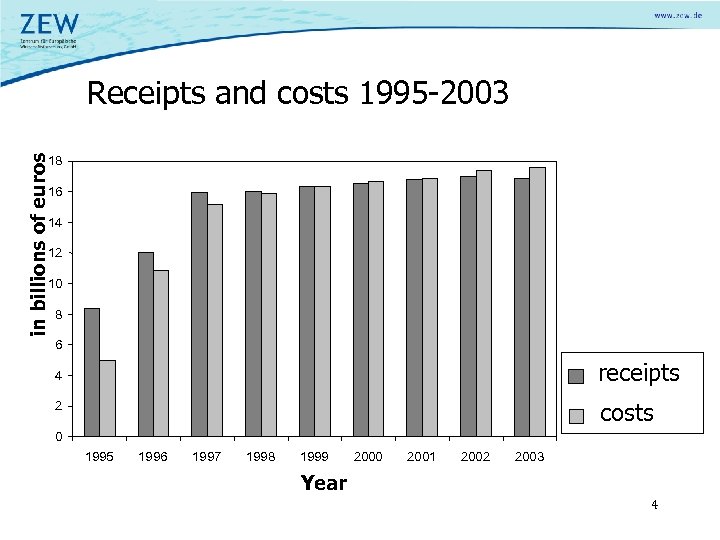 in billions of euros Receipts and costs 1995 -2003 18 16 14 12 10 8 6 4 receipts 2 costs 0 1995 1996 1997 1998 1999 2000 2001 2002 2003 Year 4
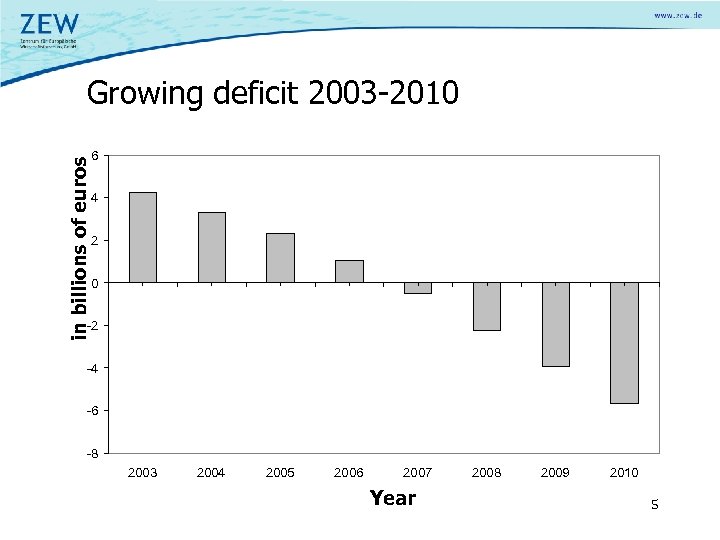 in billions of euros Growing deficit 2003 -2010 6 4 2 0 -2 -4 -6 -8 2003 2004 2005 2006 2007 Year 2008 2009 2010 5
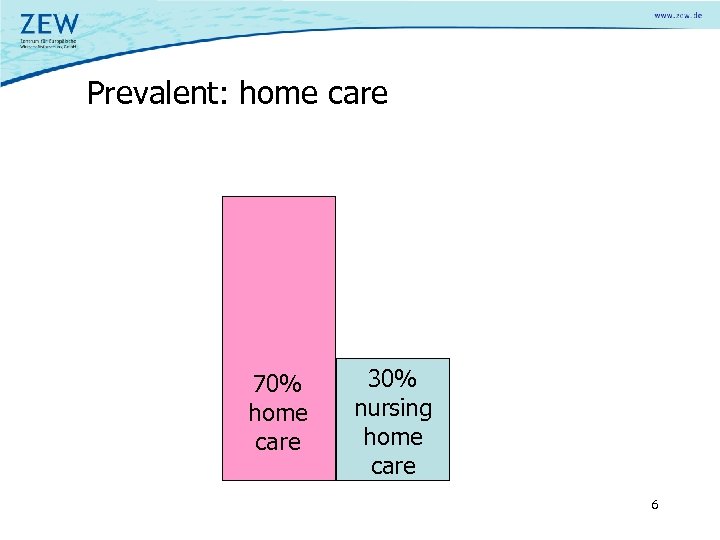 Prevalent: home care 70% home care 30% nursing home care 6
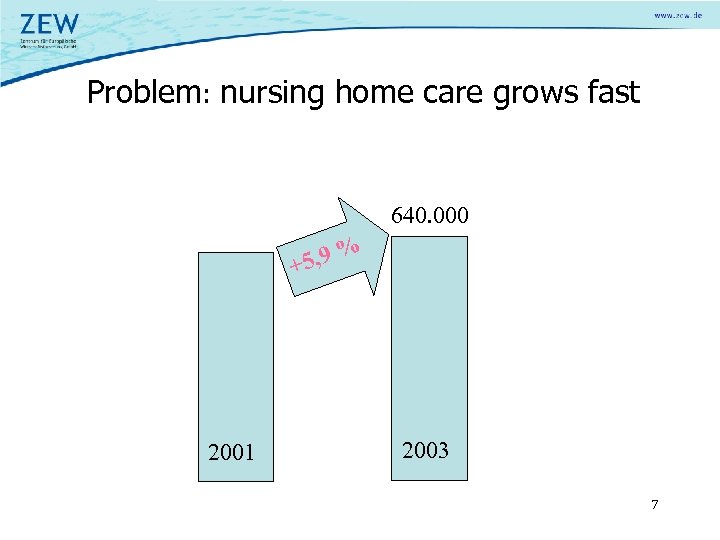 Problem: nursing home care grows fast 640. 000 % 5, 9 + 2001 2003 7
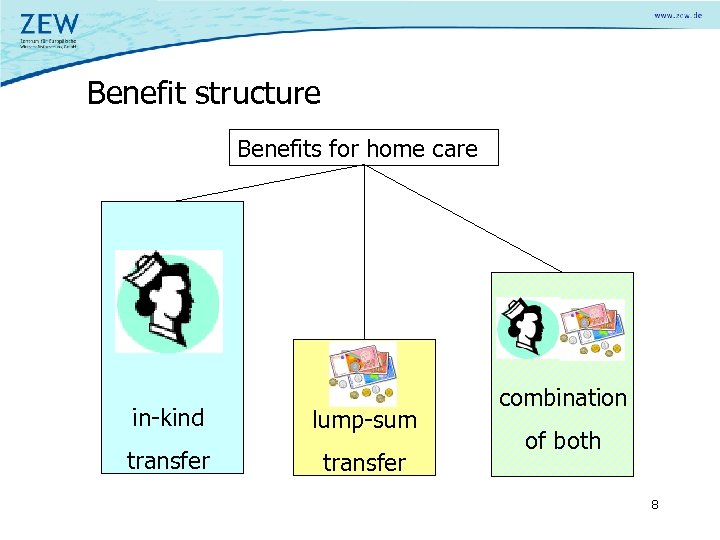 Benefit structure Benefits for home care in-kind lump-sum transfer combination of both 8
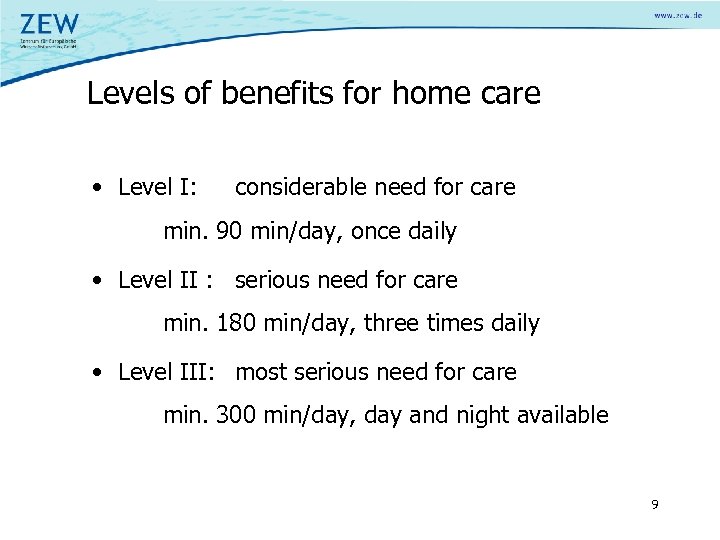 Levels of benefits for home care • Level I: considerable need for care min. 90 min/day, once daily • Level II : serious need for care min. 180 min/day, three times daily • Level III: most serious need for care min. 300 min/day, day and night available 9
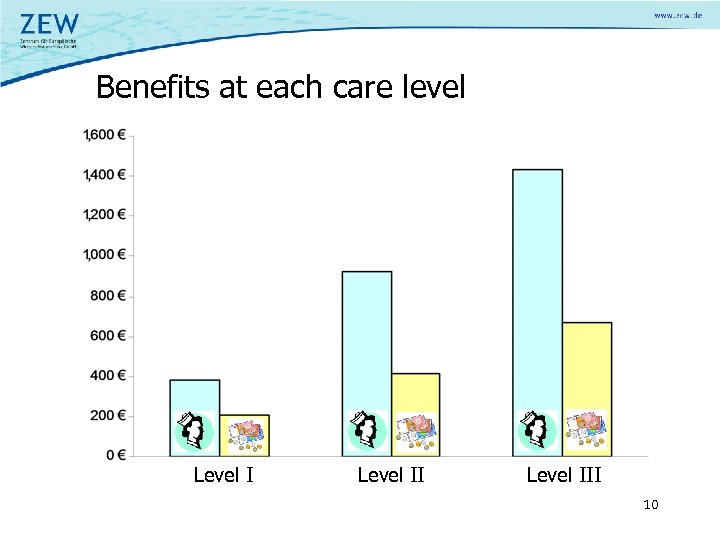 Benefits at each care level Level III 10
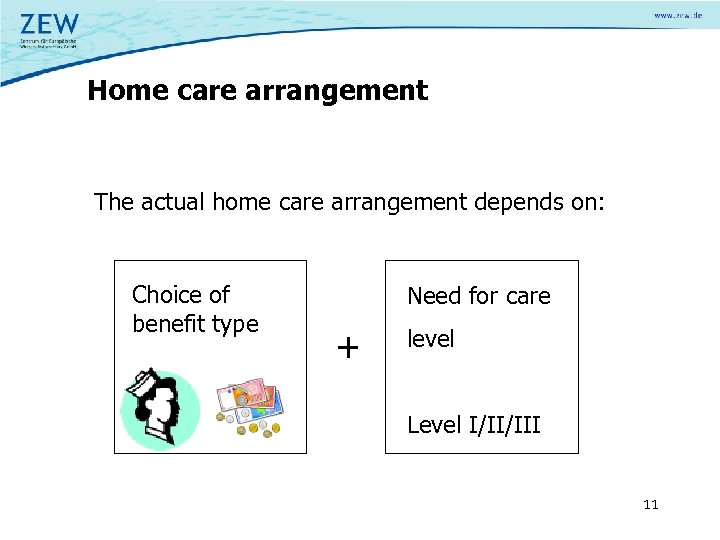 Home care arrangement The actual home care arrangement depends on: Choice of benefit type Need for care + level Level I/II/III 11
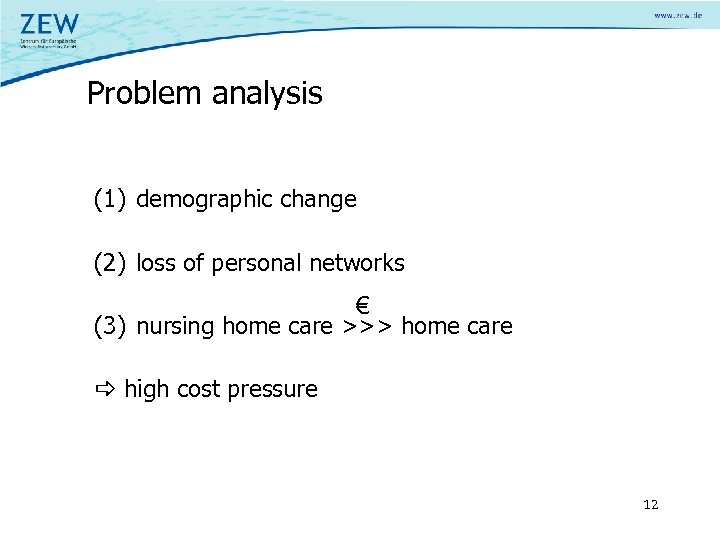 Problem analysis (1) demographic change (2) loss of personal networks € (3) nursing home care >>> home care high cost pressure 12
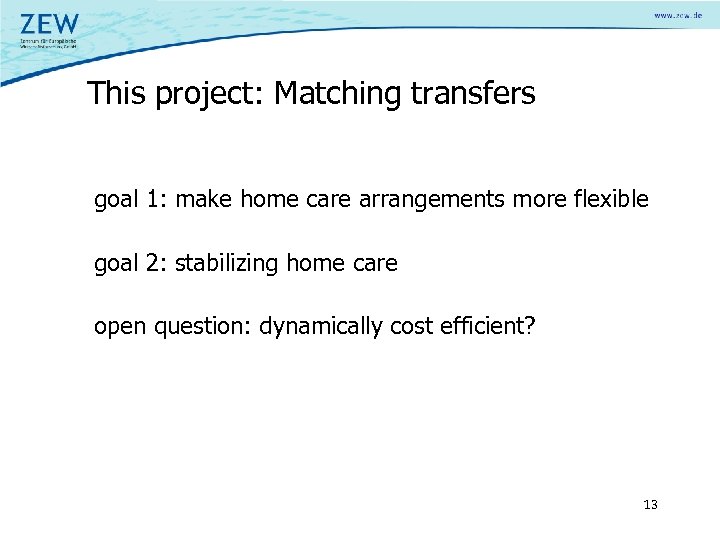 This project: Matching transfers goal 1: make home care arrangements more flexible goal 2: stabilizing home care open question: dynamically cost efficient? 13
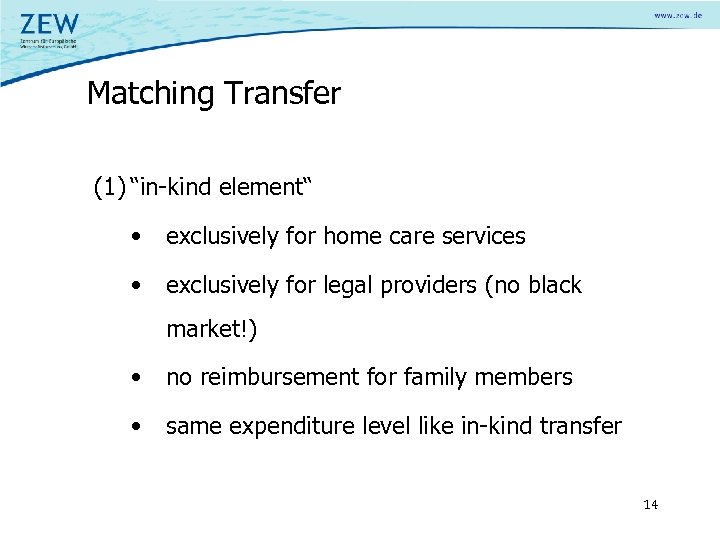 Matching Transfer (1) “in-kind element“ • exclusively for home care services • exclusively for legal providers (no black market!) • no reimbursement for family members • same expenditure level like in-kind transfer 14
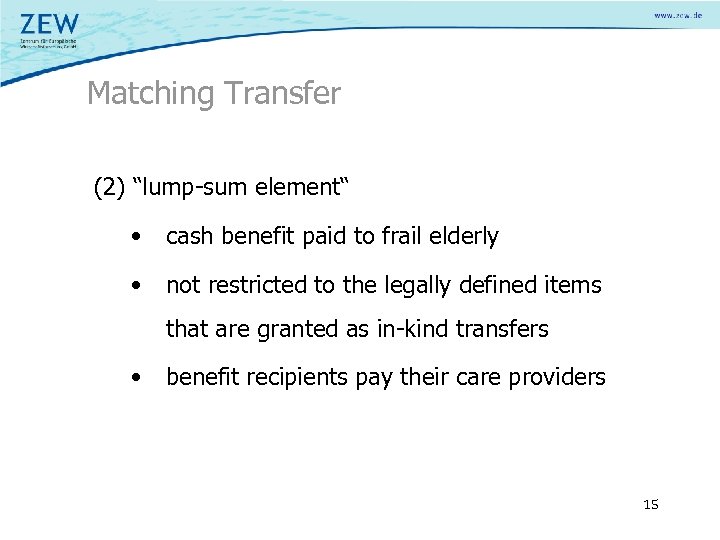 Matching Transfer (2) “lump-sum element“ • cash benefit paid to frail elderly • not restricted to the legally defined items that are granted as in-kind transfers • benefit recipients pay their care providers 15
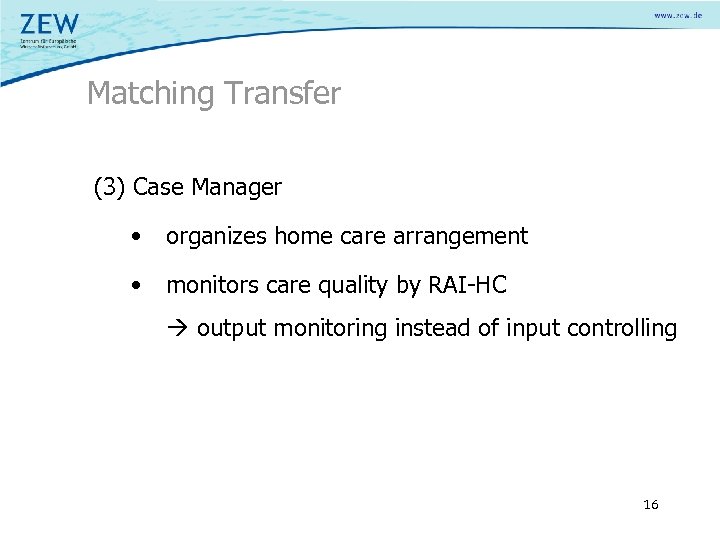 Matching Transfer (3) Case Manager • organizes home care arrangement • monitors care quality by RAI-HC output monitoring instead of input controlling 16
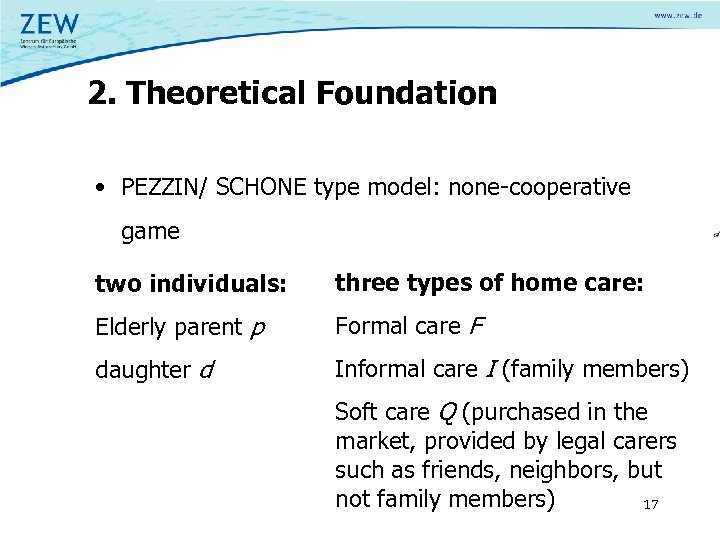 2. Theoretical Foundation • PEZZIN/ SCHONE type model: none-cooperative game two individuals: three types of home care: Elderly parent p Formal care F daughter d Informal care I (family members) Soft care Q (purchased in the market, provided by legal carers such as friends, neighbors, but not family members) 17
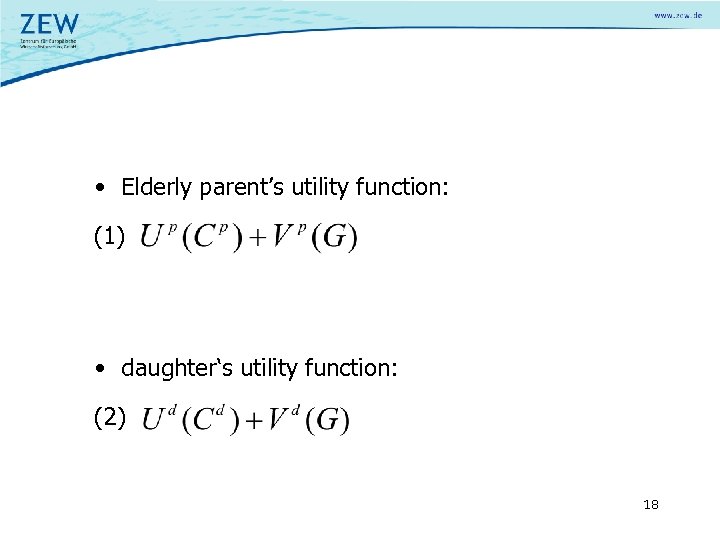 • Elderly parent’s utility function: (1) • daughter‘s utility function: (2) 18
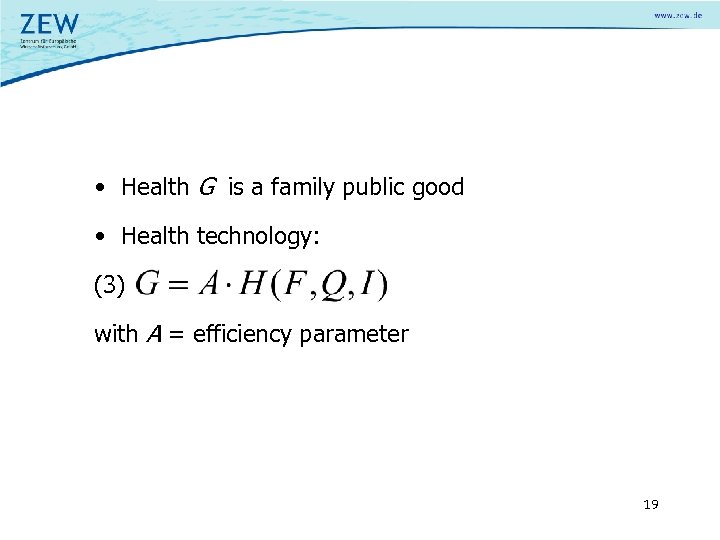 • Health G is a family public good • Health technology: (3) with A = efficiency parameter 19
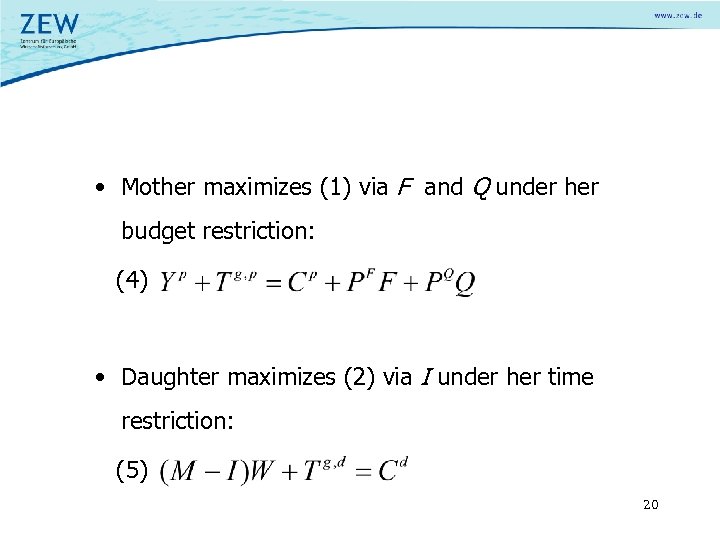 • Mother maximizes (1) via F and Q under her budget restriction: (4) • Daughter maximizes (2) via I under her time restriction: (5) 20
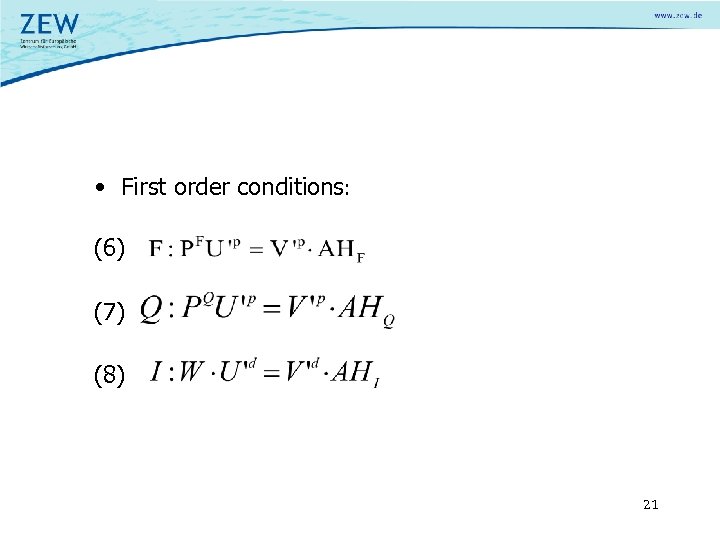 • First order conditions: (6) (7) (8) 21
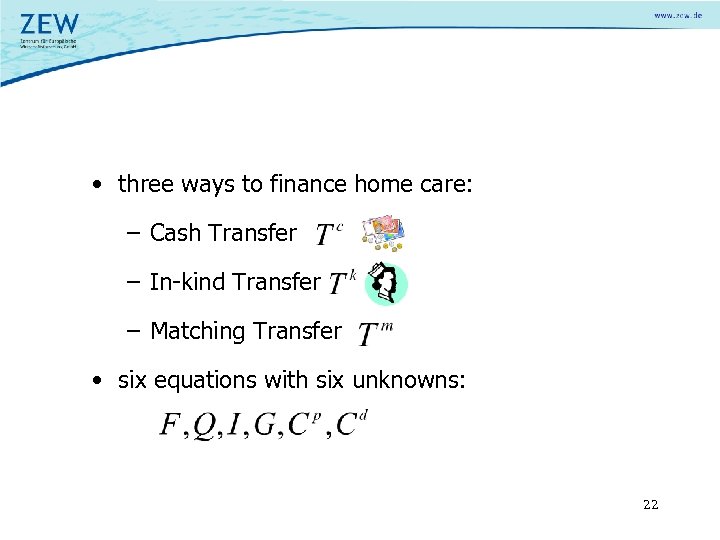 • three ways to finance home care: – Cash Transfer – In-kind Transfer – Matching Transfer • six equations with six unknowns: 22
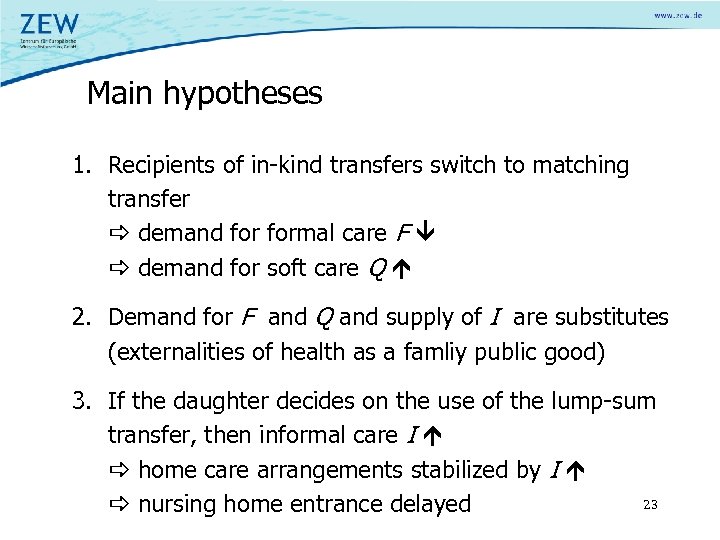 Main hypotheses 1. Recipients of in-kind transfers switch to matching transfer demand formal care F demand for soft care Q 2. Demand for F and Q and supply of I are substitutes (externalities of health as a famliy public good) 3. If the daughter decides on the use of the lump-sum transfer, then informal care I home care arrangements stabilized by I 23 nursing home entrance delayed
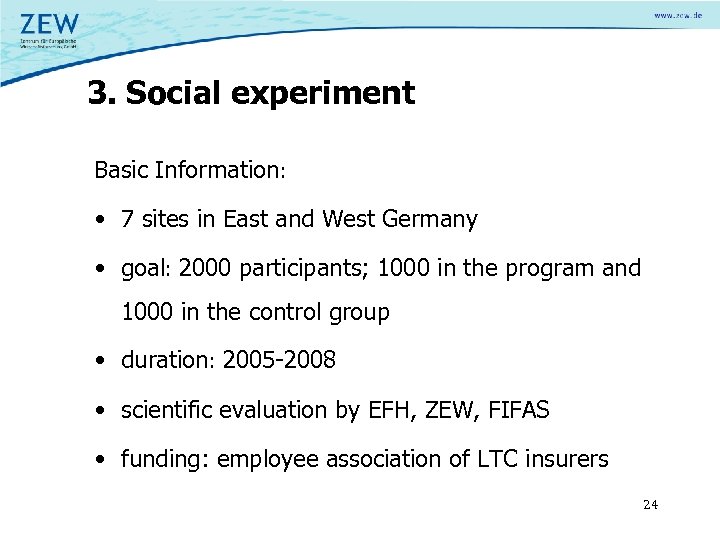 3. Social experiment Basic Information: • 7 sites in East and West Germany • goal: 2000 participants; 1000 in the program and 1000 in the control group • duration: 2005 -2008 • scientific evaluation by EFH, ZEW, FIFAS • funding: employee association of LTC insurers 24
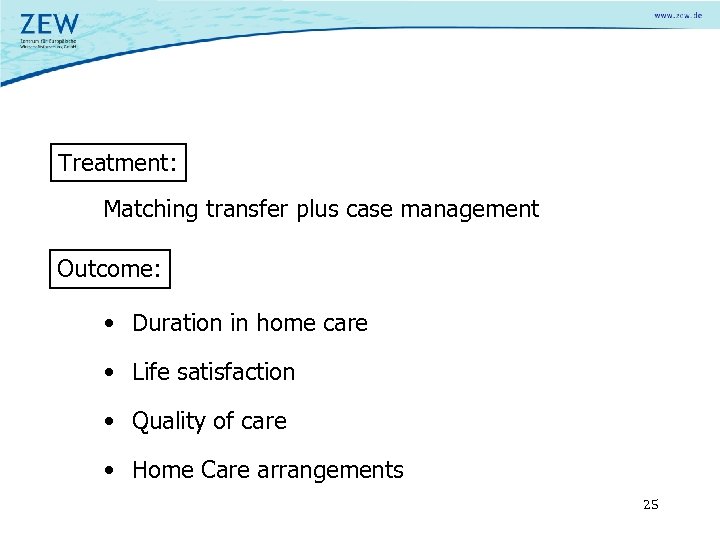 Treatment: Matching transfer plus case management Outcome: • Duration in home care • Life satisfaction • Quality of care • Home Care arrangements 25
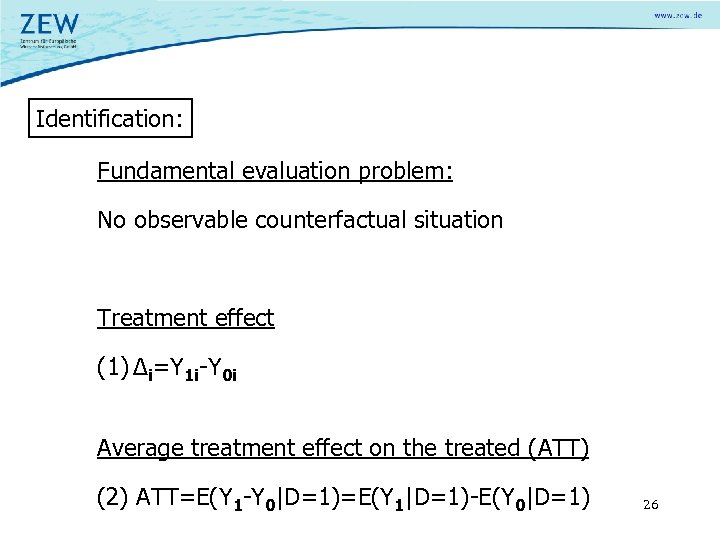 Identification: Fundamental evaluation problem: No observable counterfactual situation Treatment effect (1) Δi=Y 1 i-Y 0 i Average treatment effect on the treated (ATT) (2) ATT=E(Y 1 -Y 0|D=1)=E(Y 1|D=1)-E(Y 0|D=1) 26
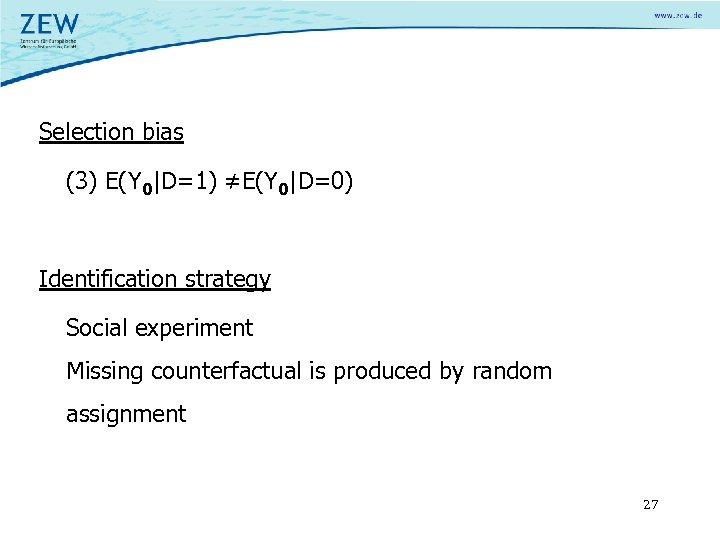 Selection bias (3) E(Y 0|D=1) ≠E(Y 0|D=0) Identification strategy Social experiment Missing counterfactual is produced by random assignment 27
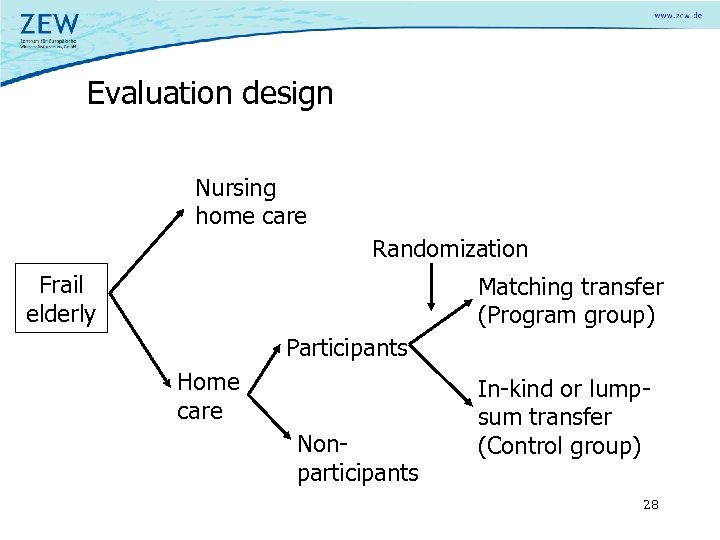 Evaluation design Nursing home care Randomization Frail elderly Matching transfer (Program group) Participants Home care Nonparticipants In-kind or lumpsum transfer (Control group) 28
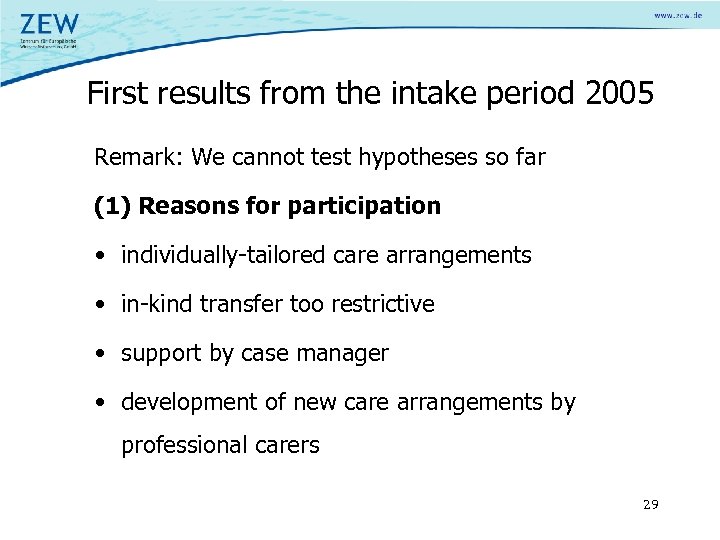 First results from the intake period 2005 Remark: We cannot test hypotheses so far (1) Reasons for participation • individually-tailored care arrangements • in-kind transfer too restrictive • support by case manager • development of new care arrangements by professional carers 29
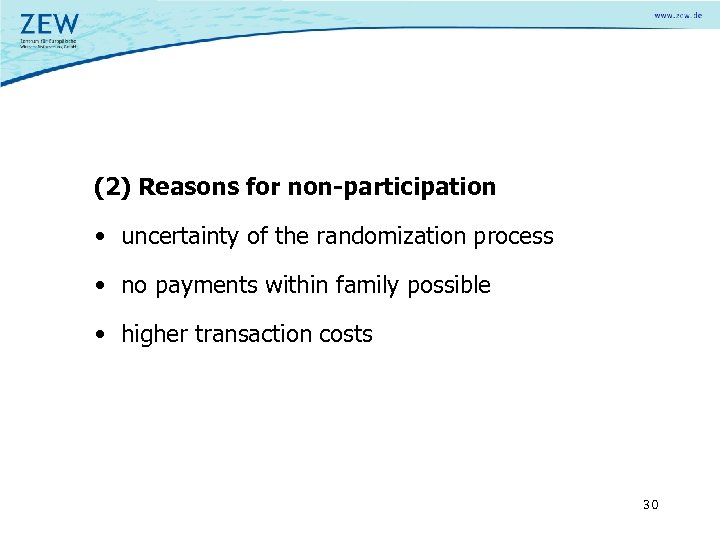 (2) Reasons for non-participation • uncertainty of the randomization process • no payments within family possible • higher transaction costs 30
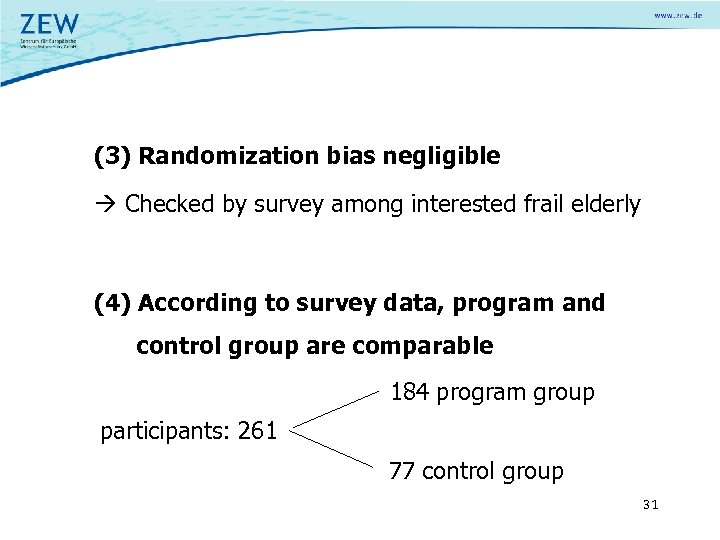 (3) Randomization bias negligible Checked by survey among interested frail elderly (4) According to survey data, program and control group are comparable 184 program group participants: 261 77 control group 31
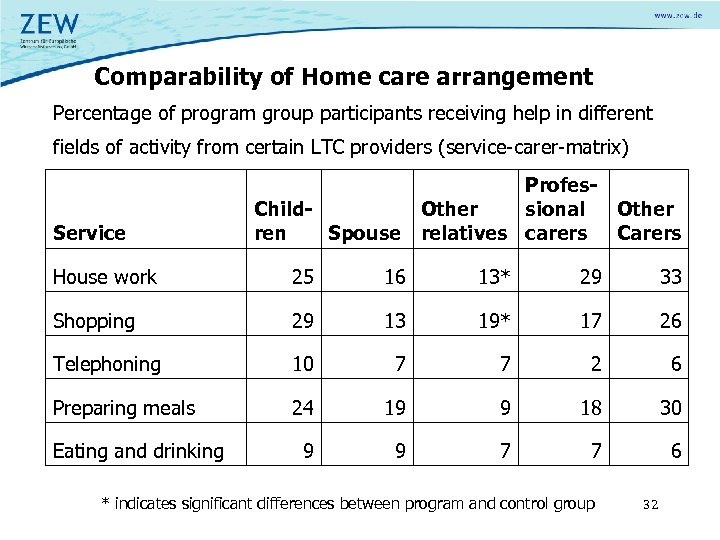 Comparability of Home care arrangement Percentage of program group participants receiving help in different fields of activity from certain LTC providers (service-carer-matrix) Service Profes. Child. Other sional Other ren Spouse relatives carers Carers House work 25 16 13* 29 33 Shopping 29 13 19* 17 26 Telephoning 10 7 7 2 6 Preparing meals 24 19 9 18 30 9 9 7 7 6 Eating and drinking * indicates significant differences between program and control group 32
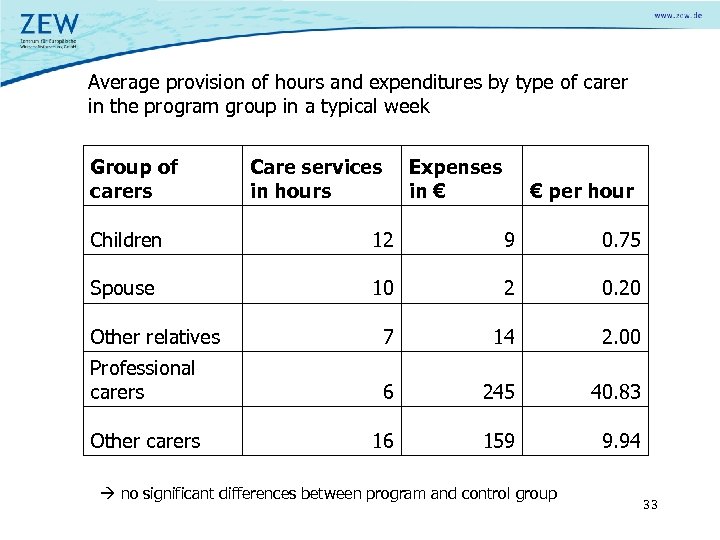 Average provision of hours and expenditures by type of carer in the program group in a typical week Group of carers Care services in hours Expenses in € € per hour Children 12 9 0. 75 Spouse 10 2 0. 20 Other relatives 7 14 2. 00 Professional carers 6 245 40. 83 Other carers 16 159 9. 94 no significant differences between program and control group 33
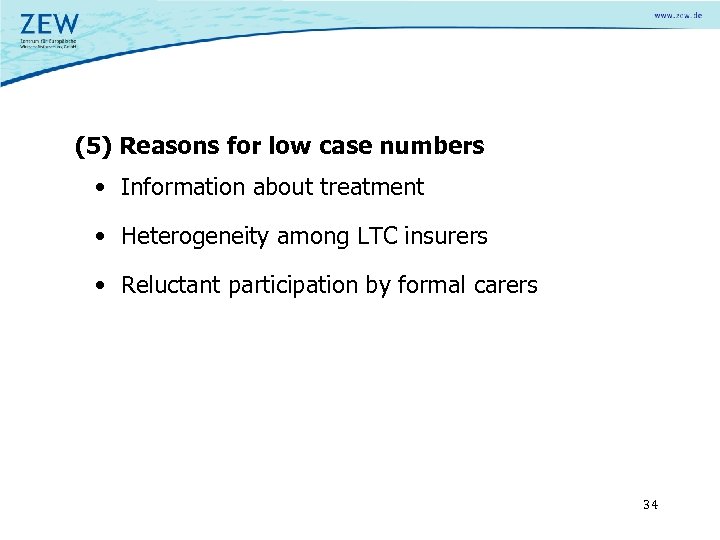 (5) Reasons for low case numbers • Information about treatment • Heterogeneity among LTC insurers • Reluctant participation by formal carers 34
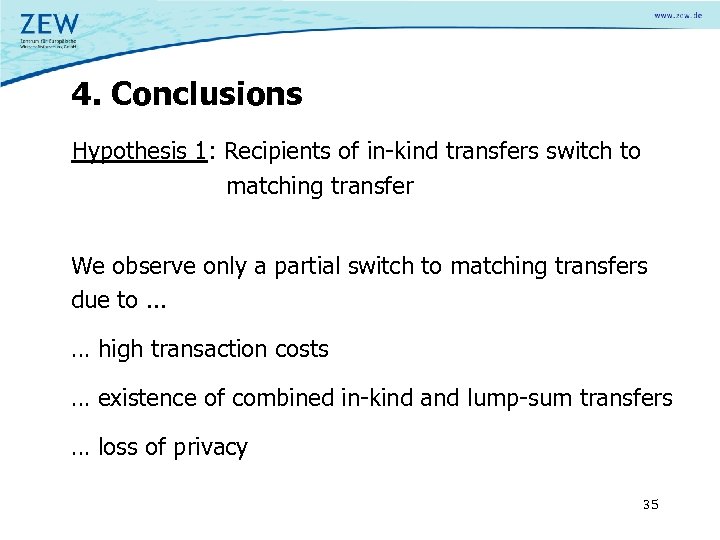 4. Conclusions Hypothesis 1: Recipients of in-kind transfers switch to matching transfer We observe only a partial switch to matching transfers due to. . . … high transaction costs … existence of combined in-kind and lump-sum transfers … loss of privacy 35
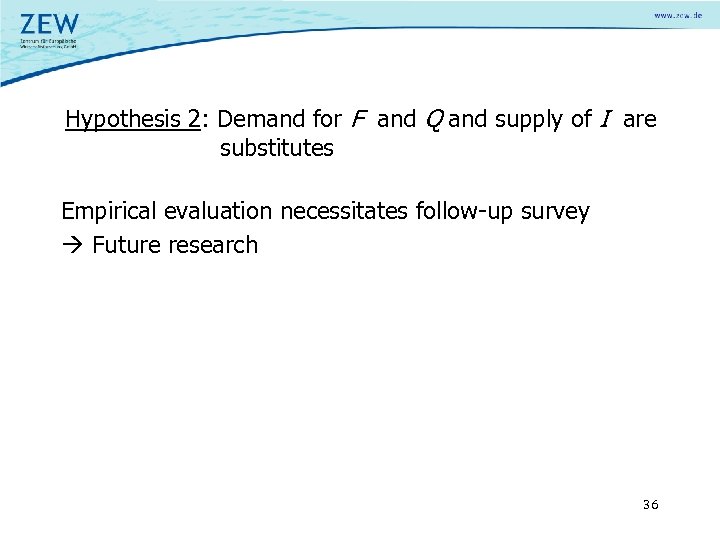 Hypothesis 2: Demand for F and Q and supply of I are substitutes Empirical evaluation necessitates follow-up survey Future research 36
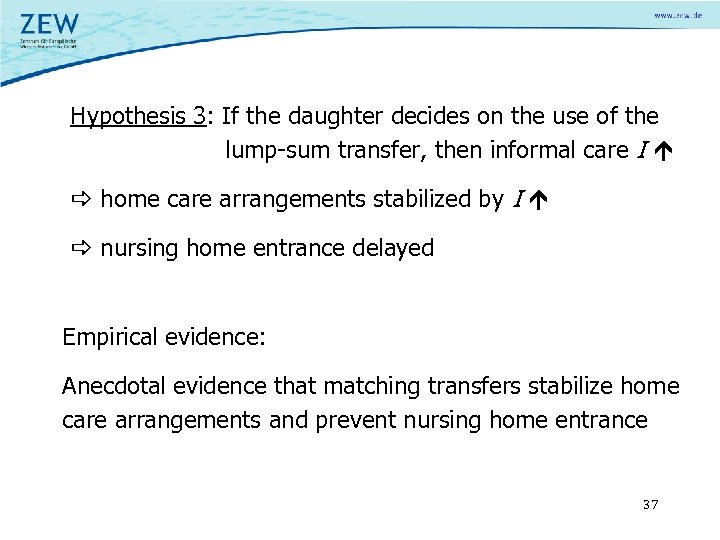 Hypothesis 3: If the daughter decides on the use of the lump-sum transfer, then informal care I home care arrangements stabilized by I nursing home entrance delayed Empirical evidence: Anecdotal evidence that matching transfers stabilize home care arrangements and prevent nursing home entrance 37