


 Скачать презентацию Reflecting on the Practice of Teaching PCMI Secondary
7009eecaaecb59e1162caa45d5f82ac6.ppt
- Количество слайдов: 42
 Reflecting on the Practice of Teaching PCMI Secondary School Teachers Program July 2007
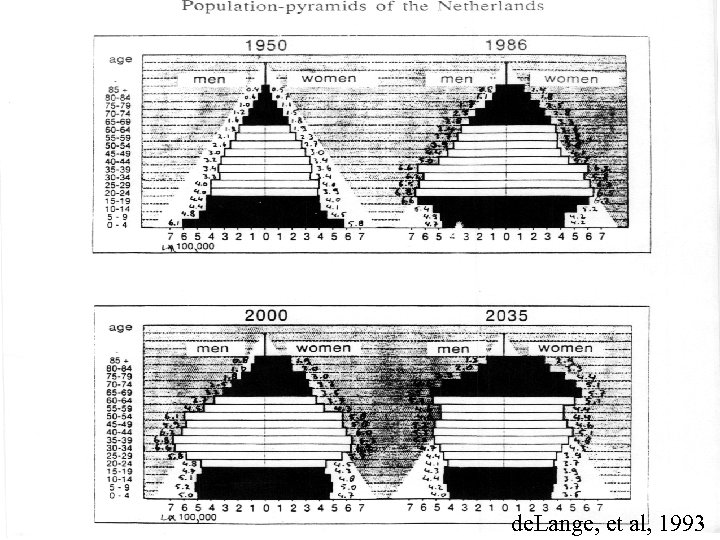 de. Lange, et al, 1993
 The Teaching Principle Effective teaching requires understanding what students know and need to learn and challenging and supporting them to learn it well. (NCTM, 2000)
 As teacher learned to • Choose tasks carefully • Listen to students(’) work • Students are often smarter than I am • Manage student responses carefully • Take risks • Let students do the work
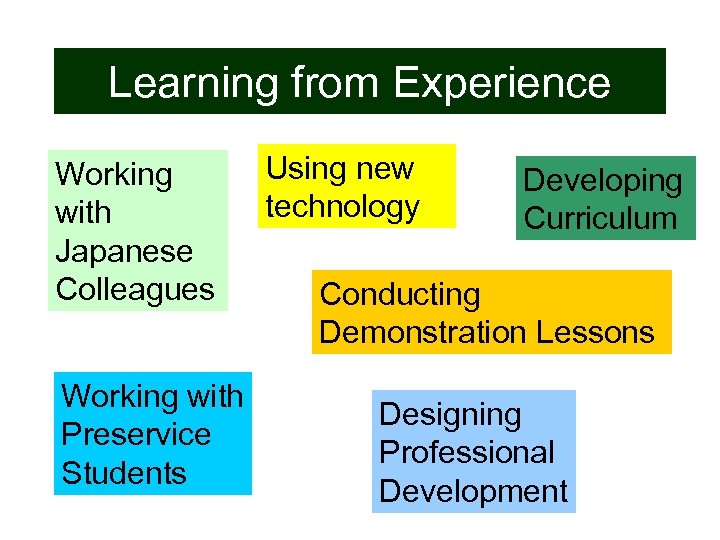 Learning from Experience Working with Japanese Colleagues Working with Preservice Students Using new technology Developing Curriculum Conducting Demonstration Lessons Designing Professional Development
 Learning from Experience Working with Japanese Colleagues
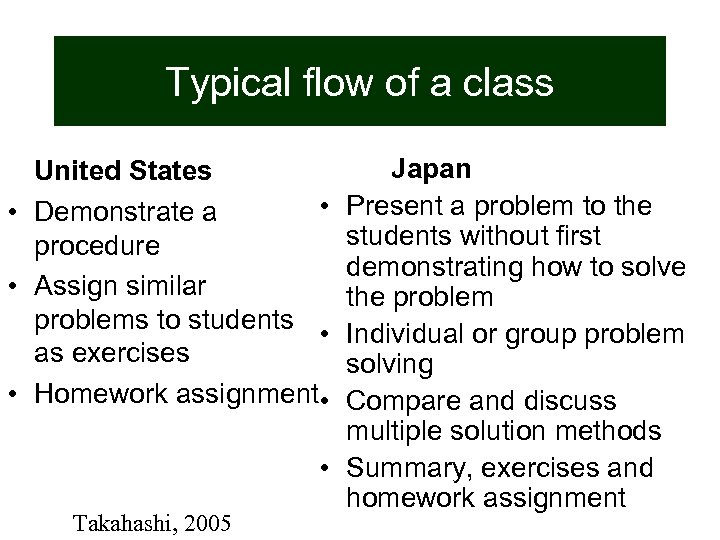 Typical flow of a class Japan Present a problem to the students without first demonstrating how to solve the problem Individual or group problem solving Compare and discuss multiple solution methods • Summary, exercises and homework assignment United States • • Demonstrate a procedure • Assign similar problems to students • as exercises • Homework assignment • Takahashi, 2005
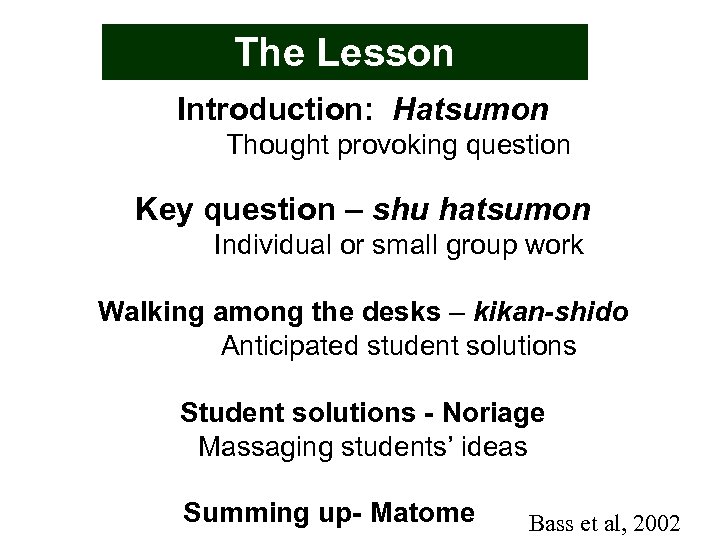 The Lesson Introduction: Hatsumon Thought provoking question Key question – shu hatsumon Individual or small group work Walking among the desks – kikan-shido Anticipated student solutions Student solutions - Noriage Massaging students’ ideas Summing up- Matome Bass et al, 2002
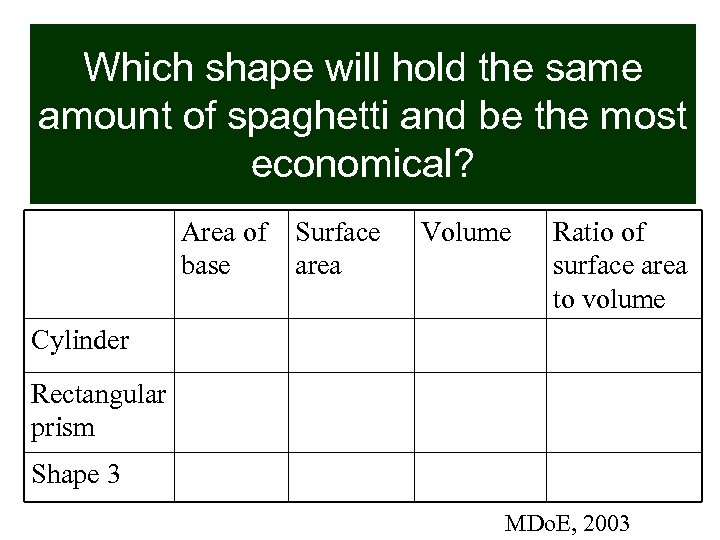 Which shape will hold the same amount of spaghetti and be the most economical? Area of base Surface area Volume Ratio of surface area to volume Cylinder Rectangular prism Shape 3 MDo. E, 2003
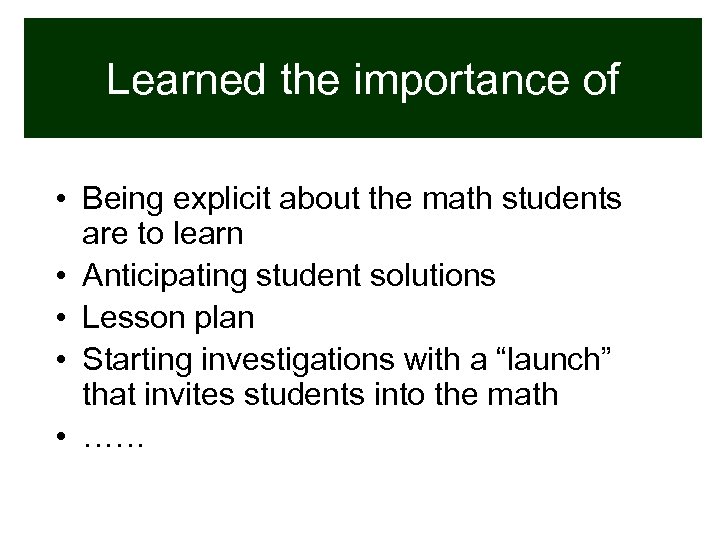 Learned the importance of • Being explicit about the math students are to learn • Anticipating student solutions • Lesson plan • Starting investigations with a “launch” that invites students into the math • ……
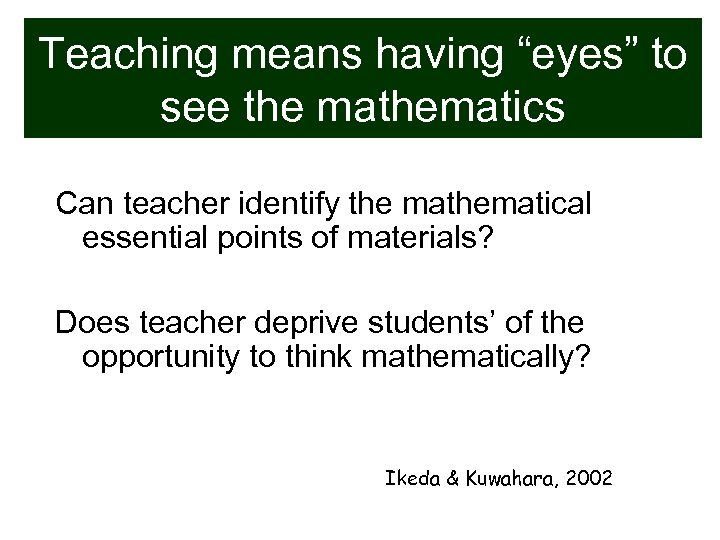 Teaching means having “eyes” to see the mathematics Can teacher identify the mathematical essential points of materials? Does teacher deprive students’ of the opportunity to think mathematically? Ikeda & Kuwahara, 2002
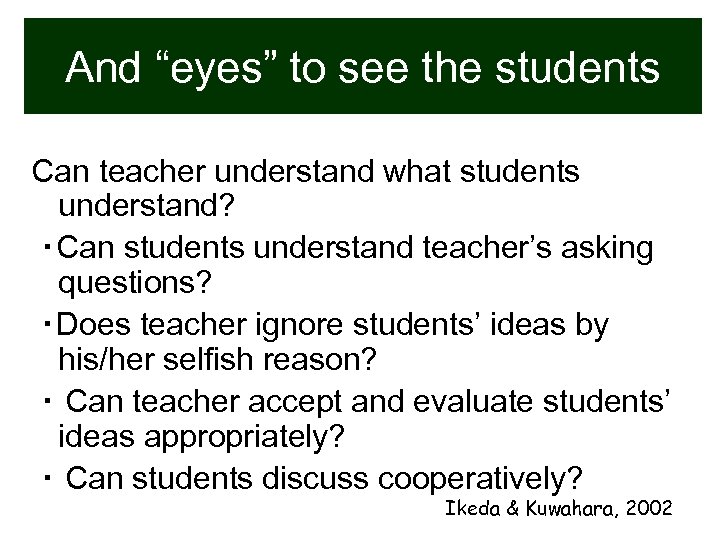 And “eyes” to see the students Can teacher understand what students understand? ・Can students understand teacher’s asking questions? ・Does teacher ignore students’ ideas by his/her selfish reason? ・ Can teacher accept and evaluate students’ ideas appropriately? ・ Can students discuss cooperatively? Ikeda & Kuwahara, 2002
 Learning from Experience Conducting Demonstration Lessons
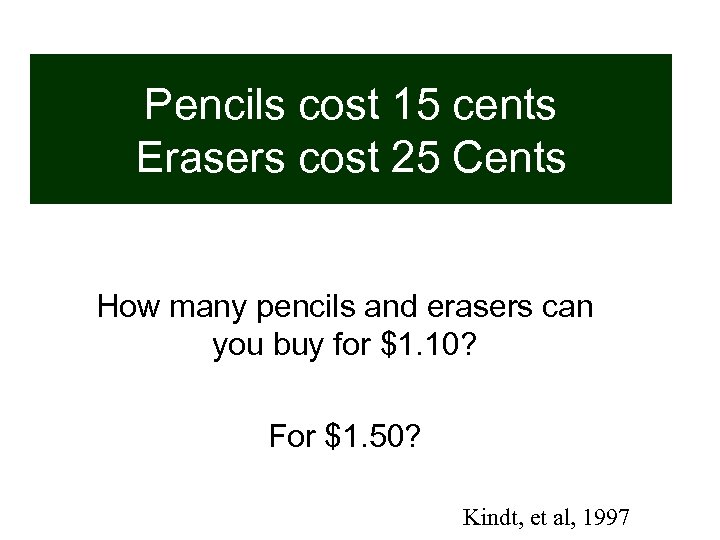 Pencils cost 15 cents Erasers cost 25 Cents How many pencils and erasers can you buy for $1. 10? For $1. 50? Kindt, et al, 1997
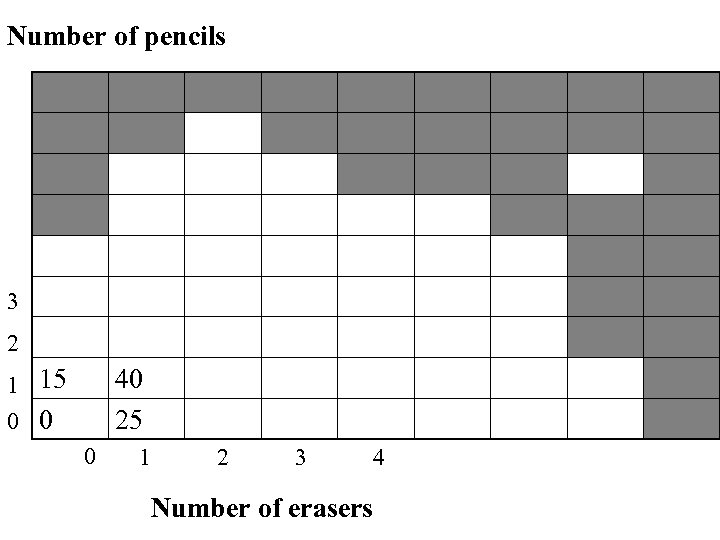 Number of pencils 3 2 1 15 0 0 40 25 0 1 2 3 4 Number of erasers
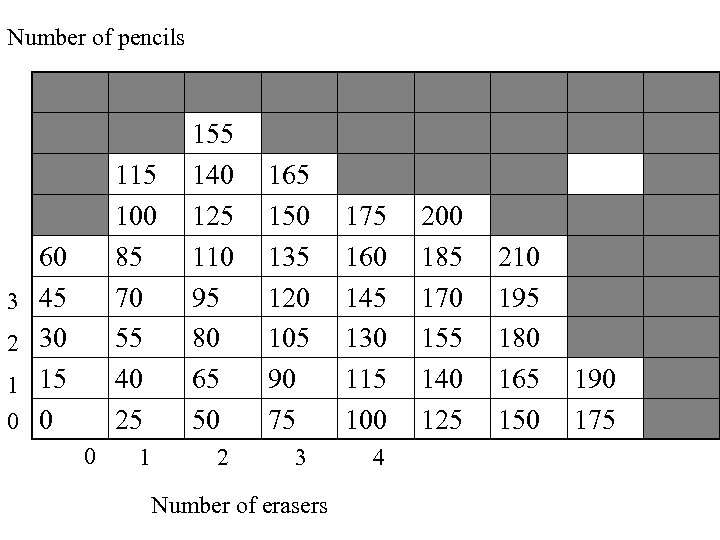 Number of pencils 3 2 1 0 115 100 85 70 55 40 25 60 45 30 15 0 0 155 140 125 110 95 80 65 50 165 150 135 120 105 90 75 160 145 130 115 100 1 2 3 4 Number of erasers 200 185 170 155 140 125 210 195 180 165 150 190 175
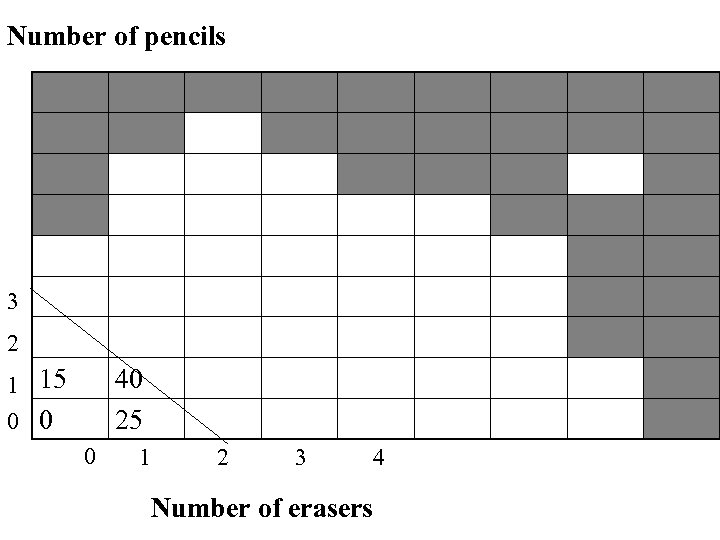 Number of pencils 3 2 1 15 0 0 40 25 0 1 2 3 4 Number of erasers
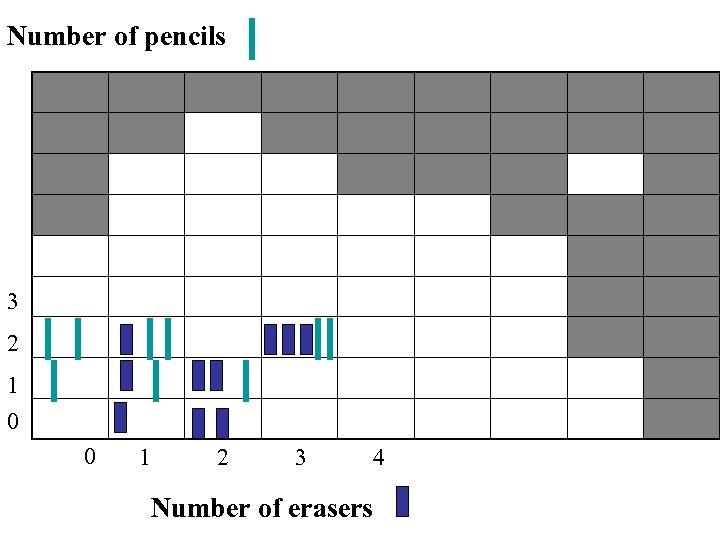 Number of pencils 3 2 1 0 0 1 2 3 4 Number of erasers
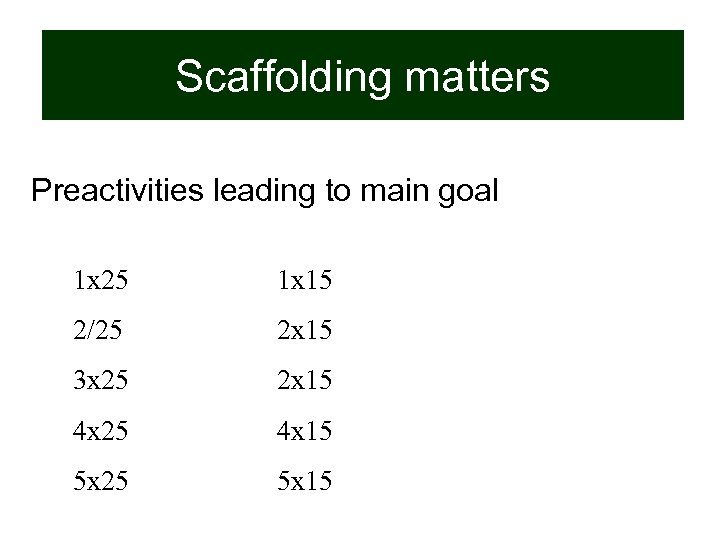 Scaffolding matters Preactivities leading to main goal 1 x 25 1 x 15 2/25 2 x 15 3 x 25 2 x 15 4 x 25 4 x 15 5 x 25 5 x 15
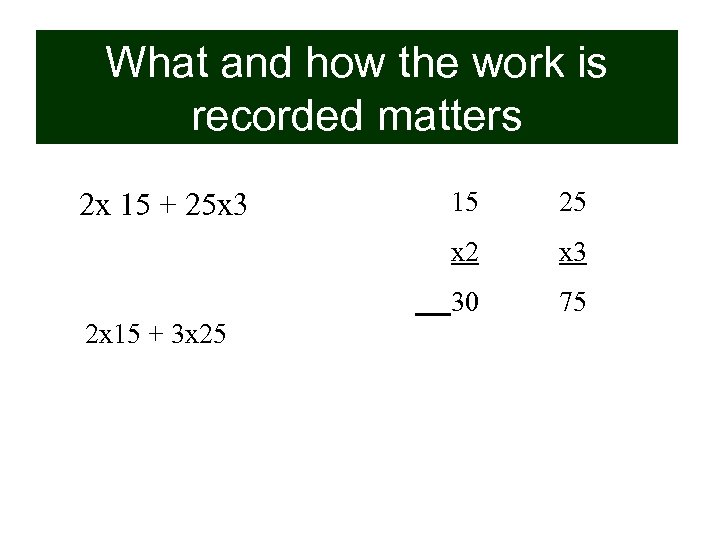 What and how the work is recorded matters 25 x 3 30 2 x 15 + 3 x 25 15 x 2 2 x 15 + 25 x 3 75
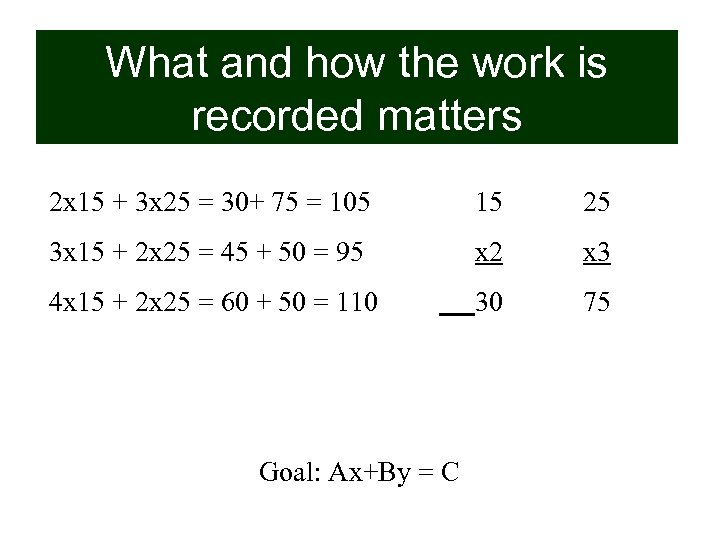 What and how the work is recorded matters 2 x 15 + 3 x 25 = 30+ 75 = 105 15 25 3 x 15 + 2 x 25 = 45 + 50 = 95 x 2 x 3 4 x 15 + 2 x 25 = 60 + 50 = 110 30 75 Goal: Ax+By = C
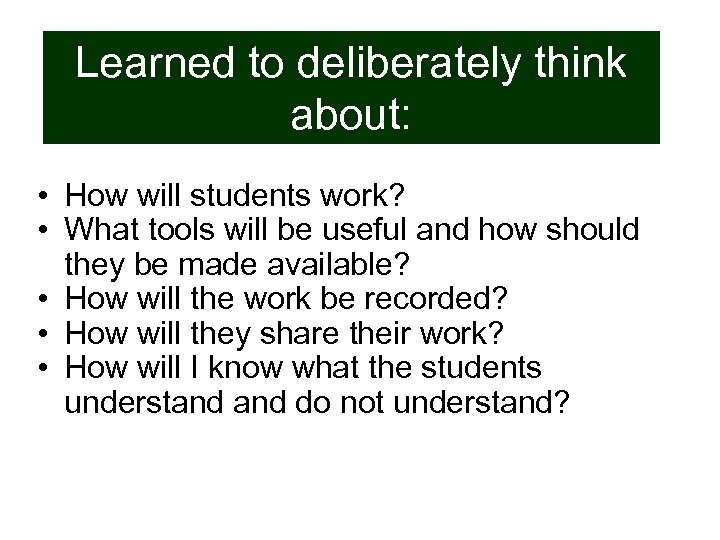 Learned to deliberately think about: • How will students work? • What tools will be useful and how should they be made available? • How will the work be recorded? • How will they share their work? • How will I know what the students understand do not understand?
 Learning from Experience Working with Preservice Students
 Expect the Unexpected
 Learned that • Boards are disappearing • Modeling is not enough; need to be explicit • Preservice students are not really aware that others have different ways of thinking • Difficult to honor mistakes
 Learning from Experience Developing Curriculum
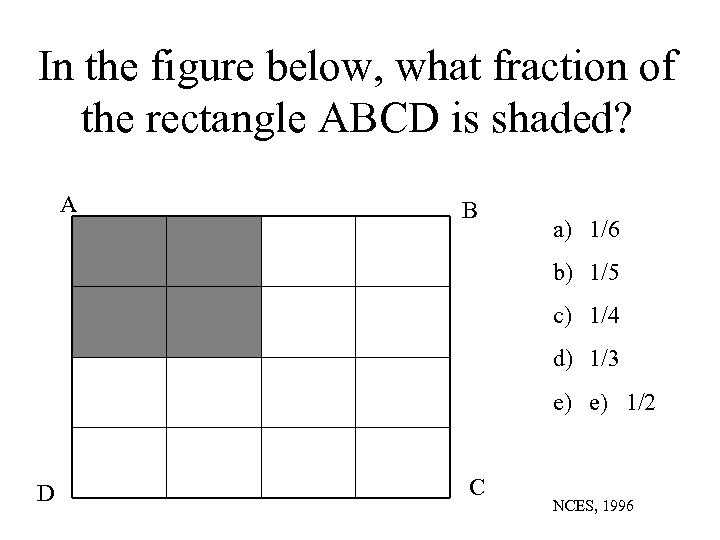 In the figure below, what fraction of the rectangle ABCD is shaded? A B a) 1/6 b) 1/5 c) 1/4 d) 1/3 e) e) 1/2 D C NCES, 1996
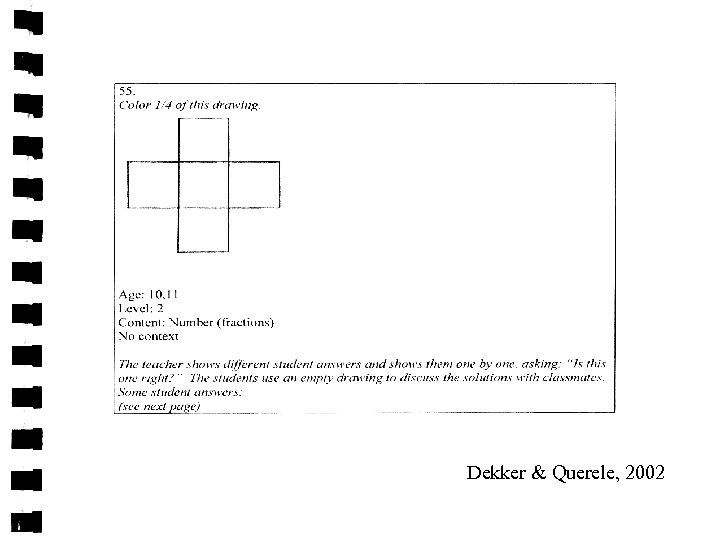 Dekker & Querele, 2002
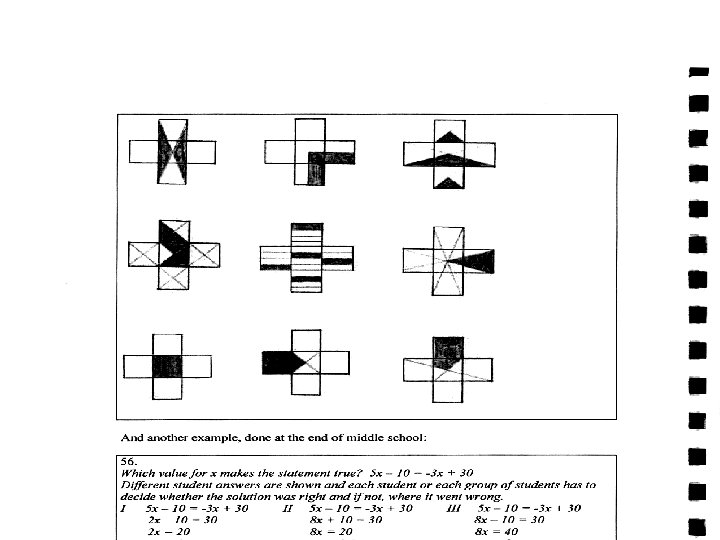
 Comparing Quantities. Kindt et al, 2006
 Learned to • Pose tasks that go beyond routines • Ask what would happen if…? What should you do if you want…. . • Frame a situation and let students comment • Collaborative work is better than individual - in doing math and in thinking about lessons
 Teaching is a profession with a body of knowledge that can be learned and applied to improve the practice of enabling students to learn.
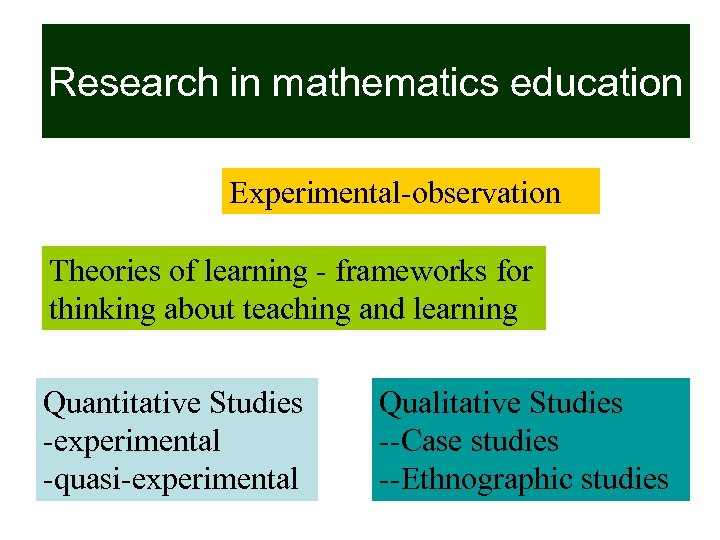 Research in mathematics education Experimental-observation Theories of learning - frameworks for thinking about teaching and learning Quantitative Studies -experimental -quasi-experimental Qualitative Studies --Case studies --Ethnographic studies
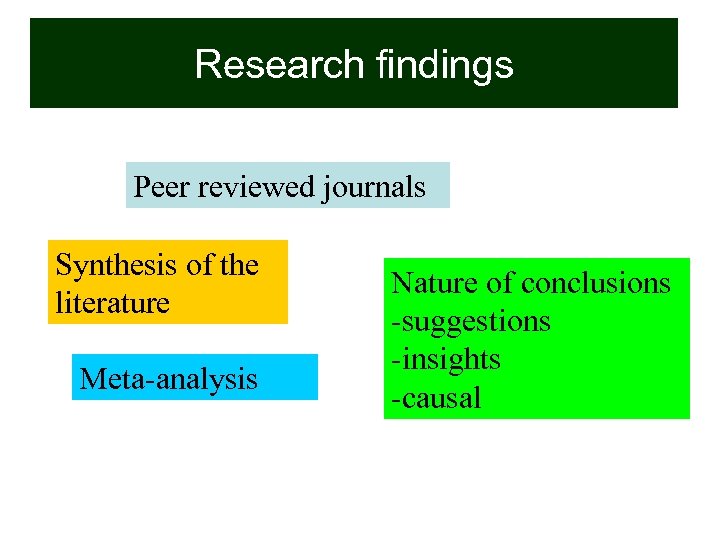 Research findings Peer reviewed journals Synthesis of the literature Meta-analysis Nature of conclusions -suggestions -insights -causal
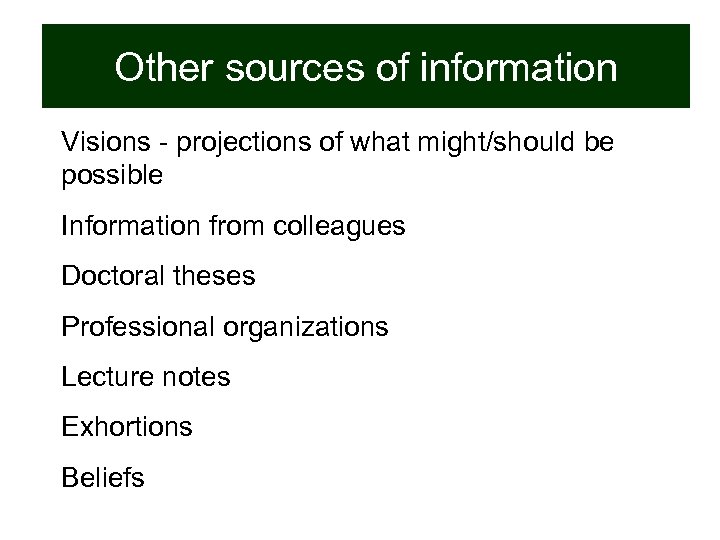 Other sources of information Visions - projections of what might/should be possible Information from colleagues Doctoral theses Professional organizations Lecture notes Exhortions Beliefs
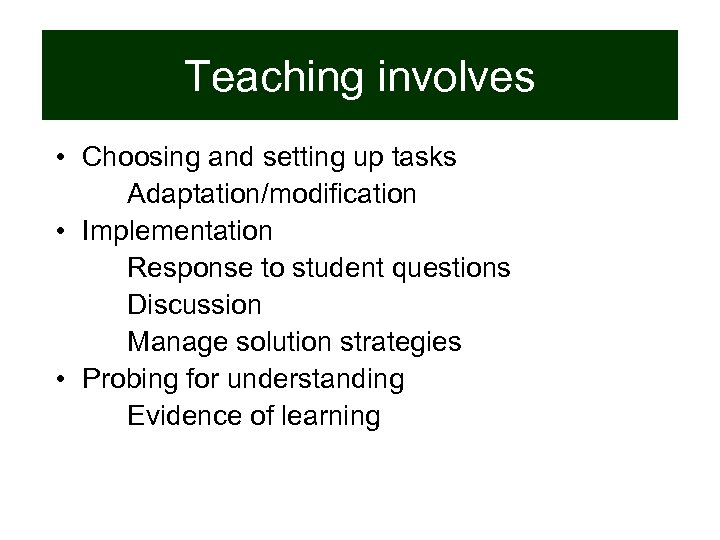 Teaching involves • Choosing and setting up tasks Adaptation/modification • Implementation Response to student questions Discussion Manage solution strategies • Probing for understanding Evidence of learning
 Our Work • Formative Assessment • Cognitive Demand/Scaffolding • Discussion/Questioning • Transfer/Learning for Understanding
 Research Report • Describe what the topic means and why it is important • Give three or four key findings and their relevance for teaching
 Reflect on your own teaching • What are some questions you have? • What are one or two things about your teaching you would like to improve? • What would you like to learn about teaching?
 Teaching is harder than it looks making students come to life in the world of mathematics. But we can learn not only from our own experience and that of our colleagues but from the research that helps explain and provides insights into teaching and learning math
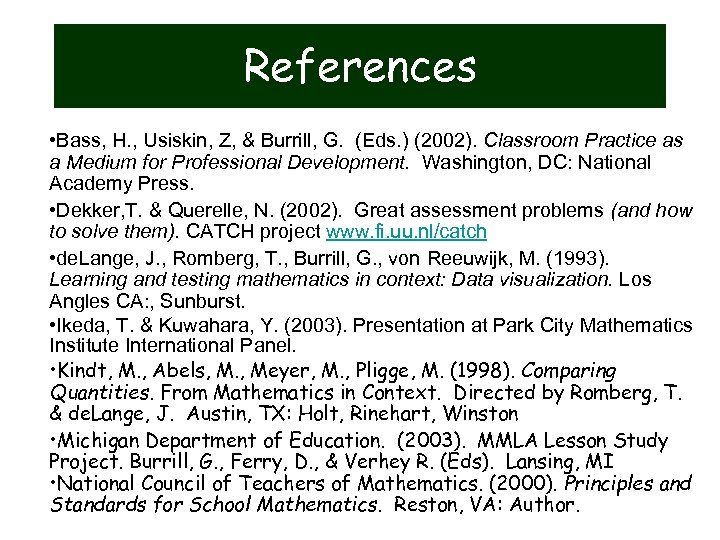 References • Bass, H. , Usiskin, Z, & Burrill, G. (Eds. ) (2002). Classroom Practice as a Medium for Professional Development. Washington, DC: National Academy Press. • Dekker, T. & Querelle, N. (2002). Great assessment problems (and how to solve them). CATCH project www. fi. uu. nl/catch • de. Lange, J. , Romberg, T. , Burrill, G. , von Reeuwijk, M. (1993). Learning and testing mathematics in context: Data visualization. Los Angles CA: , Sunburst. • Ikeda, T. & Kuwahara, Y. (2003). Presentation at Park City Mathematics Institute International Panel. • Kindt, M. , Abels, M. , Meyer, M. , Pligge, M. (1998). Comparing Quantities. From Mathematics in Context. Directed by Romberg, T. & de. Lange, J. Austin, TX: Holt, Rinehart, Winston • Michigan Department of Education. (2003). MMLA Lesson Study Project. Burrill, G. , Ferry, D. , & Verhey R. (Eds). Lansing, MI • National Council of Teachers of Mathematics. (2000). Principles and Standards for School Mathematics. Reston, VA: Author.
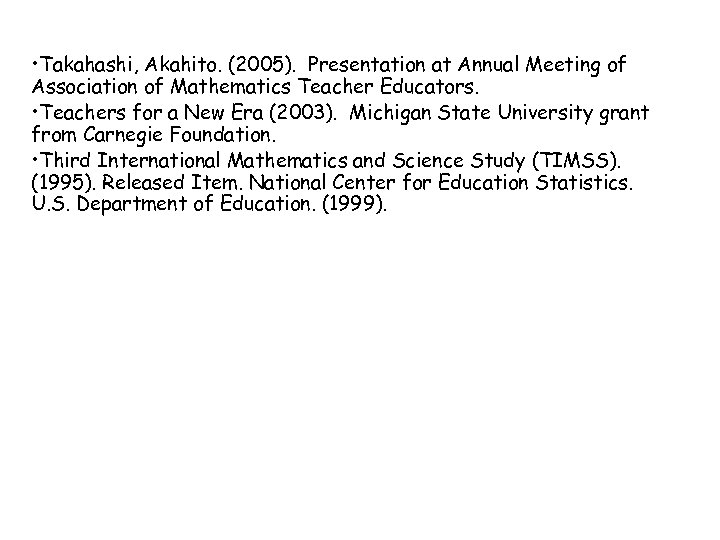 • Takahashi, Akahito. (2005). Presentation at Annual Meeting of Association of Mathematics Teacher Educators. • Teachers for a New Era (2003). Michigan State University grant from Carnegie Foundation. • Third International Mathematics and Science Study (TIMSS). (1995). Released Item. National Center for Education Statistics. U. S. Department of Education. (1999).