


 Скачать презентацию Reengineering the SIPP An Assessment of the Use
88c4226171433994574b37e02b9b29e0.ppt
- Количество слайдов: 25
 Reengineering the SIPP: An Assessment of the Use of Administrative Records Jim Farber and Sally Obenski US Census Bureau CNSTAT Panel January 26, 2007 1
 Overview • Background on the Dynamics of Economic Well-being System • Administrative records assessment methodology and outcome • Prototyping methodology and outcome • Next steps • Conclusions 2
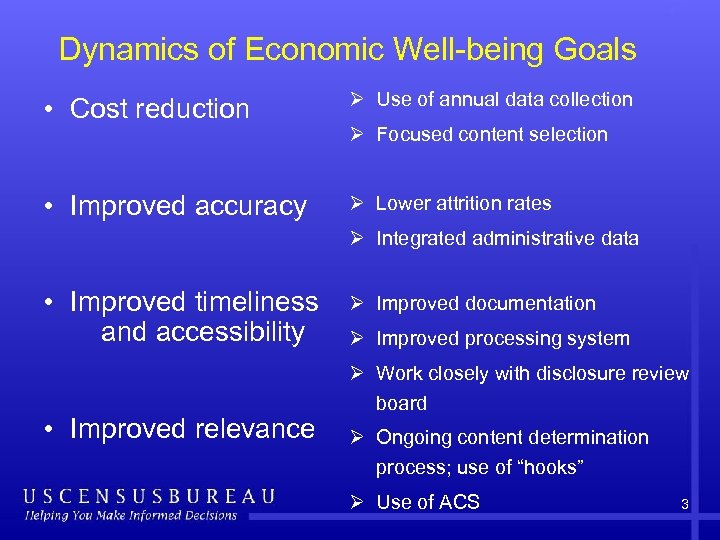 Dynamics of Economic Well-being Goals • Cost reduction Ø Use of annual data collection • Improved accuracy Ø Lower attrition rates Ø Focused content selection Ø Integrated administrative data • Improved timeliness and accessibility • Improved relevance Ø Improved documentation Ø Improved processing system Ø Work closely with disclosure review board Ø Ongoing content determination process; use of “hooks” Ø Use of ACS 3
 Scoping AR Feasibility • Inventory in-house files • Review SIPP content requirements • Assess availability and usability of inhouse files to meet SIPP requirements • Begin prototype development 4
 Assessment Methodology (1) • Identify administrative records that contain content for basic SIPP topics – – – Demographics Labor Force Health Insurance Assets General Income Program Participation • Identify and bring together experts on administrative records and on survey content 5
 Assessment Methodology (2) • For each basic SIPP topic, identify the content goal • Align available administrative records content to the survey content goal – Sometimes one-to-one alignment – Sometimes many-to-one or one-to-many • Assess administrative records quality issues • Recommend administrative records variables for prototypes 6
 Assessment Outcome: Demographics • Sources: - Social Security Numident - Census 2000 • Scope: National • Coverage: Social Security Number holders • Alignment with SIPP content: – Age, Sex, Race, Hispanic Origin, U. S. Citizenship 7
 Assessment Outcome: Labor Force • Source: IRS Tax Returns • Scope: National • Coverage: Filers • Alignment with SIPP content: – Total Earnings from job(s) or income (loss) from business(es) 8
 Assessment Outcome: Health Insurance • • Sources: Medicare, Medicaid Scope: National Coverage: Enrollees Alignment with SIPP content: – – Nearly all SIPP Medicare items Does not currently cover Medicare part D Nearly all SIPP Medicaid items Current lag of about four years hinders use of Medicaid 9
 Assessment Outcome: Assets • Sources: IRS Tax and Information Returns • Scope: National • Coverage: - Filers, - IRS-covered income earners • Alignment with SIPP content: – Nearly all aggregate SIPP asset items – Does not have detailed ownership of and income from mortgages 10
 Assessment Outcome: General Income • Sources: - Social Security Master Beneficiary Record - Supplemental Security Income Record - IRS Tax Returns • Scope: National • Coverage: Beneficiaries, SSI recipients, filers • Alignment with SIPP content: – Many SIPP general income items – Aggregated SIPP Amounts of Unemployment Compensation available from tax data – Other SIPP items available in aggregate from tax data 11
 Assessment Outcome: Program Participation • Sources: - State-specific program files (TANF, Food Stamps, etc. ) - HUD–TRACS • Scope: - States of MD, IL, and TX - National for HUD file • Coverage: Program participants • Alignment with SIPP content: – About a third of the SIPP items – No current source files for energy assistance, school meals, WIC, and some other programs 12
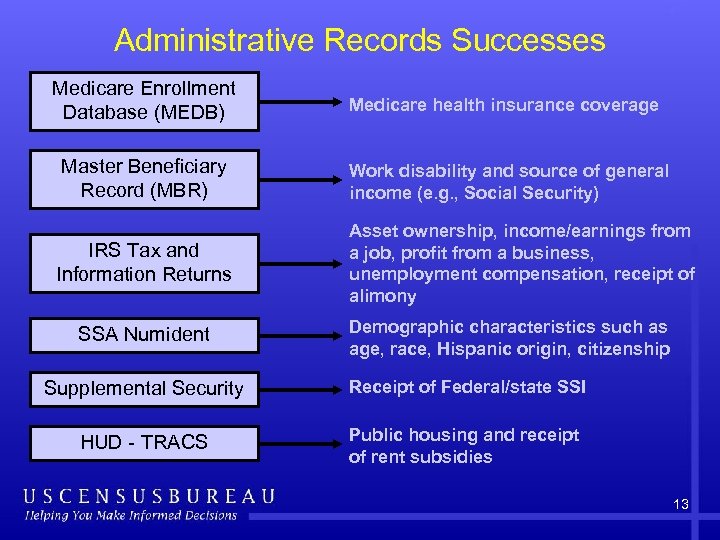 Administrative Records Successes Medicare Enrollment Database (MEDB) Medicare health insurance coverage Master Beneficiary Record (MBR) Work disability and source of general income (e. g. , Social Security) IRS Tax and Information Returns Asset ownership, income/earnings from a job, profit from a business, unemployment compensation, receipt of alimony SSA Numident Demographic characteristics such as age, race, Hispanic origin, citizenship Supplemental Security Receipt of Federal/state SSI HUD - TRACS Public housing and receipt of rent subsidies 13
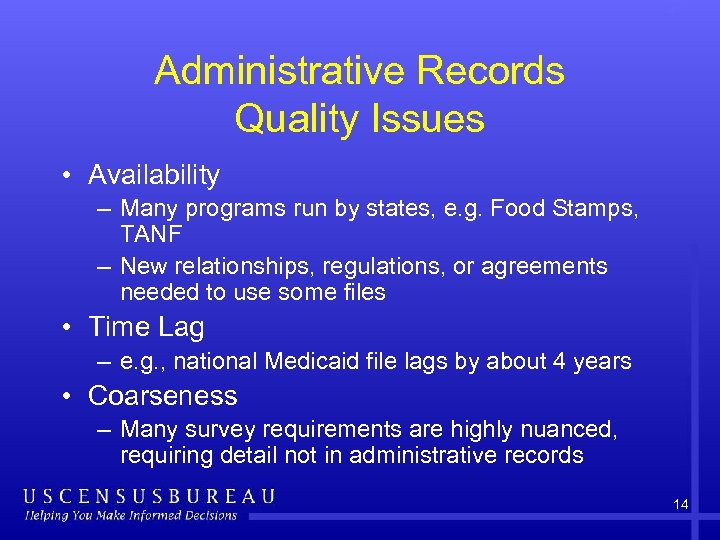 Administrative Records Quality Issues • Availability – Many programs run by states, e. g. Food Stamps, TANF – New relationships, regulations, or agreements needed to use some files • Time Lag – e. g. , national Medicaid file lags by about 4 years • Coarseness – Many survey requirements are highly nuanced, requiring detail not in administrative records 14
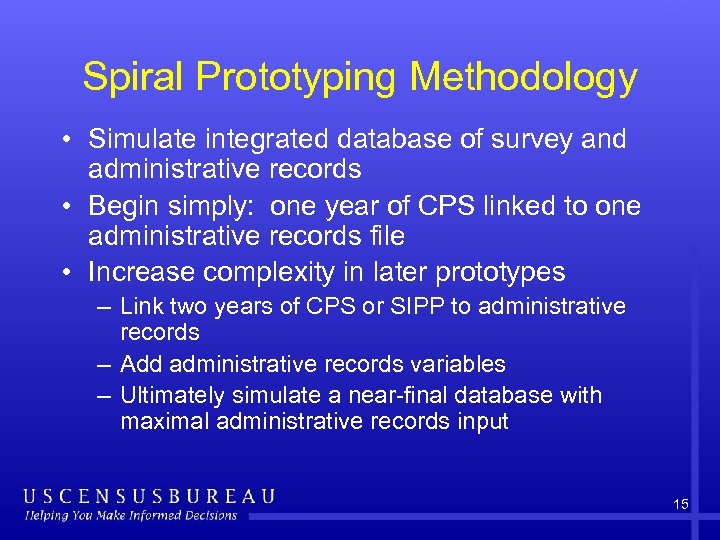 Spiral Prototyping Methodology • Simulate integrated database of survey and administrative records • Begin simply: one year of CPS linked to one administrative records file • Increase complexity in later prototypes – Link two years of CPS or SIPP to administrative records – Add administrative records variables – Ultimately simulate a near-final database with maximal administrative records input 15
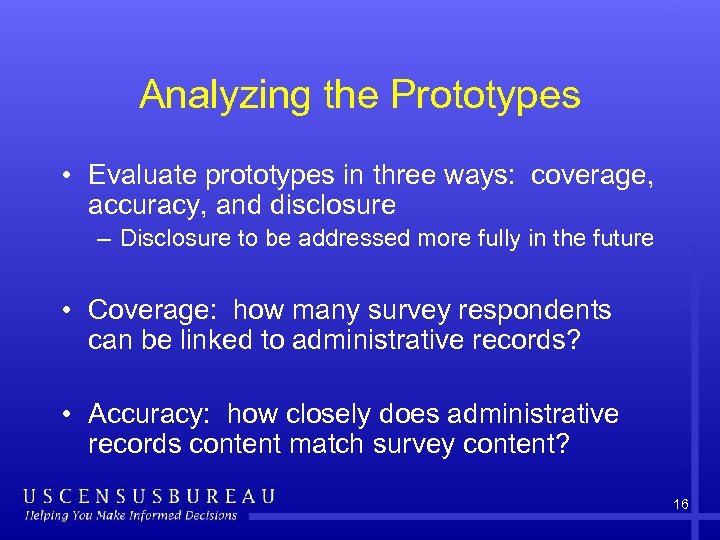 Analyzing the Prototypes • Evaluate prototypes in three ways: coverage, accuracy, and disclosure – Disclosure to be addressed more fully in the future • Coverage: how many survey respondents can be linked to administrative records? • Accuracy: how closely does administrative records content match survey content? 16
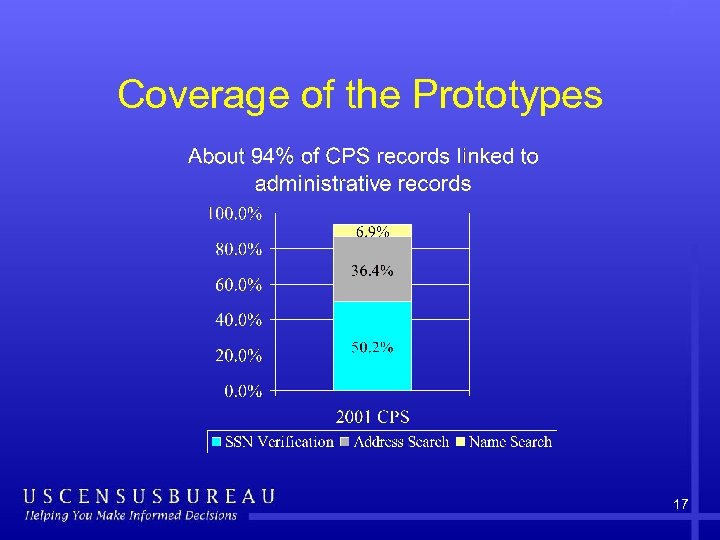 Coverage of the Prototypes 17
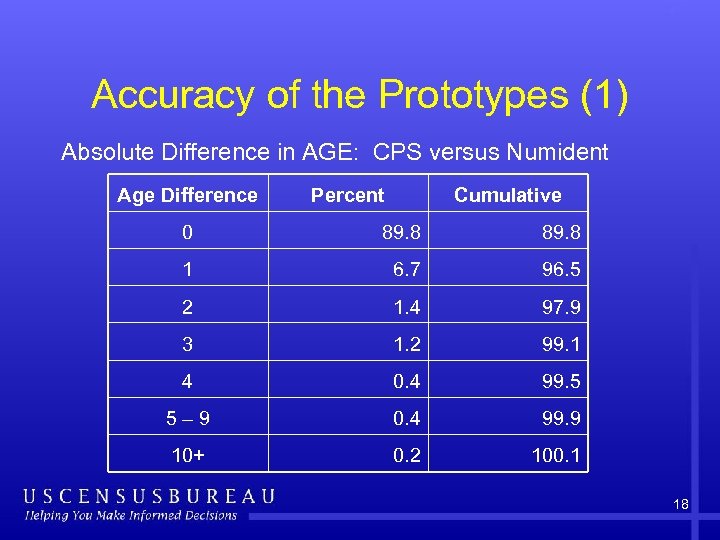 Accuracy of the Prototypes (1) Absolute Difference in AGE: CPS versus Numident Age Difference Percent Cumulative 0 89. 8 1 6. 7 96. 5 2 1. 4 97. 9 3 1. 2 99. 1 4 0. 4 99. 5 5– 9 0. 4 99. 9 10+ 0. 2 100. 1 18
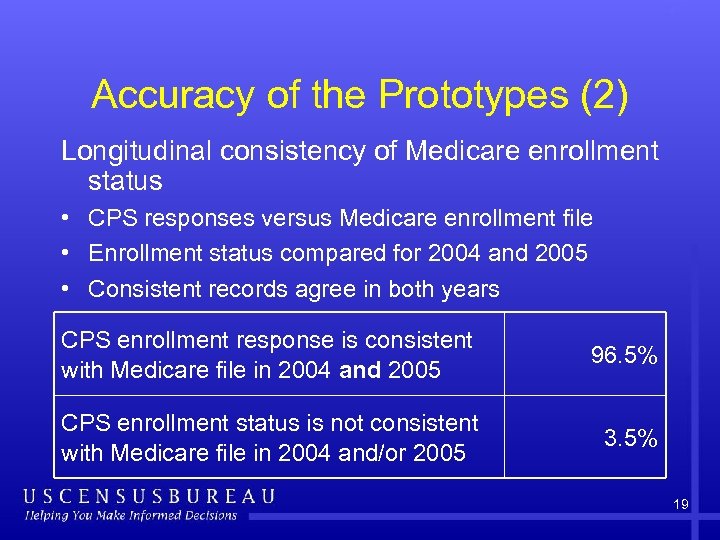 Accuracy of the Prototypes (2) Longitudinal consistency of Medicare enrollment status • CPS responses versus Medicare enrollment file • Enrollment status compared for 2004 and 2005 • Consistent records agree in both years CPS enrollment response is consistent with Medicare file in 2004 and 2005 96. 5% CPS enrollment status is not consistent with Medicare file in 2004 and/or 2005 3. 5% 19
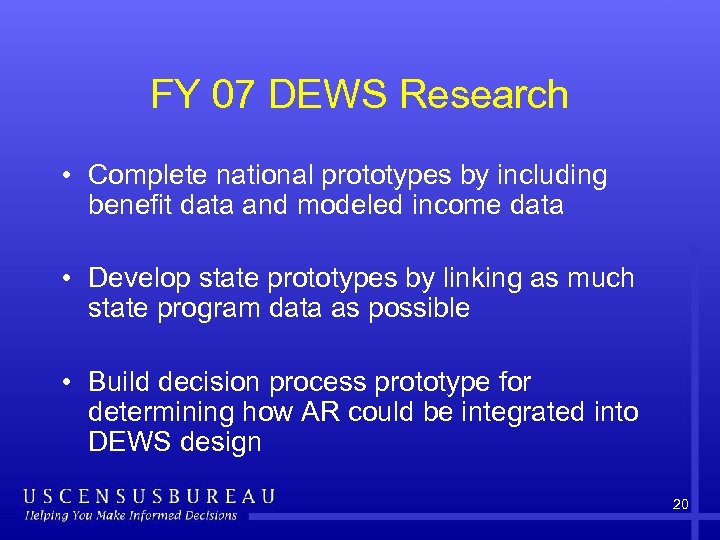 FY 07 DEWS Research • Complete national prototypes by including benefit data and modeled income data • Develop state prototypes by linking as much state program data as possible • Build decision process prototype for determining how AR could be integrated into DEWS design 20
 State Prototype Design (1) • Maryland Illinois state data and selected federal files • Some program data are in-house, e. g. : • Food stamps • State Medicaid • Temporary Cash Assistance • Unemployment Insurance • Public housing assistance • Supplemental Security • Some data need to be acquired, e. g. : • WIC, school meals, job training 21
 State Prototype Design (2) • Link multiple years of SIPP with state administrative records • Create increasingly larger prototypes as data become available • Evaluate state prototypes for coverage, accuracy, and disclosure 22
 Initial Process Prototype • Identify potential uses of administrative records in all phases of DEWS survey operations, e. g. : – Quality assurance – Editing and imputation • Identify survey requirements needed for possible use of administrative records 23
 Conclusions • Administrative records could help to inexpensively replace some SIPP content • Administrative records have quality issues like lag and coverage • Administrative records can not fully replace a field survey • An integrated approach with survey data and administrative records data is one approach to re-engineer the SIPP 24
 Contact Information U. S. DEPARTMENT OF COMMERCE U. S. Census Bureau Washington, DC 20233 James Farber Phone: 301 -763 -1844 James. Farber@Census. gov 25