 Скачать презентацию Redundancy in Dynamic Positioning DP Applications based on
f641fb95d293edead82f8aac177ec9f6.ppt
- Количество слайдов: 30



Redundancy in Dynamic Positioning (DP) Applications based on Satellite Navigation. High Precision Navigation and Positioning Conference, June 10 2008 O. Ørpen, Fugro Seastar www. fugro. com
Overview • Background • Satellite Navigation Corrections methods • Distribution of corrections • Mobile setups • Global Navigation Satellite Systems (GNSS) • Fugro developments • Conclusions www. fugro. com
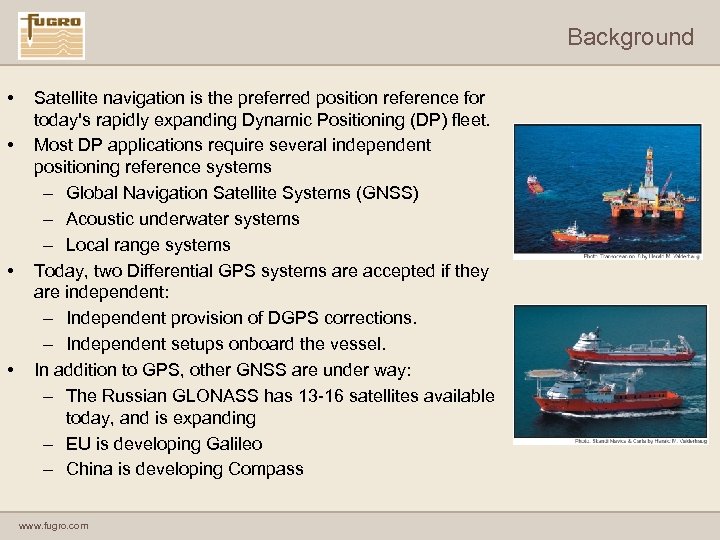
Background • • Satellite navigation is the preferred position reference for today's rapidly expanding Dynamic Positioning (DP) fleet. Most DP applications require several independent positioning reference systems – Global Navigation Satellite Systems (GNSS) – Acoustic underwater systems – Local range systems Today, two Differential GPS systems are accepted if they are independent: – Independent provision of DGPS corrections. – Independent setups onboard the vessel. In addition to GPS, other GNSS are under way: – The Russian GLONASS has 13 -16 satellites available today, and is expanding – EU is developing Galileo – China is developing Compass www. fugro. com
Overview • Background • Satellite Navigation Corrections methods • Distribution of corrections • Mobile setups • Global Navigation Satellite Systems (GNSS) • Conclusions www. fugro. com
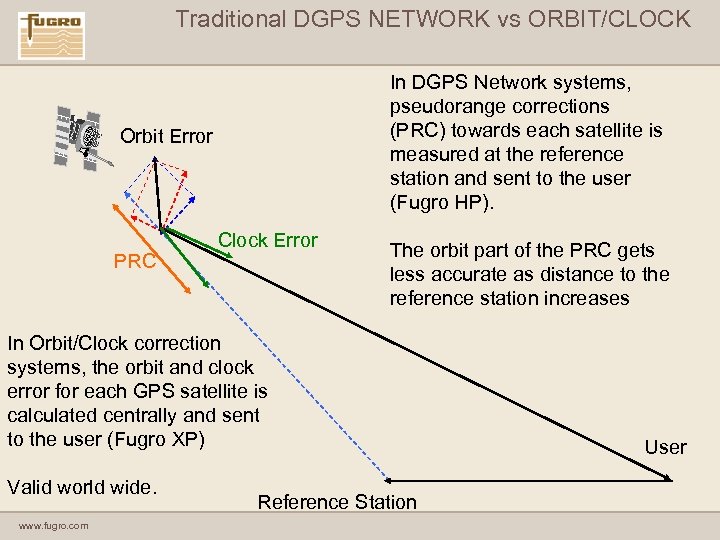
Traditional DGPS NETWORK vs ORBIT/CLOCK In DGPS Network systems, pseudorange corrections (PRC) towards each satellite is measured at the reference station and sent to the user (Fugro HP). Orbit Error PRC Clock Error The orbit part of the PRC gets less accurate as distance to the reference station increases In Orbit/Clock correction systems, the orbit and clock error for each GPS satellite is calculated centrally and sent to the user (Fugro XP) Valid world wide. www. fugro. com Reference Station User
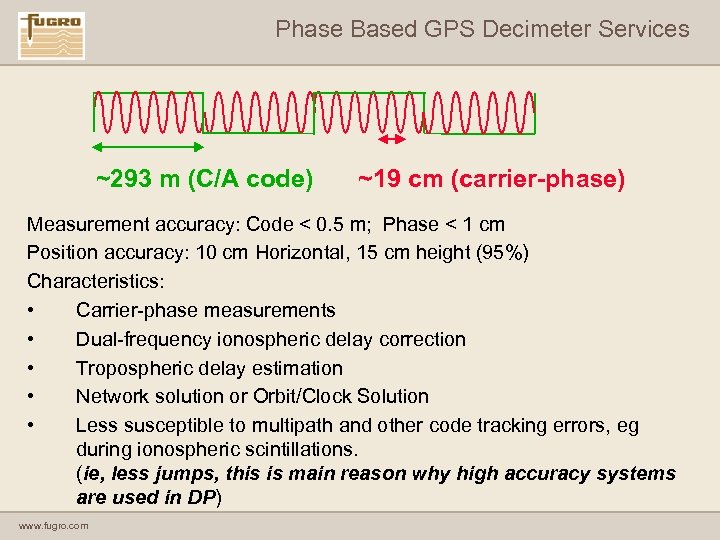
Phase Based GPS Decimeter Services ~293 m (C/A code) ~19 cm (carrier-phase) Measurement accuracy: Code < 0. 5 m; Phase < 1 cm Position accuracy: 10 cm Horizontal, 15 cm height (95%) Characteristics: • Carrier-phase measurements • Dual-frequency ionospheric delay correction • Tropospheric delay estimation • Network solution or Orbit/Clock Solution • Less susceptible to multipath and other code tracking errors, eg during ionospheric scintillations. (ie, less jumps, this is main reason why high accuracy systems are used in DP) www. fugro. com
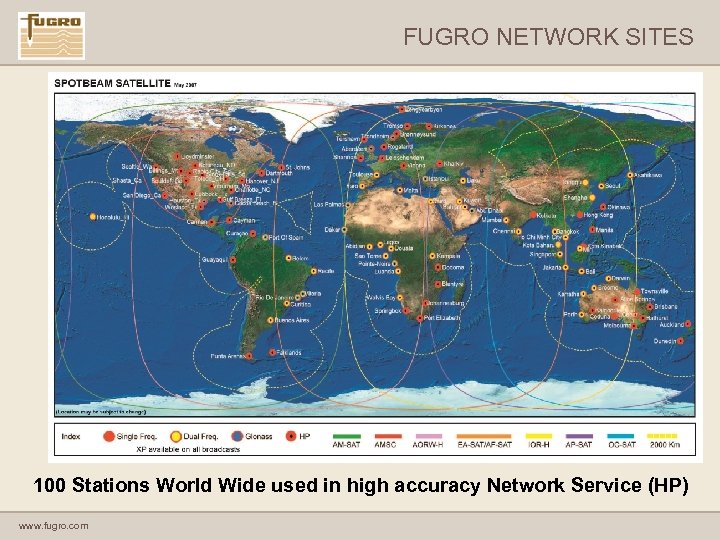
FUGRO NETWORK SITES 100 Stations World Wide used in high accuracy Network Service (HP) www. fugro. com
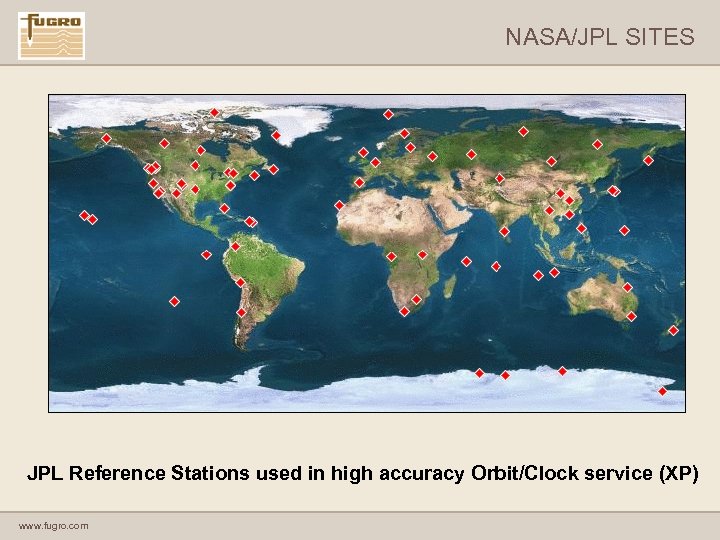
NASA/JPL SITES JPL Reference Stations used in high accuracy Orbit/Clock service (XP) www. fugro. com
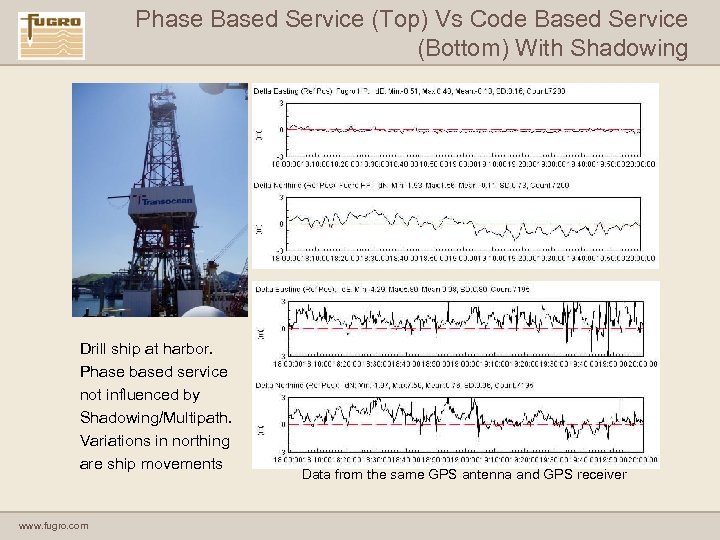
Phase Based Service (Top) Vs Code Based Service (Bottom) With Shadowing Drill ship at harbor. Phase based service not influenced by Shadowing/Multipath. Variations in northing are ship movements www. fugro. com Data from the same GPS antenna and GPS receiver
Overview • Background • Satellite Navigation Corrections methods • Distribution of corrections • Mobile setups • Global Navigation Satellite Systems (GNSS) • Fugro developments • Conclusions www. fugro. com
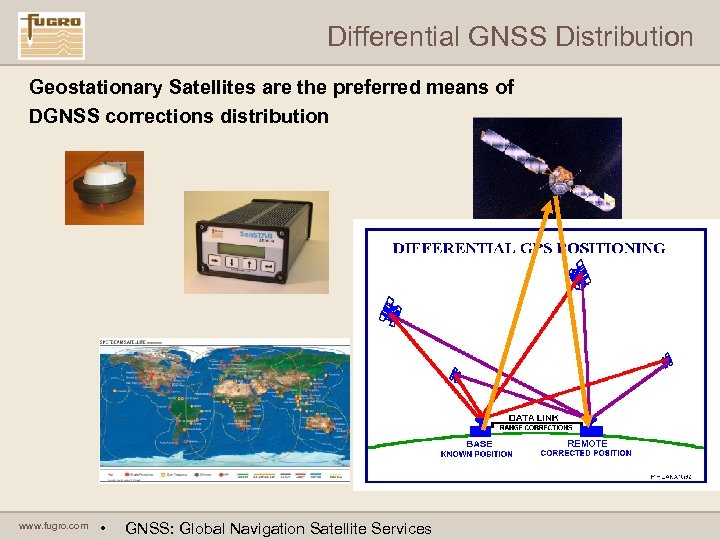
Differential GNSS Distribution Geostationary Satellites are the preferred means of DGNSS corrections distribution www. fugro. com • GNSS: Global Navigation Satellite Services
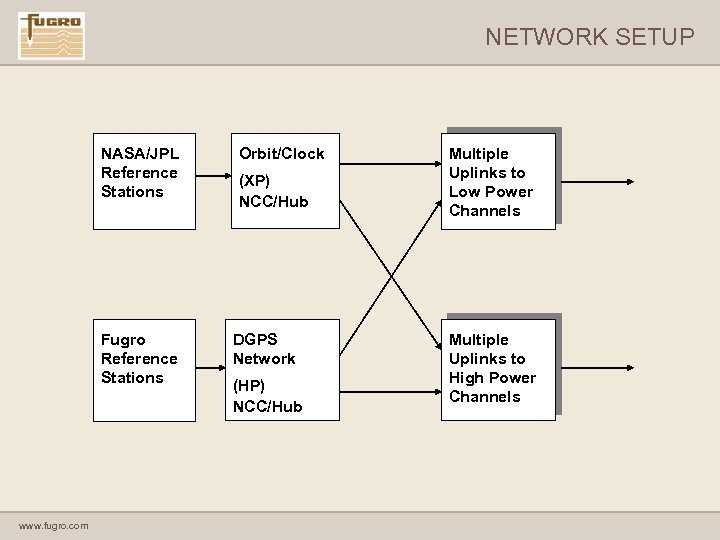
NETWORK SETUP NASA/JPL Reference Stations Fugro Reference Stations www. fugro. com Orbit/Clock (XP) NCC/Hub DGPS Network (HP) NCC/Hub Multiple Uplinks to Low Power Channels Multiple Uplinks to High Power Channels
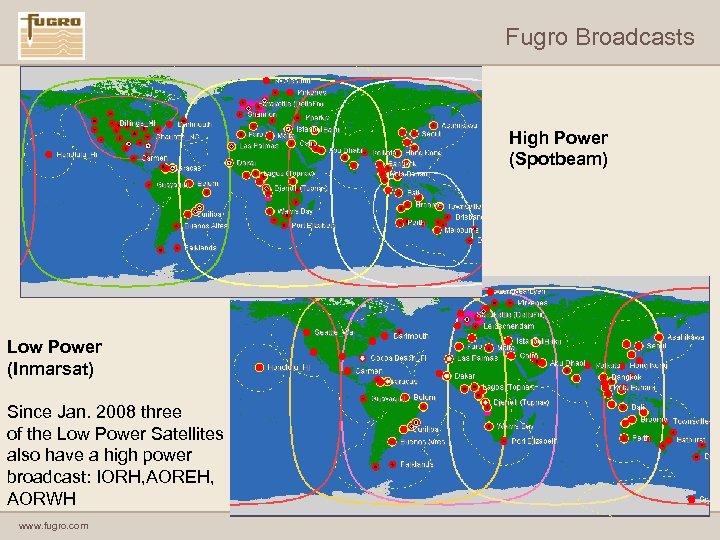
Fugro Broadcasts High Power (Spotbeam) Low Power (Inmarsat) Since Jan. 2008 three of the Low Power Satellites also have a high power broadcast: IORH, AOREH, AORWH www. fugro. com
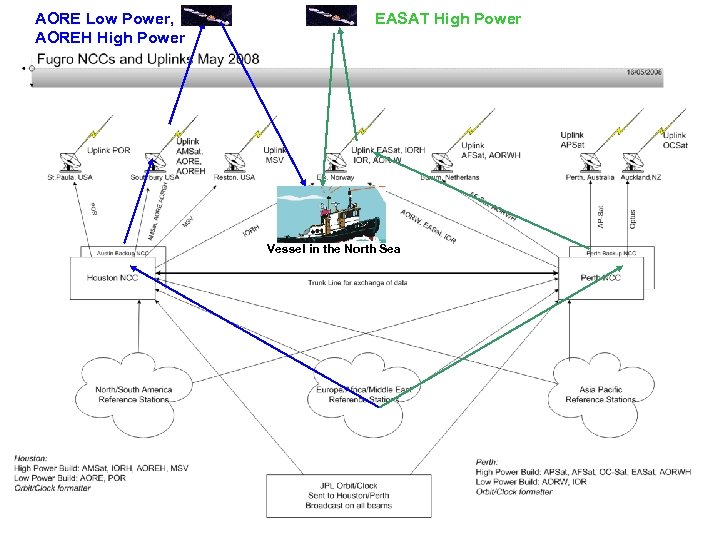
AORE Low Power, AOREH High Power EASAT High Power Vessel in the North Sea www. fugro. com
Overview • Background • Satellite Navigation Corrections methods • Distribution of corrections • Mobile setups • Global Navigation Satellite Systems (GNSS) • Fugro developments • Conclusions www. fugro. com
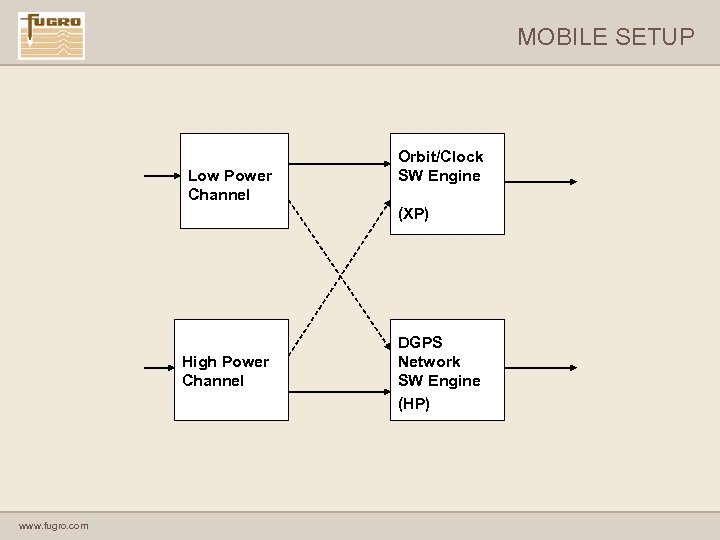
MOBILE SETUP Low Power Channel Orbit/Clock SW Engine (XP) High Power Channel www. fugro. com DGPS Network SW Engine (HP)
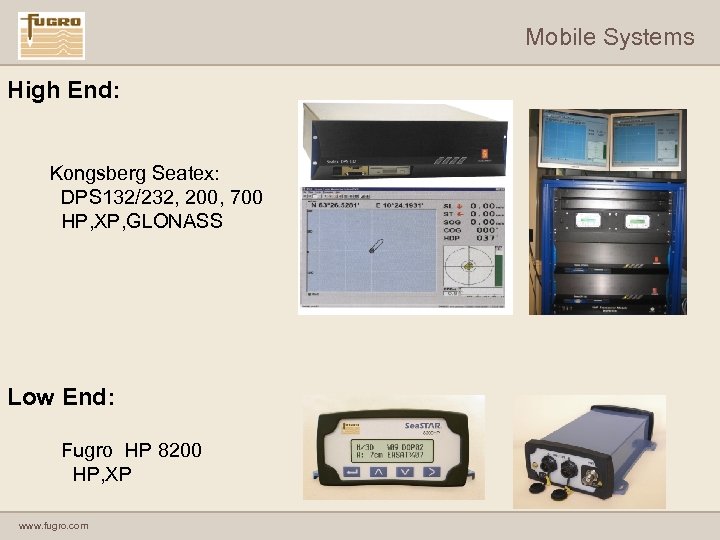
Mobile Systems High End: Kongsberg Seatex: DPS 132/232, 200, 700 HP, XP, GLONASS Low End: Fugro HP 8200 HP, XP www. fugro. com
Overview • Background • Satellite Navigation Corrections methods • Distribution of corrections • Mobile setups • Global Navigation Satellite Systems (GNSS) • Fugro developments • Conclusions www. fugro. com
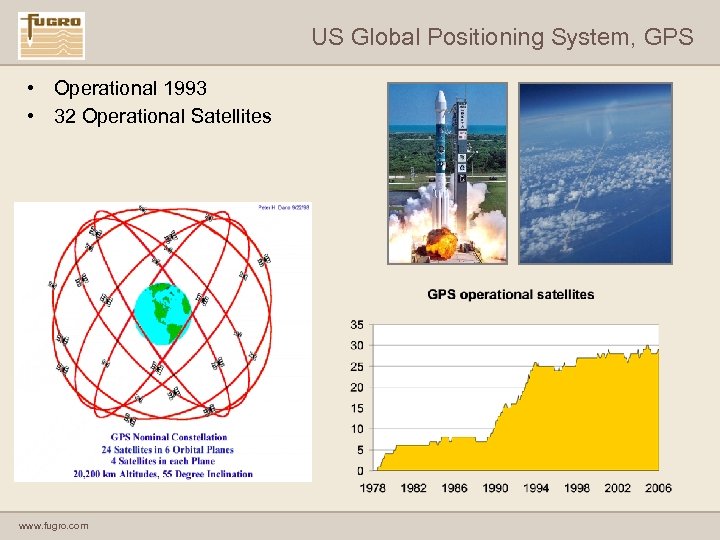
US Global Positioning System, GPS • Operational 1993 • 32 Operational Satellites www. fugro. com
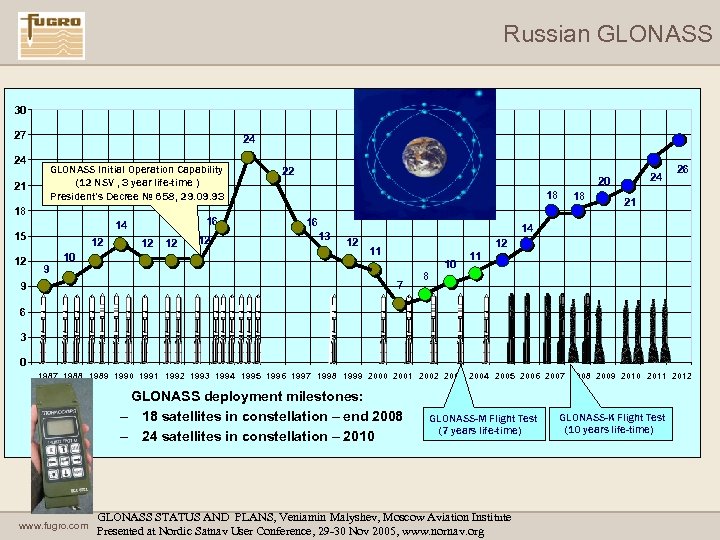
Russian GLONASS 30 27 24 24 GLONASS Initial Operation Capability (12 NSV , 3 year life-time ) President’s Decree № 658, 29. 09. 93 21 18 12 16 14 15 12 10 12 12 12 22 18 16 13 18 26 21 14 12 12 11 10 9 7 9 24 20 11 8 6 3 0 1987 1988 1989 1990 1991 1992 1993 1994 1995 1996 1997 1998 1999 2000 2001 2002 2003 2004 2005 2006 2007 2008 2009 2010 2011 2012 • www. fugro. com GLONASS deployment milestones: – 18 satellites in constellation – end 2008 – 24 satellites in constellation – 2010 GLONASS-M Flight Test (7 years life-time) GLONASS STATUS AND PLANS, Veniamin Malyshev, Moscow Aviation Institute Presented at Nordic Satnav User Conference, 29 -30 Nov 2005, www. nornav. org GLONASS-K Flight Test (10 years life-time)
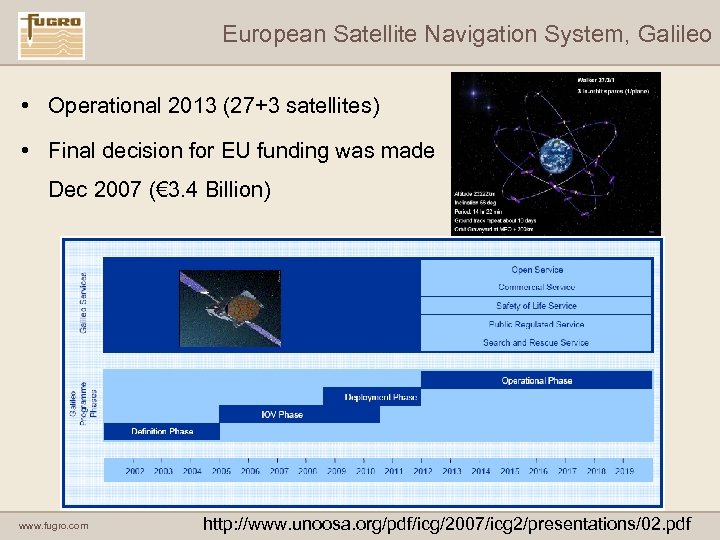
European Satellite Navigation System, Galileo • Operational 2013 (27+3 satellites) • Final decision for EU funding was made Dec 2007 (€ 3. 4 Billion) www. fugro. com http: //www. unoosa. org/pdf/icg/2007/icg 2/presentations/02. pdf
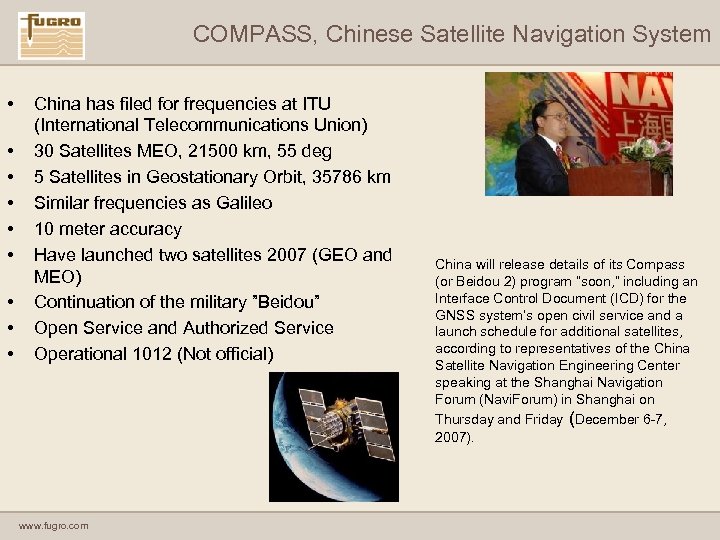
COMPASS, Chinese Satellite Navigation System • • • China has filed for frequencies at ITU (International Telecommunications Union) 30 Satellites MEO, 21500 km, 55 deg 5 Satellites in Geostationary Orbit, 35786 km Similar frequencies as Galileo 10 meter accuracy Have launched two satellites 2007 (GEO and MEO) Continuation of the military ”Beidou” Open Service and Authorized Service Operational 1012 (Not official) www. fugro. com China will release details of its Compass (or Beidou 2) program “soon, ” including an Interface Control Document (ICD) for the GNSS system’s open civil service and a launch schedule for additional satellites, according to representatives of the China Satellite Navigation Engineering Center speaking at the Shanghai Navigation Forum (Navi. Forum) in Shanghai on Thursday and Friday (December 6 -7, 2007).
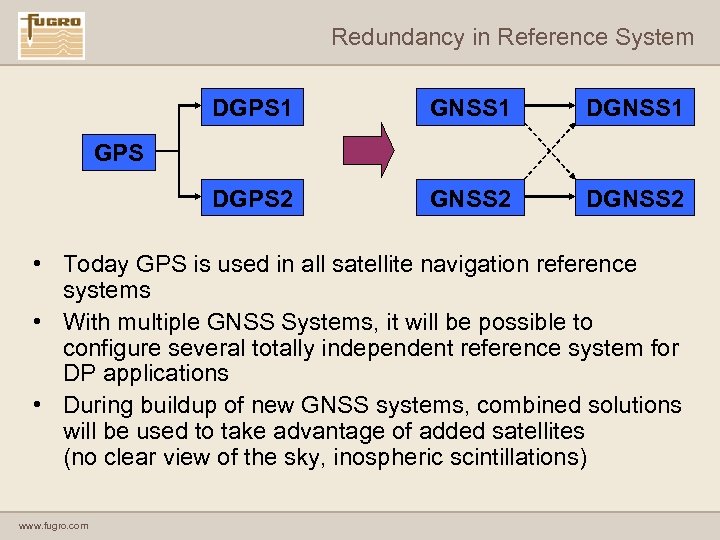
Redundancy in Reference System DGPS 1 GNSS 1 DGPS 2 GNSS 2 DGNSS 2 GPS • Today GPS is used in all satellite navigation reference systems • With multiple GNSS Systems, it will be possible to configure several totally independent reference system for DP applications • During buildup of new GNSS systems, combined solutions will be used to take advantage of added satellites (no clear view of the sky, inospheric scintillations) www. fugro. com
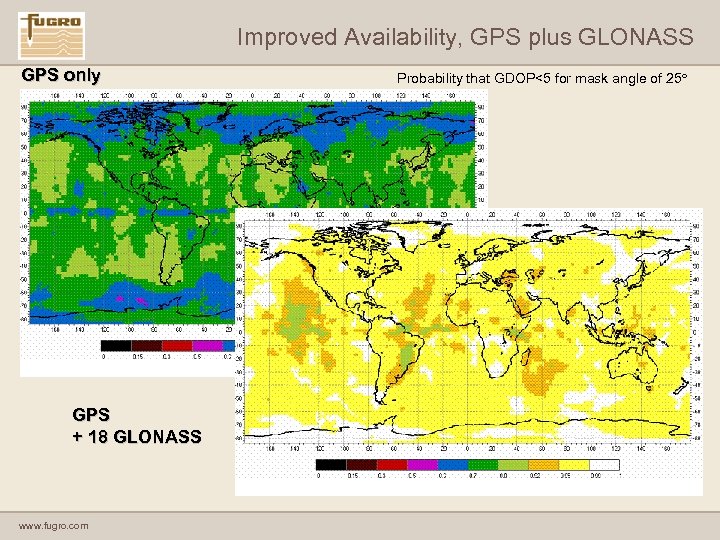
Improved Availability, GPS plus GLONASS GPS only GPS + 18 GLONASS www. fugro. com Probability that GDOP<5 for mask angle of 25
Overview • Background • Satellite Navigation Corrections methods • Distribution of corrections • Mobile setups • Global Navigation Satellite Systems (GNSS) • Fugro developments • Conclusions www. fugro. com
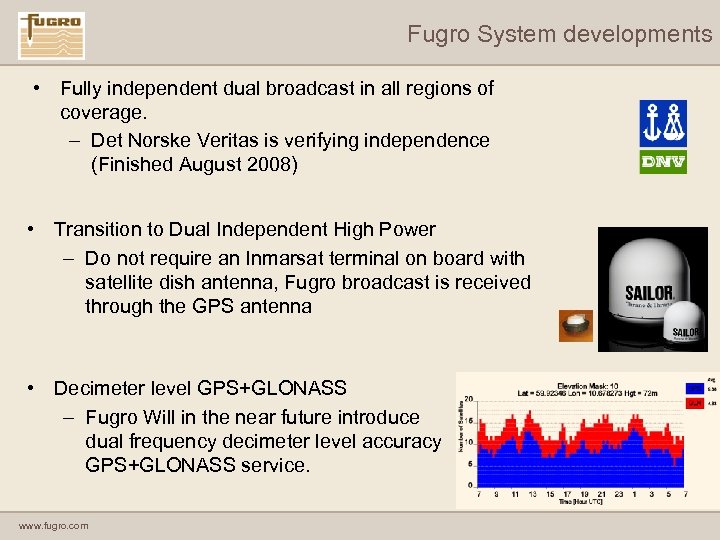
Fugro System developments • Fully independent dual broadcast in all regions of coverage. – Det Norske Veritas is verifying independence (Finished August 2008) • Transition to Dual Independent High Power – Do not require an Inmarsat terminal on board with satellite dish antenna, Fugro broadcast is received through the GPS antenna • Decimeter level GPS+GLONASS – Fugro Will in the near future introduce dual frequency decimeter level accuracy GPS+GLONASS service. www. fugro. com
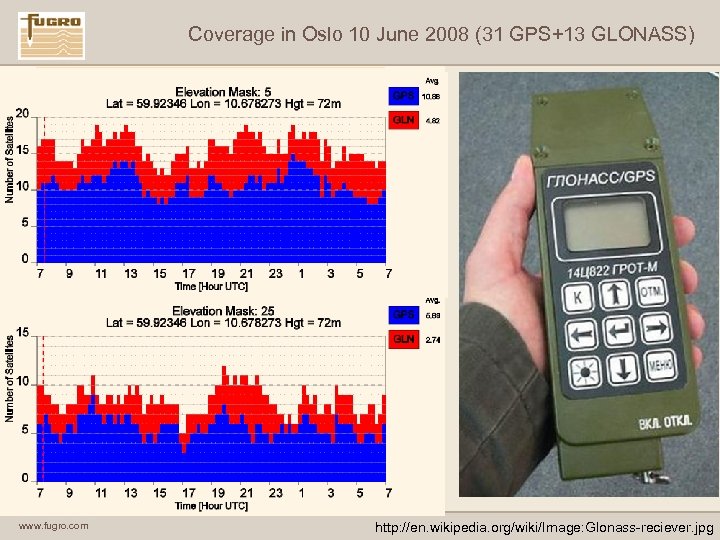
Coverage in Oslo 10 June 2008 (31 GPS+13 GLONASS) www. fugro. com http: //en. wikipedia. org/wiki/Image: Glonass-reciever. jpg
Overview • Background • Satellite Navigation Corrections methods • Distribution of corrections • Mobile setups • Global Navigation Satellite Systems (GNSS) • Fugro developments • Conclusions www. fugro. com
Conclusions • Satellite Navigation is the preferred position reference for DP • Different correction generation methods (Network – Orbit/Clock) provides independent services and dual broadcasts assures independent delivery • Additional Satellite Navigation Services Systems are under way: – Today about 45 satellites are available (32 GPS and 16 GLONASS) – In about 5 years 100+ satellites will be available, in four independent GNSS • Fugro System Characteristics – Independence Assessment by DNV – Dual High Power Beams in all regions – GPS+GLONASS decimeter level service to be launched www. fugro. com
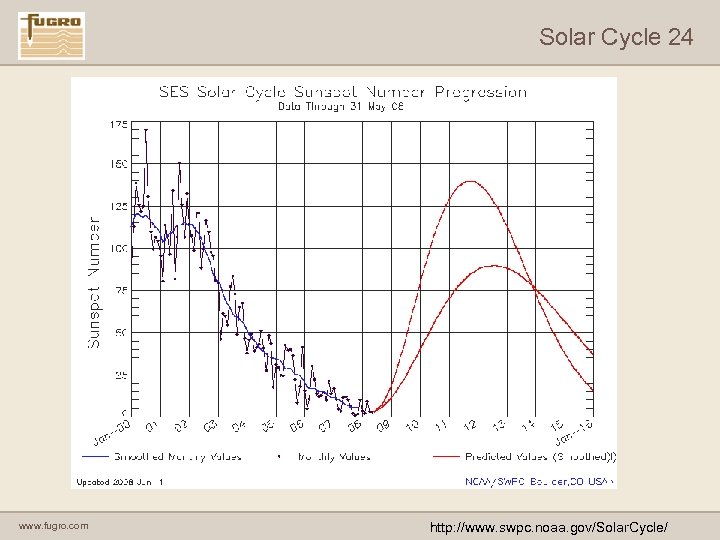
Solar Cycle 24 www. fugro. com http: //www. swpc. noaa. gov/Solar. Cycle/
Скачать презентацию Redundancy in Dynamic Positioning DP Applications based on
f641fb95d293edead82f8aac177ec9f6.ppt