


 Скачать презентацию Reduction of Remedial Cementation of Production Liners through
8f1a23998604a1512a21076f66754b75.ppt
- Количество слайдов: 15
 Reduction of Remedial Cementation of Production Liners… …through the use of Equipment, Procedures & People Nicole Baird: EPW-GOM TLP, Jackup & Platform Wells Team Lead Loran Galey: SIEP-EPT Well Performance Team – Cementing (company logo) Expert
 Objectives • Case for Action – NPT Related Trouble Time / Cost • GOM Production Cementing Staircase – Equipment, Process, People • 2007 – 2008 Results • GOM Learnings • Go-Forward Plans& Next Steps for 2008 – 2009+ • Conclusions
 Case for Action • 2004 -2005 GOM operations experienced 26 NPT events – Total Days associated with Prod Csg Cmt NPT = 25. 2 days – Total Cost (2008$$) associated with Prod Csg Cmt NPT = $4. 4 MM • Objective sands becoming depleted, 5000+ psi (34, 475 k. Pa) – Reduced Margins for cementing ECDs • Max PP – Min FG margins of 0. 6 ppg or less common (72 kg/m 3) – Compaction-induced wellbore failures • TLP weight / space constraints prohibit use of specialty equipment • Slimhole sidetracks, tighter clearances between csg strings more common
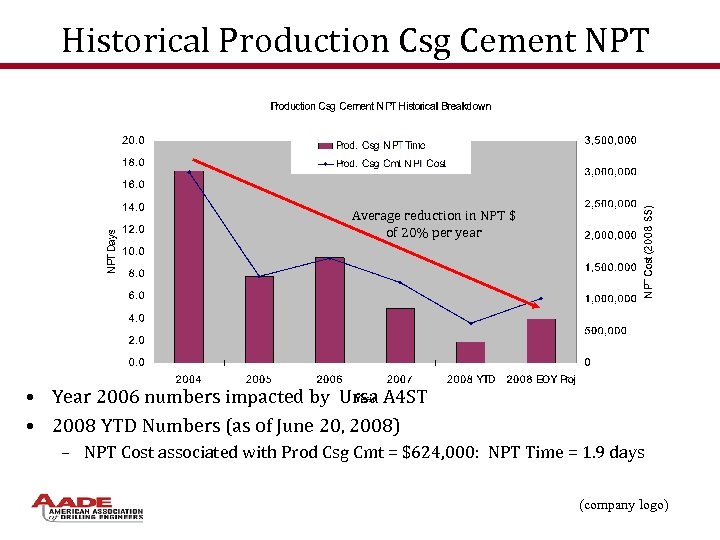 Historical Production Csg Cement NPT Average reduction in NPT $ of 20% per year • Year 2006 numbers impacted by Ursa A 4 ST • 2008 YTD Numbers (as of June 20, 2008) – NPT Cost associated with Prod Csg Cmt = $624, 000: NPT Time = 1. 9 days (company logo)
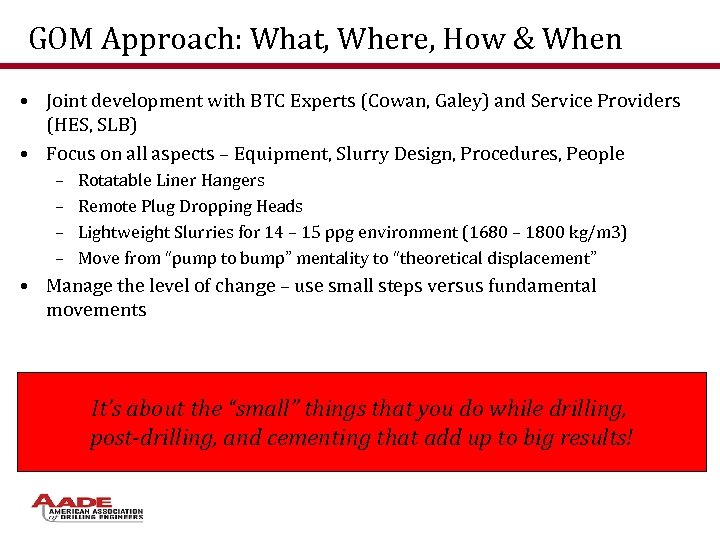 GOM Approach: What, Where, How & When • Joint development with BTC Experts (Cowan, Galey) and Service Providers (HES, SLB) • Focus on all aspects – Equipment, Slurry Design, Procedures, People – – Rotatable Liner Hangers Remote Plug Dropping Heads Lightweight Slurries for 14 – 15 ppg environment (1680 – 1800 kg/m 3) Move from “pump to bump” mentality to “theoretical displacement” • Manage the level of change – use small steps versus fundamental movements It’s about the “small” things that you do while drilling, post-drilling, and cementing that add up to big results!
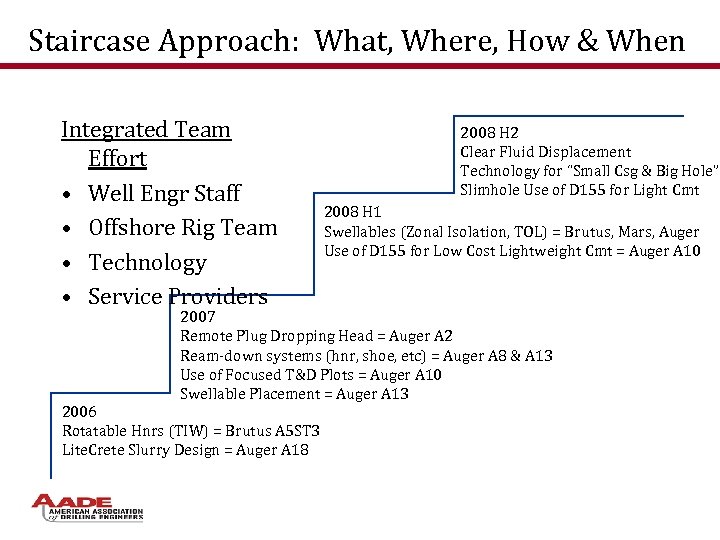 Staircase Approach: What, Where, How & When Integrated Team Effort • Well Engr Staff • Offshore Rig Team • Technology • Service Providers 2008 H 2 Clear Fluid Displacement Technology for “Small Csg & Big Hole” Slimhole Use of D 155 for Light Cmt 2008 H 1 Swellables (Zonal Isolation, TOL) = Brutus, Mars, Auger Use of D 155 for Low Cost Lightweight Cmt = Auger A 10 2007 Remote Plug Dropping Head = Auger A 2 Ream-down systems (hnr, shoe, etc) = Auger A 8 & A 13 Use of Focused T&D Plots = Auger A 10 Swellable Placement = Auger A 13 2006 Rotatable Hnrs (TIW) = Brutus A 5 ST 3 Lite. Crete Slurry Design = Auger A 18
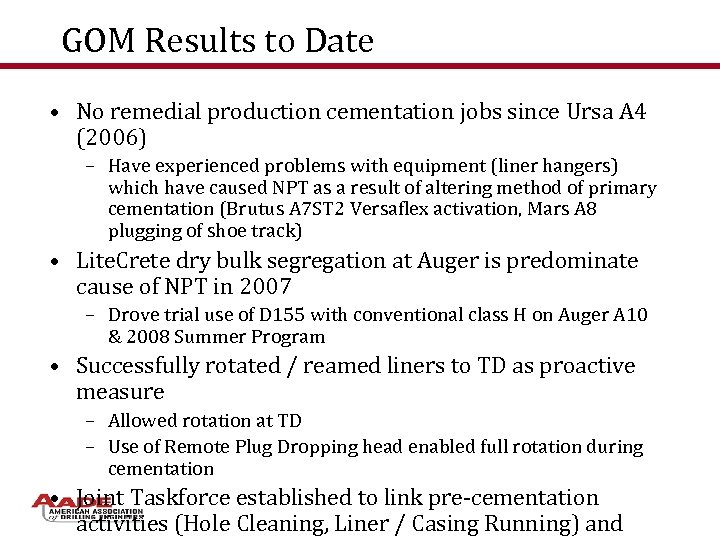 GOM Results to Date • No remedial production cementation jobs since Ursa A 4 (2006) – Have experienced problems with equipment (liner hangers) which have caused NPT as a result of altering method of primary cementation (Brutus A 7 ST 2 Versaflex activation, Mars A 8 plugging of shoe track) • Lite. Crete dry bulk segregation at Auger is predominate cause of NPT in 2007 – Drove trial use of D 155 with conventional class H on Auger A 10 & 2008 Summer Program • Successfully rotated / reamed liners to TD as proactive measure – Allowed rotation at TD – Use of Remote Plug Dropping head enabled full rotation during cementation • Joint Taskforce established to link pre-cementation activities (Hole Cleaning, Liner / Casing Running) and
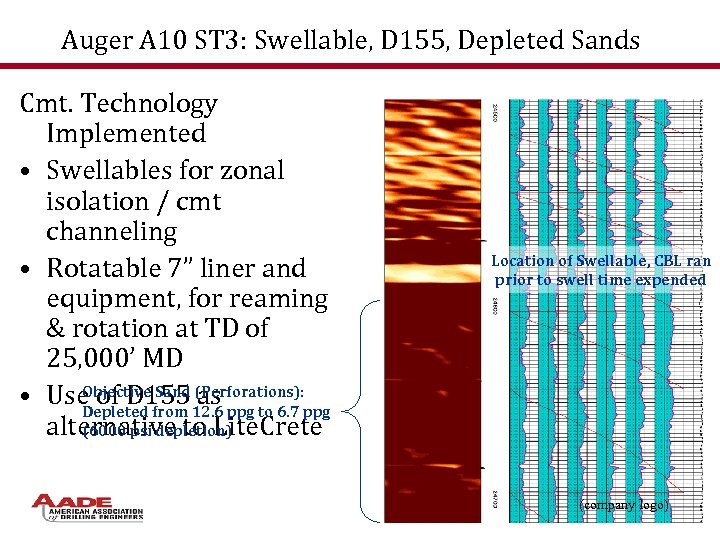 Auger A 10 ST 3: Swellable, D 155, Depleted Sands Cmt. Technology Implemented • Swellables for zonal isolation / cmt channeling • Rotatable 7” liner and equipment, for reaming & rotation at TD of 25, 000’ MD Objective Sand (Perforations): • Use of D 155 12. 6 ppg to 6. 7 ppg as Depleted from alternative to Lite. Crete (6000 psi depletion) Location of Swellable, CBL ran prior to swell time expended (company logo)
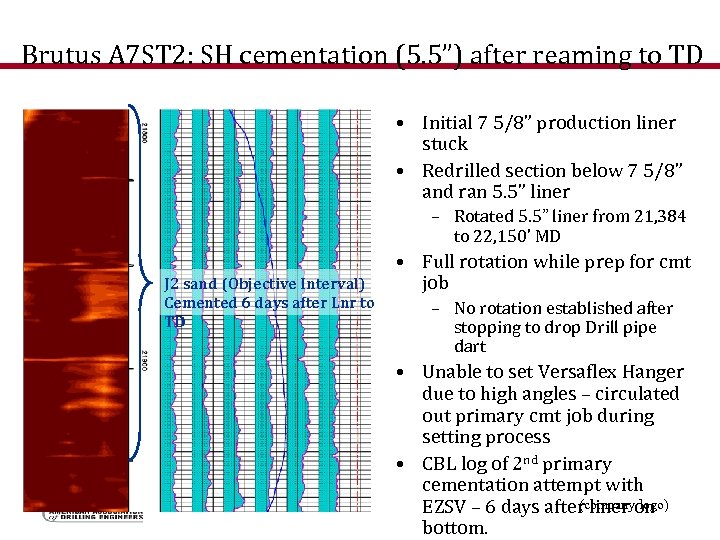 Brutus A 7 ST 2: SH cementation (5. 5”) after reaming to TD • Initial 7 5/8” production liner stuck • Redrilled section below 7 5/8” and ran 5. 5” liner – Rotated 5. 5” liner from 21, 384 to 22, 150’ MD J 2 sand (Objective Interval) Cemented 6 days after Lnr to TD • Full rotation while prep for cmt job – No rotation established after stopping to drop Drill pipe dart • Unable to set Versaflex Hanger due to high angles – circulated out primary cmt job during setting process • CBL log of 2 nd primary cementation attempt with (company logo) EZSV – 6 days after liner on bottom.
 Learnings & Continuous Improvement (1) • Utilization of Lite. Crete requires careful consideration – Issues of Dry Bulk segregation – Sensitive to mix water volumes & proper slurry recirculation for target density • D 155 as alternate to Lite. Crete – Advantages: • One dry-blend cement (Class H) for entire job • All liquid additives. Unused additives can be returned • Flexibility to make lastminute slurry density changes • Easier to sample and test • 50% cost reduction compared to Lite. CRETE – Disadvantages: • Rig space could limit job size. Deck space is needed for liquid tanks. • Liquid additive hoses present additional tripping hazards • More liquid additive volume onboard, therefore more risk of chemical spill (although D 155 is nonhazardous)
 Learnings & Continuous Improvement (2) • Use of swellables in oversized hole applications – Low side channeling prevention – Added “flow barrier” for multiple intervals (spaceout becomes critical) – Multiple companies distributing product – engineer the design upfront • Don’t overestimate the power of paradigms – “Pump until you bump” – “We’ll establish rotation once we get to TD” – “What’s 0. 1 ppg difference in ECD? ” • Shift the design one element at a time – Know what you are changing and why ensure buy-in – Test more than just cement – mud interfaces
 Next Steps: Where do we go from here? • Synthetic Based Mud Contamination – New DP Dart & Casing Liner wiper plug designs – Use of Higher Density Slurries (increased contamination resistance) • Depleted Sands in GOM – Use of Managed Pressure Drilling equipment for cementation operations – Use of graphitic carbons (G-seal, vin-seal, etc) to serve as LCM plugging in cementation slurry designs • Hole Cleaning Prior to Cementing / As Part of Cementing – Use of “foamed flushes” ahead of cement slurries – Use of “foamed spaces” as part of clean up cycle • 3 -Dimensional Modeling for Cement Displacement Efficiency • Standard Use of KCl Additive for Prevention of Shale / Clay Swelling
 Conclusions • One of the most common practices, yet it can cause significant problems later in the life of the wells – Sustained Casing Pressure – Micro-annulus • New practices, procedures & combinations can reap great benefits and not necessarily new technology – Remote Plug Dropping Heads – Class H slurries + different additive combinations – Rotation & centralization for displacement efficiency Performance Improvement is all about doing everything you can right the first time, whereby small changes add up to big results
 Acknowledgements SIEP-EPT Well Performance Team, Fluids & Cementation – Mike Cowan – Loran Galey – Ron Rock EPW Wells-GOM TLP, Jackup, Platform Drilling Engrs EPW Wells-GOM TLP, Jackup, Platform Completion Engrs Service Providers: Halliburton (Cementing, Easy. Well), Schlumberger (Cementing), TIW (Liner Hangers), Baker (Liner Hangers), MI (Fluids)
 (company logo)