


 Скачать презентацию Reduction in insulin response in a patient with
df2bbf53c5824397a9c9e10315827d5e.ppt
- Количество слайдов: 1
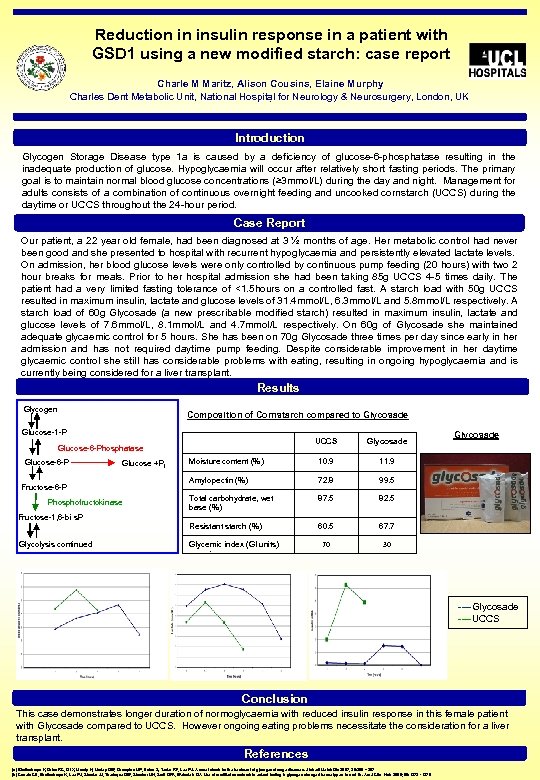 Reduction in insulin response in a patient with GSD 1 using a new modified starch: case report Charle M Maritz, Alison Cousins, Elaine Murphy Charles Dent Metabolic Unit, National Hospital for Neurology & Neurosurgery, London, UK. Introduction Glycogen Storage Disease type 1 a is caused by a deficiency of glucose-6 -phosphatase resulting in the inadequate production of glucose. Hypoglycaemia will occur after relatively short fasting periods. The primary goal is to maintain normal blood glucose concentrations (≥ 3 mmol/L) during the day and night. Management for adults consists of a combination of continuous overnight feeding and uncooked cornstarch (UCCS) during the daytime or UCCS throughout the 24 -hour period. Case Report Our patient, a 22 year old female, had been diagnosed at 3 ½ months of age. Her metabolic control had never been good and she presented to hospital with recurrent hypoglycaemia and persistently elevated lactate levels. On admission, her blood glucose levels were only controlled by continuous pump feeding (20 hours) with two 2 hour breaks for meals. Prior to her hospital admission she had been taking 85 g UCCS 4 -5 times daily. The patient had a very limited fasting tolerance of <1. 5 hours on a controlled fast. A starch load with 50 g UCCS resulted in maximum insulin, lactate and glucose levels of 31. 4 mmol/L, 6. 3 mmol/L and 5. 8 mmol/L respectively. A starch load of 60 g Glycosade (a new prescribable modified starch) resulted in maximum insulin, lactate and glucose levels of 7. 6 mmol/L, 8. 1 mmol/L and 4. 7 mmol/L respectively. On 60 g of Glycosade she maintained adequate glycaemic control for 5 hours. She has been on 70 g Glycosade three times per day since early in her admission and has not required daytime pump feeding. Despite considerable improvement in her daytime glycaemic control she still has considerable problems with eating, resulting in ongoing hypoglycaemia and is currently being considered for a liver transplant. Results Glycogen Composition of Cornstarch compared to Glycosade Glucose-1 -P UCCS Glycosade Moisture content (%) 10. 9 Amylopectin (%) 72. 8 99. 5 Total carbohydrate, wet base (%) 87. 5 82. 5 Resistant starch (%) Glucose-6 -P Glucose +Pi Fructose-6 -P Phosphofructokinase 60. 5 67. 7 70 Glycosade 11. 9 30 Glucose-6 -Phosphatase Fructose-1, 6 -bi s. P Glycolysis continued Glycemic index (GI units) ----Glycosade ----UCCS Conclusion This case demonstrates longer duration of normoglycaemia with reduced insulin response in this female patient with Glycosade compared to UCCS. However ongoing eating problems necessitate the consideration for a liver transplant. References [a] Bhattacharya K, Orton RC, Qi X, Mundy H, Morley DW, Champion MP, Eaton S, Tester RF, Lee PJ. A novel starch for the treatment of glycogen storage diseases. J Inherit Metab Dis 2007, 30: 350 – 357 [b] Correia CE, Bhattacharya K, Lee PJ, Shuster JJ, Theriaque DW, Shankar MN, Smit GPA, Weinstein DA. Use of modified cornstarch to extend fasting in glycogen storage disease types 1 a and 1 b. Am J Clin Nutr 2008; 88: 1272 - 1276