


 Скачать презентацию Reducing the Cost of IT Operations Is
2904cea5459fabcb738258a4b21fda27.ppt
- Количество слайдов: 14
 Reducing the Cost of IT Operations – Is automation always the answer Aaron Brown and Joseph Hellerstein
 Salvation Through Automation ► Businesses want to drive down the cost of IT administration § 50% - 80% of IT budgets devoted to operational costs § People are expensive, so it would be better if they could be disposed of § If a college drop-out can get an MCSE in a week, then surely an automatic administration system should be possible
 Irony of Automation ► Cost automation is often more expensive than manual operation § Automation full of hidden costs ►Adapting systems to automation ►Up front costs ►Automatic-System administration cost ►More complex failure scenarios § We need a way to determine when automation is cost effective
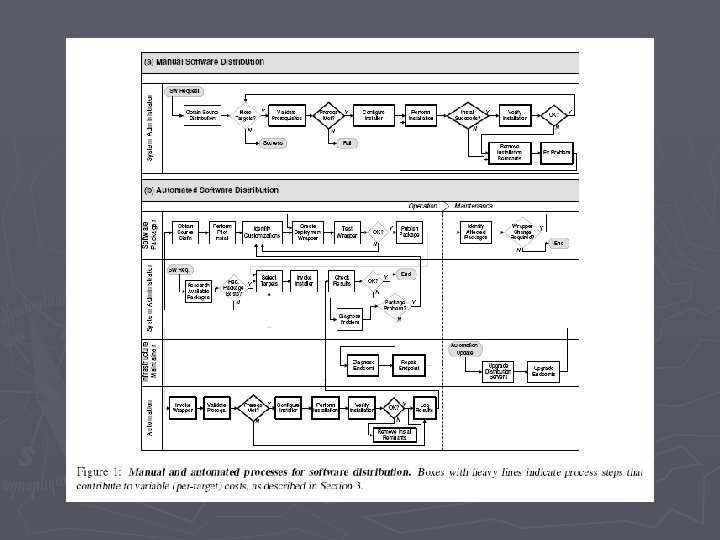
 Example Case ► Software distribution § Common to all IT operations § Most significant activity performed by IT ► Operations can be distilled to into a process or processes § Described by a swim-lane chart
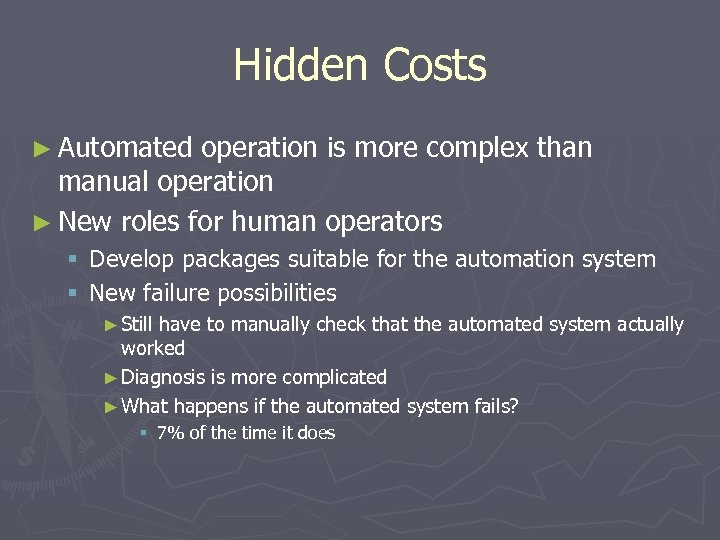 Hidden Costs ► Automated operation is more complex than manual operation ► New roles for human operators § Develop packages suitable for the automation system § New failure possibilities ► Still have to manually check that the automated system actually worked ► Diagnosis is more complicated ► What happens if the automated system fails? § 7% of the time it does
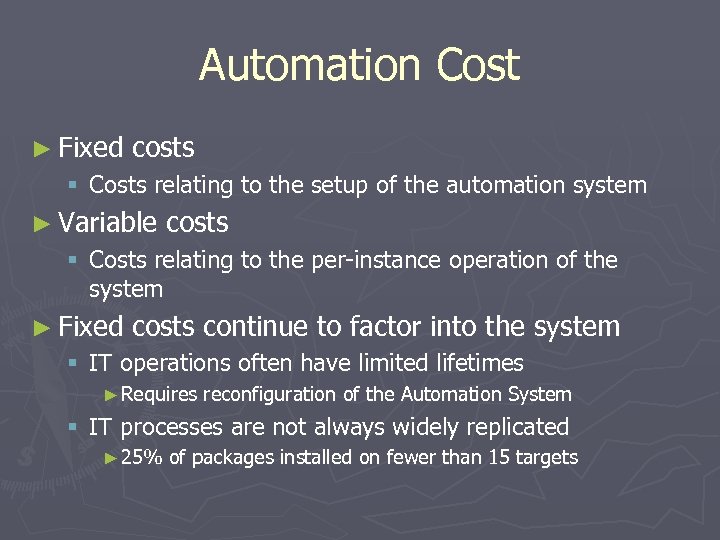 Automation Cost ► Fixed costs § Costs relating to the setup of the automation system ► Variable costs § Costs relating to the per-instance operation of the system ► Fixed costs continue to factor into the system § IT operations often have limited lifetimes ► Requires reconfiguration of the Automation System § IT processes are not always widely replicated ► 25% of packages installed on fewer than 15 targets
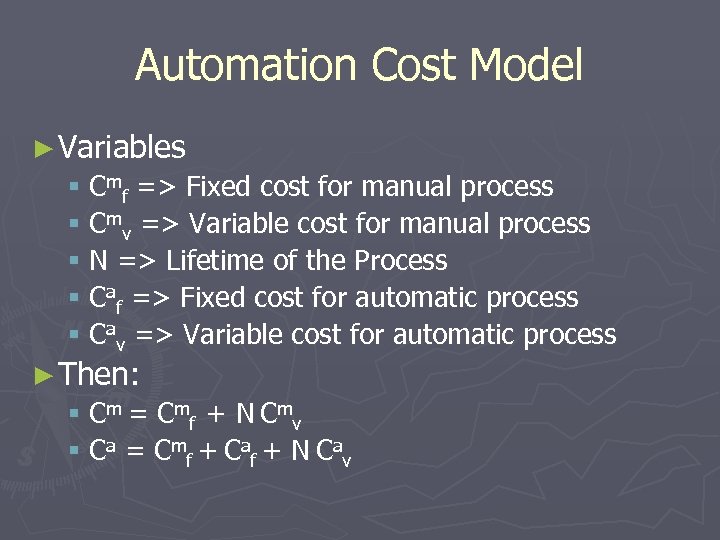 Automation Cost Model ► Variables § Cmf => Fixed cost for manual process § Cmv => Variable cost for manual process § N => Lifetime of the Process § Caf => Fixed cost for automatic process § Cav => Variable cost for automatic process ► Then: § Cm = Cmf + N Cmv § Ca = Cmf + Caf + N Cav
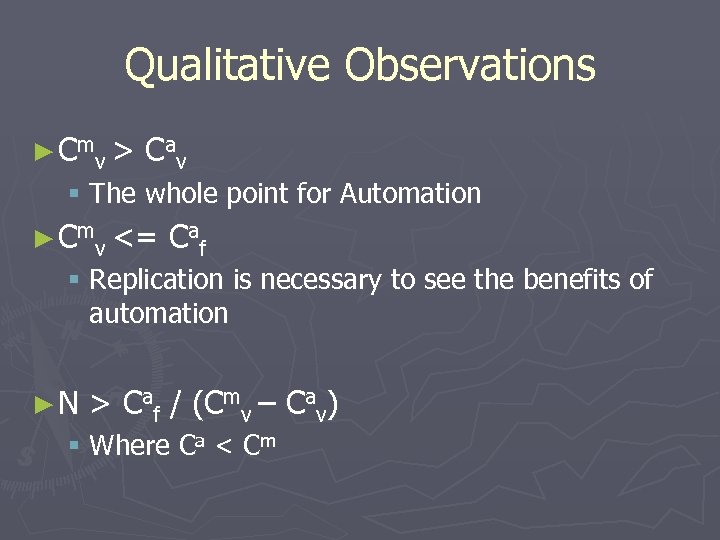 Qualitative Observations ► Cmv > Cav § The whole point for Automation ► Cmv <= Caf § Replication is necessary to see the benefits of automation ►N > C a f / ( C m v – C a v) § Where Ca < Cm
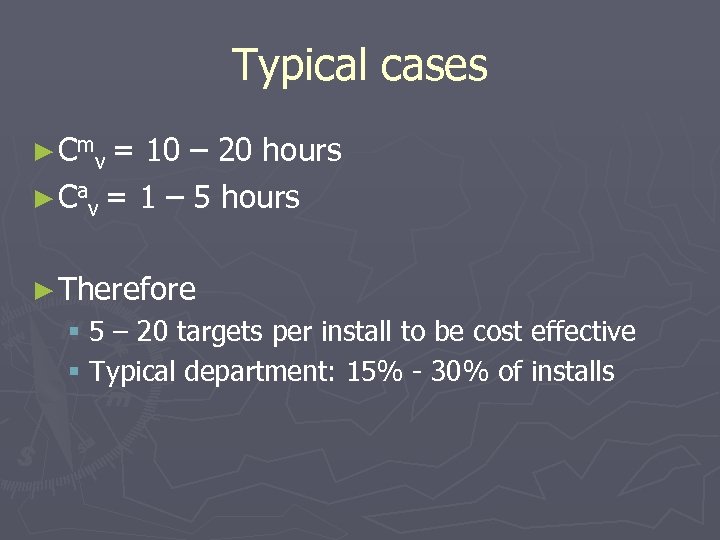 Typical cases ► Cmv = 10 – 20 hours ► Cav = 1 – 5 hours ► Therefore § 5 – 20 targets per install to be cost effective § Typical department: 15% - 30% of installs
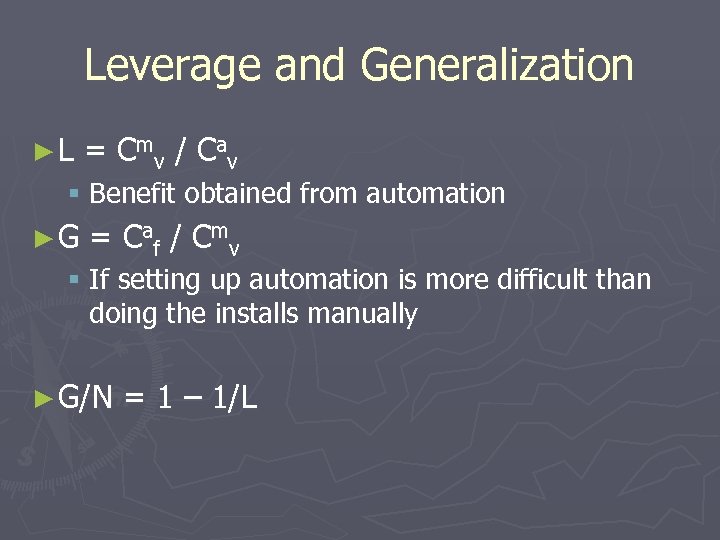 Leverage and Generalization ►L = Cmv / Cav § Benefit obtained from automation ►G = Caf / Cmv § If setting up automation is more difficult than doing the installs manually ► G/N = 1 – 1/L
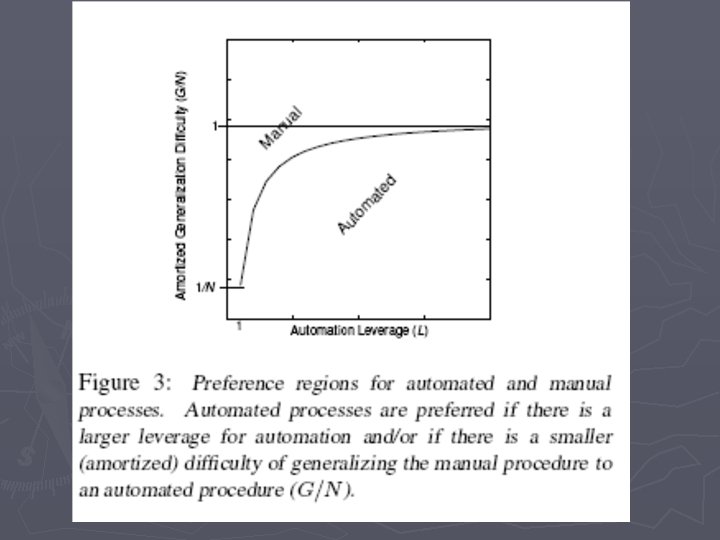
 Making it work ► Reduce G § Modularity in Caf ► Increase L ► Increase N § Increase uniformity among hardware and software
 Obvious Observations ► Automation creates extra systems to deploy and manage ► Automation introduces extra system setup cost ► Automation failure is more complicated to analyze and deal with