 Скачать презентацию Reducing Failure of Persons with Learning Disabilities Introducing
66b67eedb123726fe4730c5271a576f7.ppt
- Количество слайдов: 103



Reducing Failure of Persons with Learning Disabilities Introducing "Universal Design" to Adult Literacy Glenn Young Learning Disabilities Consultant gyoungxlt@adelphia. net glennyoungcsld. com
How Do We Measure Drop Outs – Changing Paradigm n In 1996 the U. S. Department of Education's National Center for Education Statistics (NCES) reported three types of dropout rates: The same data could give very different results • The national dropout rate using one approach was 4. 5 percent, and • Using a different approach it was 11. 0 percent. http: //www. ed. gov/pubs/OR/Consumer. Guides/dropout. html
How Do We Measure Drop Outs n Old way of counting the data was showed a situation bad enough A 1996 report showed • In 1993, approximately 381, 000 students in grades 10 through 12 dropped out of school • Approximately 3. 4 million persons in the United States ages 16 through 24 were high school dropouts. http: //www. ed. gov/pubs/OR/Consumer. Guides/dropout. html
How Do We Measure Drop Outs – The Change The Manhattan Institute for Policy Research (2002) counted all those entering 9 th grade and followed the whole cohort. They found not a rate of 11% but 29%: • The national graduation rate for the class of 1998 was 71%. n 78%, for white students n 56% for African-American students and n 54% for Latino students. n Manhattan stated that the discrepancy between the NCES’ finding and the 71% rate is largely caused by NCES’ counting of General Educational Development (GED) graduates and others with alternative credentials as high school graduates, and by its reliance on a methodology that is likely to undercount dropouts. http: //www. manhattan-institute. org/html/cr_baeo. htm
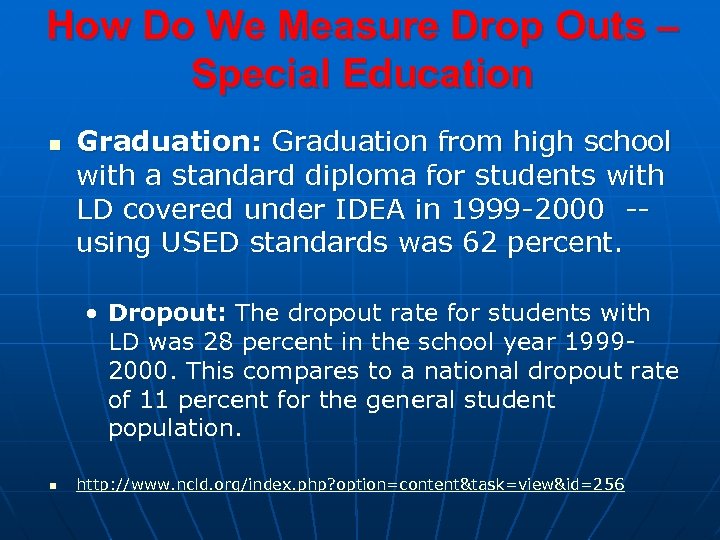
How Do We Measure Drop Outs – Special Education n Graduation: Graduation from high school with a standard diploma for students with LD covered under IDEA in 1999 -2000 -using USED standards was 62 percent. • Dropout: The dropout rate for students with LD was 28 percent in the school year 19992000. This compares to a national dropout rate of 11 percent for the general student population. n http: //www. ncld. org/index. php? option=content&task=view&id=256
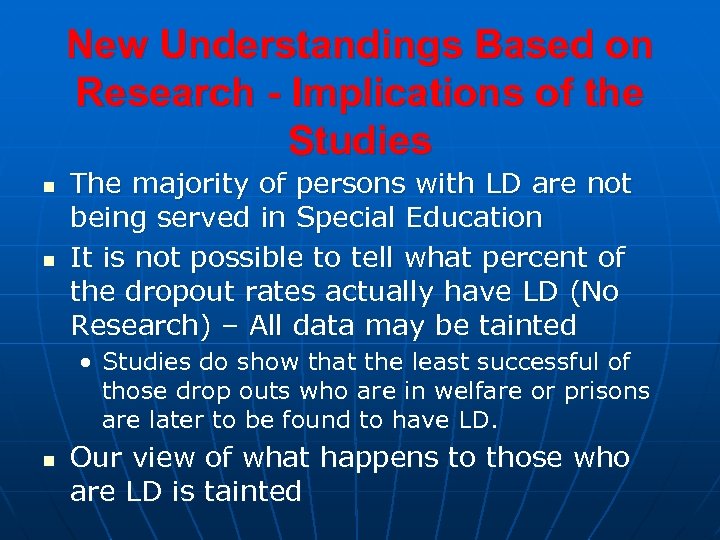
New Understandings Based on Research - Implications of the Studies n n The majority of persons with LD are not being served in Special Education It is not possible to tell what percent of the dropout rates actually have LD (No Research) – All data may be tainted • Studies do show that the least successful of those drop outs who are in welfare or prisons are later to be found to have LD. n Our view of what happens to those who are LD is tainted
Disability, not Teaching Failure n n The definitions show learning disabilities to have a foundation of impairment in the central nervous system. The academic (and social) failings are based on the impairment, not lack of access or opportunity
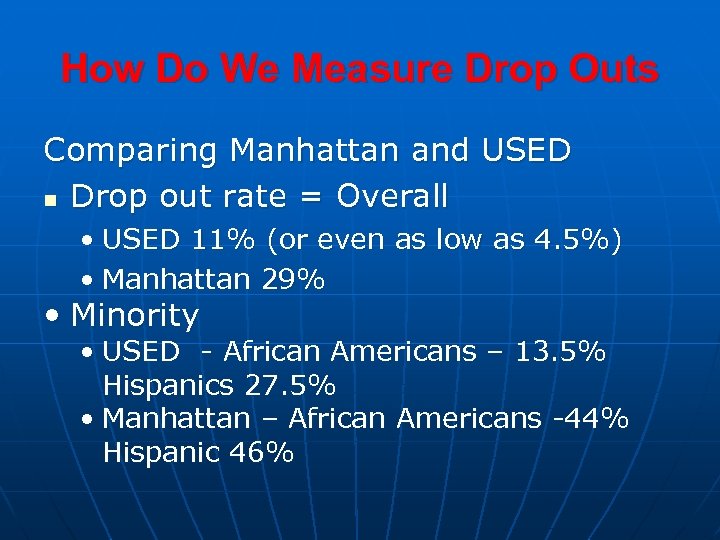
How Do We Measure Drop Outs Comparing Manhattan and USED n Drop out rate = Overall • USED 11% (or even as low as 4. 5%) • Manhattan 29% • Minority • USED - African Americans – 13. 5% Hispanics 27. 5% • Manhattan – African Americans -44% Hispanic 46%
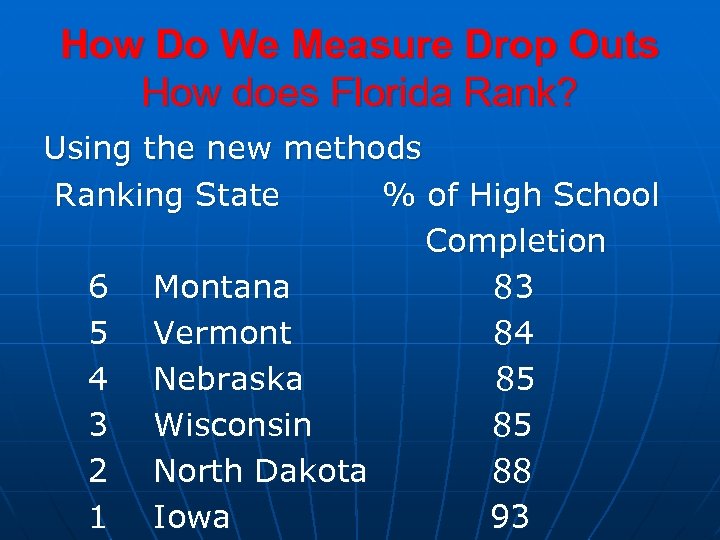
How Do We Measure Drop Outs How does Florida Rank? Using the new methods Ranking State % of High School Completion 6 Montana 83 5 Vermont 84 4 Nebraska 85 3 Wisconsin 85 2 North Dakota 88 1 Iowa 93
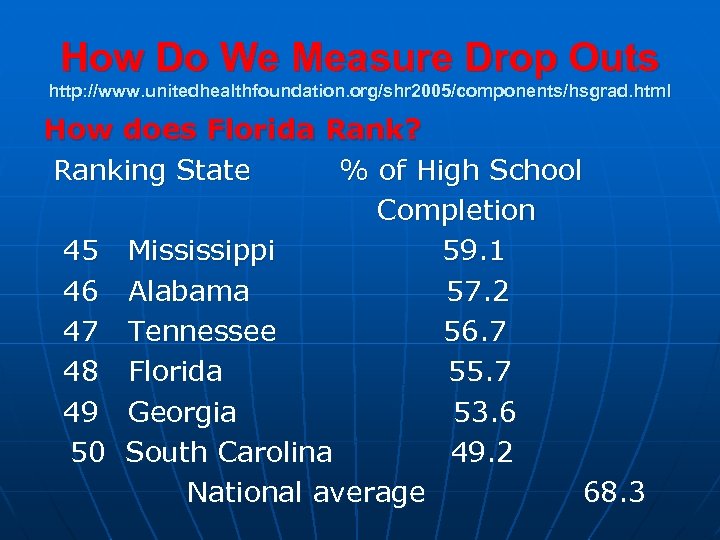
How Do We Measure Drop Outs http: //www. unitedhealthfoundation. org/shr 2005/components/hsgrad. html How does Florida Rank? Ranking State % of High School Completion 45 Mississippi 59. 1 46 Alabama 57. 2 47 Tennessee 56. 7 48 Florida 55. 7 49 Georgia 53. 6 50 South Carolina 49. 2 National average 68. 3
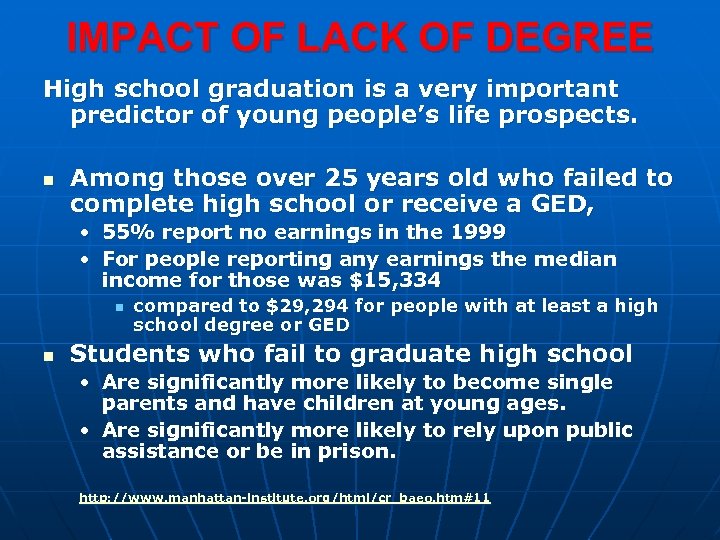
IMPACT OF LACK OF DEGREE High school graduation is a very important predictor of young people’s life prospects. n Among those over 25 years old who failed to complete high school or receive a GED, • 55% report no earnings in the 1999 • For people reporting any earnings the median income for those was $15, 334 n n compared to $29, 294 for people with at least a high school degree or GED Students who fail to graduate high school • Are significantly more likely to become single parents and have children at young ages. • Are significantly more likely to rely upon public assistance or be in prison. http: //www. manhattan-institute. org/html/cr_baeo. htm#11

Without Education …. . n n More than nine million working Americans— 25 percent of whom work full time, year round— earn less than the official poverty level, and More than 40 million Americans earn below 200 percent of the poverty level, a widely accepted proxy for a minimum family sustainable. The longer one stays in a low-wage, low-skill job, the farther one falls behind other workers in whose skills and futures employers are more eager to invest (Andersson, Holzer, and Lane 2003). http: //www. jff. org/jff/PDFDocuments/nextchallenge. pdf
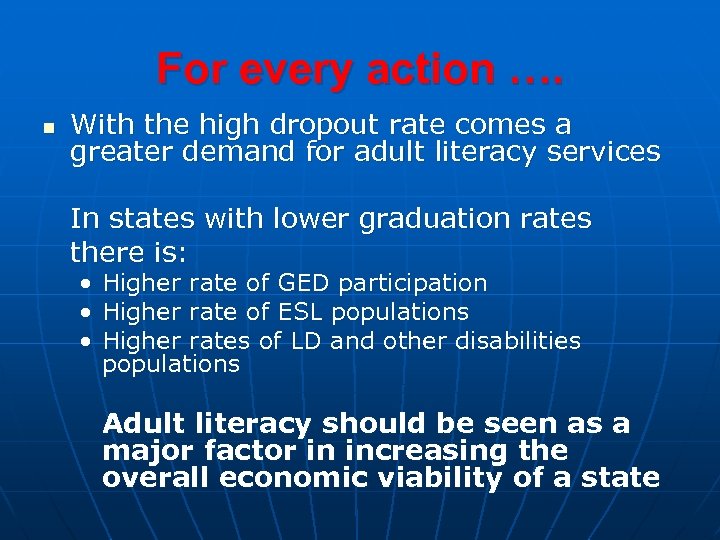
For every action …. n With the high dropout rate comes a greater demand for adult literacy services In states with lower graduation rates there is: • • • Higher rate of GED participation Higher rate of ESL populations Higher rates of LD and other disabilities populations Adult literacy should be seen as a major factor in increasing the overall economic viability of a state
Why So Many Failures? There are too many potential reason to list why the skill level of students transitioning into employment are not adequate • However, one issue that is consistently missed is the issue of Learning Disabilities
Estimated Rates of Adults with LD Documentation n n While schools are identifying about 5% with LD, While the estimates run as high as 15 -20% of adults with LD While adult education and literacy programs have estimated ranges of 30 -70% LD. Due to none identification and decrease requirements for “retesting” in K-12 • IT IS ESTMIATED THAT LESS THAN 1% OF ADULTS AND OUT OF SCHOOL YOUTH, WITH LD, HAVE PROPER DOCUMENTATION TO PROVE THE DISABILITY OUTSIDE OF SCHOOLS
Estimated Rates of Adults and Out of School Youth with LD Documentation n Who are these 99% of adults and Out of School Youth who have LD who do not have documentation? • Disproportional rates of women • Minority language populations • Low-literate adults (disproportional people of color) n Where do we find them? • • Job training programs Literacy/LEP programs Prisons Not in standard disability programs.
Estimated Rates of Adults with LD Documentation These “ 99% of those with LD” can not fit the standard disability process. • Under current law, persons with disabilities are responsible for self identifying and asking for accommodations. • Adult with LD either do not know they have a disability, or • No longer have current documentation (was documented in school)
Estimated Rates of Adults with LD Documentation Most if not all of these persons received no transition services • They were not in special education • They dropped out prior to the start of transition services • They were not considered “disabled enough” by transition service programs
Bottom Line Without solid research its hard to really say, but based on n The NALS, the NAALS, and the studies of Welfare and other limited achieving populations indicates that: n It appears that the majority of those in adult literacy programs (both English and ESL) have LD, and • Are without any real record of it – or with documentation that is “too old” for current use
WHO HAS BEEN MISSED n Clearly the populations that have been missed for definition of LD in the current system and in current transition services • Low-income populations • Females • Minority Language Populations
Gender Bias n 20 th Report to Congress talks of ongoing Gender Bias in reference to Special Education of Females for LD services • Presumed issues are: Boys act out more n Boys have LD at a higher rate n • Actual Issue includes – Diagnostic Tests are Gender Biased
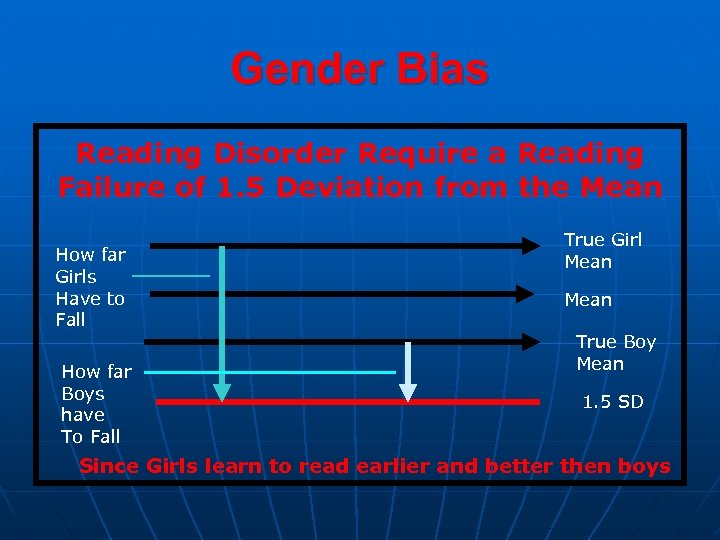
Gender Bias Reading Disorder Require a Reading Failure of 1. 5 Deviation from the Mean How far Girls Have to Fall How far Boys have To Fall True Girl Mean True Boy Mean 1. 5 SD Since Girls learn to read earlier and better then boys
Identifying LD in Minority Languages n n Allyn, and Bacon in Selective Crossbattery Assessments: Guideline for Culturally and Linguistically Diverse Populations (Intelligence Test Desk Reference (Mc. Graw & Flanagan, ed. ), state that “Assessment of the cognitive capabilities of individuals from culturally and linguistically diverse populations” is “one of the most difficult tasks facing psychologist today. ”
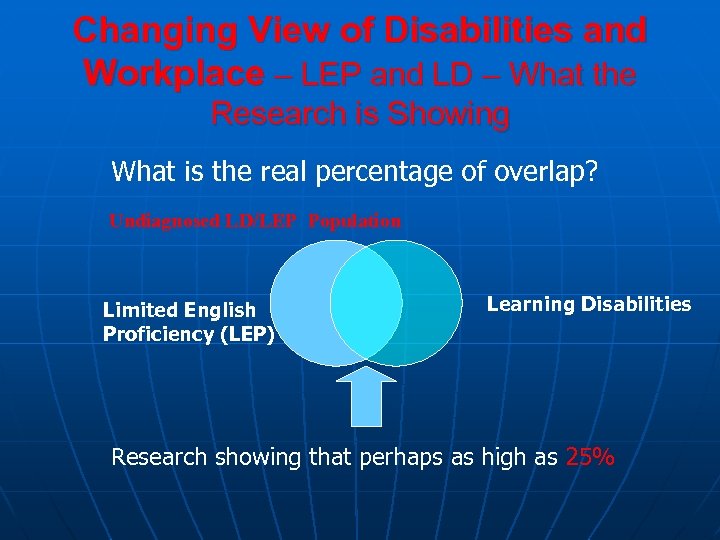
Changing View of Disabilities and Workplace – LEP and LD – What the Research is Showing What is the real percentage of overlap? Undiagnosed LD/LEP Population Limited English Proficiency (LEP) Learning Disabilities Research showing that perhaps as high as 25%
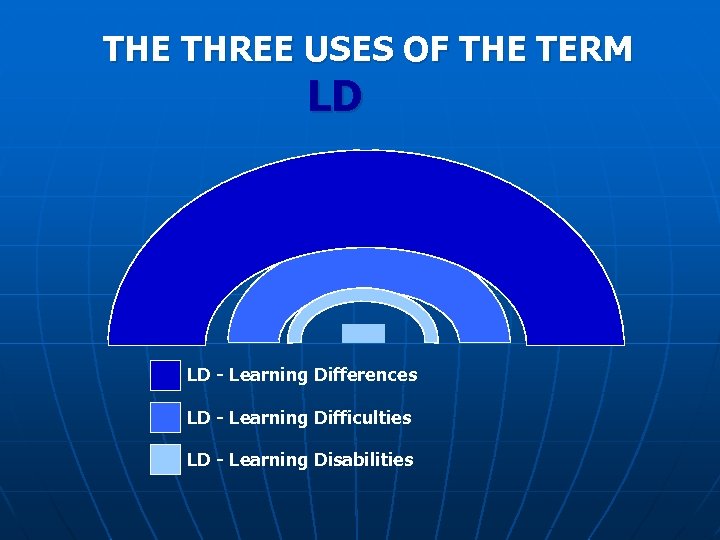
THE THREE USES OF THE TERM LD LD - Learning Differences LD - Learning Difficulties LD - Learning Disabilities
Who is Covered by Civil Rights Laws Only persons with disabilities are covered by civil rights laws. • There is no civil rights protection for having a learning difference. • There is no civil rights protection for have learning difficulties • There is civil rights protection for having a disability including learning disabilities, if there if proof of the disability n Therefore, under current structure … Most of those with LD are not covered
FEDERAL CIVIL RIGHTS LAWS FOR DISABILITY ISSUES n n THE REHABILITATION ACT OF 1973/SECTION 504 INDIVIDUALS WITH DISABILITIES EDUCATION ACT (IDEA 1990/97) (FORMERLY- PUBLIC LAW 94 -142 THE AMERICANS WITH DISABILITIES ACT OF 1990 WORKFORCE INVESTMENT ACT OF 1998/SEC. 188
Not Entitled to Reasonable Accommodations n n In Federal law "reasonable accommodations, " is defined as meaning: modifications or adjustments. . . that enable a qualified individual with disability to perform the essential functions (of the job or activity). {ADA regulation. Section 1630. 2(o)} A qualified individual means an individual with a disability who. . . with or without reasonable accommodations, can perform the essential functions (of the activity). {ADA regulation Section 1630. 2(m)
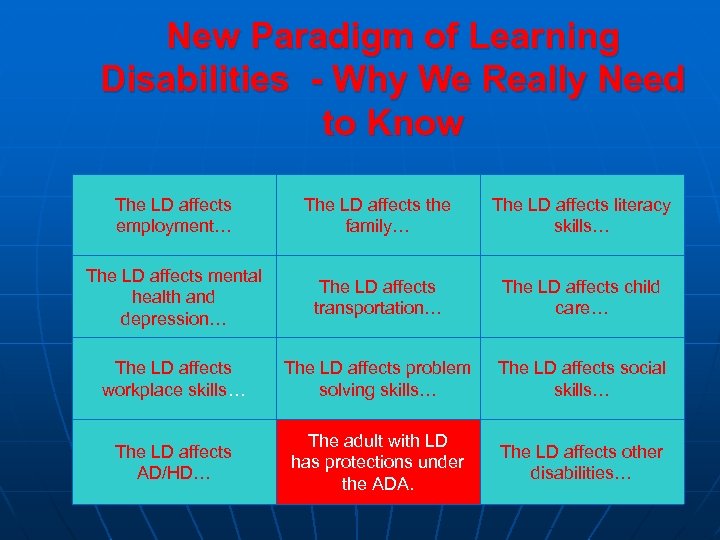
New Paradigm of Learning Disabilities - Why We Really Need to Know The LD affects employment… The LD affects the family… The LD affects literacy skills… The LD affects mental health and depression… The LD affects transportation… The LD affects child care… The LD affects workplace skills… The LD affects problem solving skills… The LD affects social skills… The LD affects AD/HD… The adult with LD has protections under the ADA. The LD affects other disabilities…
Why We Really Need to Know Critical Factors for Success of Persons with Disabilities n n n Self Awareness - understanding of having a disability. Understanding of laws and protections under the laws and, Accessing assistive technology and other accommodations. • Office of Disability and Employment Policy (ODEP) http: //www. dol. gov/odep/
Critical Factors for Success of Persons with Disabilities n Most adults and older teens with Learning Disabilities are not self awareness • do not have an understanding that they have a disability. • do not understand disability laws and protections offered under these laws, and • are not able to access assistive technology and other accommodations. • They don’t fit into the standard models for success
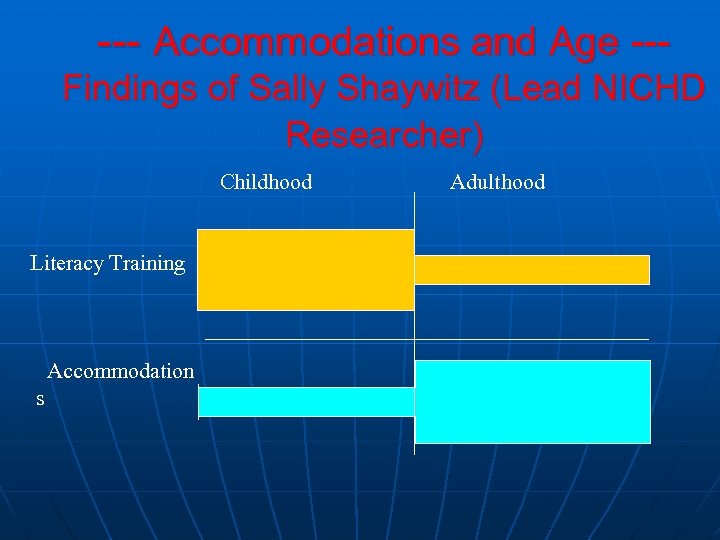
--- Accommodations and Age --Findings of Sally Shaywitz (Lead NICHD Researcher) Childhood Literacy Training Accommodation s Adulthood
What is Needed to Diagnose LD Diagnostics for LD need to be conducted by professional psychologist or psychiatrist There are two main diagnostic approaches Educational Psychological (ED-PSYC) Neurological Psychological (NERUO-PSYC)
What is Needed to Diagnose LD Different “settings’ require different types of evaluations If a new diagnostic is needed, the type should be based on consumer need. Educational Psychological (ED-PSYC) K-12, Adult Education programs, Community Colleges, most Four-Year Colleges. Neurological Psychological (NEURO-PSYC) Vocational Rehabilitation, most job training programs, most employment settings. GED requires its own testing requirements (Form L-15) that has elements of both Ed-Psycs and Neuro-Psycs)
The Key Diagnostic Testing Tool for Spanish n The Woodcock-Muñoz Psychoeducational Battery or in Spanish, “Bateria Woodcock-Muñoz Revisada. ” • The Cognitive Battery is named Pruebas de habilidad congitiva (tests of cognitive ability) • The achievement battery is the “Pruebas de aprovechamiento” (tests of achievement). n Administering all the sub-tests of the Pruebas de Habilidad Cognitiva would involve up to 4 hours of testing.
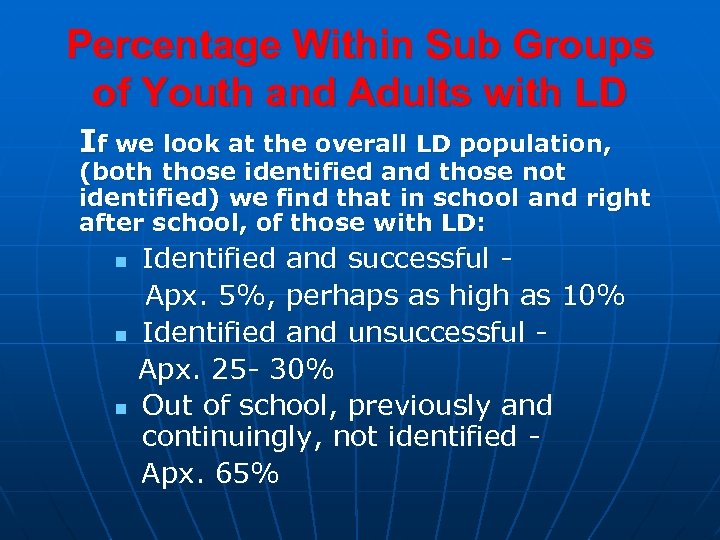
Percentage Within Sub Groups of Youth and Adults with LD If we look at the overall LD population, (both those identified and those not identified) we find that in school and right after school, of those with LD: n n n Identified and successful Apx. 5%, perhaps as high as 10% Identified and unsuccessful Apx. 25 - 30% Out of school, previously and continuingly, not identified Apx. 65%
What Can We Do? n n n Hey, were just little literacy programs We don’t have control of state programs and agendas We have to follow the curriculum We can’t afford to get diagnostics The student doesn’t want to know about it – shame, denial, bad memories of special education
UNIVESAL DESIGN The general core of the “universal” concept developed in the 1960’s, can simply be stated as: If “things” (buildings and services) are planned with the needs of persons with disabilities taken into consideration, then all persons benefit.
Unintended Consequences Most of the Use of Disabilities Interventions are not by people with Disabilities n Closed Captioning (bars and bedrooms) n Curb Cuts (Bike riders and baby carriages n Books on Tape (Everyone with a CD player in the Car)
UNIVESAL DESIGN The Core Principles of UD are: n Equitable Use: Useful and marketable to people with diverse abilities. n Flexibility in Use: Accommodates a wide range of individual preferences and abilities. n Simple and Intuitive Use: Easy to understand, regardless of the user’s experience, knowledge, language skills, or current concentration level.
UNIVESAL DESIGN The Core Principles of UD are: n Perceptible Information: Communicates necessary information to the user, regardless of ambient conditions or the user’s sensory abilities. n Tolerance for Error: Minimizes hazards and the adverse consequences of accidental or unintended actions. n Low Physical Effort: Can be used efficiently and comfortably and with a minimum of fatigue. n Size and Space for Approach and Use: Appropriate size and space is provided for approach, reach, manipulation, and use regardless of user’s body size, posture, or mobility.
UNIVESAL DESIGN Acceptance in the general One Stop world … n n n Wisconsin has developed state-wide standards for One-Stop Centers that include many of the concepts of universal access. http: //www. dwd. state. wi. us/dws/staff/jc_standards_ta_not es. htm Rhode Island has instituted a wide range program to assure incorporating the universal access approach through a number of partnerships, training efforts, and designated staff. http: //www. onestoptoolkit. org/profile_Rhode. Island. cfm [1] For an overview of other state activities in Universal Access efforts see: http: //www. onestoptoolkit. org/statelocal. cfm and (youth website)
Universal Design Model in Adult Literacy n Treat everyone as if they have LD and teach them as if they were LD – without ever calling it LD. • Give them intensive phonics training • Give them assistive technology from the start – including tape (CD) where they can learn on their own (addressing Information Deficit Disorder) • Give them the accommodations they need to pass the GED in training for the GED (extended time, calculator, etc. )
Universal Design Model – In Adult Literacy n Treat everyone as if they have LD and teach them as if they were LD – without ever calling it LD. • Fight the powers that be where you can … challenge the GED rules … get the high school documentation if it exists • Don’t be passive … be aggressive with both the student and the system
Customize, Customize n n UD does not mean one size fits all – (we make everything open and were done) UD means meeting the individualized needs of each student based on student needs and timeframe and evaluation • Intake is key and - use of validated screening for LD should be done at intake • Stop TABEing everyone to death … also use n n n screens for phonemic awareness short term memory recall sequencing issues auditory processing basic vision and hearing
Lessons for Adult Literacy from UD - Focus on Customers Needs n What are the immediate needs of the student? (Identified or not) • • n What are the long-term goals? • • • n Get a GED? Get a Job ? Avoid Dropping out? Is testing needed for these goals? Go to College Be successful in work? Is testing needed for these goals? What is the student’s time-frame? • http: //www. design. ncsu. edu/cud/
Greatest Barrier to Success n In adults (and youth out of school) the greatest barrier to success may not be low-literacy per say, but • Information Deficit Disorder While everyone was trying to teach them how to read … they didn’t teach them what everyone else was learning … So they do not have the same base of knowledge as others with which they are competing So while we are trying to teach them to read (again) we really should be giving them information in the manner they can manage to learn and be more competitive.
How Do We Translate To Adult Literacy We have to follow the existing rules n n We have to collect data for NRS We need to show gain You need “proof of disability” to give the accommodations We can’t afford testing (so best to ignore the issue? )
How Do We Translate To Adult Literacy Yes - We have to follow the existing rules – but what really are the rules? n We have to collect data for NRS – yes but so what? • Report the rates found –keep second book on screened and suspected rates (building the case for more recognition) n We need to show gain - yes • The is nothing in the rules that says you can not measure gain using “accommodations” – so since they don’t say you can’t, you can …
How Do We Translate To Adult Literacy Yes - We have to follow the existing rules – but what really are the rules? n You need “proof of disability” to give the accommodations • No you don’t – adult literacy is not required to do so in how it gives services … It is needed for GED or CC but not in adult literacy - call it “teaching methods” and your covered
How Do We Translate To Adult Literacy Yes - We have to follow the existing rules- but what really are the rules? n We can’t afford testing (so best to ignore the issue? ) • Testing not actually required in Adult Literacy – for in house service interventions • Testing needed for GED or Community Colleges n Multiple ways to get the testing for those who really need it … • Use the internet with Puerto Rico VR … for Spanish speaking diagnostics n So go ahead … Based on UD Principles provide the services as if there was a disability.
Treat Everyone Like Having A Disability, But …. n For some students, with certain goals, just treating them like the have a disability will meet their needs. . • But if they have goals that require documentation … Adult literacy should see themselves as the Source for more information and, n Conduit for the student’s greater need for services and documentation • We must end the smokestack mentality n
Lessons from UD – Focus on Customers Needs Student With Different Background Need Different Information For the Student - previously unidentified with LD – but show indications and have shown LD through screening n Would knowledge that they have LD impact • the student’s goals? • the student’s time-frame? If so, how? n n Would knowledge of the LD open up additional resources? If so, what are these resources? Can the program get them tested in time?
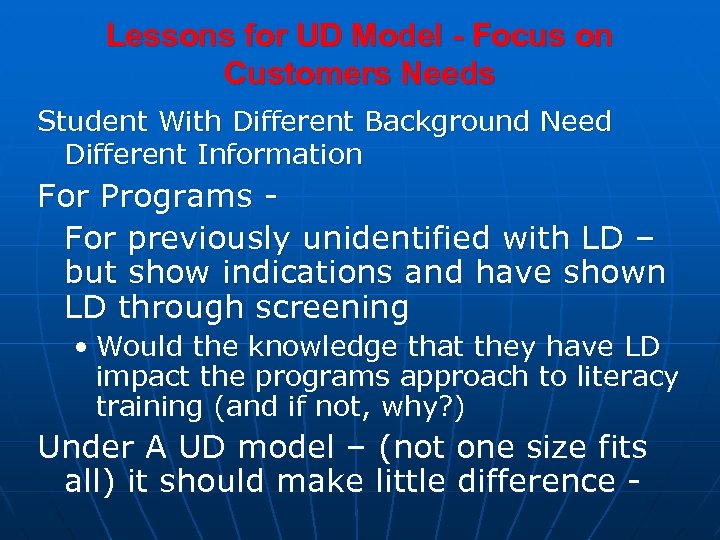
Lessons for UD Model - Focus on Customers Needs Student With Different Background Need Different Information For Programs For previously unidentified with LD – but show indications and have shown LD through screening • Would the knowledge that they have LD impact the programs approach to literacy training (and if not, why? ) Under A UD model – (not one size fits all) it should make little difference -
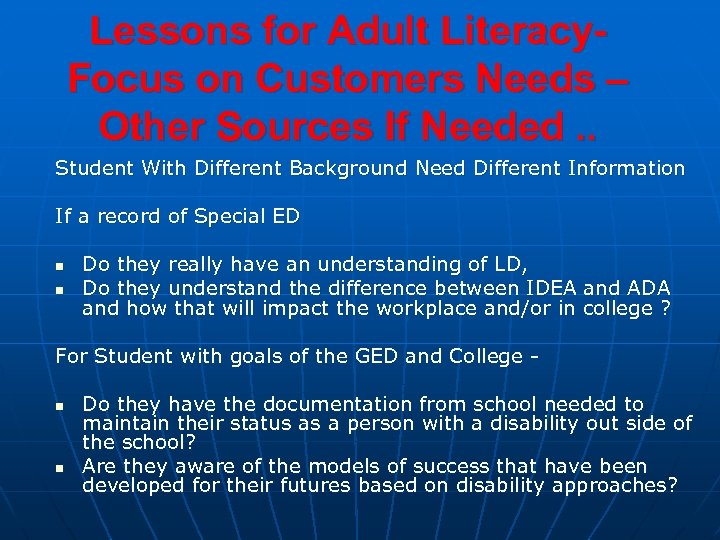
Lessons for Adult Literacy. Focus on Customers Needs – Other Sources If Needed. . Student With Different Background Need Different Information If a record of Special ED n n Do they really have an understanding of LD, Do they understand the difference between IDEA and ADA and how that will impact the workplace and/or in college ? For Student with goals of the GED and College n n Do they have the documentation from school needed to maintain their status as a person with a disability out side of the school? Are they aware of the models of success that have been developed for their futures based on disability approaches?
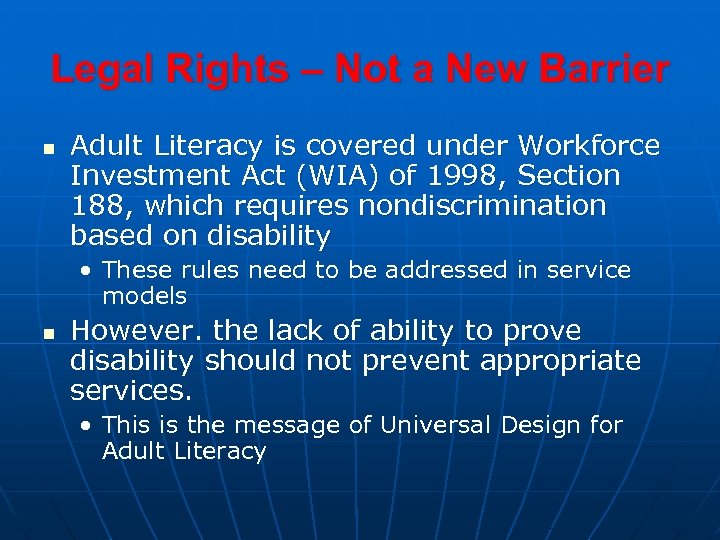
Legal Rights – Not a New Barrier n Adult Literacy is covered under Workforce Investment Act (WIA) of 1998, Section 188, which requires nondiscrimination based on disability • These rules need to be addressed in service models n However. the lack of ability to prove disability should not prevent appropriate services. • This is the message of Universal Design for Adult Literacy
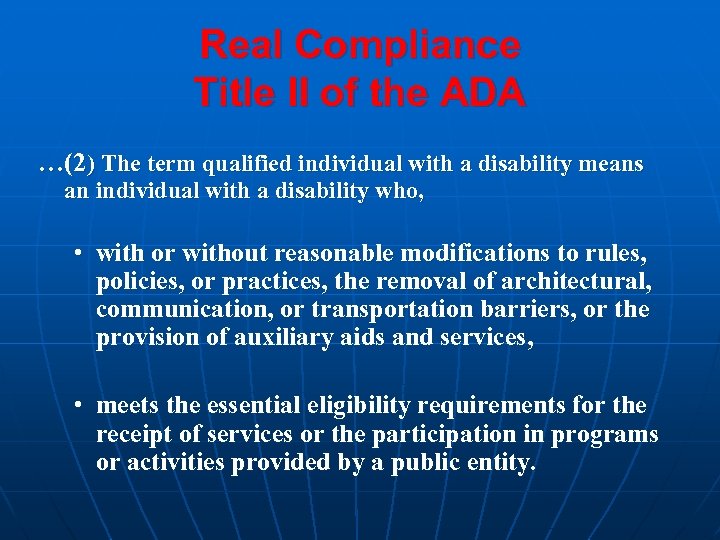
Real Compliance Title II of the ADA …(2) The term qualified individual with a disability means an individual with a disability who, • with or without reasonable modifications to rules, policies, or practices, the removal of architectural, communication, or transportation barriers, or the provision of auxiliary aids and services, • meets the essential eligibility requirements for the receipt of services or the participation in programs or activities provided by a public entity.
Addendums n n n NICHD Research on LD Federal Definition of Disability Definitions of LD • IDEA • VR • NJCLD n n Known Causes of LD Subtypes of LD Intervention models Resources
New Research - Roots of “No Child Left Behind” n n In 1984 A report to Congress on Learning Disabilities basically said no one agrees on definition, demographics and impact. Congress commissioned National Institute for Child and Human Development (NICHD) to conduct research to answers questions on LD
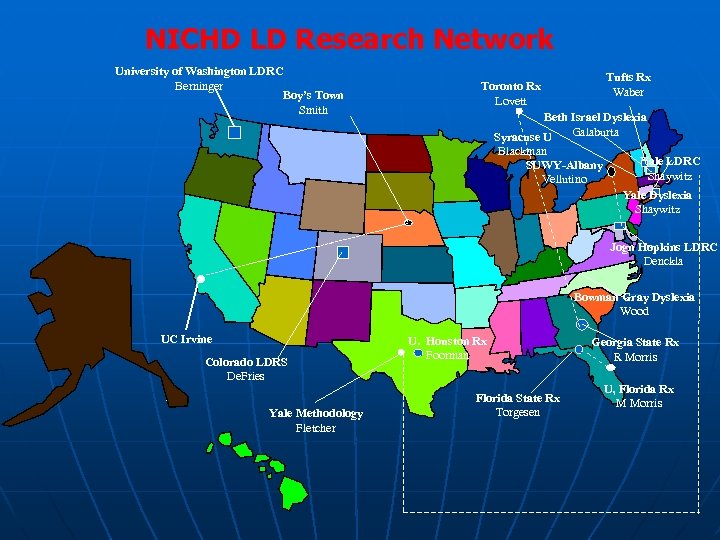
NICHD LD Research Network University of Washington LDRC Berninger Boy’s Town Smith Tufts Rx Waber Toronto Rx Lovett Beth Israel Dyslexia Galaburta Syracuse U Blackman SUWY-Albany Vellutino Yale LDRC Shaywitz Yale Dyslexia Shaywitz Jogn Hopkins LDRC Denckla Bowman Gray Dyslexia Wood UC Irvine Colorado LDRS De. Fries Yale Methodology Fletcher U. Houston Rx Foorman Florida State Rx Torgesen Georgia State Rx R Morris U, Florida Rx M Morris
FINDINGS OF NIH RESEARCH IN THE AREA OF LEARNING DISABILITIES (1987 -97) n n RATE: 17% of the population has a reading disability CRITICAL DEFICIT: Specific deficits within the language system concerning processing of sound (phonemic awareness); damage in links to area of brain involved in reading process
FINDINGS OF NIH RESEARCH IN THE AREA OF LEARNING DISABILITIES (1987 -97) No significant gender differential n Persistence of reading disabilities into adulthood n Early identification and intervention based on multiple approaches lessen impact of impairment n
NIH RESEACH SUGGESTS MAJOR SERVICE GAP n n n NIH is finding 17% Schools are identifying 5% Two thirds of persons with LD have not been getting services in schools • They have gone through unidentified and un-served. • Who are they?
Part of the Problem - Traditional Paradigm of Adults with LD Hoffmann et al. (1987) describes the “typical learning disabled adult” subject in his studies as: n n an unemployed, unmarried 23 -year old white male who had graduated from high school
Traditional Paradigm of Adults with LD (cont. ) Hoffmann et al. (1987) describes the “typical learning disabled adult” subject in his studies as: n who had received some form of specialized education n who had previously been labeled learning disabled, and n who was being supported by his parents
New Paradigm on Make-up of Adults with LD. UNLIKE - Hoffmann et al. (1987) “typical learning disabled adult” we now see that adults with LD can be: n any age - and struggling with work, or education n of any color or race, with a greater chance for minorities based on poverty. n who HAS NOT graduated from high school
New Paradigm on Make-up of Adults with LD. (cont. ) UNLIKE - Hoffmann et al. (1987) “typical learning disabled adult” we now see that adults with LD can be: n n n who HAS NOT received some form of specialized education who HAS NOT previously been labeled learning disabled, and who was on TANF, in job training programs of all kinds, at work, in college - etc.
The Operative Word in “Learning Disabilities is “Disabilities” n In order to understand Learning Disabilities we need to first understand disabilities
Federal Definition of Disability for purpose of Civil Rights n n n A physical or mental impairment that substantially limits one or more of the major life activities of such individual A record of such an impairment Being regarded as having such and impairment. ADA Regulations 1630. 2 - Definition
Federal Definition of Physical or Mental Impairment n Any physiological disorder, or condition, cosmetic disfigurement, or anatomical loss affecting one or more of the following body systems: neurological, musculoskeletal, special sense organs, respiratory, cardiovascular, reproductive, digestive, genito-urinary, memic and lymphatic, skin and endocrine, or • ADA Regulations 1630. 2, Definition
Federal Definition of Physical or Mental Impairment n Any mental or psychological disorder, such as mental retardation, organic brain syndrome, emotional or mental illness and specific learning disabilities ADA Regulations 1630. 2, Definition
Federal Definition of Major Life Activity Functions such as: caring for oneself performing manual tasks walking seeing hearing speaking breathing learning working ADA REGS 1630. 2 DEFINITIONS
Federal Definition of “Substantially Limits: ADA Regs. 1630. 2 Definitions 1) Unable to perform a major life activity that the average person in the general population can perform, or: 2) Significantly restricted as to the condition manner or duration under which an individual can perform a particular major live activities as compared to the conditions manner or duration under which the average person in the general population can perform that same major life activity
WITH RESPECT TO THE MAJOR LIFE ACTIVITY OF "WORKING" THE FEDERAL DEFINITION OF SUBSTANTIALLY LIMITS IS n n Significantly restricted in the ability to perform either a class of jobs or a broad range of jobs in various classes as compared to the average person having comparable training skills and abilities. The inability to perform a single particular job does not constitute a substantial limitation in the major life activity of working. n AMERICANS WITH DISABILITIES ACT REGULATIONS 1630. 2 DEFINITION
“Specific Learning Disability” in the Individuals with Disabilities Education Act (IDEA) n n n The term 'specific learning disability' means a disorder in one or more of the basic psychological processes involved in understanding or in using language, spoken or written, which disorder may manifest itself in imperfect ability to listen, think, speak, read, write, spell or do mathematical calculations. The term includes such conditions as perceptual disabilities, brain injury, minimal brain dysfunction, dyslexia and developmental aphasia. The term does not include a learning problem that is primarily the result of visual, hearing or motor disabilities; of mental retardation; of emotional disturbance; or of environmental, cultural, or economic disadvantage. [34 CFR 300. 7(c)]
Vocational Rehabilitation Services Administration - Definition n VR defines LD as: A specific learning disability is a disorder in one or more of the central nervous system processes involved in • perceiving, understanding, and/or using concepts through • verbal (spoken or written) language or non- verbal means.
Vocational Rehabilitation Services Administration - Definition VR defines LD as: n This disorder manifests itself with a deficit in one or more of the following areas: • attention, - reasoning, • processing, - memory, • communication, - reading, • writing, - spelling, • calculation, - coordination, • social competence, and • emotional maturity.
National Joint Committee on Learning Disabilities (NJCLD) (definition revised 1994) n n “Learning disabilities” is a general term that refers to a heterogeneous group of disorders manifested by significant difficulties in the acquisition and use of listening, speaking, reading, writing, reasoning, or mathematical abilities. These disorders are intrinsic to the individual, presumed to be due to central nervous system dysfunction, and may occur across the life span. . .
National Joint Committee on Learning Disabilities (NJCLD) (Definition revised 1994) Although learning disabilities may occur concomitantly with other handicapping conditions • (for example: sensory impairments, mental retardation, or serious emotional disturbance) or with extrinsic influences (such as cultural differences, insufficient or inappropriate instruction), they are not the result of those conditions or influences.
Every Child a Learner: Reducing Risks of Learning Impairment During Pregnancy and Infancy, Newman and Buka, 1990 n The causes of learning impairments are: 1) low birth-weight, 2) prenatal alcohol exposure, 3) maternal smoking, 4) prenatal exposure to drugs, 5) lead poisoning, 6) child abuse and neglect, and 7) malnutrition.
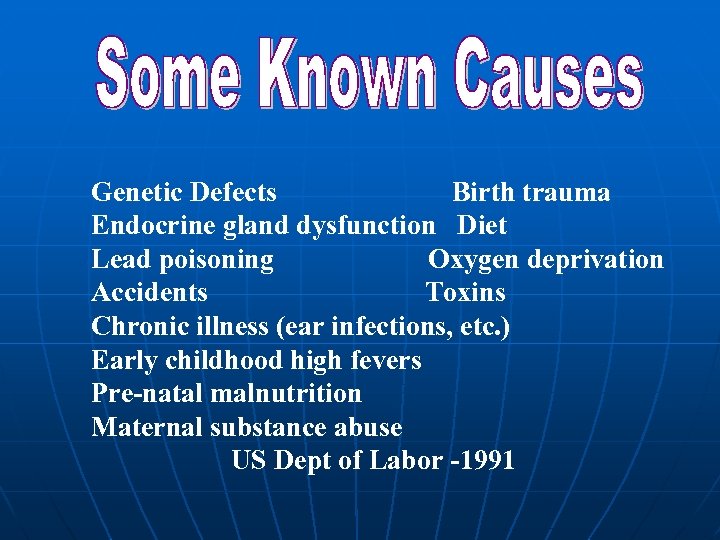
Genetic Defects Birth trauma Endocrine gland dysfunction Diet Lead poisoning Oxygen deprivation Accidents Toxins Chronic illness (ear infections, etc. ) Early childhood high fevers Pre-natal malnutrition Maternal substance abuse US Dept of Labor -1991
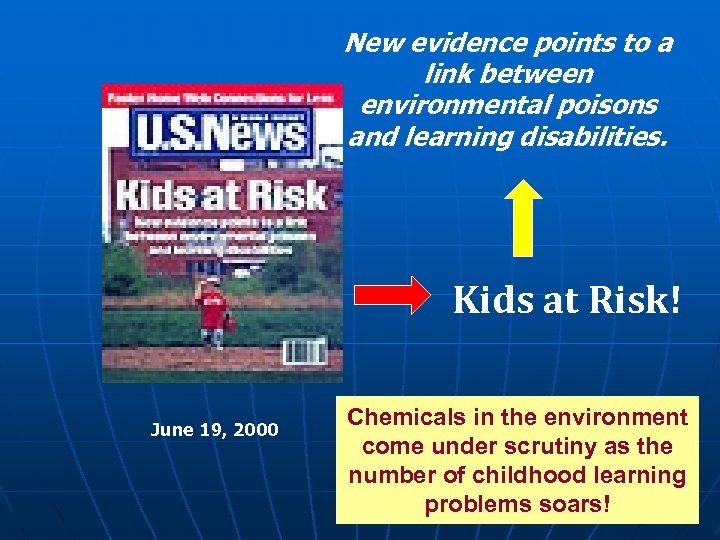
New evidence points to a link between environmental poisons and learning disabilities. Kids at Risk! June 19, 2000 Chemicals in the environment come under scrutiny as the number of childhood learning problems soars!
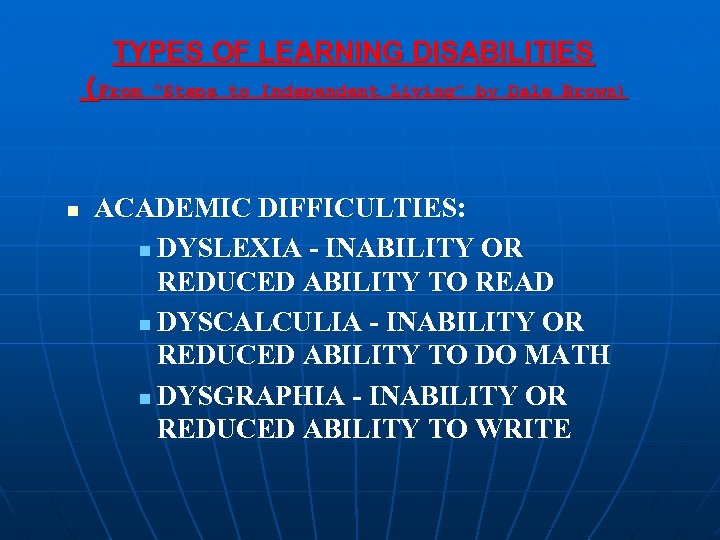
TYPES OF LEARNING DISABILITIES (From n “Steps to Independent Living” by Dale Brown) ACADEMIC DIFFICULTIES: n DYSLEXIA - INABILITY OR REDUCED ABILITY TO READ n DYSCALCULIA - INABILITY OR REDUCED ABILITY TO DO MATH n DYSGRAPHIA - INABILITY OR REDUCED ABILITY TO WRITE
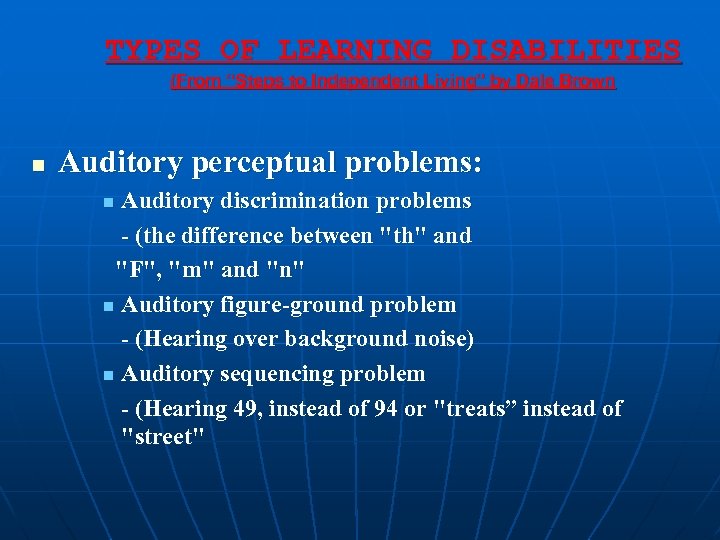
TYPES OF LEARNING DISABILITIES (From “Steps to Independent Living” by Dale Brown n Auditory perceptual problems: Auditory discrimination problems - (the difference between "th" and "F", "m" and "n" n Auditory figure-ground problem - (Hearing over background noise) n Auditory sequencing problem - (Hearing 49, instead of 94 or "treats” instead of "street" n
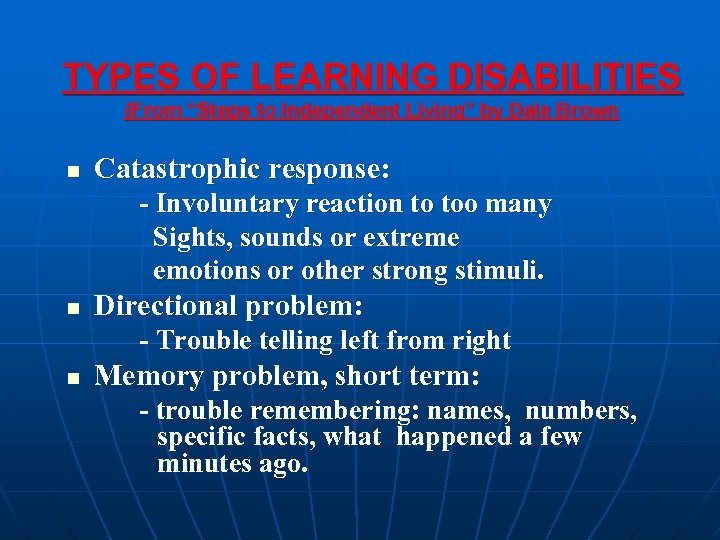
TYPES OF LEARNING DISABILITIES (From “Steps to Independent Living” by Dale Brown n Catastrophic response: - Involuntary reaction to too many Sights, sounds or extreme emotions or other strong stimuli. n Directional problem: - Trouble telling left from right n Memory problem, short term: - trouble remembering: names, numbers, specific facts, what happened a few minutes ago.
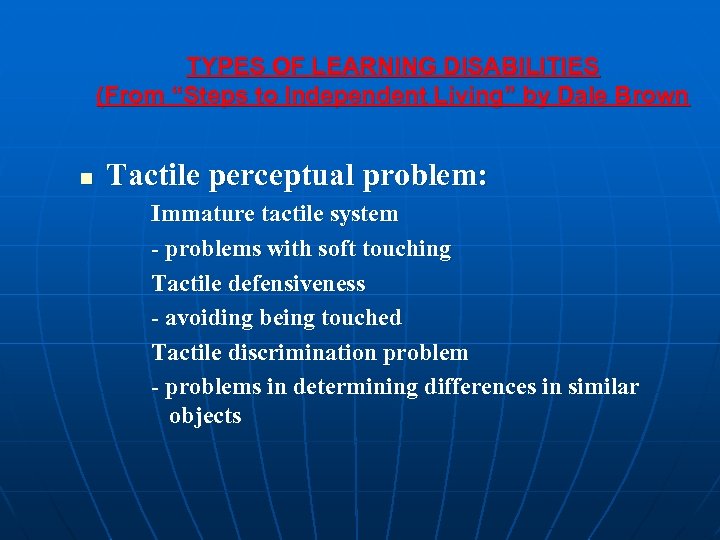
TYPES OF LEARNING DISABILITIES (From “Steps to Independent Living” by Dale Brown n Tactile perceptual problem: Immature tactile system - problems with soft touching Tactile defensiveness - avoiding being touched Tactile discrimination problem - problems in determining differences in similar objects
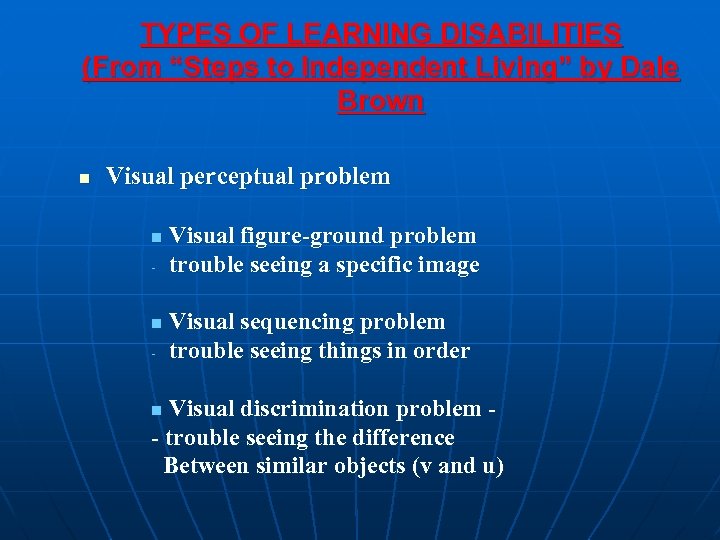
TYPES OF LEARNING DISABILITIES (From “Steps to Independent Living” by Dale Brown n Visual perceptual problem n - Visual figure-ground problem trouble seeing a specific image Visual sequencing problem trouble seeing things in order Visual discrimination problem - trouble seeing the difference Between similar objects (v and u) n
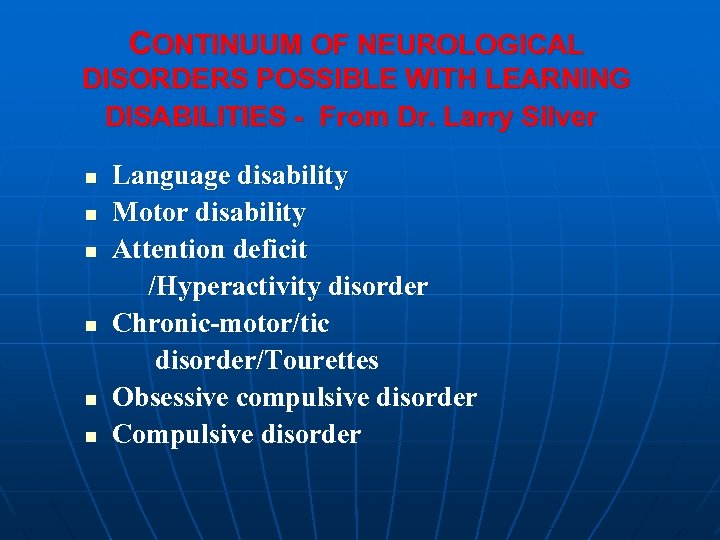
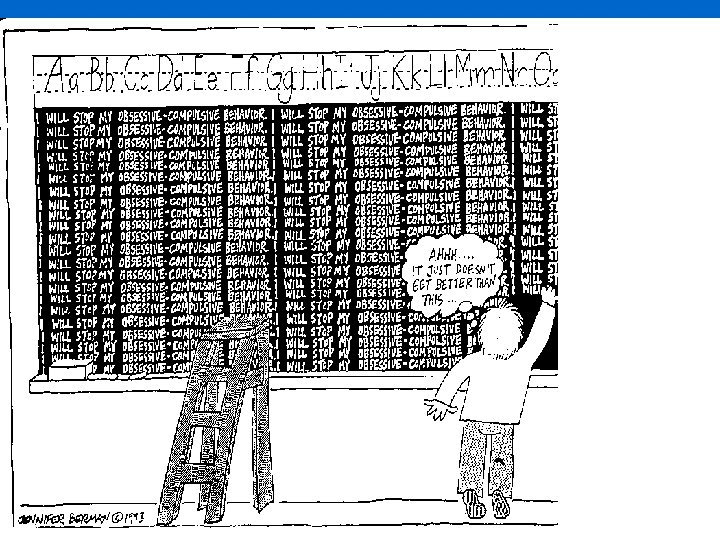
CONTINUUM OF NEUROLOGICAL DISORDERS POSSIBLE WITH LEARNING DISABILITIES - From Dr. Larry Silver n n n Language disability Motor disability Attention deficit /Hyperactivity disorder Chronic-motor/tic disorder/Tourettes Obsessive compulsive disorder Compulsive disorder
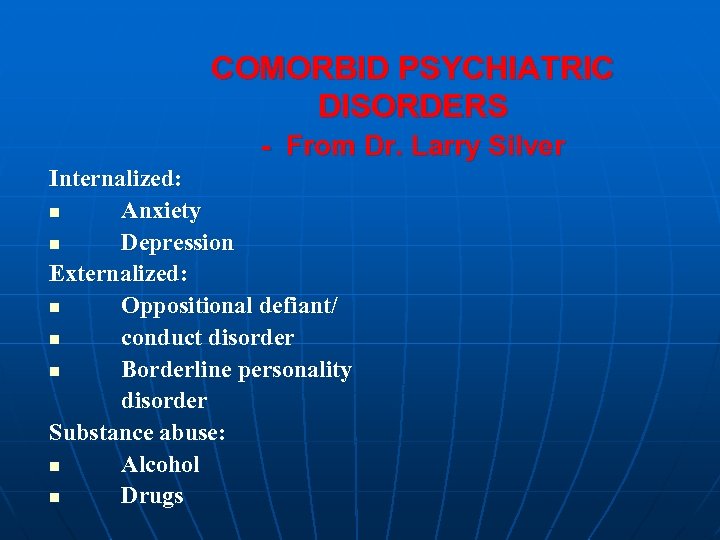
COMORBID PSYCHIATRIC DISORDERS - From Dr. Larry Silver Internalized: n Anxiety n Depression Externalized: n Oppositional defiant/ n conduct disorder n Borderline personality disorder Substance abuse: n Alcohol n Drugs
Bridges to Practice in Adult Literacy Bridges to Practice: A Research-based Guide for Literacy Practitioners Serving Adults with Learning Disabilities is the latest publication of AED’s National Adult Literacy and Learning Disabilities Center. The guide is designed to increase awareness among practitioners in adult literacy programs about learning disabilities, and to help program leaders make programs more responsive to the needs of adults with learning disabilities. Such adults frequently experience difficulties in reading, getting off welfare, and finding and keeping jobs. The product of a five-year collaboration between the Center and the University of Kansas Institute for Research on Learning Disabilities, Bridges to Practice is a research -based, five-book series that documents "best practices. " Tools include four guidebooks, a professional development manual with training agendas and scripts, transparency and handout masters, and an 11 -1/2 minute motivational video, Bridges to Systemic Reform.
Some Contacts n National Center on Workforce and Disability for Adults (www. onestops. info) n Collaborative on Workforce and Disability for Youth (www. ncwd-youth. info) n Job Accommodation Network (www. jan. wvu. edu/) n National Institute for Literacy (www. nifl. gov) n NIFL Adult LD site http: //ldlink. coe. utk. edu/
Some Contacts n n Office Of Disability and Employment Policy (ODEP) http: //www. dol. gov/odep/ Section 188 Check list • http: //www. dol. gov/oasam/programs/cr c/WIASection 188 Disability. Checklist. htm
Job Accommodation Network Helping employees with disabilities and managers achieve an adaptive and welcoming Public Service work environment The Job Accommodation Network (JAN) is not a job placement service, but an international tollfree consulting service that provides information about job accommodations and the employability of people with disabilities. JAN also provides information regarding the Americans with Disabilities Act (ADA). Please take a few moments to surf around and find out about our free services. Click on "Points of Interest" for our table of contents. West Virginia University PO Box 6080 Morgantown, WV 26506 -6080 1 -800 -526 -7234
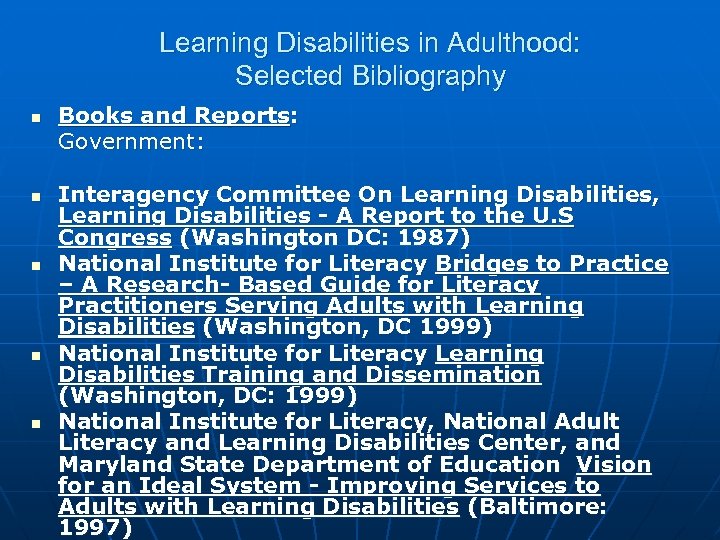
Learning Disabilities in Adulthood: Selected Bibliography n n n Books and Reports: Government: Interagency Committee On Learning Disabilities, Learning Disabilities - A Report to the U. S Congress (Washington DC: 1987) National Institute for Literacy Bridges to Practice – A Research- Based Guide for Literacy Practitioners Serving Adults with Learning Disabilities (Washington, DC 1999) National Institute for Literacy Learning Disabilities Training and Dissemination (Washington, DC: 1999) National Institute for Literacy, National Adult Literacy and Learning Disabilities Center, and Maryland State Department of Education Vision for an Ideal System - Improving Services to Adults with Learning Disabilities (Baltimore: 1997)
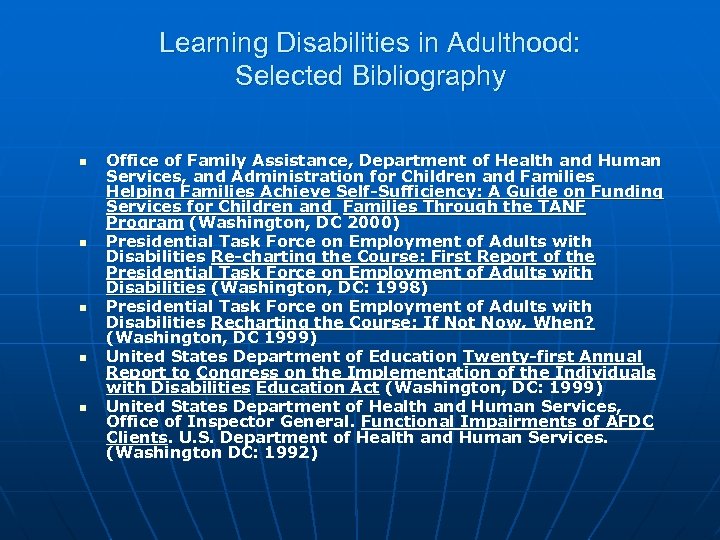
Learning Disabilities in Adulthood: Selected Bibliography n n n Office of Family Assistance, Department of Health and Human Services, and Administration for Children and Families Helping Families Achieve Self-Sufficiency: A Guide on Funding Services for Children and Families Through the TANF Program (Washington, DC 2000) Presidential Task Force on Employment of Adults with Disabilities Re-charting the Course: First Report of the Presidential Task Force on Employment of Adults with Disabilities (Washington, DC: 1998) Presidential Task Force on Employment of Adults with Disabilities Recharting the Course: If Not Now, When? (Washington, DC 1999) United States Department of Education Twenty-first Annual Report to Congress on the Implementation of the Individuals with Disabilities Education Act (Washington, DC: 1999) United States Department of Health and Human Services, Office of Inspector General. Functional Impairments of AFDC Clients. U. S. Department of Health and Human Services. (Washington DC: 1992)
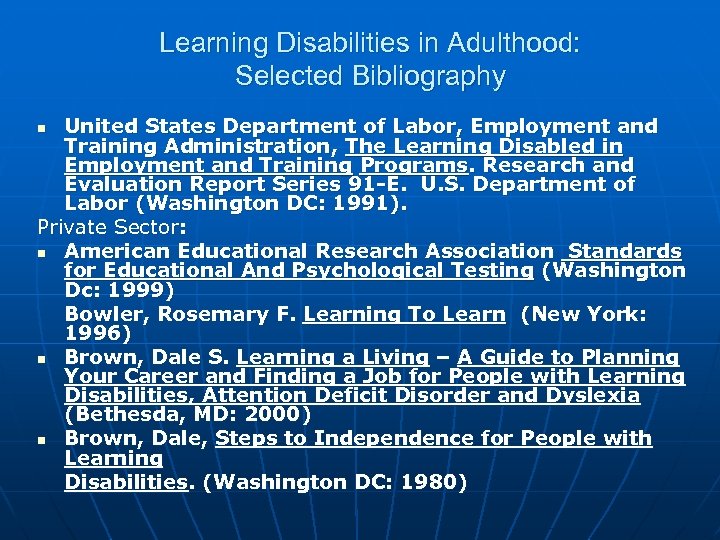
Learning Disabilities in Adulthood: Selected Bibliography United States Department of Labor, Employment and Training Administration, The Learning Disabled in Employment and Training Programs. Research and Evaluation Report Series 91 -E. U. S. Department of Labor (Washington DC: 1991). Private Sector: n American Educational Research Association Standards for Educational And Psychological Testing (Washington Dc: 1999) Bowler, Rosemary F. Learning To Learn (New York: 1996) n Brown, Dale S. Learning a Living – A Guide to Planning Your Career and Finding a Job for People with Learning Disabilities, Attention Deficit Disorder and Dyslexia (Bethesda, MD: 2000) n Brown, Dale, Steps to Independence for People with Learning Disabilities. (Washington DC: 1980) n
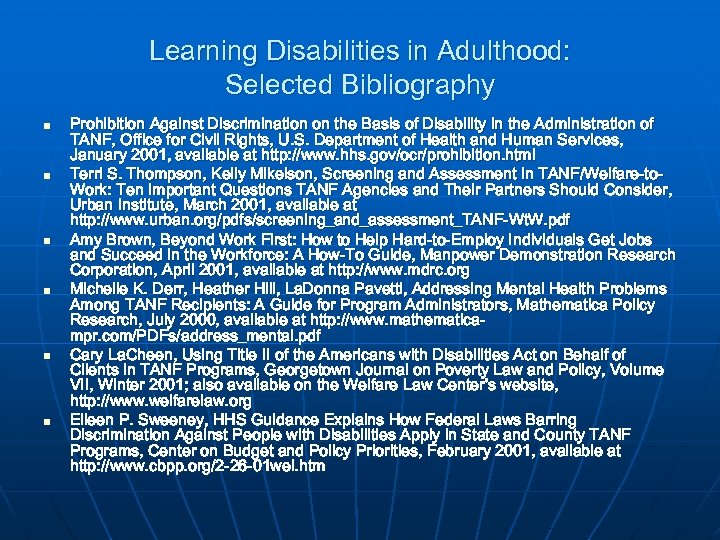
Learning Disabilities in Adulthood: Selected Bibliography n n n Prohibition Against Discrimination on the Basis of Disability in the Administration of TANF, Office for Civil Rights, U. S. Department of Health and Human Services, January 2001, available at http: //www. hhs. gov/ocr/prohibition. html Terri S. Thompson, Kelly Mikelson, Screening and Assessment in TANF/Welfare-to. Work: Ten Important Questions TANF Agencies and Their Partners Should Consider, Urban Institute, March 2001, available at http: //www. urban. org/pdfs/screening_and_assessment_TANF-Wt. W. pdf Amy Brown, Beyond Work First: How to Help Hard-to-Employ Individuals Get Jobs and Succeed in the Workforce: A How-To Guide, Manpower Demonstration Research Corporation, April 2001, available at http: //www. mdrc. org Michelle K. Derr, Heather Hill, La. Donna Pavetti, Addressing Mental Health Problems Among TANF Recipients: A Guide for Program Administrators, Mathematica Policy Research, July 2000, available at http: //www. mathematicampr. com/PDFs/address_mental. pdf Cary La. Cheen, Using Title II of the Americans with Disabilities Act on Behalf of Clients in TANF Programs, Georgetown Journal on Poverty Law and Policy, Volume VII, Winter 2001; also available on the Welfare Law Center's website, http: //www. welfarelaw. org Eileen P. Sweeney, HHS Guidance Explains How Federal Laws Barring Discrimination Against People with Disabilities Apply in State and County TANF Programs, Center on Budget and Policy Priorities, February 2001, available at http: //www. cbpp. org/2 -26 -01 wel. htm
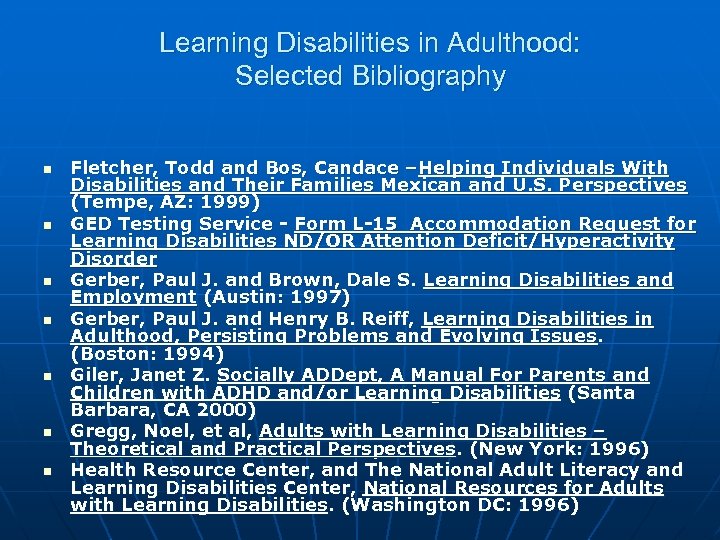
Learning Disabilities in Adulthood: Selected Bibliography n n n n Fletcher, Todd and Bos, Candace –Helping Individuals With Disabilities and Their Families Mexican and U. S. Perspectives (Tempe, AZ: 1999) GED Testing Service - Form L-15 Accommodation Request for Learning Disabilities ND/OR Attention Deficit/Hyperactivity Disorder Gerber, Paul J. and Brown, Dale S. Learning Disabilities and Employment (Austin: 1997) Gerber, Paul J. and Henry B. Reiff, Learning Disabilities in Adulthood, Persisting Problems and Evolving Issues. (Boston: 1994) Giler, Janet Z. Socially ADDept, A Manual For Parents and Children with ADHD and/or Learning Disabilities (Santa Barbara, CA 2000) Gregg, Noel, et al, Adults with Learning Disabilities – Theoretical and Practical Perspectives. (New York: 1996) Health Resource Center, and The National Adult Literacy and Learning Disabilities Center, National Resources for Adults with Learning Disabilities. (Washington DC: 1996)
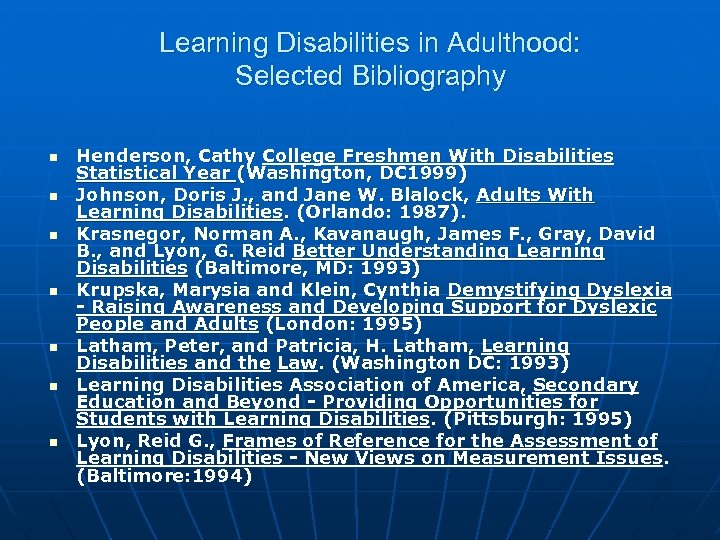
Learning Disabilities in Adulthood: Selected Bibliography n n n n Henderson, Cathy College Freshmen With Disabilities Statistical Year (Washington, DC 1999) Johnson, Doris J. , and Jane W. Blalock, Adults With Learning Disabilities. (Orlando: 1987). Krasnegor, Norman A. , Kavanaugh, James F. , Gray, David B. , and Lyon, G. Reid Better Understanding Learning Disabilities (Baltimore, MD: 1993) Krupska, Marysia and Klein, Cynthia Demystifying Dyslexia - Raising Awareness and Developing Support for Dyslexic People and Adults (London: 1995) Latham, Peter, and Patricia, H. Latham, Learning Disabilities and the Law. (Washington DC: 1993) Learning Disabilities Association of America, Secondary Education and Beyond - Providing Opportunities for Students with Learning Disabilities. (Pittsburgh: 1995) Lyon, Reid G. , Frames of Reference for the Assessment of Learning Disabilities - New Views on Measurement Issues. (Baltimore: 1994)
www. ldonline. org Here’s a sampling of assistive technology resources useful to students and adults with learning disabilities: • Keyboard Alternatives • Keyboard/Mouse Interface Software • Portable Word Processing Alternatives • Word Prediction Software
• Text-To_Speech • Screen Reading Software • Optical Character Recognition Software • Writing/Composing Software • Spelling Checkers, Dictionaries, • & Thesauruses • Assistive Technology Information Sites • Speech Recognition • Books on Disc/Tape • Variable Speech Control • Listening Aides • Talking Calculators
ACCOMMODATIONS Accommodating Adults with Disabilities in Adult Education Programs University of Kansas Institute for Adult Services
Скачать презентацию Reducing Failure of Persons with Learning Disabilities Introducing
66b67eedb123726fe4730c5271a576f7.ppt