 Скачать презентацию Reducing barriers for e-business in SME s through an
07751f81fa38fb65011566737b8ed5aa.ppt
- Количество слайдов: 24



Reducing barriers for e-business in SME’s through an open service oriented infrastructure ICEC’ 06 Tuesday August 14 nd 2006 Fredericton, New Brunswick, Canada Mikkel Hippe Brun (mhb@itst. dk) Christian Lanng (chl@itst. dk) National IT- and Telecom Agency Ministry of Science, Technology and Innovation
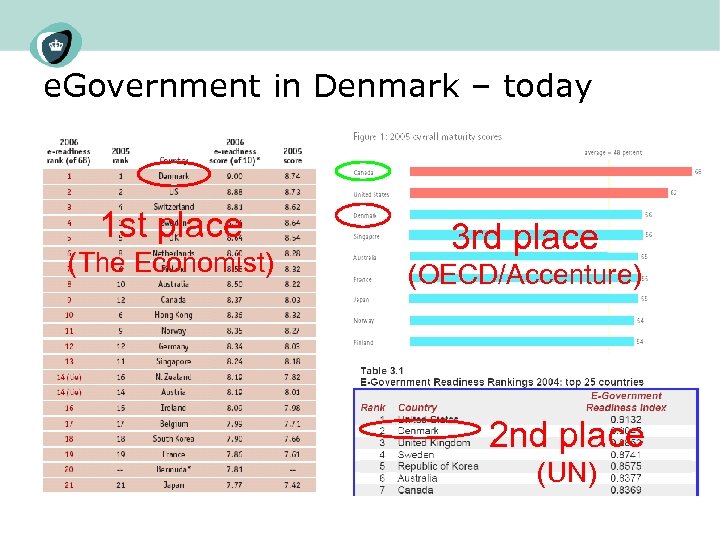
e. Government in Denmark – today 1 st place (The Economist) 3 rd place (OECD/Accenture) 2 nd place (UN)
Vision for e-government 2010 n n n 50% of all Danish companies are doing full electronic business 90% of all Danish companies, citizens and public authorities have a digital signature certificate That the public sector organizations follow Enterprise Architecture principles and become service enabled (SOA) That we have ONE citizens portal drawing on all the different service offerings across the public sector That the public sector play an offensive and innovative role in shaping SOA enablement both in the private as well as the public sector Enable competition on services rather than infrastructure, formats or vendor lock-in Source: ”New challenges, New priorities”, ”Danish Globalization Strategy”, ”Strategy for e-government in Denmark”
But there are still barriers towards realizing the SOA nirvana A survey we did of 600 private companies showed that the main barriers could be divided into 4 groups (KPMG 2005) : n n Technical Cost vs. benefit barriers Organizational Legal / Legislative These barriers were echoed by the IT-vendors and CIO’s we spoke with in the public sector.
Technical barriers Interoperability is a huge challenge n It is not trivial to satisfy the basic conditions for inter-enterprise transactions on a large scale: n n n n Authentication Authorization Confidentiality Integrity Non-repudiation Toolkits are not mature Standardization n Many different standards n n Technical standards Data standards (content)
Cost vs. benefit barriers Without critical mass benefit is small n Existing infrastructure investments for Big Inc. n n No good business case for moving services from an existing infrastructure (e. g. EDI) No good business case for establishing new services on a new infrastructure, who is the first mover? “If it works – don’t fix it!” Johns one man company My. Garage Technologies on the other hand would prefer to use internet technologies when doing business. n On the other hand – John only saves little time in the handling of his 100 annual invoices and he may not have an incentive to do participate in Big Inc. ’s electronic supply chain at all (unless of course everybody else were doing it).
Organizational barriers Critical mass is the key to success n n SME’s are needed if critical mass is to be reached Specific barriers to small and medium sized enterprises (SME) n n n SME’s generally don’t have the capability to participate in SOA based supply chains i. e. they often don’t have 24/7/365 online message handlers High barriers to participate in an electronic supply chain with current infrastructure (EDI) Usability can be a critical issue n n n Installation of software Initialization Complex requirements
Legal / Legislative barriers n n Laws on PKI-based digital signatures must be passed Laws need to be tried in court before mass adoption Privacy issues National laws may stand in the way n n E. g. in Denmark a bilateral agreement must be made between the parties exchanging electronic invoices. E. g. in Germany a paper trail of invoicing transactions must be kept.
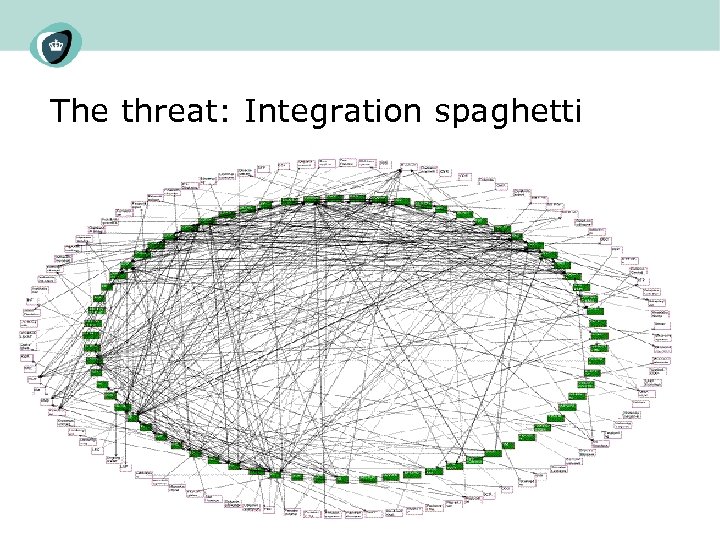
The threat: Integration spaghetti
The case: Danish e-invoicing law As of February 1 th 2005 – all invoices to the public sector has sent electronically n 18 million invoices will be exchanged n The initiatives is mandated by legislation n 440. 000 companies affected n Scanning agencies handle the conversion of paper invoices n OASIS Universal Business Language is the underlying standard n Total estimated savings in public sector 120 million € per year.
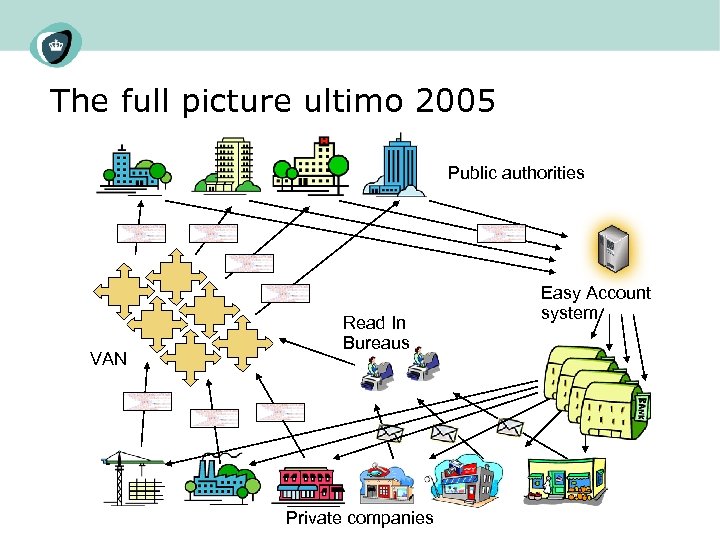
The full picture ultimo 2005 Public authorities VAN Read In Bureaus Private companies Easy Account system
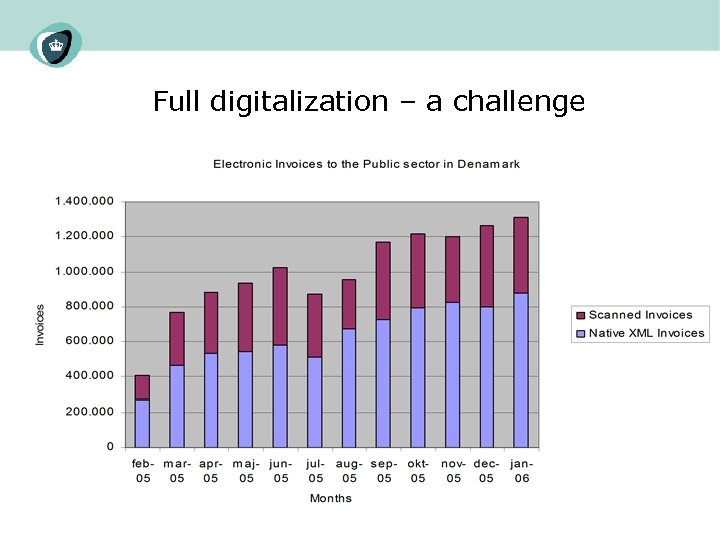
Full digitalization – a challenge
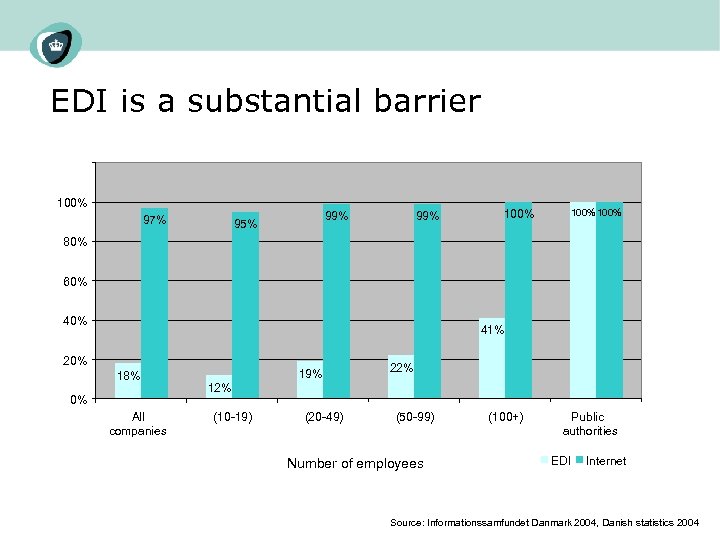
EDI is a substantial barrier 100% 97% 99% 95% 99% 100% 80% 60% 41% 20% 18% 0% All companies 19% 22% 12% (10 -19) (20 -49) (50 -99) Number of employees (100+) Public authorities EDI Internet Source: Informationssamfundet Danmark 2004, Danish statistics 2004
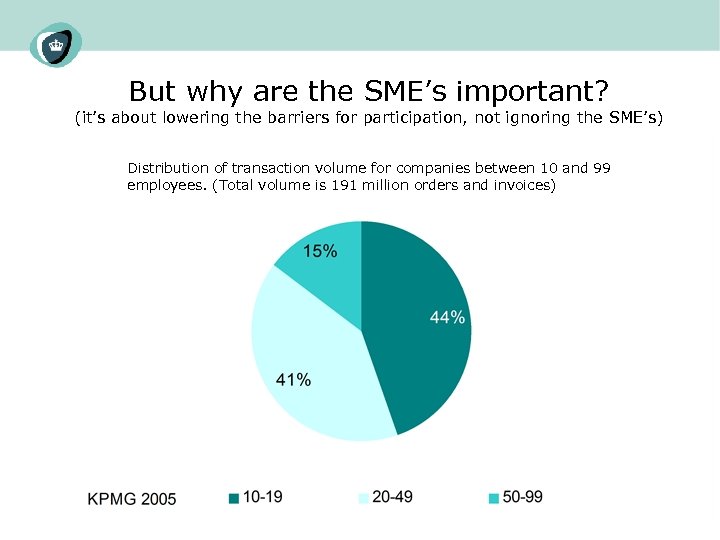
But why are the SME’s important? (it’s about lowering the barriers for participation, not ignoring the SME’s) Distribution of transaction volume for companies between 10 and 99 employees. (Total volume is 191 million orders and invoices)
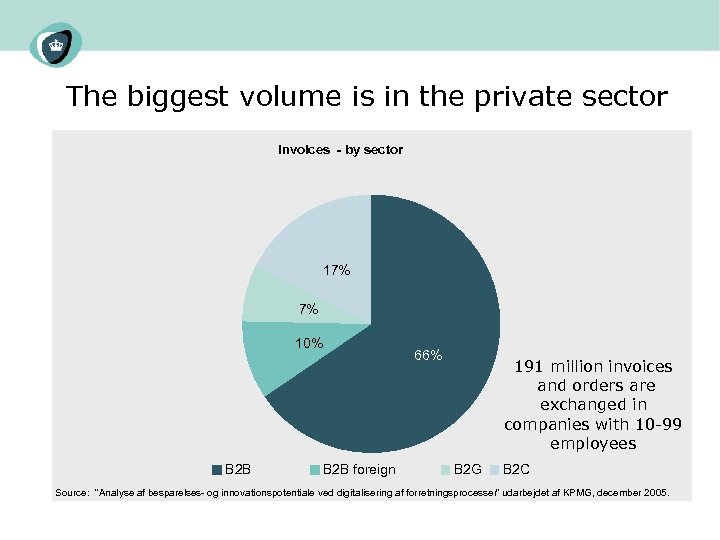
The biggest volume is in the private sector Invoices - by sector 17% 7% 10% B 2 B foreign 66% 191 million invoices and orders are exchanged in companies with 10 -99 employees B 2 G B 2 C Source: "Analyse af besparelses- og innovationspotentiale ved digitalisering af forretningsprocesser" udarbejdet af KPMG, december 2005.
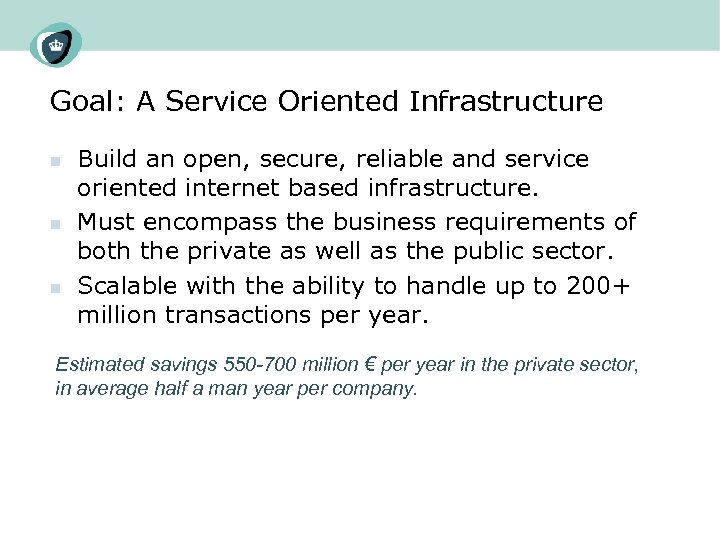
Goal: A Service Oriented Infrastructure n n n Build an open, secure, reliable and service oriented internet based infrastructure. Must encompass the business requirements of both the private as well as the public sector. Scalable with the ability to handle up to 200+ million transactions per year. Estimated savings 550 -700 million € per year in the private sector, in average half a man year per company.
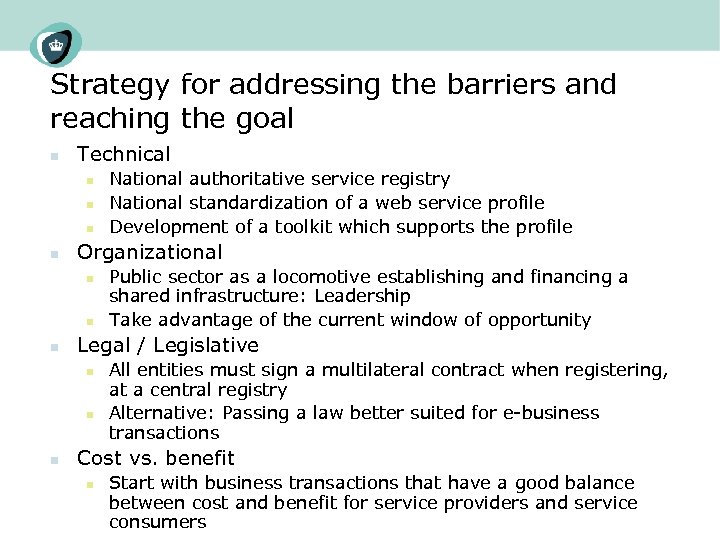
Strategy for addressing the barriers and reaching the goal n Technical n n Organizational n n n Public sector as a locomotive establishing and financing a shared infrastructure: Leadership Take advantage of the current window of opportunity Legal / Legislative n n n National authoritative service registry National standardization of a web service profile Development of a toolkit which supports the profile All entities must sign a multilateral contract when registering, at a central registry Alternative: Passing a law better suited for e-business transactions Cost vs. benefit n Start with business transactions that have a good balance between cost and benefit for service providers and service consumers
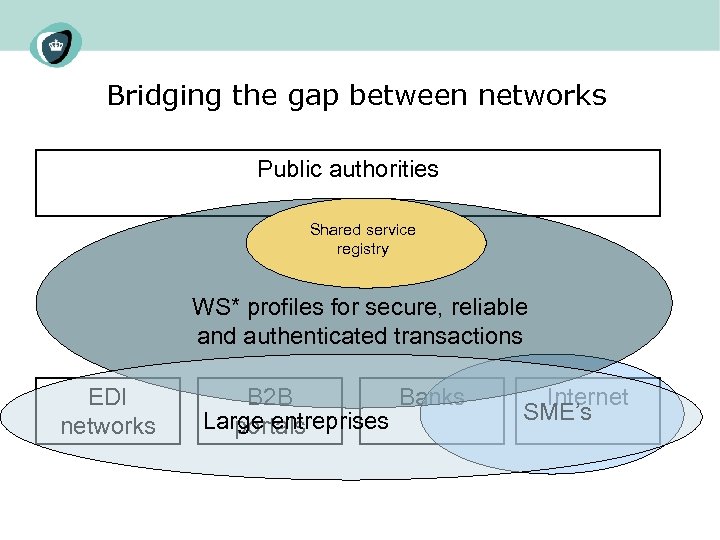
Bridging the gap between networks Public authorities Shared service registry WS* profiles for secure, reliable and authenticated transactions EDI networks B 2 B Banks Large entreprises portals Internet SME’s
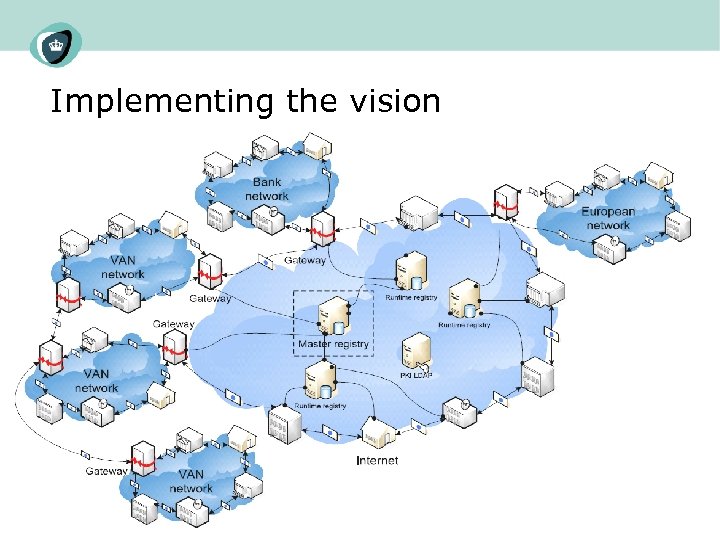
Implementing the vision
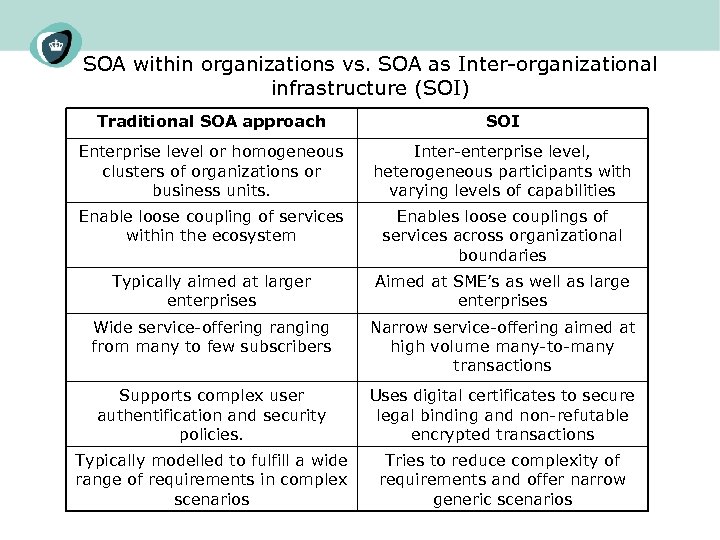
SOA within organizations vs. SOA as Inter-organizational infrastructure (SOI) Traditional SOA approach SOI Enterprise level or homogeneous clusters of organizations or business units. Inter-enterprise level, heterogeneous participants with varying levels of capabilities Enable loose coupling of services within the ecosystem Enables loose couplings of services across organizational boundaries Typically aimed at larger enterprises Aimed at SME’s as well as large enterprises Wide service-offering ranging from many to few subscribers Narrow service-offering aimed at high volume many-to-many transactions Supports complex user authentification and security policies. Uses digital certificates to secure legal binding and non-refutable encrypted transactions Typically modelled to fulfill a wide range of requirements in complex scenarios Tries to reduce complexity of requirements and offer narrow generic scenarios
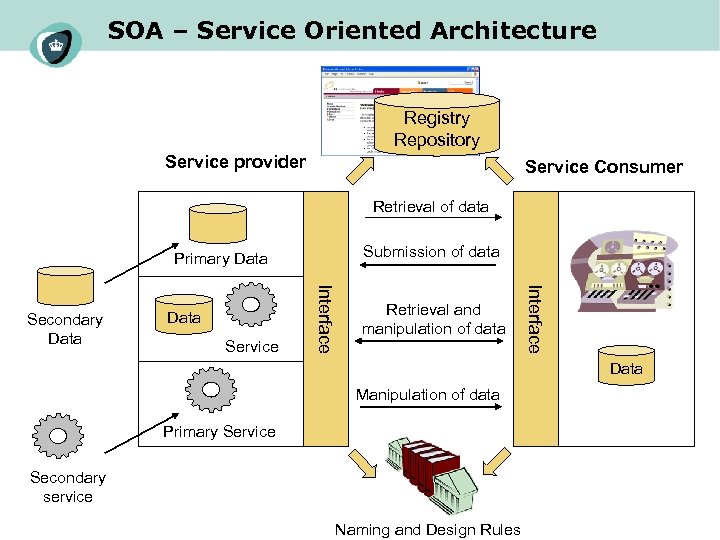
SOA – Service Oriented Architecture Registry Repository Service provider Service Consumer Retrieval of data Submission of data Primary Data Service Retrieval and manipulation of data Interface Data Interface Secondary Data Manipulation of data Primary Service Secondary service Naming and Design Rules
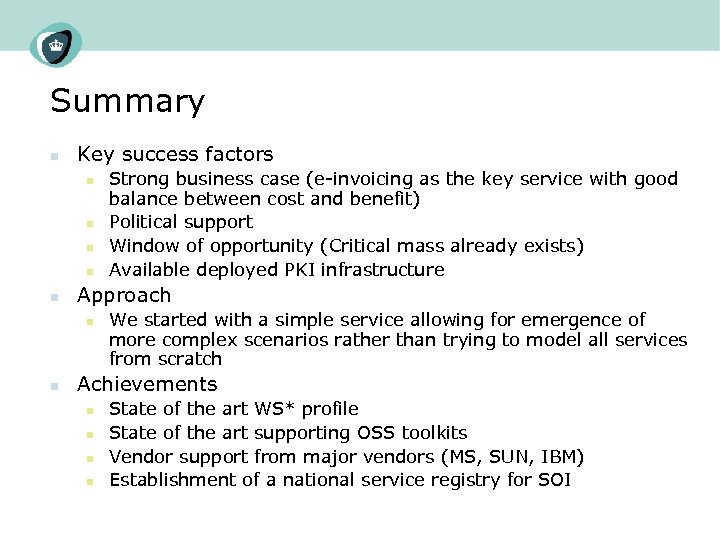
Summary n Key success factors n n n Approach n n Strong business case (e-invoicing as the key service with good balance between cost and benefit) Political support Window of opportunity (Critical mass already exists) Available deployed PKI infrastructure We started with a simple service allowing for emergence of more complex scenarios rather than trying to model all services from scratch Achievements n n State of the art WS* profile State of the art supporting OSS toolkits Vendor support from major vendors (MS, SUN, IBM) Establishment of a national service registry for SOI
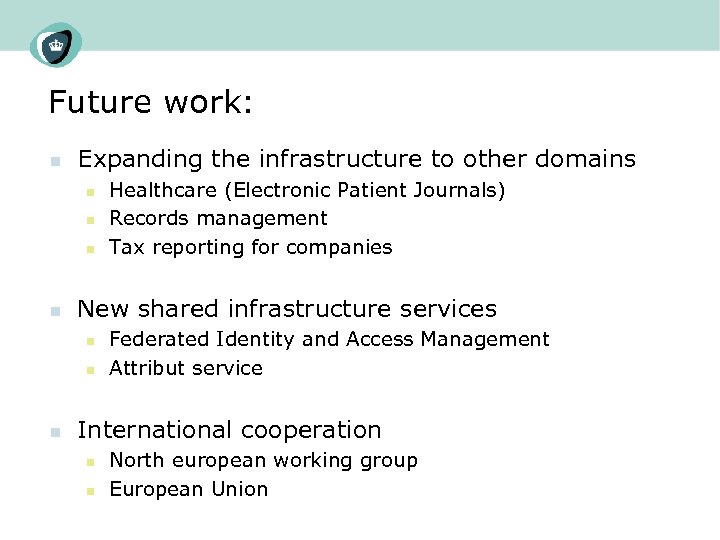
Future work: n Expanding the infrastructure to other domains n n New shared infrastructure services n n n Healthcare (Electronic Patient Journals) Records management Tax reporting for companies Federated Identity and Access Management Attribut service International cooperation n n North european working group European Union
Questions Service Oriented Infrastructure: http: //www. oio. dk/arkitektur/soa/infrastruktur/english Legislation and statute on electronic invoicing http: //www. oio. dk/XML/standardisering/e. Handel/materialer/OIOXMLe. Invoice Online Validator: http: //purl. oclc. org/NET/OIOXMLe. Faktura/validator Info. Structure. Base – repository / registry http: //isb. oio. dk mhb@itst. dk chl@vtu. dk
Скачать презентацию Reducing barriers for e-business in SME s through an
07751f81fa38fb65011566737b8ed5aa.ppt