


 Скачать презентацию Redshift Evolution Of The Morphology Density Relation Peter
72bc48e76ff808add559205eaa4c218a.ppt
- Количество слайдов: 15
 Redshift Evolution Of The Morphology Density Relation Peter Capak B. Mobasher, R. Abraham, R. Ellis, K. Sheth, N. Scoville Postdoctoral Fellow California Institute of Technology
 What Does Morphology Tell Us? • The light distribution of a galaxy • Linked to the orbits of the stars – Spherical galaxies are dynamically relaxed – Disk galaxies are not • Disk galaxies can become spheroids through interactions • Evolution of the morphological fraction traces the interaction history
 Morphology Density Relation • Higher Spheroid (E + S 0) galaxies in high density regions (Dressler et. Al. 1980) – Galaxies in dense regions are more relaxed • Seen up to z~1 (Dressler et. Al. 1996, Smith et. Al. 2004, Postman et. Al. 2005) • Possible differential evolution with redshift (Smith et. al. 2004) – Systematic Effects • Morphological classification • Density measurement
 Morphological Classification • Eyeball classification is the traditional method – Not practical for ~500, 000 galaxies – Need automated classifier – Not free from systematic effects • COSMOS is only one band (F 814 W) – Classifier must be independent of band shifting • Surface brightness dimming a problem – Classifier must be independent of surface brightness
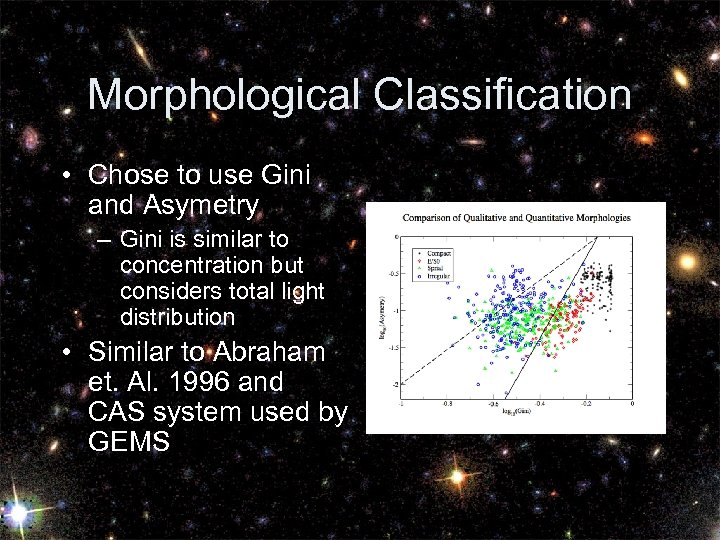 Morphological Classification • Chose to use Gini and Asymetry – Gini is similar to concentration but considers total light distribution • Similar to Abraham et. Al. 1996 and CAS system used by GEMS
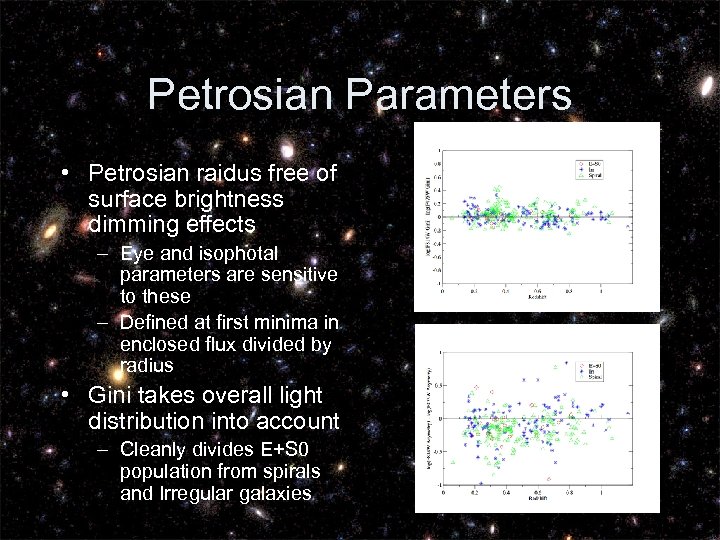 Petrosian Parameters • Petrosian raidus free of surface brightness dimming effects – Eye and isophotal parameters are sensitive to these – Defined at first minima in enclosed flux divided by radius • Gini takes overall light distribution into account – Cleanly divides E+S 0 population from spirals and Irregular galaxies
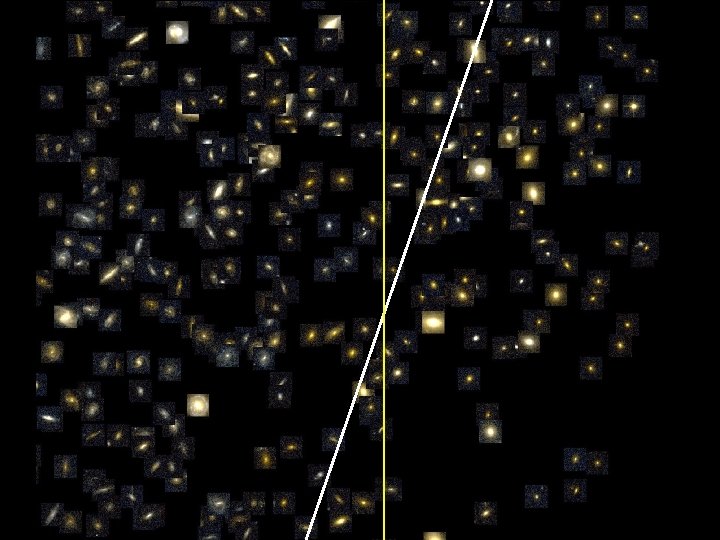
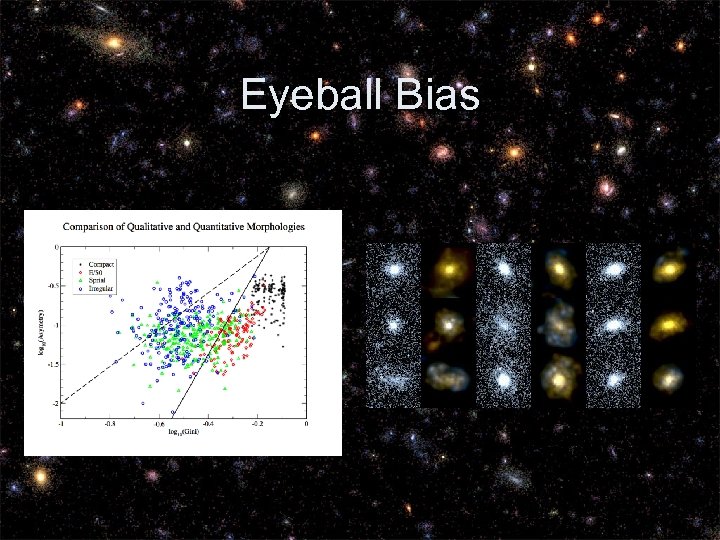 Eyeball Bias
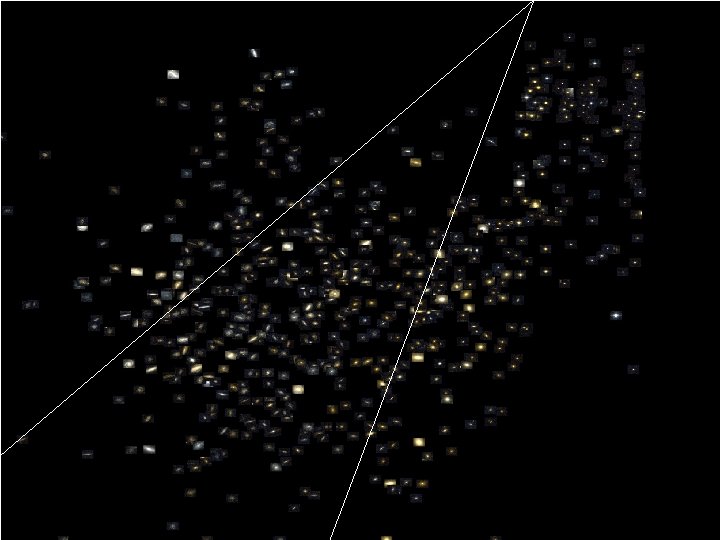
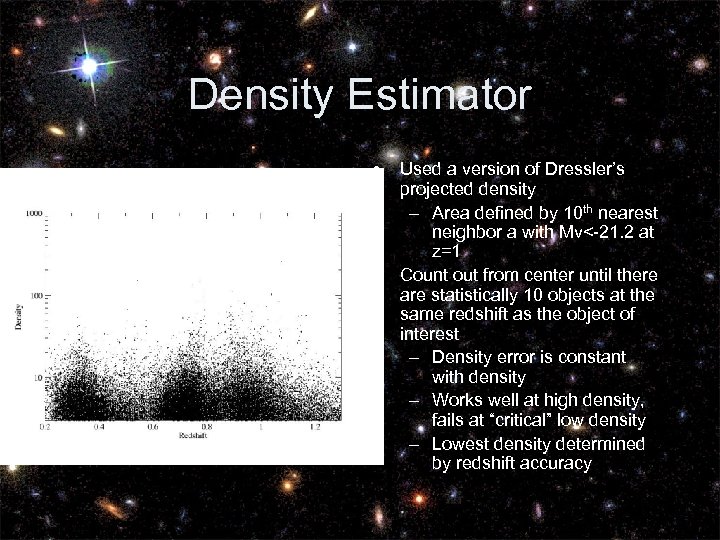 Density Estimator • • Used a version of Dressler’s projected density – Area defined by 10 th nearest neighbor a with Mv<-21. 2 at z=1 Count out from center until there are statistically 10 objects at the same redshift as the object of interest – Density error is constant with density – Works well at high density, fails at “critical” low density – Lowest density determined by redshift accuracy
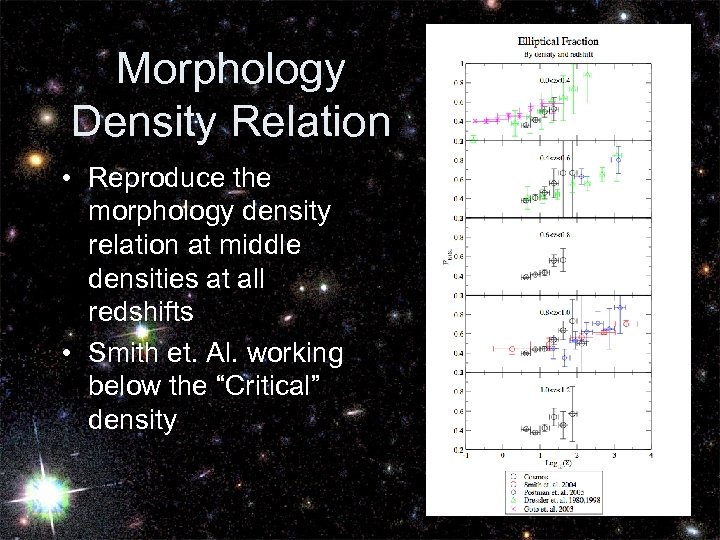 Morphology Density Relation • Reproduce the morphology density relation at middle densities at all redshifts • Smith et. Al. working below the “Critical” density
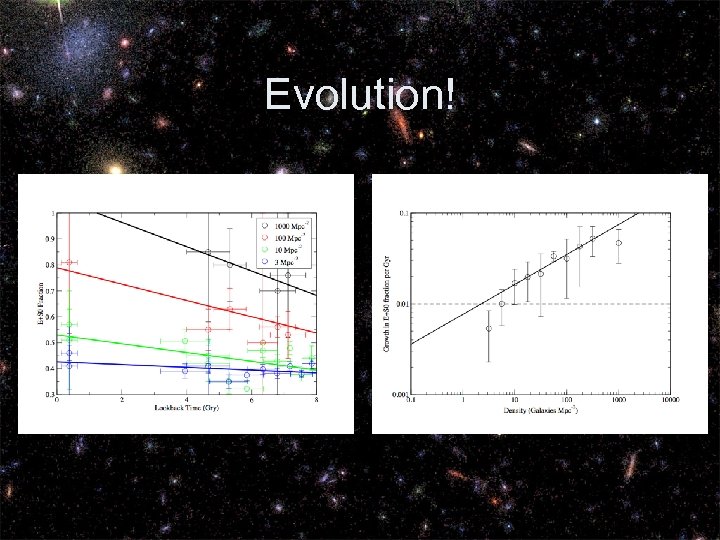 Evolution!
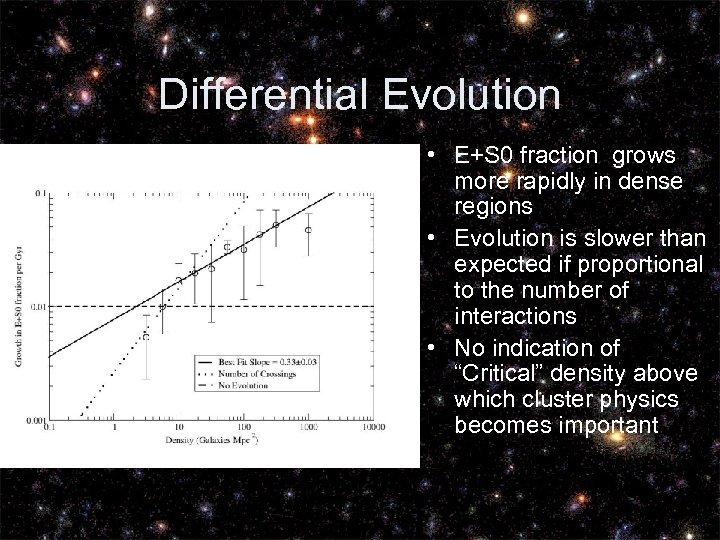 Differential Evolution • E+S 0 fraction grows more rapidly in dense regions • Evolution is slower than expected if proportional to the number of interactions • No indication of “Critical” density above which cluster physics becomes important
 Conclusions • Elliptical and spiral galaxies can be separated with single band morphologies • Density can be measured with photometric redshift accuracy • Morphology Density relation is differentially evolving – Slower than expected from a simple interaction model – However No “Critical” density down to 3 galaxies per Mpc 2