 Скачать презентацию Rediscovering Housing Need in England David Robinson Centre
0abd769839e5e865ef99290b5c1cf35e.ppt
- Количество слайдов: 23



Rediscovering Housing Need in England David Robinson Centre for Regional Economic and Social Research Sheffield Hallam University HSA Conference, University of York, 19 March 2012
Overview p Laying the Foundations: A Housing Strategy for England p Values and Failures: Narratives of Housing Need p Re-engaging Neglected Narratives
Laying the Foundations: A Housing Strategy for England HM Government 2011

This is a radical and unashamedly ambitious strategy – and it has two main aims. First, to help drive local economies and create jobs. Unblocking the market will provide a much-needed boost to employment. Second, these plans are designed to spread opportunity in our society. For too long, millions have been locked out of home ownership. We want to build an economy that works for everyone, one in which people who work hard and play by the rules can expect to own a decent home of their own. This goes right to the heart of what this Government is about. David Cameron and Nick Clegg (Foreword)
For the individual: Housing is crucial for our social mobility, health and wellbeing – with quality and choice having an impact on social mobility and wellbeing from an early age, and our homes accounting for about half of all household wealth. Social housing should provide support for those who need it, when they need it, and should help vulnerable people to live independently. And opportunities for wealth must be open to all, with housing choices helping rather than hindering people’s ability to build assets and find employment For society and the economy: Housing is inextricably linked to the wider health of the economy, the financial markets and consumer confidence. …. Getting house building moving again is crucial for economic growth …. Without building new homes our economic recovery will take longer than it needs to. Eric Pickles (Executive Summary)
Improving social mobility – helping everyone to enjoy that freedom to succeed – is the principal aim of the Government’s social policy. And to achieve this aim, we need to recognise the fundamentally important role that housing can play in supporting social mobility. People will want and need different things from housing throughout their lives. But there are common threads. People need to find housing in the right place – enabling them to find work, to maintain contacts with friends and family, and often to provide care. Housing needs to be suitable for the size and shape of the household. . . And housing can be a source of wealth – opening opportunities at critical life stages, such as helping children with their education or into home ownership in their own right. When these essential elements are not provided, housing can act as a brake on rather than as an engine of social mobility. Unfortunately, in recent years this has too often been the reality. (Chapter 1 Housing: the need for a new approach, p 1)
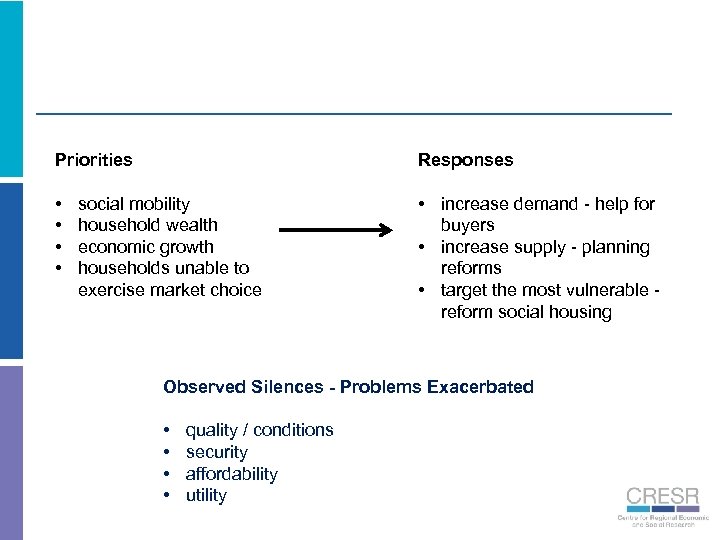
Priorities Responses • • • increase demand - help for buyers • increase supply - planning reforms • target the most vulnerable - reform social housing social mobility household wealth economic growth households unable to exercise market choice Observed Silences - Problems Exacerbated • • quality / conditions security affordability utility
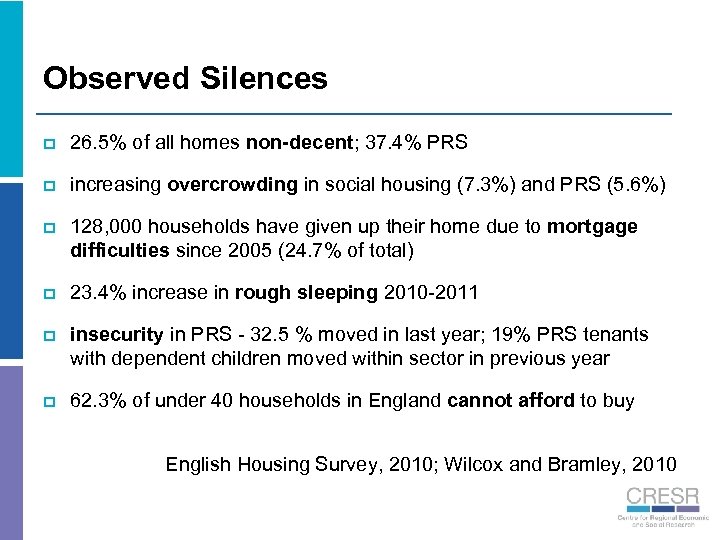
Observed Silences p 26. 5% of all homes non-decent; 37. 4% PRS p increasing overcrowding in social housing (7. 3%) and PRS (5. 6%) p 128, 000 households have given up their home due to mortgage difficulties since 2005 (24. 7% of total) p 23. 4% increase in rough sleeping 2010 -2011 p insecurity in PRS - 32. 5 % moved in last year; 19% PRS tenants with dependent children moved within sector in previous year p 62. 3% of under 40 households in England cannot afford to buy English Housing Survey, 2010; Wilcox and Bramley, 2010
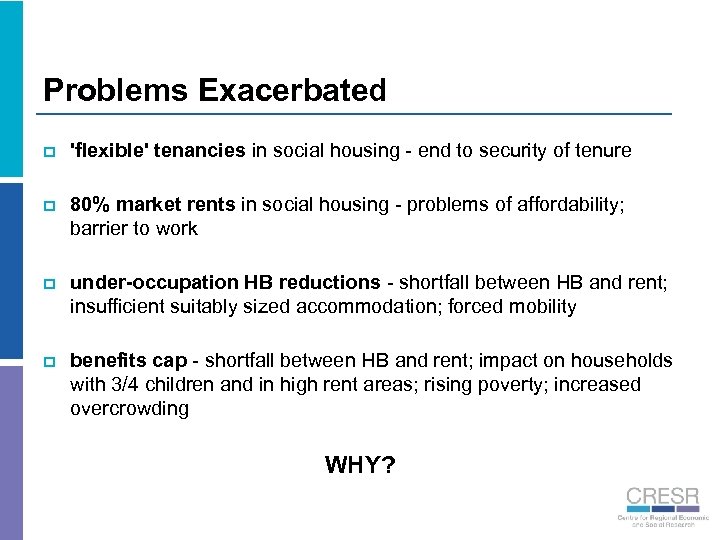
Problems Exacerbated p 'flexible' tenancies in social housing - end to security of tenure p 80% market rents in social housing - problems of affordability; barrier to work p under-occupation HB reductions - shortfall between HB and rent; insufficient suitably sized accommodation; forced mobility p benefits cap - shortfall between HB and rent; impact on households with 3/4 children and in high rent areas; rising poverty; increased overcrowding WHY?
Values and Failures: Narratives of Housing Need
p society tends to regard some level of housing provision as a necessity, irrespective of income and wealth or of the costs of provision p because the outcome of the market is thought unacceptable, suitable definitions of what is regarded as adequate must be developed p definitions involve assessments rooted in value judgements about the distributional failures that housing policy is seeking to overcome Whitehead (1991) p what values and what failures?
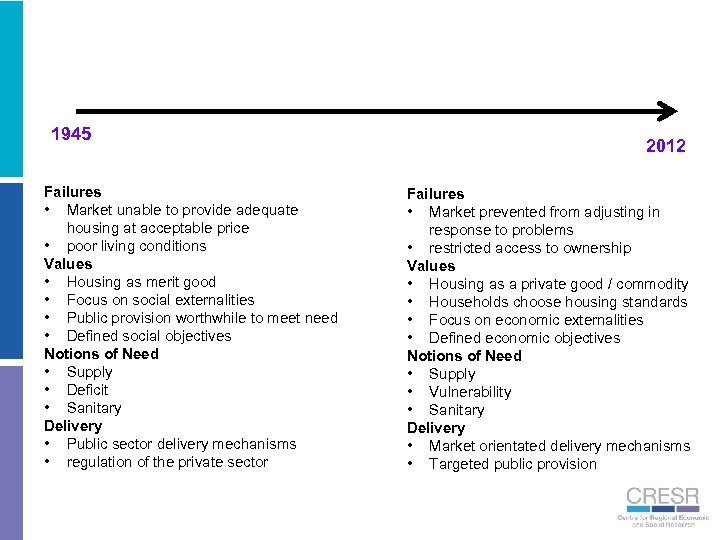
1945 Failures • Market unable to provide adequate housing at acceptable price • poor living conditions Values • Housing as merit good • Focus on social externalities • Public provision worthwhile to meet need • Defined social objectives Notions of Need • Supply • Deficit • Sanitary Delivery • Public sector delivery mechanisms • regulation of the private sector 2012 Failures • Market prevented from adjusting in response to problems • restricted access to ownership Values • Housing as a private good / commodity • Households choose housing standards • Focus on economic externalities • Defined economic objectives Notions of Need • Supply • Vulnerability • Sanitary Delivery • Market orientated delivery mechanisms • Targeted public provision
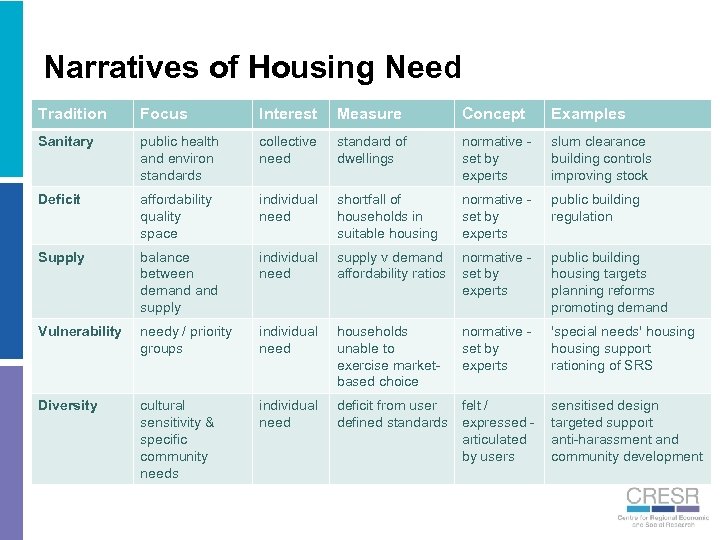
Narratives of Housing Need Tradition Focus Interest Measure Concept Examples Sanitary public health and environ standards collective need standard of dwellings normative - set by experts slum clearance building controls improving stock Deficit affordability quality space individual need shortfall of households in suitable housing normative - set by experts public building regulation Supply balance between demand supply individual need supply v demand affordability ratios normative - set by experts public building housing targets planning reforms promoting demand Vulnerability needy / priority groups individual need households unable to exercise marketbased choice normative - set by experts 'special needs' housing support rationing of SRS Diversity cultural sensitivity & specific community needs individual need deficit from user felt / defined standards expressed - articulated by users sensitised design targeted support anti-harassment and community development
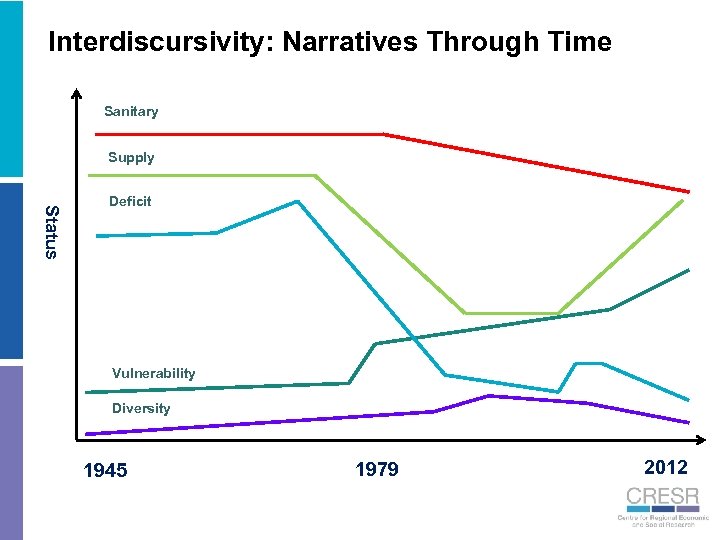
Interdiscursivity: Narratives Through Time Sanitary Supply Status Deficit Vulnerability Diversity 1945 1979 2012
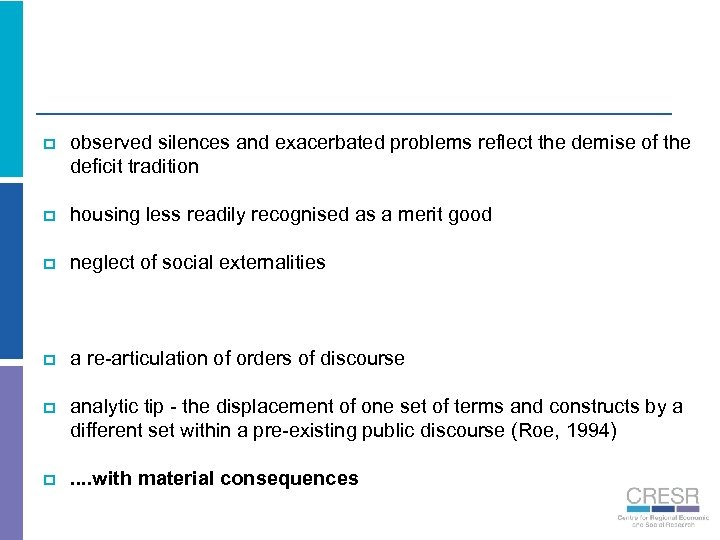
p observed silences and exacerbated problems reflect the demise of the deficit tradition p housing less readily recognised as a merit good p neglect of social externalities p a re-articulation of orders of discourse p analytic tip - the displacement of one set of terms and constructs by a different set within a pre-existing public discourse (Roe, 1994) p . . with material consequences
Re-engaging with Neglected Narratives of Housing Need
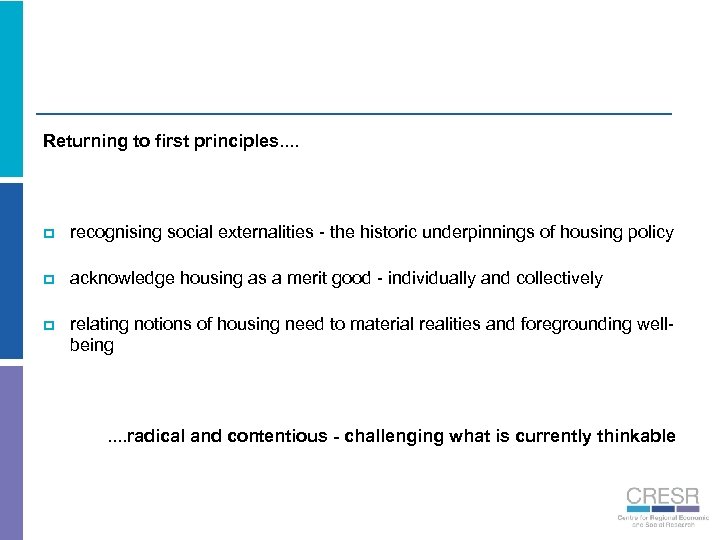
Returning to first principles. . p recognising social externalities - the historic underpinnings of housing policy p acknowledge housing as a merit good - individually and collectively p relating notions of housing need to material realities and foregrounding wellbeing . . radical and contentious - challenging what is currently thinkable
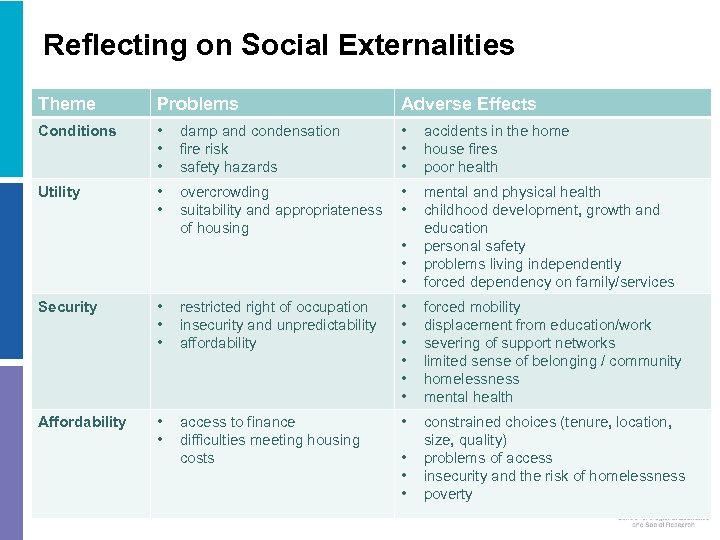
Reflecting on Social Externalities Theme Problems Adverse Effects Conditions • • • damp and condensation fire risk safety hazards • • • Utility • • overcrowding • suitability and appropriateness • of housing • • • Security • • • restricted right of occupation insecurity and unpredictability affordability • • • forced mobility displacement from education/work severing of support networks limited sense of belonging / community homelessness mental health Affordability • • access to finance difficulties meeting housing costs • constrained choices (tenure, location, size, quality) problems of access insecurity and the risk of homelessness poverty • • • accidents in the home house fires poor health mental and physical health childhood development, growth and education personal safety problems living independently forced dependency on family/services
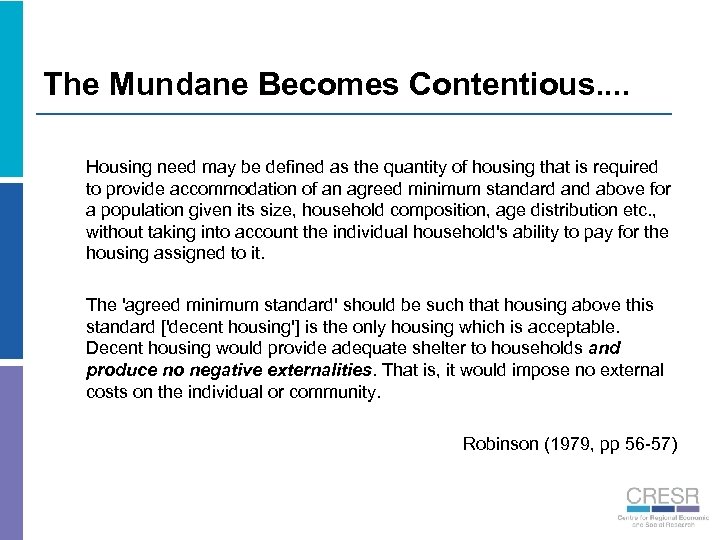
The Mundane Becomes Contentious. . Housing need may be defined as the quantity of housing that is required to provide accommodation of an agreed minimum standard and above for a population given its size, household composition, age distribution etc. , without taking into account the individual household's ability to pay for the housing assigned to it. The 'agreed minimum standard' should be such that housing above this standard ['decent housing'] is the only housing which is acceptable. Decent housing would provide adequate shelter to households and produce no negative externalities. That is, it would impose no external costs on the individual or community. Robinson (1979, pp 56 -57)

Some important caveats - vulnerability and diversity p the failings of the 'metanarrative' - presumption that universalistic notions and measures are superior to local or more grounded stories p universalistic standards might not always be in line with specific consumers' priorities p a focus on physical targets and aesthetics can result in disregard for occupiers and their individual notions of home and need p existing policy levers might not be capable of meeting identified need Harrison (2004)
In Conclusion
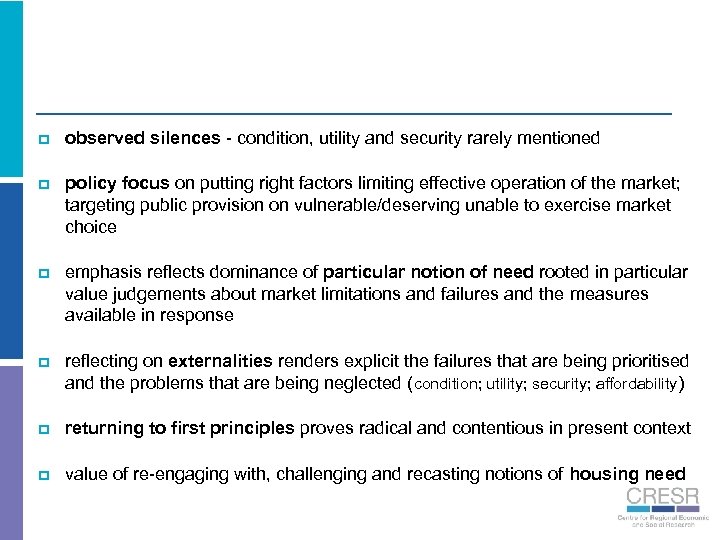
p observed silences - condition, utility and security rarely mentioned p policy focus on putting right factors limiting effective operation of the market; targeting public provision on vulnerable/deserving unable to exercise market choice p emphasis reflects dominance of particular notion of need rooted in particular value judgements about market limitations and failures and the measures available in response p reflecting on externalities renders explicit the failures that are being prioritised and the problems that are being neglected (condition; utility; security; affordability) p returning to first principles proves radical and contentious in present context p value of re-engaging with, challenging and recasting notions of housing need
References p Department for Communities and Local Government (2012) English Housing Survey. London: DCLG. p Harrison, M. (2004) Defining housing quality and environment: disability, standards and social factors. Housing Studies, 19, 5, 691 -708. p HM Government (2011) Laying the Foundations: A Housing Strategy for England. London: DCLG. p Robinson, R (1979) Housing Economics and Public Policy. London: Macmillan. p Roe, E. (1994) Narrative Policy Analysis: Theory and Practice. Duke University Press. p Whitehead, C. (1991) From need to affordability: an analysis of UK housing objectives. Urban Studies, 28, 6, 1991 871 -887. p Wilcox, S. and Bramley, G. (2010) Evaluating requirements for market and affordable housing. Fareham: NHPAU.
Скачать презентацию Rediscovering Housing Need in England David Robinson Centre
0abd769839e5e865ef99290b5c1cf35e.ppt