


 Скачать презентацию Redesign Medicaid in New York State MRT
df1e54aa1de466e19b48bec4c6625093.ppt
- Количество слайдов: 43
 Redesign Medicaid in New York State MRT Affordable Housing Work Group February 22, 2013 – 10: 00 AM to 3: 00 PM New York State Department of Health Metropolitan Regional Office New York City
 Goals for Today o Update the MRT Work Group on the progress of the sub work groups: Ø o These are ideas developed by members of the sub work groups. Achieve general consensus on a series of policy recommendations. Medicaid Redesign Affordable Housing Work Group 2
 MRT Affordable Housing Work Groups o Program Model and Development & Funding Ted Houghton, Chair ü Brenda Rosen, Chair ü Tony Hannigan, Co-Chair ü o Planning and Service Coordination ü Constance Tempel, Chair ü Kristin Miller, Co-Chair Medicaid Redesign Affordable Housing Work Group 3
 Program Model and Development & Funding Work Group
 Program Model and Development & Funding Work Group 1. Identify barriers to moving high-need individuals into supportive housing. 2. Identify New Affordable/Supportive Housing Models. 3. Define “supportive housing. ” 4. Advise the State on how to allocate 2013 -14 MRT Supportive Housing Funds. 5. Advise the State on appropriate set-asides and incentives for supportive housing. 6. Develop principles for a new supportive housing initiative. 7. Develop a plan to create “social impact investment bonds. ” 8. Identify ways to leverage federal and private funds. Medicaid Redesign Affordable Housing Work Group 5
 Updates & Discussion Items o Supportive housing definition. o MRT Supportive Housing Allocation Plan Recommendations. o Model Design Elements of Pilot Programs. Medicaid Redesign Affordable Housing Work Group 6
 Defining Supportive Housing o Supportive housing is defined as affordable rental housing operated by non-profit organizations, in which all members of the tenant household have easy, facilitated access to a flexible and comprehensive array of supportive services designed to assist the tenants to achieve and sustain housing stability and to live more productive lives in the community. o Supportive housing units are intended to meet the needs of people with special needs who are homeless or would be at-risk of homelessness-or cycling through institutional care-were it not for the integration of affordable housing and supportive services. Medicaid Redesign Affordable Housing Work Group 7
 Defining Supportive Housing A supportive housing unit is defined by the following elements: o The unit is available to, and intended for, a person or family whose head of household or member is homeless, or at-risk of homelessness/institutionalization, and has multiple barriers to employment and housing stability, which might include mental illness, chemical dependency, and/or other disabling or chronic health conditions; o The tenant household ideally pays no more than 30% household income towards rent and utilities, and never pays more than 50% of income toward such housing expenses; o The tenant household has a lease (or similar form of occupancy agreement) in permanent affordable rental housing with no limits on length of tenancy, as long as the terms and conditions of the lease or agreement are met; Medicaid Redesign Affordable Housing Work Group 8
 Defining Supportive Housing (continued) o The unit’s operations are managed through an effective partnership among representatives of the project owner and/or sponsor, the property management agent, the supportive services providers, the relevant public agencies, and the tenants; o All members of the tenant household have easy, facilitated access to flexible and comprehensive array of supportive services designed to assist the tenants to achieve and sustain housing stability; o Service providers proactively seek to engage tenants in on-site and community-based supportive services, but participation in such supportive servicers is not a condition of ongoing tenancy; and o Service and property management strategies include effective, coordinated approaches for addressing issues resulting from substance use, relapse, mental health crises and medical circumstances, with a focus on fostering housing stability Medicaid Redesign Affordable Housing Work Group 9
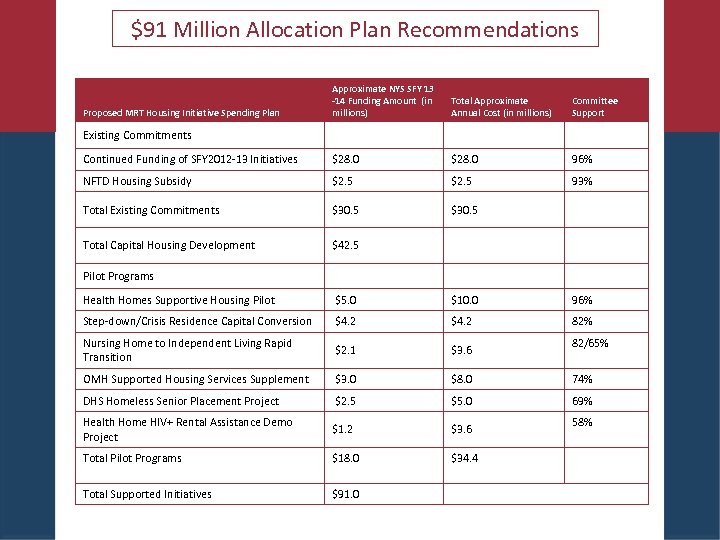 $91 Million Allocation Plan Recommendations Approximate NYS SFY 13 -14 Funding Amount (in millions) Total Approximate Annual Cost (in millions) Committee Support Continued Funding of SFY 2012 -13 Initiatives $28. 0 96% NFTD Housing Subsidy $2. 5 93% Total Existing Commitments $30. 5 Total Capital Housing Development $42. 5 Proposed MRT Housing Initiative Spending Plan Existing Commitments Pilot Programs Health Homes Supportive Housing Pilot $5. 0 $10. 0 96% Step-down/Crisis Residence Capital Conversion $4. 2 82% Nursing Home to Independent Living Rapid Transition $2. 1 $3. 6 OMH Supported Housing Services Supplement $3. 0 $8. 0 74% DHS Homeless Senior Placement Project $2. 5 $5. 0 69% Health Home HIV+ Rental Assistance Demo Project $1. 2 $3. 6 Total Pilot Programs $18. 0 $34. 4 Total Supported Initiatives $91. 0 82/65% 58%
 Pilot Program Descriptions $34. 4 million Annual Cost $18 million SFY 2013 -14
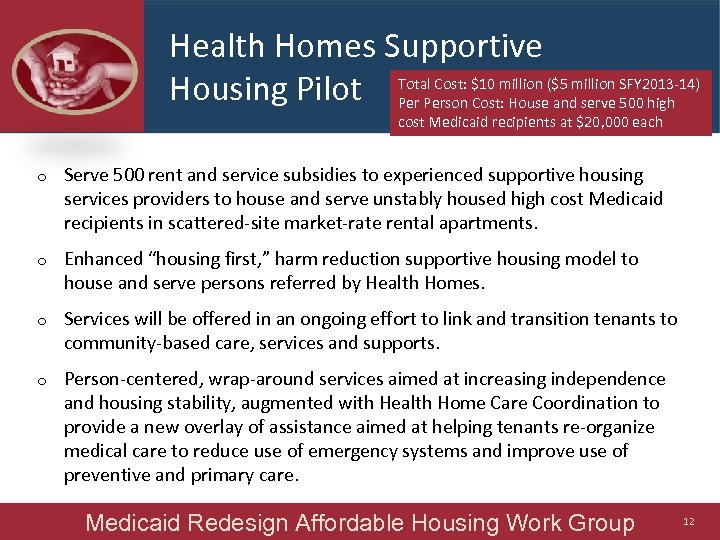 Health Homes Supportive Housing Pilot Total Cost: $10 million ($5 million SFY 2013 -14) Person Cost: House and serve 500 high cost Medicaid recipients at $20, 000 each o Serve 500 rent and service subsidies to experienced supportive housing services providers to house and serve unstably housed high cost Medicaid recipients in scattered-site market-rate rental apartments. o Enhanced “housing first, ” harm reduction supportive housing model to house and serve persons referred by Health Homes. o Services will be offered in an ongoing effort to link and transition tenants to community-based care, services and supports. o Person-centered, wrap-around services aimed at increasing independence and housing stability, augmented with Health Home Care Coordination to provide a new overlay of assistance aimed at helping tenants re-organize medical care to reduce use of emergency systems and improve use of preventive and primary care. Medicaid Redesign Affordable Housing Work Group 12
 Health Homes Supportive Housing Pilot o Key program components include: Ø Scattered Site units available to Health Homes across state; Ø Funding for operating and services would be RFP’d to housing providers applying in partnership with Health Homes; Ø Contracts of 25 to 50 units would be held by experienced supportive housing providers, managed by OTDA; Ø Contracts will provide $20, 000 per individual per year to cover rental costs, service and support staff; Medicaid Redesign Affordable Housing Work Group 13
 Health Homes Supportive Housing Pilot (continued) o Key program components include: Ø Government agency (NYC HRA, DOH, OMH SPOA) would certify eligibility; Ø Health Homes would manage referral process and prioritize clients for housing; Ø Health Home care coordination is conducted directly by the housing provider, or through explicit Health Home-Supportive Housing Provider agreements that spell out how care coordination will be integrated with housing-based services; Ø Specific diagnoses will not be a criteria for eligibility Ø Once placed in housing, tenants will receive person-centered, wraparound case management services aimed at increasing independence and housing stability Ø Active, collaborative, real-time evaluation and data collection. Medicaid Redesign Affordable Housing Work Group 14
 Nursing Home to Independent Living Rapid Transition Total Cost: $3. 6 million ($2. 1 million in SFY 2013 -14) Person Cost: Will serve 200 individuals at approximately $24, 000 each per year o Offer individuals with mobility impairments or other severe physical disabilities an alternative pathway to community living. o Housing subsidies, combined with MLTC enrollment or service funding will allow targeted high cost Medicaid recipients who live in nursing homes or are nursing home eligible to move into an apartment in the community. o Program activities will include educational outreach and identification of eligible, interested and capable high cost Medicaid recipients who are homeless or living in nursing homes with physical disabilities. Comprehensive assessment relating to living environment, transitional needs, and long-term care needs and customized retrofitting of apartments will follow. o The individual’s move and full transition to independent living will be facilitated by the support team of staff, funded through the MLTC waiver or a relatively modest services contract. Medicaid Redesign Affordable Housing Work Group 15
 Step-down/Crisis Residence Capital Conversion Total Capital Cost: $800, 000 (one-time cost) One year’s operating costs: $3 million for twelve residences with 24 -36 beds total (NYC-5; Long Island-2; Rest of State-5) Person Cost: 2 week avg LOS = 100 high cost Medicaid recipients in crisis. o Transition individuals from psychiatric hospitals into community settings and divert individuals in crisis from use of such services. o Short-term level of intensive behavioral health respite care for individuals being discharged from psychiatric hospitals, not quite ready for a full transition into the community. o The designated providers would work in partnership with hospitals to identify and assess individuals in need of transitional services, as well as screen and assess individuals in crisis who may require short-term diversionary placement services. Medicaid Redesign Affordable Housing Work Group 16
 Step-down/Crisis Residence Capital Conversion (continued) o This type of pilot program would allow for a specified number of existing community residential service providers to convert a certain number of beds into crisis or step-down service units. o The proposed model would require funding for startup costs, including one-time capital improvement dollars to reconfigure spaces to be able to provide crisis and transitional services, and staff training. Medicaid Redesign Affordable Housing Work Group 17
 OMH Supported Housing Services Supplement $8 million ($3 million in SFY 2013 -14) Person Cost: 1, 600 high cost Medicaid recipients at $5, 000 each per year o Supplementary funding to allow nonprofit OMH Supported Housing providers to offer a time-limited service enhancement to SPMI high-cost Medicaid recipients enrolled in Health Homes and living in scattered-site apartments. o The augmented services will supplement the minimal services in OMH Supported Housing in order to provide necessary day-to-day continuity of place-based, wraparound support services through a flexible critical time intervention approach o More direct and active engagement to achieve successful adjustment and stabilization during a flexible 12 -month transition from institutions (psychiatric hospitals, adult homes, shelters, street, jails/prisons) to the community. Medicaid Redesign Affordable Housing Work Group 18
 OMH Supported Housing Services Supplement (continued) Program elements will include: Ø A focus on managing the social determinants of health that impact tenure in housing. Ø Evidenced-based practices delivered in a housing context to assist with the adoption of a healthy life style. Ø Leading and supporting the individual to engage in, and follow up with, medical and behavioral services, in conjunction with health home care coordination. Ø Connect the individual to opportunities forging healthy and naturally occurring relationships in the community, critical for people with SMI who tend to isolation and recidivism to shelters and hospitals. Medicaid Redesign Affordable Housing Work Group 19
 Homeless Senior Placement Project Total Cost: $2. 5 million/$5. 0 million Total Person Cost: 300 individuals at approximately $14, 000 person per year o A Housing intervention intended to reduce Medicaid spending that is predictive – targeting a group of individuals who are likely to become high Medicaid users rather than those that have been in the past. o Among the current shelter population, there are 578 single adults age 55 and over and receiving SSI who, as a group, are largely defined by these characteristics. o Annual $2. 3 m in rent subsidy, $1. 4 m for an increased amount of aftercare transitional services provided by shelter provider and $300 k in apartment locator, inspection and placement services. Medicaid Redesign Affordable Housing Work Group 20
 Health Home HIV+ Rental Assistance Demonstration Project Total Cost: $3. 6 million (SFY 13 -14: $1. 2 million ) Person Cost: Serve 200 persons o Rental assistance for 200 homeless and unstably housed Health Home participants diagnosed with HIV infection but medically ineligible for the existing HIV-specific enhanced rental assistance program for New Yorkers with AIDS or advanced HIV-illness (AIDS Rental Assistance). o Provides rental subsidies, apartment locating services, broker’s fees and security deposits for 200 HIV+ individuals o Administered by Health Home providers as a component of Care Coordination o Available to HIV+ Medicaid-eligible households who have an immediate housing but whose HIV disease has not progressed to the point of eligibility for the AIDS Shelter Allowance o The project would employ an experimental design to evaluate health care utilization, outcomes and costs in the periods before and after receipt of rental assistance for the pilot group of HIV+ Health Home participants. Medicaid Redesign Affordable Housing Work Group 21
 Additional Considered Pilots Senior Supportive Housing Models o Provide stable, affordable senior housing plus services to enable low-income seniors to remain in the community; provide a platform for Medicaid Managed Long Term Care and Health Home services; and support the transition of people from nursing homes to the community and independent living. Medicaid Redesign Affordable Housing Work Group 22
 Additional Considered Pilots Senior Supportive Housing Models Program Elements Proposed: o Capital grant: capital funding would be available to incorporate supportive housing features such as universal design modifications, renovation and reconfiguration including co-location of supportive services, gap financing for new senior housing “pipeline” construction, security systems and other technologies for residents to maintain safety and independence, vehicles to provide transportation for residents, or other projects as determined by the department of health. o Supportive services: assistance with obtaining meals, access to groceries and pharmacy, transportation, referral services related to resources available in the community, housekeeping, and security. Grant funding will be limited to funding for the services explicitly stated above. Medicaid Redesign Affordable Housing Work Group 23
 Planning and Service Coordination Work Group
 Planning and Service Coordination Work Group 1. Improve interagency coordination. 2. Improve the Capital Development process. 3. Evaluate perceived barriers to utilization of supportive housing. 4. Provide advice on overall coordination and implementation of supportive housing policy. 5. Improve the coordination and timing of the availability of housing. Medicaid Redesign Affordable Housing Work Group 25
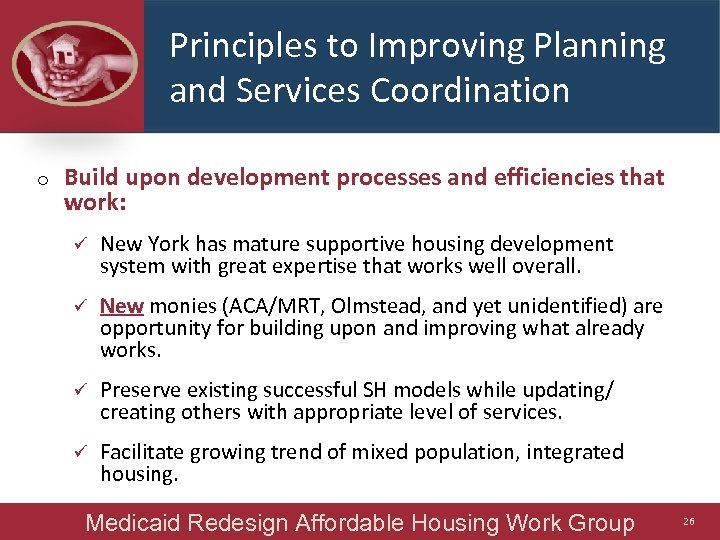 Principles to Improving Planning and Services Coordination o Build upon development processes and efficiencies that work: ü New York has mature supportive housing development system with great expertise that works well overall. ü New monies (ACA/MRT, Olmstead, and yet unidentified) are opportunity for building upon and improving what already works. ü Preserve existing successful SH models while updating/ creating others with appropriate level of services. ü Facilitate growing trend of mixed population, integrated housing. Medicaid Redesign Affordable Housing Work Group 26
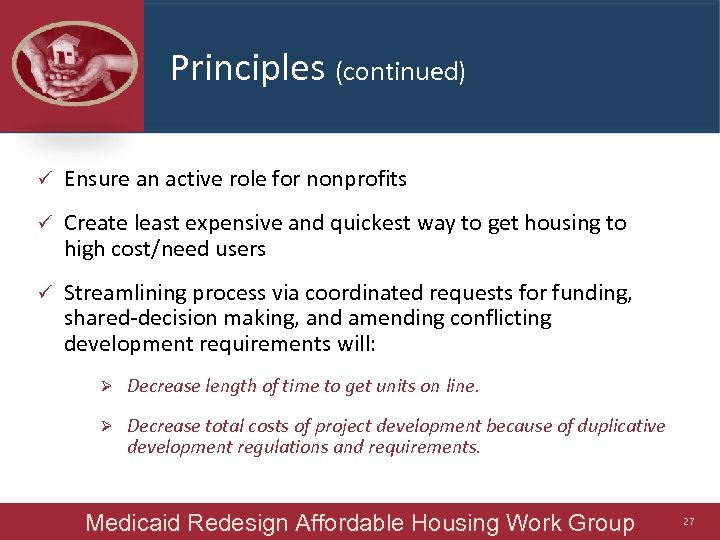 Principles (continued) ü Ensure an active role for nonprofits ü Create least expensive and quickest way to get housing to high cost/need users ü Streamlining process via coordinated requests for funding, shared-decision making, and amending conflicting development requirements will: Ø Decrease length of time to get units on line. Ø Decrease total costs of project development because of duplicative development regulations and requirements. Medicaid Redesign Affordable Housing Work Group 27
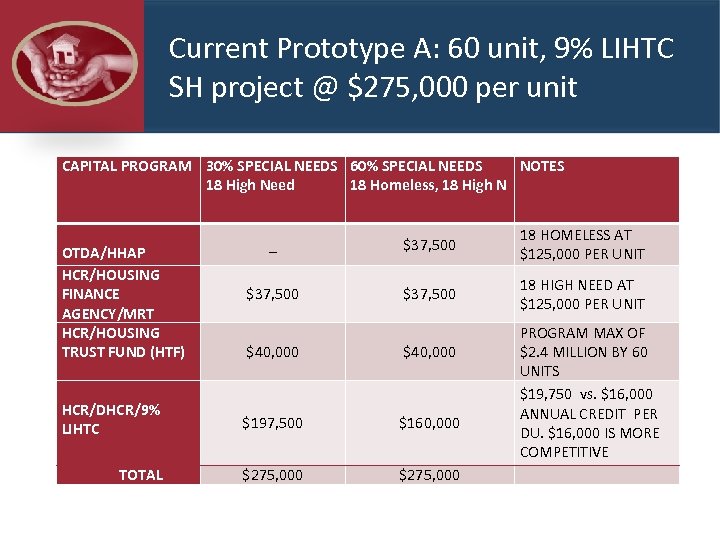 Current Prototype A: 60 unit, 9% LIHTC SH project @ $275, 000 per unit CAPITAL PROGRAM 30% SPECIAL NEEDS 60% SPECIAL NEEDS NOTES 18 High Need 18 Homeless, 18 High N OTDA/HHAP HCR/HOUSING FINANCE AGENCY/MRT HCR/HOUSING TRUST FUND (HTF) _ $37, 500 18 HOMELESS AT $125, 000 PER UNIT $37, 500 18 HIGH NEED AT $125, 000 PER UNIT $40, 000 HCR/DHCR/9% LIHTC $197, 500 $160, 000 TOTAL $275, 000 PROGRAM MAX OF $2. 4 MILLION BY 60 UNITS $19, 750 vs. $16, 000 ANNUAL CREDIT PER DU. $16, 000 IS MORE COMPETITIVE
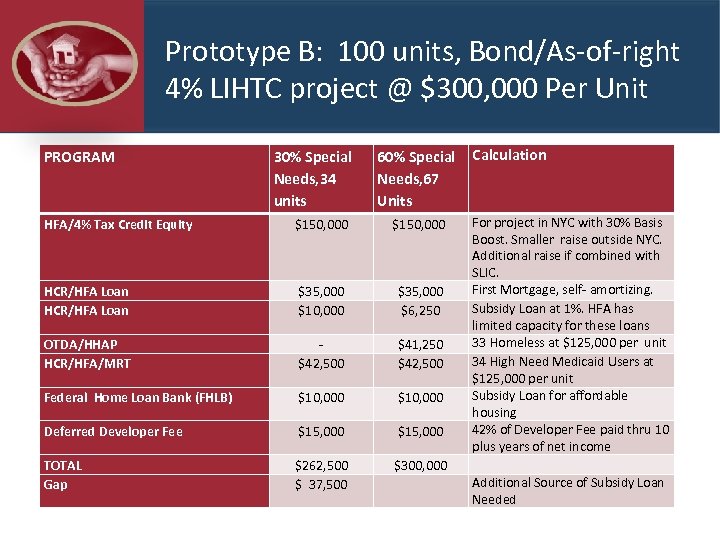 Prototype B: 100 units, Bond/As-of-right 4% LIHTC project @ $300, 000 Per Unit PROGRAM 30% Special Needs, 34 units 60% Special Needs, 67 Units HFA/4% Tax Credit Equity $150, 000 HCR/HFA Loan $35, 000 $10, 000 $35, 000 $6, 250 OTDA/HHAP HCR/HFA/MRT $42, 500 $41, 250 $42, 500 Federal Home Loan Bank (FHLB) $10, 000 Deferred Developer Fee $15, 000 TOTAL Gap $262, 500 $ 37, 500 $300, 000 Calculation For project in NYC with 30% Basis Boost. Smaller raise outside NYC. Additional raise if combined with SLIC. First Mortgage, self- amortizing. Subsidy Loan at 1%. HFA has limited capacity for these loans 33 Homeless at $125, 000 per unit 34 High Need Medicaid Users at $125, 000 per unit Subsidy Loan for affordable housing 42% of Developer Fee paid thru 10 plus years of net income Additional Source of Subsidy Loan Needed
 Recommendation 1: Streamline SH Capital Development Function o Build upon existing HHAC model. o Create development process that coordinates timing of awards and requirements of various RFPs, underwriting, design, timetables, legal docs. o HPD SH Loan Program-like model: responsible for SH capital awards but consults/ties in with health & human service agencies for operation and services. o Retain expertise of health & human service agencies. o Ensure health & human service agencies still have ownership of the process and product. o State partners with SH developers and continue to share risk of SH development. Medicaid Redesign Affordable Housing Work Group 30
 Recommendation 2: Create Funding Council to Facilitate Integrated Housing o Create Coordinated Funding Council to assure timely awards of capital, operating and service dollars from various agencies to individual projects o The Funding Council’s impact on SH development: ü Retain rolling RFP’s yet allow HHAP to inform Unified Funding Application determinations for early vetting of projects. ü Maintain value of OTDA/HHAP connection to LSS districts & Co. Cs plans. ü Set minimum for on-site service provisions & quality of services. ü Retain SH underwriting provisions, e. g. , larger operating reserves, design specifications, rent-up provisions. ü Ensure robust asset management capacity. Medicaid Redesign Affordable Housing Work Group 31
 Create Funding Council to Facilitate Integrated Housing (continued) o Maintain ability to fund different models of PSH (without tax credits, very small projects). o Maintain lead role/ownership of supportive housing development for non-profit developers. o Provide adequate pre-development and acquisition funds. o Maintain set-aside and point preferences for SH at HCR. o Funding Council examples include NJ, WA and CT’s joint release and review of supportive housing funding requests. Medicaid Redesign Affordable Housing Work Group 32
 Recommendation 3: Create Targeting Mechanism o Principles to Targeting Utilization of Supportive Housing: ü No wrong door to SH for high need/cost Medicaid recipient with inappropriate or no housing. ü Constant and predictable intake/placement process that is flexible based on location, changing target population and/or changing population needs. ü Promotes tenant mobility and choice, and solicits tenant feedback. Medicaid Redesign Affordable Housing Work Group 33
 Targeting Pilot for High Users of Medicaid o Create standardized eligibility and assessment process modeled on Money Follows the Person: ü Data-driven identifying high cost Medicaid users through data matching and/or case finding predictive algorithms that look at multiple years of data; ü Matched with homeless or inappropriately housed; and ü Assessment of type of housing needed by person. o Assist providers in accepting high need referrals. o Provide training and resources, as needed. Medicaid Redesign Affordable Housing Work Group 34
 Example: DESC’s 1811 Eastlake (Seattle, WA) o Supportive housing for 75 individuals with chronic alcohol addiction. o Tenants identified through County data analysis of highest users of county detox and jail services. o Evaluation found decrease in use of detox and jail services resulting in a 76% decrease in public costs (including 41% decrease in Medicaid costs) and significant decreases in alcohol use. Medicaid Redesign Affordable Housing Work Group 35
 New York Medicaid Targeting Pilot o Data match between Medicaid and homelessness data systems (e. g. NYC CARES or HMIS (Upstate)) to identify homeless, high-cost Medicaid clients: ü Begin with Health Home Health Status/Severity Groups. ü Match HH groups to homelessness data to identify individuals with specific threshold of homelessness (e. g. at least 120 days). ü Determine prevalence of homelessness among groups. ü Matched individuals become eligible for housing unit/subsidy plus care management services corresponding to severity/acuity rating. Medicaid Redesign Affordable Housing Work Group 36
 Recommendation 4: Create Placement and Tracking System o Medicaid High Utilizer Placement System must: ü Clearly define process for prioritizing populations based on cost and clinical appropriateness for housing, not diagnostic or population group priorities ü Efficiently identify available supportive housing units § § ü Web-based master list of all housing appropriate for supportive housing placements, including set-asides Track Section 504 accessible units = coming on line through development and vacancies Effectively match people, housing and appropriate support Medicaid Redesign Affordable Housing Work Group 37
 Placement and Tracking System (continued) o Transparent feedback loop ü Tracking health outcomes, cost outcomes, and process outcomes (e. g. , how long the matching process takes, comparative performance of contracted agencies, satisfaction of individual patients with housing and housing stability) to drive quality improvement. ü Local systems set metrics at the outset and report key data monthly to MRT leadership. Regional learning network regularly share challenges and innovative solutions to overcoming barriers to enable effective and rapid implementation. Medicaid Redesign Affordable Housing Work Group 38
 Examples of Placement Systems o CSH Housing Options Tool (HOT): ü Web-based tool that quickly and easily connects users with a ranked list of customized housing options. ü Currently in use in Chicago, Indiana, and is in development in Connecticut. ü Can be used as a universal housing application and centralized waitlist. ü Streamlines the process of accessing housing for clients, organizations and the system. Medicaid Redesign Affordable Housing Work Group 39
 Examples of Placement Systems o CUCS: ü Database that identifies all vacancies in NY/NY I & II funded units (NYC). ü SPOA: Single Point of Access. Medicaid Redesign Affordable Housing Work Group 40
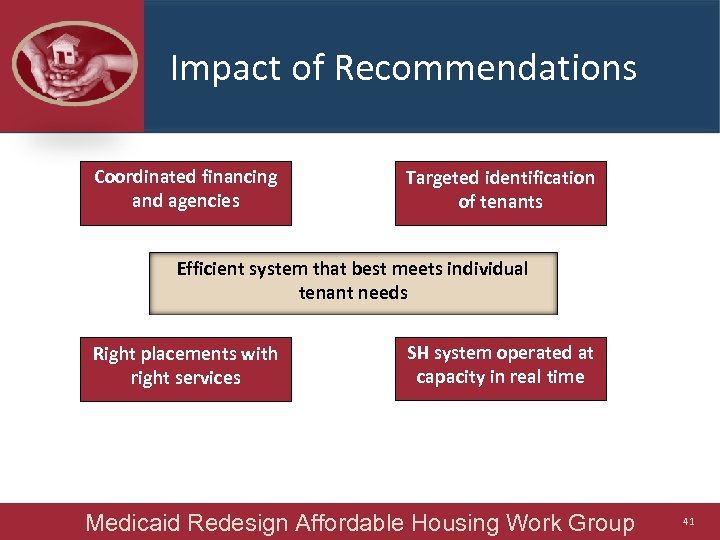 Impact of Recommendations Coordinated financing and agencies Targeted identification of tenants Efficient system that best meets individual tenant needs Right placements with right services SH system operated at capacity in real time Medicaid Redesign Affordable Housing Work Group 41
 Coordination Next Steps o Placement and Tracking System: Undergo a Needs Assessment to determine: Tracking systems already in place; ü Requirements of new system; ü Where to pilot the new system. ü o Earmark $10, 000 - $50, 000 for Needs Assessment and $50, 000 -$150, 000 for programming new system. o Similar process and numbers for Targeting Tool. Medicaid Redesign Affordable Housing Work Group 42
 Next Steps o March Meeting Ø Moving On Initiative Ø Salient Education and Training Ø Social Impact Bonds Medicaid Redesign Affordable Housing Work Group 43