


 Скачать презентацию Red Rock Seminar Design Pattern Factory Patterns
9da8a5f6f1fab8ff205ca0a87d944122.ppt
- Количество слайдов: 20
 Red. Rock Seminar Design Pattern – Factory Patterns Aniruddha Chakrabarti Target Corp India Red. Rock
 What is Design Pattern • Addresses a recurring design problem that arises in specific design situations and presents a solution to it. • Constitutes a set of rules describing how to accomplish certain tasks in software development • Focus more on reuse of recurring architectural design themes, while frameworks focus on detailed design and implementation • Identify and specify abstractions that are above the level of single classes and instances or of components. (Gamma, Johnson, and Vlissides, 1993) • Helps in improving code quality Target Corp India Red. Rock
 Little bit of History • Began to be recognized more formally in the early ‘ 90 s by Eric Gamma - described patterns incorporated in the GUI app f/w • Continued Discussion & meeting lead to publication of parent book – “Design Patterns: Elements of Reusable Software” by Gof (Erich Gamma, Richard Helm, Ralph Johnson, & John Vlissides) in ‘ 95 – Had a powerful impact on S/W Development community – Became an all-time bestseller. Describes 23 commonly occurring & generally useful patterns & comments on how and when to apply them. • Other useful books were published later – One closely related book is The Design Patterns Smalltalk Companion – Later books on different language like Java, VB, . net were published Target Corp India Red. Rock
 Grouping Design Patterns • Creational patterns create objects for you rather than having you instantiate objects directly. Gives program more flexibility in deciding which objects need to be created for a given case • Structural patterns help you compose groups of objects into larger structures, such as complex user interfaces or accounting data. • Behavioral patterns help you define the communication between objects in your system and how the flow is controlled in a complex program. Target Corp India Red. Rock
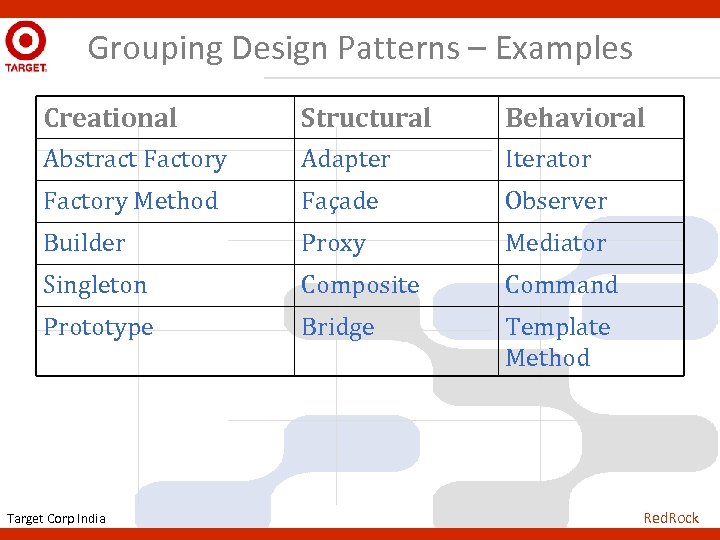 Grouping Design Patterns – Examples Creational Structural Behavioral Abstract Factory Adapter Iterator Factory Method Façade Observer Builder Proxy Mediator Singleton Composite Command Prototype Bridge Template Method Target Corp India Red. Rock
 Factory Design Patterns • Just what their name implies: they are classes that create or construct something. • Provide encapsulation of code required to render an instance of abstract class type as an implementation class • Provides a simple decision-making class that returns one of several possible subclasses of an abstract base class, depending on the data that are provided. • The factory can initialize, pull in data, configure, set state, & perform nearly any other creational operation needed • Three different flavors of Factory Design Patterns – Simple Factory – Abstract Factory – Factory Method Target Corp India Red. Rock
 Simple Factory • Very popular – could be found again & again • Returns an instance of one of several possible classes, depending on the data provided to it. • Usually all of the classes it returns have a common parent class and common methods but each of them performs a task differently and is optimized for different kinds of data. • Not a Go. F patterns, but it serves here as an introduction to the somewhat more subtle Abstract Factory & Factory Method Go. F pattern Target Corp India Red. Rock
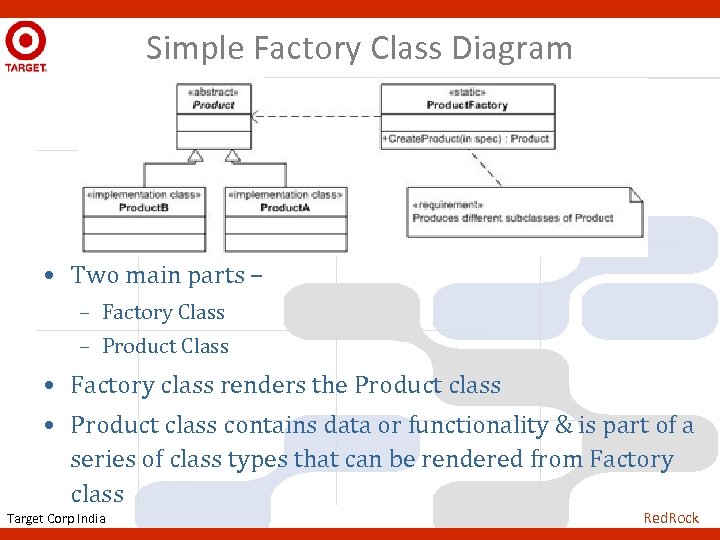 Simple Factory Class Diagram • Two main parts – – Factory Class – Product Class • Factory class renders the Product class • Product class contains data or functionality & is part of a series of class types that can be rendered from Factory class Target Corp India Red. Rock
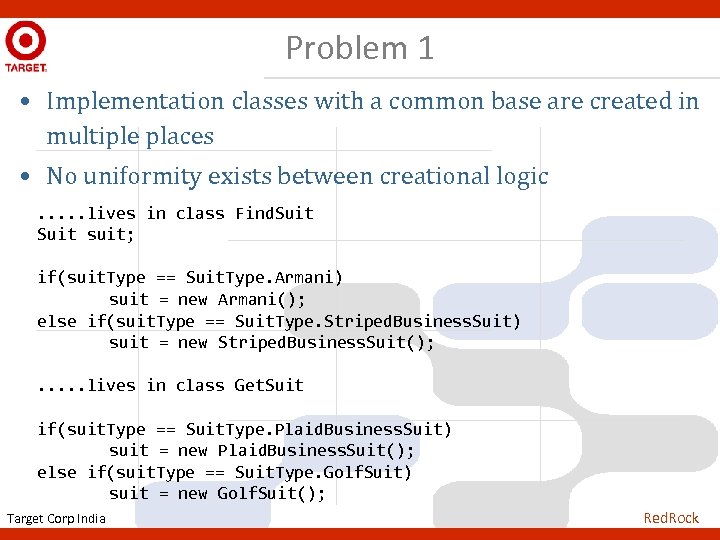 Problem 1 • Implementation classes with a common base are created in multiple places • No uniformity exists between creational logic. . . lives in class Find. Suit suit; if(suit. Type == Suit. Type. Armani) suit = new Armani(); else if(suit. Type == Suit. Type. Striped. Business. Suit) suit = new Striped. Business. Suit(); . . . lives in class Get. Suit if(suit. Type == Suit. Type. Plaid. Business. Suit) suit = new Plaid. Business. Suit(); else if(suit. Type == Suit. Type. Golf. Suit) suit = new Golf. Suit(); Target Corp India Red. Rock
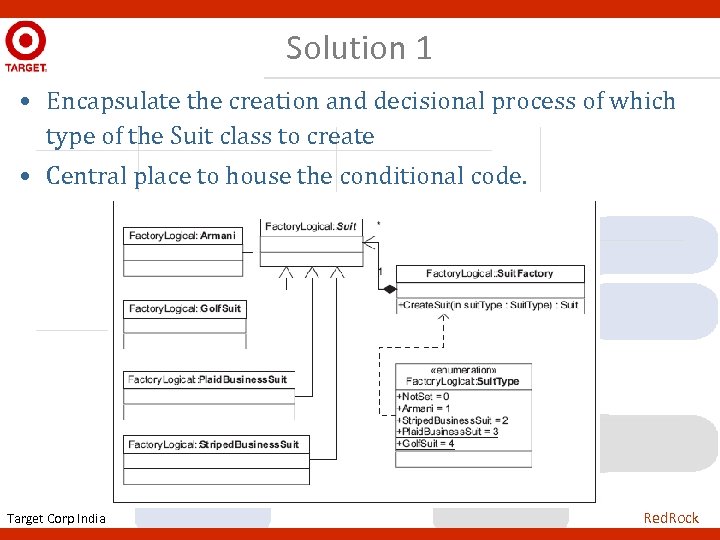 Solution 1 • Encapsulate the creation and decisional process of which type of the Suit class to create • Central place to house the conditional code. Target Corp India Red. Rock
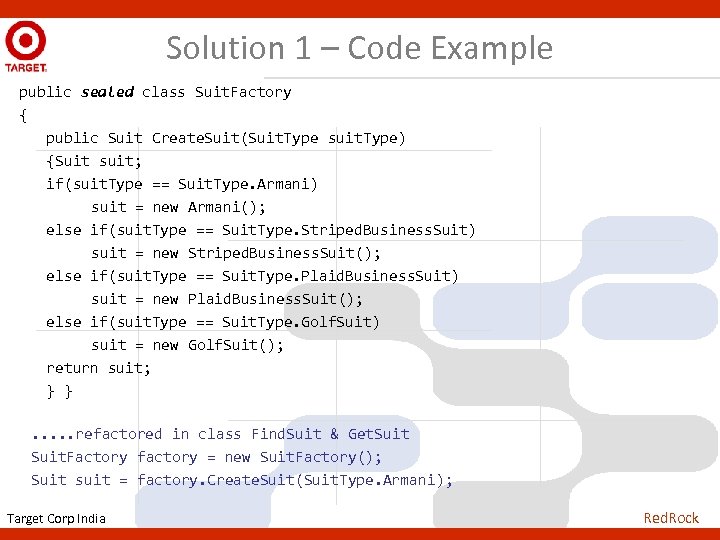 Solution 1 – Code Example public sealed class Suit. Factory { public Suit Create. Suit(Suit. Type suit. Type) {Suit suit; if(suit. Type == Suit. Type. Armani) suit = new Armani(); else if(suit. Type == Suit. Type. Striped. Business. Suit) suit = new Striped. Business. Suit(); else if(suit. Type == Suit. Type. Plaid. Business. Suit) suit = new Plaid. Business. Suit(); else if(suit. Type == Suit. Type. Golf. Suit) suit = new Golf. Suit(); return suit; } }. . . refactored in class Find. Suit & Get. Suit. Factory factory = new Suit. Factory(); Suit suit = factory. Create. Suit(Suit. Type. Armani); Target Corp India Red. Rock
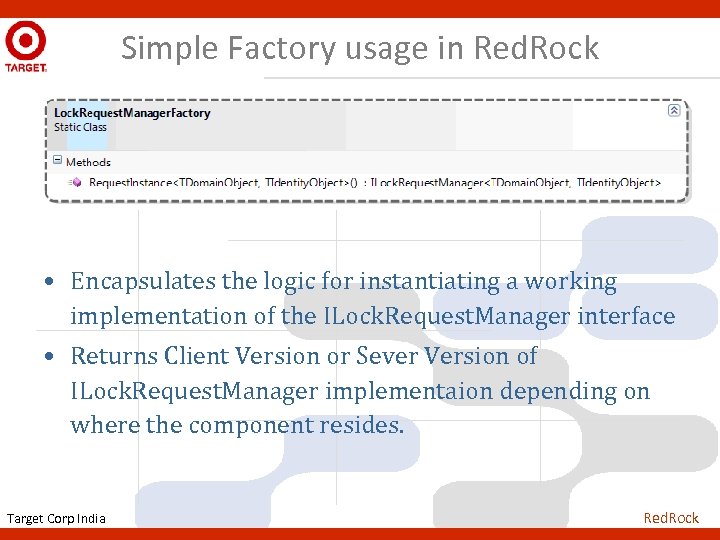 Simple Factory usage in Red. Rock • Encapsulates the logic for instantiating a working implementation of the ILock. Request. Manager interface • Returns Client Version or Sever Version of ILock. Request. Manager implementaion depending on where the component resides. Target Corp India Red. Rock
 Abstract Factory • Expands the basic Factory pattern • Gives us a way to allow factories with similar methods and access points to be interchangeable. Target Corp India Red. Rock
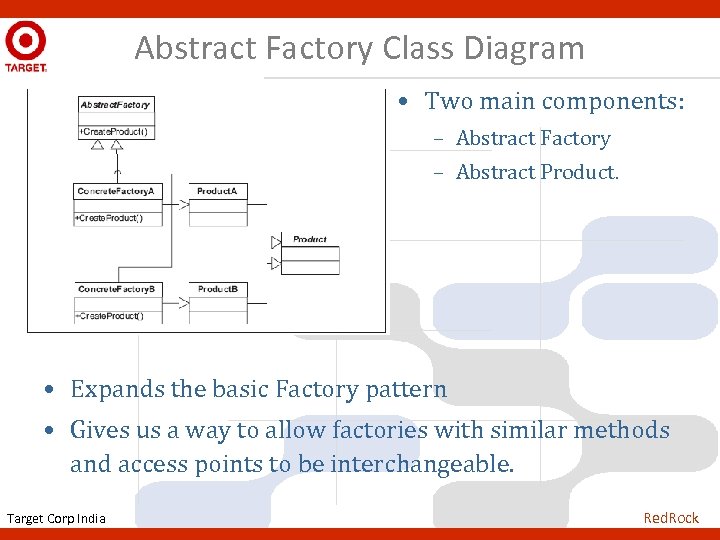 Abstract Factory Class Diagram • Two main components: – Abstract Factory – Abstract Product. • Expands the basic Factory pattern • Gives us a way to allow factories with similar methods and access points to be interchangeable. Target Corp India Red. Rock
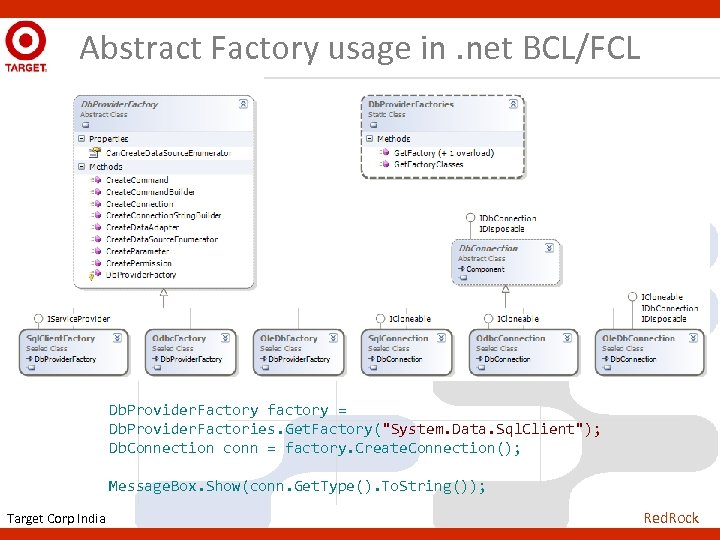 Abstract Factory usage in. net BCL/FCL Db. Provider. Factory factory = Db. Provider. Factories. Get. Factory("System. Data. Sql. Client"); Db. Connection conn = factory. Create. Connection(); Message. Box. Show(conn. Get. Type(). To. String()); Target Corp India Red. Rock
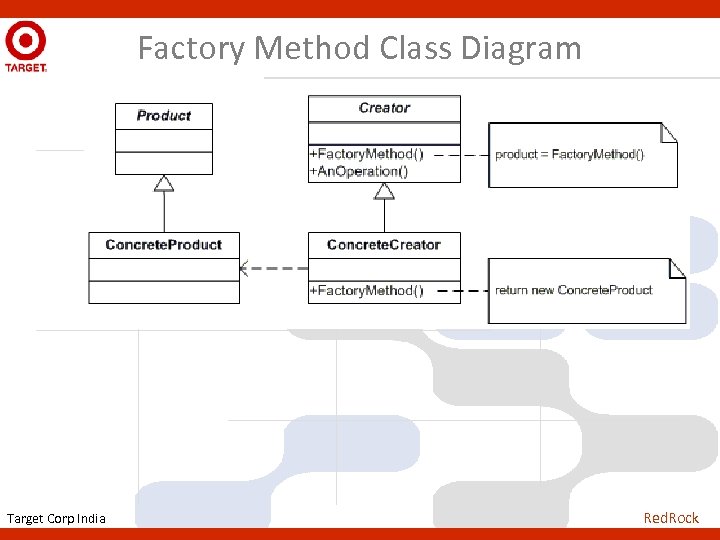 Factory Method Class Diagram Target Corp India Red. Rock
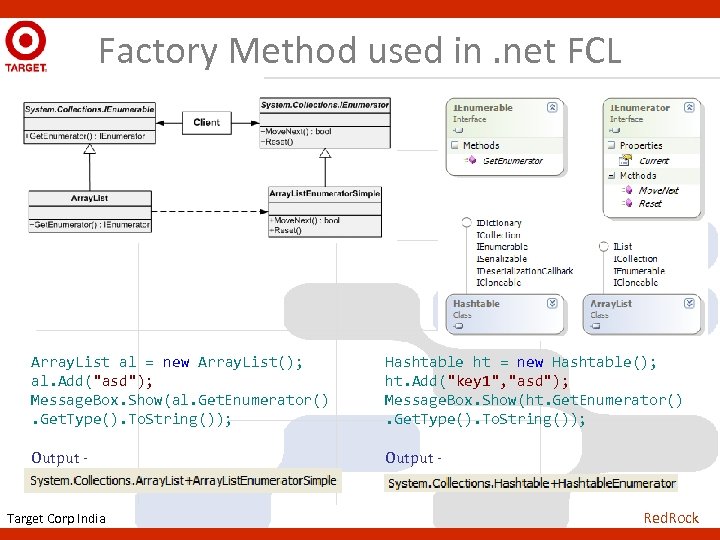 Factory Method used in. net FCL Array. List al = new Array. List(); al. Add("asd"); Message. Box. Show(al. Get. Enumerator(). Get. Type(). To. String()); Hashtable ht = new Hashtable(); ht. Add("key 1", "asd"); Message. Box. Show(ht. Get. Enumerator(). Get. Type(). To. String()); Output - Target Corp India Red. Rock
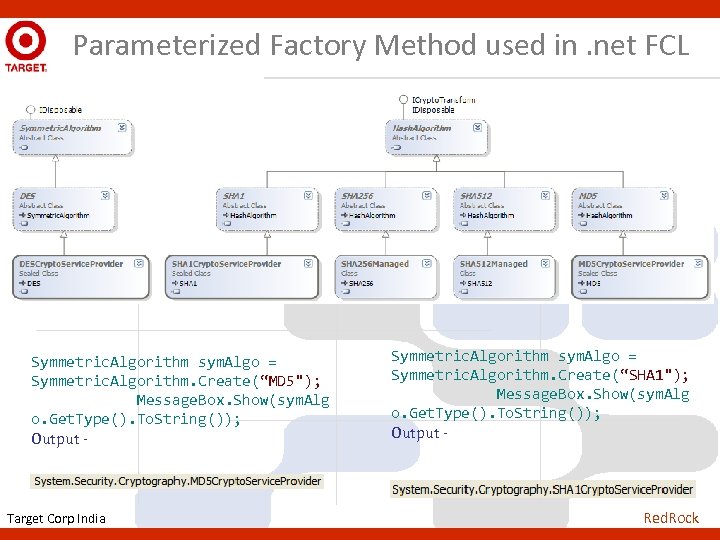 Parameterized Factory Method used in. net FCL Symmetric. Algorithm sym. Algo = Symmetric. Algorithm. Create(“MD 5"); Message. Box. Show(sym. Alg o. Get. Type(). To. String()); Output - Target Corp India Symmetric. Algorithm sym. Algo = Symmetric. Algorithm. Create(“SHA 1"); Message. Box. Show(sym. Alg o. Get. Type(). To. String()); Output - Red. Rock
 Resources • Website – Usage of factory Method with in. net FCL/BCLhttp: //www. ondotnet. com/pub/a/dotnet/2003/08/11/factorypatt ern. html – Design Patterns in C# and VB http: //www. dofactory. com/Patterns. aspx • Books – Design Patterns – GOF – Design Patterns – Christpher G Lasater – Software Factories – Jack Greenfield and Keith Short Target Corp India Red. Rock
 Questions If (Questions == null || Questions. Count == 0) { Thank you; } Target Corp India Red. Rock