 Скачать презентацию Recurrency Transition Training Mel Burkart MCFI Recurrency Transition Training
aaabc38a55231f2a5c3d0fcf798b6cc9.ppt
- Количество слайдов: 29



Recurrency/Transition Training Mel Burkart, MCFI
Recurrency/Transition Training a. Regulatory Requirements (FAR 61. 56, 61. 57, 61. 31(j)) b. c. d. e. f. g. Flight Review Wings Program Endorsements (FAR 61. 56, 61. 31) Transition Training Syllabi Instructor qualifications Training Goals
Currency Requirements FAR 61. 56 Q FAR 61. 56 - Flight Review – – – Every 24 calendar months 1 hour of ground instruction, and 1 hour, or 3 flights, of flight training Q FAR 61. 57 - Recent Flight Experience – 3 take-off’s and landings § within 90 days to carry passengers § Night – same requirement during nighttime. – Note: For night and tailwheel, takeoff and landings must be full stop – Same category, class § Category - airplane, rotorcraft, glider § Class - single engine, multiengine, land, water
Flight Review FAR 61. 56 Q Flight Review is “NOT” a flight test § Note: the words “review” and “training”. in FAR 61. 56. § Objective - Training to proficiency – Engage the applicant in the learning process § Ask the student to evaluate his strengths and weakness § suggest areas to work on. – Review FAR Part 61 and 91 as appropriate – Use PTS to define standards – Make appropriate logbook entry § Advisory Circular 61. 65 E Appendix 1
Flight Review FAR 61. 56 Q Who needs a flight review? – Everyone! § (Private, Commercial, ATP, Flight Instructor) Q What category/class of aircraft is the review good for? – ALL! – A single flight review covers a pilot for all ratings – CFI should evaluate the scope of his action.
Flight Review FAR 61. 56 Q Alternative approaches – Obtain a new rating or certificate – Use the FAA Wings program § the WINGS program ends December 31, 2007. § Flight Standards District Offices (FSDO) will continue to accept phases completed by this date until January 31, 2008. – Advisory Circular 61 -91 H: – http: //www. faa. gov/safety/awards/wings/ – New Wings Program § designed to help each pilot construct an educational curriculum suitable for their unique flight requirements. – https: //www. faasafety. gov/WINGS/pppinfo/default. aspx
Emergency Procedures on Tow QRope break at various altitudes – Discussion QPre-flight questioning – What questions do you ask? QIn flight questioning – What questions do you ask? QPractice at safe altitude – How do you practice a rope break at altitude?
Emergency Procedures on Landing Q What do you do now? – Discussion § § 1. 2. 3. 4. Q What are you going to do in the future? – Discussion § § 1. 2. 3. 4
Currency vs. Proficiency Q Definition of Currency – currency simply refers to being up to date or occurring within a recent period of time. Q Definition of Proficiency – "performing a given skill with expert correctness. “ – Pilot proficiency - ability to perform tasks associated with the safe conduct of a flight – ". . . that practice is the key to the secret of flying. " Q Reasons for lack of proficiency – Prolonged period of inactivity – Fear of maneuver
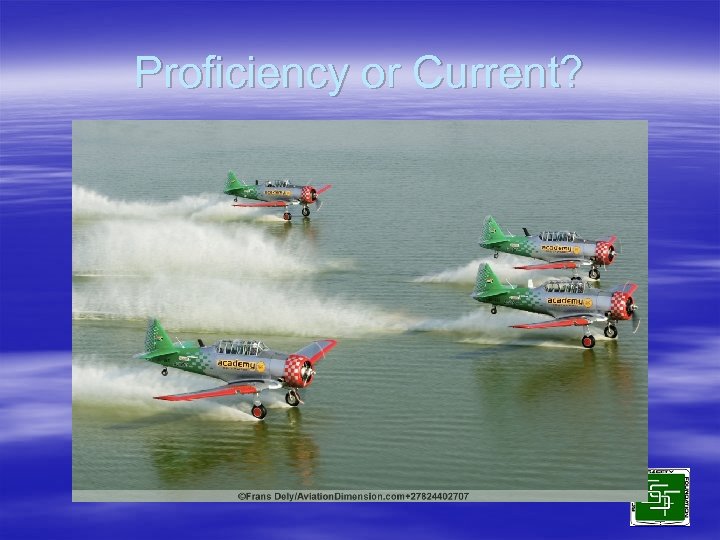
Proficiency or Current?
FAR 61. 69 – Glider Towing QInitial glider towing prerequisites – At least Private Pilot certificate – At least 100 hours of pilot-in-command in aircraft category, class, and type – if required or – Logged at least 10 flights towing a glider before May 17, 1967
FAR 61. 69 – Glider Towing QInitial training requirements in towplane – Ground & flight training in gliders § Emergency procedures § Ground air signals § Maximum bank angles – 3 flights, real or simulated tows, § as sole operator of the controls towing a glider while accompanied by a pilot who meets these requirements (61. 69, c) § If endorsing pilot has private pilot privileges must meet the requirements of 61. 69 (d)(i)(ii) – Appropriate Logbook Endorsements
FAR 61. 69 – Glider Towing Q Annual recurrent training requirements – Within the preceding 12 months § Made at least 3 actual or simulated tows while accompanied by a qualified tow pilot OR § Made at least 3 flights as PIC of a glider being aero-towed
Pilot Factors Q FAR 61. 23 (b) Operations not requiring a medical certificate. A person is not required to hold a medical certificate: (1) When exercising the privileges of a pilot certificate with a glider category rating; Q FAR 61. 53 (b) Operations that do not require a medical certificate. For operations provided for in § 61. 23(b) of this part, a person shall not act as pilot in command, or in any other capacity as a required pilot flight crewmember, while that person knows or has reason to know of any medical condition that would make the person unable to operate the aircraft in a safe manner.
Pilot Factors Practical Aspects Q General health issues – Cold/Flu – OTC drugs Q Specific medical conditions – Prescription drugs – Surgical procedures & recovery Q Aging - average 54 – General trends – more physical problems – Reduction in motor skills - ? ? ? § Age 70 + § FAA eliminates Age 60 rule for airline pilots – Increase in experience
Club Safety Culture Q Institutionalize practices and procedures that encourage ALL pilots to actively engage in safe practices Q How do we do accomplish that? – Empower tow-pilots to refuse a launch § Both pilots are at risk – Empower ANY pilot to hold/stop an operation Q Offer dual flying opportunities § Ref: SLSA Programs
Types of Transition Training QAdding a new launch method – Aerotow, Ground launch, Self launch QMoving to a higher/lower performance glider – The step down is just as big as the step up! QAdditional Glider Rating
Types of Transition Training Additional Launch methods QCFI endorsement is all that’s required – Training syllabus so applicant knows what to study (e. g. , AC 61 -94 for motorgliders) – Ground school to discus new launch procedures – Flight training to practice launch procedure – logbook endorsement to finish process
Types of Transition Training Moving to a New Glider QReview Pilot Operating Handbook – Assembly/disassembly procedures – Manual or automatic flight controls hookups – Weight and Balance information QReview aircraft systems – Radio/transponder – Vario/flight computer – GPS
Types of Transition Training Moving to a New Glider QReview ground/flight characteristics – Speeds § Tow, Approach & Landing § Thermaling, Inter-thermal cruising – T. O. /Landing attitude § effect of tow-hook position – Pilot experience and decision heights QLog book endorsements
Types of Transition Training Moving to a New Glider QPrepare plan for 1 st flight – Tow height – Basic maneuvers § Stall characteristics in different configurations § Turn coordination exercises § Other maneuvers § Approach and landing considerations QLog book endorsements
Types of Transition Training Additional Category Rating QAdding a Glider rating – Evaluate previous experience – Introduce differences § Launch procedures § Thermal etiquette, flying close to other gliders § Approach and landing procedures QReview regulatory requirements QLog book endorsements – When do they expire?
Log Book Endorsements QStudent pilots – Pre-solo, specify launch procedure – Post-solo – Sign student pilot certificate QOther rated pilots – Log book endorsement only – May not have an explicit expiration date QSample endorsements – Advisory Circular 61. 65 E, Appendix 1
Training Syllabi Q Improves communication between instructor and student Q Should include both instructor and student components Q Multiple sources available – Publications (FAA, SSA, Knauff, Piggott, Wander) – Internal club/school documents – personally developed
Training Syllabi QInstructor components include – Record of ground/flight training – Records kept at club/school – Records available for review by student and instructor – Lesson plans describing the training steps
Training Syllabi QStudent components include – Training syllabus with detailed objectives – List of reference material provided for study – Completion standards specified § PTS – Practical Test Standars
Training Goals Q Ensure applicant reaches correlation stage of learning Q Ensure applicant operates glider within defined safety limits Q Ensure applicant enjoys the learning experience
Serial vs Parallel Tasks QSerial – Sequential events – Time independent QParallel – Multiple simultaneous events – Time critical
Instructor Qualifications Q Holds current flight instructor certificate Q Current in appropriate launch procedure Q Current in specific glider/motorglider Q Practiced in appropriate Emergency procedures
Скачать презентацию Recurrency Transition Training Mel Burkart MCFI Recurrency Transition Training
aaabc38a55231f2a5c3d0fcf798b6cc9.ppt