


 Скачать презентацию Recruiting And Retaining Community Preceptors Is There Hope
6ab29baea9b7d247a18db648d95a5f44.ppt
- Количество слайдов: 38
 Recruiting And Retaining Community Preceptors: Is There Hope Without Pay? Rik Stringham, M. D. Karen J. Connell, M. S. Nipa Shah, M. D. Department of Family Medicine University of Illinois at Chicago
 Purpose • Discuss pros and cons of payment for clerkship teaching • Discuss strategies used to recruit 3 new sites without pay • Share differences in residency and non-residency survey results and implications for recruitment and retention
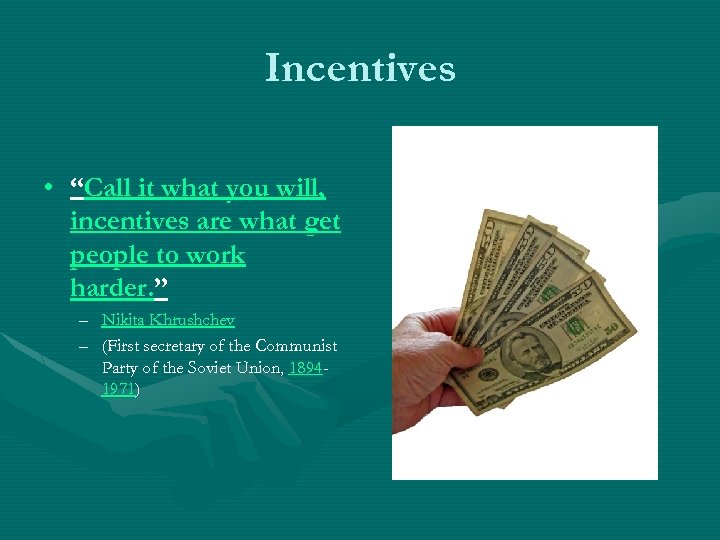 Incentives • “Call it what you will, incentives are what get people to work harder. ” – Nikita Khrushchev – (First secretary of the Communist Party of the Soviet Union, 18941971)
 Caribbean Medical Schools • July 2007 • St. George’s University in Grenada • $1923/6 weeks/student • Affiliation with NYC Health and Hospitals Corp • 2009 • American University of Caribbean School of Medicine • $3425/6 weeks/student • Affiliation with Nassau Uni. Medical Center in NY
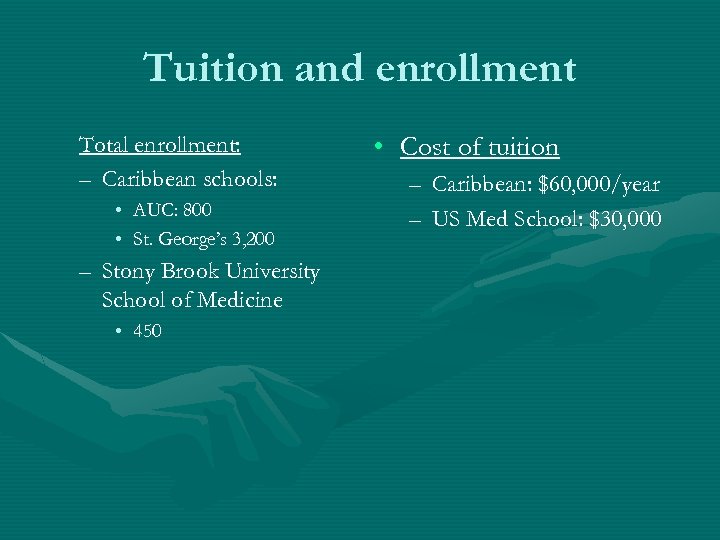 Tuition and enrollment Total enrollment: – Caribbean schools: • AUC: 800 • St. George’s 3, 200 – Stony Brook University School of Medicine • 450 • Cost of tuition – Caribbean: $60, 000/year – US Med School: $30, 000
 • “Everybody in the country is worried that this will spread. It is a major threat to U. S. medical schools. ” ” – Dr. Nancy Nielson, past president of the American Medical Association and associate dean for medical education at the University at Buffalo.
 Hippocratic Oath
 • “I will respect the hard-won scientific gains of those physicians in whose steps I walk, and gladly share such knowledge as is mine with those who are to follow. ”
 • Pros? • Cons?
 Background to our Situation • We averaged 7 more students/block than normal over 6 month period (1/09 -6/09) due to having… – 7 instead of normal 8 blocks – Large 3 rd year class size (n=205, normal=180)
 Our Challenge • Dr. Shah convinced some current sites to take extra students but we were still short… …We needed 3 new sites!
 Barriers • 5 other medical schools in our city (at least one of which pays preceptors) • We don’t pay our community-based preceptors. • Physicians tend to forget how much they enjoy teaching
 Our Advantages • Very supportive predoctoral team • My experience in private practice
 Strategies We Tried • Letters to medical offices in area… 2 weeks -- no response • Contacted physicians recommended by medical students • Contacted non-collaborating residency programs • Asked faculty/staff to identify physicians who might be interested • Contacted recent residency graduates • Checked websites of medical groups looking for our medical school graduates
 Results: 3 New Sites • Private physician – student had rotated with him 1 year prior • Residency program formerly affiliated with us • Private physician whose medical assistant was the sister of our predoctoral coordinator
 Our Observations… • People already having a connection to the university are more likely to agree • Doing a “site visit” helps start a good relationship– “putting a face to the name” • Small “tokens of appreciation” such as a university mug add a friendly touch • Don’t be afraid to be told “no” – many tries before success
 Discussion What has helped you – or not – recruit community physicians to teach medical students?
 Retention…. • Urgent recruiting challenge raised our consciousness about the importance of “tuning in” to our existing preceptors • Hence…. Survey of UIC Community Preceptors
 Methods • Personal letter from Associate Predoctoral Director (RS) • Brief 6 -question Survey mailed to key preceptors in collaborating sites (7 residency, 16 non-residency) • Responses from 15/23 sites (65%) – 5/7 residency (71%) – 10/16 non-residency (63%) • 11/15 respondents (73%) >3 years
 Survey Questions • • • Why precept UIC medical students? Students from other medical schools too? Importance of each of 9 factors when considering whether or not to precept Which “Perks” important? Why UIC over another medical school? How can we do better?
 REASONS FOR PRECEPTING • Both residency and non-residency preceptors want to influence students’ career choice; residency preceptors also cited recruitment • Non-residency preceptors emphasized “joy of teaching” and “staying current” • Results consistent with others’ findings (Latressa, et al; Scott, et al; Ullian, et al)
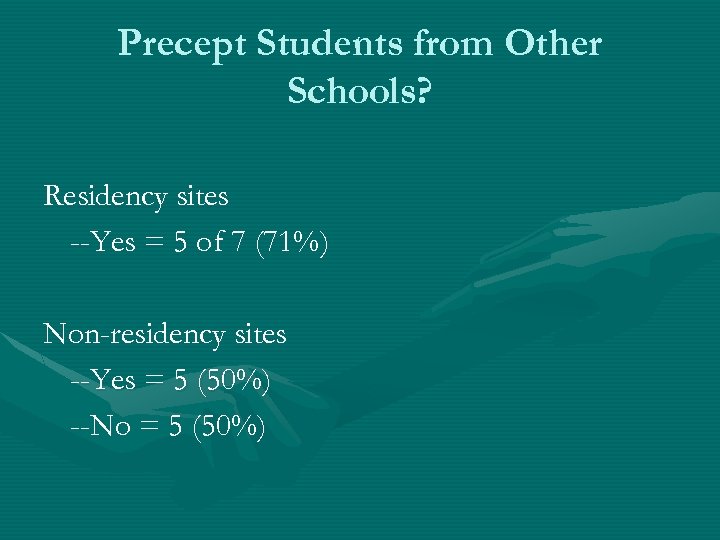 Precept Students from Other Schools? Residency sites --Yes = 5 of 7 (71%) Non-residency sites --Yes = 5 (50%) --No = 5 (50%)
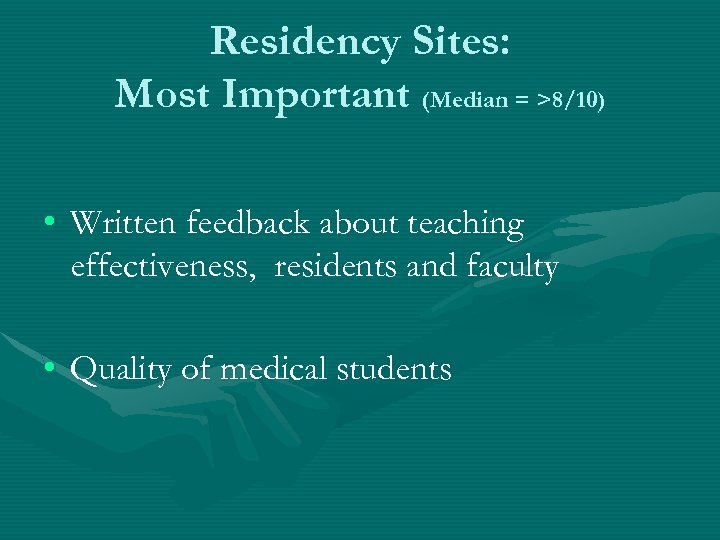 Residency Sites: Most Important (Median = >8/10) • Written feedback about teaching effectiveness, residents and faculty • Quality of medical students
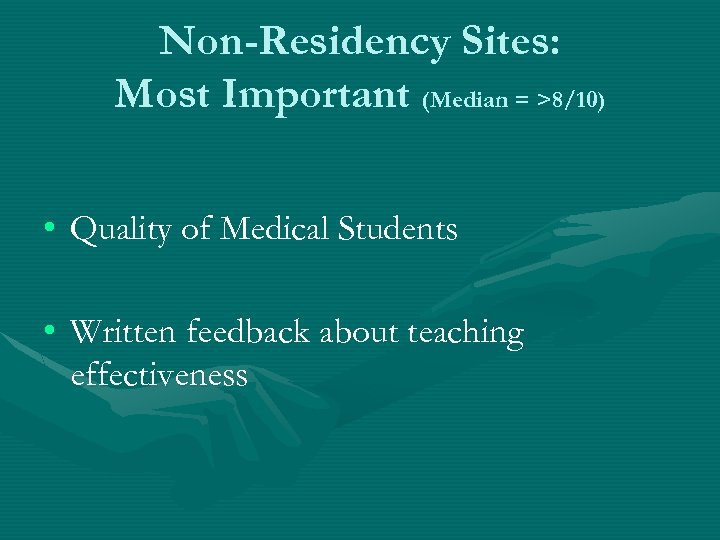 Non-Residency Sites: Most Important (Median = >8/10) • Quality of Medical Students • Written feedback about teaching effectiveness
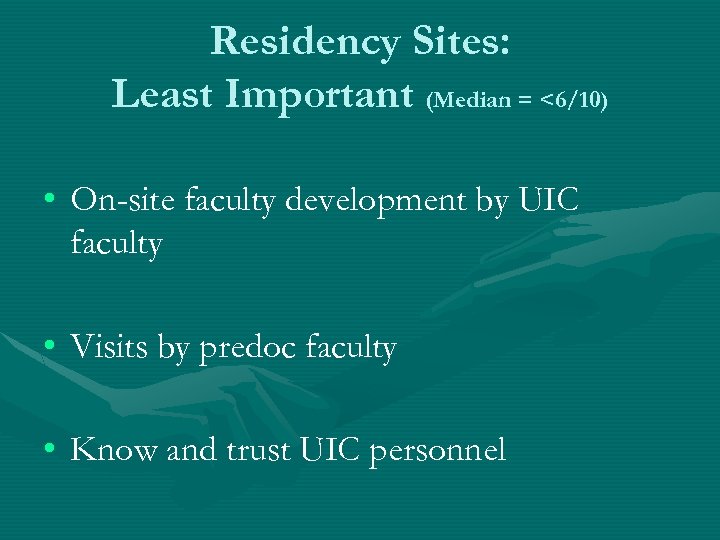 Residency Sites: Least Important (Median = <6/10) • On-site faculty development by UIC faculty • Visits by predoc faculty • Know and trust UIC personnel
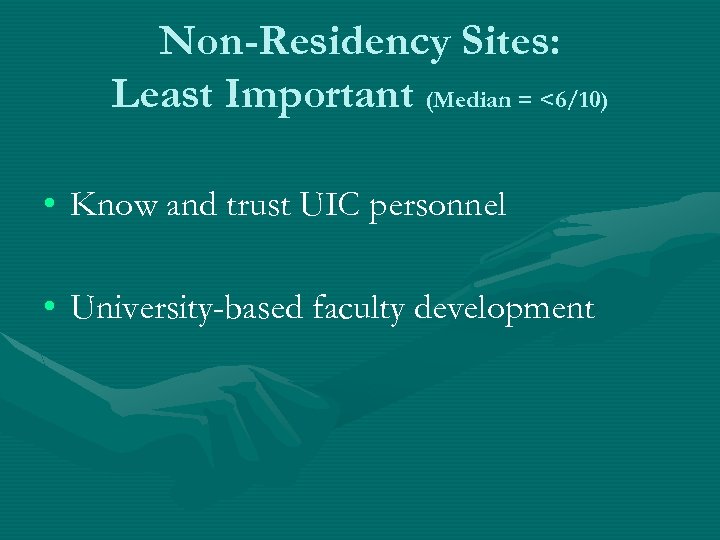 Non-Residency Sites: Least Important (Median = <6/10) • Know and trust UIC personnel • University-based faculty development
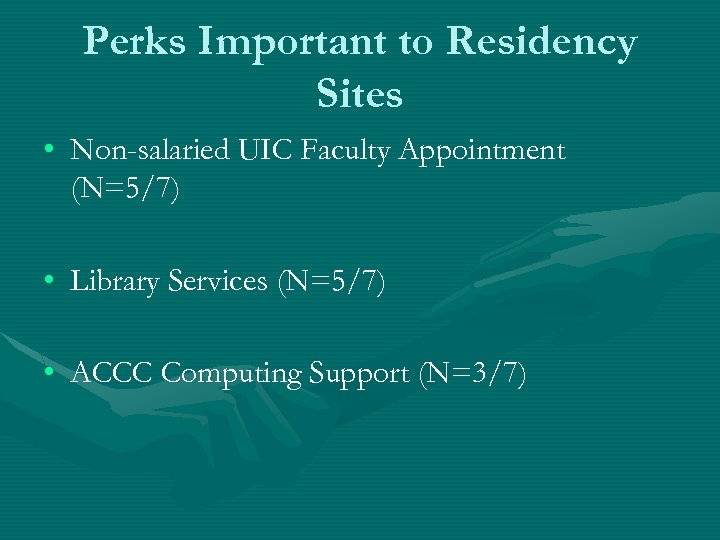 Perks Important to Residency Sites • Non-salaried UIC Faculty Appointment (N=5/7) • Library Services (N=5/7) • ACCC Computing Support (N=3/7)
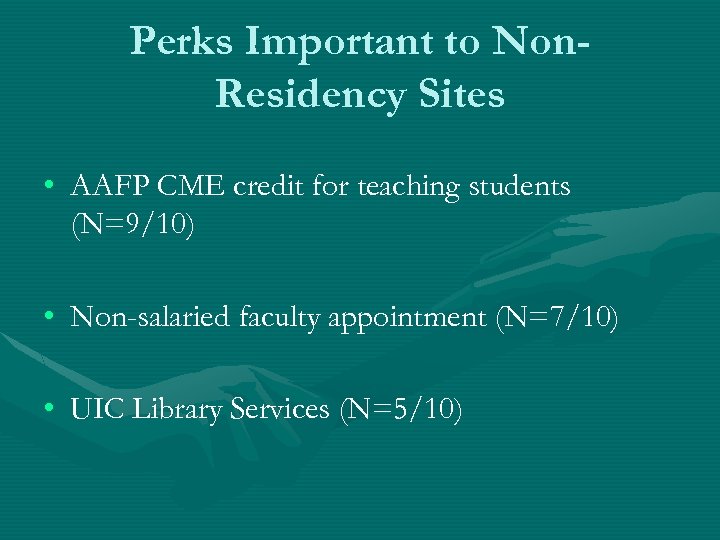 Perks Important to Non. Residency Sites • AAFP CME credit for teaching students (N=9/10) • Non-salaried faculty appointment (N=7/10) • UIC Library Services (N=5/10)
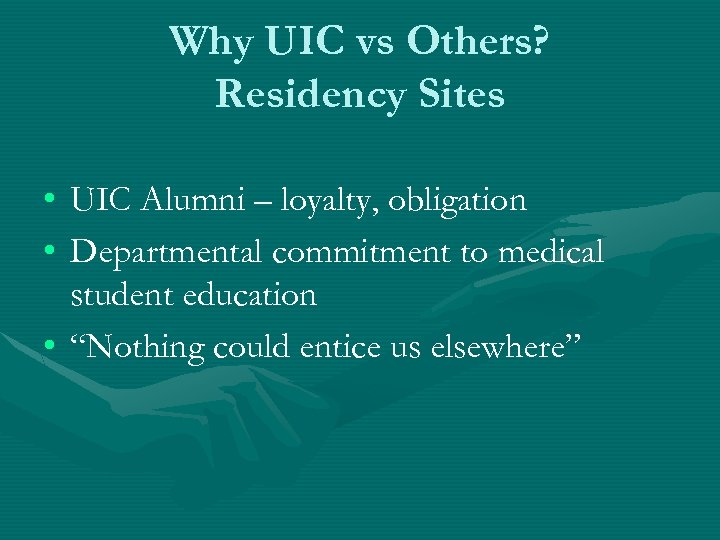 Why UIC vs Others? Residency Sites • UIC Alumni – loyalty, obligation • Departmental commitment to medical student education • “Nothing could entice us elsewhere”
 Why UIC vs Others? Non-Residency Sites • UIC Alumni – loyalty, obligation • Quality of students • UIC’s recognition of Family Medicine and reputation • Appreciate my willingness to teach • Nothing would entice away
 How Can We Do Better? Residency Sites • • • More involvement in FMIG UIC offer faculty development workshops for us Share more of the curriculum details re how students’ time is spent • Remind regularly about what students should learn while with us
 How Can We Do Better? Non-Residency Sites • • • Continue feedback re teaching Continue teaching tips – “Teaching Physician” CME re teaching skills Meet with Department now and then Let us know number/name of students scheduled for the year – not just by block • Pay would be nice (N=1)
 Conclusions Like others, we confirmed the importance of • Non-salaried faculty appointments • Access to University library services • CME credit for non-residency preceptors • Focusing recruitment efforts on alumni • Flexible faculty development programs
 Conclusions continued… • Financial compensation is not a primary motivator for physicians choosing to precept students • Written feedback on teaching effectiveness
 Our Plans… • Continue written feedback • Help preceptors use feedback, e. g. , via sitespecific faculty development • Communicate curricular information more thoroughly and consistently to each site
 Plans continued. . • Encourage preceptor involvement in non-clinical teaching, e. g. , FMIG • Offer UIC-based faculty development for residency faculty • Offer site-based faculty development for nonresidency sites with CME credit • Individualize and personalize communication and incentives by site
 AT LEAST FOR NOW, THERE APPEARS TO BE HOPE WITHOUT PAY!
 References Baldor RA, Brooks WB, Warfield ME, et al. A survey of primary care physicians’ perceptions and needs regarding the precepting of medical students in their offices. Med Educ. 2001 Aug: 35(8) 789 -95 Latessa R, Beaty N, et al. Family medicine community receptors: different from other physician specialties? Fam Med. 2008 Feb; 40(2): 96 -101 Scott I, Sazegar P. Why community physicians teach students (or not): barriers and opportunities for receptor recruitment. Med Teach. 2006 Sep; 28(6): 563 -5 Ullian JA, Shore WB, First LR, What did we learn about the impact on community-based faculty? Recommendations for recruitment, retention, and rewards. Acad Med. 2001 Apr; 76(4 Suppl): S 78 -85 Vinson DC, Paden C, Devera-Sales A. Impact of medical student teaching on family physicians’ use of time. J Fam Pract. 1996 Mar; 42(3): 243 -9