


 Скачать презентацию Recovery Oriented Computing A New Research Agenda for
d93172022c6284c5c07a52ee4c4bc22e.ppt
- Количество слайдов: 61
 Recovery Oriented Computing: A New Research Agenda for a New Century Dave Patterson University of California at Berkeley patterson@cs. berkeley. edu HPCA 8 Keynote February 2002 www. cs. berkeley. edu/~patterson/talks/keynote. html Slide 1
 Outline • The past: where we have been • The present: new realities and challenges • A future: Recovery-Oriented Computing (ROC) • ROC techniques and principles Slide 2
 • • The past: research goals and assumptions of last 15 years Goal #1: Improve performance Goal #2: Improve performance Goal #3: Improve cost-performance Assumptions – Humans are perfect (they don’t make mistakes during installation, wiring, upgrade, maintenance or repair) – Software will eventually be bug free (Hire better programmers!) – Hardware MTBF is already very large (~100 years between failures), and will continue to increase – Maintenance costs irrelevant vs. Purchase price (maintenance a function of price, so cheaper helps) Slide 3
 After 15 years of research on price-performance, what’s next? • Services as model for future of IT • Availability is now vital metric for services – near-100% availability is becoming mandatory » for e-commerce, enterprise apps, online services, ISPs – but, service outages are frequent » 65% of IT managers report that their websites were unavailable to customers over a 6 -month period • 25%: 3 or more outages – outage costs are high » social effects: negative press, loss of customers who “click over” to competitor Source: Internet. Week 4/3/2000 Slide 4
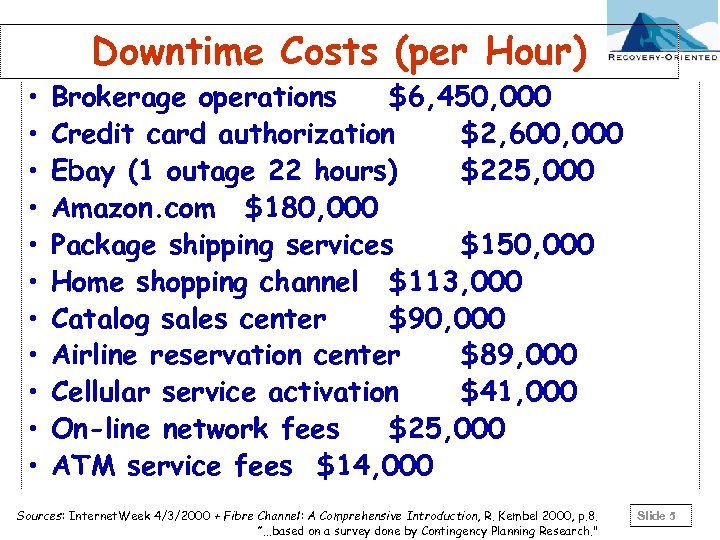 • • • Downtime Costs (per Hour) Brokerage operations $6, 450, 000 Credit card authorization $2, 600, 000 Ebay (1 outage 22 hours) $225, 000 Amazon. com $180, 000 Package shipping services $150, 000 Home shopping channel $113, 000 Catalog sales center $90, 000 Airline reservation center $89, 000 Cellular service activation $41, 000 On-line network fees $25, 000 ATM service fees $14, 000 Sources: Internet. Week 4/3/2000 + Fibre Channel: A Comprehensive Introduction, R. Kembel 2000, p. 8. ”. . . based on a survey done by Contingency Planning Research. " Slide 5
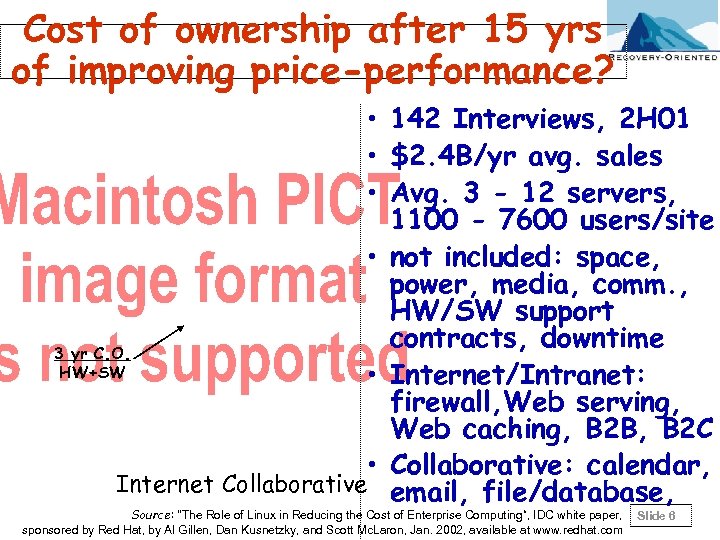 Cost of ownership after 15 yrs of improving price-performance? • 142 Interviews, 2 H 01 • $2. 4 B/yr avg. sales • Avg. 3 - 12 servers, 1100 - 7600 users/site • not included: space, power, media, comm. , HW/SW support contracts, downtime 3 yr C. O. HW+SW • Internet/Intranet: firewall, Web serving, Web caching, B 2 B, B 2 C • Collaborative: calendar, Internet Collaborative email, file/database, Source: "The Role of Linux in Reducing the Cost of Enterprise Computing“, IDC white paper, sponsored by Red Hat, by Al Gillen, Dan Kusnetzky, and Scott Mc. Laron, Jan. 2002, available at www. redhat. com Slide 6
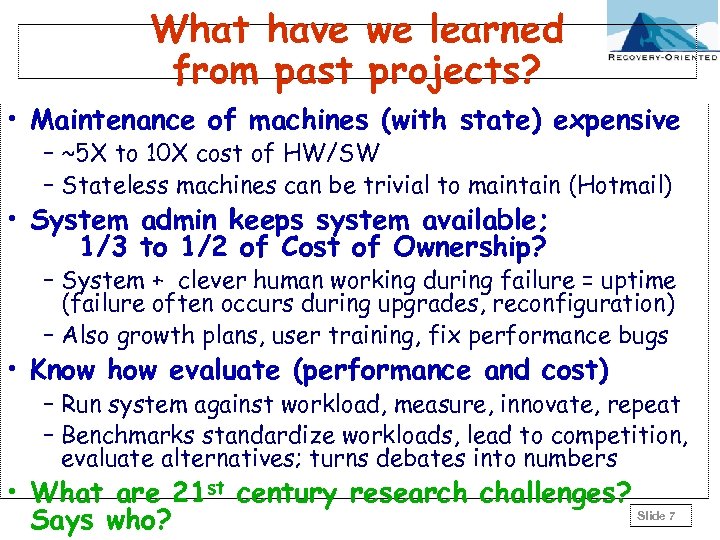 What have we learned from past projects? • Maintenance of machines (with state) expensive – ~5 X to 10 X cost of HW/SW – Stateless machines can be trivial to maintain (Hotmail) • System admin keeps system available; 1/3 to 1/2 of Cost of Ownership? – System + clever human working during failure = uptime (failure often occurs during upgrades, reconfiguration) – Also growth plans, user training, fix performance bugs • Know how evaluate (performance and cost) – Run system against workload, measure, innovate, repeat – Benchmarks standardize workloads, lead to competition, evaluate alternatives; turns debates into numbers • What are 21 st century research challenges? Slide 7 Says who?
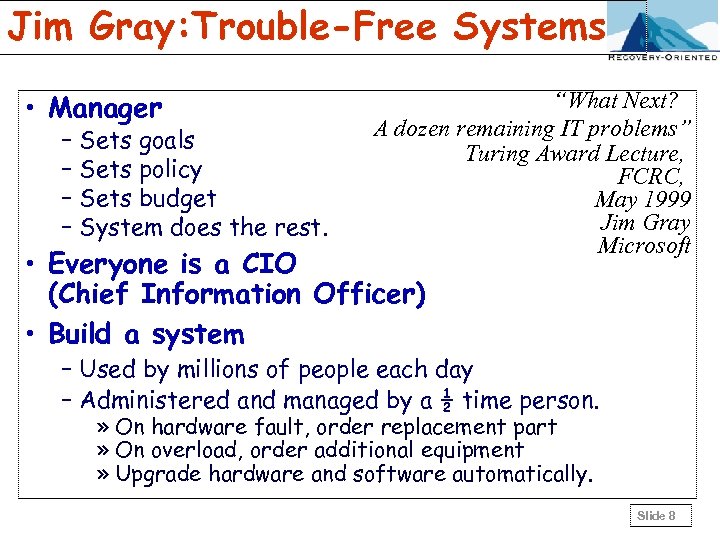 Jim Gray: Trouble-Free Systems • Manager – Sets goals – Sets policy – Sets budget – System does the rest. “What Next? A dozen remaining IT problems” Turing Award Lecture, FCRC, May 1999 Jim Gray Microsoft • Everyone is a CIO (Chief Information Officer) • Build a system – Used by millions of people each day – Administered and managed by a ½ time person. » On hardware fault, order replacement part » On overload, order additional equipment » Upgrade hardware and software automatically. Slide 8
 John Hennessy: What Should the “New World” Focus Be? • Availability – Both appliance & service • Maintainability – Two functions: » Enhancing availability by preventing failure » Ease of SW and HW upgrades • Scalability “Back to the Future: Time to Return to Longstanding – Especially of service Problems in Computer Systems? ” Keynote address, • Cost FCRC, – per device and per service transaction May 1999 John Hennessy • Performance Stanford – Remains important, but its not SPECint Slide 9
 IBM Research (10/15/’ 01) • • Overview: Computing is too hard. It's time we stop our preoccupation with faster and more powerful and start making them smarter. The Solution: “Autonomic Computing” a systemic view of computing modeled after a self-regulating biological system; largely selfmanaging, self-diagnostic. User perspective: – – – Flexible The system will be able to sift data via a platform- and device-agnostic approach Accessible The nature of the autonomic system is that it is always on Transparent The system will perform its tasks and adapt to a user's needs without dragging the user into the intricacies of its workings Slide 10 Source: www. research. ibm. com/autonomic/
 Bill Gates M/S (1/15/2002): “Trustworthy Computing” • Trustworthiness is a fundamental challenge that spans entire computing ecosystem, from individual chips to global Internet services – Availability: System outages should become a thing of the past because of SW architecture that supports redundancy and automatic recovery – Privacy: Users should be in control of how their data is used – Security: should be easy for developers to understand build into their apps • February ’ 02: 7000 M/S programmers stop development to get special training, fix bugs Source: “Microsoft Makes Software Safety a Top Goal, ” by John Markoff, N. Y. Times, 1/17/02 Slide 11
 New research goals for a New Century: ACME • Availability – 24 x 7 delivery of service to users • Changability – support rapid deployment of new software, apps, UI • Maintainability – reduce burden on system administrators – provide helpful, forgiving Sys. Admin environments • Evolutionary Growth – allow easy system expansion over time without sacrificing availability or maintainability • (Also Security/Privacy, but I don’t know much about it, so I’ll leave out of this talk) Slide 12
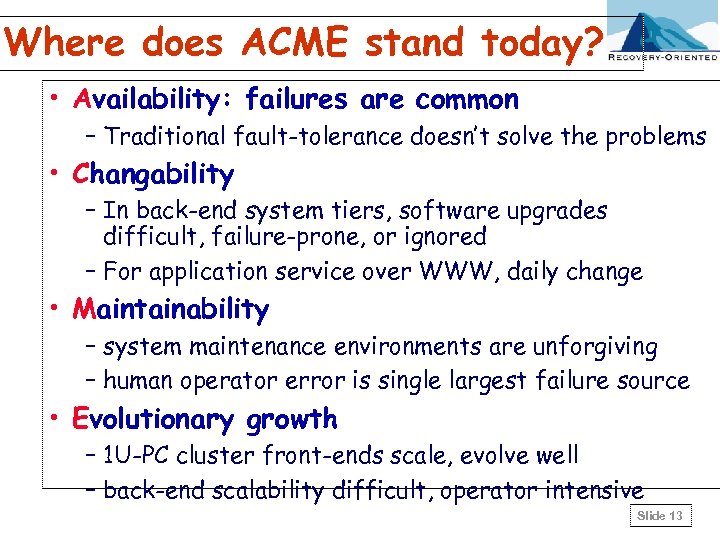 Where does ACME stand today? • Availability: failures are common – Traditional fault-tolerance doesn’t solve the problems • Changability – In back-end system tiers, software upgrades difficult, failure-prone, or ignored – For application service over WWW, daily change • Maintainability – system maintenance environments are unforgiving – human operator error is single largest failure source • Evolutionary growth – 1 U-PC cluster front-ends scale, evolve well – back-end scalability difficult, operator intensive Slide 13
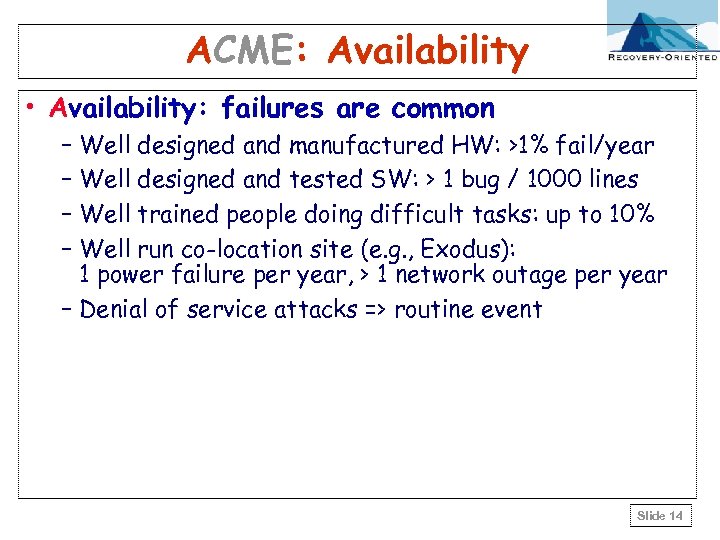 ACME: Availability • Availability: failures are common – Well designed and manufactured HW: >1% fail/year – Well designed and tested SW: > 1 bug / 1000 lines – Well trained people doing difficult tasks: up to 10% – Well run co-location site (e. g. , Exodus): 1 power failure per year, > 1 network outage per year – Denial of service attacks => routine event Slide 14
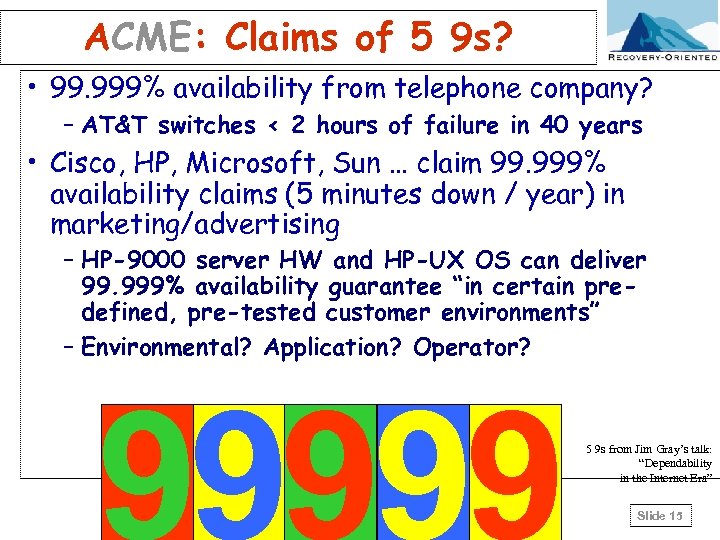 ACME: Claims of 5 9 s? • 99. 999% availability from telephone company? – AT&T switches < 2 hours of failure in 40 years • Cisco, HP, Microsoft, Sun … claim 99. 999% availability claims (5 minutes down / year) in marketing/advertising – HP-9000 server HW and HP-UX OS can deliver 99. 999% availability guarantee “in certain predefined, pre-tested customer environments” – Environmental? Application? Operator? 99999 5 9 s from Jim Gray’s talk: “Dependability in the Internet Era” Slide 15
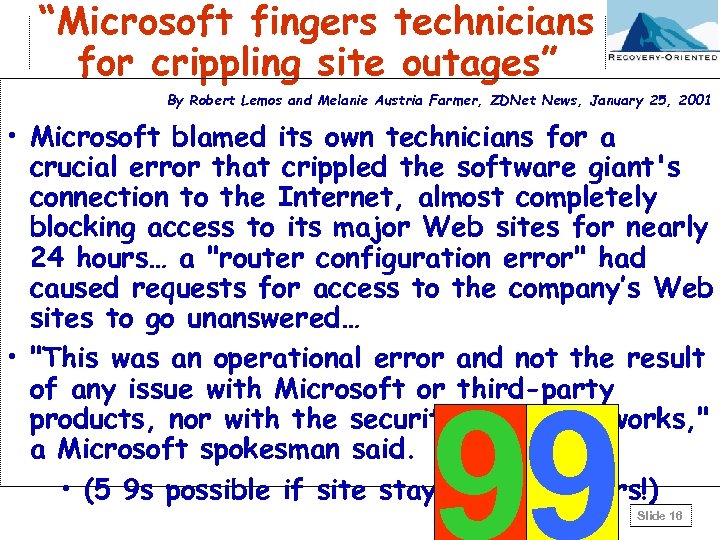 “Microsoft fingers technicians for crippling site outages” By Robert Lemos and Melanie Austria Farmer, ZDNet News, January 25, 2001 • Microsoft blamed its own technicians for a crucial error that crippled the software giant's connection to the Internet, almost completely blocking access to its major Web sites for nearly 24 hours… a "router configuration error" had caused requests for access to the company’s Web sites to go unanswered… • "This was an operational error and not the result of any issue with Microsoft or third-party products, nor with the security of our networks, " a Microsoft spokesman said. • (5 9 s possible if site stays up 250 years!) 99 Slide 16
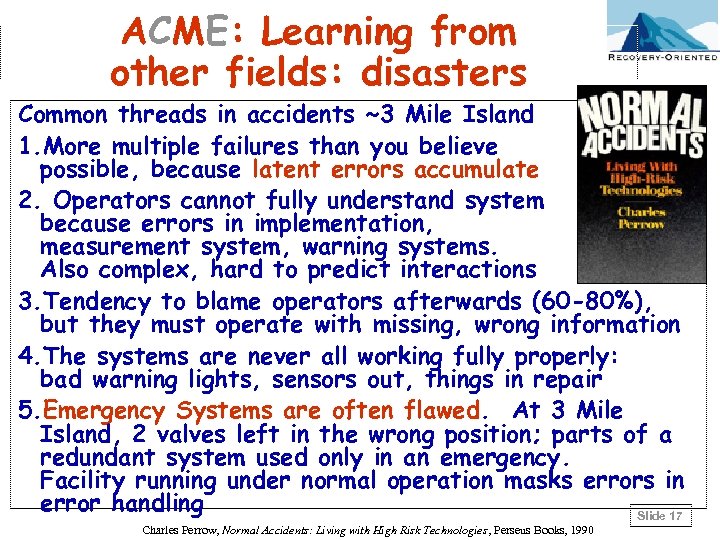 ACME: Learning from other fields: disasters Common threads in accidents ~3 Mile Island 1. More multiple failures than you believe possible, because latent errors accumulate 2. Operators cannot fully understand system because errors in implementation, measurement system, warning systems. Also complex, hard to predict interactions 3. Tendency to blame operators afterwards (60 -80%), but they must operate with missing, wrong information 4. The systems are never all working fully properly: bad warning lights, sensors out, things in repair 5. Emergency Systems are often flawed. At 3 Mile Island, 2 valves left in the wrong position; parts of a redundant system used only in an emergency. Facility running under normal operation masks errors in error handling Slide 17 Charles Perrow, Normal Accidents: Living with High Risk Technologies, Perseus Books, 1990
 ACME Learning from other fields: human error • Two kinds of human error 1) slips/lapses: errors in execution 2) mistakes: errors in planning – errors can be active (operator error) or latent (design error, management error) • Human errors are inevitable – “humans are furious pattern-matchers” » sometimes the match is wrong – cognitive strain leads brain to think up least-effort solutions first, even if wrong • Humans can self-detect errors – about 75% of errors are immediately detected Source: J. Reason, Human Error, Cambridge, 1990. Slide 18
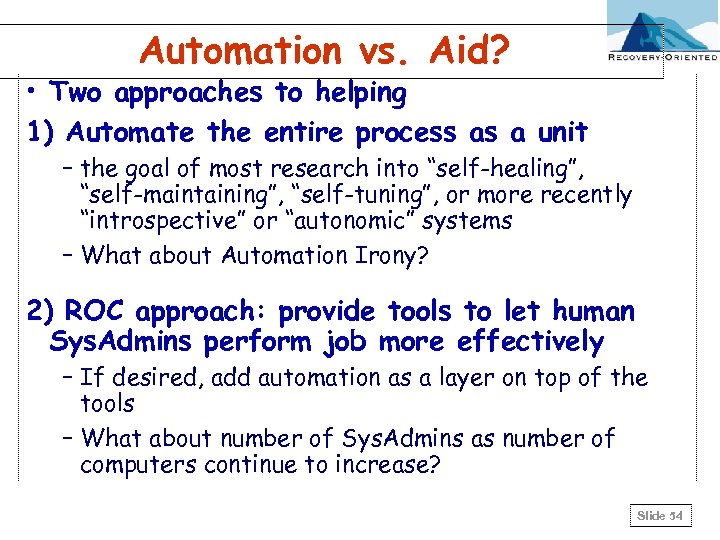
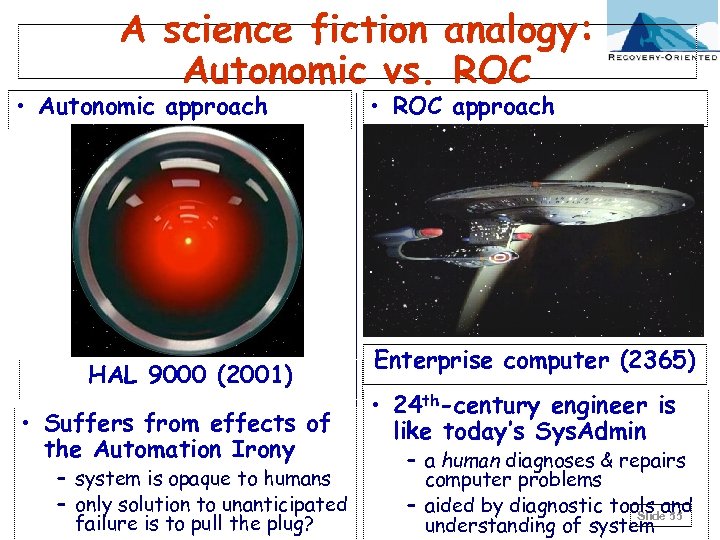
 ACME: The Automation Irony • Automation does not cure human error – Automation shifts some errors from operator errors to design errors » harder to detect/tolerate/fix design errors – Automation addresses the easy tasks, leaving the complex, unfamiliar tasks for the human » humans are ill-suited to these tasks, especially under stress – Automation hinders understanding and mental modeling » decreases system visibility and increases complexity » operators don’t get hands-on control experience » prevents building mental rules and models for troubleshooting Slide 19
 Learning from others: Bridges • 1800 s: 1/4 iron truss railroad bridges failed! • Safety is now part of Civil Engineering DNA • Techniques invented since 1800 s: – Learn from failures vs. successes – Redundancy to survive some failures – Margin of safety 3 X-6 X vs. calculated load – (CS&E version of safety margin? ) • What will people of future think of our computers? Slide 20
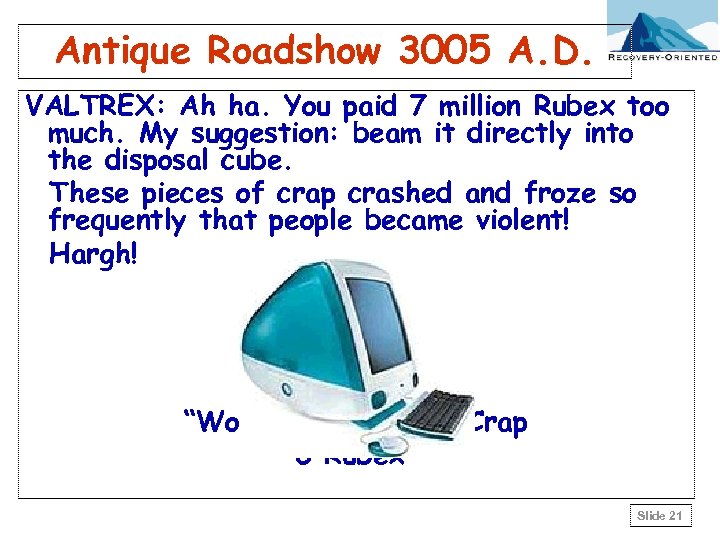 Antique Roadshow 3005 A. D. VALTREX: Ah ha. You paid 7 million Rubex too much. My suggestion: beam it directly into the disposal cube. These pieces of crap crashed and froze so frequently that people became violent! Hargh! “Worthless Piece of Crap 0 Rubex” Slide 21
 Summary: the present • We help create a brittle technology, which world depends on; will history judge IT kindly? • After >15 years of working on performance, 21 st Century research needs new, relevant goals – ACME: Availability, Changability, Maintainability, Evolutionary growth (+ Security/Privacy) • Challenges in achieving ACME: – HW, SW, network failures continue to plague us – Human operator errors continue to plague us » Automation Irony tells us that we can’t eliminate human – Untested emergency systems, latent errors remain – Traditional high-availability/fault-tolerance techniques don’t solve the problem Slide 22 – Software in Internet services evolves rapidly
 Outline • The past: where we have been • The present: new realities and challenges • A future: Recovery-Oriented Computing (ROC) • ROC techniques and principles Slide 23
 Recovery-Oriented Computing Philosophy “If a problem has no solution, it may not be a problem, but a fact, not to be solved, but to be coped with over time” — Shimon Peres (“Peres’s Law”) • People/HW/SW failures are facts, not problems • Improving recovery/repair improves availability – Un. Availability = MTTR (assuming MTTR much less than MTTF) MTTF – 1/10 th MTTR just as valuable as 10 X MTBF • Recovery/repair is how we cope with above facts • Since major Sys Admin job is recovery after failure, ROC also helps with maintenance/TCO • Since Cost of Ownership is 5 -10 X HW/SW, if necessary, sacrifice disk/DRAM space and Slide 24 processor performance for ACME
 ROC approach • • Collect data to see why services fail Create benchmarks to measure ACME • • Use failure data as workload for benchmarks Benchmarks inspire and enable researchers / humiliate companies to spur improvements in ACME Apply Margin of Safety from Civil to Availability target: Spare 9 s? Create and Evaluate techniques to help ACME • • • Identify best practices of Internet services Make human-machine interactions synergistic vs. antagonistic ROC focus on fast repair (they are facts of life) vs. FT focus longer time between failures (problems) Slide 25
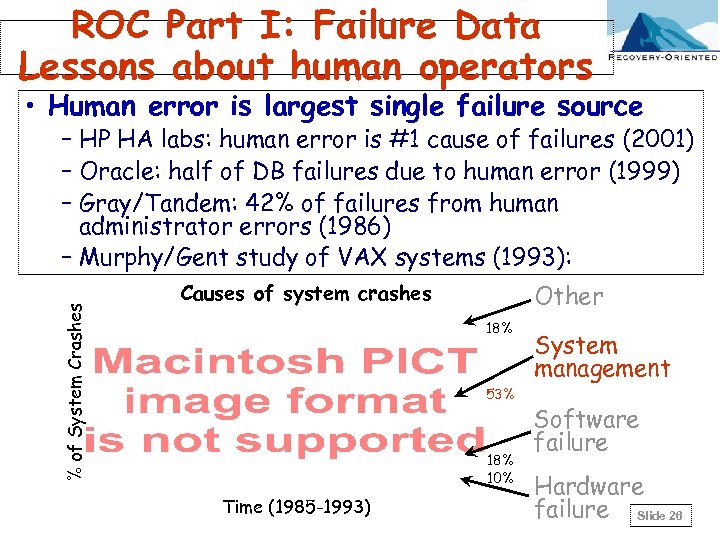 ROC Part I: Failure Data Lessons about human operators • Human error is largest single failure source % of System Crashes – HP HA labs: human error is #1 cause of failures (2001) – Oracle: half of DB failures due to human error (1999) – Gray/Tandem: 42% of failures from human administrator errors (1986) – Murphy/Gent study of VAX systems (1993): Other Causes of system crashes 18% 53% 18% 10% Time (1985 -1993) System management Software failure Hardware failure Slide 26
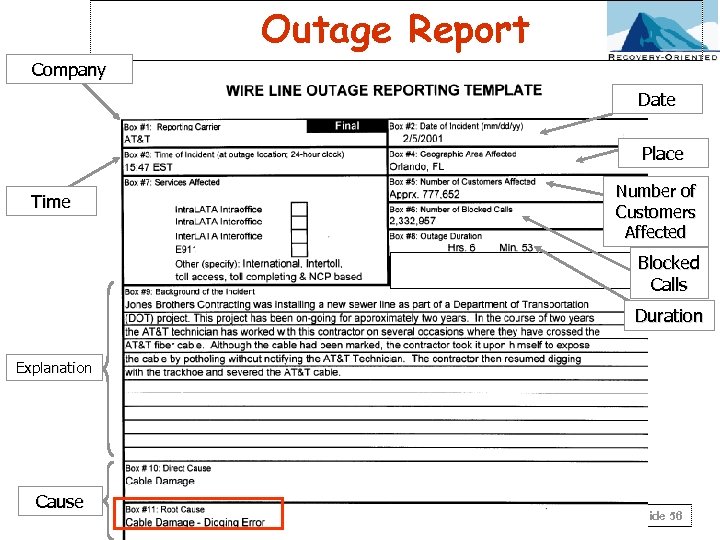
 • Failure Data: Public Switched Telephone Network (PSTN) Detailed telephone service failure data available from the Federal Communications Commission (FCC) – – • Outage and reason (direct vs. root cause) – • But how big an outage? Length of outage * potential customers affected – • Required by law for outages affecting 30, 000 people or lasting at least 30 minutes 3 ways to report But what if 2 AM vs. 2 PM? Blocked calls: actual calls tried but unsuccessful due to outage (!) Slide 27
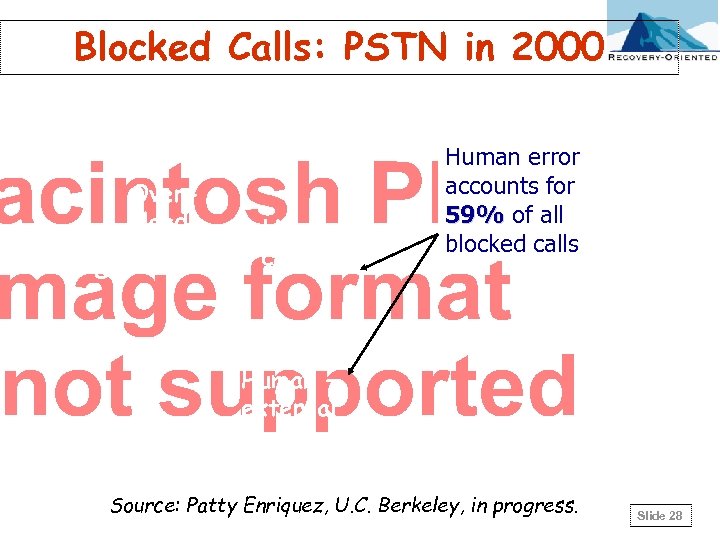 Blocked Calls: PSTN in 2000 Overload SW HW Human – company Human error accounts for 59% of all blocked calls Human – external Source: Patty Enriquez, U. C. Berkeley, in progress. Slide 28
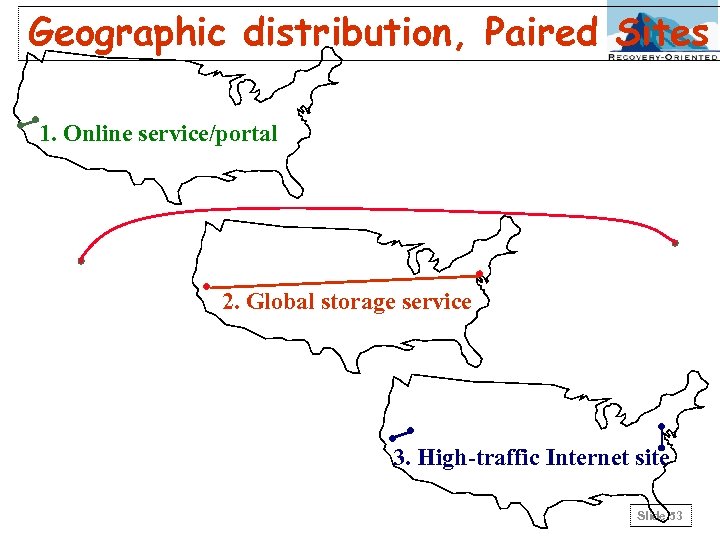
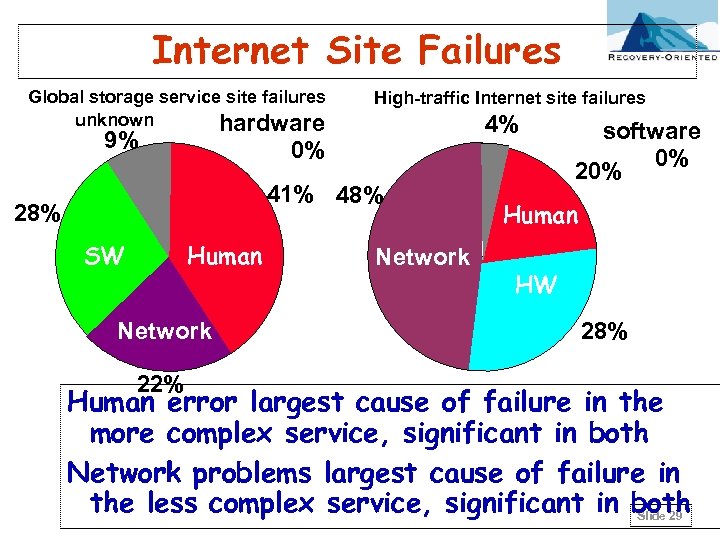 Internet Site Failures Global storage service site failures unknown hardware 9% High-traffic Internet site failures 4% 0% 41% 48% 28% SW Human Network 22% Network software 0% 20% Human HW 28% Human error largest cause of failure in the more complex service, significant in both Network problems largest cause of failure in the less complex service, significant in both Slide 29
 ROC Part 1: Failures Data Collection (so far) • Humans substantial cause of failures – As end users – As operators • Internet sites also challenged by network outages – Significant outages due to relying on collocation site facilities – Problem diagnosis/repair difficult when components maintained by independent entities • Very interested in getting more data (under NDA if desired) if you know where to get it Slide 30
 ROC Part 2: ACME benchmarks • Traditional benchmarks focus on performance – ignore ACME goals – assume perfect hardware, software, human operators • 20 th Century Winner: fastest on SPEC/TPC? • 21 st Century Winner: fastest to recover from failure? • New benchmarks needed to drive progress toward ACME, evaluate ROC success – for example, availability and recovery benchmarks – How else convince developers, customers to adopt new technology? Slide – How else enable researchers to find new challenges? 31
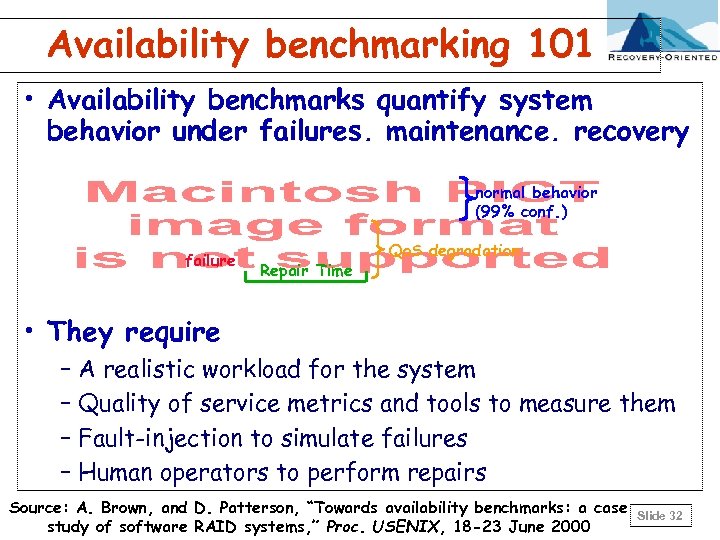 Availability benchmarking 101 • Availability benchmarks quantify system behavior under failures, maintenance, recovery normal behavior (99% conf. ) failure Repair Time Qo. S degradation • They require – A realistic workload for the system – Quality of service metrics and tools to measure them – Fault-injection to simulate failures – Human operators to perform repairs Source: A. Brown, and D. Patterson, “Towards availability benchmarks: a case study of software RAID systems, ” Proc. USENIX, 18 -23 June 2000 Slide 32
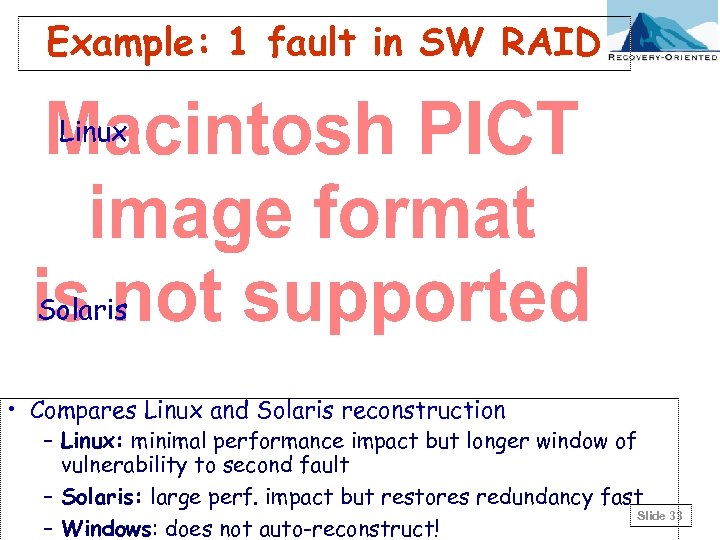 Example: 1 fault in SW RAID Linux Solaris • Compares Linux and Solaris reconstruction – Linux: minimal performance impact but longer window of vulnerability to second fault – Solaris: large perf. impact but restores redundancy fast Slide 33 – Windows: does not auto-reconstruct!
 ROC Part 3: Margin of Safety in CS&E? • Like Civil Engineering, never make dependable systems until add margin of safety (“margin of ignorance”) for what we don’t (can’t) know? • Marketing claims available 5 9 s (99. 999%) but customers achieve 2 -3 9 s (99% to 99. 9%) • Perhaps we need to “over engineer” by a 1 -2 9’s to deliver what we claim? • E. g. , RAID 6 (double failure OK) covers – Temperature, vibration causing failure before repair – Plus operator removing good disk vs. bad disk • Extra resources to mask errors + to “time travel” before SW or human fault? Slide 34
 ROC Part 4: Create/Evaluate Techniques to help ACME • Need a theory on constructing dependable, maintainable sites for networked services – Document best practices of successful sites? • Need a theory on good design for operators as well as good design for end users – Airplane Analogy: user interface to passengers (747) vs. user interface to pilots (Cessna) • Need new definition of failure – Need IT equivalent of PSTN “blocked calls”? » PSTN switches required to collect blocked calls; why don’t Internet switches collect failures? – Failure > unavailable for 100% of users: (e. g. , available to 10% of users is not “up”) Slide 35
 Safe, forgiving for operator? • Expect human error and tolerate it – protect system data from human error – allow mistakes to be easily reversed • Allow human operator to learn naturally – “mistakes are OK”: design to encourage exploration, experimentation • Make training on real system an everyday process • Match interfaces to human capabilities • Automate tedious or difficult tasks, but retain manual procedures – Encourage periodic use of manual procedures to increase familiarity Slide 36
 Partitioning and Redundancy? • System is Partitionable – To isolate faults – To enable online repair/recovery – To enable online HW growth/SW upgrade – To enable operator training/expand experience on portions of real system without fear of system failure – Techniques: Geographically replicated sites, Virtual Machine Monitors • System is Redundant – Sufficient HW redundancy/Data replication => part of system down but satisfactory service still available – Enough to survive 2 nd (nth? ) failure during recovery – Techniques: RAID-6, N-copies of data Slide 37
 Input Insertion for Detection? • System enables input insertion, output check of all modules (including fault insertion) – To check module sanity to find failures faster – To test correctness of recovery mechanisms » insert (random) faults and known-incorrect inputs » also enables availability benchmarks – To expose and remove latent errors from system – To train/expand experience of operator » Periodic reports to management on skills – To discover if warning systems are broken » How else tell? – To simplify use of ACME benchmarks • Major focus of Berkeley ROC project Slide 38
 Aid Diagnosis? • System assists human in diagnosing problems – Root-cause analysis to suggest possible failure points » Track resource dependencies of all requests » Correlate symptomatic requests with component dependency model to isolate culprit components – “health” reporting to detect failed/failing components » Failure information, self-test results propagated upwards – Don’t rely on things connected according to plans » Example: Discovery of network, power topology • Not a major focus of Berkeley or Stanford ROC projects Slide 39
 Refresh via Restart? • Many Internet services refresh system by periodic restart • “Recursive Restart” (Candea, Fox) restarts optimal number of components of system • Reduces time to repair by 5 X or more, depending on system • Major focus of Stanford ROC project Source: G. Candea and A. Fox, “Recursive Restartability: Turing the Reboot Sledgehammer into a scalpel, ” 8 th Workshop on Hot Topics in Operating Systmes (Hot. OS -VIII), May 2001 Slide 40
 Support Operator Trial & Error? • Provide an Undo for system administration – to create an environment that forgives operator error – to let Sys. Admins fix latent errors even after they’re manifested » this is no ordinary word processor undo! • The Three R’s: undo meets time travel – Rewind: roll system state backwards in time – Repair: fix latent or active error » automatically or via human intervention – Redo: roll system state forward, replaying user interactions lost during rewind • Major focus of Berkeley ROC project Source: Aaron Brown, U. C. Berkeley, in progress. Slide 41
 Undo for Sysadmin • 3 cases needing Undo – Reverse the effects of a mistyped command (rm –rf *) – Roll back a software upgrade without losing user data – “Go back in time” to retroactively install virus filter on email server; effects of virus are squashed on redo • The 3 R’s vs. check pointing, reboot, logging – Check pointing gives Rewind only – Reboot may give Repair, but only for “Heisenbugs” – Logging can give all 3 R’s » but need more than RDBMS logging, since system state changes are interdependent and non-transactional » 3 R-logging requires careful dependency tracking, and attention to state granularity and externalized events • Undo offers time travel for safety margin Slide 42
 Summary: from ACME to ROC • 2002: Peres’s Law greater than Moore’s Law? – Must cope with fact that people, SW, HW fail – Industry: may soon compete on recovery time v. SPEC • 21 st Century Research challenge is Availability, Changability, Maintainability, Evolutionary Growth – Need theory of design for Internet services, easy for operator as well as easy for user • Recovery Oriented Computing is one path – Failure data collection + Benchmarks to evaluate ACME – Partitioning, Redundancy, Diagnosis, Partial Restart, Input/Fault Insertion, Undo, Margin of Safety (spare 9 s) • Significantly reducing MTTR (people/SW/HW) => better Availability & Cost of Ownership Slide 43
 Interested in ROCing? • More research opportunities than 2 university projects can cover. Many could help with: – Failure data collection, analysis, and publication – Create/Run Availability, Maintainability benchmarks: compare (by vendor) databases, files systems, routers, … – Invent, evaluate techniques to reduce MTTR and TCO in computation, storage, and network systems – (Lots of low hanging fruit) “If it’s important, how can you say it’s impossible if you don’t try? ” Jean Monnet, a founder of European Union http: //ROC. cs. berkeley. edu Slide 44
 BACKUP SLIDES Slide 45
 ROC Part 2: ACME Benchmarks (so far) • Race to recover vs. race to finish line • Many opportunities to compare commercial products and claims, measure value of research ideas, … with availability benchmarks • Maintainability benchmarks involve people, but so do most research by social scientists • Partial failures: Evaluate “Service level” benchmarks that insert faults that do not bring down entire service for all users? • Even initial Availability benchmarks find peculiarities of systems measured • Lots of low hanging fruit (~ early RAID days) Slide 46
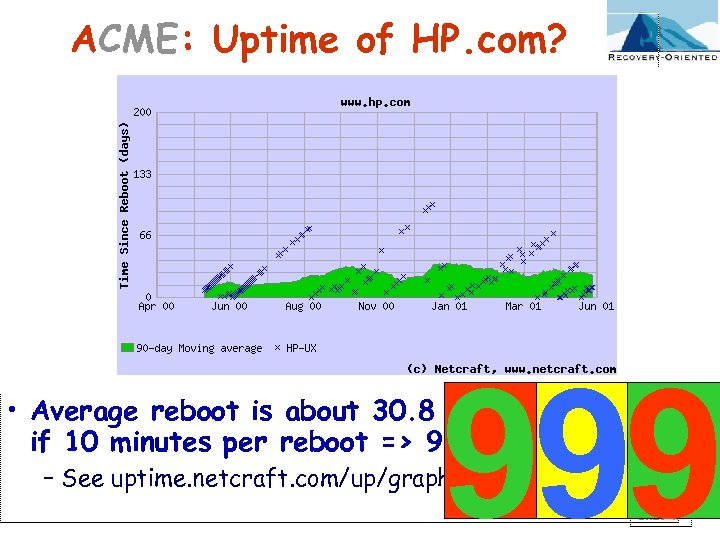 ACME: Uptime of HP. com? 999 • Average reboot is about 30. 8 days; if 10 minutes per reboot => 99. 9% uptime – See uptime. netcraft. com/up/graph? site=www. hp. com Slide 47
 Availability Benchmarking Environment • Fault workload – Must accurately reflect failure modes of real-world Internet service environments » plus random tests to increase coverage, simulate Heisenbugs – But, no existing public failure dataset » we have to collect this data » a challenge due to proprietary nature of data – major contribution will be to collect, anonymize, and publish a modern set of failure data • Fault injection harness – build into system: needed anyway for online verification Slide 48
 Software RAID: Qo. S behavior • Response to double-fault scenario – a double fault results in unrecoverable loss of data on the RAID volume – Linux: blocked access to volume – Windows: blocked access to volume – Solaris: silently continued using volume, delivering fabricated data to application! » clear violation of RAID availability semantics » resulted in corrupted file system and garbage data at the application level » this undocumented policy has serious availability implications for applications Slide 49
 Failure Data: 2 Internet Sites • Global storage service – ~500 machines, 4 colo. facilities + customer sites – all service software custom-written (x 86/free OS) – Read/Write, more complex workload • High-traffic Internet site – ~5000 of machines, 4 collocation facilities – ~100 million hits/day – all service software custom-written (x 86/free OS) – Read mostly – Read, More HW, Software more mature • Looked at trouble tickets over 3 -6 months Source: David Oppenheimer, U. C. Berkeley, in progress. Slide 50
 Total Cost Own. Hypothesis • “Moore’s Law” + hypercompetitve marketplace improves cost and speed of CPUs, cost and capacity of memory and disks • Morris (IBM) $3 M comparison 1984 v. 2001: – CPU: Minicomputer to PC, 3000 X faster – DRAM: Memory boards to DIMMs, 3000 X bigger – Disks: 8 -inch drives to 3. 5 -inch drives, 4000 X bigger • Unless avg. user demands grow with Moore’s Law, a service increases in number of users • HW/SW costs shrink; salaries go up over time • Hypothesis: Cost of Ownership is more a function of number of users versus HW/SW $, so T. C. O. today is mostly people costs Slide 51
 Butler Lampson: Systems Challenges • Systems that work • • “Computer Systems Research – Meeting their specs -Past and Future” Keynote address, – Always available 17 th SOSP, – Adapting to changing environment Dec. 1999 – Evolving while they run Butler Lampson Microsoft – Made from unreliable components – Growing without practical limit Credible simulations or analysis Writing good specs Testing Performance – Understanding when it doesn’t matter Slide 52
 Geographic distribution, Paired Sites 1. Online service/portal 2. Global storage service 3. High-traffic Internet site Slide 53
 Automation vs. Aid? • Two approaches to helping 1) Automate the entire process as a unit – the goal of most research into “self-healing”, “self-maintaining”, “self-tuning”, or more recently “introspective” or “autonomic” systems – What about Automation Irony? 2) ROC approach: provide tools to let human Sys. Admins perform job more effectively – If desired, add automation as a layer on top of the tools – What about number of Sys. Admins as number of computers continue to increase? Slide 54
 A science fiction analogy: Autonomic vs. ROC • Autonomic approach HAL 9000 (2001) • Suffers from effects of the Automation Irony – system is opaque to humans – only solution to unanticipated failure is to pull the plug? • ROC approach Enterprise computer (2365) • 24 th-century engineer is like today’s Sys. Admin – a human diagnoses & repairs computer problems – aided by diagnostic tools and Slide 55 understanding of system
 Outage Report Company Date Place Time Number of Customers Affected Blocked Calls Duration Explanation Cause Slide 56
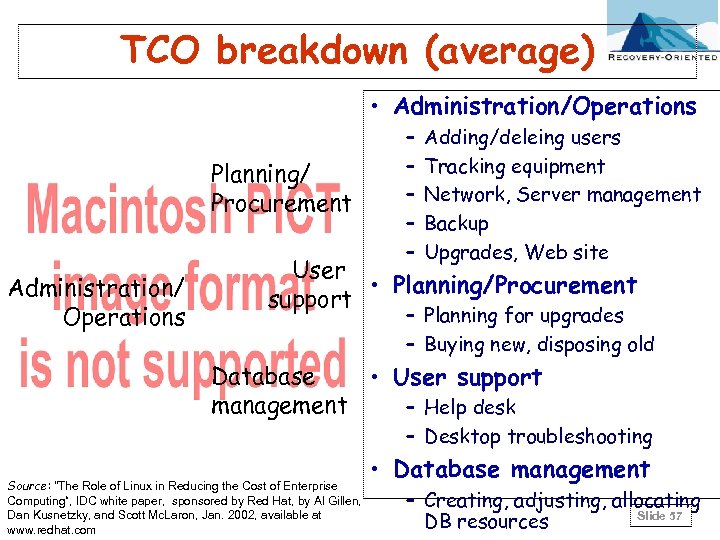 TCO breakdown (average) • Administration/Operations Planning/ Procurement Administration/ Operations – – – Adding/deleing users Tracking equipment Network, Server management Backup Upgrades, Web site User • Planning/Procurement support – Planning for upgrades – Buying new, disposing old Database • User support management – Help desk – Desktop troubleshooting Source: "The Role of Linux in Reducing the Cost of Enterprise Computing“, IDC white paper, sponsored by Red Hat, by Al Gillen, Dan Kusnetzky, and Scott Mc. Laron, Jan. 2002, available at www. redhat. com • Database management – Creating, adjusting, allocating Slide 57 DB resources
 Internet x 86/Linux Breakdown Slide 58
 Evaluating ROC: human aspects • Must include humans in availability benchmarks – to verify effectiveness of undo, training, diagnostics – humans act as system administrators • Subjects should be admin-savvy – system administrators – CS graduate students • Challenge will be compressing timescale – i. e. , for evaluating training • We have some experience with these trials – earlier work in maintainability benchmarks used 5 person pilot study Slide 59
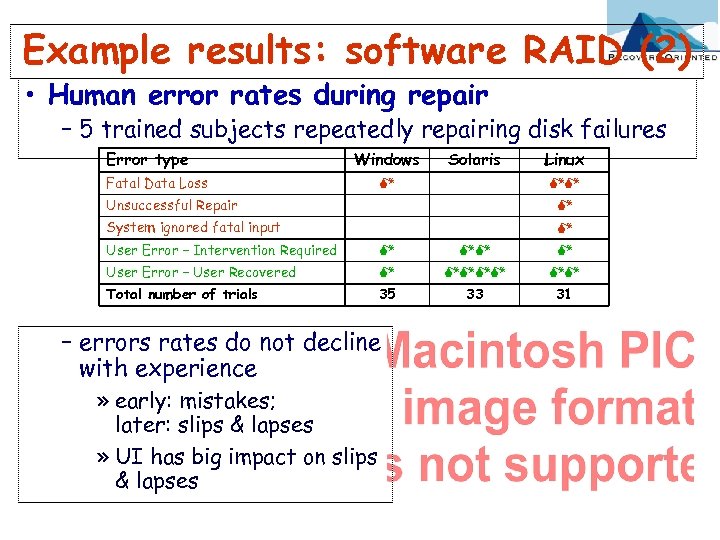 Example results: software RAID (2) • Human error rates during repair – 5 trained subjects repeatedly repairing disk failures Error type Windows Fatal Data Loss Solaris M Linux MM Unsuccessful Repair M System ignored fatal input M User Error – Intervention Required M MM M User Error – User Recovered M MMMM MM Total number of trials 35 33 31 – errors rates do not decline with experience » early: mistakes; later: slips & lapses » UI has big impact on slips & lapses Slide 60
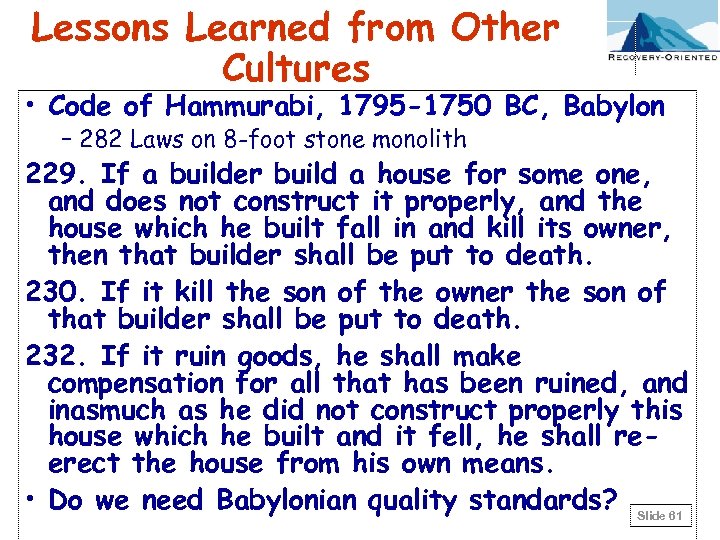 Lessons Learned from Other Cultures • Code of Hammurabi, 1795 -1750 BC, Babylon – 282 Laws on 8 -foot stone monolith 229. If a builder build a house for some one, and does not construct it properly, and the house which he built fall in and kill its owner, then that builder shall be put to death. 230. If it kill the son of the owner the son of that builder shall be put to death. 232. If it ruin goods, he shall make compensation for all that has been ruined, and inasmuch as he did not construct properly this house which he built and it fell, he shall reerect the house from his own means. • Do we need Babylonian quality standards? Slide 61