



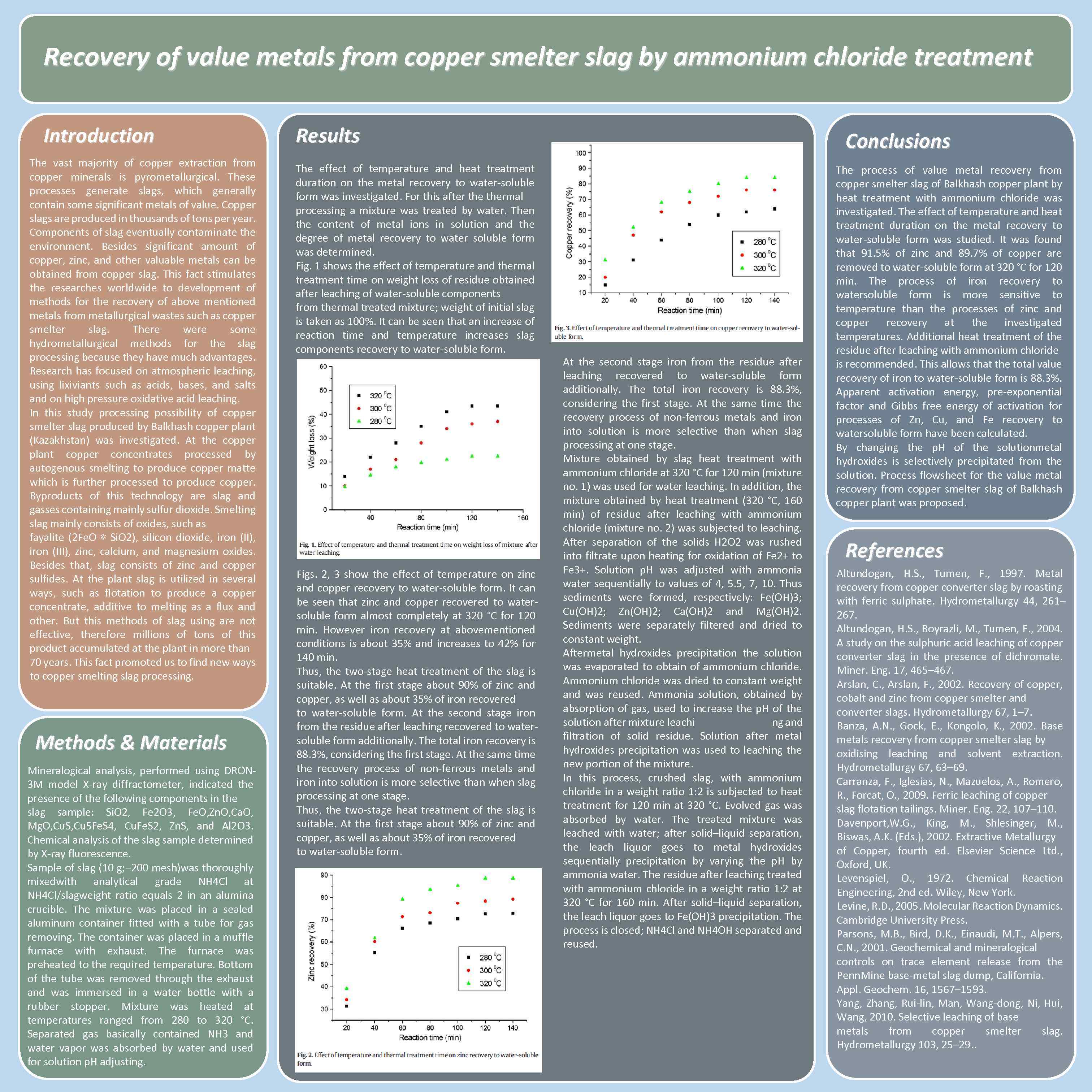
 Recovery of value metals from copper smelter slag by ammonium chloride treatment Introduction The vast majority of copper extraction from copper minerals is pyrometallurgical. These processes generate slags, which generally contain some significant metals of value. Copper slags are produced in thousands of tons per year. Components of slag eventually contaminate the environment. Besides significant amount of copper, zinc, and other valuable metals can be obtained from copper slag. This fact stimulates the researches worldwide to development of methods for the recovery of above mentioned metals from metallurgical wastes such as copper smelter slag. There were some hydrometallurgical methods for the slag processing because they have much advantages. Research has focused on atmospheric leaching, using lixiviants such as acids, bases, and salts and on high pressure oxidative acid leaching. In this study processing possibility of copper smelter slag produced by Balkhash copper plant (Kazakhstan) was investigated. At the copper plant copper concentrates processed by autogenous smelting to produce copper matte which is further processed to produce copper. Byproducts of this technology are slag and gasses containing mainly sulfur dioxide. Smelting slag mainly consists of oxides, such as fayalite (2 Fe. O ∗ Si. O 2), silicon dioxide, iron (II), iron (III), zinc, calcium, and magnesium oxides. Besides that, slag consists of zinc and copper sulfides. At the plant slag is utilized in several ways, such as flotation to produce a copper concentrate, additive to melting as a flux and other. But this methods of slag using are not effective, therefore millions of this product accumulated at the plant in more than 70 years. This fact promoted us to find new ways to copper smelting slag processing. Methods & Materials Mineralogical analysis, performed using DRON 3 M model X-ray diffractometer, indicated the presence of the following components in the slag sample: Si. O 2, Fe 2 O 3, Fe. O, Zn. O, Ca. O, Mg. O, Cu. S, Cu 5 Fe. S 4, Cu. Fe. S 2, Zn. S, and Al 2 O 3. Chemical analysis of the slag sample determined by X-ray fluorescence. Sample of slag (10 g; − 200 mesh)was thoroughly mixedwith analytical grade NH 4 Cl at NH 4 Cl/slagweight ratio equals 2 in an alumina crucible. The mixture was placed in a sealed aluminum container fitted with a tube for gas removing. The container was placed in a muffle furnace with exhaust. The furnace was preheated to the required temperature. Bottom of the tube was removed through the exhaust and was immersed in a water bottle with a rubber stopper. Mixture was heated at temperatures ranged from 280 to 320 °C. Separated gas basically contained NH 3 and water vapor was absorbed by water and used for solution р. H adjusting. Results The effect of temperature and heat treatment duration on the metal recovery to water-soluble form was investigated. For this after thermal processing a mixture was treated by water. Then the content of metal ions in solution and the degree of metal recovery to water soluble form was determined. Fig. 1 shows the effect of temperature and thermal treatment time on weight loss of residue obtained after leaching of water-soluble components from thermal treated mixture; weight of initial slag is taken as 100%. It can be seen that an increase of reaction time and temperature increases slag components recovery to water-soluble form. Figs. 2, 3 show the effect of temperature on zinc and copper recovery to water-soluble form. It can be seen that zinc and copper recovered to watersoluble form almost completely at 320 °С for 120 min. However iron recovery at abovementioned conditions is about 35% and increases to 42% for 140 min. Thus, the two-stage heat treatment of the slag is suitable. At the first stage about 90% of zinc and copper, as well as about 35% of iron recovered to water-soluble form. At the second stage iron from the residue after leaching recovered to watersoluble form additionally. The total iron recovery is 88. 3%, considering the first stage. At the same time the recovery process of non-ferrous metals and iron into solution is more selective than when slag processing at one stage. Thus, the two-stage heat treatment of the slag is suitable. At the first stage about 90% of zinc and copper, as well as about 35% of iron recovered to water-soluble form. Conclusions At the second stage iron from the residue after leaching recovered to water-soluble form additionally. The total iron recovery is 88. 3%, considering the first stage. At the same time the recovery process of non-ferrous metals and iron into solution is more selective than when slag processing at one stage. Mixture obtained by slag heat treatment with ammonium chloride at 320 °C for 120 min (mixture no. 1) was used for water leaching. In addition, the mixture obtained by heat treatment (320 °C, 160 min) of residue after leaching with ammonium chloride (mixture no. 2) was subjected to leaching. After separation of the solids H 2 O 2 was rushed into filtrate upon heating for oxidation of Fe 2+ to Fe 3+. Solution p. H was adjusted with ammonia water sequentially to values of 4, 5. 5, 7, 10. Thus sediments were formed, respectively: Fe(OH)3; Cu(OH)2; Zn(OH)2; Ca(OH)2 and Mg(OH)2. Sediments were separately filtered and dried to constant weight. Aftermetal hydroxides precipitation the solution was evaporated to obtain of ammonium chloride. Ammonium chloride was dried to constant weight and was reused. Ammonia solution, obtained by absorption of gas, used to increase the p. H of the solution after mixture leachi ng and filtration of solid residue. Solution after metal hydroxides precipitation was used to leaching the new portion of the mixture. In this process, crushed slag, with ammonium chloride in a weight ratio 1: 2 is subjected to heat treatment for 120 min at 320 °C. Evolved gas was absorbed by water. The treated mixture was leached with water; аfter solid–liquid separation, the leach liquor goes to metal hydroxides sequentially precipitation by varying the p. H by ammonia water. The residue after leaching treated with ammonium chloride in a weight ratio 1: 2 at 320 °C for 160 min. After solid–liquid separation, the leach liquor goes to Fe(OH)3 precipitation. The process is closed; NH 4 Cl and NH 4 OH separated and reused. The process of value metal recovery from copper smelter slag of Balkhash copper plant by heat treatment with ammonium chloride was investigated. The effect of temperature and heat treatment duration on the metal recovery to water-soluble form was studied. It was found that 91. 5% of zinc and 89. 7% of copper are removed to water-soluble form at 320 °C for 120 min. The process of iron recovery to watersoluble form is more sensitive to temperature than the processes of zinc and copper recovery at the investigated temperatures. Additional heat treatment of the residue after leaching with ammonium chloride is recommended. This allows that the total value recovery of iron to water-soluble form is 88. 3%. Apparent activation energy, pre-exponential factor and Gibbs free energy of activation for processes of Zn, Cu, and Fe recovery to watersoluble form have been calculated. By changing the p. H of the solutionmetal hydroxides is selectively precipitated from the solution. Process flowsheet for the value metal recovery from copper smelter slag of Balkhash copper plant was proposed. References Altundogan, H. S. , Tumen, F. , 1997. Metal recovery from copper converter slag by roasting with ferric sulphate. Hydrometallurgy 44, 261– 267. Altundogan, H. S. , Boyrazli, M. , Tumen, F. , 2004. A study on the sulphuric acid leaching of copper converter slag in the presence of dichromate. Miner. Eng. 17, 465– 467. Arslan, C. , Arslan, F. , 2002. Recovery of copper, cobalt and zinc from copper smelter and converter slags. Hydrometallurgy 67, 1– 7. Banza, A. N. , Gock, E. , Kongolo, K. , 2002. Base metals recovery from copper smelter slag by oxidising leaching and solvent extraction. Hydrometallurgy 67, 63– 69. Carranza, F. , Iglesias, N. , Mazuelos, A. , Romero, R. , Forcat, O. , 2009. Ferric leaching of copper slag flotation tailings. Miner. Eng. 22, 107– 110. Davenport, W. G. , King, M. , Shlesinger, M. , Biswas, A. K. (Eds. ), 2002. Extractive Metallurgy of Copper, fourth ed. Elsevier Science Ltd. , Oxford, UK. Levenspiel, O. , 1972. Chemical Reaction Engineering, 2 nd ed. Wiley, New York. Levine, R. D. , 2005. Molecular Reaction Dynamics. Cambridge University Press. Parsons, M. B. , Bird, D. K. , Einaudi, M. T. , Alpers, C. N. , 2001. Geochemical and mineralogical controls on trace element release from the Penn. Mine base-metal slag dump, California. Appl. Geochem. 16, 1567– 1593. Yang, Zhang, Rui-lin, Man, Wang-dong, Ni, Hui, Wang, 2010. Selective leaching of base metals from copper smelter slag. Hydrometallurgy 103, 25– 29. .