


 Скачать презентацию Records Management Management Now and in the Future
c824af191cbdd56bc4bba8931d121266.ppt
- Количество слайдов: 39
 Records Management: Management Now and in the Future Susan R. Cummings National Archives and Records Administration CENDI/National Library of Medicine June 13, 2001
 Overview of Today’s Presentation • External Environment • NARA’s View of Electronic Records (Context for the E-Sig Presentation) • A Summary of the Major Points of GPEA • NARA’s Future: ERA
 The External Environment - I • GPEA - Electronic transactions – Interoperability & document exchange – Web enabled government • Rising customer expectations • Mixed customer requirements
 The External Environment - II • Concern for computer security • Concern for privacy • Concern for government accountability • Increased litigation risks
 All Records Are Not Equal • Much of what we create qualifies as a record under the federal definition. • To serve as a record of business activity the records must be trustworthy – Reliability – Authenticity Integrity Usability • Adequate and proper documentation doesn’t mean everything must be retained forever.
 The Policy Challenges • Defining what is an electronic record • Defining a “trustworthy” electronic record • Determining what records management theory applies and what must be replaced • Developing standards • The relationship of records management to legal and security issues • Balancing multiple requirements and costs
 NARA’s Core Policy Ideas - I • Policy must balance: – Electronic records as one part of overall documentation – Special character of electronic records - they are separate and equal records • Steer not row - importance of practices, e. g. , 5015. 2 best
 NARA’s Core Policy Ideas - II • Records Management is not a stand-alone concept • Trustworthy electronic records • Content, context, and structure as framework
 Implementing Records Management - I • A joint approach to records management policy – Agency responsibilities – NARA responsibilities – Other agencies • A team approach to implementation
 Implementing Records Management - II • The importance of business needs in determining levels of documentation • Implementation as risk based
 What Does NARA Mean By Electronic Recordkeeping? • Creating and maintaining records in electronic form so that those records can successfully serve as the records to meet an agency’s legal, fiscal, administrative, and other business needs, and when necessary be preserved permanently as part of our Nation’s historical record
 Does GPEA Require ERK? • E-Government means records are created • NARA does feel that E-Government and electronic recordkeeping fit together well • It makes more sense to maintain the records created electronically in electronic form, but that is not a requirement. • NARA sees its role as the advocate for addressing recordkeeping issues.
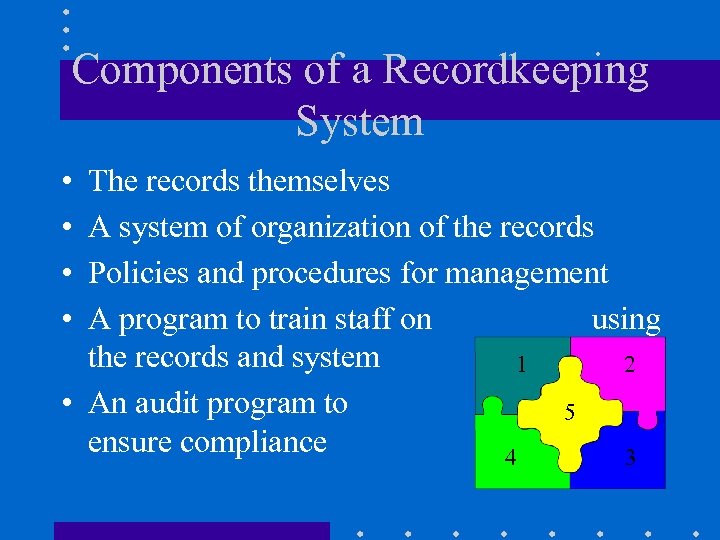 Components of a Recordkeeping System • • The records themselves A system of organization of the records Policies and procedures for management A program to train staff on using the records and system 1 2 • An audit program to 5 ensure compliance 4 3
 These Ideas Are Not Absolutes • Based on business needs – Administrative, legal, fiscal – Oversight – Appropriate public access – Historical preservation • Based on assessment of risk • No different from paper
 Government Paperwork Elimination Act (GPEA) P. L. 105 -277 (Title VII) • Agencies to automate interactions with outside partners/customers by October 2003 to the extent practicable. • OMB, in consultation with Commerce, Justice, Treasury & NARA, to promulgate policies and procedures within 18 months. • Procedures are to encourage both electronic filing and electronic recordkeeping, particularly by employers.
 Signature: UCC Definition (§ 1 -201(39)) • Any symbol executed or adopted by a party with present intention to authenticate a writing.
 Legal Effect and Validity Electronic records submitted or maintained in accordance with procedures developed under this title, or electronic signatures or other forms of electronic authentication used in accordance with such procedures, shall not be denied legal effect, validity, or enforceability because such records are in electronic form. -GPEA, section 1707
 Other GPEA Guidance • OMB - http: //www. cio. gov/docs/gpea 2. htm • Dept. of Treasury – http: //www. fms. treas. gov/eauth/index. html • Dept. of Justice – http: //www. cio. gov/docs/eprocmemo. htm • Dept. of Commerce – http: //csrc. nist. gov/publications/nistpubs/index. html
 Executive Summary Points (1 of 2) • Agencies must consider RM when implementing GPEA • E-sig systems will produce new records or augment existing records • Various approaches ensure trustworthy esigned records • Agencies must maintain trustworthiness of e -signed records over time
 Executive Summary Points (2 of 2) • Use of 3 rd party contractors in implementing e-sig systems raise adequacy of documentation issues • Scheduling issues must be addressed before disposing of e-sig records • Records disposition authorities of e-signed records may need to be modified • Permanent e-signed records documenting legal rights have special considerations
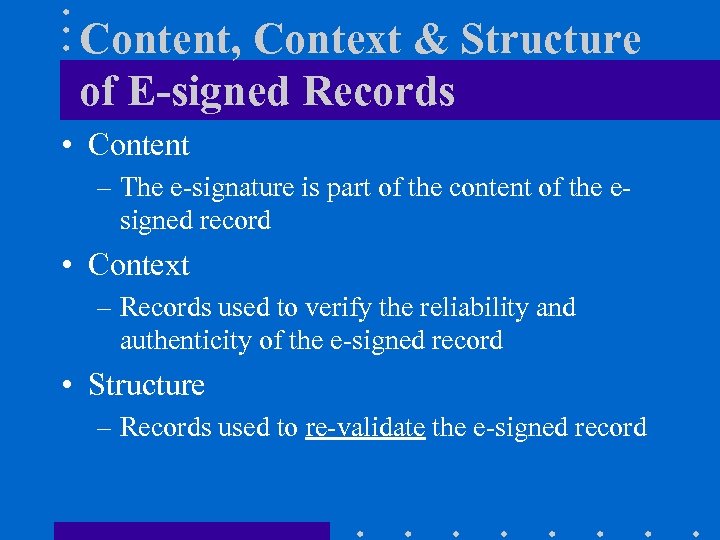 Content, Context & Structure of E-signed Records • Content – The e-signature is part of the content of the esigned record • Context – Records used to verify the reliability and authenticity of the e-signed record • Structure – Records used to re-validate the e-signed record
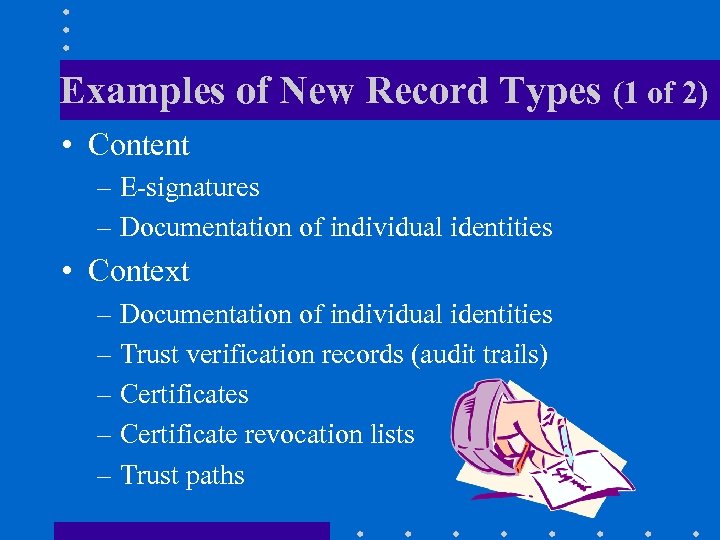 Examples of New Record Types (1 of 2) • Content – E-signatures – Documentation of individual identities • Context – Documentation of individual identities – Trust verification records (audit trails) – Certificates – Certificate revocation lists – Trust paths
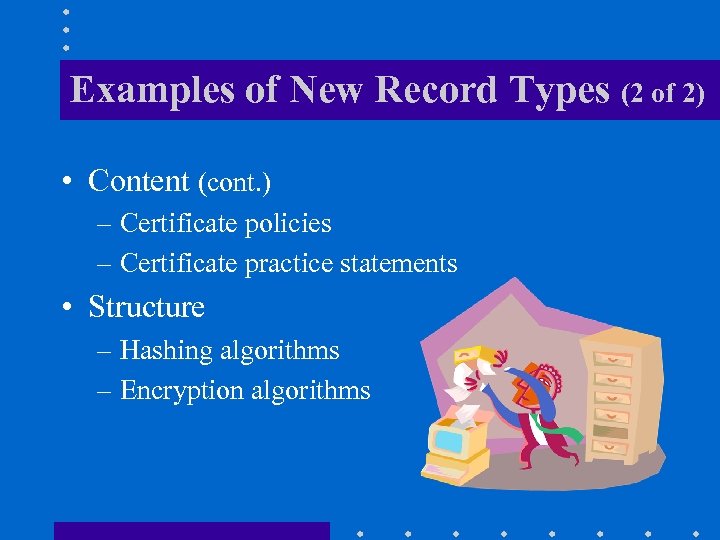 Examples of New Record Types (2 of 2) • Content (cont. ) – Certificate policies – Certificate practice statements • Structure – Hashing algorithms – Encryption algorithms
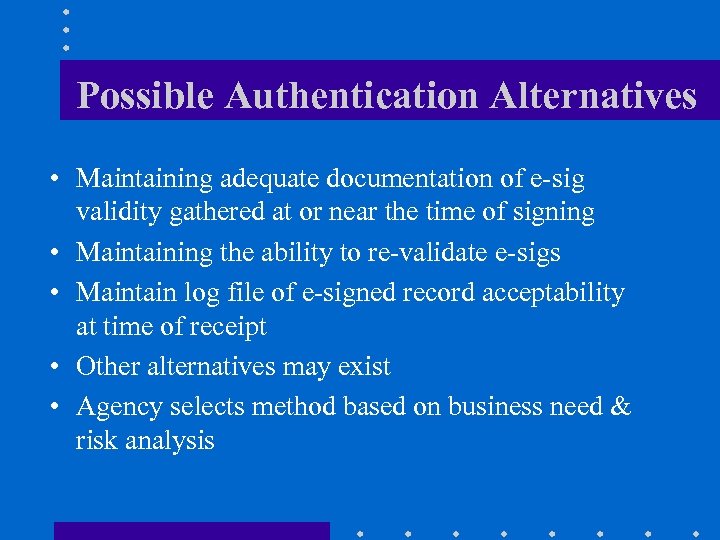 Possible Authentication Alternatives • Maintaining adequate documentation of e-sig validity gathered at or near the time of signing • Maintaining the ability to re-validate e-sigs • Maintain log file of e-signed record acceptability at time of receipt • Other alternatives may exist • Agency selects method based on business need & risk analysis
 Scheduling E-signed Records Is Necessary When. . . • New content, context or structure records (as determined by your risk analysis/ business practices) are being created • Agency determines incorporation of e-sig will result in changes in retention period of e-signed record • Incorporation of e-sig and/or changes in work processes significantly change the character of the record
 NARA’s Future: ERA Electronic Records Archives Program 26
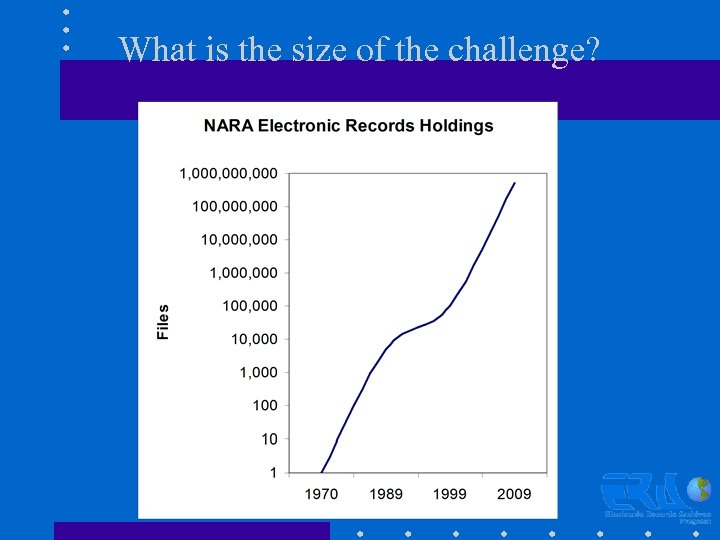 What is the size of the challenge?
 Critical Challenge • The proven methods for preserving digital information across generations of technology are limited to the simplest formats • Available methods are increasingly inadequate
 What do we need to do? • Overcome technological obsolescence in a way that preserves demonstrably authentic records. • Build a dynamic solution that incorporates the expectation of continuing change in information technology and in the records it produces. • Find ways to take advantage of continuing progress in information technology in order to maintain and improve both performance and customer service
 NARA’s Requirements • Scale • Variety • Permanence
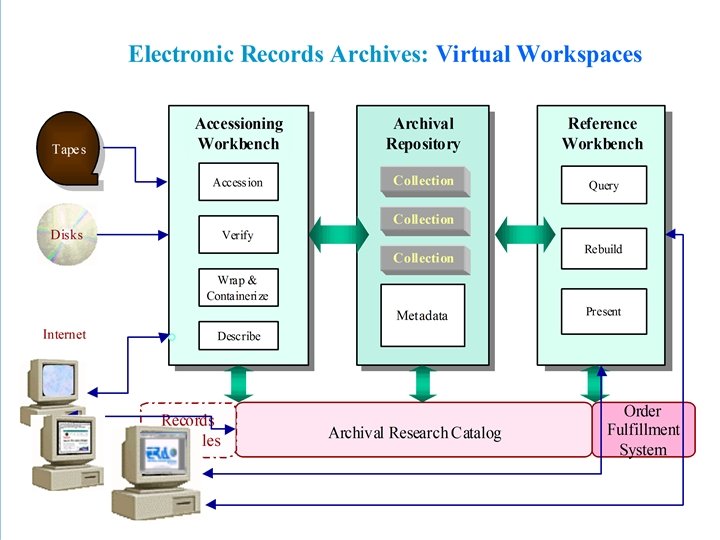
 The Electronic Records Archives is a comprehensive, systematic, and dynamic means of providing continuing access to authentic electronic records over time.
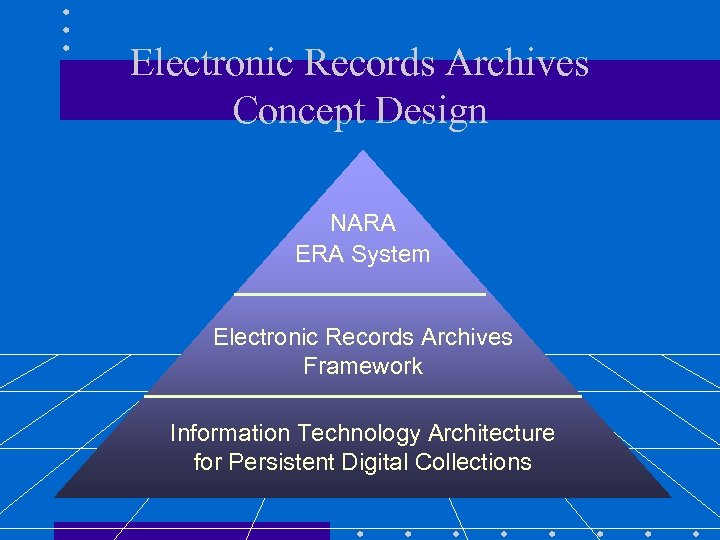 Electronic Records Archives Concept Design NARA ERA System Electronic Records Archives Framework Information Technology Architecture for Persistent Digital Collections
 Strategies for Digital Preservation • Existing Technologies – Technology Preservation • Maintain original hardware and software • Imitate original technology – Data Format Migration • Version Migration • Standardize Formats
 Emerging Technologies Transformation to Persistent Form Persistent Object Preservation Ingest and storage demonstration for several diverse collections of electronic records representing the following genres: E-mail Geospatial data Office automation products Databases Images Access demonstrated for a few collections Usenet e-mail example: 1 million message collected, ingested, stored, and made available for access in just over one day
 NARA Partnerships • Open Archival Information System (OAIS) Reference Model – NASA, Consultative Committee on Space Data Systems • Distributed Object Computation Testbed (DOCT) – Defense Advanced Research Projects Agency, U. S. Patent and Trademark Office • National Partnership for Advanced Computational Infrastructure (NPACI) – National Science Foundation
 NARA Partnerships Presidential Electronic Records Processing Operational System (PERPOS) Army Research Laboratory, Georgia Tech Research Institute Archivist’s Workbench NHPRC Grant to San Diego Supercomputer Center International research on Permanent Authentic Records in Electronic Systems (Inter. PARES) 7 international research teams, 10 national archives
 ERA Program Schedule • Continue research in order to accumulate knowledge, experience, and metrics • Develop system(s) at point where enabling technologies mature and are available on the market • Prototypes, pilots, and operational components rolled out over next few years with a goal of minimal production capability by 2005
 Contact Information • Susan R. Cummings • Policy and Communication Staff • 301 -713 -7360, ext. 238 • susan. cummings@nara. gov • www. nara. gov/records/index. html