


 Скачать презентацию Reconstruction The North may have won the Civil
ef2588625122bd03a6cb9f231c3e5fa9.ppt
- Количество слайдов: 16
 Reconstruction “The North may have won the Civil War but the South won the peace that followed” Samuel Elliot Morrison
 Background to Reconstruction • Years between 1865 and 1877 • Questions to answer: – What conditions should be placed on the south before they can assume their former rights? – Which branch of government can/will reconstruct? – What rights should be granted to freed slaves? – How will the economy of the south be rebuilt?
 Conflict over Reconstruction • Lincoln believed that the southern states had never seceded • The Union should forgive the south • Radical Republicans refused to recognize this plan • Condemned the Lincoln/Johnson plan: – Infringing on Congressional power – Too lenient – Endangering Republican influence – Abandoning freed slaves
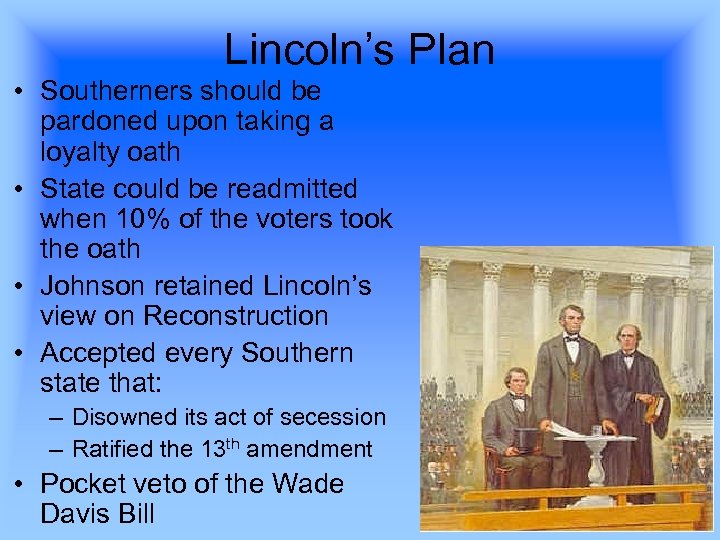 Lincoln’s Plan • Southerners should be pardoned upon taking a loyalty oath • State could be readmitted when 10% of the voters took the oath • Johnson retained Lincoln’s view on Reconstruction • Accepted every Southern state that: – Disowned its act of secession – Ratified the 13 th amendment • Pocket veto of the Wade Davis Bill
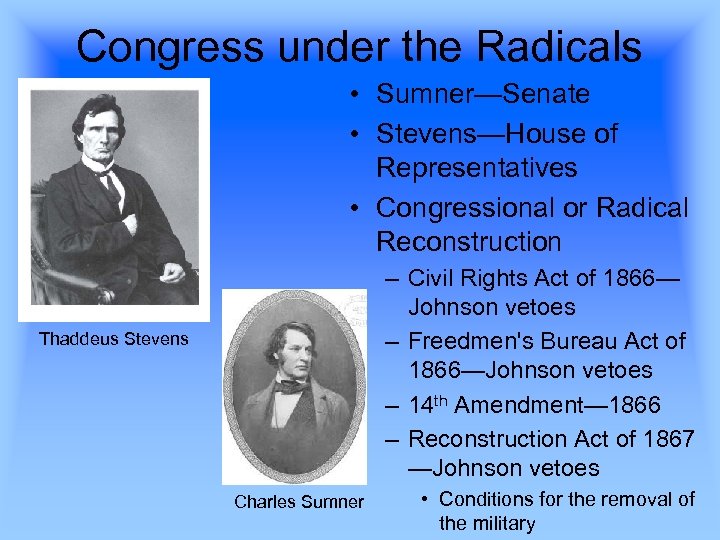 Congress under the Radicals • Sumner—Senate • Stevens—House of Representatives • Congressional or Radical Reconstruction – Civil Rights Act of 1866— Johnson vetoes – Freedmen's Bureau Act of 1866—Johnson vetoes – 14 th Amendment— 1866 – Reconstruction Act of 1867 —Johnson vetoes Thaddeus Stevens Charles Sumner • Conditions for the removal of the military
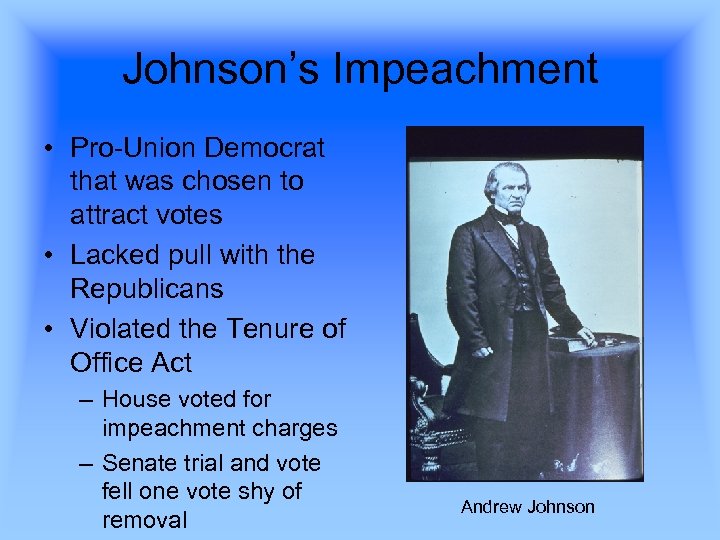 Johnson’s Impeachment • Pro-Union Democrat that was chosen to attract votes • Lacked pull with the Republicans • Violated the Tenure of Office Act – House voted for impeachment charges – Senate trial and vote fell one vote shy of removal Andrew Johnson
 Reconstruction Governments • Controlling political groups – – Confederate leaders banned Carpetbaggers Scalawags Freed Slaves—Enfranchised by the 15 th amendment • Criticism of Reconstruction governments – – Corruption Heavy taxation Increased public debt Protected by federal troops
 Defense of Reconstruction Government • Framed constitutions that protected civil liberties • Began to rebuild the South – Infrastructure—land grant railroads • Improved access to public education • Corruption marked the governments all around the country not just in the South
 White Resistance to Radical Reconstruction • Ku Klux Klan—Tennessee in 1865 – Drive out the carpetbaggers – Frighten scalawags – Frighten blacks to prevent voting • • Burned homes and practiced lynching Subdued by Federal troops Increased number of white voters Northern interest in black rights wanes
 Election of 1876 • Democrats select Samuel Tilden of NY • Republicans select Rutheford B. Hayes of Ohio • At the end of the election: – Tilden— 184 – Hayes— 165 – Twenty votes outstanding from the south – Congressional commission reviewed disputed votes (8 -republicans and 7 -democrats) – All votes went to Hayes—Tilden won the popular vote
 Compromise of 1877 • Hayes calmed Democratic opposition by offering: – Provide funds for internal improvements – Appoint a southern to a cabinet post – Remove all federal troops from the south • 1877—Hayes removed all troops and remaining carpetbag governments collapsed
 Lasting Impacts • Solid South – First crack doesn’t happen until 1928 • Southern agricultural economy Maintained – Sharecropping • New South—development of industry – Steel mills – Textile mills – Cigarette factories
 Reconstruction at the National Level • Election of 1868—Grant accepts radical reconstruction – “waving the bloody shirt” • Grant’s character • Election of 1872 – Grant vs. Greely – Attempts to get rid of corruption lose to the “bloody shirt” campaign
 Corruption in the Grant Administration • “Jubilee” Jim Fiske and Jay Gould—corner the gold market • Whiskey Ring • Credit Mobilier Scandal
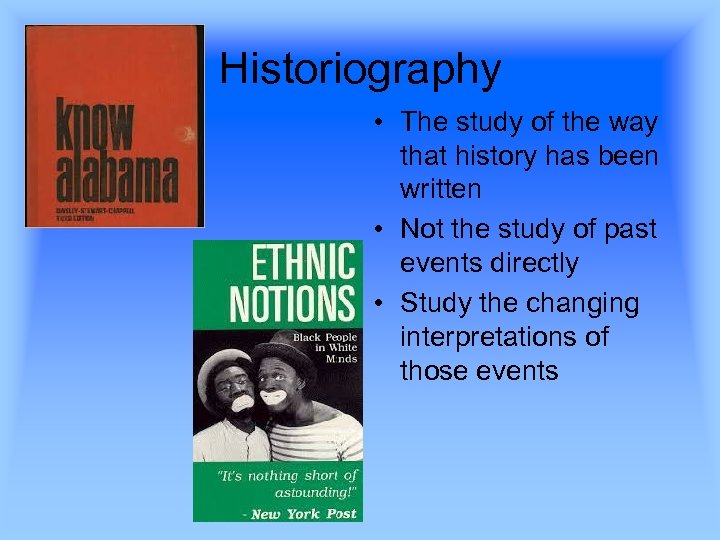 Historiography • The study of the way that history has been written • Not the study of past events directly • Study the changing interpretations of those events
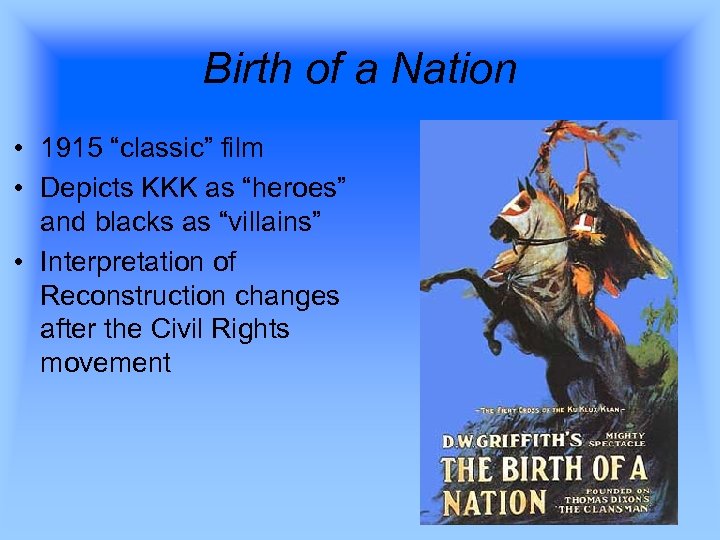 Birth of a Nation • 1915 “classic” film • Depicts KKK as “heroes” and blacks as “villains” • Interpretation of Reconstruction changes after the Civil Rights movement