


 Скачать презентацию Reconstruction Starter n Jim Crow laws which
2a0d9b5e76dcae0009f85b5414b31ff3.ppt
- Количество слайдов: 49
 Reconstruction
 Starter n Jim Crow laws, which were passed in Southern states following Reconstruction, were intended to – A. support the goals of the 13 th, 14 th, and 15 th Amendments – B. encourage African Americans to buy their own farms – C. provide basic education to former slaves – D. institute racial segregation
 BIG IDEA n At the end of the Civil War, Reconstruction helped shape the United States for years to come.
 I Can Statements. . . n 1. Explain how President Lincoln’s assassination furthered the struggle over control of Reconstruction. n 2. Explain how President Johnson’s impeachment impacted Reconstruction.
 n 3. Explain the major policies that came out of Reconstruction including, the 13 th, 14 th, and 15 th Amendments. n 4. Explain the impact of the Ku Klux Klan (KKK) and the creation of the black codes during and after Reconstruction.
 Definition n Rebuilding the nation after war (Civil War)
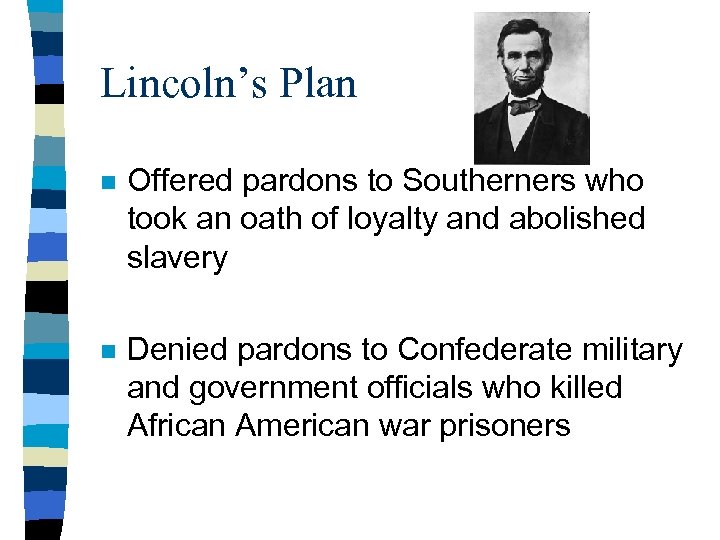 Lincoln’s Plan n Offered pardons to Southerners who took an oath of loyalty and abolished slavery n Denied pardons to Confederate military and government officials who killed African American war prisoners
 Continued n Could hold a constitutional convention when 10% of the state had taken the oath – to create a state constitution n After all of this the state could hold elections and join the Union again
 Radical Republicans n n n Republicans in Congress opposed Lincoln’s plan Wanted to prevent Confederate leaders from returning to power after the war Wanted to guarantee African Americans the right to vote and equality
 Starter n Part of President Lincoln’s plan for Reconstruction was to offer _____ to Southerners who would take an oath of loyalty to the United States. – A. imprisonment – B. pardon – C. debt peonage – D. exile
 Wade-Davis Bill n n Summer 1864 Compromise between moderates and radicals
 Bill Continued n Bill – Majority of while males had to take the oath – Could hold a convention to create a new state government – “iron-clad” oath- taken by those at the convention • never fought against the Union or supported the Confederacy – State Constitution had to: • abolish slavery • reject debts the state had as part of the Confederacy • No former Confederate officials could hold office in new government
 Veto n Lincoln blocked Wade-Davis Bill with a pocket veto – indirectly vetoing a bill by letting a session of Congress expire without signing the bill – Didn’t want a harsh peace – Feared it would alienate whites in the South
 Freedmen’s Bureau n Freedmen: newly freed African Americans n Bureau established in 1865 by Congress – feeding and clothing war refugees in the South using surplus Army supplies – helped them find work on plantations
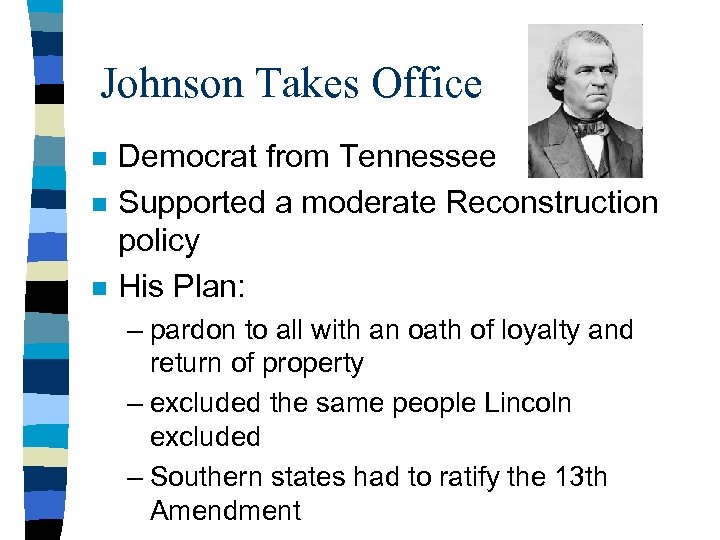 Johnson Takes Office n n n Democrat from Tennessee Supported a moderate Reconstruction policy His Plan: – pardon to all with an oath of loyalty and return of property – excluded the same people Lincoln excluded – Southern states had to ratify the 13 th Amendment
 Aftermath n n By December 1865 Johnson’s plan was working Many Confederate leaders were elected to Congress – angered many
 Black Codes n n Passed by Southern legislatures Required African Americans to: – Sign annual labor contracts – Vagrancy Laws- for those who didn’t follow codes • could be whipped, beaten, or forced into servitude – Curfews – Land Restrictions • could only rent houses or land in rural areas
 Radical Reconstruction n Election of Confederates and Black Codes caused more Republicans to join radicals n 1865 House and Senate leaders created a Joint Committee on Reconstruction to make their own plan
 Civil Rights Act of 1866 n Civil Rights Act of 1866 – granted citizenship to all persons born in the United States, except Native Americans – African Americans could own property – Everyone treated equally in court – Could sue anyone who violated those rights – Johnson vetoed it, but radicals were able to override it
 14 th Amendment n n n Granted citizenship to all persons born or naturalized in the United States and declared the no state could deprive any person of life, liberty, or property “without due process of law” also, no state could deny any person “equal protection of the laws” ratified in 1868
 n n n Johnson did not support the 14 th Amendment In 1868 congressional elections he hoped Northerners would vote out Radical Republicans won and had enough to override any presidential veto
 Military Reconstruction Act n n Passed in 1867 Divided south into 5 military districts Union general put in charge of each Each former Confederate state had to hold another constitutional convention – had to give the right to vote to ALL male citizens – had to ratify the 14 th Amend.
 Johnson’s Impeachment n Congress passes the Tenure in Office Act – Senate must approve removal of official that had been approved by the Senate n n Johnson fired Secretary of War, supported Radical Republicans In May the Senate voted – 1 vote shy of removing him from office
 Election of Grant n n n Johnson does not run for re-election Ulysses S. Grant wins Republicans remain in control of Congress
 15 th Amendment n n The right to vote “shall not be denied…on account of race, color, or previous servitude” Ratified by March 1870
 Republican Rule
 n n By 1870 all former Confederate states had rejoined the union There were still problems between the North and South
 Carpetbags n Carpetbaggers: – Name given to Northerners who traveled to the South during Reconstruction and supported the Republicans – arrived with belongings in suitcases made of carpet
 Scalawags n Scalawags: – Name given to Southerners who supported Republican Reconstruction of the South – Old Scots-Irish term for weak, underfed, worthless animals
 African Americans n n n Many men entered politics elected to many positions at all levels of government 14 elected to the House of Representatives and 2 elected to the Senate
 n The Freedman’s Bureau helped establish schools in the South n By 1876 about 40% of African American children attended school n Also began building churches that became the center of communities
 Republican Reforms n Instituted the following reforms: – Repealed the Black Codes – Created state hospitals and institutions for orphans – Rebuilt roads, railways, and bridges – Funded new construction
 n n Many white Southerners disliked the reforms States increased taxes and borrowed money to pay for reforms – lead many landowners to lose land
 Southern Resistance n Largest Group was the Ku Klux Klan – started in 1866 by former Confederate soldiers in Tennessee – Dressed in hoods and white robes and terrorized African Americans and their supporters at night
 n Congress Responds to the KKK – Enforcement Acts in 1870 and 1871 • outlawed the activities of the Klan • not very successful in stopping the Klan
 Reconstruction Ends
 President Grant n n Left policy-making up to Congress Radical Republicans became strong, but left the President weak – lost public support for Reconstruction
 Party Splits n Critics in the Republican Party split to become Liberal Republicans – nominated their own candidate for president – Grant wins again anyway
 Problems n n Economy suffers Panic of 1873 set off depression Scandals in Grant administration In 1874 elections the Democrats win control of House of Representatives
 Compromise of 1877 n n Changes and problems made continuing Reconstruction difficult Northerners especially were more concerned about the economy than the South
 Continued n 1876 Election – Rutherford B. Hayes (Rep. ) versus Samuel Tilden (Dem. ) – Disputed electoral votes
 n Solved with the Compromise of 1877 – Not sure about what happened – Promise of Republicans to pull troops out of the South if Hayes was elected – a month later troops were removed
 A “New South” Arises n n Believed they had to develop a strong industrial economy Could not have an agricultural economy dominated by elite
 n North worked with the South to build: – railroads – iron and steel industry – tobacco processing – cotton mills
 n For many the end of Reconstruction meant a return to the “Old South” – little political power – forced to labor under difficult conditions – African Americans would not get their own land
 n Many returned to plantations owned by whites – worked for wages – or become tenant farmers and rented land
 – Sharecroppers: • paid a share of crops to rent the land, and pay for tools, seed, and supplies • Local suppliers provided things on credit, but if they were unable to pay they could be imprisoned or had to do forced labor
 Starter n After the Civil War, many formerly enslaved African Americans earned a living by becoming – A. railroad workers in the West – B. sharecroppers on Southern farms – C. workers in Northern factories – D. gold miners in California
 Starter n How did the Democrats regain power in the South by the 1870 s? – A. by appeals to white racism – B. by promising to build new railroads and industry – C. by blaming Republicans for high taxes – D. by bringing in more federal troops