


 Скачать презентацию Reconstructing sociolinguistic situations Test case East Africa Maarten
4f54bacab006511701e2cdaf70e7945f.ppt
- Количество слайдов: 85
 Reconstructing sociolinguistic situations: Test case East Africa Maarten Mous Leiden University, RCLT, La Trobe
 Credo: historical linguistics • contact linguistics presumes the comparative method and does not aim at questioning it • contact linguistics adds to a fuller understanding of the linguistics history; comparative method shows only part of the story and may give wrong impression of neat split • scientific robustness of regular sound change in comparative method is absent in contact linguistics
 Situations of language contact • • mixed population and bilingualism migration: expansion in small jumps expulsion (ostracism as punishment) economic links (group and individual) client groups growing up in other area (Cameroon) generational language (Bonek)
 Situations of language contact • • mixed marriage (Gorwaa) marriage pattern (e. g. women from outside), temporary emigration refugees trade captives of war charismatic founder of group (Saygilo doo Magena)
 Situations of language contact • registers and special languages – register of respect, – initiation language – argot of hippo hunters – spirit possession language – taboo
 Situations of language contact • • • re settlements multilingualism in the city seasonal work education radio
 Patterns (stable? ) of language policy • • • mono lingualism (Maasai) interpreters dominant language neutral lingua franca maximal multilingualism shift
 contact <> change testcases • • • comparable sociolinguistically comparable economically comparable culturally comparable different results
 East Africa • 4/5 language families. A lot of contact is across language family. • extreme geographical differences • language density/diversity is not extremely high; enough to have plenty of contact, not so much that it becomes unmanagable • economic differences
 Test cases • • Ma’á <> Taita Aasáx <> Akiek Iraqw <> Alagwa Datooga <> Maasai
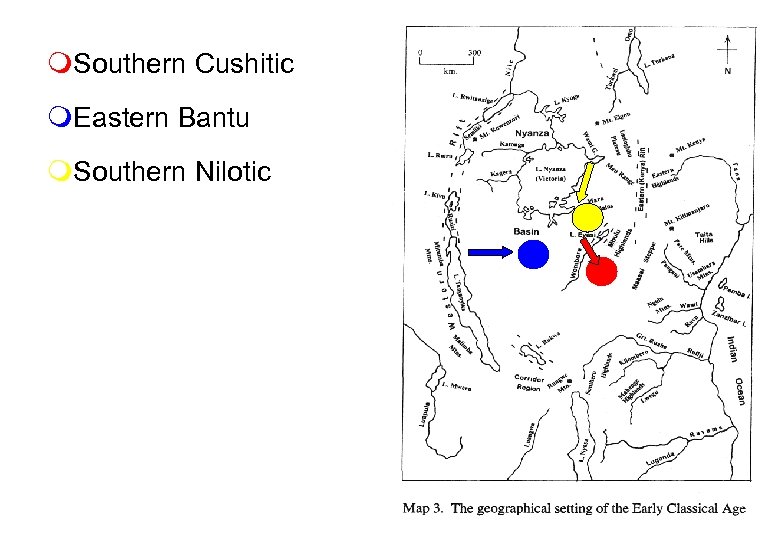 m. Southern Cushitic m. Eastern Bantu m. Southern Nilotic
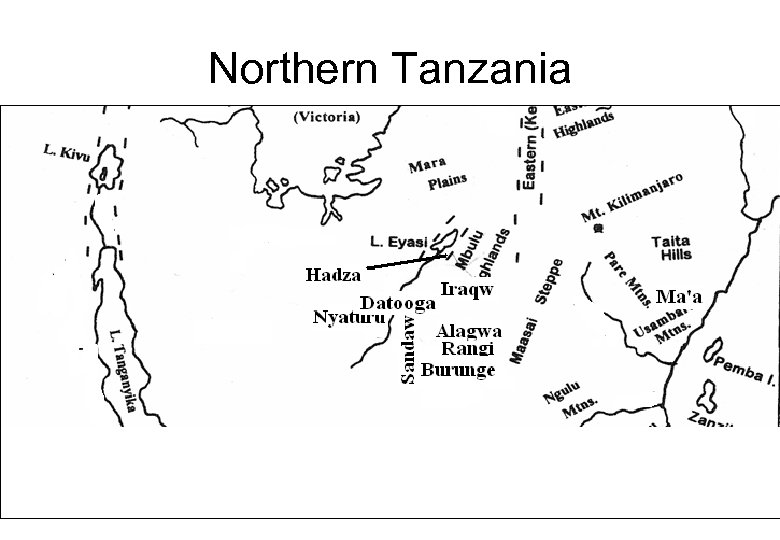 Northern Tanzania
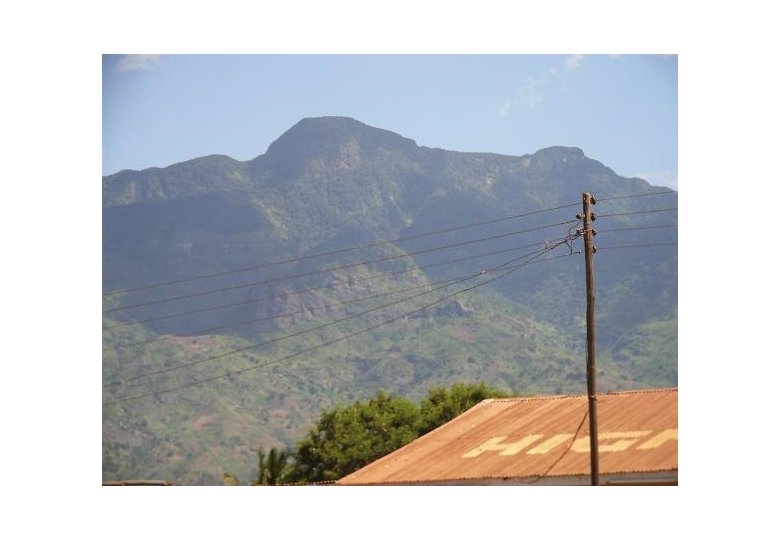
 Ma’á <> Taita • Usambara and Taita mountains: Two mountain areas not far from each other. • Once a Cushitic language was spoken. • In Taita, now only Bantu; • in Usambara a mixed language Ma’á.
 Taita • Two Bantu languages Saghala, Davida • Two former occupants: W asi, Bisha • several hunter gatherer groups around: Degere, Vuna, (A)Langulu, Waata. • Bisha agriculturalists; burial sites • Massive sets of Cushitic loans • some common with Cushitic lexemes in Ma’a • Saghala had a lateral fricative
 Lateral fricative • Wray (1894) used a trigraph tly in Sagala • now it is an implosive (palatalised? ) voiced velar stop written as g (Philippson) • Harris (1978) about Mbale Davida: voiced lateral fricative in positions where other dialects have a voiced alveolar fricative • Williamson (1943) writes • Philippson: lateral realisation of r • some correspond with ɬ in Ma’a
 Ma’á • Mbugu or Ma’á in the Usambara mountains • they speak two languages. • these two languages share one grammar the vocabulary is parallel. • “normal” Mbugu language is very similar to the Bantu language Pare both in grammar and in lexicon. • “inner” Mbugu language (or Ma’á) has a lot of deviant lexical material which is partly Southern Cushitic in origin • it does not differ in grammar from “normal” Mbugu; • it is a parasite of Normal Mbugu (Mixed Language)
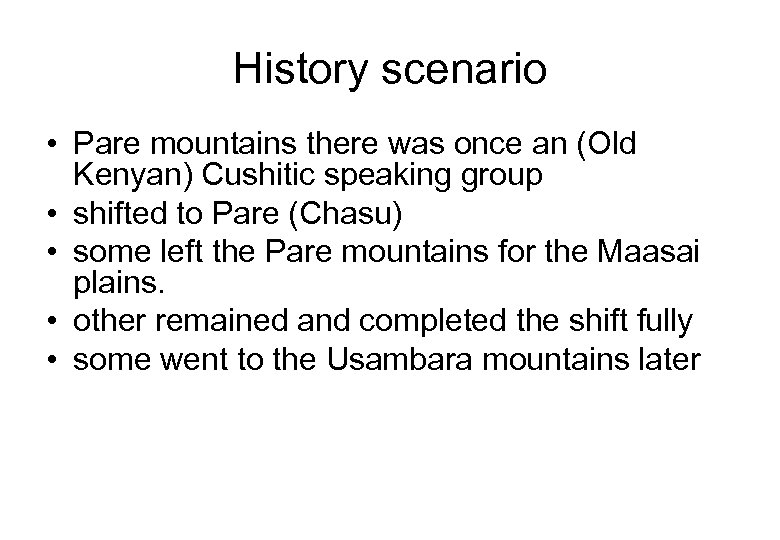 History scenario • Pare mountains there was once an (Old Kenyan) Cushitic speaking group • shifted to Pare (Chasu) • some left the Pare mountains for the Maasai plains. • other remained and completed the shift fully • some went to the Usambara mountains later
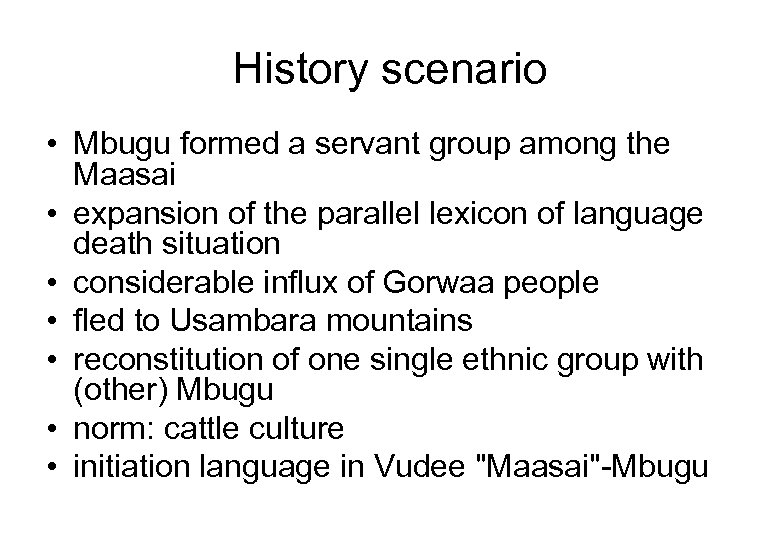 History scenario • Mbugu formed a servant group among the Maasai • expansion of the parallel lexicon of language death situation • considerable influx of Gorwaa people • fled to Usambara mountains • reconstitution of one single ethnic group with (other) Mbugu • norm: cattle culture • initiation language in Vudee "Maasai" Mbugu
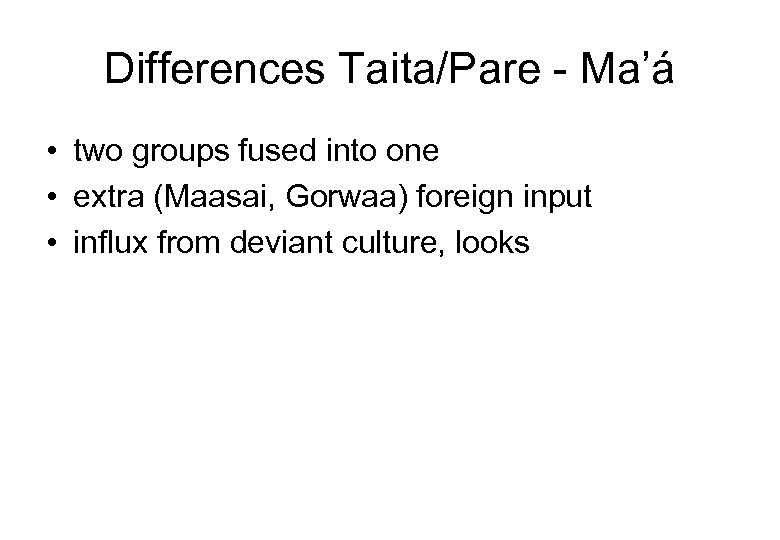 Differences Taita/Pare Ma’á • two groups fused into one • extra (Maasai, Gorwaa) foreign input • influx from deviant culture, looks
 Aasáx <> Akiek • Two “dorobo” groups, i. e. subservient hunter gatherer or people without cattle among the Maasai. • One lost their language (Aasáx) • the other retained their language (Akiek).
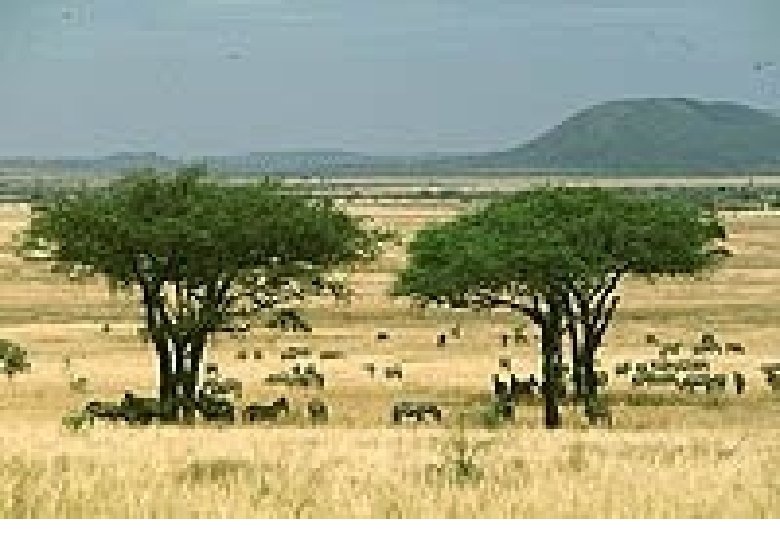
 • • • Akiek In the middle of the Maasai plains about 50? honey specialists beehives are made by the Cushitic Burunge a Southern Nilotic language very close/identical to the Okiek in Kenya a bee hunting dorobo group. no knowledge about their “brothers”. contact with the Maasai in Maasai no language death homogeneous
 Aasáx (Winter 1979) Hunter gatherers; dorobo among Maasai Story of the loss of their language: • Rinderpest • Maasai join Aasax as survival option • Maasai daytime village language • Aasáx acquired cattle • dominant language in settlement had changed • cultural identity had changed • when Maasai left the village; so did the others.
 dorobo • such groups attract drop outs, adventurers and criminals • can be ethnically very heterogeneous
 Difference • Shift cultural goal and economy
 Alagwa <> Iraqw • • 10 20. 000 vs >500. 000 Iraqw come from Alagwa area no dramatic linguistic changes recent bilingualism in Swahili
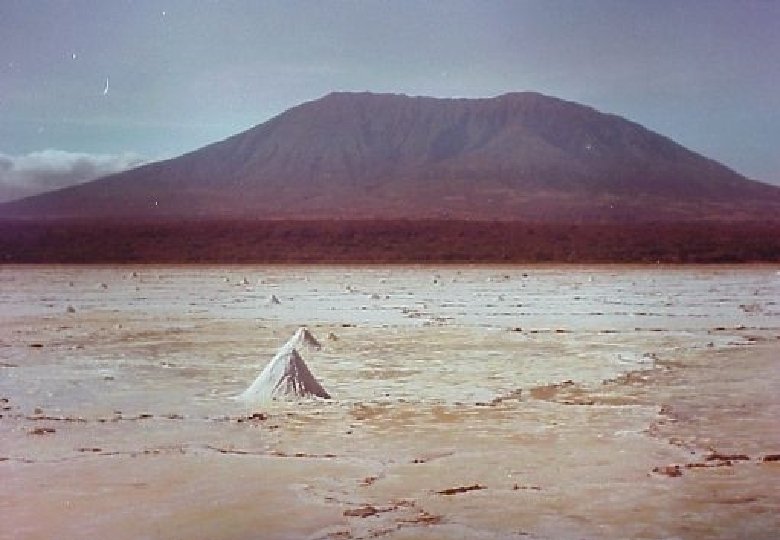
 Alagwa • widespread bilingualism in Bantu Rangi but not in interior • Rangi neighbours • once dominant political power (really? ) • slowly decreasing • influx of Burunge women few centuries ago • some admixture of Datooga
 Lexical influence • • • Burunge > Alagwa (double reflexes) Rangi > Alagwa > Rangi Alagwa > Sandawe (economic influence) pre Alagwa <> pre Sandawe
 Structural transfer • word order influence: Rangi > Alagwa • no pronunciation influence on Alagwa • morphology: loss of final suffixes (Burunge)
 Iraqw • from 3 to 27 clans: immigrant society • linguistically and culturally: history of Iraqw Datooga contact • several Bantu clans > Iraqw, • Alagwa > Iraqw • Sandawe > Iraqw, • + Suule: What did the Suule speak? No recollection • shift without trace
 history of Iraqw Datooga contact • • highland plains were once Datooga but Iraqw before Datooga Iraqw Datooga conflicts Hegemony: Iraqw, Datooga, Iraqw bilingualism in Datooga in certain area More Datooga bilingualism in Iraqw now Datooga become farmers and Iraqw
 Iraqw • little dialect differentiation, no central organisation, migration within • no neighbours • some non recent Bantu borrowings • chupa > tupa > chupa
 Datooga > Iraqw • • • cultural vocabulary sentence connector indirectly, shape of “selectors” prepositions of space structural conditions > morphophonological reductions
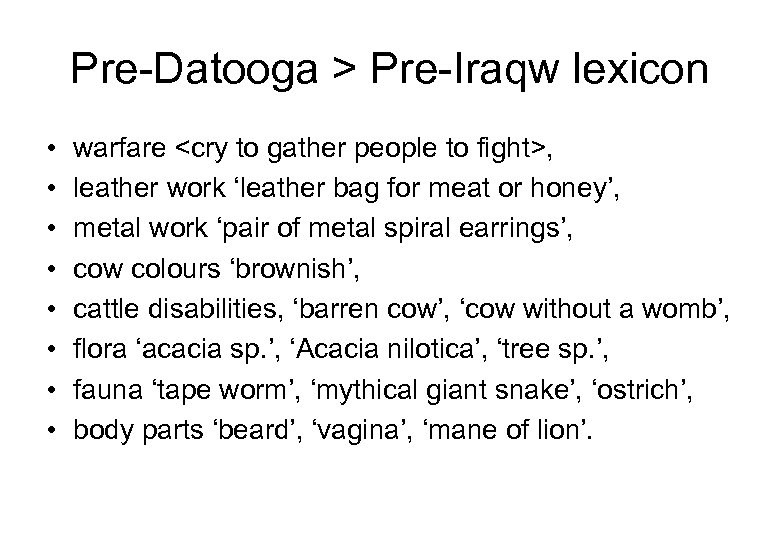 Pre Datooga > Pre Iraqw lexicon • • warfare
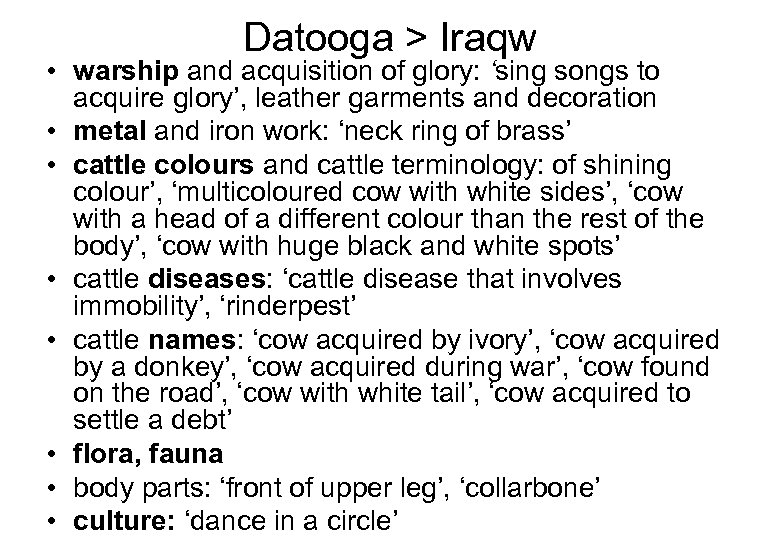 Datooga > Iraqw • warship and acquisition of glory: ‘sing songs to acquire glory’, leather garments and decoration • metal and iron work: ‘neck ring of brass’ • cattle colours and cattle terminology: of shining colour’, ‘multicoloured cow with white sides’, ‘cow with a head of a different colour than the rest of the body’, ‘cow with huge black and white spots’ • cattle diseases: ‘cattle disease that involves immobility’, ‘rinderpest’ • cattle names: ‘cow acquired by ivory’, ‘cow acquired by a donkey’, ‘cow acquired during war’, ‘cow found on the road’, ‘cow with white tail’, ‘cow acquired to settle a debt’ • flora, fauna • body parts: ‘front of upper leg’, ‘collarbone’ • culture: ‘dance in a circle’
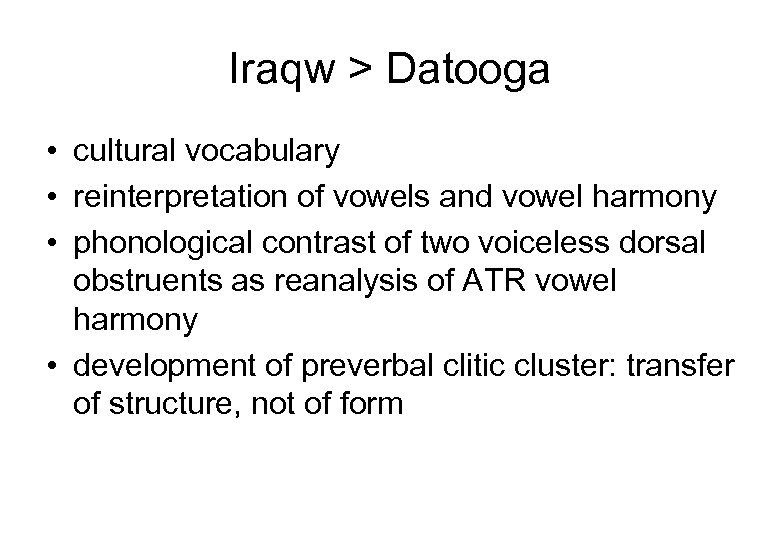 Iraqw > Datooga • cultural vocabulary • reinterpretation of vowels and vowel harmony • phonological contrast of two voiceless dorsal obstruents as reanalysis of ATR vowel harmony • development of preverbal clitic cluster: transfer of structure, not of form
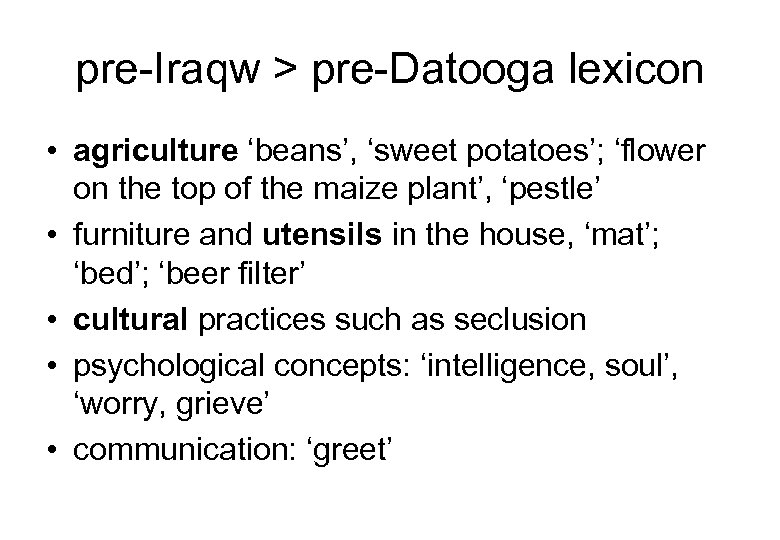 pre Iraqw > pre Datooga lexicon • agriculture ‘beans’, ‘sweet potatoes’; ‘flower on the top of the maize plant’, ‘pestle’ • furniture and utensils in the house, ‘mat’; ‘bed’; ‘beer filter’ • cultural practices such as seclusion • psychological concepts: ‘intelligence, soul’, ‘worry, grieve’ • communication: ‘greet’
 Datooga and Maasai In common • two cattle complex people • transhumance • age sets
 • Profound influence of Datooga on farming communities without economic shift: Iraqw, Nyaturu cattle acquired from Datooga • Maasai no influence on farming communities • Maasai: war, hatred, fear, disrespect • Maasai more radical cattle people • Southern Nilotes cattle+farming • Prehistory: Sirikwa, Engaruka
 Sprachbund Abflussloses Gebiet
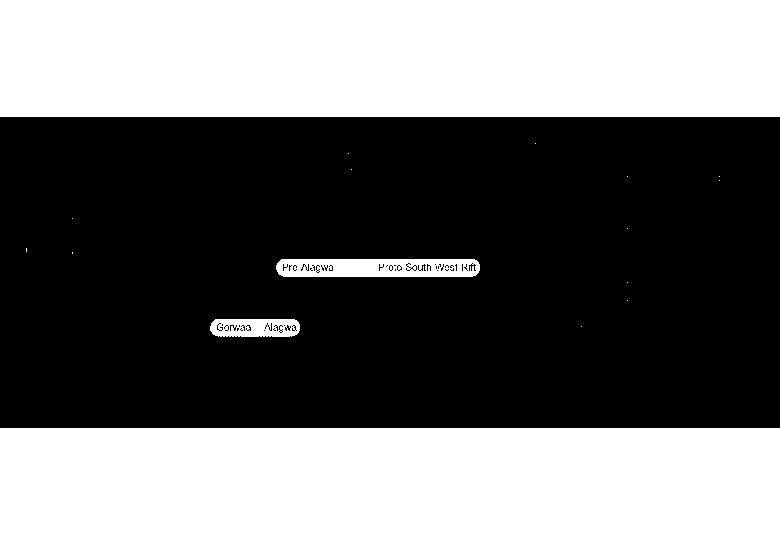
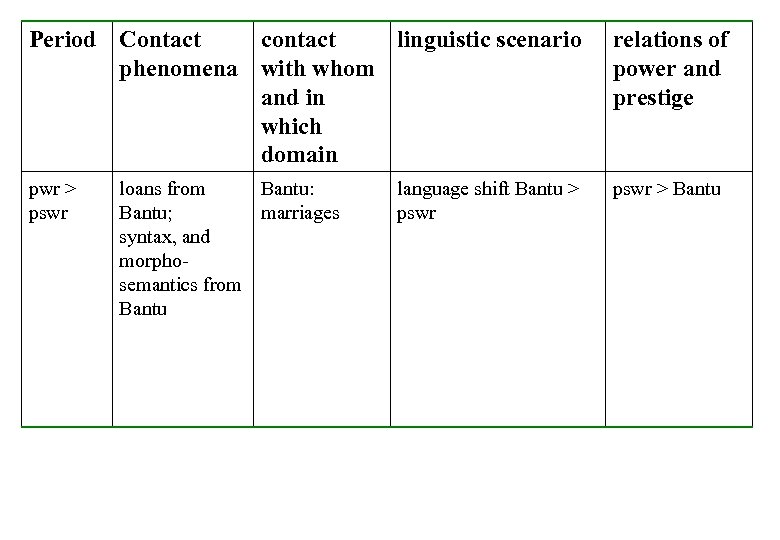 Period Contact contact linguistic scenario phenomena with whom and in which domain relations of power and prestige pwr > pswr > Bantu loans from Bantu: Bantu; marriages syntax, and morphosemantics from Bantu language shift Bantu > pswr
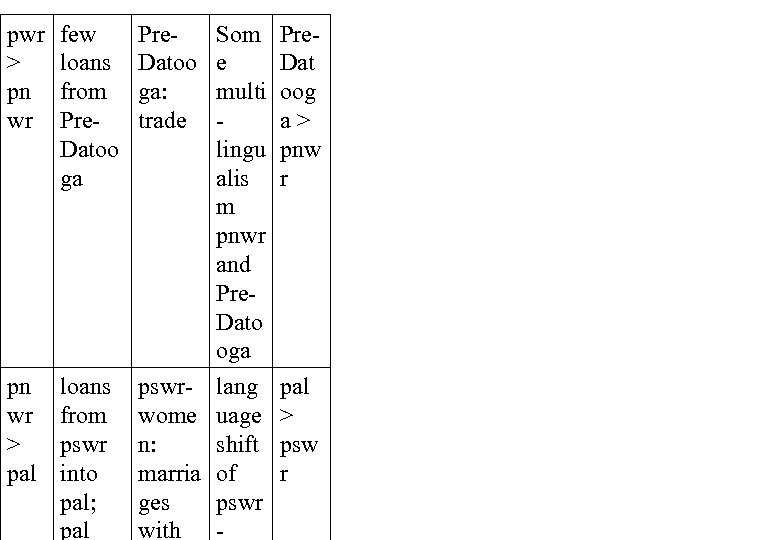 pwr > pn wr few loans from Pre. Datoo ga: trade Som e multi lingu alis m pnwr and Pre. Dato oga Pre. Dat oog a> pnw r pn wr > pal loans from pswr into pal; pal pswrwome n: marria ges with lang uage shift of pswr - pal > psw r
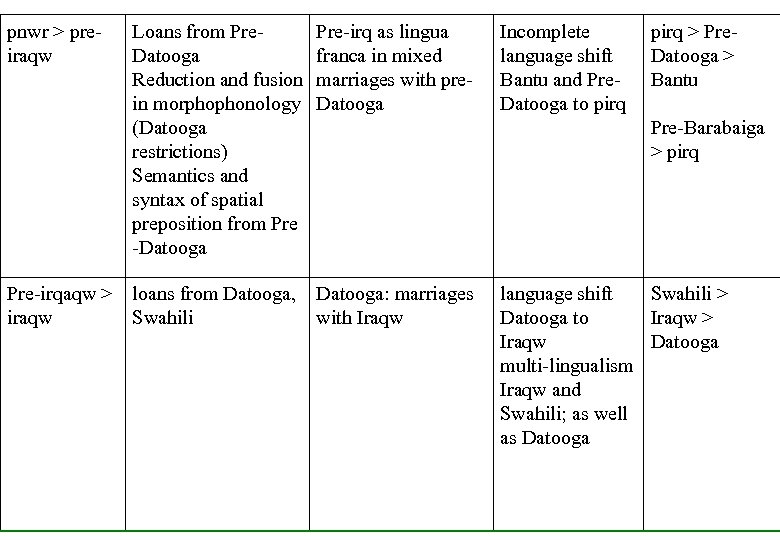 pnwr > preiraqw Pre-irqaqw > iraqw Loans from Pre. Datooga Reduction and fusion in morphophonology (Datooga restrictions) Semantics and syntax of spatial preposition from Pre -Datooga Pre-irq as lingua franca in mixed marriages with pre. Datooga loans from Datooga, Swahili Datooga: marriages with Iraqw Incomplete language shift Bantu and Pre. Datooga to pirq > Pre. Datooga > Bantu Pre-Barabaiga > pirq language shift Swahili > Datooga to Iraqw > Iraqw Datooga multi-lingualism Iraqw and Swahili; as well as Datooga
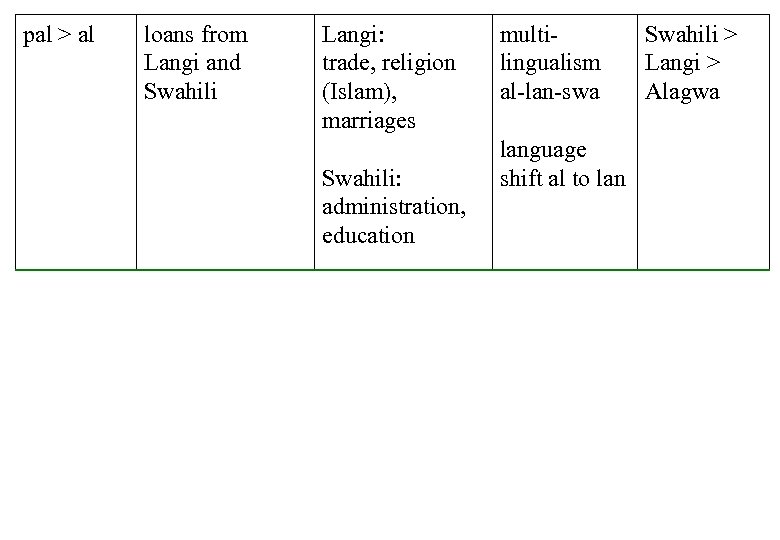 pal > al loans from Langi and Swahili Langi: trade, religion (Islam), marriages Swahili: administration, education multilingualism al‑lan‑swa language shift al to lan Swahili > Langi > Alagwa
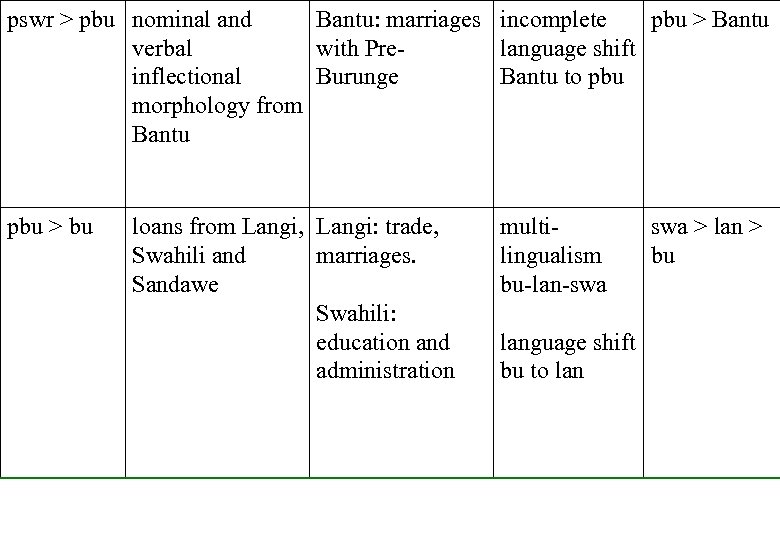 pswr > pbu nominal and Bantu: marriages incomplete pbu > Bantu verbal with Prelanguage shift inflectional Burunge Bantu to pbu morphology from Bantu pbu > bu loans from Langi, Langi: trade, Swahili and marriages. Sandawe Swahili: education and administration multilingualism bu‑lan‑swa language shift bu to lan swa > lan > bu
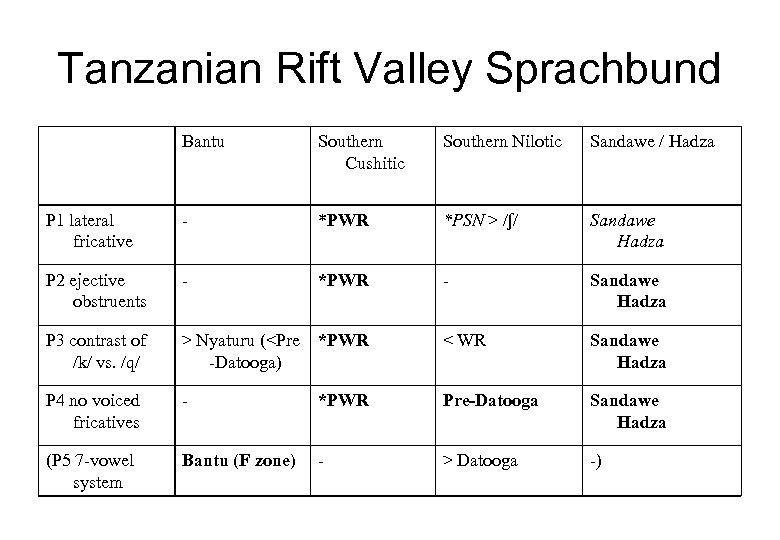 Tanzanian Rift Valley Sprachbund Bantu Southern Cushitic Southern Nilotic Sandawe / Hadza P 1 lateral fricative - *PWR *PSN > /ʃ/ Sandawe Hadza P 2 ejective obstruents - *PWR - Sandawe Hadza P 3 contrast of /k/ vs. /q/ > Nyaturu (
Datooga -)
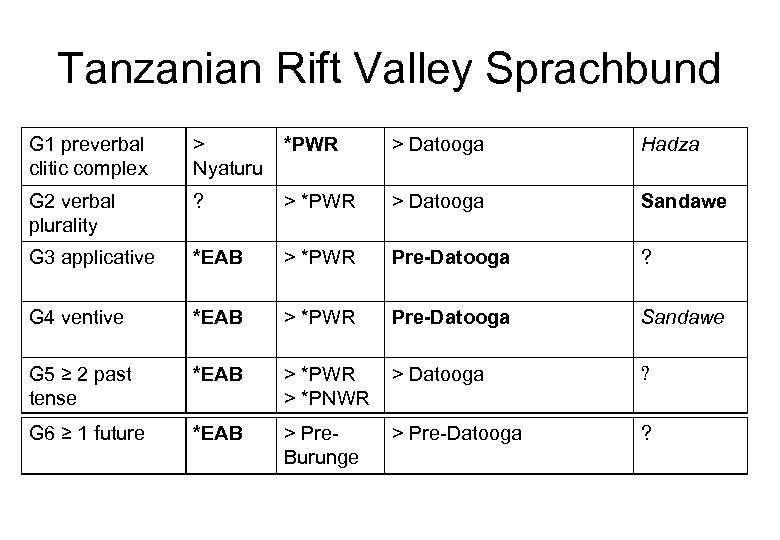 Tanzanian Rift Valley Sprachbund G 1 preverbal clitic complex > Nyaturu *PWR > Datooga Hadza G 2 verbal plurality ? > *PWR > Datooga Sandawe G 3 applicative *EAB > *PWR Pre-Datooga ? G 4 ventive *EAB > *PWR Pre-Datooga Sandawe G 5 ≥ 2 past tense *EAB > *PWR > *PNWR > Datooga ? G 6 ≥ 1 future *EAB > Pre Burunge > Pre Datooga ?
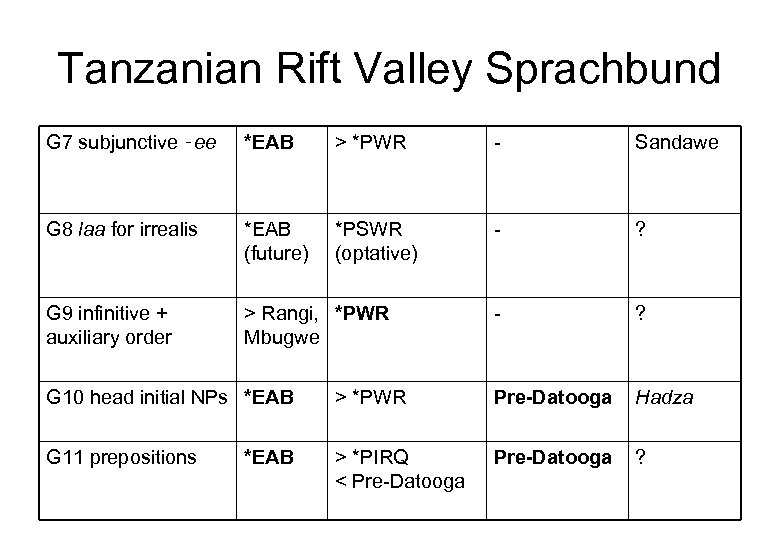 Tanzanian Rift Valley Sprachbund G 7 subjunctive ‑ee *EAB > *PWR Sandawe G 8 laa for irrealis *EAB (future) *PSWR (optative) ? G 9 infinitive + auxiliary order > Rangi, *PWR Mbugwe ? G 10 head initial NPs *EAB > *PWR Pre-Datooga Hadza G 11 prepositions > *PIRQ < Pre Datooga Pre-Datooga ? *EAB
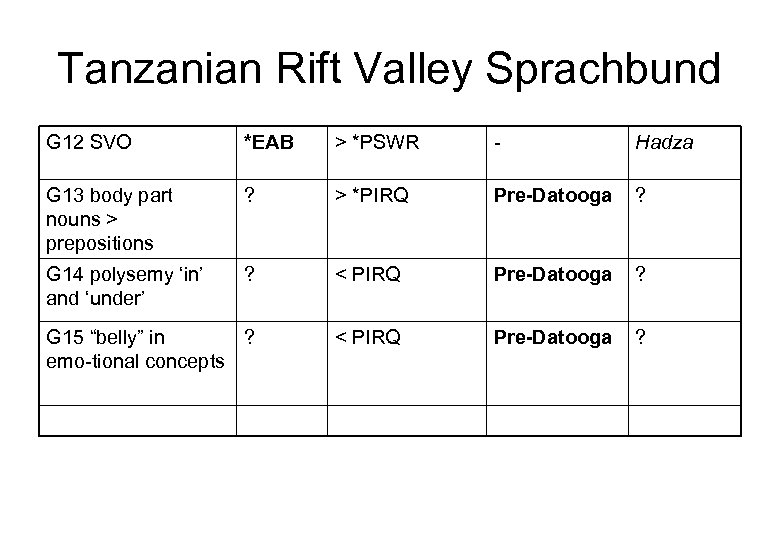 Tanzanian Rift Valley Sprachbund G 12 SVO *EAB > *PSWR Hadza G 13 body part nouns > prepositions ? > *PIRQ Pre-Datooga ? G 14 polysemy ‘in’ and ‘under’ ? < PIRQ Pre-Datooga ? G 15 “belly” in ? emo tional concepts < PIRQ Pre-Datooga ?
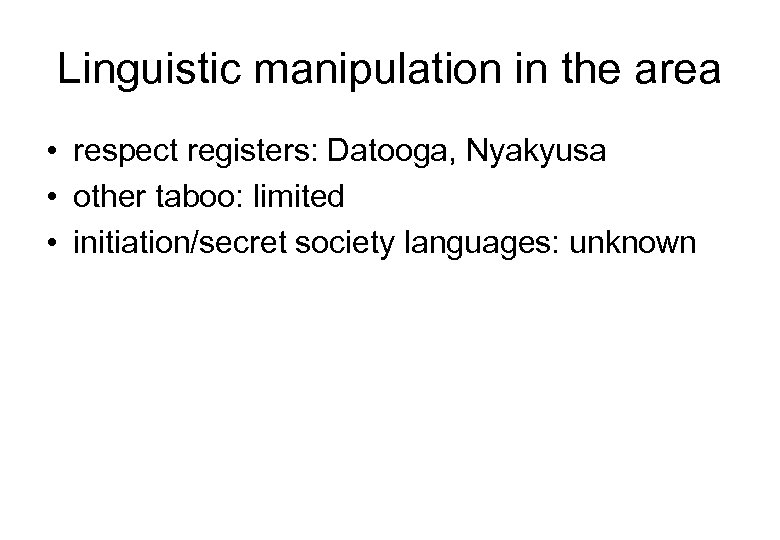 Linguistic manipulation in the area • respect registers: Datooga, Nyakyusa • other taboo: limited • initiation/secret society languages: unknown
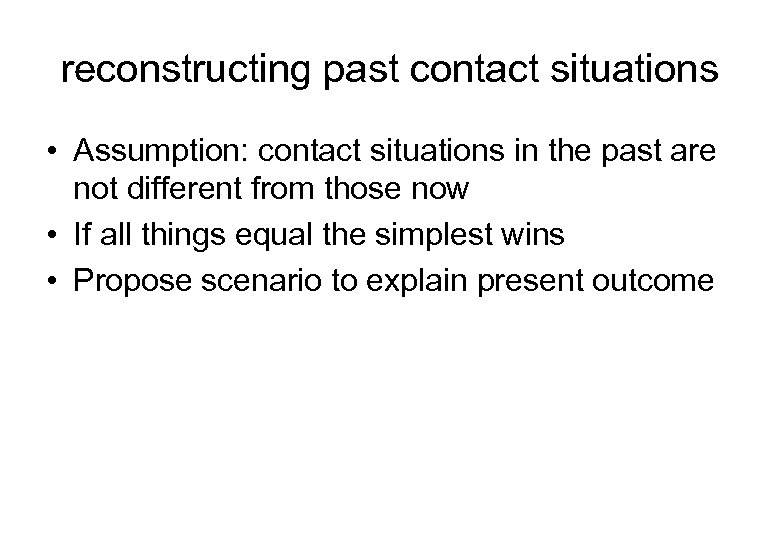 reconstructing past contact situations • Assumption: contact situations in the past are not different from those now • If all things equal the simplest wins • Propose scenario to explain present outcome
 problems with the scenario game • limits of imagination • never are all other things equal
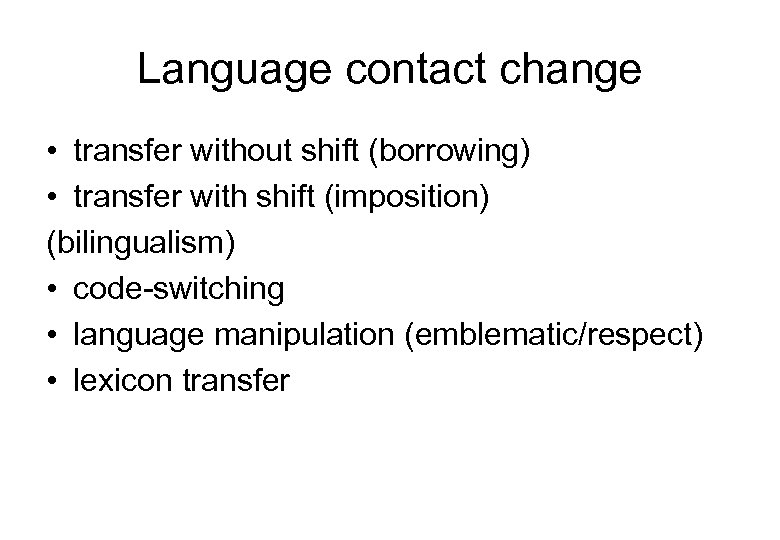 Language contact change • transfer without shift (borrowing) • transfer with shift (imposition) (bilingualism) • code switching • language manipulation (emblematic/respect) • lexicon transfer
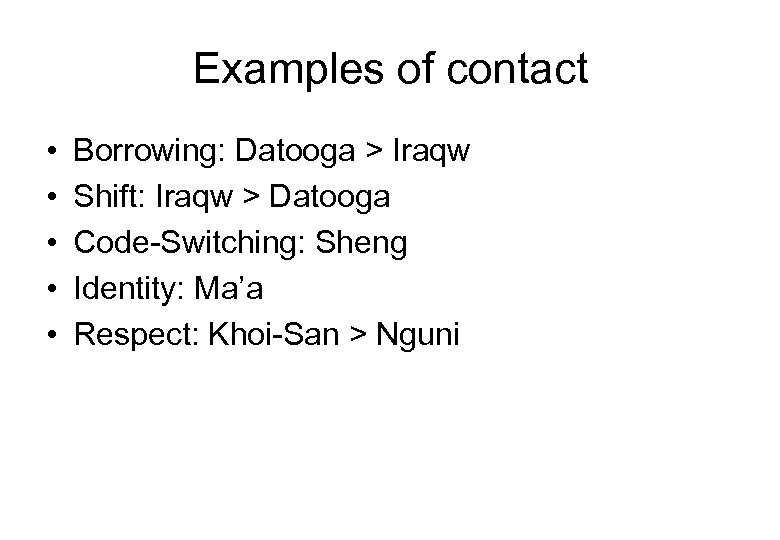 Examples of contact • • • Borrowing: Datooga > Iraqw Shift: Iraqw > Datooga Code Switching: Sheng Identity: Ma’a Respect: Khoi San > Nguni
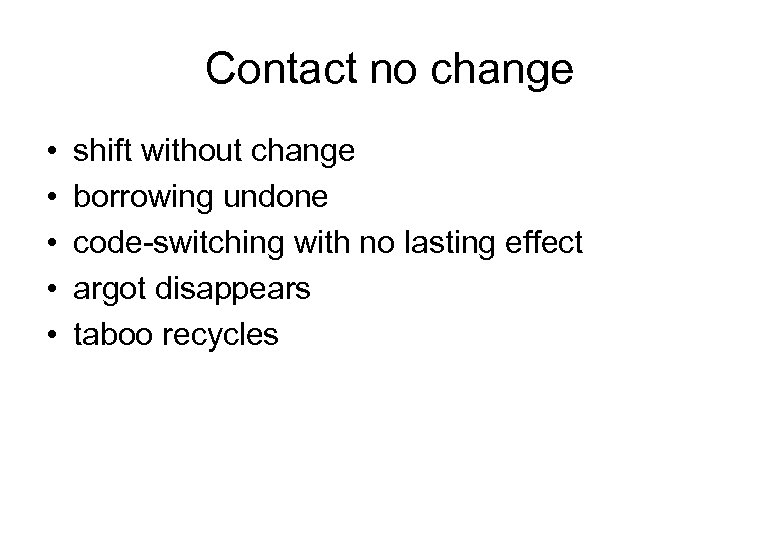 Contact no change • • • shift without change borrowing undone code switching with no lasting effect argot disappears taboo recycles
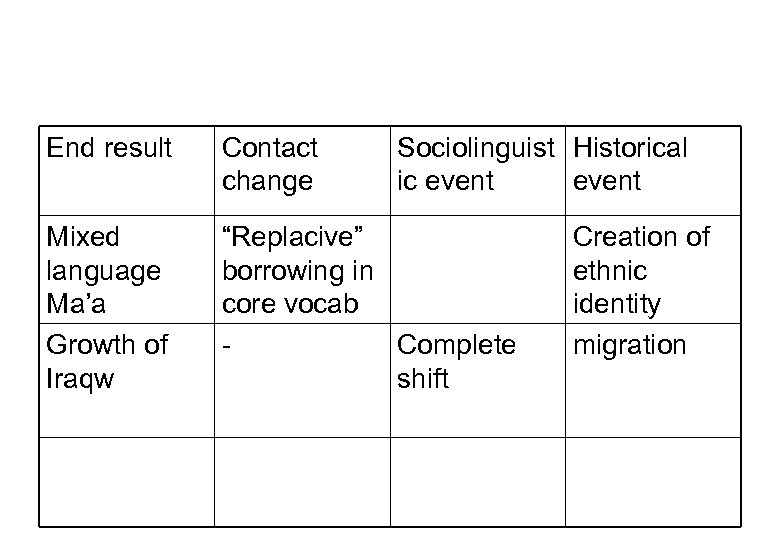 End result Contact change Sociolinguist Historical ic event Mixed language Ma’a Growth of Iraqw “Replacive” borrowing in core vocab Complete shift Creation of ethnic identity migration
 Contact change in lexicon • “Additive” borrowing: Taita Bantu, Iraqw, Datooga, Algawa: Complete shift • “Replacive” borrowing in core vocabulary: Ma’a (Khoisan>Nguni): lexical manipulation for identity / respect (possibly distinguishable)
 Contact change in phonology • lateral fricative in Taita (but disappeared): carry over of pronunciation in transferred lexicon: stage in shift • lateral fricative in Ma’a: replacement as manipulation: identity formation • split in Datooga k/q and vowel reduction: reinterpretation of phonetic differences/adaptation to old language habits: shift with trace
 • Morphophonological reductions in Iraqw: restrictions of old language: shift with trace
 Structural changes spatial preposition in Iraqw: carry over of concept and structure from old language (D): shift with trace etc
 structural changes in shift • Bilingualism of e. g. Datooga in Iraqw. • Iraqw dominant language 1. Pronunciation habits and surface syntax of Datooga in Iraqw speech 2. Categorisation, meaning, structure of Datooga in Iraqw speech 3. Categorisation, meaning, structure of in Iraqw Datooga speech
 Which changes materialize • 3 often disappears because these speakers shift to Iraqw. But if they don’t and influence rest of Datooga or if their speech becomes a new language, it may look the opposite (shift Iraqw to Datooga) (Ma’a) • 1, 2 whether these changes spread to all speakers depends on linguistic and non linguistic factors
 Factors • linguistic complications, simplifications, advantages in the receiving language • prestige shifters • number of shifters • are they mothers • do they remain an ethnic entity
 Proposed correlations socio history language change • Guy Ross based on Van Coetsem
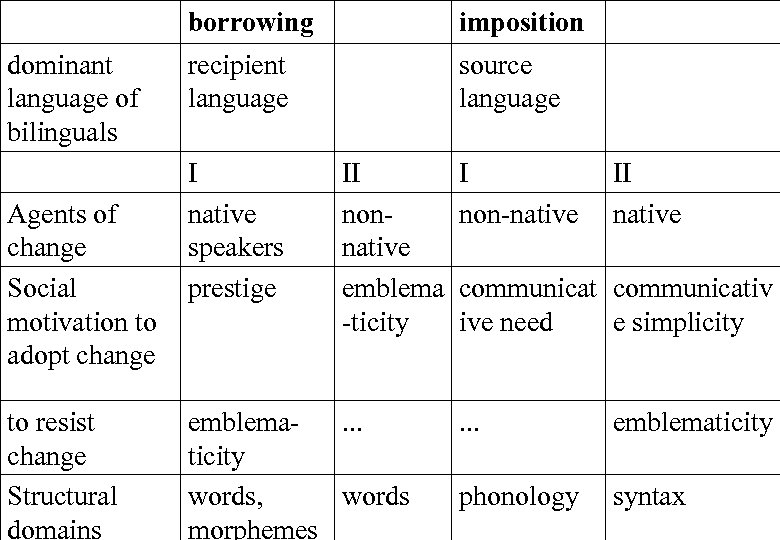 borrowing dominant language of bilinguals Agents of change Social motivation to adopt change to resist change Structural domains imposition recipient language source language I native speakers prestige II nonnative emblema -ticity emblema. . . ticity words, words morphemes I non-native II native communicativ ive need e simplicity. . . emblematicity phonology syntax
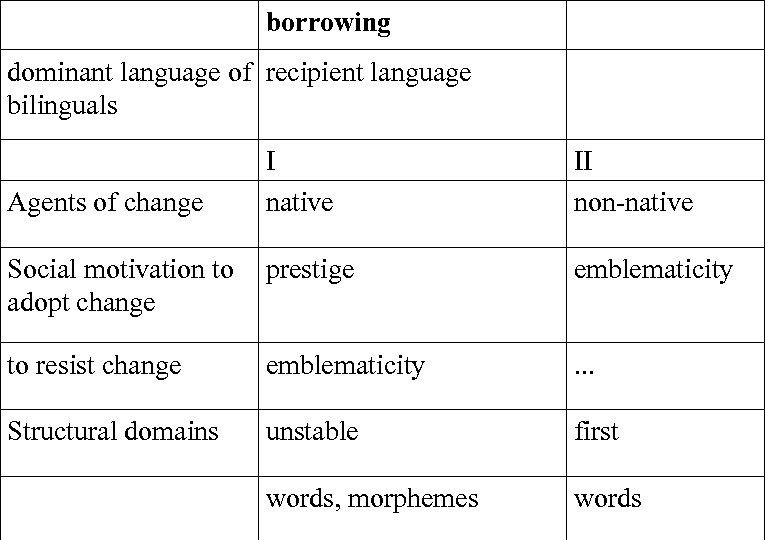 borrowing dominant language of recipient language bilinguals I native II non-native Social motivation to adopt change prestige emblematicity to resist change emblematicity . . . Structural domains unstable first words, morphemes words Agents of change
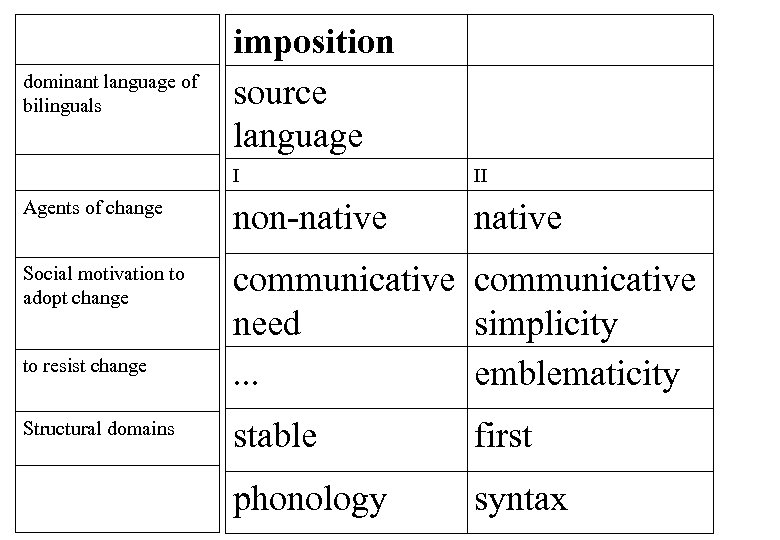 dominant language of bilinguals imposition source language I II Agents of change non-native Social motivation to adopt change communicative need simplicity. . . emblematicity to resist change Structural domains stable first phonology syntax
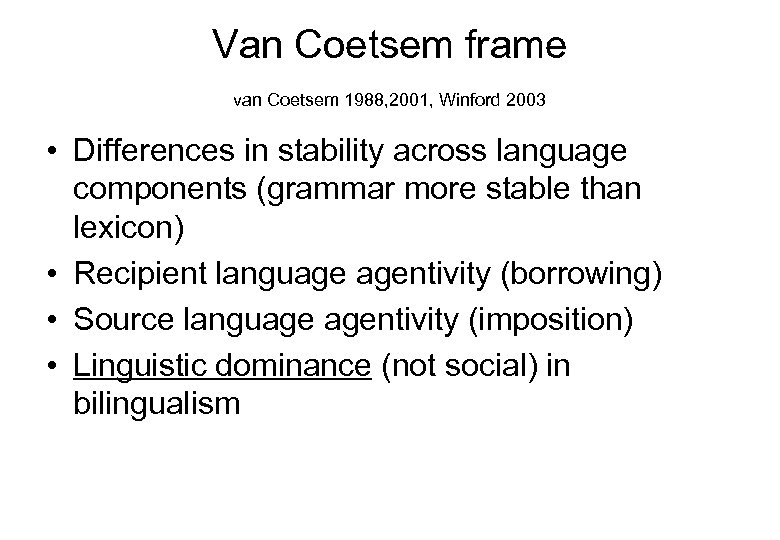 Van Coetsem frame van Coetsem 1988, 2001, Winford 2003 • Differences in stability across language components (grammar more stable than lexicon) • Recipient language agentivity (borrowing) • Source language agentivity (imposition) • Linguistic dominance (not social) in bilingualism
 contact situations 1. Recipient L agentivity A B 2. Source L agentivity A B Agents / Agentivity imitation / adaptation 1: borrowing 2: imposition processes in individual
 Examples • Rec. L activity, borrowing, extreme case Media Lengua Quechua with every lexeme borrowed from Spanish • Source. L activity: structures of dominant language in recipient language. Dominant language can be the new language influencing the language which is in process of being abandoned in cognitive and grammatical structure. Asia Minor Greek (RL): Turkish (SL) dominant. (and RL activity when speaking T)
 Additions by Reh If only migration as cause for contact Added factors • Intensity of contact • Linguistic heterogeneity of community
 Other factors • • • identifiable group after “migration” degree of bilingualism language attitude size of group prestige
 Individual – Community • Model refers to the mind of the individual • Essential is language as social construct: establishment of the norm
 Shift • complete shift (common ? ) • shift with effect of original language on recognizable community; with effect on language as a whole • shift with carry over of vocabulary (e. g. pygmy technical vocabulary) • arrested shift, u turn when too late, re borrowing of original vocabulary
 How common is shift without a trace • • Nyaturu > Sandawe Many Iraqw clans Datooga among Alagwa Mbugu Pare speakers
 Shift with trace • • • Bisha > Saghala X > Pare (Ma’á) Iraqw > Datooga > Iraqw Burunge > Alagwa
 Other Comparable situations • • • Northern Songhay Mozambican Swahili Pygmies Creole studies etc
 languages of pygmies Duke, Daniel 2001 Aka as a contact language: sociolinguistic and grammatical evidence. MA University of Texas at Arlington. • speak different languages • which probably were once language of their patron • also speak language of patron • pygmy special vocabulary • patrons and their language are link and obstacle to outside world (forest pygmies have better knowledge of languages of wider communication)
 Creole languages • study link socio history and outcome of language change • similar sociolinguistic situations for a number of them • similar outcome • imcomplete second language acquisition
 Mixed Languages Bakker • grammar and (basic) lexicon not from the same source • originate in new communities of systematic mixed marriage: mother’s grammar with father’s lexicon • originate as extended argot of itinerant and other groups who maintain identity under pressure: grammar of dominant language, deviant lexicon • note the genetic difference for the two scenario’s
 prospects of multidisciplinary • need for chronology, time depth • need for quantative approach • indication for some factors from archeology, genetics, not for language attitude, communication policy