


 Скачать презентацию Recommender Systems User Experience and System Issues Joseph
906a155b3a90abc4f61727d95c49a73f.ppt
- Количество слайдов: 105
 Recommender Systems: User Experience and System Issues Joseph A. Konstan University of Minnesota konstan@cs. umn. edu http: //www. grouplens. org UNIVERSITY OF MINNESOTA
 About me … • Professor of Computer Science & Engineering, Univ. of Minnesota • Ph. D. (1993) from U. C. Berkeley § GUI toolkit architecture • Teaching Interests: HCI, GUI Tools • Research Interests: General HCI, and. . . § Recommender Systems § Online Community and Participatioin § Online Public Health Applications Konstan: Recommender Systems, Summer 2009
 A Bit of History • Ants, Cavemen, and Early Recommender Systems § The emergence of critics • Information Retrieval and Filtering • Manual Collaborative Filtering • Automated Collaborative Filtering • The Commercial Era Konstan: Recommender Systems, Summer 2009
 A Bit of History • Ants, Cavemen, and Early Recommender Systems § The emergence of critics • Information Retrieval and Filtering • Manual Collaborative Filtering • Automated Collaborative Filtering • The Commercial Era Konstan: Recommender Systems, Summer 2009
 Information Retrieval • Static content base § Invest time in indexing content • Dynamic information need § Queries presented in “real time” • Common approach: TFIDF § Rank documents by term overlap § Rank terms by frequency Konstan: Recommender Systems, Summer 2009
 Information Filtering • Reverse assumptions from IR § Static information need § Dynamic content base • Invest effort in modeling user need § Hand-created “profile” § Machine learned profile § Feedback/updates • Pass new content through filters Konstan: Recommender Systems, Summer 2009
 A Bit of History • Ants, Cavemen, and Early Recommender Systems § The emergence of critics • Information Retrieval and Filtering • Manual Collaborative Filtering • Automated Collaborative Filtering • The Commercial Era Konstan: Recommender Systems, Summer 2009
 Collaborative Filtering • Premise § Information needs more complex than keywords or topics: quality and taste • Small Community: Manual § Tapestry – database of content & comments § Active CF – easy mechanisms forwarding content to relevant readers Konstan: Recommender Systems, Summer 2009
 A Bit of History • Ants, Cavemen, and Early Recommender Systems § The emergence of critics • Information Retrieval and Filtering • Manual Collaborative Filtering • Automated Collaborative Filtering • The Commercial Era Konstan: Recommender Systems, Summer 2009
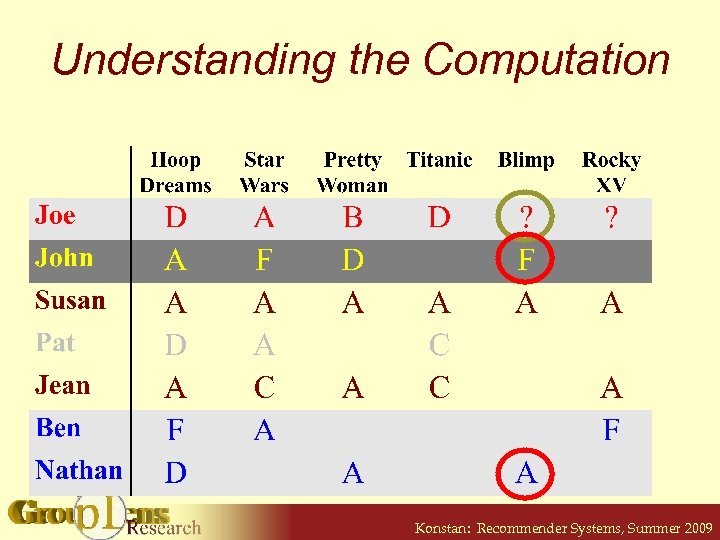
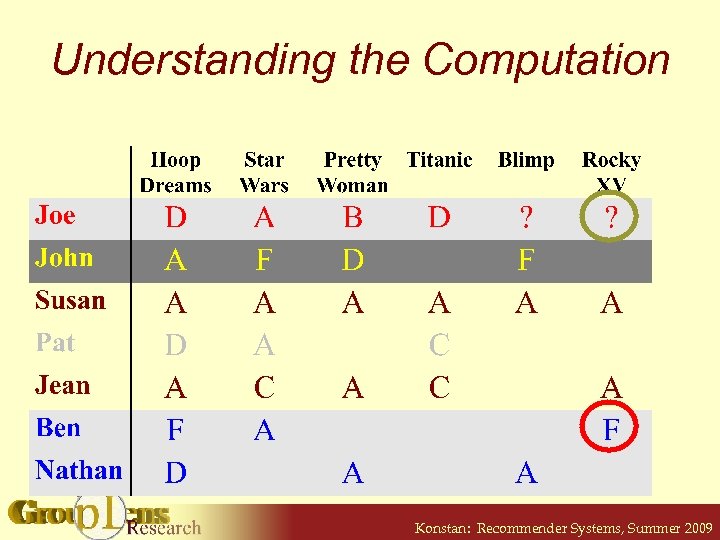
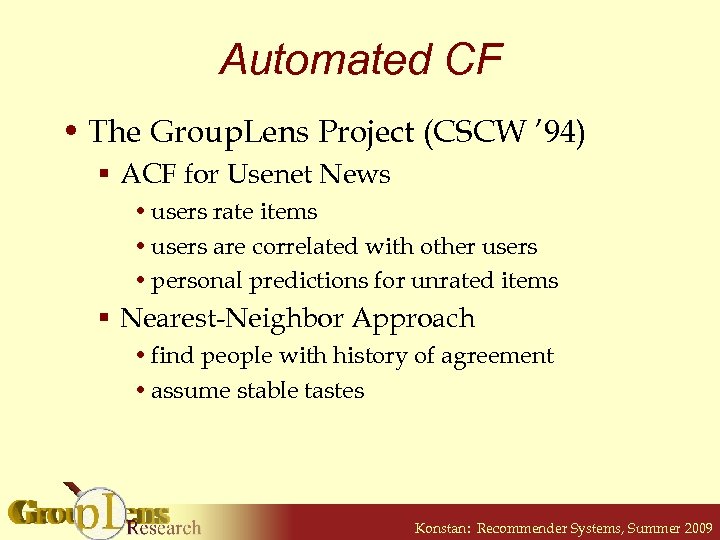 Automated CF • The Group. Lens Project (CSCW ’ 94) § ACF for Usenet News • users rate items • users are correlated with other users • personal predictions for unrated items § Nearest-Neighbor Approach • find people with history of agreement • assume stable tastes Konstan: Recommender Systems, Summer 2009
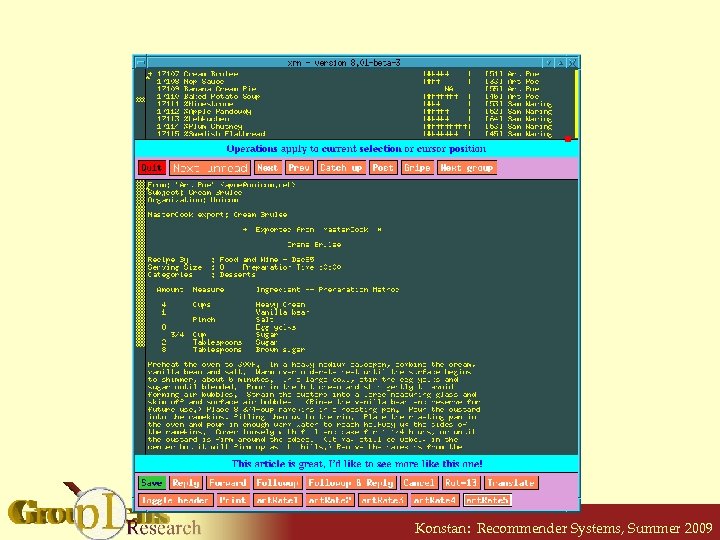 Usenet Interface Konstan: Recommender Systems, Summer 2009
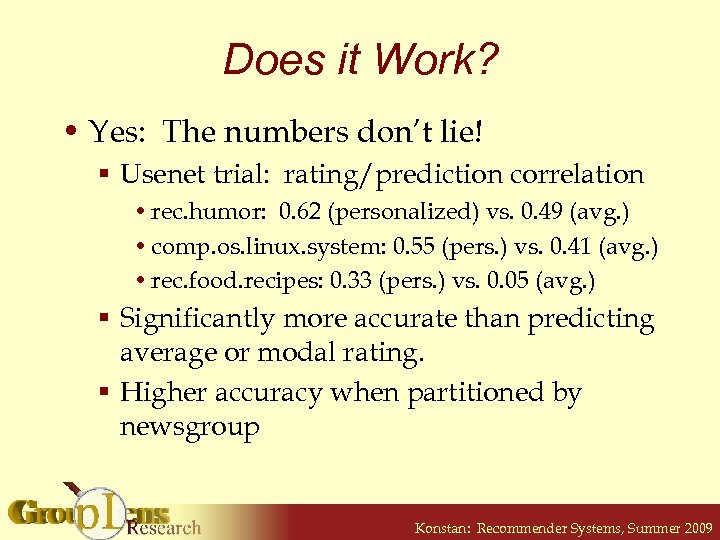 Does it Work? • Yes: The numbers don’t lie! § Usenet trial: rating/prediction correlation • rec. humor: 0. 62 (personalized) vs. 0. 49 (avg. ) • comp. os. linux. system: 0. 55 (pers. ) vs. 0. 41 (avg. ) • rec. food. recipes: 0. 33 (pers. ) vs. 0. 05 (avg. ) § Significantly more accurate than predicting average or modal rating. § Higher accuracy when partitioned by newsgroup Konstan: Recommender Systems, Summer 2009
 It Works Meaningfully Well! • Relationship with User Behavior § Twice as likely to read 4/5 than 1/2/3 • Users Like Group. Lens § Some users stayed 12 months after the trial! Konstan: Recommender Systems, Summer 2009
 A Bit of History • Ants, Cavemen, and Early Recommender Systems § The emergence of critics • Information Retrieval and Filtering • Manual Collaborative Filtering • Automated Collaborative Filtering • The Commercial Era Konstan: Recommender Systems, Summer 2009
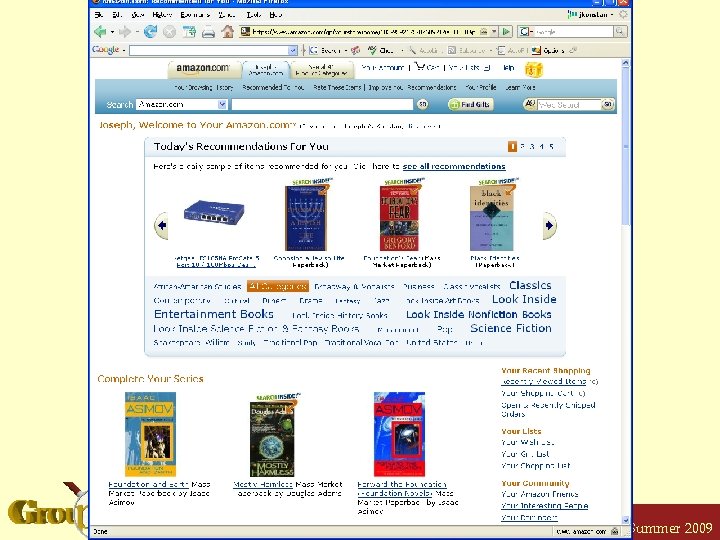 Amazon. com Konstan: Recommender Systems, Summer 2009
 Historical Challenges • Collecting Opinion and Experience Data • Finding the Relevant Data for a Purpose • Presenting the Data in a Useful Way Konstan: Recommender Systems, Summer 2009
 Recommenders • Tools to help identify worthwhile stuff § Filtering interfaces • E-mail filters, clipping services § Recommendation interfaces • Suggestion lists, “top-n, ” offers and promotions § Prediction interfaces • Evaluate candidates, predicted ratings § Search/Query interfaces § Conversational interfaces Konstan: Recommender Systems, Summer 2009
 Scope of Recommenders • Purely Editorial Recommenders • Content Filtering Recommenders • Collaborative Filtering Recommenders • Hybrid Recommenders Konstan: Recommender Systems, Summer 2009
 Wide Range of Algorithms • Simple Keyword Vector Matches • Pure Nearest-Neighbor Collaborative Filtering • Machine Learning on Content or Ratings Konstan: Recommender Systems, Summer 2009
 Classic Collaborative Filtering • Movie. Lens* • K-nearest neighbor algorithm • Model-free, memory-based implementation • Intuitive application, supports typical interfaces • *Note – newest releases use updated architecture/algorithm Konstan: Recommender Systems, Summer 2009
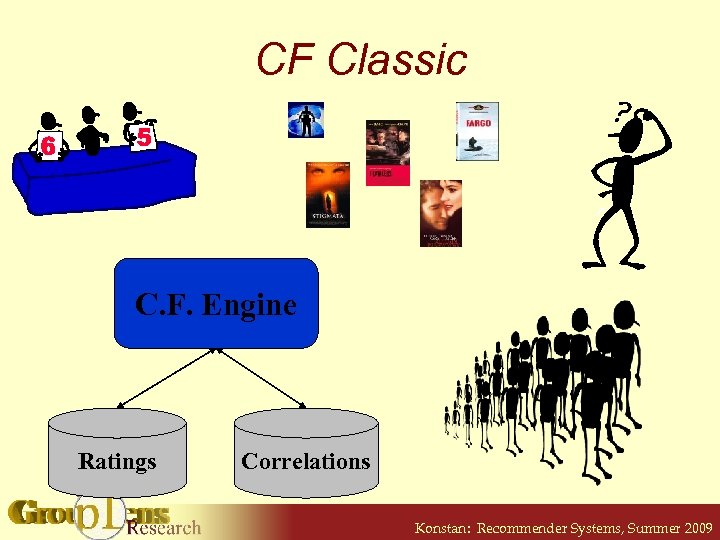 CF Classic C. F. Engine Ratings Correlations Konstan: Recommender Systems, Summer 2009
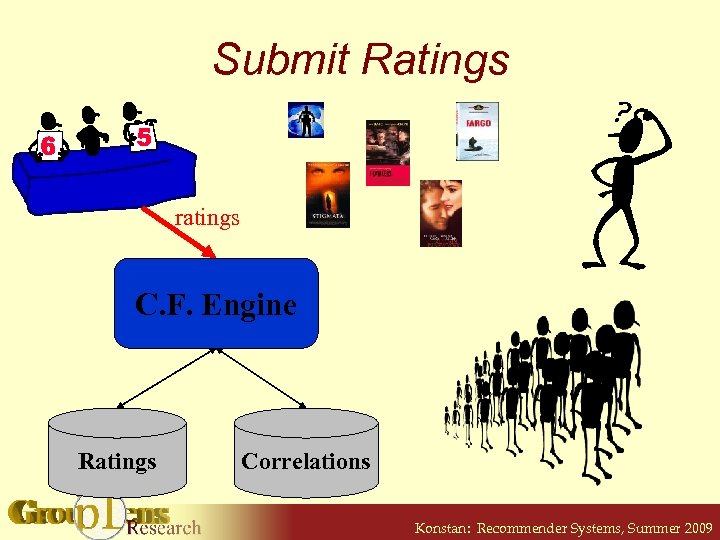 Submit Ratings ratings C. F. Engine Ratings Correlations Konstan: Recommender Systems, Summer 2009
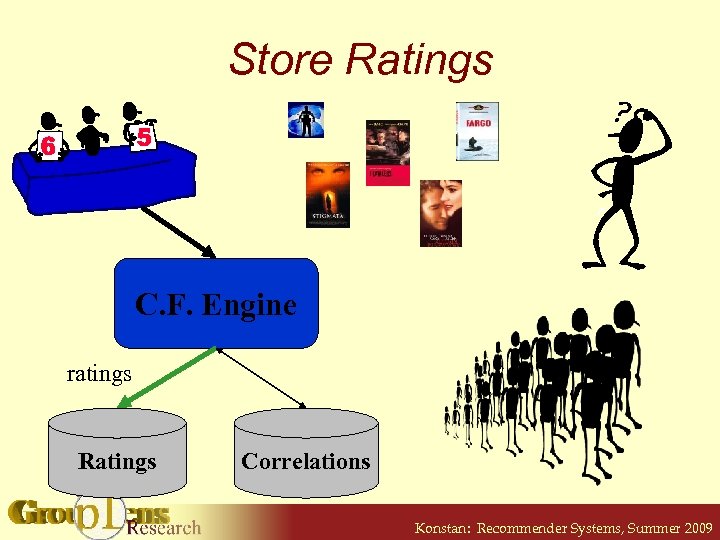 Store Ratings C. F. Engine ratings Ratings Correlations Konstan: Recommender Systems, Summer 2009
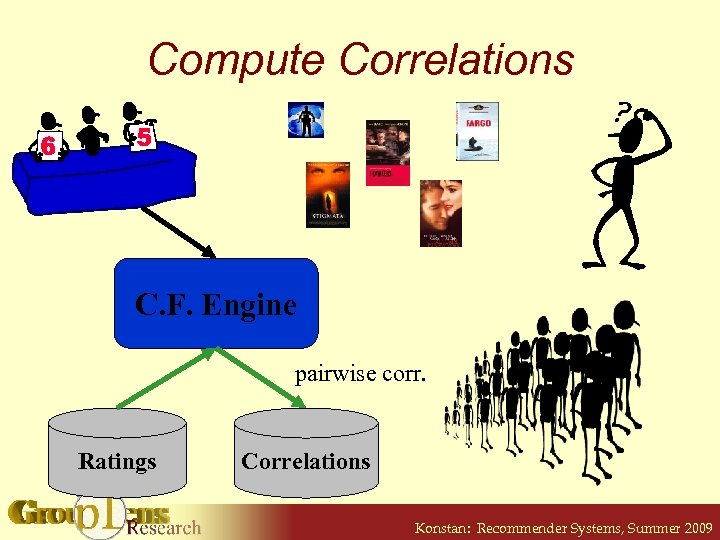 Compute Correlations C. F. Engine pairwise corr. Ratings Correlations Konstan: Recommender Systems, Summer 2009
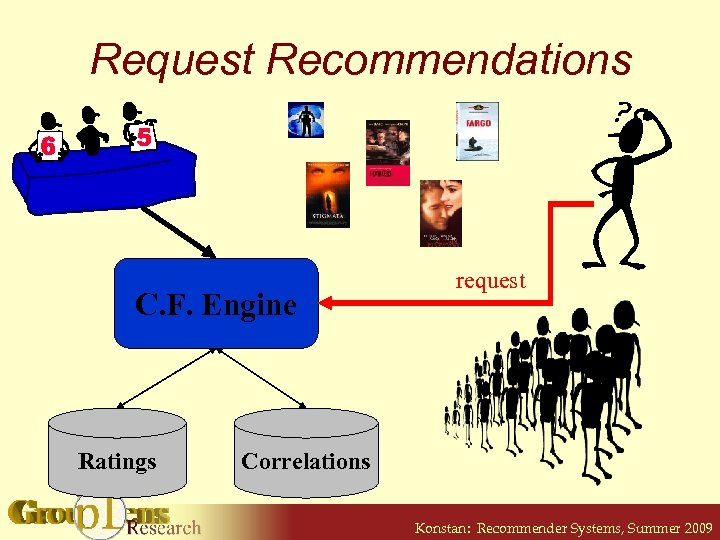 Request Recommendations C. F. Engine Ratings request Correlations Konstan: Recommender Systems, Summer 2009
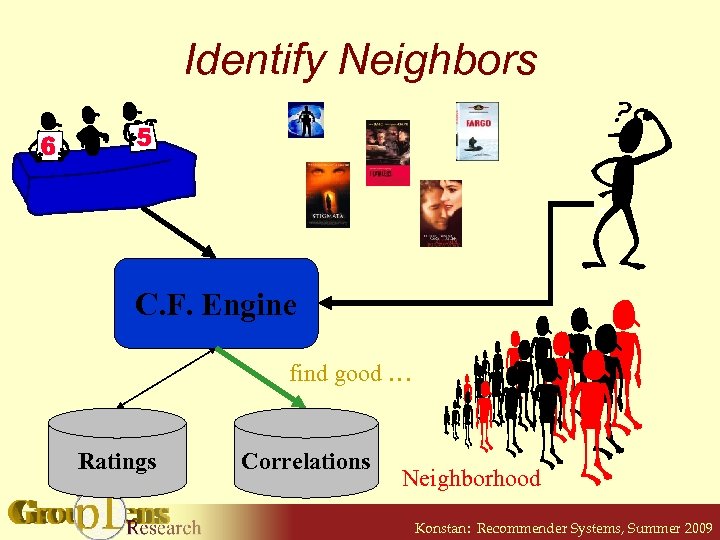 Identify Neighbors C. F. Engine find good … Ratings Correlations Neighborhood Konstan: Recommender Systems, Summer 2009
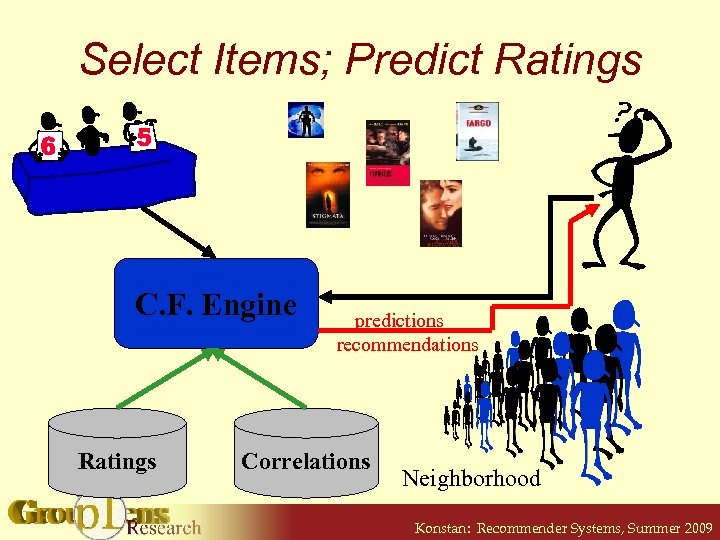 Select Items; Predict Ratings C. F. Engine Ratings predictions recommendations Correlations Neighborhood Konstan: Recommender Systems, Summer 2009
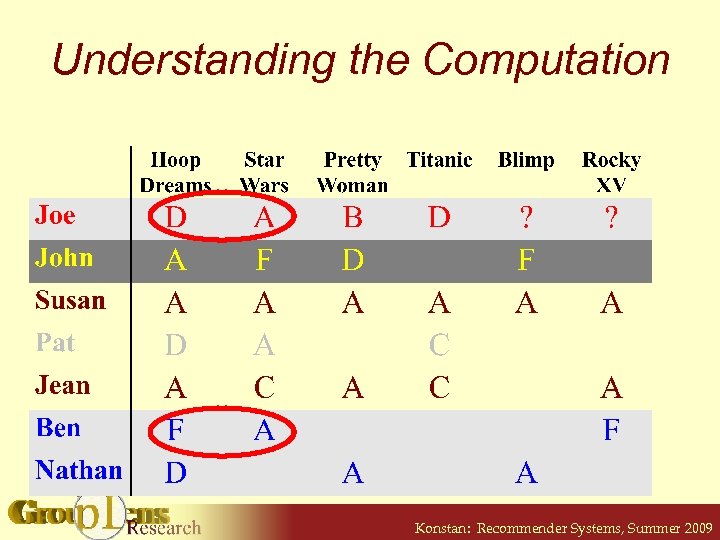
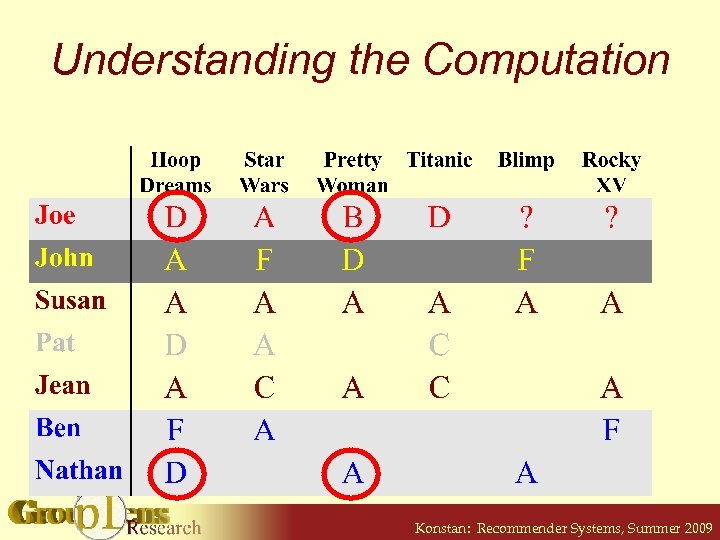
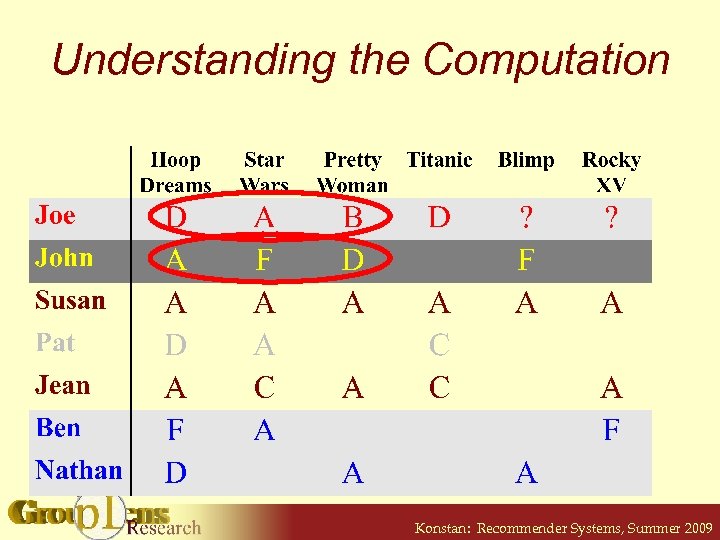
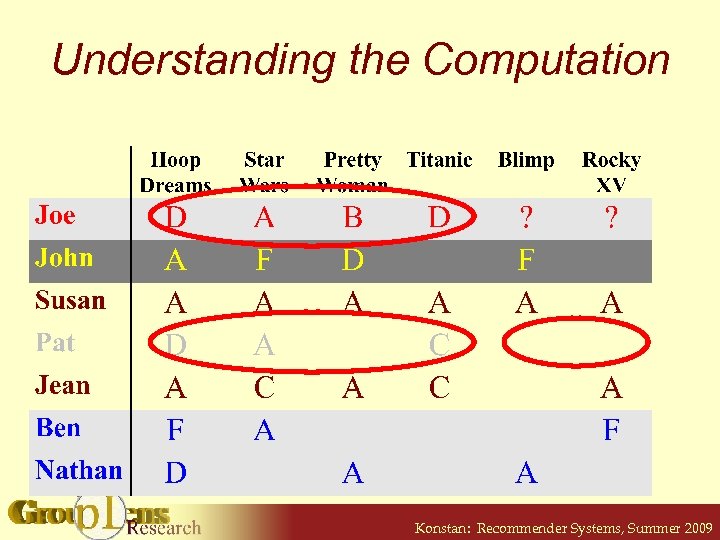
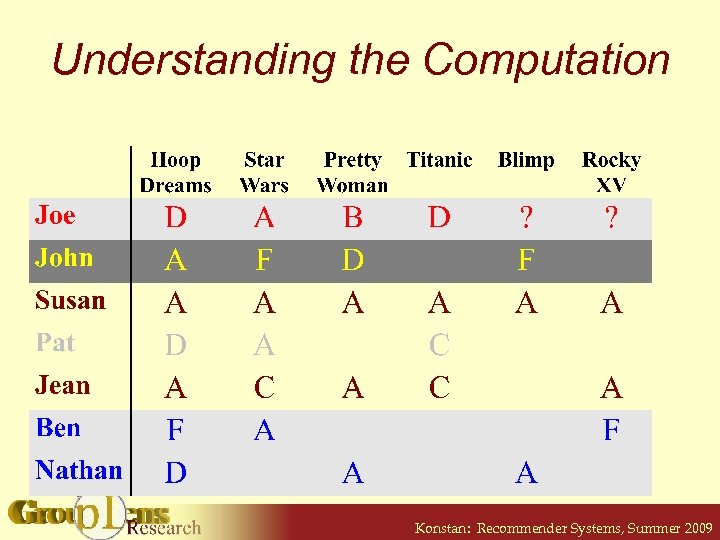 Understanding the Computation Konstan: Recommender Systems, Summer 2009
 Understanding the Computation Konstan: Recommender Systems, Summer 2009
 Understanding the Computation Konstan: Recommender Systems, Summer 2009
 Understanding the Computation Konstan: Recommender Systems, Summer 2009
 Understanding the Computation Konstan: Recommender Systems, Summer 2009
 Understanding the Computation Konstan: Recommender Systems, Summer 2009
 Understanding the Computation Konstan: Recommender Systems, Summer 2009
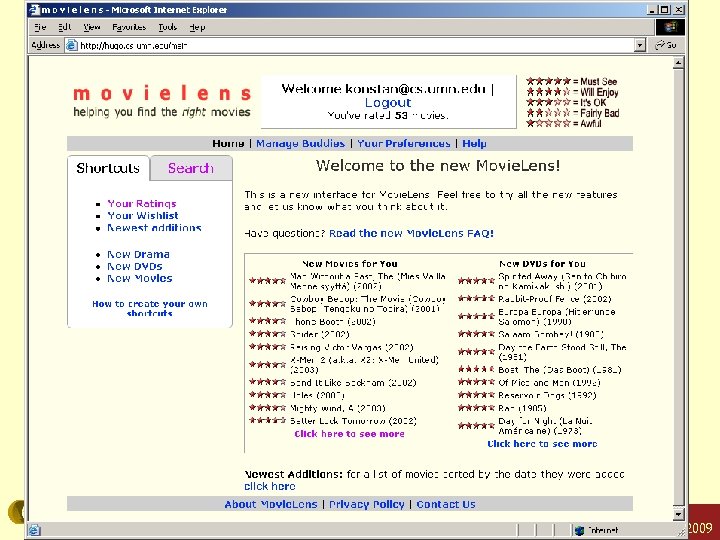
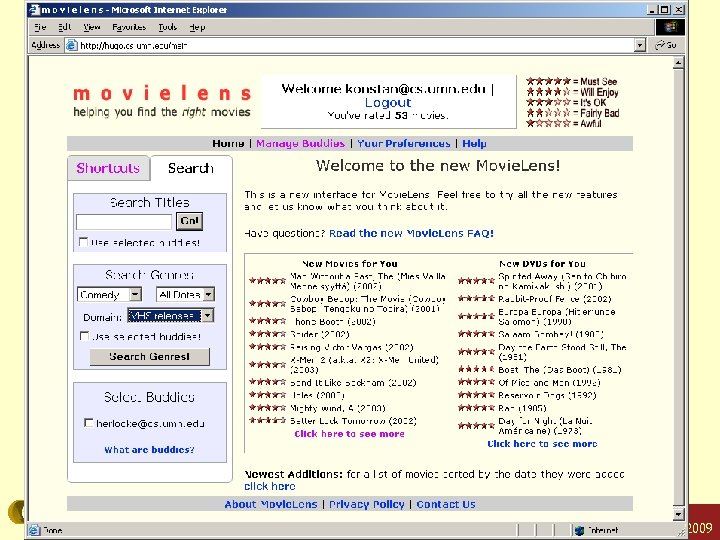
 Movie. Lens Freely accessible at: http: //www. movielens. org Konstan: Recommender Systems, Summer 2009
 ML-home Konstan: Recommender Systems, Summer 2009
 ML-comedy Konstan: Recommender Systems, Summer 2009
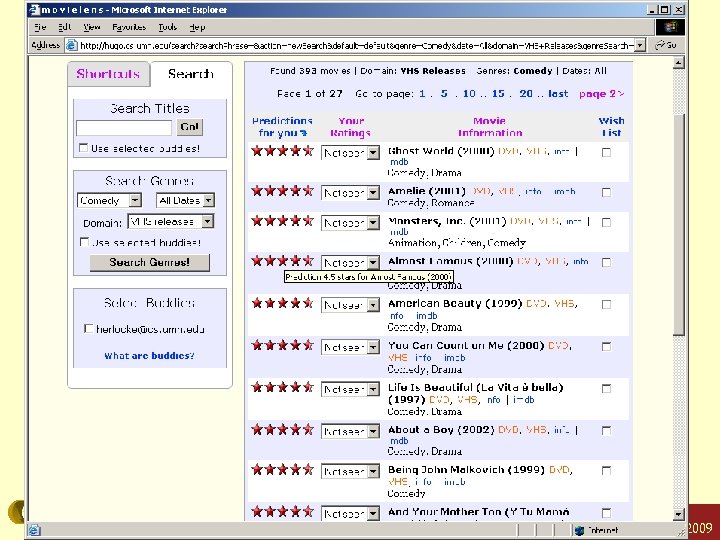 ML-clist Konstan: Recommender Systems, Summer 2009
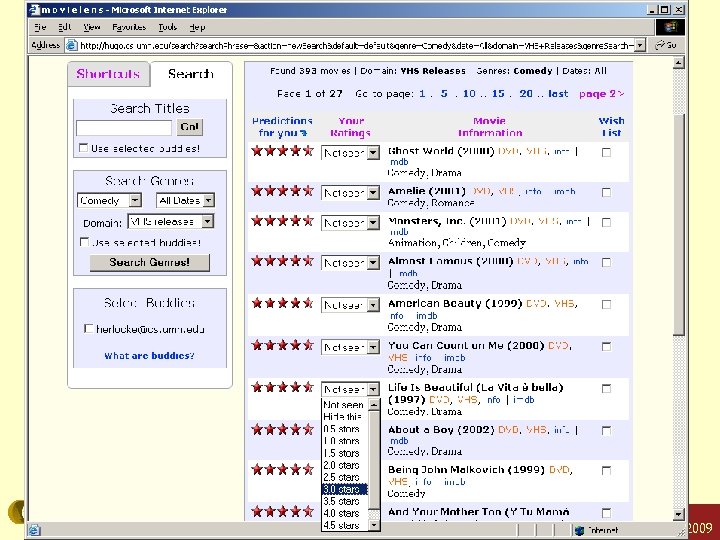 ML-rate Konstan: Recommender Systems, Summer 2009
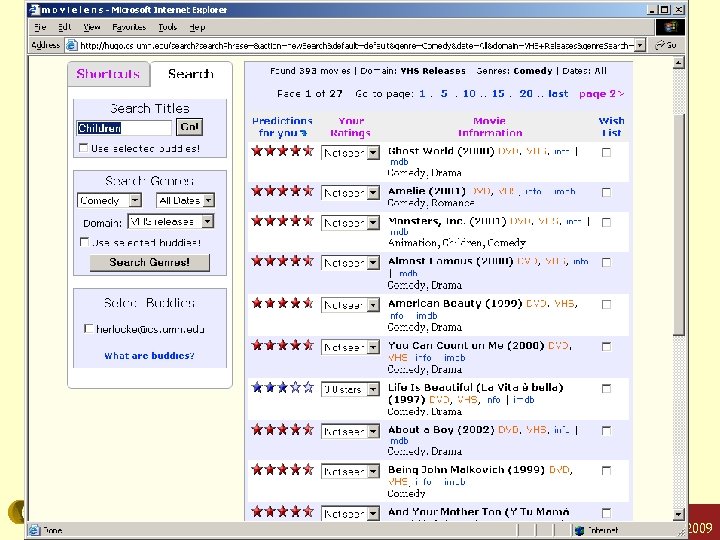 ML-search Konstan: Recommender Systems, Summer 2009
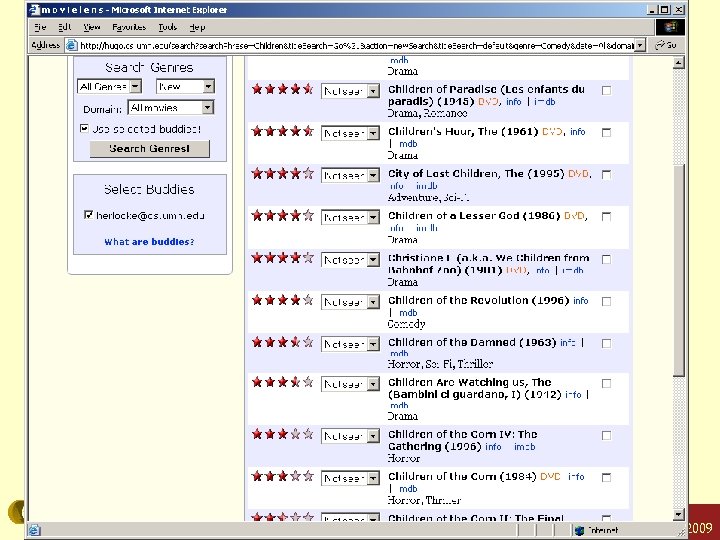 ML-slist Konstan: Recommender Systems, Summer 2009
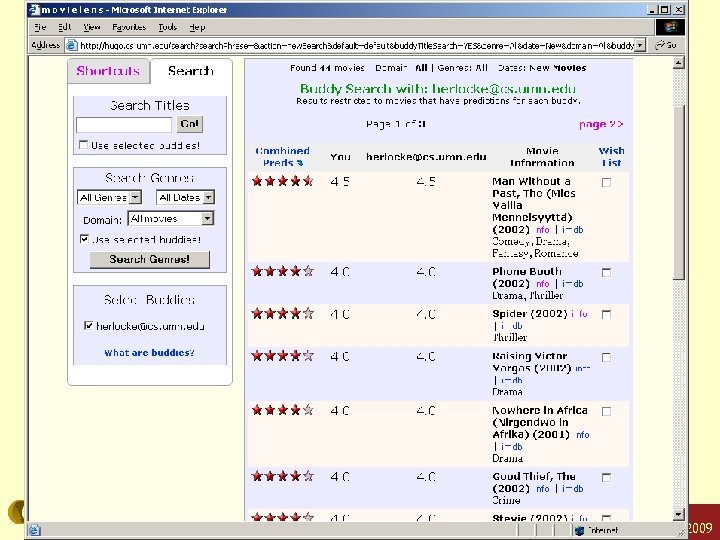 ML-buddies Konstan: Recommender Systems, Summer 2009
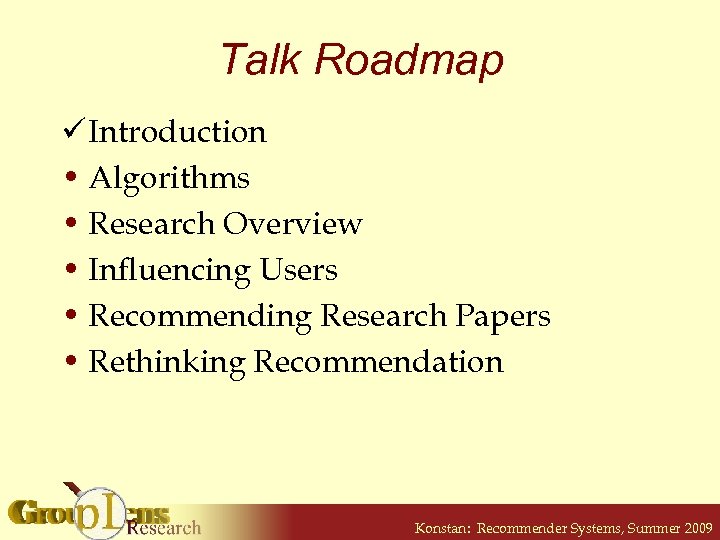 Talk Roadmap ü Introduction • Algorithms • Research Overview • Influencing Users • Recommending Research Papers • Rethinking Recommendation Konstan: Recommender Systems, Summer 2009
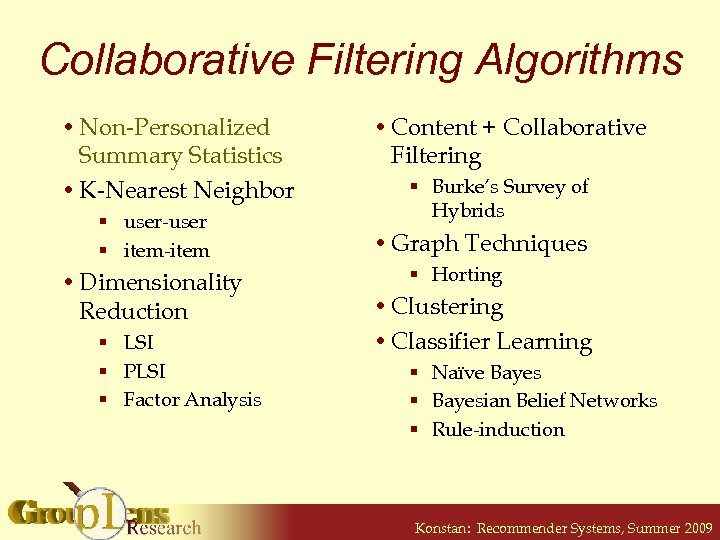 Collaborative Filtering Algorithms • Non-Personalized Summary Statistics • K-Nearest Neighbor § user-user § item-item • Dimensionality Reduction § LSI § PLSI § Factor Analysis • Content + Collaborative Filtering § Burke’s Survey of Hybrids • Graph Techniques § Horting • Clustering • Classifier Learning § Naïve Bayes § Bayesian Belief Networks § Rule-induction Konstan: Recommender Systems, Summer 2009
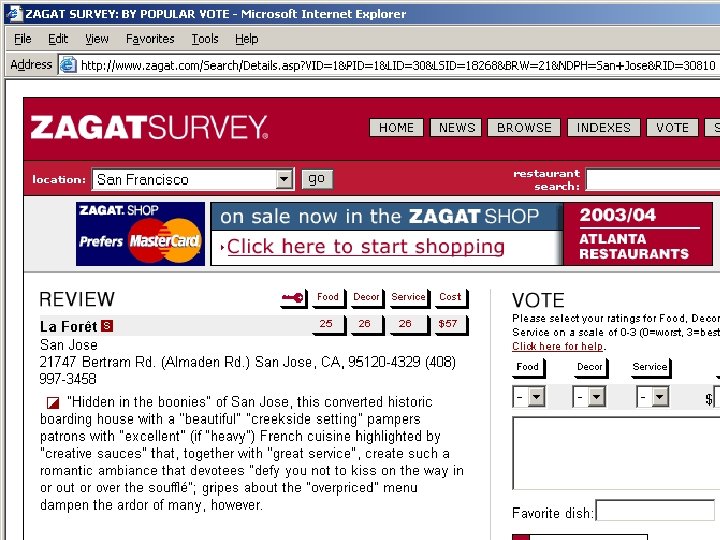 Zagat Guide Detail Konstan: Recommender Systems, Summer 2009
 Collaborative Filtering Algorithms • Non-Personalized Summary Statistics • K-Nearest Neighbor § user-user § item-item • Dimensionality Reduction § LSI § PLSI § Factor Analysis • Content + Collaborative Filtering § Burke’s Survey of Hybrids • Graph Techniques § Horting • Clustering • Classifier Learning § Naïve Bayes § Bayesian Belief Networks § Rule-induction Konstan: Recommender Systems, Summer 2009
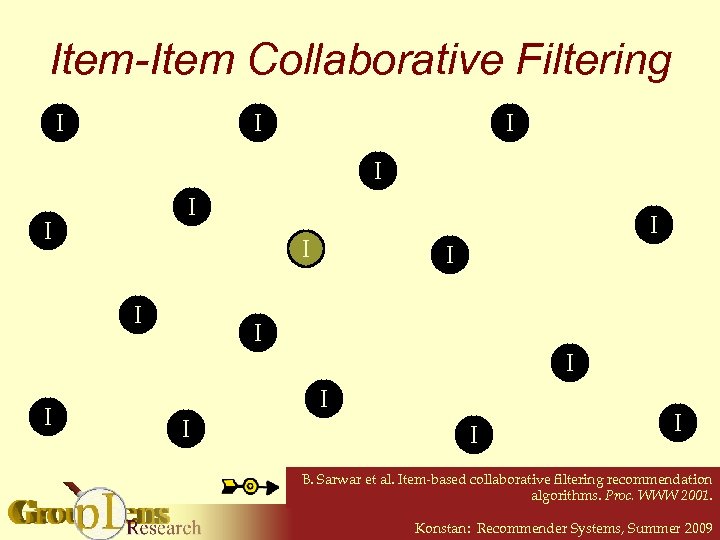 Item-Item Collaborative Filtering I I I I I B. Sarwar et al. Item-based collaborative filtering recommendation algorithms. Proc. WWW 2001. Konstan: Recommender Systems, Summer 2009
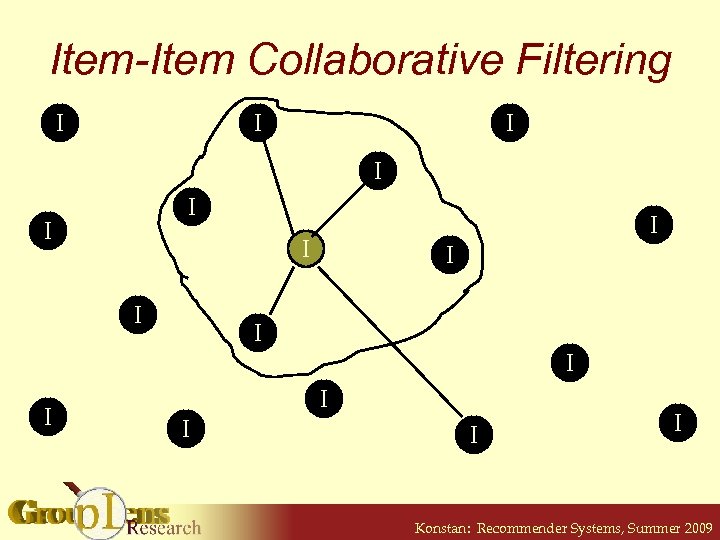 Item-Item Collaborative Filtering I I I I I Konstan: Recommender Systems, Summer 2009
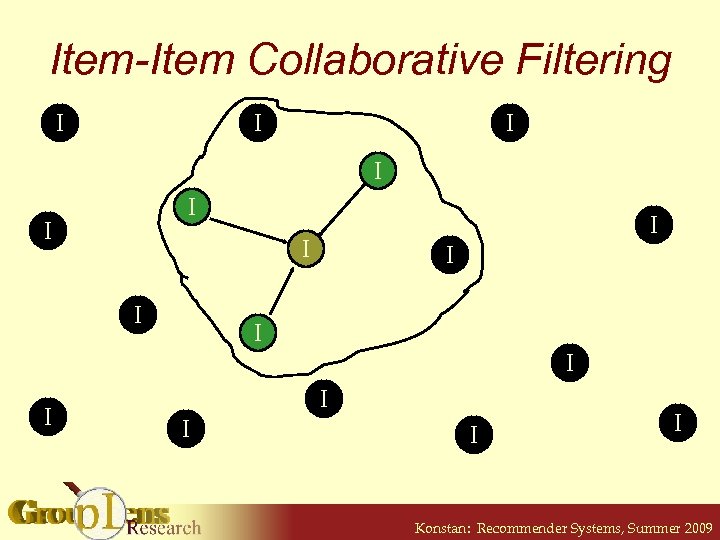 Item-Item Collaborative Filtering I I I I I Konstan: Recommender Systems, Summer 2009
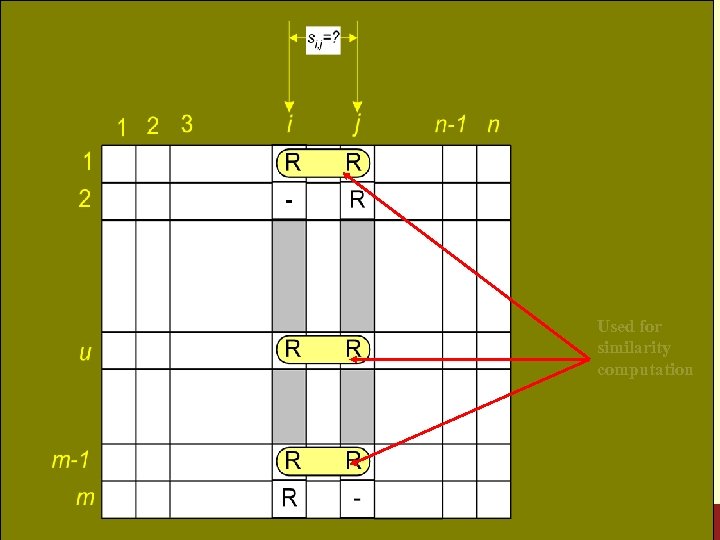 Item Similarities Used for similarity computation Konstan: Recommender Systems, Summer 2009
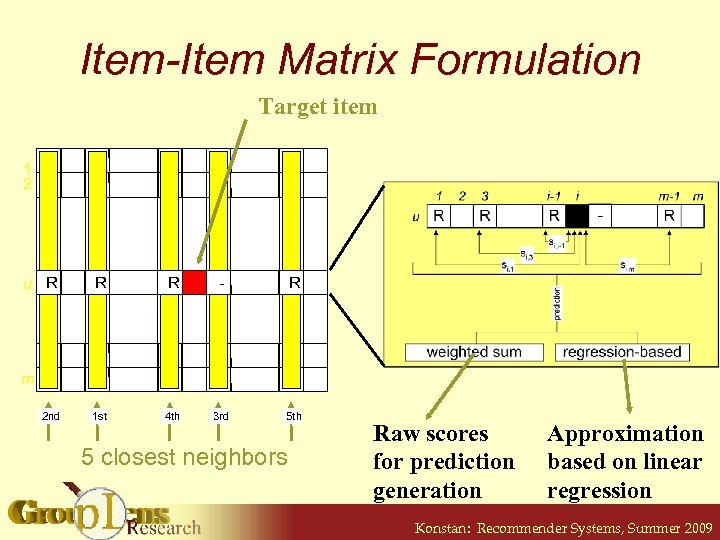 Item-Item Matrix Formulation Target item 1 2 u R R R - R 1 st 4 th 3 rd 5 th m 2 nd 5 closest neighbors Raw scores for prediction generation Approximation based on linear regression Konstan: Recommender Systems, Summer 2009
 Item-Item Discussion • Good quality, in sparse situations • Promising for incremental model building § Small quality degradation § Big performance gain Konstan: Recommender Systems, Summer 2009
 Collaborative Filtering Algorithms • Non-Personalized Summary Statistics • K-Nearest Neighbor § user-user § item-item • Dimensionality Reduction § LSI § PLSI § Factor Analysis • Content + Collaborative Filtering § Burke’s Survey of Hybrids • Graph Techniques § Horting • Clustering • Classifier Learning § Naïve Bayes § Bayesian Belief Networks § Rule-induction Konstan: Recommender Systems, Summer 2009
 Dimensionality Reduction • Latent Semantic Indexing § Used by the IR community § Worked well with the vector space model § Used Singular Value Decomposition (SVD) • Main Idea § Term-document matching in feature space § Captures latent association § Reduced space is less-noisy B. Sarwar et al. Incremental SVD-Based Algorithms for Highly Scaleable Recommender Systems. Proc ICCIT 2002. Konstan: Recommender Systems, Summer 2009
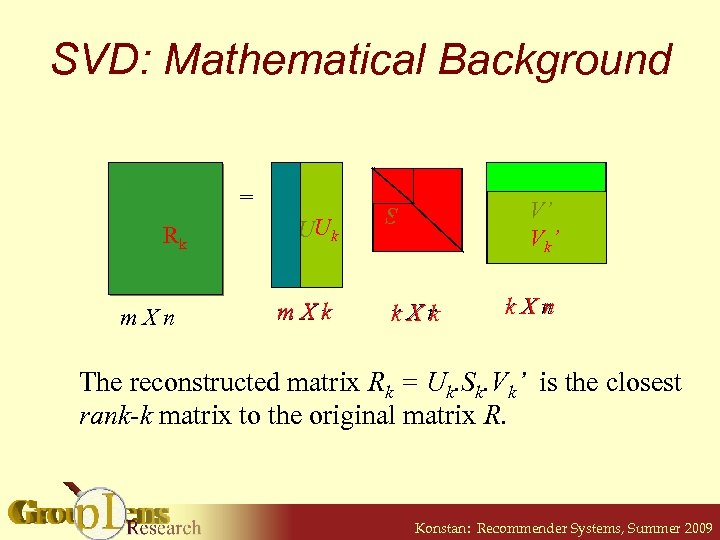 SVD: Mathematical Background = R R k m. Xn UUk k m. Xr V’ V k’ Sk S r. Xr k k k r. Xn The reconstructed matrix Rk = Uk. Sk. Vk’ is the closest rank-k matrix to the original matrix R. Konstan: Recommender Systems, Summer 2009
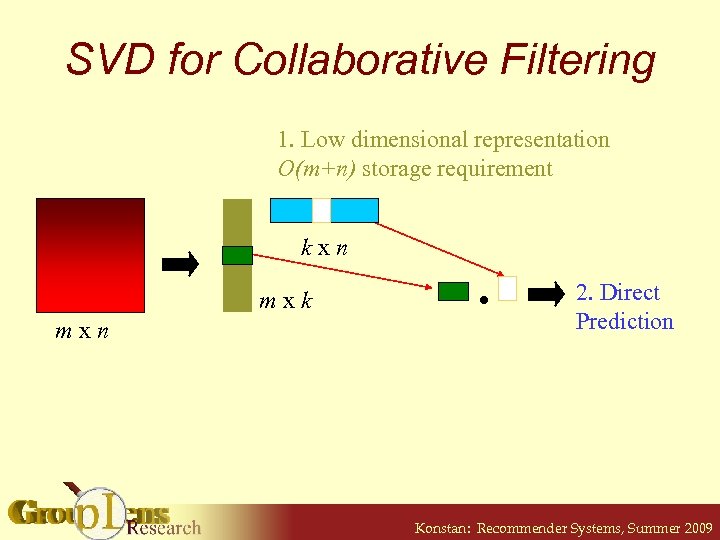 SVD for Collaborative Filtering 1. Low dimensional representation O(m+n) storage requirement kxn mxk mxn . 2. Direct Prediction Konstan: Recommender Systems, Summer 2009
 Singular Value Decomposition Reduce dimensionality of problem • Results in small, fast model • Richer Neighbor Network Incremental Update • Folding in • Model Update Konstan: Recommender Systems, Summer 2009
 Collaborative Filtering Algorithms • Non-Personalized Summary Statistics • K-Nearest Neighbor § user-user § item-item • Dimensionality Reduction § LSI § PLSI § Factor Analysis • Content + Collaborative Filtering § Burke’s Survey of Hybrids • Graph Techniques § Horting • Clustering • Classifier Learning § Naïve Bayes § Bayesian Belief Networks § Rule-induction Konstan: Recommender Systems, Summer 2009
 Talk Roadmap ü Introduction ü Algorithms • Research Overview • Influencing Users • Recommending Research Papers • Rethinking Recommendation Konstan: Recommender Systems, Summer 2009
 Current and Recent Research User Experience § § § Impact of Ratings on Users New User “Orientation” Confidence Displays Interface Design Human-Recommender Interaction Algorithmic and Systems Issues § Beyond Accuracy: Metrics and Algorithms § Buddies and Multi-User Recommendations § Influence and Shilling Eliciting Participation in On-Line Communities § Reinventing Conversation § User-Maintained Communities Extending Recommendation to New Domains § Recommending Research Papers Konstan: Recommender Systems, Summer 2009
 Talk Roadmap ü Introduction ü Algorithms ü Research Overview • Influencing Users • Recommending Research Papers • Rethinking Recommendation D. Cosley et al. Is Seeing Believing? How Recommender Systems Influence Users' Opinions. Proc. CHI 2003. Konstan: Recommender Systems, Summer 2009
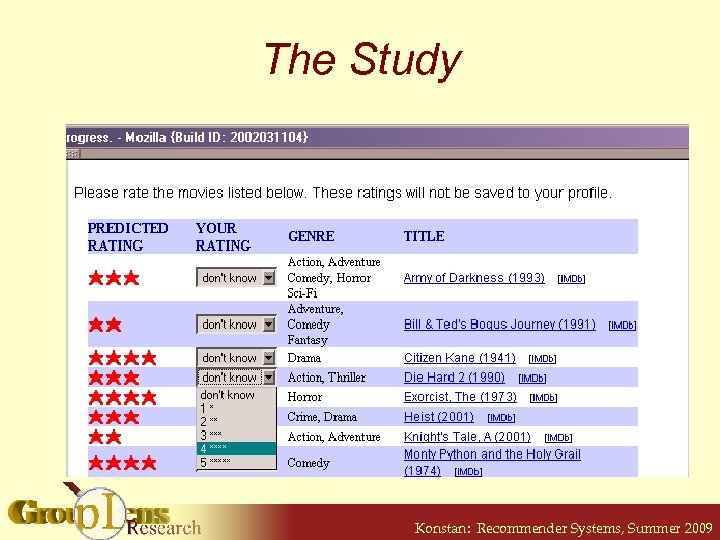
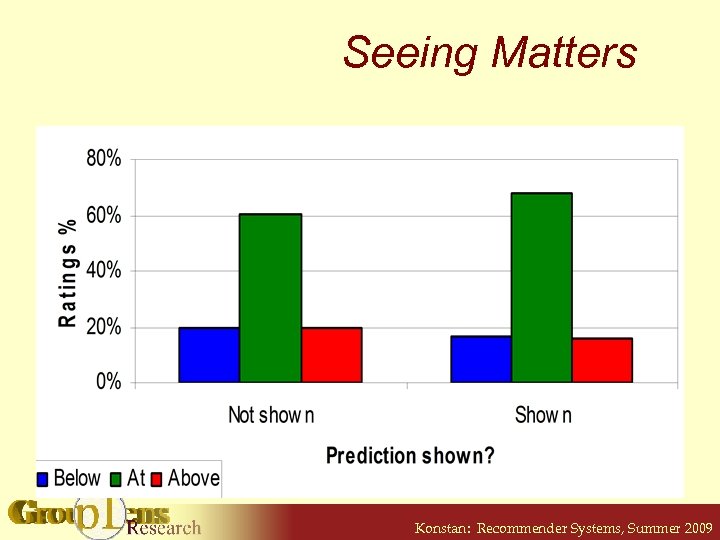
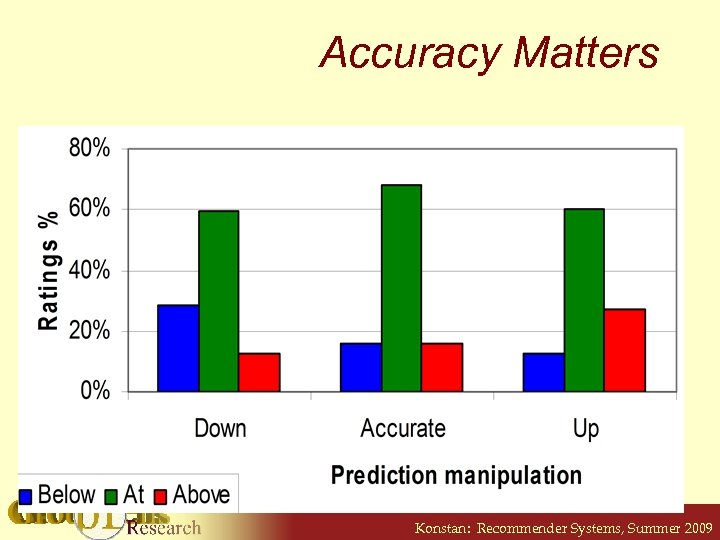
 Does Seeing Predictions Affect User Ratings? • RERATE: Ask 212 users to rate 40 movies § 10 with no shown prediction § 30 with shown predictions (random order): 10 accurate, 10 up a star, 10 down a star • Compare ratings to accurate predictions § “Prediction” is user’s original rating § Hypothesis: users rate in the direction of the shown prediction Konstan: Recommender Systems, Summer 2009
 The Study Konstan: Recommender Systems, Summer 2009
 Seeing Matters Konstan: Recommender Systems, Summer 2009
 Accuracy Matters Konstan: Recommender Systems, Summer 2009
 Domino Effects? • The power to manipulate? Konstan: Recommender Systems, Summer 2009
 Rated, Unrated, Doesn’t Matter • Recap of RERATE effects: § Showing prediction changed 8% of ratings § Altering shown prediction changed 12% • Similar experiment, UNRATED movies § 137 experimental users, 1599 ratings § Showing prediction changed 8% of ratings § Altering shown prediction changed 14% Konstan: Recommender Systems, Summer 2009
 But Users Notice! • Users are often insensitive… • UNRATED part 2: satisfaction survey § Control group: only accurate predictions § Experimental predictions accurate, useful? § ML predictions overall accurate, useful? • Manipulated preds less well liked • Surprise: 24 bad = Movie. Lens worse! Konstan: Recommender Systems, Summer 2009
 Talk Roadmap ü Introduction ü Algorithms ü Research Overview ü Influencing Users • Recommending Research Papers • Rethinking Recommendation Konstan: Recommender Systems, Summer 2009
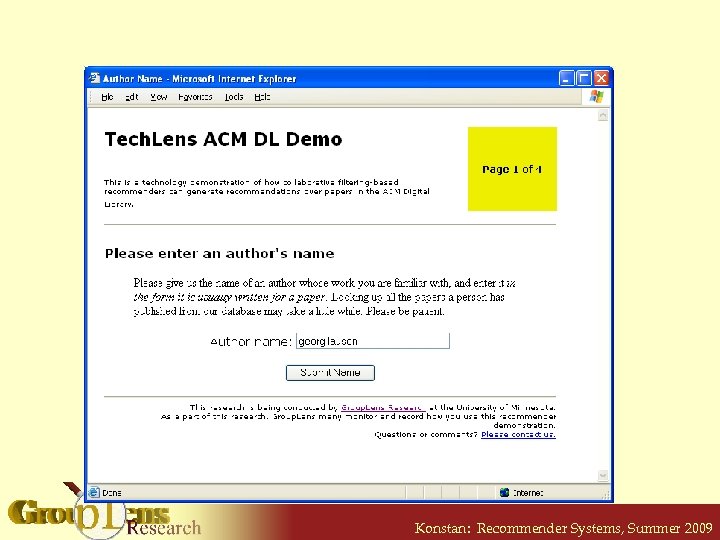
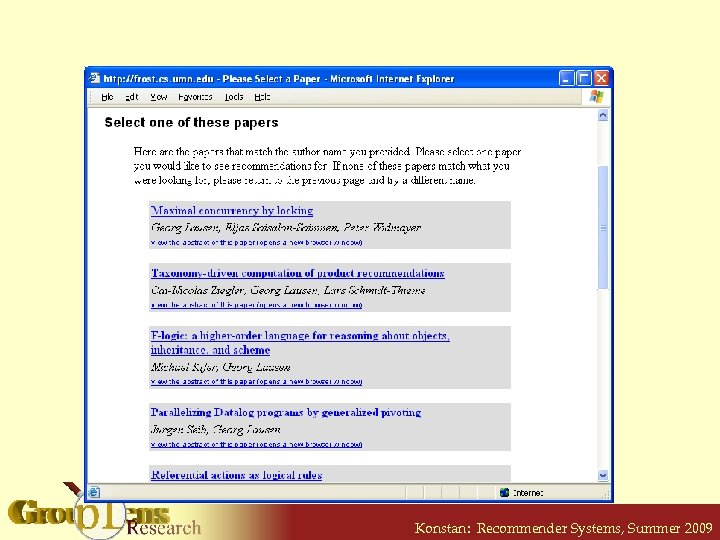
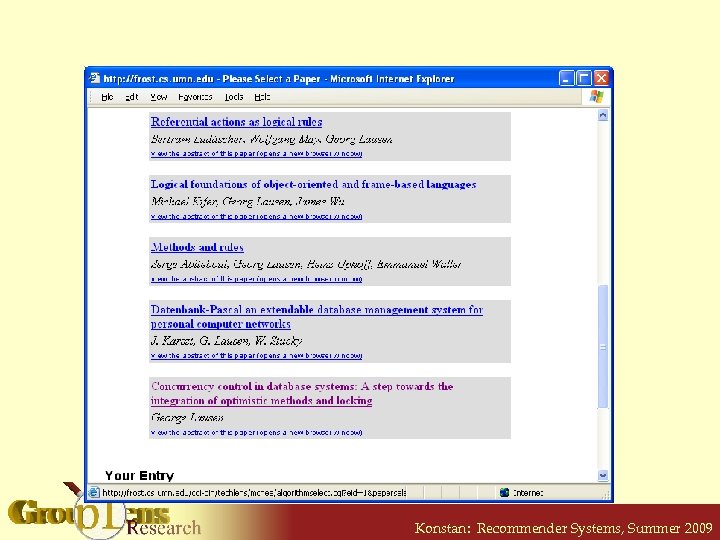
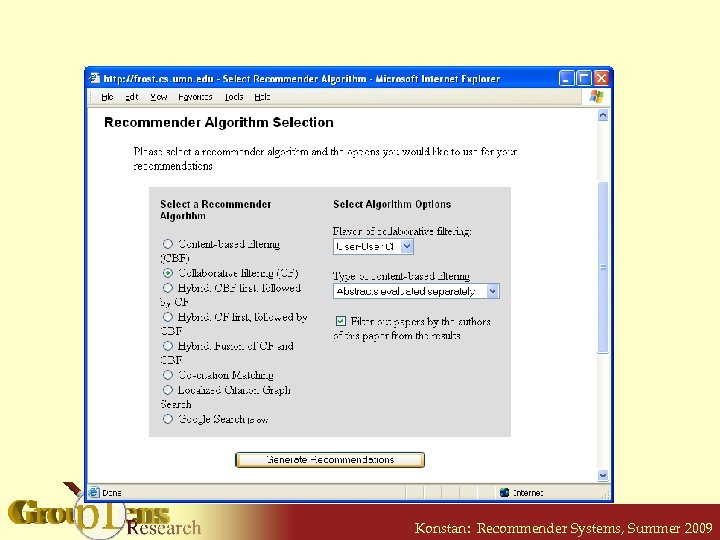
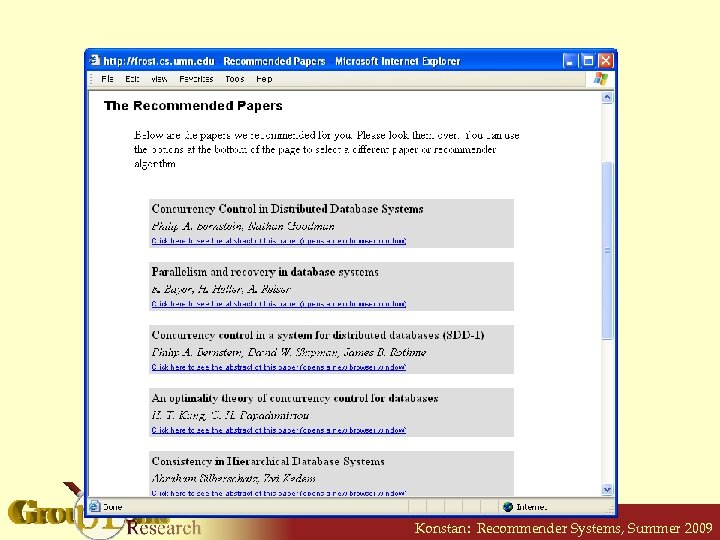
 Recommending Research Papers • Using Citation Webs • For a full paper, we can recommend citations § A paper “rates” the papers it cites § Every paper has ratings in the system • Other citation web mappings are possible, but many are have problems S. Mc. Nee et al. “On the Recommending of Citations for Research Papers”, in Proc. CSCW 2002 and R. Torres et al. “Enhancing Digital Libraries with Tech. Lens+”, in Proc. JCDL 2004. Konstan: Recommender Systems, Summer 2009
 Konstan: Recommender Systems, Summer 2009
 Konstan: Recommender Systems, Summer 2009
 Konstan: Recommender Systems, Summer 2009
 Konstan: Recommender Systems, Summer 2009
 Konstan: Recommender Systems, Summer 2009
 Pure Experiment Results -- Online Konstan: Recommender Systems, Summer 2009
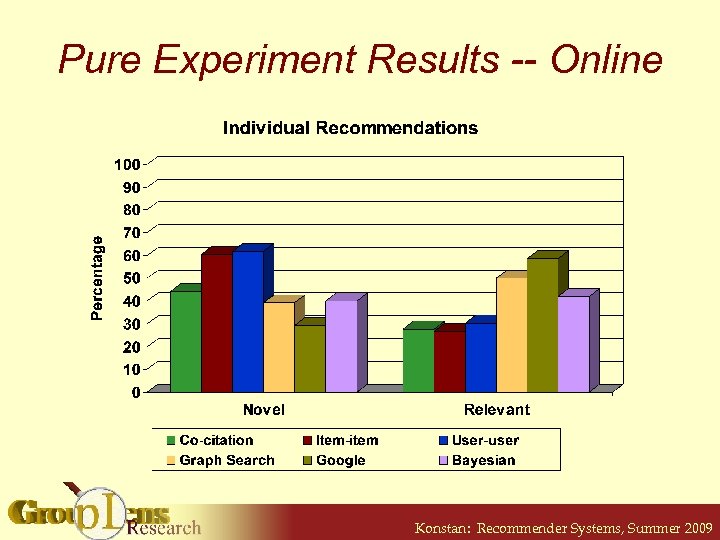
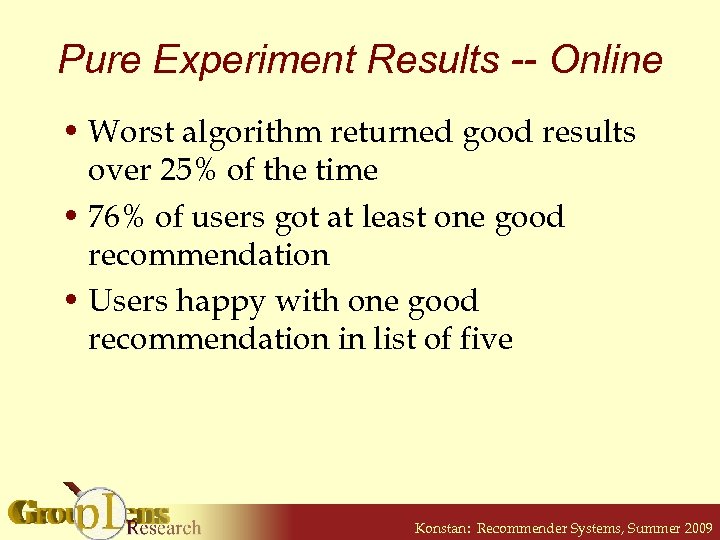 Pure Experiment Results -- Online • Worst algorithm returned good results over 25% of the time • 76% of users got at least one good recommendation • Users happy with one good recommendation in list of five Konstan: Recommender Systems, Summer 2009
 What’s Next? • Short-Term Efforts § Task-specific recommendation § Understanding personal bibliographies § Privacy issues • Longer-Term Efforts § Toolkits to support librarians and other power users § Exploring the shape of disciplines § Rights issues Konstan: Recommender Systems, Summer 2009
 Task-Specific Recommendations • Many different user needs § § awareness in area of expertise find specific work in area of expertise explore peripheral or new area find people with relevant expertise • reviewers, program committees, collaborators § reading list for students, newcomers • individuals or groups • Different algorithms fulfill different needs Konstan: Recommender Systems, Summer 2009
 Talk Roadmap ü Introduction ü Algorithms ü Research Overview ü Influencing Users ü Recommending Research Papers • Rethinking Recommendation Konstan: Recommender Systems, Summer 2009
 Evaluating Recommendations • Prediction Accuracy § MAE, MSE, • Decision-Support Accuracy § Reversals, ROC • Recommendation Quality § Top-n measures • Item-Set Coverage J. Herlocker et al. Evaluating Collaborative Filtering Recommender Systems. ACM Transactions on Information Systems 22(1), Jan. 2004. Konstan: Recommender Systems, Summer 2009
 From Items to Lists • Do users really experience recommendations in isolation? C. Ziegler et al. “Improving Recommendation Lists through Topic Diversification”. , in Proc. WWW 2005. Konstan: Recommender Systems, Summer 2009
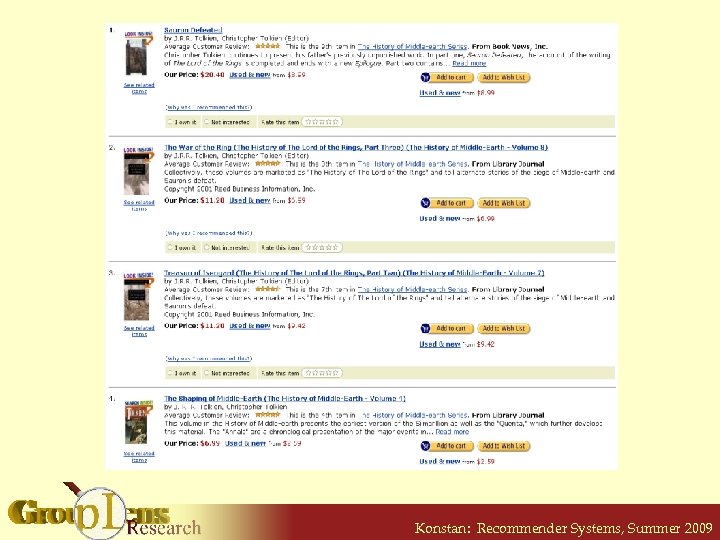 Amazon. com example Konstan: Recommender Systems, Summer 2009
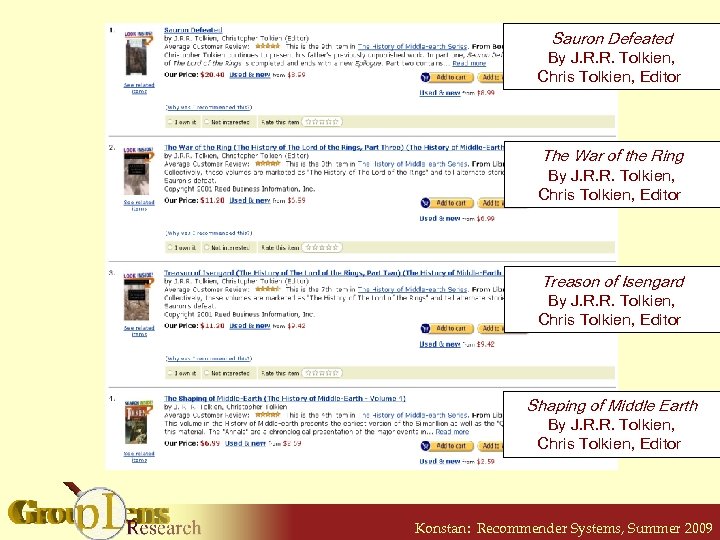 Sauron Defeated Amazon. com example By J. R. R. Tolkien, Chris Tolkien, Editor The War of the Ring By J. R. R. Tolkien, Chris Tolkien, Editor Treason of Isengard By J. R. R. Tolkien, Chris Tolkien, Editor Shaping of Middle Earth By J. R. R. Tolkien, Chris Tolkien, Editor Konstan: Recommender Systems, Summer 2009
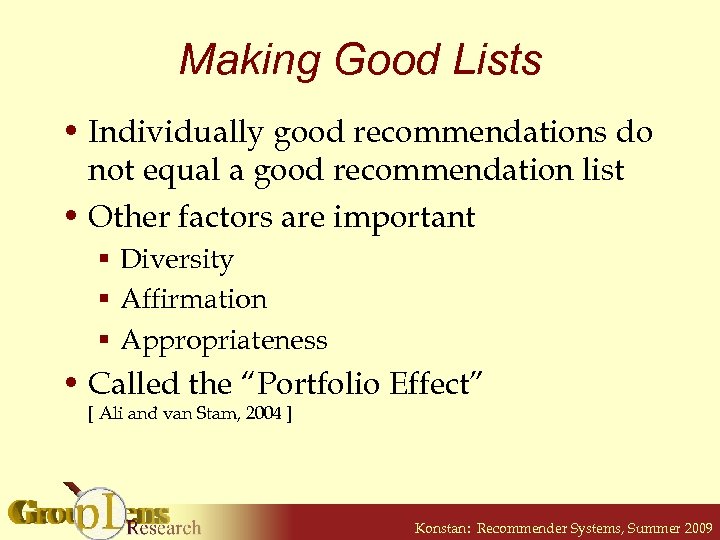 Making Good Lists • Individually good recommendations do not equal a good recommendation list • Other factors are important § Diversity § Affirmation § Appropriateness • Called the “Portfolio Effect” [ Ali and van Stam, 2004 ] Konstan: Recommender Systems, Summer 2009
 Topic Diversification • Re-order results in a rec list • Add item with least similarity to all items already on list • Weight with a ‘diversification factor’ • Ran experiments to test effects Konstan: Recommender Systems, Summer 2009
 Experimental Design • Books from Book. Crossing. com • Algorithms § Item-based CF § User-based CF • Experiments § On-line user surveys § 2125 users each saw one list of 10 recommendations Konstan: Recommender Systems, Summer 2009
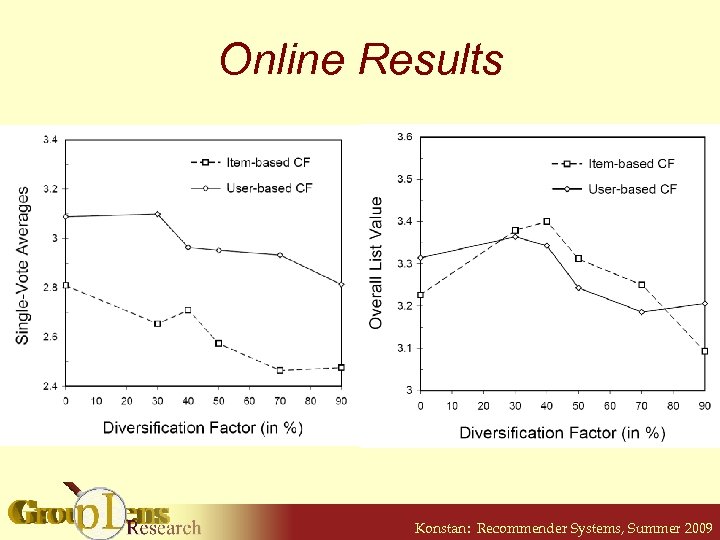 Online Results Konstan: Recommender Systems, Summer 2009
 Diversity is Important • User satisfaction more complicated than only accuracy • List makeup is important to users • 30% change enough to alter user opinion • Change not equal across algorithms Konstan: Recommender Systems, Summer 2009
 Human-Recommender Interaction • Three premises: § § § Users perceive recommendation quality in context; users evaluate lists Users develop opinions of recommenders based on interactions over time Users have an information need and come to a recommender as a part of their information seeking behavior S. Mc. Nee et al. “Making Recommendations Better: An Analytic Model for Human-Recommender Interaction” in Ext. Abs. CHI 2006 Konstan: Recommender Systems, Summer 2009
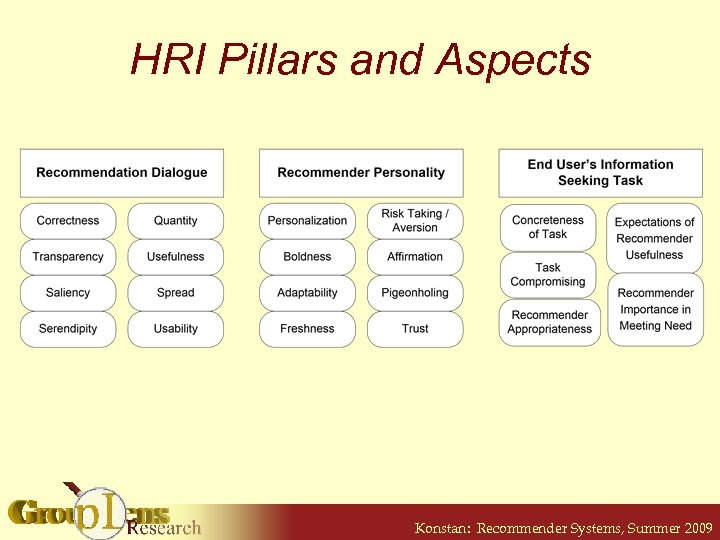 HRI Pillars and Aspects Konstan: Recommender Systems, Summer 2009
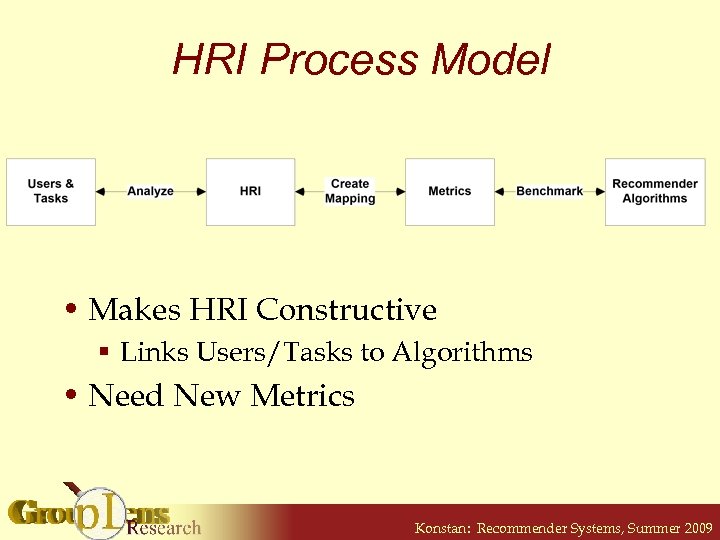 HRI Process Model • Makes HRI Constructive § Links Users/Tasks to Algorithms • Need New Metrics Konstan: Recommender Systems, Summer 2009
 New Metrics • Benchmark a variety of algorithms • Need several metrics inspired by different HRI Aspects • Examples: § Ratability § Boldness § Adaptability Konstan: Recommender Systems, Summer 2009
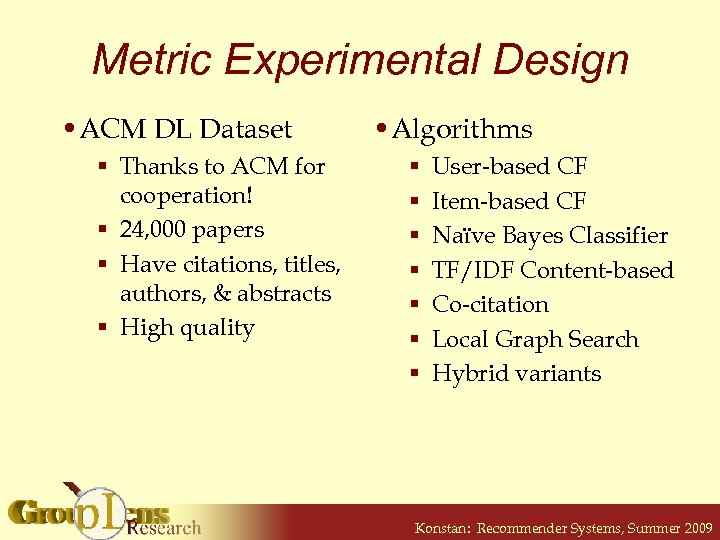 Metric Experimental Design • ACM DL Dataset § Thanks to ACM for cooperation! § 24, 000 papers § Have citations, titles, authors, & abstracts § High quality • Algorithms § § § § User-based CF Item-based CF Naïve Bayes Classifier TF/IDF Content-based Co-citation Local Graph Search Hybrid variants Konstan: Recommender Systems, Summer 2009
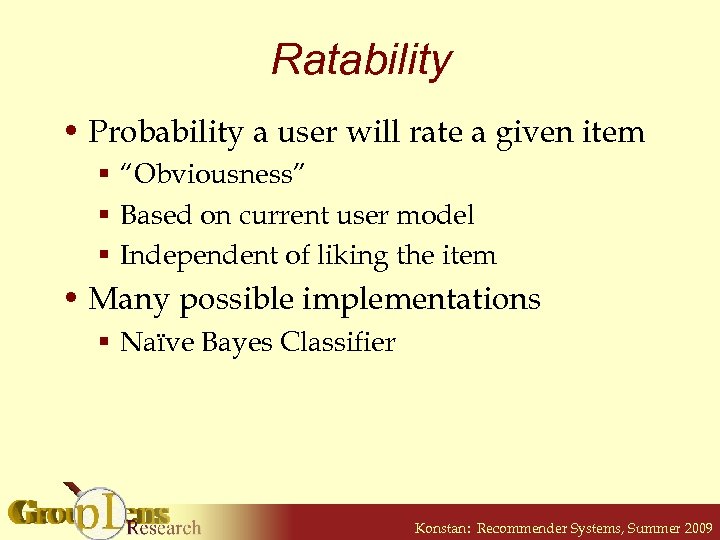 Ratability • Probability a user will rate a given item § “Obviousness” § Based on current user model § Independent of liking the item • Many possible implementations § Naïve Bayes Classifier Konstan: Recommender Systems, Summer 2009
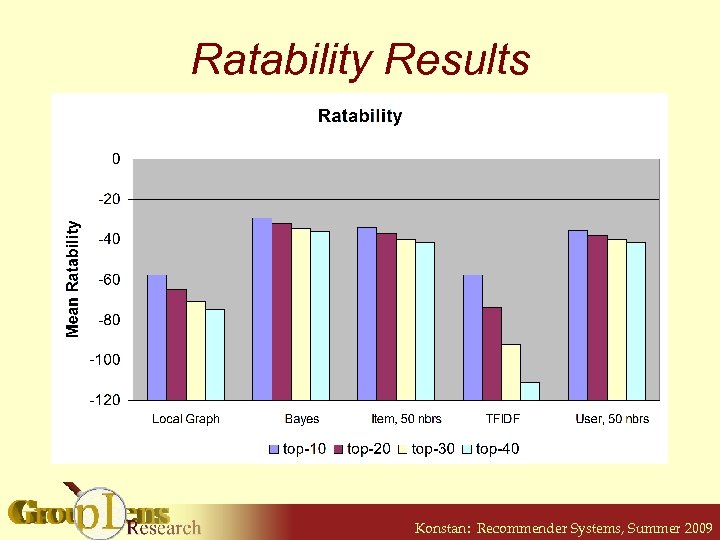 Ratability Results Konstan: Recommender Systems, Summer 2009
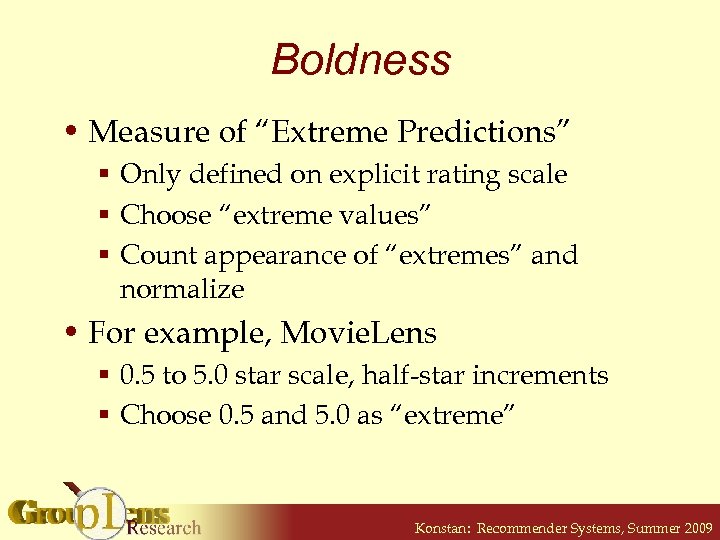 Boldness • Measure of “Extreme Predictions” § Only defined on explicit rating scale § Choose “extreme values” § Count appearance of “extremes” and normalize • For example, Movie. Lens § 0. 5 to 5. 0 star scale, half-star increments § Choose 0. 5 and 5. 0 as “extreme” Konstan: Recommender Systems, Summer 2009
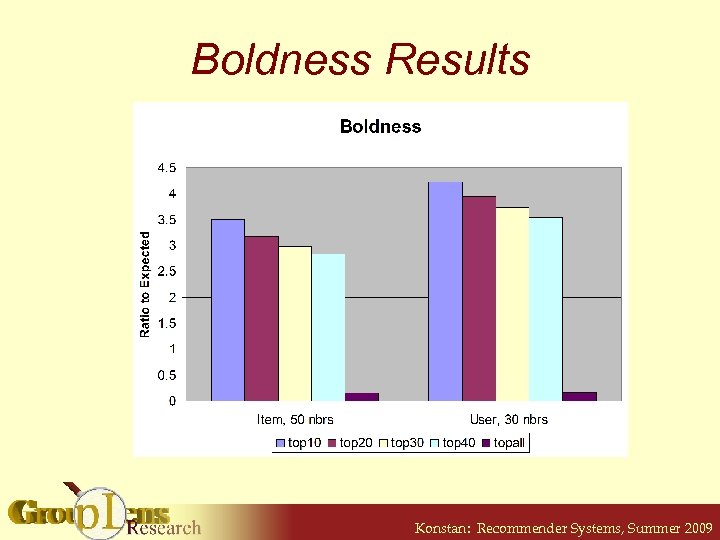 Boldness Results Konstan: Recommender Systems, Summer 2009
 Adaptability • Measure of how algorithm changes in response to changes in user model § How do users grow in the system? • Perturb a user model with a model from another random user § 50% each § See quality of new recommendation lists Konstan: Recommender Systems, Summer 2009
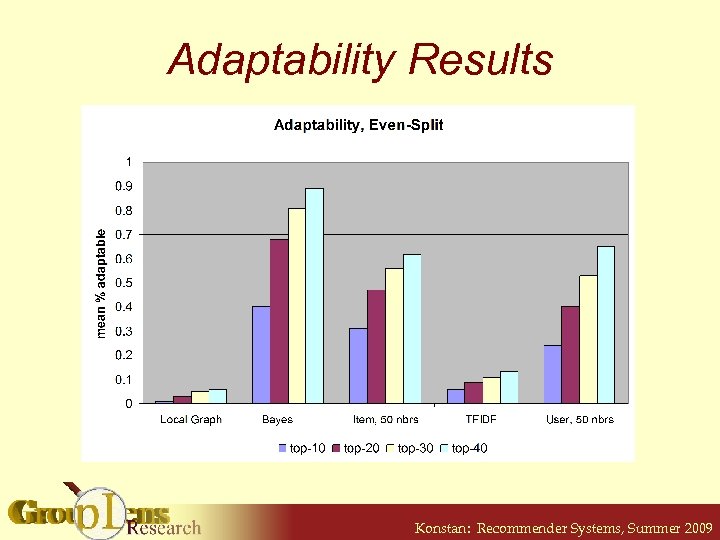 Adaptability Results Konstan: Recommender Systems, Summer 2009
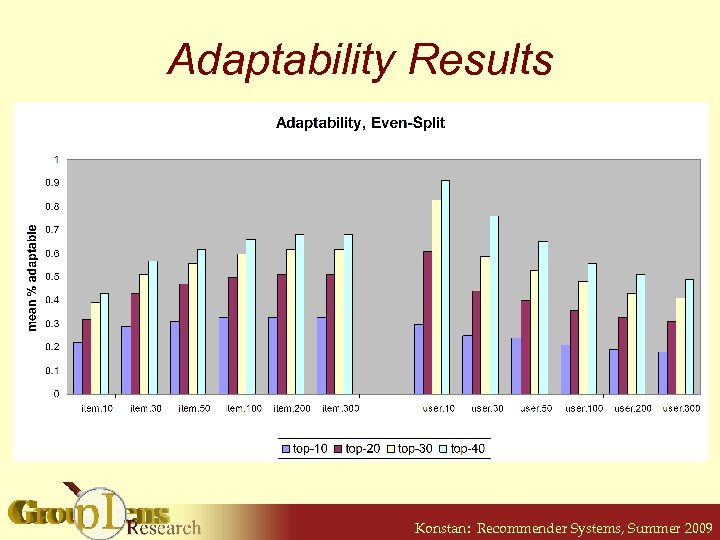 Adaptability Results Konstan: Recommender Systems, Summer 2009
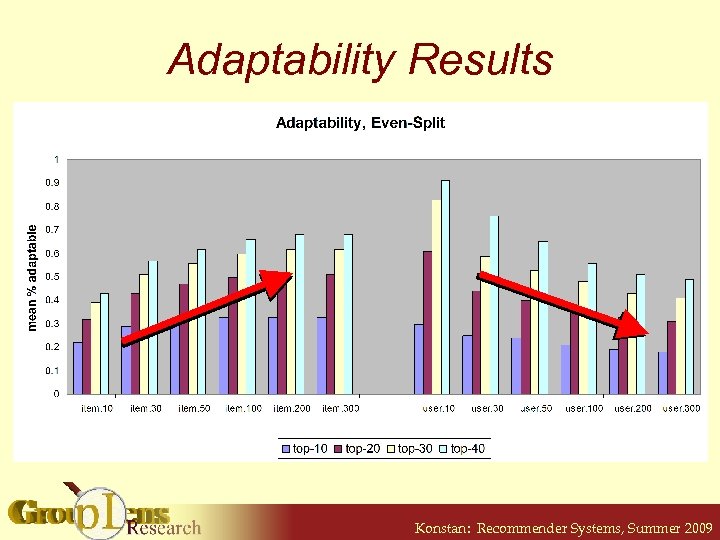 Adaptability Results Konstan: Recommender Systems, Summer 2009
 Conclusions • From humble origins … § § Substantial algorithmic research HCI and online community research Important applications Commercial deployment Konstan: Recommender Systems, Summer 2009
 Acknowledgements • This work is supported by grants from the National Science Foundation, and by grants from Net Perceptions, Inc. • Many people have contributed ideas, time, and energy to this project. Konstan: Recommender Systems, Summer 2009
 Recommender Systems: User Experience and System Issues Joseph A. Konstan University of Minnesota konstan@cs. umn. edu http: //www. grouplens. org UNIVERSITY OF MINNESOTA