 Скачать презентацию Recommender systems Arnaud De Bruyn Doctoral student in
77739bda21ef263b5afec702efb2479a.ppt
- Количество слайдов: 41



Recommender systems Arnaud De Bruyn Doctoral student in Marketing The Pennsylvania State University The Smeal College of Business Administration 701 -L Business Administration Building University Park, PA 16802 Phone: Fax: Email: (814) 865 -5944 (814) 865 -3015 adebruyn@psu. edu
The articles • E-Commerce Recommendation Applications – J. Ben Schafer – Joseph A. Konstan – John Riedl • Recommender Systems – Paul Resnick – Hal R. Varian • Scope: – Introducing recommender systems – Classifying along several dimensions
Outline • Types of recommendation systems – – – – Search-based recommendations Category-based recommendations Collaborative filtering Clustering (Horting) Association rules Information filtering Classifiers • Taxonomy of recommender systems – Targeted customer inputs – Community inputs – Outputs delivered
Part I Types of recommendation systems
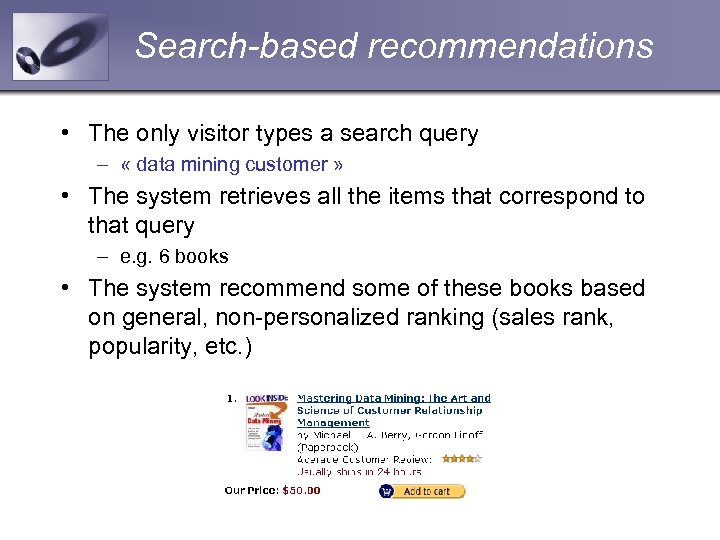
Search-based recommendations • The only visitor types a search query – « data mining customer » • The system retrieves all the items that correspond to that query – e. g. 6 books • The system recommend some of these books based on general, non-personalized ranking (sales rank, popularity, etc. )
Search-based recommendations • Pros: – Simple to implement • Cons: – – Not very powerful Which criteria to use to rank recommendations? Is it really « recommendations » ? The user only gets what he asked
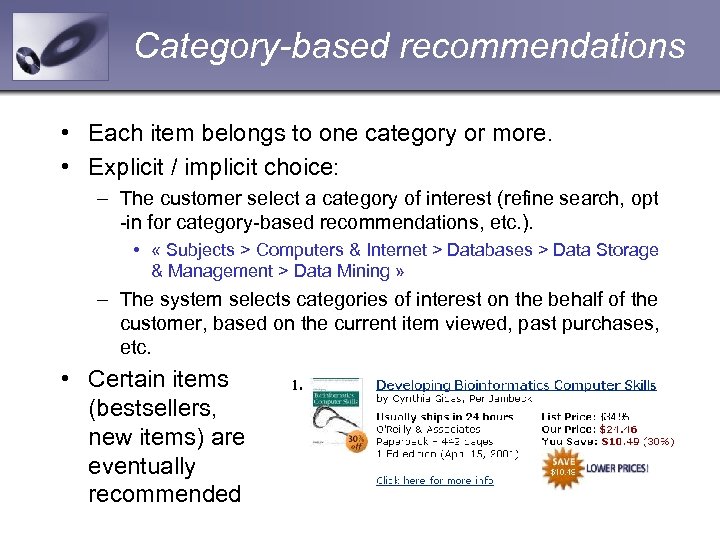
Category-based recommendations • Each item belongs to one category or more. • Explicit / implicit choice: – The customer select a category of interest (refine search, opt -in for category-based recommendations, etc. ). • « Subjects > Computers & Internet > Databases > Data Storage & Management > Data Mining » – The system selects categories of interest on the behalf of the customer, based on the current item viewed, past purchases, etc. • Certain items (bestsellers, new items) are eventually recommended
Category-based recommendations • Pros: – Still simple to implement • Cons: – Again: not very powerful, which criteria to use to order recommendations? is it really « recommendations » ? – Capacity highly dependd upon the kind of categories implemented • Too specific: not efficient • Not specific enough: no relevant recommendations
Collaborative filtering • Collaborative filtering techniques « compare » customers, based on their previous purchases, to make recommendations to « similar » customers • It’s also called « social » filtering • Follow these steps: – 1. Find customers who are similar ( « nearest neighbors » ) in term of tastes, preferences, past behaviors – 2. Aggregate weighted preferences of these neighbors – 3. Make recommendations based on these aggregated, weighted preferences (most preferred, unbought items)
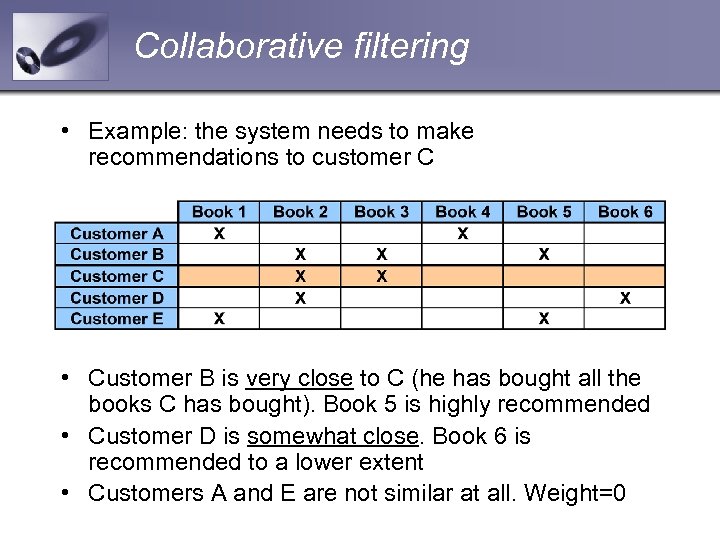
Collaborative filtering • Example: the system needs to make recommendations to customer C • Customer B is very close to C (he has bought all the books C has bought). Book 5 is highly recommended • Customer D is somewhat close. Book 6 is recommended to a lower extent • Customers A and E are not similar at all. Weight=0
Collaborative filtering • Pros: – Extremely powerful and efficient – Very relevant recommendations – (1) The bigger the database, (2) the more the past behaviors, the better the recommendations • Cons: – Difficult to implement, resource and time-consuming – What about a new item that has never been purchased? Cannot be recommended – What about a new customer who has never bought anything? Cannot be compared to other customers no items can be recommended
Clustering • Another way to make recommendations based on past purchases of other customers is to cluster customers into categories • Each cluster will be assigned « typical » preferences, based on preferences of customers who belong to the cluster • Customers within each cluster will receive recommendations computed at the cluster level
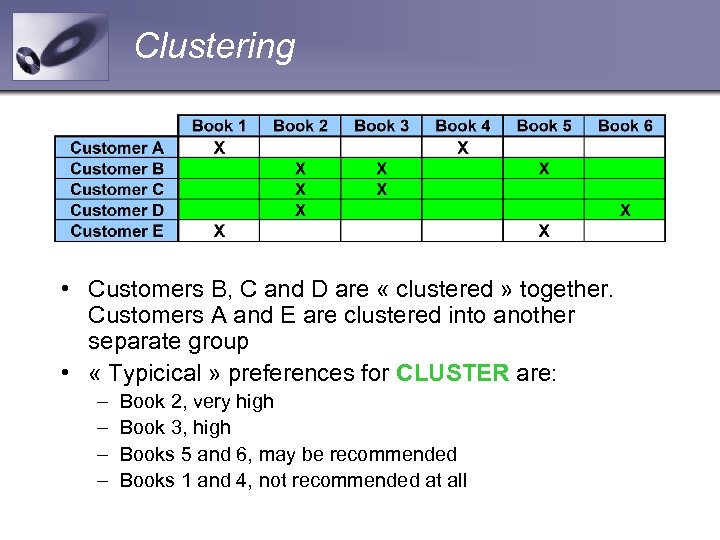
Clustering • Customers B, C and D are « clustered » together. Customers A and E are clustered into another separate group • « Typicical » preferences for CLUSTER are: – – Book 2, very high Book 3, high Books 5 and 6, may be recommended Books 1 and 4, not recommended at all
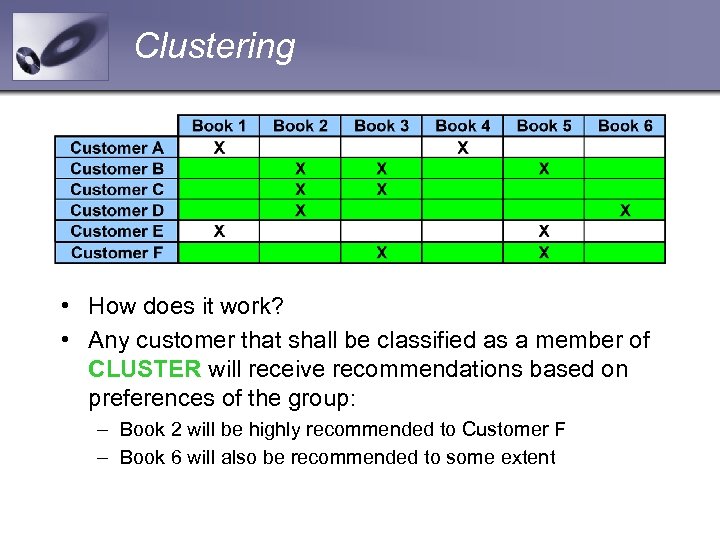
Clustering • How does it work? • Any customer that shall be classified as a member of CLUSTER will receive recommendations based on preferences of the group: – Book 2 will be highly recommended to Customer F – Book 6 will also be recommended to some extent
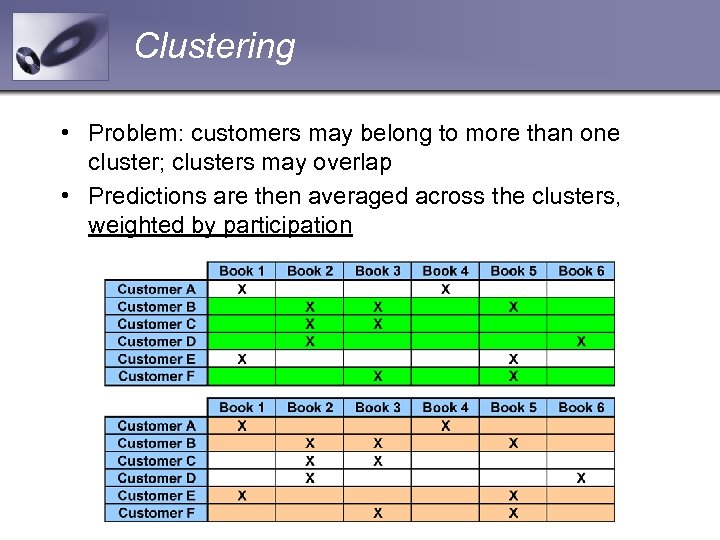
Clustering • Problem: customers may belong to more than one cluster; clusters may overlap • Predictions are then averaged across the clusters, weighted by participation
Clustering • Pros: – Clustering techniques work on aggregated data: faster – It can also be applied as a « first step » for shrinking the selection of relevant neighbors in a collaborative filtering algorithm • Cons: – Recommendations (per cluster) are less relevant than collaborative filtering (per individual)
Association rules • Clustering works at a group (cluster) level • Collaborative filtering works at the customer level • Association rules work at the item level
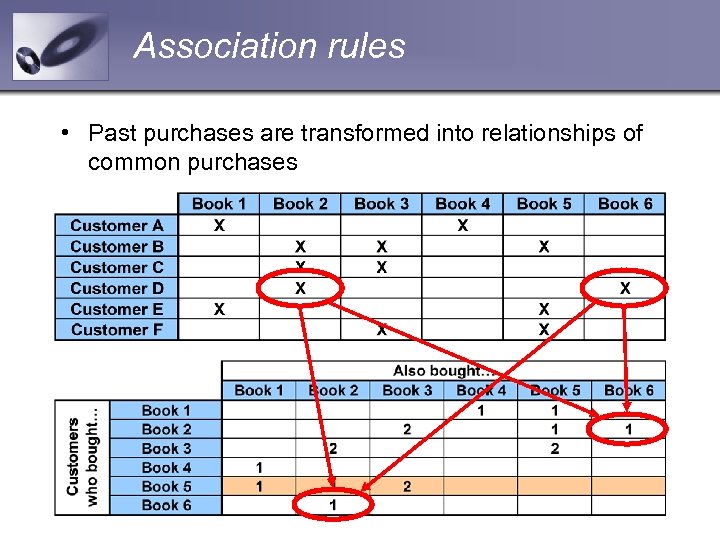
Association rules • Past purchases are transformed into relationships of common purchases
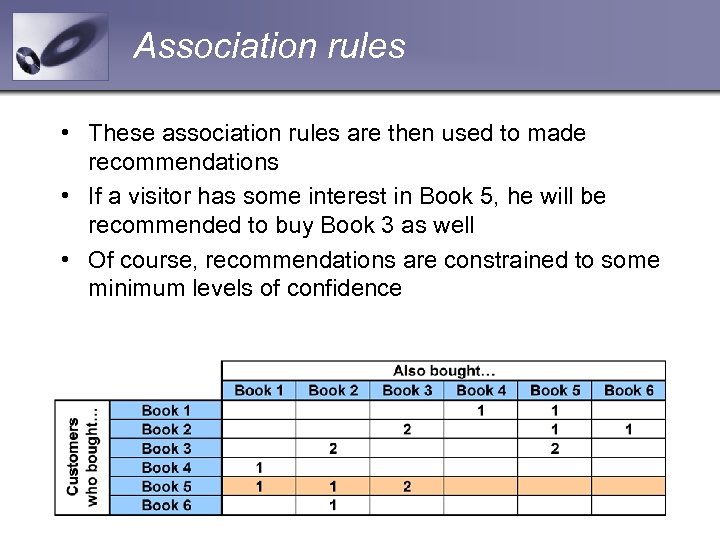
Association rules • These association rules are then used to made recommendations • If a visitor has some interest in Book 5, he will be recommended to buy Book 3 as well • Of course, recommendations are constrained to some minimum levels of confidence
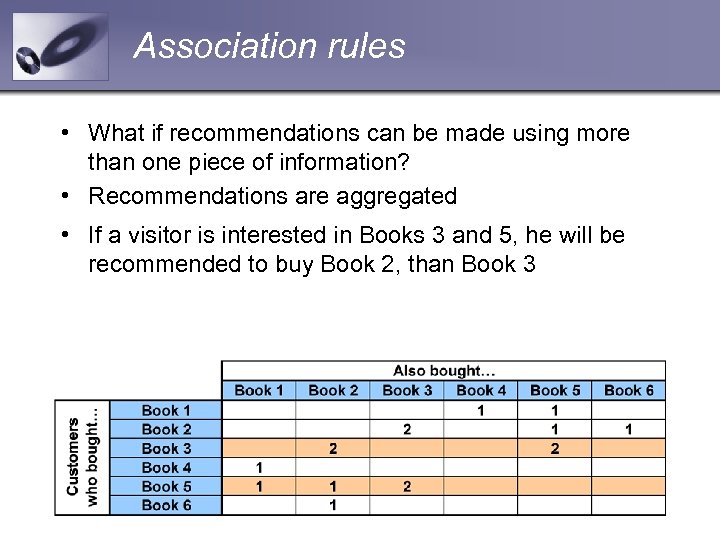
Association rules • What if recommendations can be made using more than one piece of information? • Recommendations are aggregated • If a visitor is interested in Books 3 and 5, he will be recommended to buy Book 2, than Book 3
Association rules • Pros: – – – Fast to implement Fast to execute Not much storage space required Not « individual » specific Very successful in broad applications for large populations, such as shelf layout in retail stores • Cons: – Not suitable if knowledge of preferences change rapidly – It is tempting to do not apply restrictive confidence rules May lead to litteraly stupid recommendations
Information filtering • Association rules compare items based on past purchases • Information filtering compare items based on their content • Also called « content-based filtering » or « contentbased recommendations »
Information filtering • What is the « content » of an item? • It can be explicit « attributes » or « characteristics » of the item. For example for a film: – Action / adventure – Feature Bruce Willis – Year 1995 • It can also be « textual content » (title, description, table of content, etc. ) – Several techniques exist to compute the distance between two textual documents
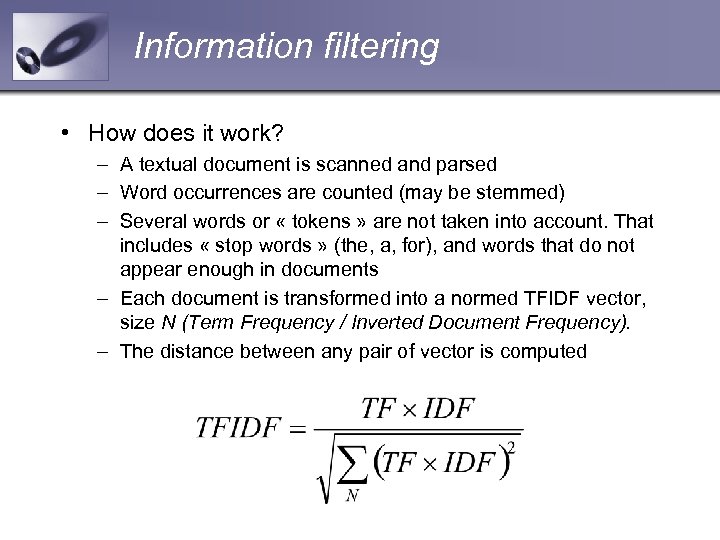
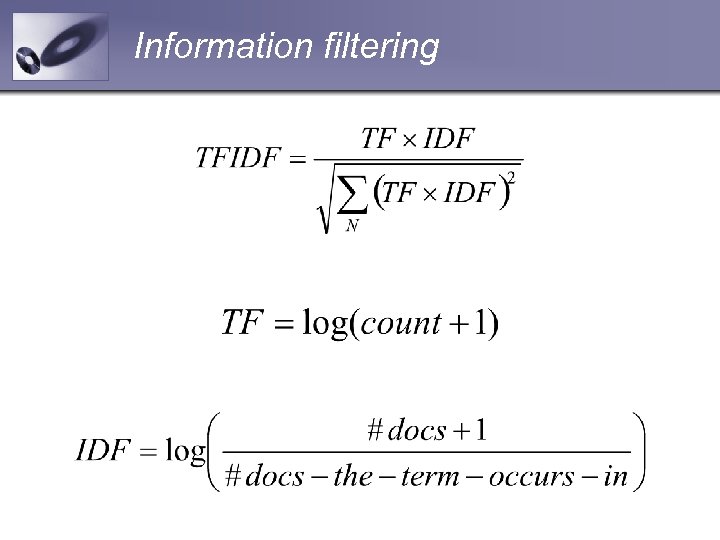
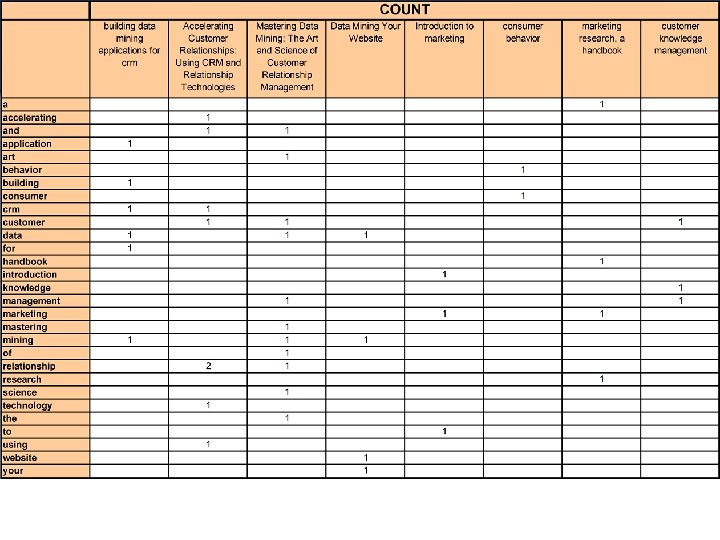
Information filtering • How does it work? – A textual document is scanned and parsed – Word occurrences are counted (may be stemmed) – Several words or « tokens » are not taken into account. That includes « stop words » (the, a, for), and words that do not appear enough in documents – Each document is transformed into a normed TFIDF vector, size N (Term Frequency / Inverted Document Frequency). – The distance between any pair of vector is computed
Information filtering
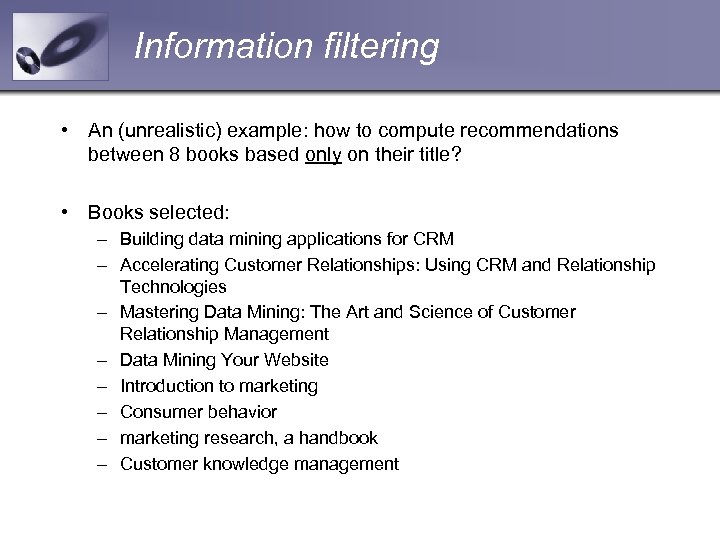
Information filtering • An (unrealistic) example: how to compute recommendations between 8 books based only on their title? • Books selected: – Building data mining applications for CRM – Accelerating Customer Relationships: Using CRM and Relationship Technologies – Mastering Data Mining: The Art and Science of Customer Relationship Management – Data Mining Your Website – Introduction to marketing – Consumer behavior – marketing research, a handbook – Customer knowledge management
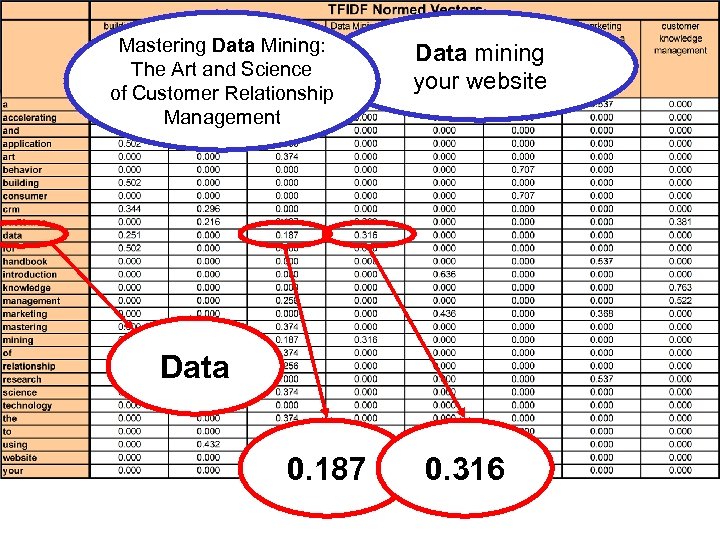
Mastering Data Mining: The Art and Science of Customer Relationship Management Data mining your website Data 0. 187 0. 316
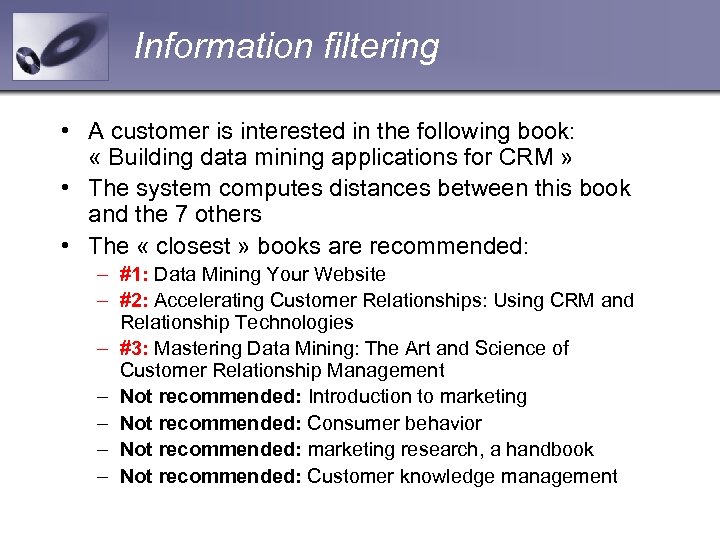
Information filtering • A customer is interested in the following book: « Building data mining applications for CRM » • The system computes distances between this book and the 7 others • The « closest » books are recommended: – #1: Data Mining Your Website – #2: Accelerating Customer Relationships: Using CRM and Relationship Technologies – #3: Mastering Data Mining: The Art and Science of Customer Relationship Management – Not recommended: Introduction to marketing – Not recommended: Consumer behavior – Not recommended: marketing research, a handbook – Not recommended: Customer knowledge management
Information filtering • Pros: – No need for past purchase history – Not extremely difficult to implement • Cons: – « Static » recommendations – Not efficient is content is not very informative e. g. information filtering is more suited to recommend technical books than novels or movies
Classifiers • Classifiers are general computational models • They may take in inputs: – Vector of item features (action / adventure, Bruce Willis) – Preferences of customers (like action / adventure) – Relations among items • They may give as outputs: – Classification – Rank – Preference estimate • That can be a neural network, Bayesian network, rule induction model, etc. • The classifier is trained using a training set
Classifiers • Pros: – Versatile – Can be combined with other methods to improve accuracy of recommendations • Cons: – Need a relevant training set
Part II Taxonomy of recommendation systems
Taxonomy • How can we classify recommender systems? – – – Targeted customer inputs Community inputs Recommendation method Outputs Delivery Degree of personnalization
Targeted customer inputs • Implicit navigation – Implicit navigation gives information to the recommender system to make recommendations (e. g. « the page you’ve just made » ) • Explicit navigation – Customer need to explicitely visit recommendations page • Keyword / item attributes – Queries, « …have also bought » , « other action films » , etc. • Attribute ratings – Explicit inputs • Purchase history
Community inputs • Item attributes – Film genre, book categories • External item popularity – Top 50, bestsellers, etc. • Community purchase history • Ratings – Costumers average ratings • Text comments – Customer comments
Recommendation method • Raw retrieval – Queries • Manually selected – E. g. category-based browsing • Statistical summaries – Within-community popularity measures, aggregate or summary ratings • Attribute-based recommendations • Item-to-item correlation – Matching items or set of items, co-purchase data, preference by common customers • User-to-user correlation – Collaborative filtering, clustering
Outputs • • Suggestion Prediction Ratings Reviews
Delivery • Push – Pro-active • Pull – Allow customers to control when recommendations are displayed • Passive – Such as displaying recommendations for products related to the current product
Degree of personalization • Non-personalized – General recommendations • Ephemeral – Using current / recent behaviors only • Persistent – Using stored, past purchase behaviors

That’s all folks! Thank you!
Скачать презентацию Recommender systems Arnaud De Bruyn Doctoral student in
77739bda21ef263b5afec702efb2479a.ppt