


 Скачать презентацию Recognizing and Intervening for the Impaired Physician Stephanie
1ab14002a088028a7c77985b72053dc1.ppt
- Количество слайдов: 33
 Recognizing and Intervening for the Impaired Physician Stephanie Andrews, LSCSW, LCSW Debby Brookstein, LCSW, LSCSW Michele Kilo, MD Section of Developmental & Behavioral Sciences
 The Impaired Fellow I. III. What does it mean to be “impaired” How does impairment present in fellowship or the workplace What to do if you are concerned, about yourself or a friend/co-fellow
 Definition of Impaired Physician l The American Medical Association Council on Mental Health published a report defining physician impairment as “the inability to practice medicine with reasonable skill and safety to patients by reason of physical or mental illness, including alcoholism and drug dependence. ”
 Potential Forms of Impairment l l Classic – Substance Use & Abuse Mental Illness – Axis I & Axis II Disruptive Behavior Medical Illness
 Risk Factors unique to physicians l l l Physical and professional demands of residency and/or medical practice – long work hours, fatigue, social isolation, making life and death decisions, delivering bad news to families Inherent personality traits of those who enter medicine – obsessive and workaholic tendencies Ready access to prescription drugs, self-medication, the belief of personal invulnerability to addiction or mental illness
 Risk Factors unique to physicians, cont’d. l l “Conspiracy of Silence” and loyalty of friends, family, co-workers who enable problem behaviors to go unchecked, fear of loss of career Unrealistic expectations of physicians (by both ourselves and others) and a belief in their ability to deal with anything that comes along and remain untouched – “God complex”
 Classic Form of Impairment l Substance Use and Abuse: – – The prevalence of substance use disorders in healthcare professionals is equal to that in the general population (8 -14%). However, successful and sustained recovery greater in physicians, 80 – 90% whereas 50% in general population. Believed to be due to the substantial “investment” in career.
 Classic Form of Impairment l Substance Use and Abuse by Medical Specialty – highest use: – – – Anesthesiology- due to access to drugs with high potential for abuse and addiction Emergency Medicine – higher prevalence in most studies – higher prevalence of marijuana and cocaine use Psychiatry – higher prevalence in most studies – benzodiazepine use.
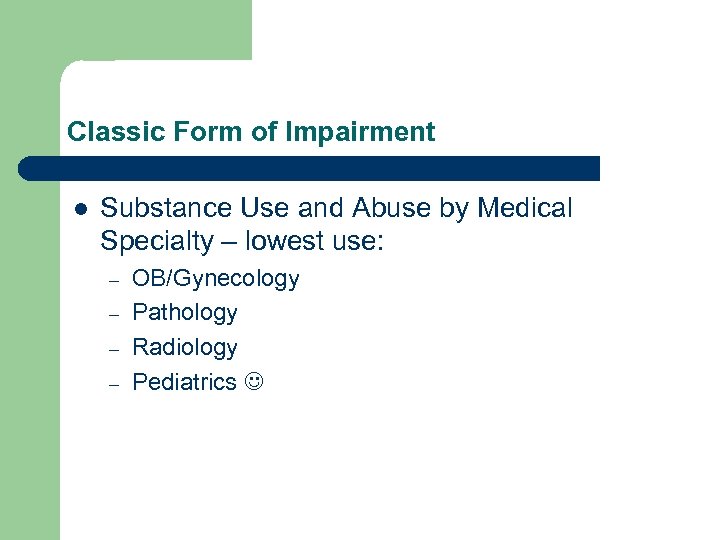 Classic Form of Impairment l Substance Use and Abuse by Medical Specialty – lowest use: – – OB/Gynecology Pathology Radiology Pediatrics
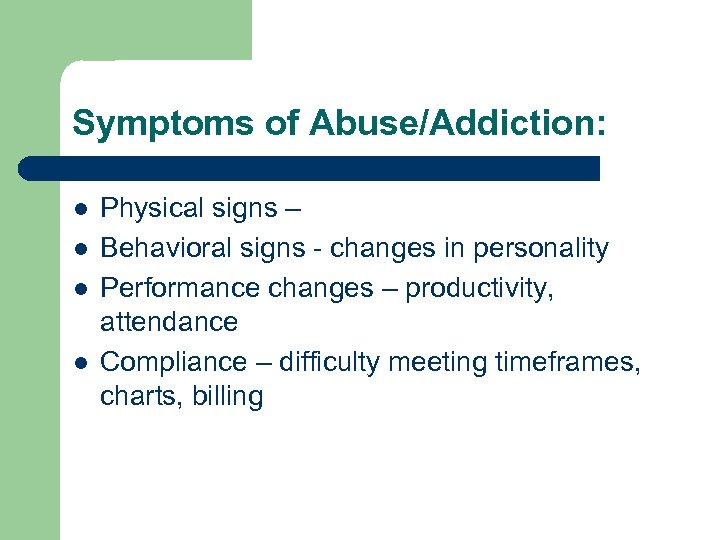 Symptoms of Abuse/Addiction: l l Physical signs – Behavioral signs - changes in personality Performance changes – productivity, attendance Compliance – difficulty meeting timeframes, charts, billing
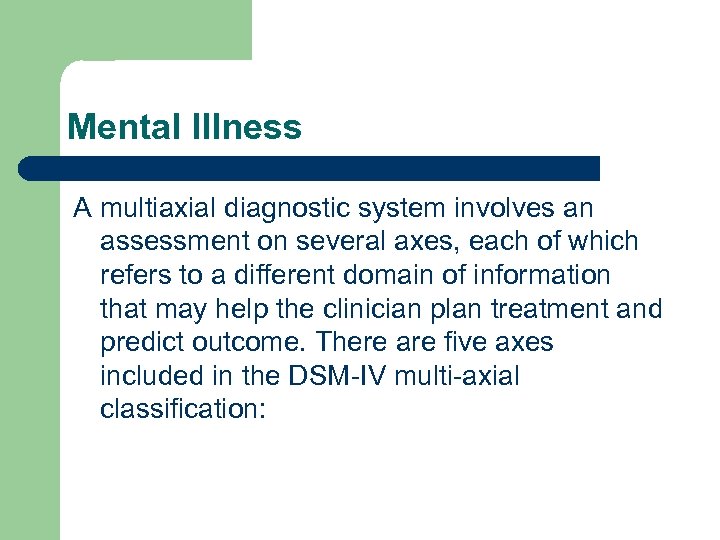 Mental Illness A multiaxial diagnostic system involves an assessment on several axes, each of which refers to a different domain of information that may help the clinician plan treatment and predict outcome. There are five axes included in the DSM-IV multi-axial classification:
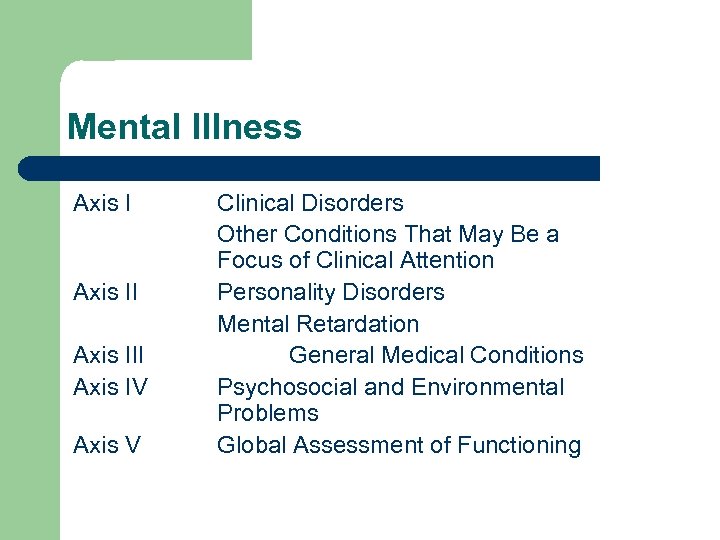 Mental Illness Axis III Axis IV Axis V Clinical Disorders Other Conditions That May Be a Focus of Clinical Attention Personality Disorders Mental Retardation General Medical Conditions Psychosocial and Environmental Problems Global Assessment of Functioning
 Mental Illness l l Axis I disorder symptoms are commonly seen in residency and fellowship and include anxiety, depression and obsessive compulsive disorder. Axis I disorders typically respond to outpatient or inpatient treatments, including psychotherapy, medication or treatment programs.
 Mental Illness l l Axis II disorders include personality disorders (narcissistic, histrionic, borderline, paranoid, schizoid antisocial). Axis II disorders are VERY difficult to treat and are EXTREMELY disruptive to the individuals around the person with this type of disorder.
 Mental Illness l l Personality disorders develop over a period of many years and are characterized by persistent difficulty in interpersonal relationships. Individuals with this type of disorder view the problems they encounter as SOMEONE ELSE’S fault.
 Symptoms of Anxiety: l l l Excessive anxiety and worry Difficulty controlling worry Restlessness, feeling keyed up or on edge Fatigued easily Difficulty concentrating or mind going blank Irritability
 Symptoms of Anxiety (continued): l l l Sleep disturbance - falling or staying asleep or restless unsatisfying sleep Symptoms not due to medical condition – racing heart, chest pain Symptoms cause clinically significant distress or impairment in social functioning - isolation
 Symptoms of Depression: l l l Depressed mood Marked diminished interest or pleasure in previously enjoyed activities Significant weight loss when not dieting or weight gain (5% variance) Insomnia or hypersomnia Psychomotor agitation or retardation
 Symptoms of Depression (cont’d): l l l Fatigue, loss of energy Feelings of worthlessness Excessive or inappropriate guilt Diminished ability to think or concentrate, indecisiveness Thoughts of suicide Causes clinically significant distress or impairment
 Symptoms of OCD: l l l Intrusive or inappropriate persistent thoughts Repetitive behaviors, physical (handwashing) versus mental (thought loop) Symptoms are time-consuming (> than 1 hour per day), cause marked distress and anxiety, and significantly interfere with person’s normal routine
 Disruptive Behavior l l May often be associated with a combination of above -mentioned forms of impairment. Overt or subtle intimidating behavior including: – – Verbal, physical, emotional, undermining, degrading, demeaning, negative Can include boundary violations such as sexual and professional boundaries Other staff refusing to work with this person Can be extremely subtle
 Medical Illness l l l Importance of attending to observed impairment in a timely manner If impairment is a newly observed behavior, may be medically induced…. diabetes…a reaction to medication, sleep disturbance Greater chance, for all impaired behavior, for a successful recovery the sooner intervention takes place.
 Response to Impairment l By Impaired Medical Staff: – – – Fear of consequences Loss of identity as physician/potential loss of career Feelings of “I can take care of myself” Strong tendency to self-diagnose and treat Disease understanding does not equal disease acceptance Shame & embarrassment
 Response to Impairment l By Staff: – – – Fear of intimidation by impaired medical staff member Fear of loss of job if known as whistle blower Peer pressure to keep “Conspiracy of Silence” After reporting concerns, lack of follow through, feelings of vulnerability Concern about being wrong
 Process of Reporting Impairment l l Ethical obligation to report a physician who may be endangering the lives of others through impairment – result of the 1972 AMA House of Delegates State Impaired Physicians Programs, also known as Physicians Health Programs, are present in all 50 states, as a result of The Disables Doctors Act of 1974.
 Process of Reporting Impairment l l The Missouri State Medical Association established the Missouri Physician Health Program (MPHP) in 1985. The MPHP is legally and financially independent of licensure and regulatory agencies, such as the Board of Healing Arts, BNDD and DEA. It has no reporting requirements to the National Practitioner Data Bank.
 Process of Reporting Impairment l l MPHP maintains a confidential hotline Physicians who volunteer to participate in the program have the opportunity to arrest the progression of their disease and check their impairment before public exposure, disciplinary action of licensing boards or loss of family relationships, financial resources and clinical privileges occurs.
 Process of Reporting Impairment l As of January 2001, the Joint Commission on Accreditation of Healthcare Organizations has required that all JCAHO accredited hospitals establish a “process to identify and manage matters of individual physician health that is separate from the medical staff disciplinary function. ”
 CMH Process of Reporting l Potential Route of Reporting: – – l Person themselves, to express your concerns Section Chief Department Chair Any chosen confidant in a position of authority Anyone and everyone can make an anonymous and confidential referral *Please remember this is a fully confidential process and program
 Your responsibility: l l Monitor yourself Monitor your friends Monitor your colleagues Monitor your staff
 Our responsibility: l Provide whatever assistance, support and guidance needed to help you through a difficult time in your life. l Children’s Mercy Hospital values you!
 Our shared responsibility: l DO SOMETHING ABOUT IT l IT COULD SAVE A CAREER l IT COULD SAVE A LIFE. . . MAYBE EVEN YOURS OR SOMEONE YOU CARE FOR
 Conclusion: l l l Physicians helping Physicians Not meant to be a punitive process Goal is for early identification and intervention for greatest opportunity for recovery and return to practice.