


 Скачать презентацию Recognition of Prior Learning — issues in quality
43777ebca1836873efa8e246230fef51.ppt
- Количество слайдов: 12
 Recognition of Prior Learning - issues in quality assurance - experiences of the Hv. A University of Applied Sciences Amsterdam Lucie te Lintelo RPL Centre Hogeschool van Amsterdam
 Content 1. Introduction: Hv. A and RPL, a quick overview 2. A perspective on quality: stakeholders, concepts and tools 3. Organization of RPL 4. Accreditation as a RPL provider
 1. Introduction Hv. A and RPL • Introduction Hv. A and RPL Hogeschool van Amsterdam [Hv. A]: • University of Applied Sciences • Bachelor degree and master degree programmes in a professional field Business Administration – Engineering - Built Environment - Social Work – Education – Communication – Law – Health – ICT • All degree courses are competence based • A regular bachelor degree course: 240 credits = a 4 -year programme • More than 34. 000 students (6. 000 are working adults studying for a degree on a parttime base)
 RPL in the Hv. A, a quick overview w Goal: enhancing accessibility of degree programmes for professional workers: » Individuals » Private and public companies: co-operation with organizations in upgrading their employees w RPL as a start of an individualized degree programme. RPL can lead to: » Exemption of part(s) of the programme » A workbased learning route (demand steered) w Standards used in RPL are educational standards » all qualifications of a bachelor degree programme, in learning outcomes
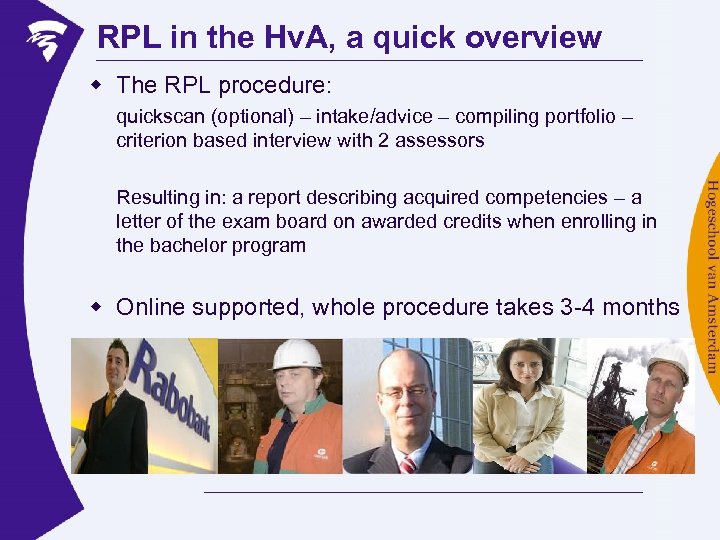 RPL in the Hv. A, a quick overview w The RPL procedure: quickscan (optional) – intake/advice – compiling portfolio – criterion based interview with 2 assessors Resulting in: a report describing acquired competencies – a letter of the exam board on awarded credits when enrolling in the bachelor program w Online supported, whole procedure takes 3 -4 months
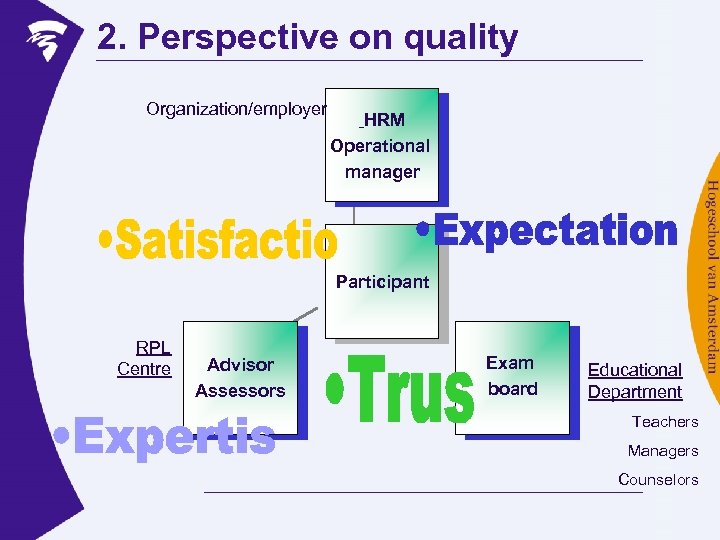 2. Perspective on quality Organization/employer HRM Operational manager Participant RPL Centre Advisor Assessors Exam board Educational Department Teachers Managers Counselors
 Focus on trust and expertise w Quality of the standard used in RPL » All competencies of a bachelor degree programme formulated in learning outcomes: professional tasks / activities / criteria » Recognisable for employees » Transparant and measurable w Quality of the advisors and assessors, see next sheet w Quality of the methods and instruments w Communication and agreement with exam board and educational department
![Quality of the assessors 1. Selection of assessors [competence profile]: internal / external 2.](https://present5.com/presentation/43777ebca1836873efa8e246230fef51/image-8.jpg "Quality of the assessors 1. Selection of assessors [competence profile]: internal / external 2.") Quality of the assessors 1. Selection of assessors [competence profile]: internal / external 2. Training programme: 1. Work conference: RPL-proces and instruments, levels, competence criteria 2. Training assessor skills: questioning- and assessing techniques; practice with authentic portfolio and actor; critical situations 3. Feedback on performance in real assessment situation [by independant assessment professional] 4. Test of assessor competence in real assessment situation - 5. To showing all assessor criteria: assessor certificate preserve the certificate - evaluation, feedback, intervision, workshops
Quality of the assessors 1. Selection of assessors [competence profile]: internal / external 2. Training programme: 1. Work conference: RPL-proces and instruments, levels, competence criteria 2. Training assessor skills: questioning- and assessing techniques; practice with authentic portfolio and actor; critical situations 3. Feedback on performance in real assessment situation [by independant assessment professional] 4. Test of assessor competence in real assessment situation - 5. To showing all assessor criteria: assessor certificate preserve the certificate - evaluation, feedback, intervision, workshops
 Focus on satisfaction and expectations w Matching the needs of the participant, and his organization, with our possibilities » Do we know what the participant wants? » Do we know what the organization wants? » Are we the right RPL provider for them? What standard(s) is/are suitable? Does the regular procedure fit or do we have to develop a tailor made procedure and/or instruments? » Who do we need to involve in this, within the Hv. A and within the company? w Openess about procedure and possible outcomes w It is about long term investments – developing partnerships – flexibility - communication
 3. Organization of RPL A central RPL Unit: w Portal for organizations/candidates w Developing RPL tools and procedures i. c. w. educational departments and organizations w Planning and organization of RPL assessments w Quality assurance and training and accreditation of assessors w Development of expertise and support LLL policy Educational departments are responsible for the tailormade flexible degree programmes Close co-operation between ed. departments and RPL Centre: every department has its RPL-co-ordinator
 4. Accreditation as a RPL provider w National policy: in 2009 all RPL providers must be accredited w National RPL Code w Process of accreditation: 1. Extensive selfevaluation on the RPL Code 2. Visit and review by one of the designated organizations for validation, resulting in a report 3. Accreditation by the Dutch Knowlegde Centre of RPL (valid for 3 years), registration as a RPL provider
 National Quality Code for RPL 1. Goal RPL is to define, evaluate and accredit individual competencies. 2. RPL answers the need of the individual. Entitlements and arrangements are clearly defined and guaranteed. 3. Procedures and instruments are reliable and based on solid standards. 4. Assessors and supervisors are competent, impartial and independent. 5. Quality of RPL is guaranteed and is being improved on an ongoing basis.