 Скачать презентацию Recognition of Credits — Achievements and Problems
74803c42c0816ec268c55476b4cf19ef.ppt
- Количество слайдов: 35



Recognition of Credits - Achievements and Problems / Challenges A Stocktaking Exercise Bologna Conference Riga Dec. 3 -5 / 2004 gehmlich@wi. fhosnabrueck. de 1
Achievements How can achievements be measured? One proposal n Critical Success Factors Suitability – fit for purpose Acceptability – fit for stakeholders Feasibility – fit to live Sustainability – fit for life gehmlich@wi. fh-osnabrueck. de 2
CSF 1 Suitability – fit for purpose? gehmlich@wi. fhosnabrueck. de 3
Suitability – fit for purpose 11 Credits document the achievement of learning objectives - expressed as learning outcomes – by the learner 12 Allocated credits to a learning module highlight the expected notional workload necessary to be invested by the learner l Common denominators ¡ l Workload and Outcome Achieved? gehmlich@wi. fh-osnabrueck. de 4
Suitability – fit for purpose l The development of ECTS from a transfer to a transfer and accumulation system and the linkage of learning outcomes with credits have made it possible l 11/12 ECTS = fit for purpose gehmlich@wi. fh-osnabrueck. de 5
Suitability – fit for purpose l 13 A credit system has to support the Bologna objective of Employability l Achieved? gehmlich@wi. fh-osnabrueck. de 6
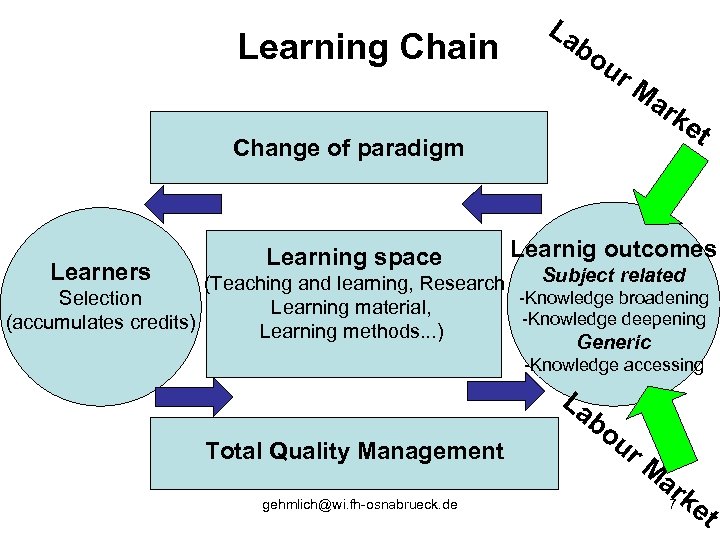
Learning Chain La bo ur Ma rk e t Change of paradigm Learners Learning space Learnig outcomes Subject related (Teaching and learning, Research -Knowledge broadening Selection Learning material, -Knowledge deepening (accumulates credits) Learning methods. . . ) Generic -Knowledge accessing La Total Quality Management gehmlich@wi. fh-osnabrueck. de bo ur M ar 7 ke t
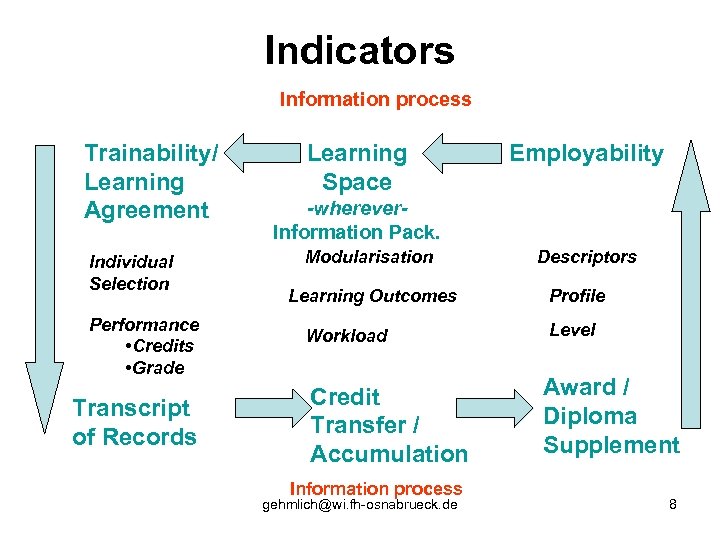
Indicators Information process Trainability/ Learning Agreement Individual Selection Performance • Credits • Grade Transcript of Records Learning Space Employability -wherever. Information Pack. Modularisation Learning Outcomes Workload Credit Transfer / Accumulation Information process gehmlich@wi. fh-osnabrueck. de Descriptors Profile Level Award / Diploma Supplement 8
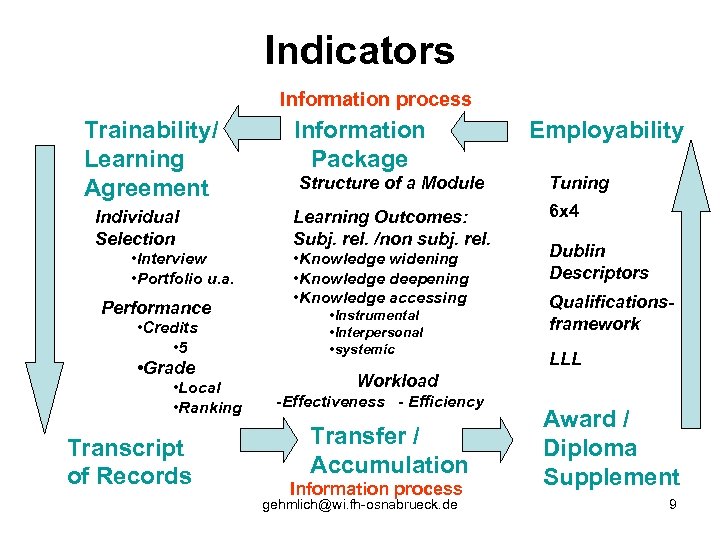
Indicators Information process Trainability/ Learning Agreement Individual Selection • Interview • Portfolio u. a. Performance • Credits • 5 • Grade • Local • Ranking Transcript of Records Information Package Structure of a Module Learning Outcomes: Subj. rel. /non subj. rel. • Knowledge widening • Knowledge deepening • Knowledge accessing • Instrumental • Interpersonal • systemic Employability Tuning 6 x 4 Dublin Descriptors Qualificationsframework LLL Workload -Effectiveness - Efficiency Transfer / Accumulation Information process gehmlich@wi. fh-osnabrueck. de Award / Diploma Supplement 9
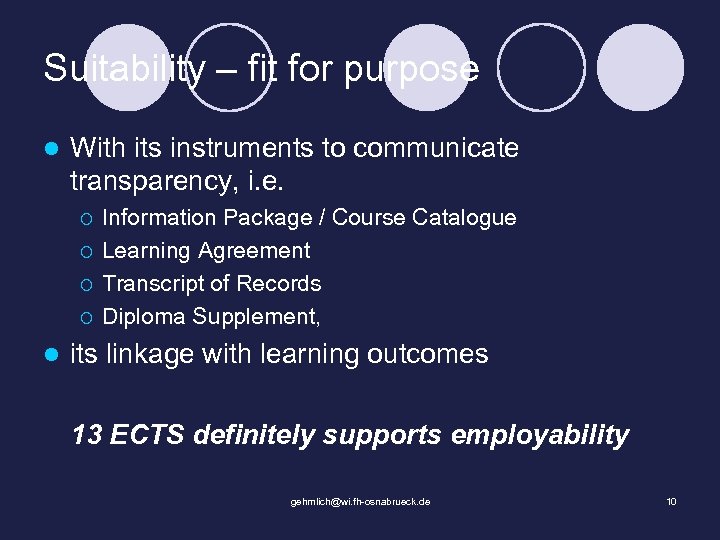
Suitability – fit for purpose l With its instruments to communicate transparency, i. e. ¡ ¡ l Information Package / Course Catalogue Learning Agreement Transcript of Records Diploma Supplement, its linkage with learning outcomes 13 ECTS definitely supports employability gehmlich@wi. fh-osnabrueck. de 10
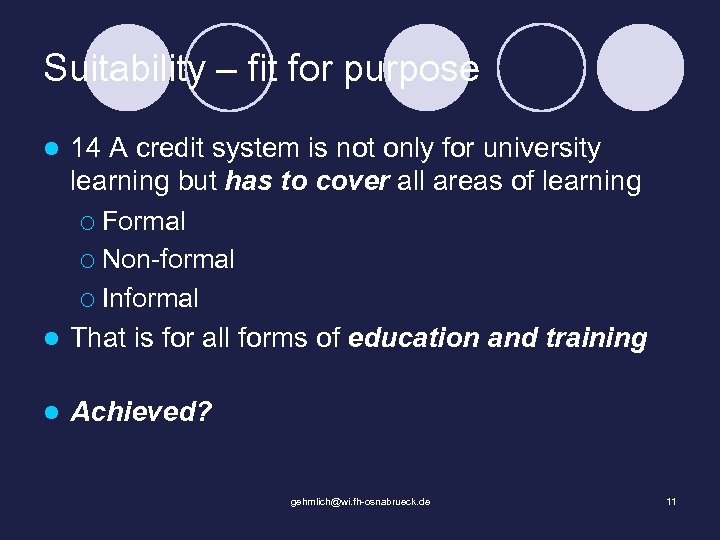
Suitability – fit for purpose 14 A credit system is not only for university learning but has to cover all areas of learning ¡ Formal ¡ Non-formal ¡ Informal l That is for all forms of education and training l l Achieved? gehmlich@wi. fh-osnabrueck. de 11
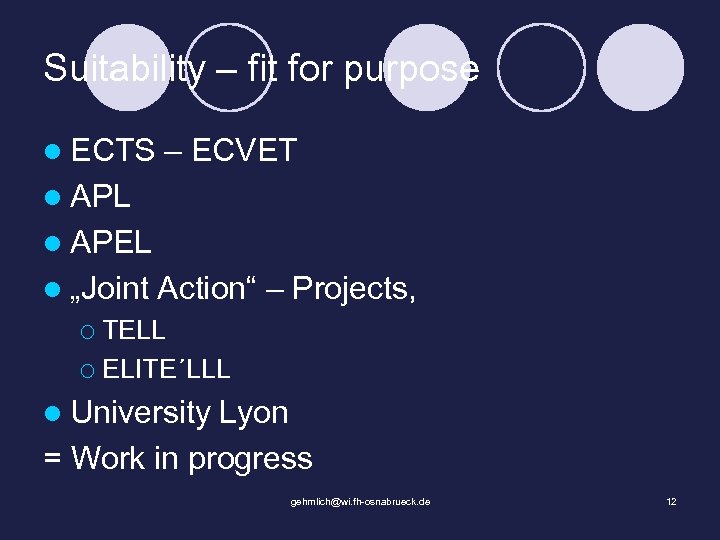
Suitability – fit for purpose l ECTS – ECVET l APL l APEL l „Joint Action“ – Projects, ¡ TELL ¡ ELITE´LLL l University Lyon = Work in progress gehmlich@wi. fh-osnabrueck. de 12
Suitability – fit for purpose l. One credit system for all forms of learning: l 14 A challenge for ECTS gehmlich@wi. fh-osnabrueck. de 13
CSF 2 Acceptability – fit for stakeholders? gehmlich@wi. fhosnabrueck. de 14
Acceptability – fit for stakeholders Whom does ECTS serve? • A credit system has to respect the perspectives of – „customers“ • Learners • Teaching and training staff • Employers – And also stakeholders in a wider sense, such as • Parents • Governments (education, training, finance…ministries – issue of governance: Whom should ECTS serve / How should purposes be determined) • Social partners • Society gehmlich@wi. fh-osnabrueck. de 15
Acceptability – fit for stakeholders Whom does ECTS serve? • Criteria are the expected performance outcome and may be expressed as „return“, „risk“, „stakeholder reaction“ • Achieved? gehmlich@wi. fh-osnabrueck. de 16
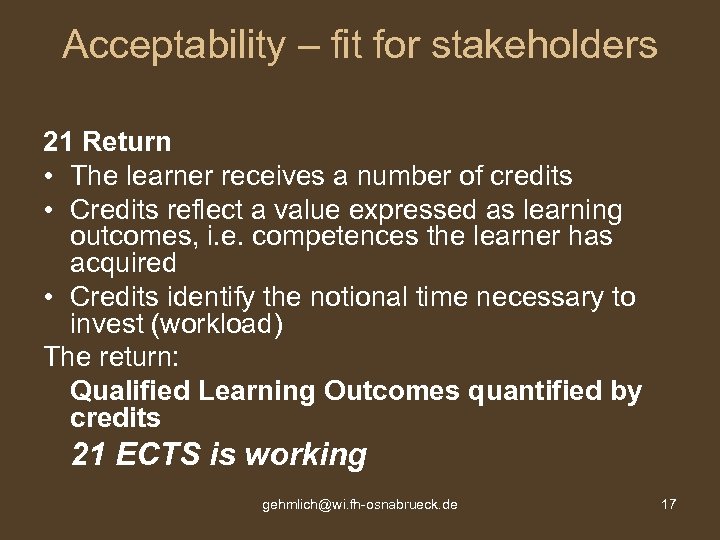
Acceptability – fit for stakeholders 21 Return • The learner receives a number of credits • Credits reflect a value expressed as learning outcomes, i. e. competences the learner has acquired • Credits identify the notional time necessary to invest (workload) The return: Qualified Learning Outcomes quantified by credits 21 ECTS is working gehmlich@wi. fh-osnabrueck. de 17
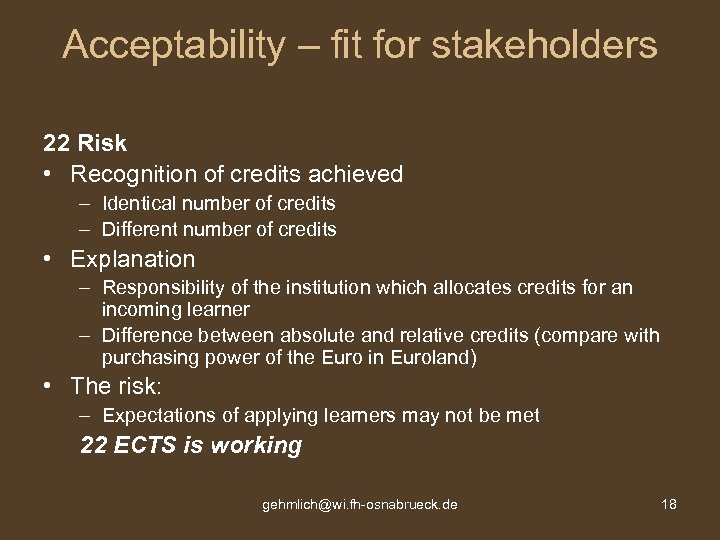
Acceptability – fit for stakeholders 22 Risk • Recognition of credits achieved – Identical number of credits – Different number of credits • Explanation – Responsibility of the institution which allocates credits for an incoming learner – Difference between absolute and relative credits (compare with purchasing power of the Euro in Euroland) • The risk: – Expectations of applying learners may not be met 22 ECTS is working gehmlich@wi. fh-osnabrueck. de 18
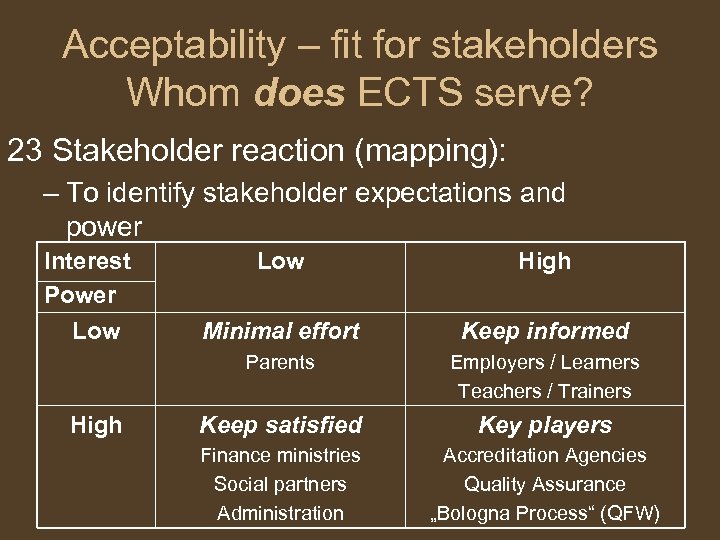
Acceptability – fit for stakeholders Whom does ECTS serve? 23 Stakeholder reaction (mapping): – To identify stakeholder expectations and power Interest Power Low High Minimal effort Keep informed Parents High Low Employers / Learners Teachers / Trainers Keep satisfied Key players Finance ministries Social partners Administration Accreditation Agencies Quality Assurance „Bologna Process“ (QFW)
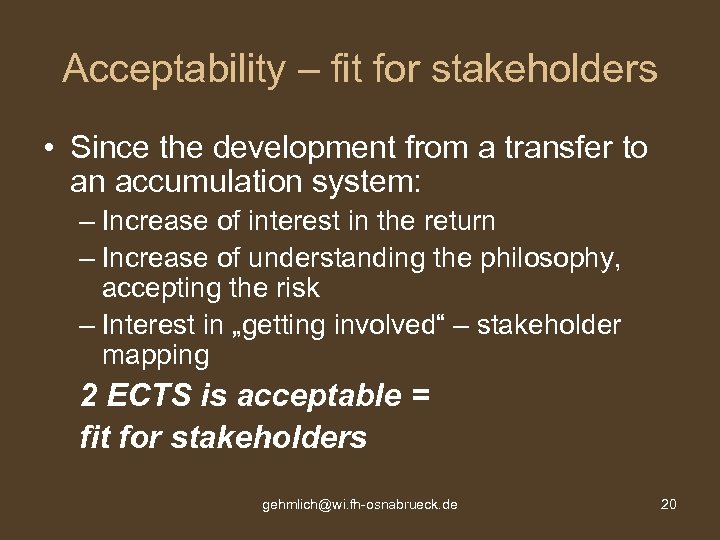
Acceptability – fit for stakeholders • Since the development from a transfer to an accumulation system: – Increase of interest in the return – Increase of understanding the philosophy, accepting the risk – Interest in „getting involved“ – stakeholder mapping 2 ECTS is acceptable = fit for stakeholders gehmlich@wi. fh-osnabrueck. de 20
CSF 3 Feasibility - fit to live gehmlich@wi. fhosnabrueck. de 21
Feasibility – fit to live Is the only credit system which has been tested European-wide l Feasibility Study revealed the possibility to develop the ECTS Transfer System, tested since 1989, into an accumulation system l CSF 3 Feasibiltiy – fit to live = Achieved l Guarantors : l ¡ ¡ European Quality Assurance System (Evaluation / Accreditation) European Qualification Framework based on learning outcomes and credits gehmlich@wi. fh-osnabrueck. de 22
CSF 4 Sustainability – fit for life gehmlich@wi. fhosnabrueck. de 23
Sustainability – fit for life Bologna-Euro (currency) for education and training l Essential basic elements l ¡ ¡ ¡ ¡ Based on trust Generally accepted Works as unit of account Respects convertibility Enables recognition Represents value Is Convertible Is compatible (common reference) gehmlich@wi. fh-osnabrueck. de 24
Sustainability – fit for life l Challenges ¡ Merge ECTS and ECVET ¡ Design a European Qualification Framework in which the levels are described by learning outcomes l which can be achieved with an identified notional workload expressed in credits l ¡ Understand the concept of „purchasing power of credits“ gehmlich@wi. fh-osnabrueck. de 25
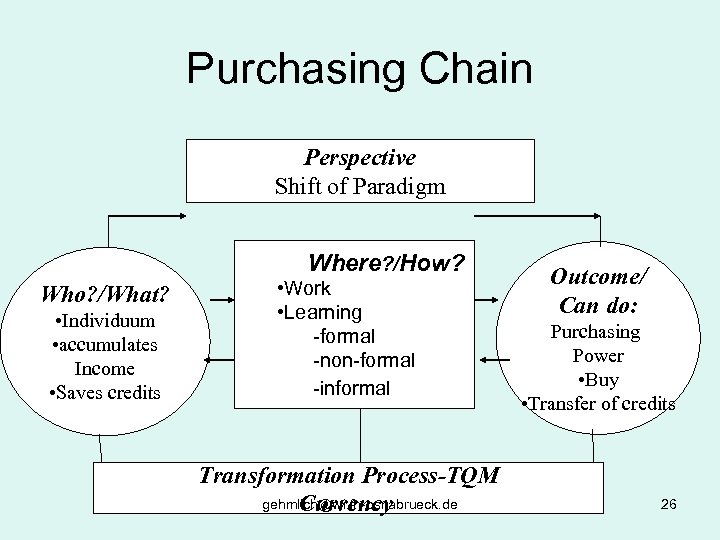
Purchasing Chain Perspective Shift of Paradigm Where? /How? Who? /What? • Individuum • accumulates Income • Saves credits • Work • Learning -formal -non-formal -informal Transformation Process-TQM gehmlich@wi. fh-osnabrueck. de Currency Outcome/ Can do: Purchasing Power • Buy • Transfer of credits 26
Sustainability – fit for life l The Credit Chameleon ¡ You achieved level B 2 of the Language Competence Framework ¡ Let´s assume for this achievement 900 hours were deemed to be the notional workload ¡ According to the Key Features this would be translated into 30 credits gehmlich@wi. fh-osnabrueck. de 27
Sustainability – fit for life l Do 30 credits count towards the 180 (let´s assume a 3 -year BA-programme)? ¡ ¡ ¡ l May they count less? May they count more? May they count exactly 30 at all? Lesson learned: ¡ ¡ Credits can have an absolute and a relative value They always become relative when they are being put into a programme Learning outcomes have to be identified precisely and concisely Credits have a „purchasing power“ gehmlich@wi. fh-osnabrueck. de 28
Sustainability – fit for life l Challenge ¡ Can all subject and generic skills be measured in absolute terms? Tuning l Experts l Groups of all stakeholders l ¡ Does this lead to standardised studyprogrammes in certain subject areas? Possible, but better not l Better: standardisation of learning outcomes in a given subject area - if the stakeholders think so l gehmlich@wi. fh-osnabrueck. de 29
Sustainability – fit for life l l What can you do with the credits received? Basically: Spend or Save ¡ Spending l To cover immediate needs • Swapping for a paper qualification (to be able to apply for a specific job e. g. ) ¡ Saving l To accumulate with • A specific intention to „barter“ the credits later for something „huge“, e. g. a degree • No specific intention yet • For the fun of it l Actions taken • Transfer to your „learning account“ gehmlich@wi. fh-osnabrueck. de 30
Sustainability – fit for life l. A ¡ currency/credit system therefore is the key requirement of life-longlearning concepts l Geared towards • • Learners Values Competences Employability gehmlich@wi. fh-osnabrueck. de 31
Conclusion • ECTS as a transfer and accumulation system is unintentionally basically designed as a currency system • All aspects related to a currency system are therefore valid for ECTS as well This relates e. g. to issues such as – „purchasing power“ of the outcomes – Conversion of achievements at institutional, national and international level – Fluctuations of values – Formal, non-formal and informal achievements gehmlich@wi. fh-osnabrueck. de 32
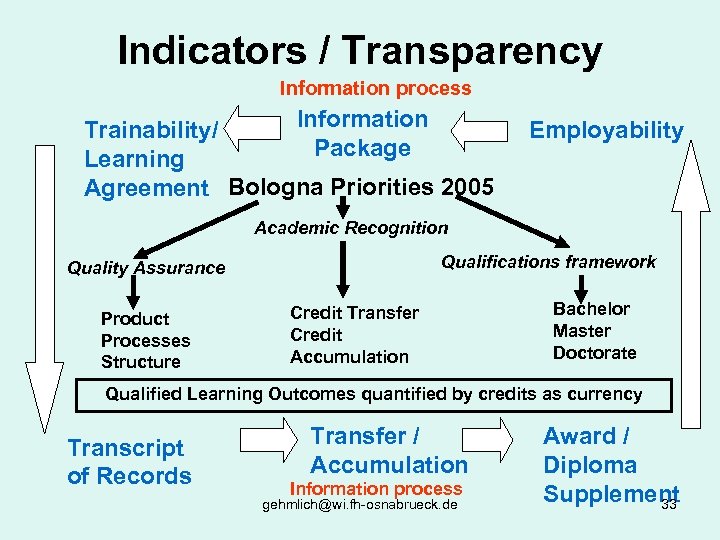
Indicators / Transparency Information process Information Trainability/ Package Learning Agreement Bologna Priorities 2005 Employability Academic Recognition Qualifications framework Quality Assurance Product Processes Structure Credit Transfer Credit Accumulation Bachelor Master Doctorate Qualified Learning Outcomes quantified by credits as currency Transcript of Records Transfer / Accumulation Information process gehmlich@wi. fh-osnabrueck. de Award / Diploma Supplement 33
Conclusion • As with any currency the basic element today is Trust • How to achieve this for ECTS? – Like in the monetary union: stability criteria – Which means for education and training: • Transparency • Quality (Structure / Process / Product) • Supported by „tuned educational structures“ (see Tuning Project, Joint Quality Initiative, etc. ) gehmlich@wi. fh-osnabrueck. de 34
Conclusion • The challenges for Bologna 2007 – Design one currency: EC(T)S or ECET (European credit in education and training) gehmlich@wi. fh-osnabrueck. de 35
Скачать презентацию Recognition of Credits — Achievements and Problems
74803c42c0816ec268c55476b4cf19ef.ppt