


 Скачать презентацию Recognition in Higher Education in South East Asia
dc616c19154fdc541b86ed9986047fc2.ppt
- Количество слайдов: 45
 Recognition in Higher Education in South. East Asia : Current Situation, Challenges, and Prospects Prof. Dr. Supachai Yavaprabhas December 6 -7 2010 Mediterranean Beach Hotel Limassol, Cyprus ASEM Conference : Quality Assurance and Recognition in Higher Education: Challenges and Prospects on Regional Cooperation and Cross Border Collaboration in Higher Education
 Outline 1. Facts about HE Landscape in ASEAN region? 2. Recognition in higher education : Current situation 3. Recognition in higher education : Challenges 4. Recognition in higher education : Prospects
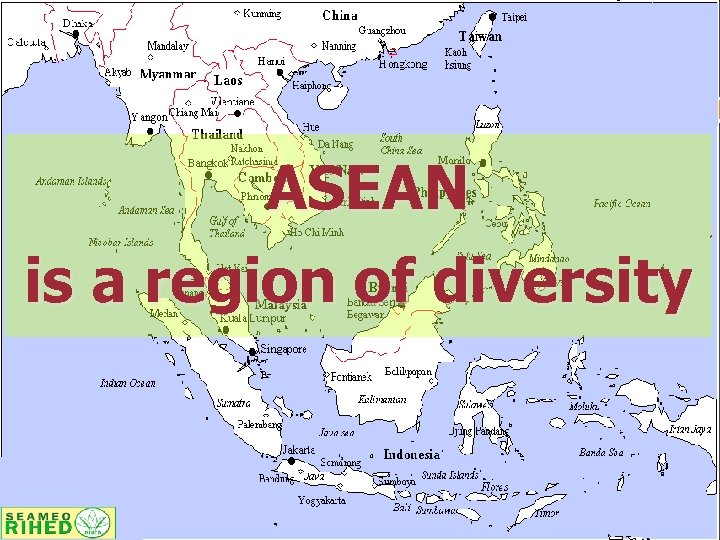 ASEAN is a region of diversity
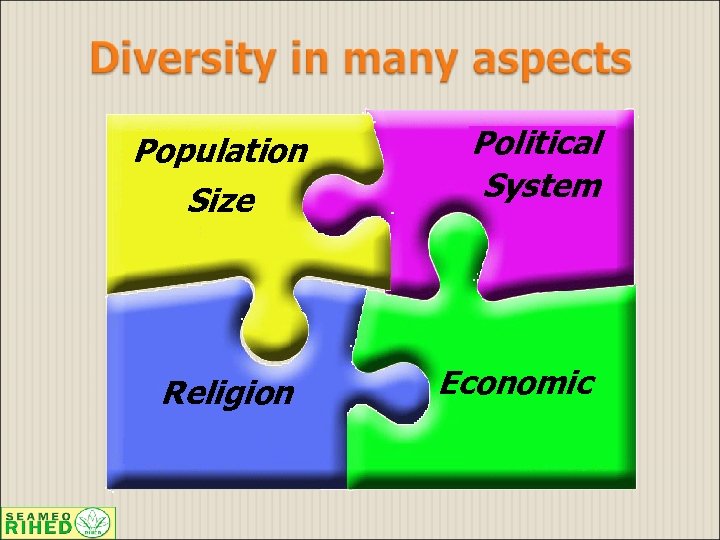 Population Size Religion Political System Economic
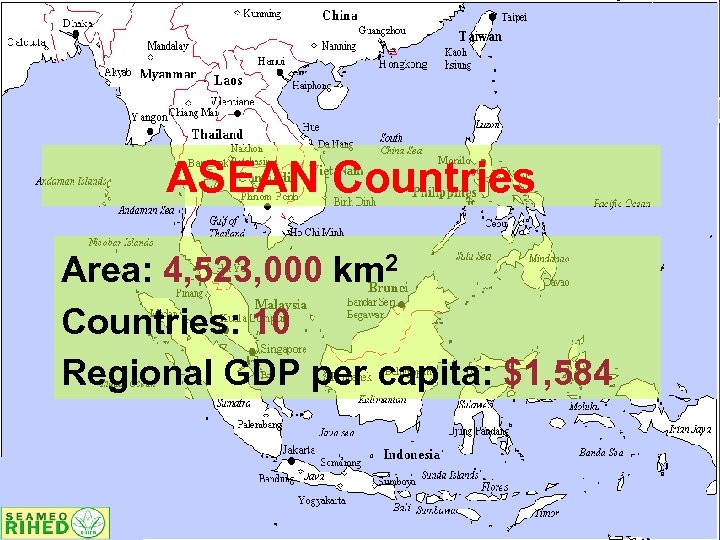 ASEAN Countries Area: 4, 523, 000 km 2 Countries: 10 Regional GDP per capita: $1, 584
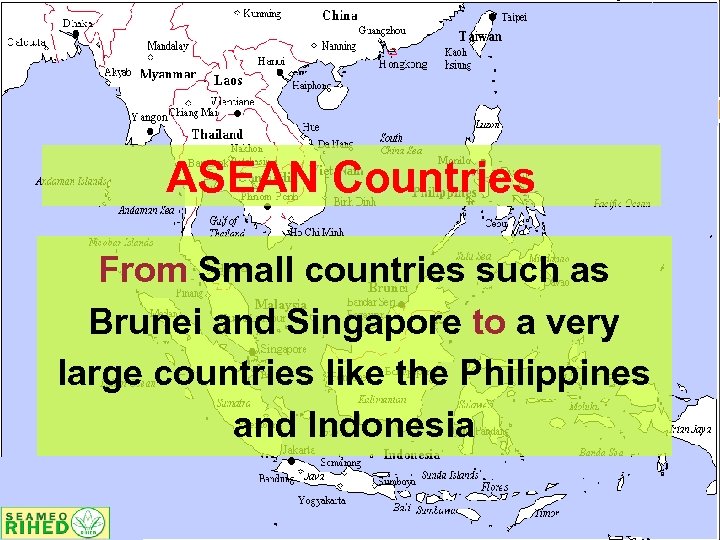 ASEAN Countries From Small countries such as Brunei and Singapore to a very large countries like the Philippines and Indonesia
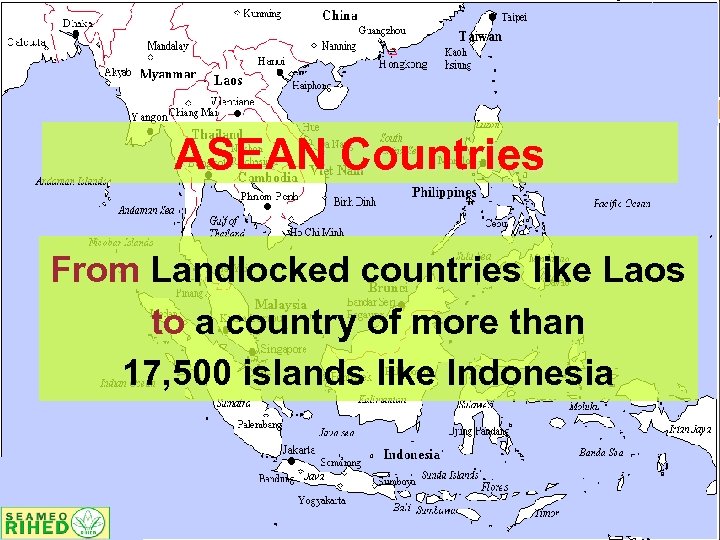 ASEAN Countries From Landlocked countries like Laos to a country of more than 17, 500 islands like Indonesia
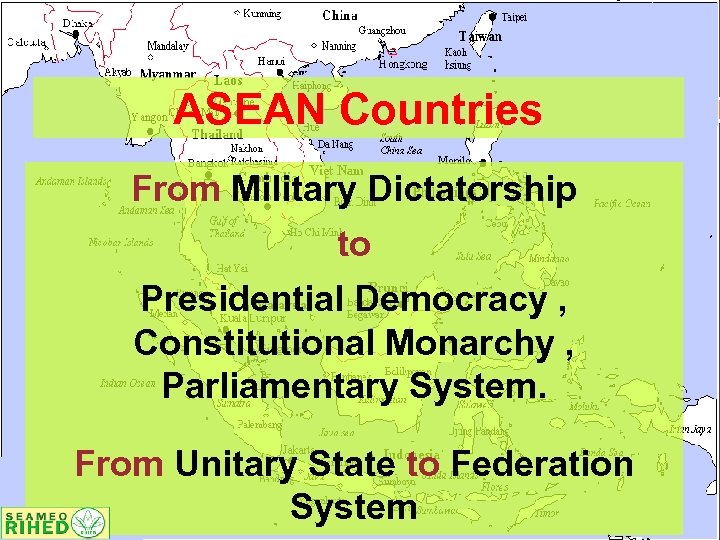 ASEAN Countries From Military Dictatorship to Presidential Democracy , Constitutional Monarchy , Parliamentary System. From Unitary State to Federation System
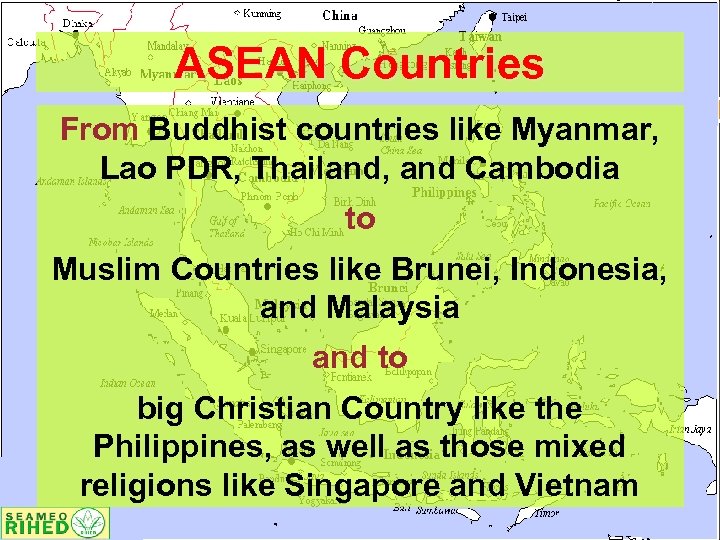 ASEAN Countries From Buddhist countries like Myanmar, Lao PDR, Thailand, and Cambodia to Muslim Countries like Brunei, Indonesia, and Malaysia and to big Christian Country like the Philippines, as well as those mixed religions like Singapore and Vietnam
 ASEAN Countries From the very poor country to the very rich country in the world
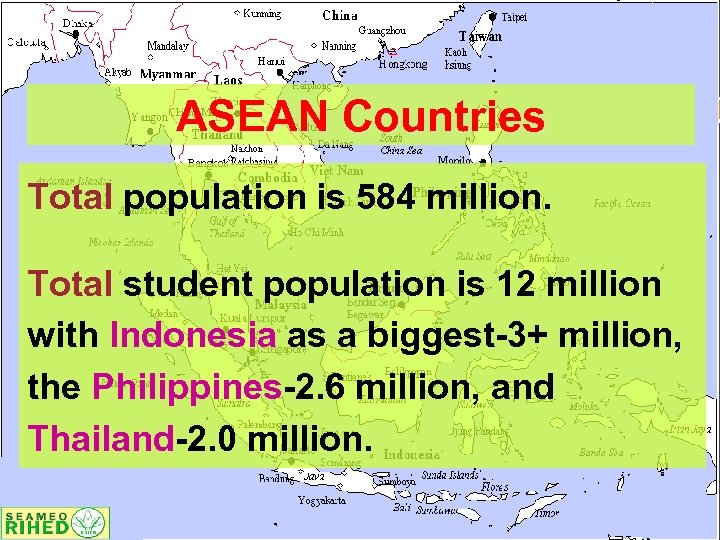 ASEAN Countries Total population is 584 million. Total student population is 12 million with Indonesia as a biggest-3+ million, the Philippines-2. 6 million, and Thailand-2. 0 million.
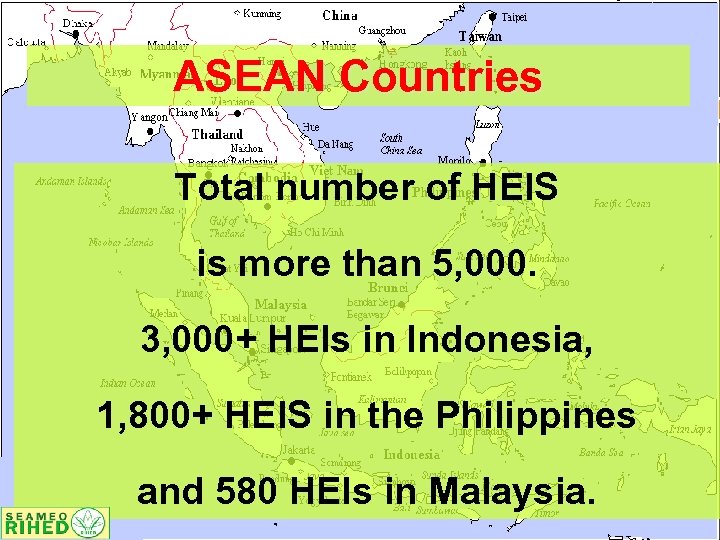 ASEAN Countries Total number of HEIS is more than 5, 000. 3, 000+ HEIs in Indonesia, 1, 800+ HEIS in the Philippines and 580 HEIs in Malaysia.
 ASEAN Countries Literacy rate is more than 90% in most countries, except Lao PDR and Cambodia
 ASEAN : Higher Education Landscape In the region, Higher Education systems range from very centralised and highly regulated by the Ministry, to the highly autonomous, and also a mix of both within one country
 ASEAN : Student Population Total population is 584 million. Total student population is 12+ million with Indonesia as a biggest 3+ million, the Philippines 2. 6 million, Thailand 2. 0 million, and Malaysia 1. 8 million
 Southeast Asia is a region of diversity in different aspects including higher education system
 Common Challenges in Higher Education in ASEAN • Geographic spread and diversity of HEIS • Ensuring equitable access for all students • Lack of qualified faculty staff • Limited experience of quality assurance processes • Limited research expertise
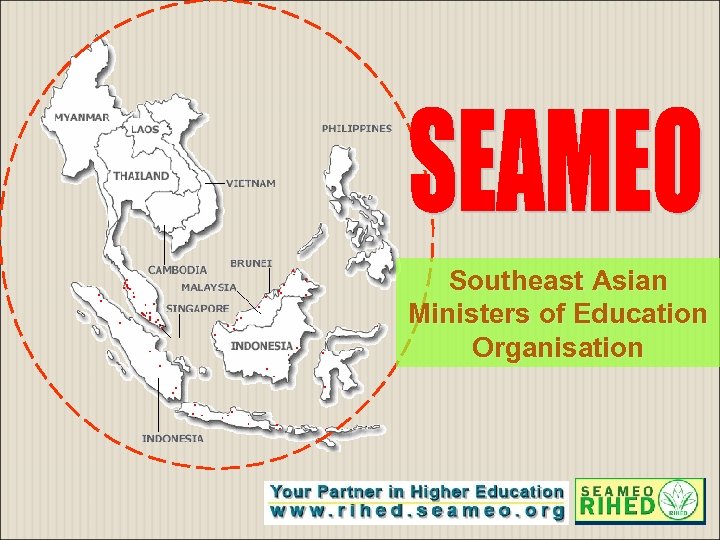 Southeast Asian Ministers of Education Organisation
 SEAMEO Centres SEAMEO 19 specialist institutions : -To enhance regional understanding, cooperation, and networks
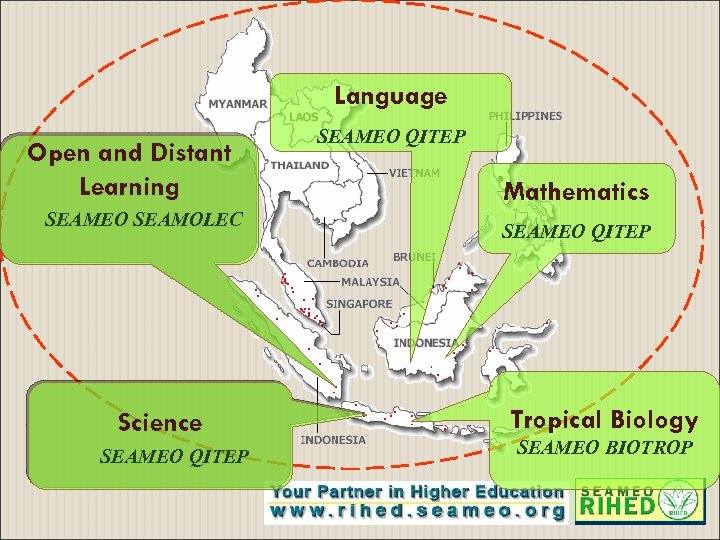 Language Open and Distant Learning SEAMEO SEAMOLEC Science SEAMEO QITEP Mathematics SEAMEO QITEP Tropical Biology SEAMEO BIOTROP
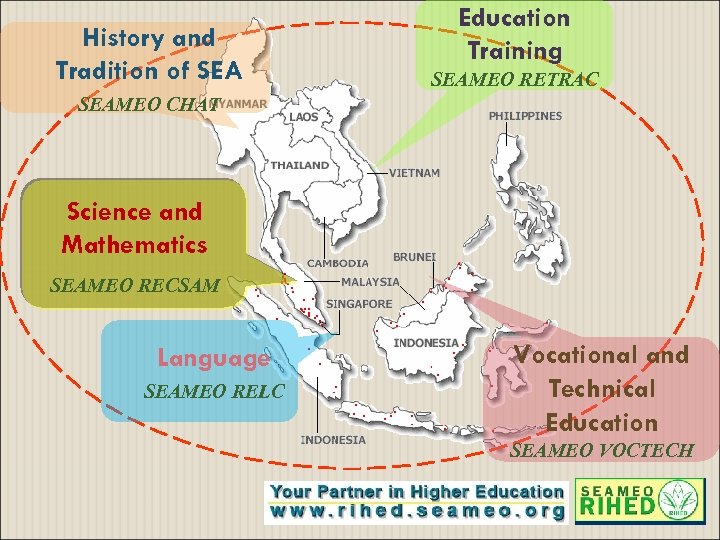 History and Tradition of SEA Education Training SEAMEO RETRAC SEAMEO CHAT Science and Mathematics SEAMEO RECSAM Language SEAMEO RELC Vocational and Technical Education SEAMEO VOCTECH
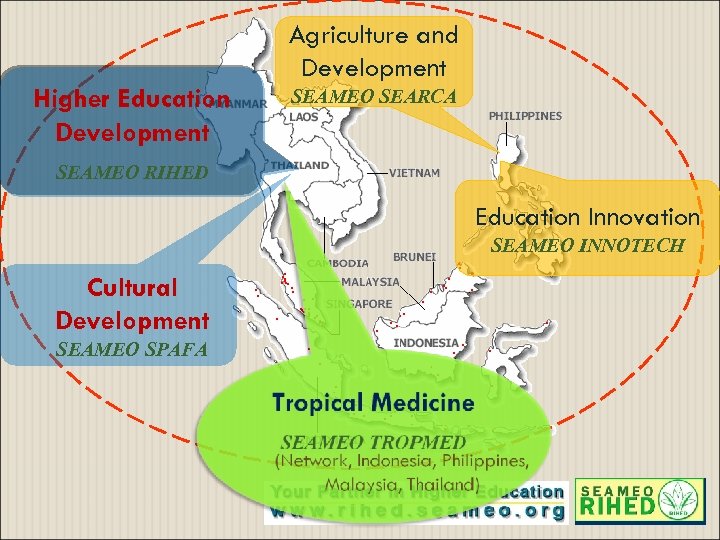 Agriculture and Development Higher Education Development SEAMEO SEARCA SEAMEO RIHED Education Innovation SEAMEO INNOTECH Cultural Development SEAMEO SPAFA
 SEAMEO RIHED’s MISSION ‘To assist member countries in promoting efficiency and effectiveness in higher education policy planning and development. ’
 Outline 1. Facts about HE Landscape in ASEAN region? 2. Recognition in Higher Education : Current situation 3. Recognition in higher education : Challenges 4. Recognition in higher education : Prospects
 If recognition means…………. . An acceptance by national authority, of demonstration of compliance with requirements-generally a substantial equivalence It’s more on case by case basis Public Service Authority / HE Authority
 If recognition means…………. . An agreement between two organizations to recognize each other’s processes or programmes It’s also on case by case basis : -University to University agreement /Programme to programme arrangement
 If recognition means…………. . A formal acknowledgement of an individual’s professional status and right to practice a profession It’s also a profession to profession agreement /G to G agreement / or an ASEAN Agreement
 Outline 1. Facts about HE Landscape in ASEAN region? 2. Recognition in Higher Education : Current situation 3. Recognition in Higher Education : Challenges 4. Recognition in Higher Education : Prospects
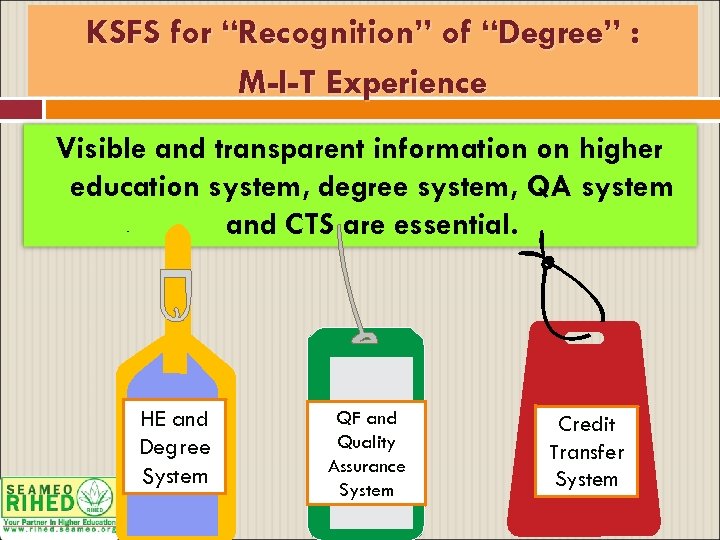 KSFS for “Recognition” of “Degree” : M-I-T Experience Visible and transparent information on higher education system, degree system, QA system and CTS are essential. HE and Degree System QF and Quality Assurance System Credit Transfer System
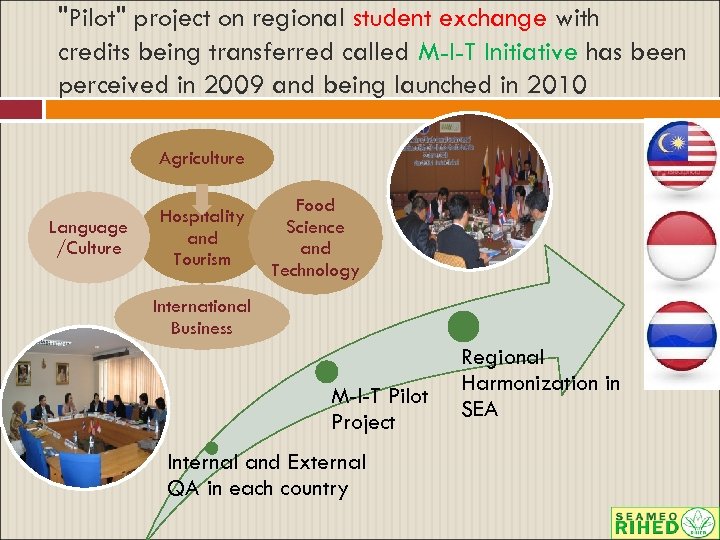 "Pilot" project on regional student exchange with credits being transferred called M-I-T Initiative has been perceived in 2009 and being launched in 2010 Agriculture Language /Culture Hospitality and Tourism Food Science and Technology International Business M-I-T Pilot Project Internal and External QA in each country Regional Harmonization in SEA
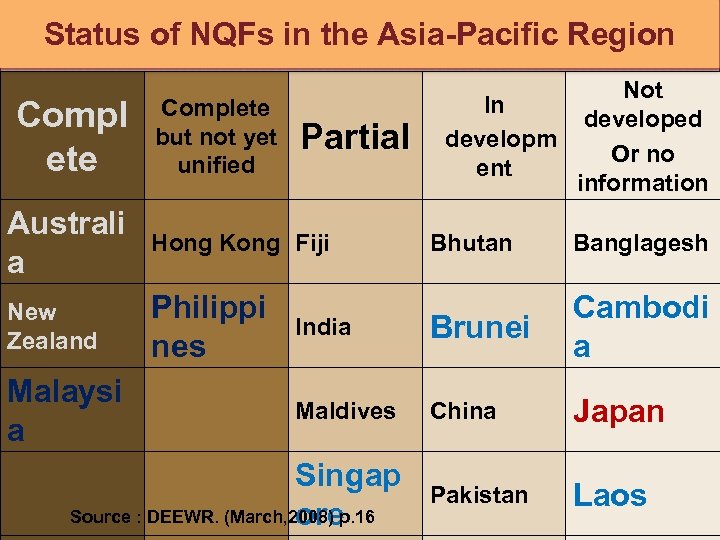 Status of NQFs in the Asia-Pacific Region Compl ete 33 Complete but not yet unified Partial Australi a Hong Kong Fiji New Zealand Philippi nes Malaysi a Not In developed developm Or no ent information Bhutan Banglagesh India Brunei Cambodi a Maldives China Japan Pakistan Laos Singap Source : DEEWR. (March, 2008) p. 16 ore
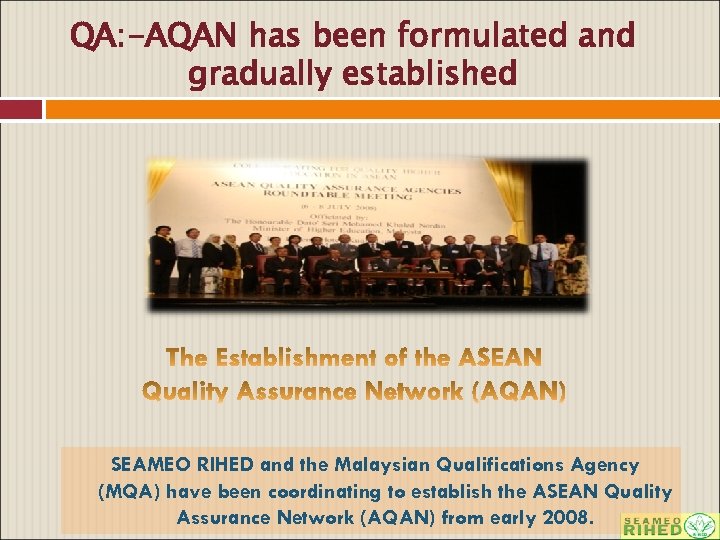 QA: -AQAN has been formulated and gradually established SEAMEO RIHED and the Malaysian Qualifications Agency (MQA) have been coordinating to establish the ASEAN Quality Assurance Network (AQAN) from early 2008.
 AQA NB oard Mee ting
 SEA Credit Transfer System: What to do together? SEAMEO RIHED : Southeast Asia Forum UTCS International Conference, 2010 Shangri-La Hotel, Bangkok 29 -30 June 2010
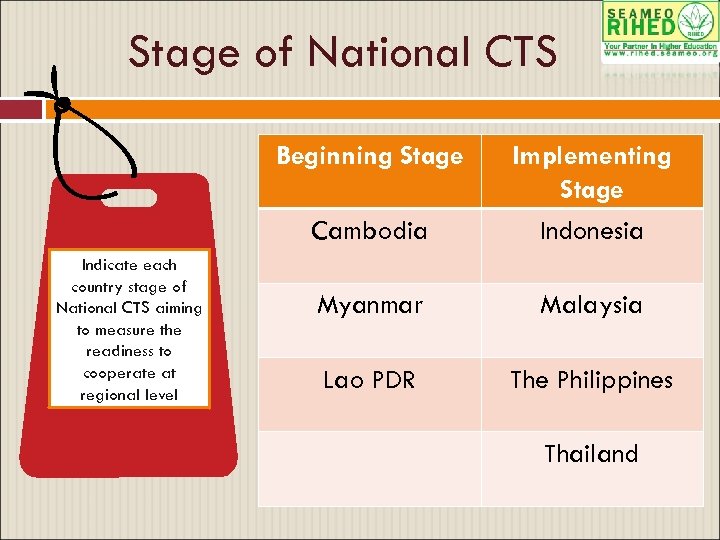 Stage of National CTS Beginning Stage Cambodia Indicate each country stage of National CTS aiming to measure the readiness to cooperate at regional level Implementing Stage Indonesia Myanmar Malaysia Lao PDR The Philippines Thailand
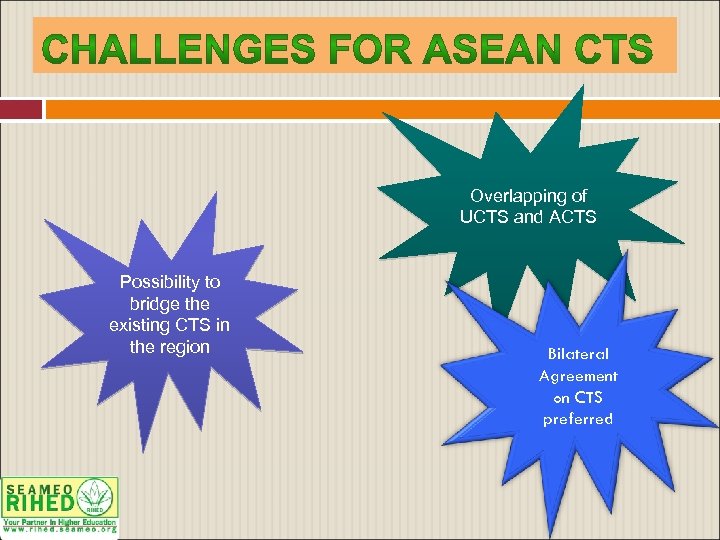 Overlapping of UCTS and ACTS Possibility to bridge the existing CTS in the region Bilateral Agreement on CTS preferred
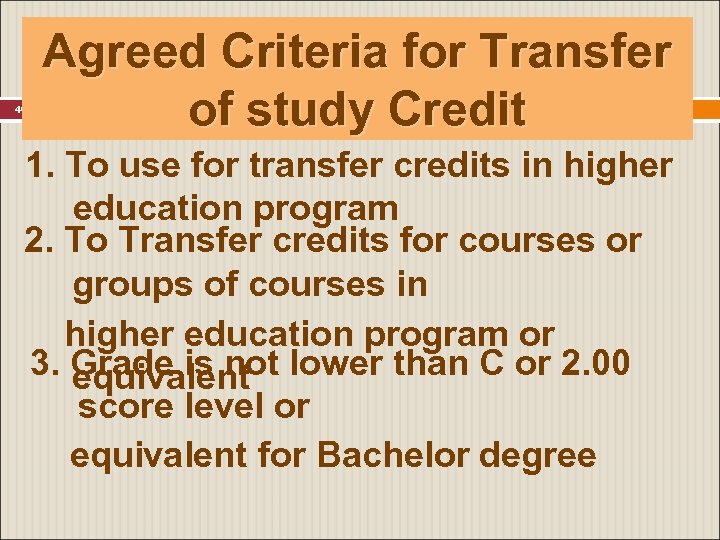 40 Agreed Criteria for Transfer of study Credit 1. To use for transfer credits in higher education program 2. To Transfer credits for courses or groups of courses in higher education program or 3. Grade is not lower than C or 2. 00 equivalent score level or equivalent for Bachelor degree
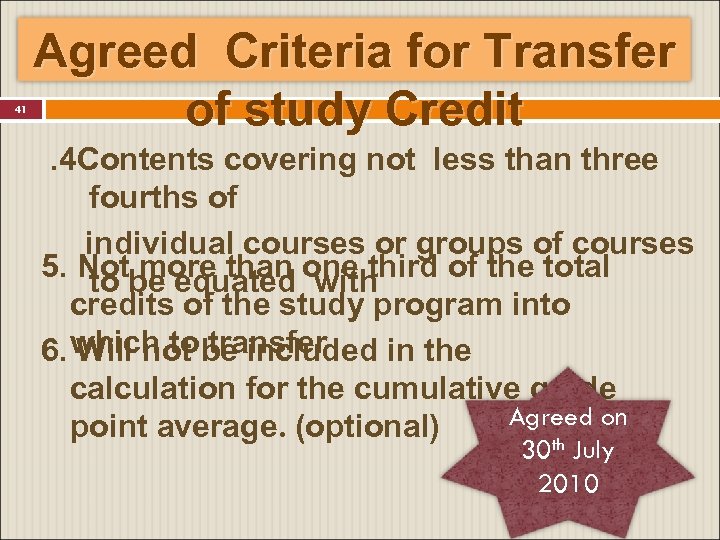 41 Agreed Criteria for Transfer of study Credit. 4 Contents covering not less than three fourths of individual courses or groups of courses 5. Notbe equated one third of the total to more than with credits of the study program into 6. which to be included in the Will not transfer calculation for the cumulative grade Agreed on point average. (optional) th 30 July 2010
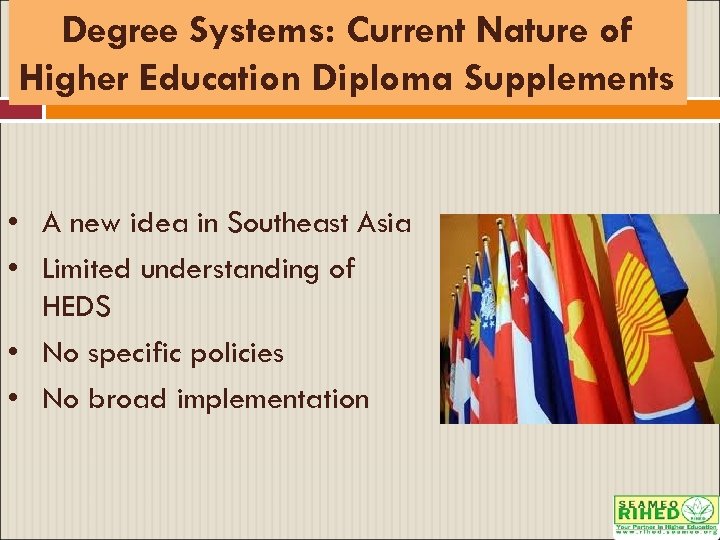 Degree Systems: Current Nature of Higher Education Diploma Supplements • A new idea in Southeast Asia • Limited understanding of HEDS • No specific policies • No broad implementation
 Potential for Future Development • Vietnam interested as part of internationalisation strategy • Also acknowledges benefits of fitting qualifications into global labour market • Malaysia considers it a HEI rather than government responsibility • Myanmar believes that current transcript provides adequate information
 Diploma Supplements: Specific Issues Faced • Awareness of the notion and role of HEDS • Commitment of Institutions to put HEDS in development plans • Diversity of universities in the region, in government run HEI’s would be quite simple. . . • Compatability with existing academic systems and transcripts
 Outline 1. Facts about HE Landscape in ASEAN region? 2. Recognition in Higher Education : Current situation 3. Recognition in Higher Education : Challenges 4. Recognition in Higher Education : Prospects
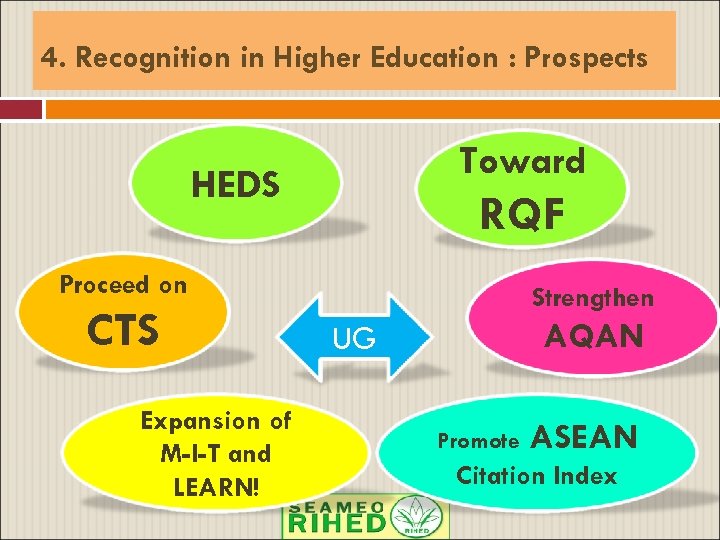 4. Recognition in Higher Education : Prospects Toward HEDS RQF Proceed on CTS Expansion of M-I-T and LEARN! Strengthen AQAN UG Promote ASEAN Citation Index
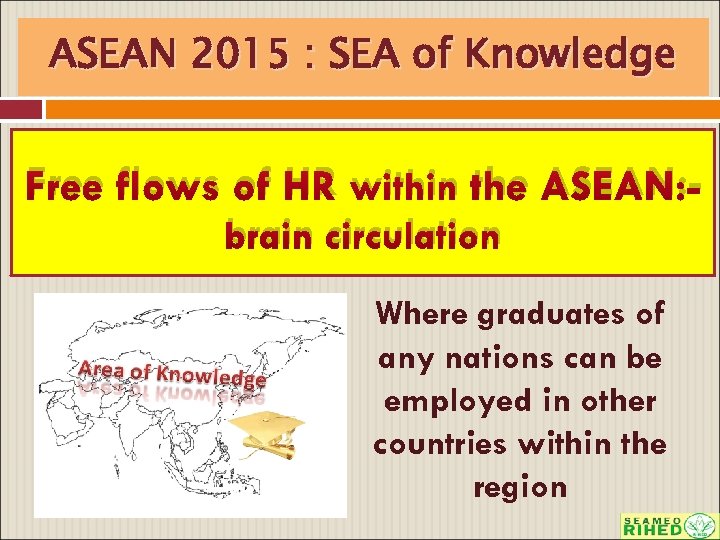 ASEAN 2015 : SEA of Knowledge Free flows of HR within the ASEAN: brain circulation Where graduates of any nations can be employed in other countries within the region
 Terima Kasih Kop Khun (Thailand) Cam On (Viet Nam) 50 Malaysia, Singapore) THANK YOU Jae zu tin bar tae (Myanmar) (Brunei, Indonesia, Kop jai (Laos) Salamat Po Or kun (Cambodia) (Philippines)