


 Скачать презентацию Recognition and measurement of the elements of the
Recognition and measurement.pptx
- Количество слайдов: 70
 Recognition and measurement of the elements of the financial statemets
 Primacy of definitions • It must be established • Based on either: • assets and liabilities; or: • expenses and income.
 Primacy of decisions • to start with on assets, there is a hierarchy of decisions: • Is the item an asset? • If yes, should the asset be recognized in the balance sheet? • If yes, how should it be measured?
 Primacy of decisions • which definitions have primacy • is examined first in the context of assets and expenses • In the case of payments related to assets, • decisions about: – whether such payments should be added to the asset – or should be treated as an expense
 Examples of such payments • • • repairs; decorating or redecorating; extensions; improvements; replacements of parts future inevitable payments for dismantling
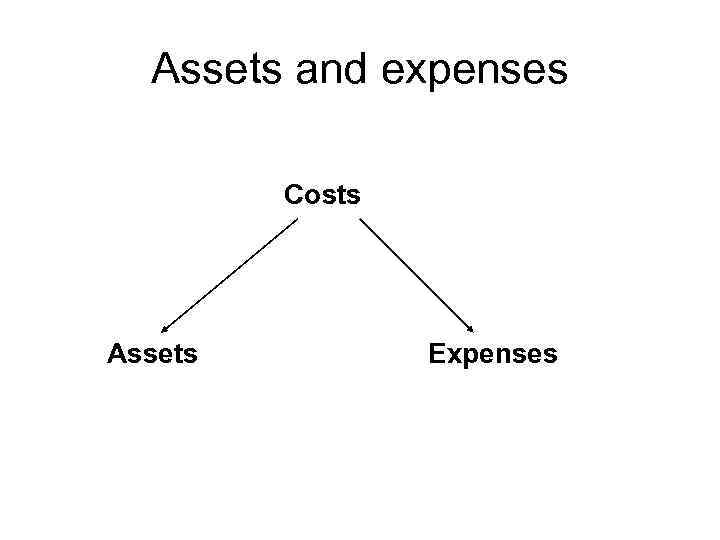
 'applications' of resources • They are all recorded as 'debits' in the double-entry system. • Those costs that do not generate assets (and are not added to existing assets) • are expenses • accounting can work on one of two bases:
 Method 1 • Expenses of 20 X 7 are the costs of any period that relate to 20 X 7; • And therefore. . . • Assets at the end of 20 X 7 are any remaining costs.
 Method 2 • Assets at the end of 20 X 7 – are resources controlled by the entity – that are expected to give benefits; • and therefore. . • Expenses are any remaining costs.
 Assets and expenses Costs Assets Expenses
 Definition of the asset • The Framework gives primacy to the second way of defining the elements, • an asset defined as follows (par. 49): a resource controlled by the enterprise as a result of past events and from which future economic benefits are expected to flow to the enterprise
 The Framework • This has the effect of reducing the importance of the 'matching' concept, • If an expense is postponed in order to match it against a future revenue, • it would have to be stored in the balance sheet as an asset. • this is not allowed unless the amount meets the definition of an asset
 Liability Framework, paragraph 49: A liability is a present obligation of the enterprise arising from past events, the settlement of which is expected to result in an outflow from the enterprise of resources
 Obligation • Obligation is an unavoidable requirement to transfer resources to a third party • Many liabilities are clear legal obligations of exact amounts, – such as accounts payable or loans from the bank.
 Provisions • Some liabilities are of uncertain timing or amount • These are called 'provisions' • Depending on the nature of legal contracts, some of these provisions are also legally enforceable, – such as provisions to pay pensions to retired employees or – to repair machinery sold to customers that breaks down soon after sale
 Provisions • Some obligations are not based on precise laws or legal contracts • but would probably be enforced by a court of law based on normal business practices
 Other provisions • outside of IFRS requirements, • some companies might make provisions when there is no obligation. – the example of provisions for repair expenses. – The double entry for the creation of the liability is an expense.
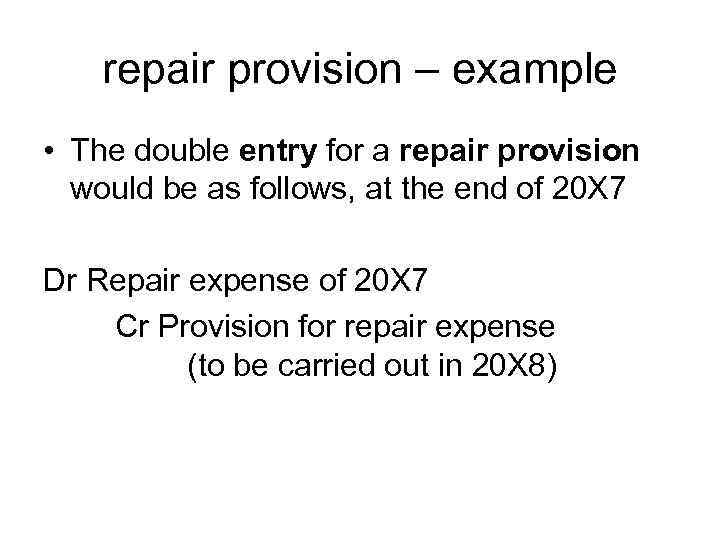 repair provision – example • The double entry for a repair provision would be as follows, at the end of 20 X 7 Dr Repair expense of 20 X 7 Cr Provision for repair expense (to be carried out in 20 X 8)
 Hierarchy of decisions
 The first stage • Is to apply three-stage hierarchy of decisions • The IASB Framework and most others, suggest that the first stage is to ask: • Is there an asset/liability? • not all asset and liabilities should be recognized!
 Recognition • The second stage is to ask – whether an asset or liability should be recognized in the balance sheet • For example, the value of some asset may be so difficult to measure • that they should be omitted from balance sheets
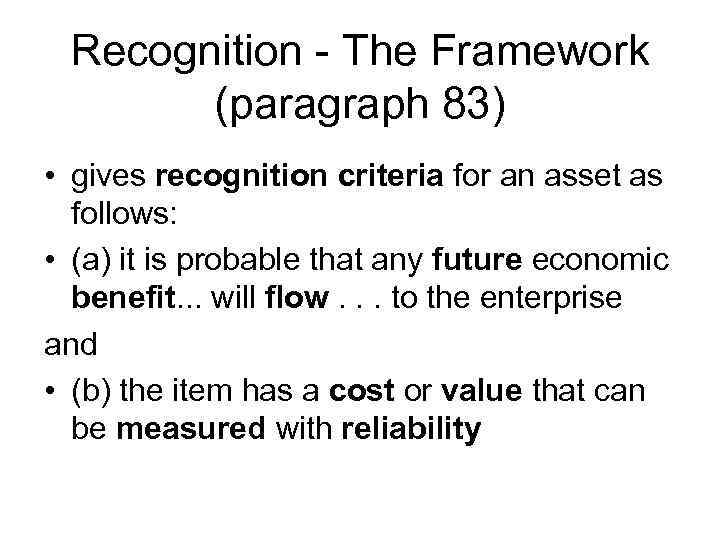 Recognition - The Framework (paragraph 83) • gives recognition criteria for an asset as follows: • (a) it is probable that any future economic benefit. . . will flow. . . to the enterprise and • (b) the item has a cost or value that can be measured with reliability
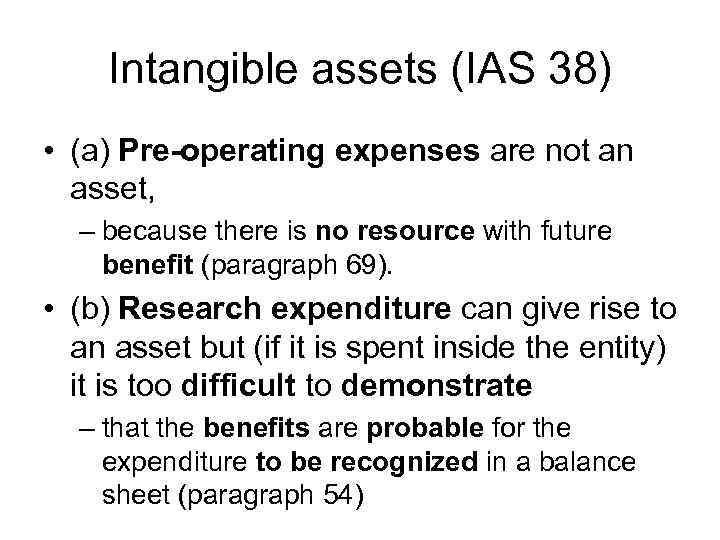 Intangible assets (IAS 38) • (a) Pre-operating expenses are not an asset, – because there is no resource with future benefit (paragraph 69). • (b) Research expenditure can give rise to an asset but (if it is spent inside the entity) it is too difficult to demonstrate – that the benefits are probable for the expenditure to be recognized in a balance sheet (paragraph 54)
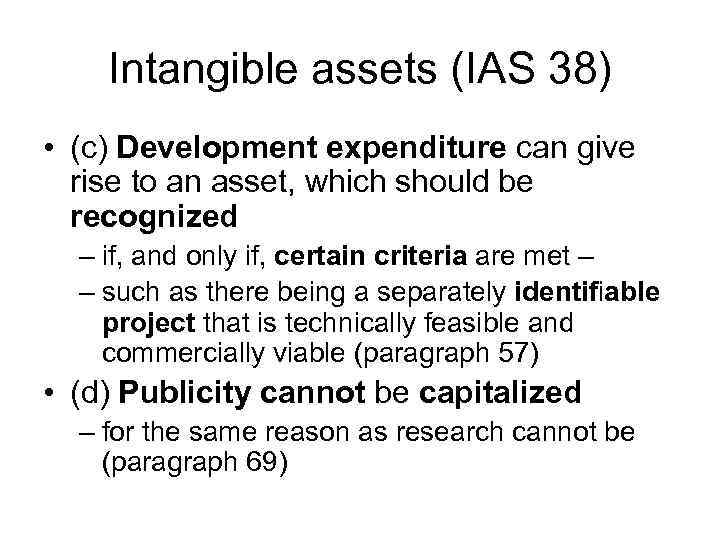 Intangible assets (IAS 38) • (c) Development expenditure can give rise to an asset, which should be recognized – if, and only if, certain criteria are met – – such as there being a separately identifiable project that is technically feasible and commercially viable (paragraph 57) • (d) Publicity cannot be capitalized – for the same reason as research cannot be (paragraph 69)
 Views around the world • Views differ on these issues For example: • under the rules of the United States, • even development expenditure cannot be recognized as an asset • unless it relates to software
 EU Fourth Directive • A more general European example of problems • concerning the recognition of assets • can be seen • in the list of items shown under • the heading 'Assets' in the EU Fourth Directive
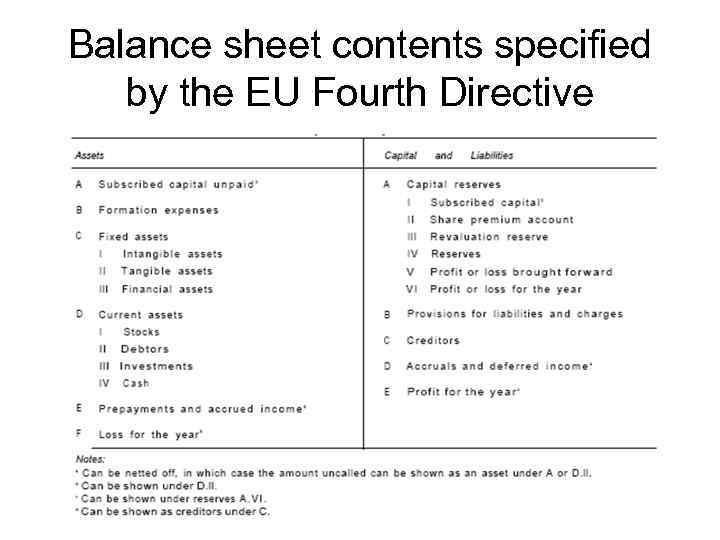 Balance sheet contents specified by the EU Fourth Directive
 Measurement • If an asset or liability should be recognized, • it is necessary to measure its value • In most systems of accounting – initial recognition takes place at cost • If this were not the case: this leads to recognition of a gain or loss
 Cost of an asset • It is obvious, such as – when a machine is bought for cash. • However, even then, decisions have to be made about – what to do with taxes on the purchase, – delivery charges, and so on. The cost should include not only the invoice price of the asset but also all costs involved in getting the asset into a location and condition where it can be productive
 Cost of an asset This will include (machinery, equipment): • delivery charges, • sales taxes and • installation charges (in the case of plant and machinery)
 Cost of an asset For land buildings cost will include: • legal fees, • architect's fees • clearing the land so on, • the builder's bill • the cost of the land
 Capitalization of costs • If a company has used its own labour or materials to construct an asset, • these should also increase the cost of the asset – rather than being treated as current expenses (they are capitalized) • It is also possible to capitalize the interest cost on money borrowed to create fixed assets
 If labour and material is capitalized • certain formats of the income statement show this (capitalized) item as revenue. • This is because • all the labour and materials used – have been charged elsewhere in the income statement.
 Cost of an asset • • Any payments that make the asset better than it was originally are capitalized: added to the asset! • Any other payments are expenses.
 Expenses and improvements In general, • repairs and maintenance • are treated as current expenses, • improvements are capitalized
 Expenses and improvements – example • a new engine for a company vehicle will usually be treated as an expense, – since it keeps the vehicle in running order rather than improving it, – unless the engine is recorded as a separate asset. • In contrast, the painting of advertising signs on the company's fleet of vans – may well be treated as capital item, if material in size.
 Materiality • the accountant needs to consider whether the amounts relating to the improvements are material enough to capitalize them. • He or she tends to treat as much as possible as expense, – since this is the prudent and administratively more convenient method. • this will also speed up tax deductibility
 a list of six payments - example Q: Which of these should be added to the cost of an asset, and which should be treated as an immediate expense? • repairs; • decorating or redecorating; • extensions; • improvements; • replacement of parts; • future inevitable payments for dismantling, decommissioning or cleaning up.
 a list of six payments - example • Repairs: expense, they don’t improve the asset • Decorating costs might be capitalizable, if it is material in size • The cost of building extensions – should normally be added to the asset being extended, – or could create a separately identified asset. • Improvements should probably be capitalized.
 a list of six payments - example • Replacement of parts should be an expense – unless the part is treated as a separate depreciable asset, – so that replacement is treated as a disposal followed by a purchase. • Future costs of dismantling, etc. should be discounted and added to the cost of the asset
 Fair value • Some purchases are not made with cash • but in exchange for the future payment of cash or for exchange with other assets. • the current 'fair value' of the purchase consideration should be estimated as accurately as possible.
 Fair value in IFRS the amount at which • an asset could be exchanged, • or a liability settled, • between knowledgeable, willing parties • in an arm's length legal transaction. (an arm's length transaction: where the parties are not related)
 Problem • After initial recognition, • whether to take account of subsequent changes in the value of an asset. • For assets to be sold: – when, to take account of changes in value, • the current value is recognized at the point of sale in the calculation of profit
 Valuing an asset • • Conventional accounting in most countries continues to use cost as the basis for valuing most assets until the point of sale. • Because its cheapness and greater reliability.
 Historical cost • is an easier and cheaper method of valuation • Because it uses information already recorded and does not require expensive estimations • for most assets the cost is more reliably determined than the fair value
 Reliability vs relevance • Reliability is important (Framework) • The Framework (paragraph 44) also suggests that regulators and preparers should be aware of the cost of the accounting, – to ensure that it does not exceed the benefits to the users
 Reliability vs relevance - the problem • the Framework's other key characteristic is relevance for economic decisions. • It is difficult to see that the historical cost is the most relevant information for making decisions – which normally requires estimation of the future, – particularly the prediction of cash flows
 Example • Suppose, a company buys an investment for € 800, in 2007. Its market value is € 1000 at year end. It is sold for € 850 in 2008. • In order to give useful information, should the balance sheet show cost or market value at the end of 2007?
 Example It seems that the € 800 cost is not a very useful predictor of cash flows at 31 December 20 X 7, particularly if the asset had been held for a longer period. Also, if only cost is recorded until sale, then a gain of € 50 will be shown in 20 X 8 even though the asset has fallen in value in 20 X 8. The result of management's decision not to sell asset early in 20 X 8 is not reflected in the 20 X 8 statements.
 The main asset valuation bases instead of cost • fair value: assumes that the business is neither buying nor selling; • replacement cost: takes account of the transaction costs of replacement; • net realizable value: expected sales receipts less any costs to finish and to sell; • value in use (or economic value): is the present value (discounted value) of the expected net cash flows from the asset
 The main asset valuation bases instead of cost • these values may be more relevant than past values, • they involve much more subjectivity than historical cost valuations
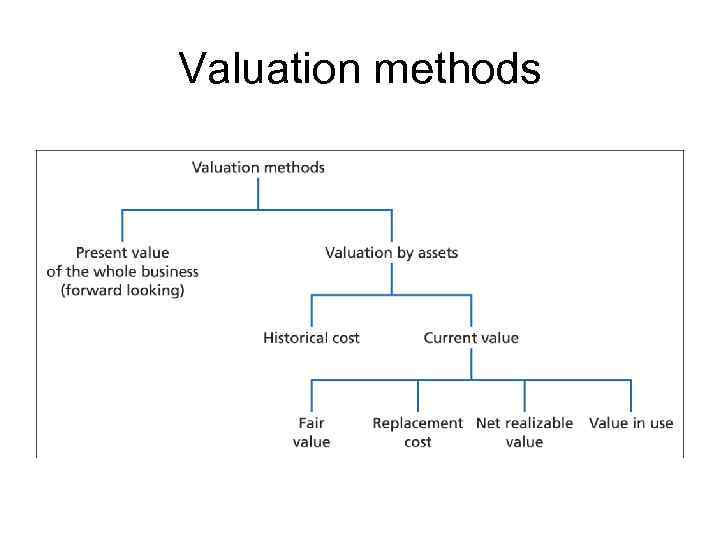 Valuation methods
 Choice of valuation methods • Depends on who requires it • Owners want more realistic estimate (going concern) • Lenders may want a much more conservative valuation, – based on the lowest likely valuation of the individual assets – in the event that the business has to be closed down.
 Choice of valuation methods • Managers may be prepared to put up with more estimated numbers, – because they can trust themselves to estimate fairly. • there is a need for reliability • and therefore • a difficult trade-off between relevance and reliability
 conventional accounting • for most assets, • the cheapness and reliability of historical cost has ensured its dominance, • doubts about relevance.
 assets with active markets • such as some markets for shares • fair values are reliable. • there seems a strong argument for the use of fair values in financial reporting.
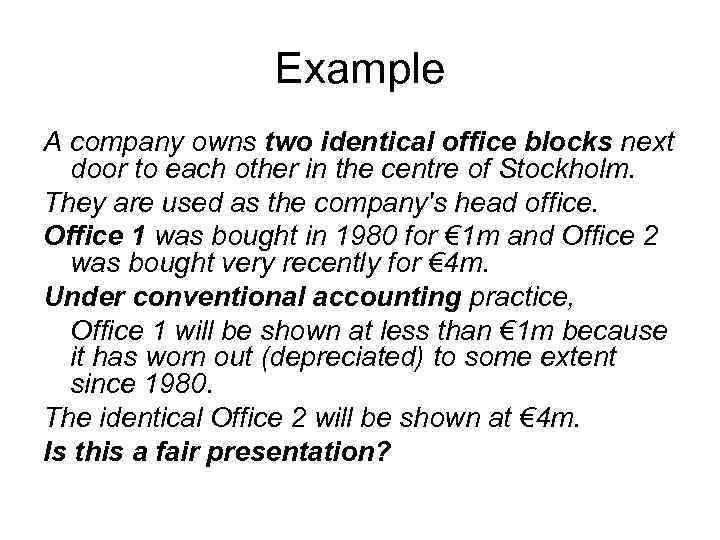 Example A company owns two identical office blocks next door to each other in the centre of Stockholm. They are used as the company's head office. Office 1 was bought in 1980 for € 1 m and Office 2 was bought very recently for € 4 m. Under conventional accounting practice, Office 1 will be shown at less than € 1 m because it has worn out (depreciated) to some extent since 1980. The identical Office 2 will be shown at € 4 m. Is this a fair presentation?
 conventional accounting - example It sometimes takes account of market values before the sale of assets. • to be prudent, inventories are usually valued at the lower of cost and net realizable value, • fixed assets are written down below cost if their value is impaired
 Income recongition • the recognition of income does not always need to await the receipt of cash; • that is, the accruals convention is used. • the determination of the exact moment when income should be recognized is a practical problem.
 EU laws is expressed in terms of 'realization': income should be recognized in the income statement when it is realized. In practice, this does not help much because there is no clear way to define what is realized, ( if it does not mean 'received in cash'. )
 Defining ‘realized’ One possibility is to define realized as • having either received cash or • a contractual right to cash. • This allows income recognition before a customer pays a bill.
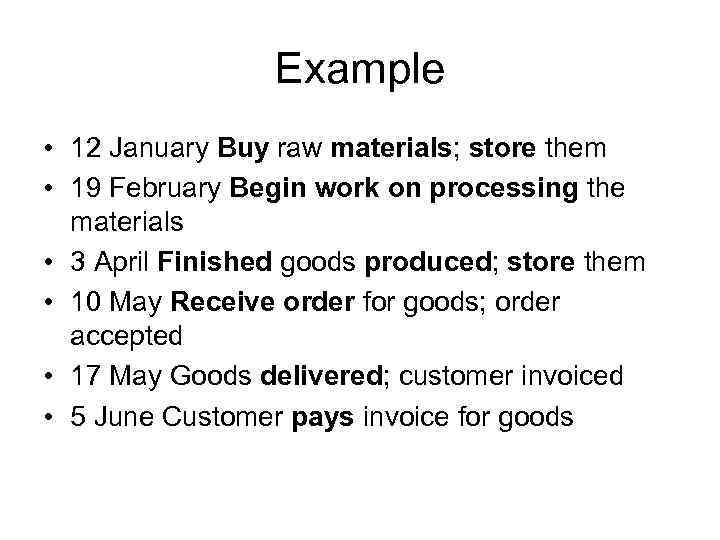 Example • 12 January Buy raw materials; store them • 19 February Begin work on processing the materials • 3 April Finished goods produced; store them • 10 May Receive order for goods; order accepted • 17 May Goods delivered; customer invoiced • 5 June Customer pays invoice for goods
 Example • • It is clear that the eventual profit will be the difference between the final sales receipts and the various costs involved.
 At what point should the income be recognized? • Is the profit earned gradually over the manufacturing process, • or when a contract of sale is agreed, • or when the goods are delivered, • or when cash is finally paid?
 Realization convention • profits that have not been realized are not recorded • income is not recognized until • a sale has been agreed, – and possibly even later.
 Realization convention • income recognition usually occurs a little later: • when control of the goods passes • and the invoice is raised • (17 May in our example).
 Definition of revenue • (Framework, paragraph 70): • Income is increases in economic benefits during the accounting period • in the form of inflows or enhancements of assets or decreases of liabilities – that result in increases in equity
 Income • the Framework contrasts the word 'income' (rather than the word 'revenue') with the word 'expense'. • The Framework uses the word 'revenue‘ to mean income from customers
 Problems 1) practical problems for the recognition of revenue from the sale of goods and rendering of services; and 2) major theoretical problems of when to recognize the gains on assets if they are revalued in the balance sheet.
 Problem 1 The IASB addresses it in IAS 18 Revenue: revenue from the sale of goods is to be recognized when control and risks have passed to the customer.
 Problem 2 • It is the problem of gains on unsold assets • where a company owns listed equities that rise in value, • it might seem relevant and reliable to record the assets in the balance sheet at the higher values. • Are such gains to be treated as income?