


 Скачать презентацию Reception Reading Workshop Please Sign in on the
0c9904c1068149815497426b49b8ca5c.ppt
- Количество слайдов: 25
 Reception Reading Workshop Please Sign in on the sheet at the front
 Welcome and Introduction Welcome Support at home makes a difference What we will cover
 Support at Home How to encourage your child to read Read yourself Keep books safe Point out words all around you Visit the library Make time to read Keep in touch with school Dual language books
 How to help with reading Be positive Avoid distractions Give your child time Follow the words Don’t make your child try too hard! Let your child read favourites Ask lots of questions Don’t read for too long
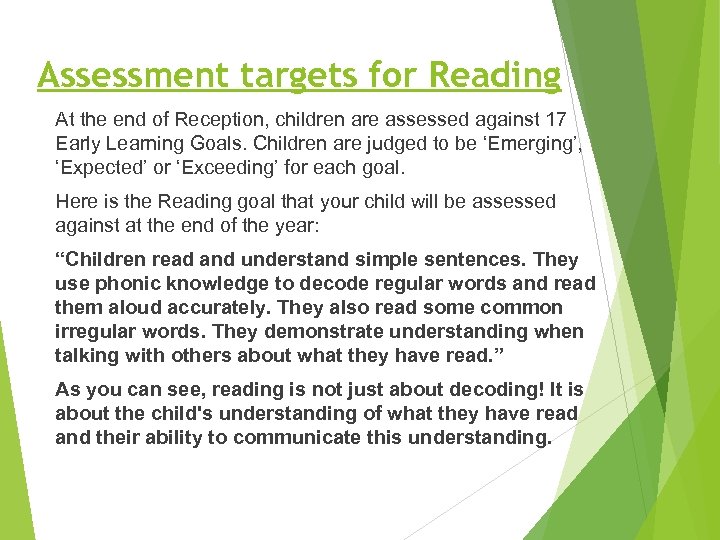 Assessment targets for Reading At the end of Reception, children are assessed against 17 Early Learning Goals. Children are judged to be ‘Emerging’, ‘Expected’ or ‘Exceeding’ for each goal. Here is the Reading goal that your child will be assessed against at the end of the year: “Children read and understand simple sentences. They use phonic knowledge to decode regular words and read them aloud accurately. They also read some common irregular words. They demonstrate understanding when talking with others about what they have read. ” As you can see, reading is not just about decoding! It is about the child's understanding of what they have read and their ability to communicate this understanding.
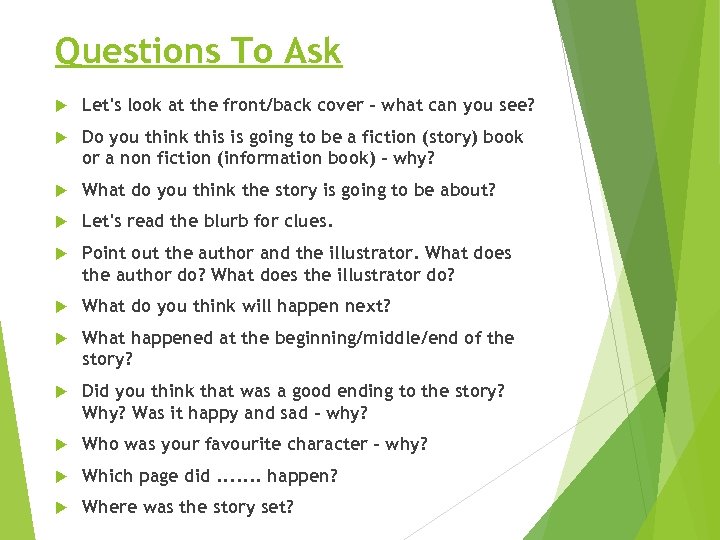 Questions To Ask Let's look at the front/back cover - what can you see? Do you think this is going to be a fiction (story) book or a non fiction (information book) - why? What do you think the story is going to be about? Let's read the blurb for clues. Point out the author and the illustrator. What does the author do? What does the illustrator do? What do you think will happen next? What happened at the beginning/middle/end of the story? Did you think that was a good ending to the story? Why? Was it happy and sad - why? Who was your favourite character - why? Which page did. . . . happen? Where was the story set?
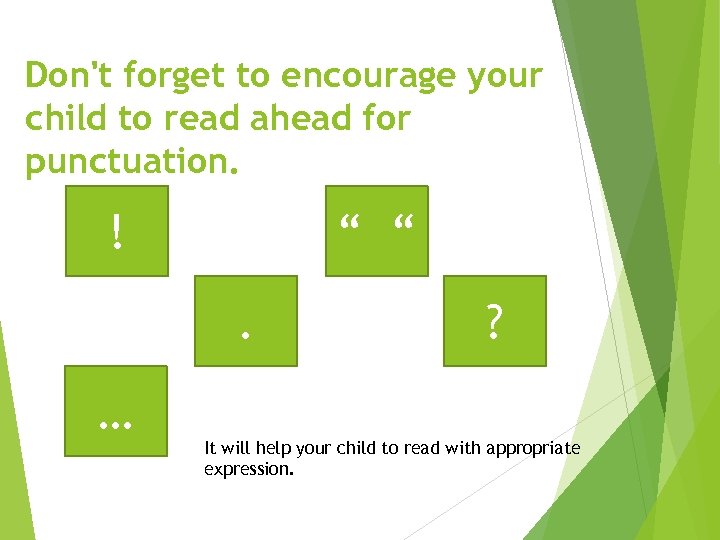 Don't forget to encourage your child to read ahead for punctuation. ! “ “. … ? It will help your child to read with appropriate expression.
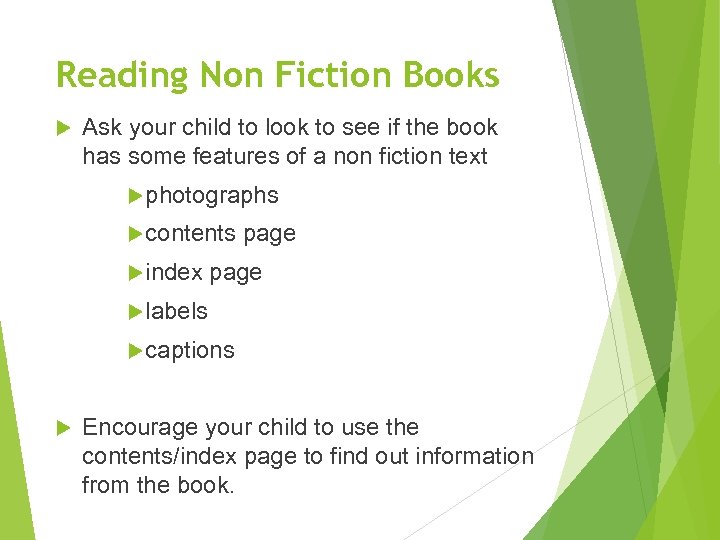 Reading Non Fiction Books Ask your child to look to see if the book has some features of a non fiction text photographs contents index page labels captions Encourage your child to use the contents/index page to find out information from the book.
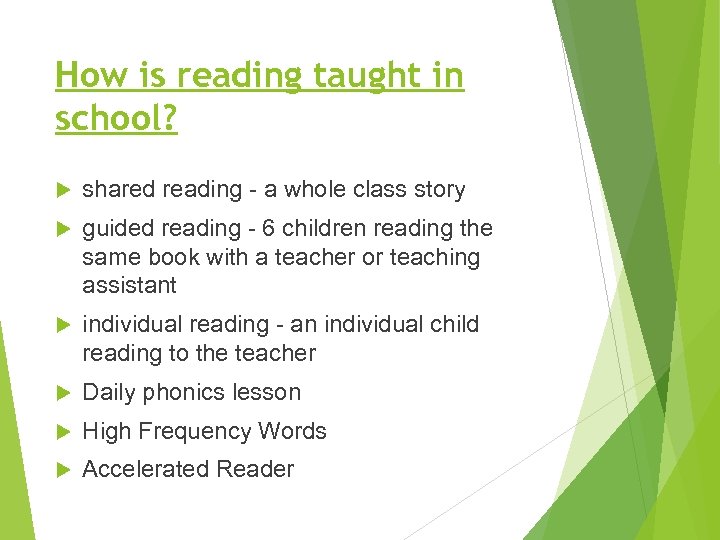 How is reading taught in school? shared reading - a whole class story guided reading - 6 children reading the same book with a teacher or teaching assistant individual reading - an individual child reading to the teacher Daily phonics lesson High Frequency Words Accelerated Reader
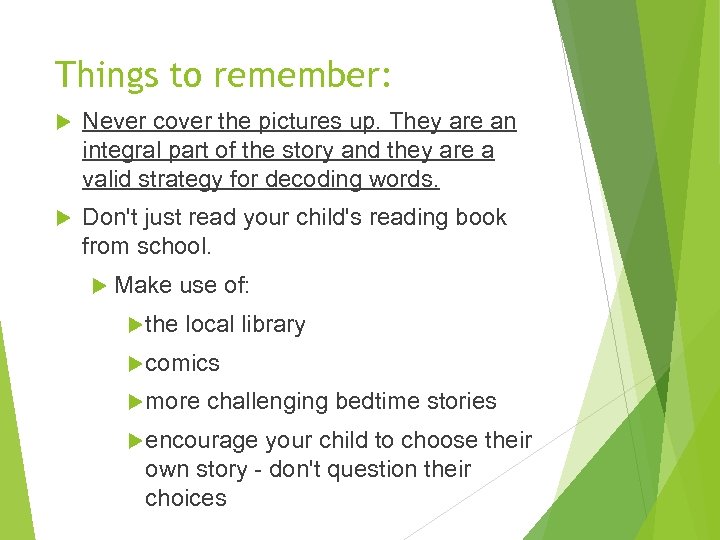 Things to remember: Never cover the pictures up. They are an integral part of the story and they are a valid strategy for decoding words. Don't just read your child's reading book from school. Make the use of: local library comics more challenging bedtime stories encourage your child to choose their own story - don't question their choices
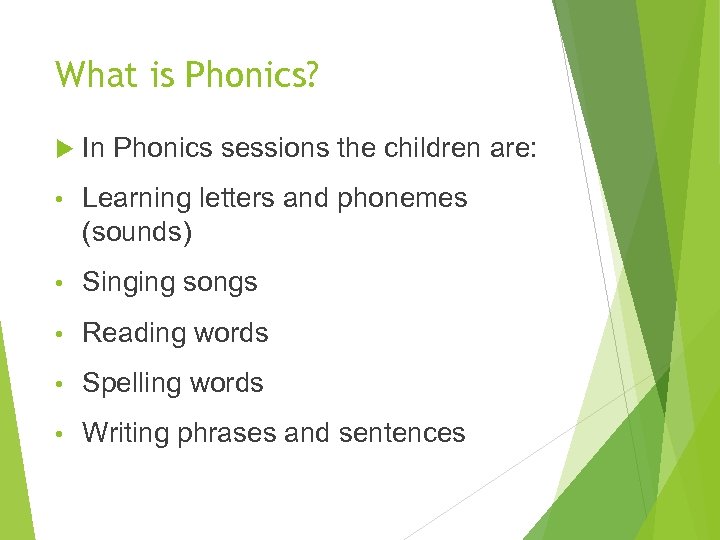 What is Phonics? In Phonics sessions the children are: • Learning letters and phonemes (sounds) • Singing songs • Reading words • Spelling words • Writing phrases and sentences
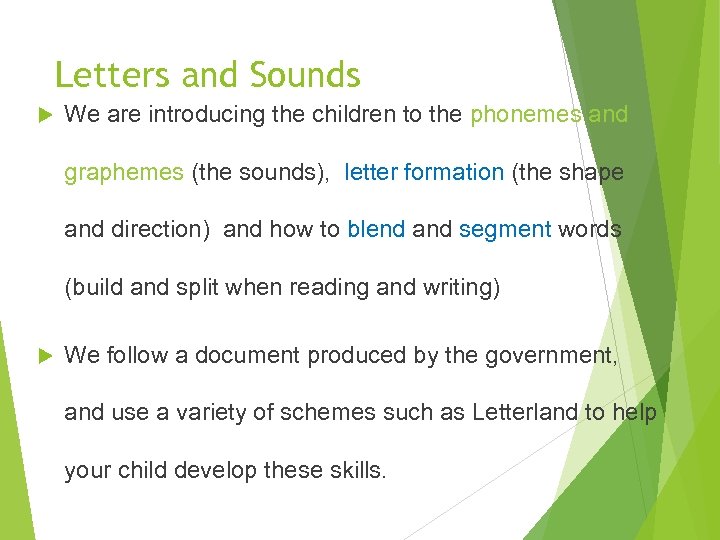 Letters and Sounds We are introducing the children to the phonemes and graphemes (the sounds), letter formation (the shape and direction) and how to blend and segment words (build and split when reading and writing) We follow a document produced by the government, and use a variety of schemes such as Letterland to help your child develop these skills.
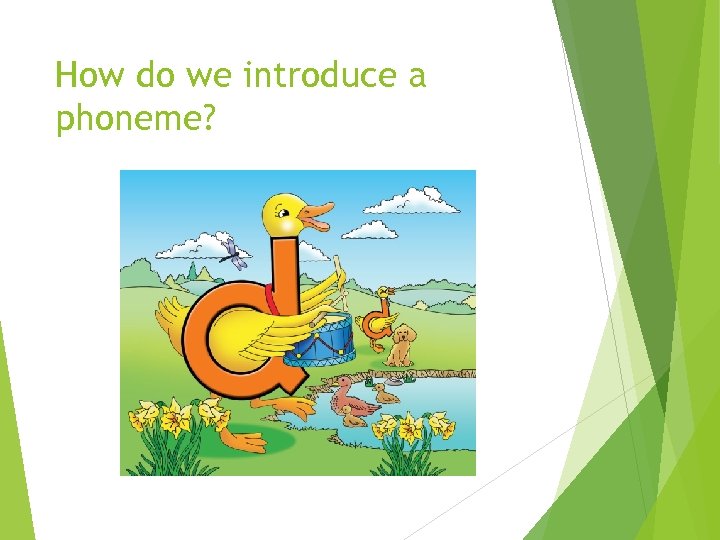 How do we introduce a phoneme?
 How do we introduce a phoneme? For example the phoneme d This is from the Letterland Scheme. We enjoy singing the song, and the song and story help us to remember the sound. It is important for the children to associate the sound with its letter shape. We practise the letter formation, drawing the letter shape in the air. We introduce the capital letter shape and talk about different text styles.
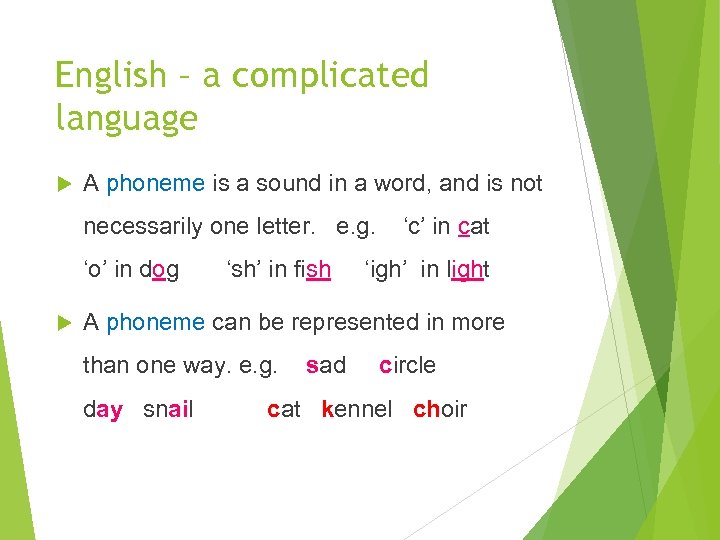 English – a complicated language A phoneme is a sound in a word, and is not necessarily one letter. e. g. ‘o’ in dog ‘sh’ in fish ‘c’ in cat ‘igh’ in light A phoneme can be represented in more than one way. e. g. day snail sad circle cat kennel choir
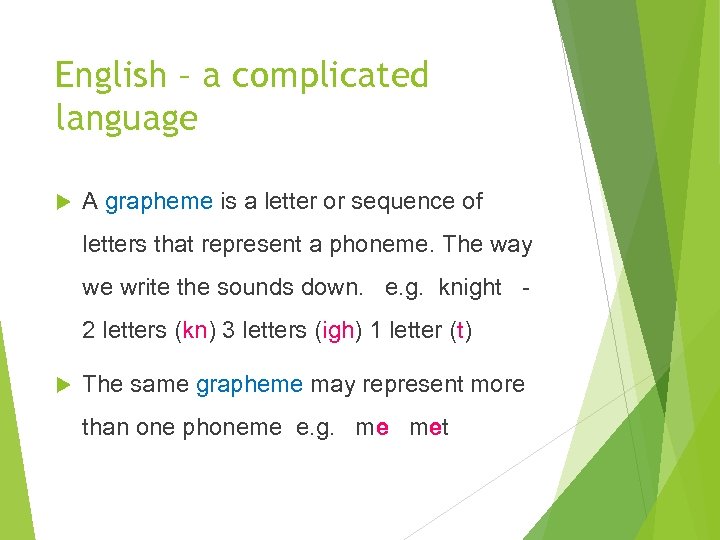 English – a complicated language A grapheme is a letter or sequence of letters that represent a phoneme. The way we write the sounds down. e. g. knight 2 letters (kn) 3 letters (igh) 1 letter (t) The same grapheme may represent more than one phoneme e. g. me met
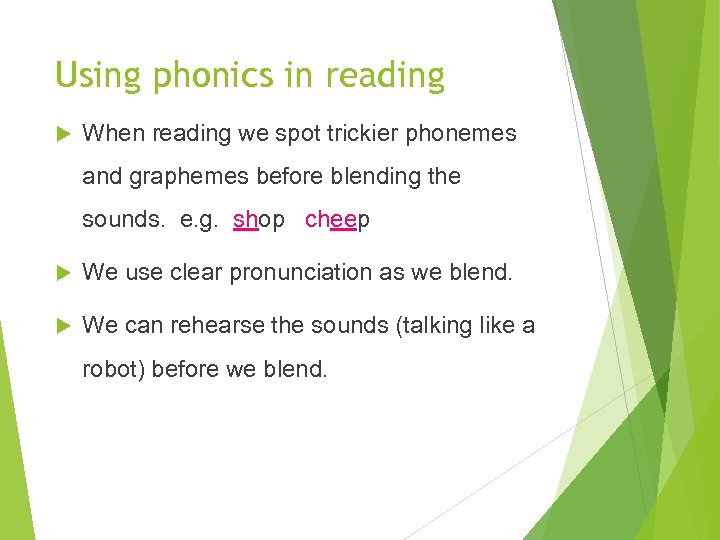 Using phonics in reading When reading we spot trickier phonemes and graphemes before blending the sounds. e. g. shop cheep We use clear pronunciation as we blend. We can rehearse the sounds (talking like a robot) before we blend.
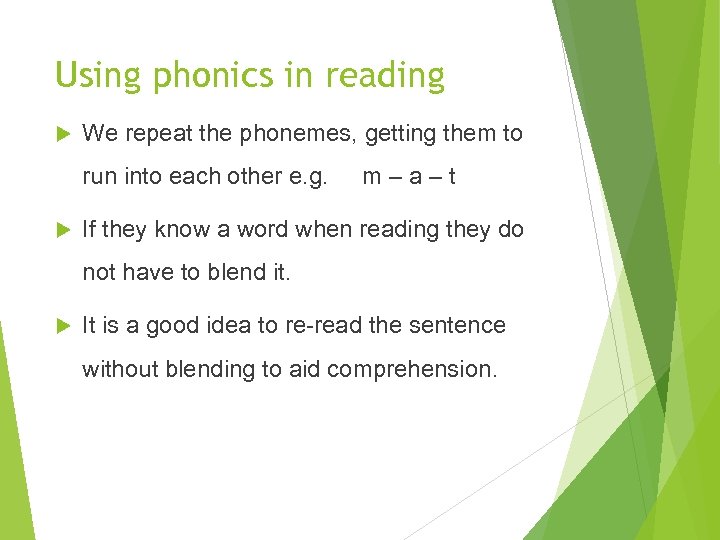 Using phonics in reading We repeat the phonemes, getting them to run into each other e. g. m–a–t If they know a word when reading they do not have to blend it. It is a good idea to re-read the sentence without blending to aid comprehension.
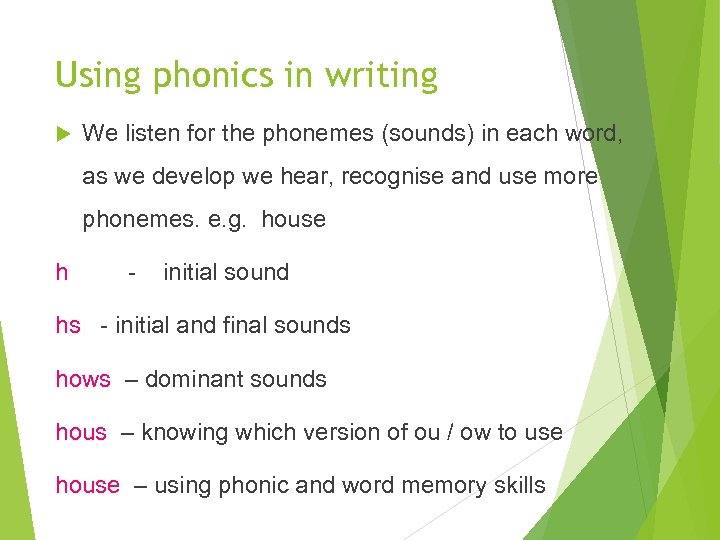 Using phonics in writing We listen for the phonemes (sounds) in each word, as we develop we hear, recognise and use more phonemes. e. g. house h - initial sound hs - initial and final sounds hows – dominant sounds hous – knowing which version of ou / ow to use house – using phonic and word memory skills
 Using phonics in writing In Reception we are building up our phonic skills each week. We let the children spell phonetically to build confidence as an independent writer. If they ask us how to spell a word, we will ask them what they can hear.
 Using phonics in writing The children use sound sheets to help them find the letters that match the phoneme they hear. When your child is ready we will be talking about tricky words and how to spell them. e. g. was to the
 Differentiating Phonics is held as a class session while we are tackling the first seven sets of sounds. We will then be assessing your child’s recognition, blending, segmenting and spelling skills. This will help us to target our program of work to meet their individual needs.
 Differentiating Phonics After the assessment the phonics sessions will be differentiated to meet the needs of all children: Some children will need to recap over sets 1 -7 to ensure clear pronunciation and instant recognition. Some will need to practise using their phonic knowledge with blending activities. Some will be ready to meet new sound phonemes and graphemes. Others may even be ready to tackle higher level phonic skills.
 Differentiating Phonics Please do not worry if your child is finding it hard to remember letter shapes, or struggles to blends their sounds together. Some children find particular skills more challenging than others. We will provide a range of activities for your child to practise their skills, and are happy to offer guidance and support, for you to help at home.
 Thank you for coming! “If one cannot enjoy reading a book over and over again, there is no use to reading at all. ” Oscar Fingal Wilde “A reader lives a thousand lives before he dies, said Jojen. The man who never reads lives only one. ” George R. R. Martin, A Dance With Dragons