 Скачать презентацию Recent Progress in the Million Book Digital Library
675d36118fc6573801b3b9336749b896.ppt
- Количество слайдов: 25



Recent Progress in the Million Book Digital Library Project in China By Prof. Jihai Zhao Zhejiang University Libraries, Hangzhou, China Email: jhzhao@lib. zju. edu. cn
Outline n Introduction n Scanning centers in China n Digitization progress n Next plan n Conclusion
Introduction n In Dec. 2000, the Memorandum of Understanding on the China-US Million Book Digital Library Project was signed. n A short name of the project: CADAL (China -America Digital Academic Library). n In Sept. 2002, three Chinese government agencies decided to support the Project to scan 1 million volumes of books.
n In Aug. 2004, MOE approved to allocate RMB 70 million yuan (US$8. 65 million) to support the staffing and operation of the 16 scanning centers and 2 technical centers around China. n The project startup conference was held in Beijing in November 2004.
n By Aug. 2006, 1 Million books had been scanned, and the first-phase (2001 -2005) project passed the national appraisal, though most of the Chinese ebooks are still under the OCR and Metadata processing.
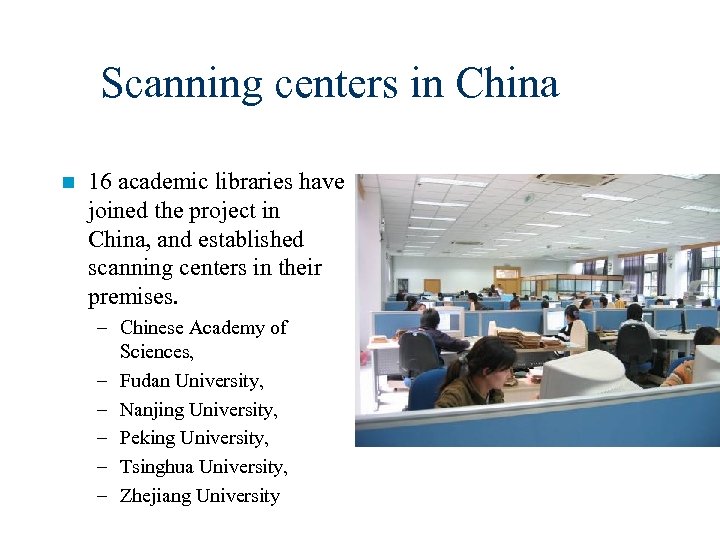
Scanning centers in China n 16 academic libraries have joined the project in China, and established scanning centers in their premises. – Chinese Academy of Sciences, – Fudan University, – Nanjing University, – Peking University, – Tsinghua University, – Zhejiang University
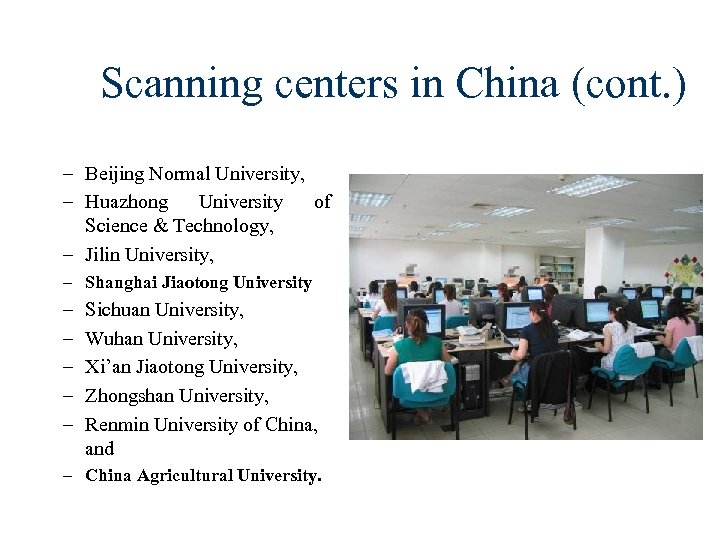
Scanning centers in China (cont. ) – Beijing Normal University, – Huazhong University of Science & Technology, – Jilin University, – Shanghai Jiaotong University – – – Sichuan University, Wuhan University, Xi’an Jiaotong University, Zhongshan University, Renmin University of China, and – China Agricultural University.
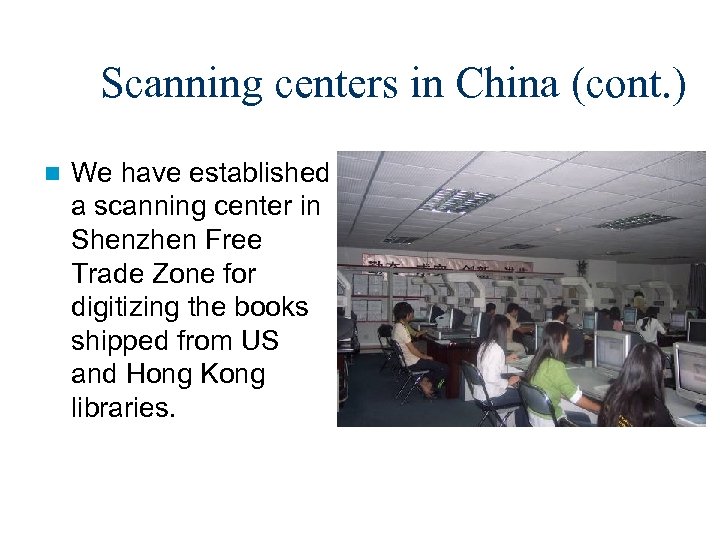
Scanning centers in China (cont. ) n We have established a scanning center in Shenzhen Free Trade Zone for digitizing the books shipped from US and Hong Kong libraries.
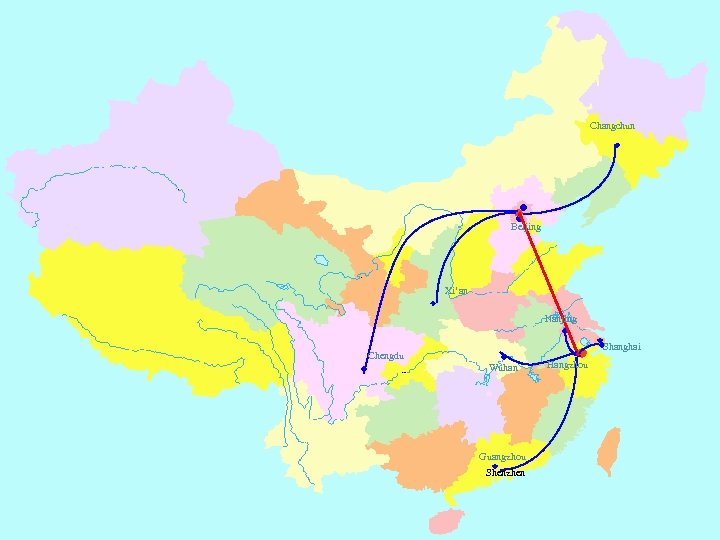
Changchun Beijing Xi’an Nanjing Chengdu Xi’an Wuhan Shanghai Hangzhou Nanjing Chengdu Shanghai Guangzhou Wuhan Shenzhen Hangzhou Scanning centers in China, 2005 Guangzhou Shenzhen
n Avoid duplication of scanning books. – 4 partners responsible for check duplication for 4 types of books respectively. n Quality Control (QC) – QC in scan and data production – QC after data submitted to SC (15 staff) and NC (7 staff)
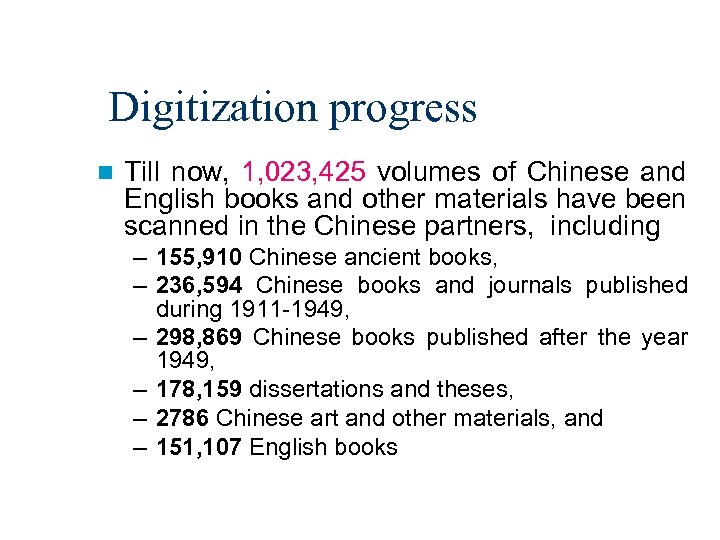
Digitization progress n Till now, 1, 023, 425 volumes of Chinese and English books and other materials have been scanned in the Chinese partners, including – 155, 910 Chinese ancient books, – 236, 594 Chinese books and journals published during 1911 -1949, – 298, 869 Chinese books published after the year 1949, – 178, 159 dissertations and theses, – 2786 Chinese art and other materials, and – 151, 107 English books
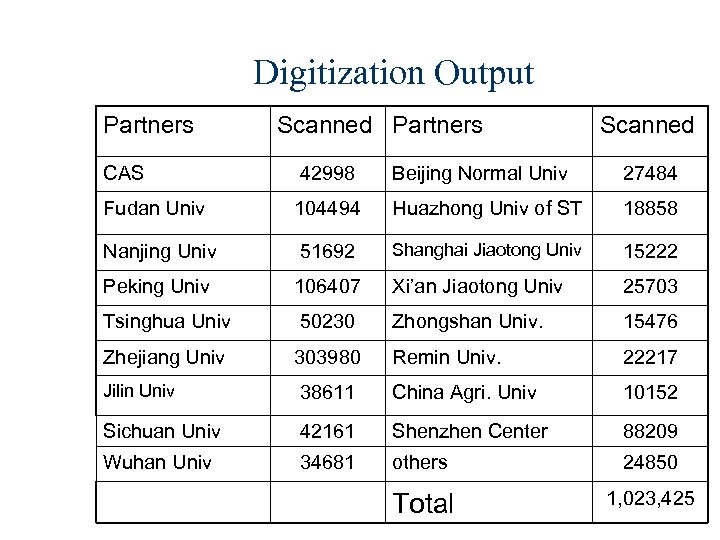
Digitization Output Partners Scanned CAS 42998 Beijing Normal Univ 27484 Fudan Univ 104494 Huazhong Univ of ST 18858 Nanjing Univ 51692 Shanghai Jiaotong Univ 15222 Peking Univ 106407 Xi’an Jiaotong Univ 25703 Tsinghua Univ 50230 Zhongshan Univ. 15476 Zhejiang Univ 303980 Remin Univ. 22217 Jilin Univ 38611 China Agri. Univ 10152 Sichuan Univ 42161 Shenzhen Center 88209 Wuhan Univ 34681 others 24850 Total 1, 023, 425
n Among the scanned books, about 300 thousand are still in the copyright protection duration. Why did we scan these books? – The status of collections. The books published before 1980’s are under poor conditions. – The central government of China passed new regulations about digitization and web service based on the Copyright Law.
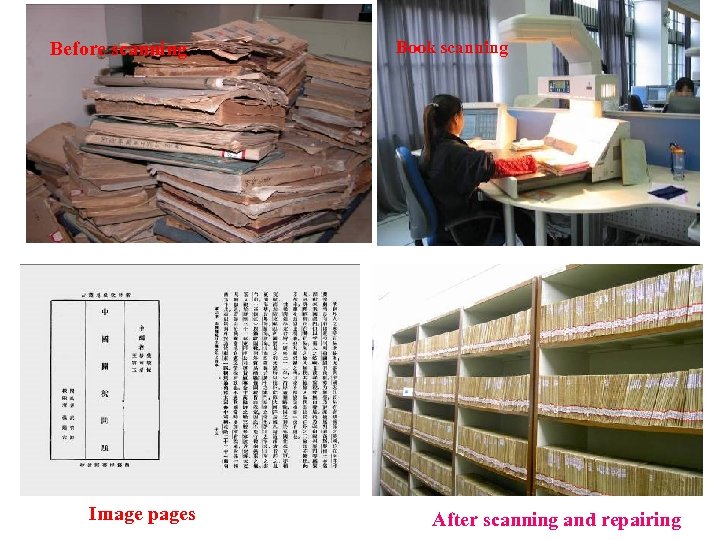
Before scanning Image pages Book scanning After scanning and repairing
New copyright regulations Regulations on Protection of Rights of Communication Via the Information Network came into effect on July 1, 2006. The library, archive and museum may digitize a published work in its collection for display or archiving, and provide the digital work with its own network for public reading to its readers within its premises, without permission from the copyright owner, and no remuneration is paid according to the regulations, but it should not get any economic benefits from the process. (Article 8)
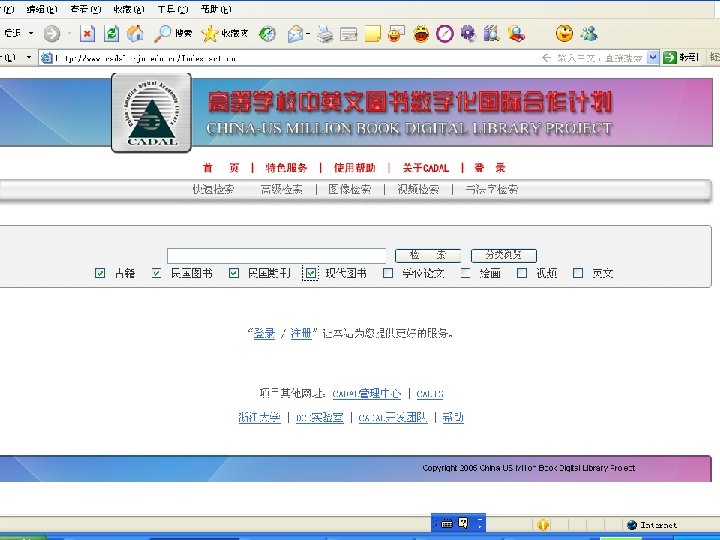
A portal to search and view the digital books was established: http: //www. cadal. zju. edu. cn
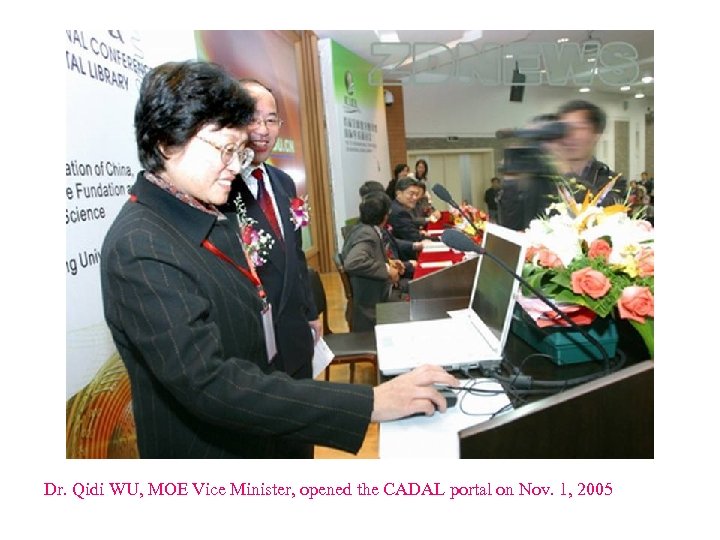
Dr. Qidi WU, MOE Vice Minister, opened the CADAL portal on Nov. 1, 2005
.
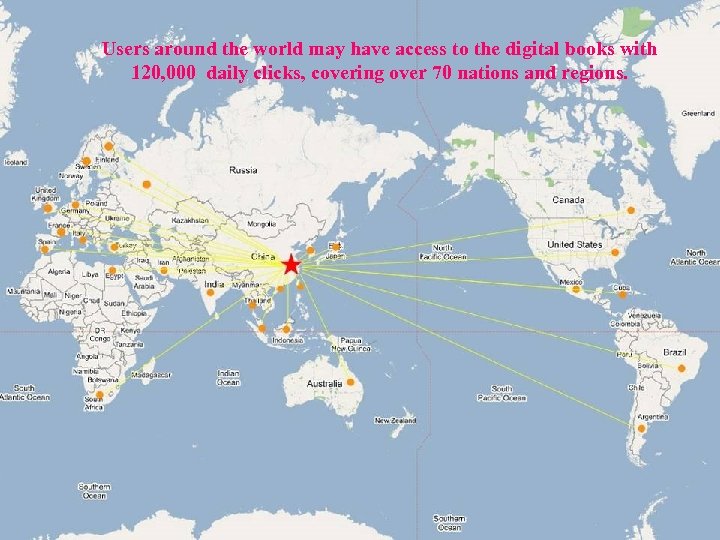
Users around the world may have access to the digital books with 120, 000 daily clicks, covering over 70 nations and regions.
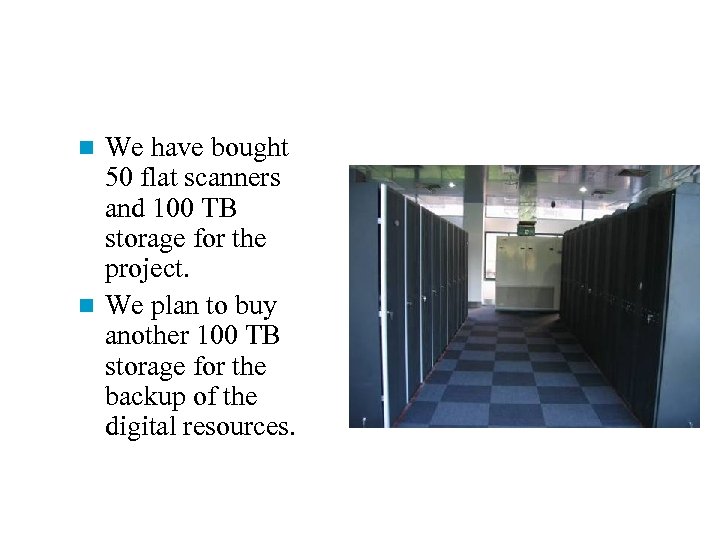
We have bought 50 flat scanners and 100 TB storage for the project. n We plan to buy another 100 TB storage for the backup of the digital resources. n
Next Plan n Scanning. The second 1 million books n Digital preservation. Storage and backup n Access. OCR, Infrastructure, Integration, Manpower and technical supports… n Cooperation. Domestic: develop new partners; International: technology and personnel exchange…
Conclusion n The first 1 million books have been scanned, and the digital resources have been freely accessed to and applied by the users around the world as well as the partners. CADAL Project for the Tenth-five Year Plan (2001 -2005) has passed the national appraisal for the achievements and accomplishments of the project objective.
n We are preparing the second phase of the project for the Eleventh-five Year (2006 -2010) Plan, and hope to scan next 1 million books and more materials in other formats, such as audios, videos, newspapers, microforms, paintings, photos, and so on. We hope CADAL project, as part of UDL, will make more and more great contributions in knowledge dissemination, academic communications and digital preservation of cultural treasures, beneficial for this and next generations.
We are looking forward more cooperative partners around the World in the next phase of CADAL project.
Thank you very much! November 19, 2006
Скачать презентацию Recent Progress in the Million Book Digital Library
675d36118fc6573801b3b9336749b896.ppt