 Скачать презентацию Recent Developments in Spatially Distributed Control Systems on
b6125c08765b7411d3dce0c23f227612.ppt
- Количество слайдов: 68




Recent Developments in Spatially Distributed Control Systems on the Paper Machine Greg Stewart and James Fan Honeywell, North Vancouver Presented by Guy Dumont University of British Columbia
Outline • Industrial Paper Machine Operation • Selected recent developments: - Automatic Tuning for Multiple Array Spatially Distributed Processes - Closed-Loop Identification of CD Controller Alignment 2 HONEYWELL - CONFIDENTIAL CDC-ECC'05 Seville, Spain

Industrial Paper Machine Operation
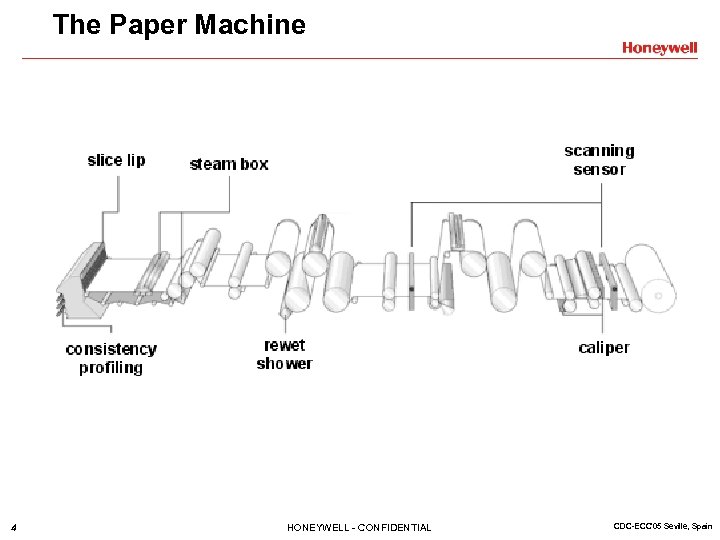
The Paper Machine 4 HONEYWELL - CONFIDENTIAL CDC-ECC'05 Seville, Spain
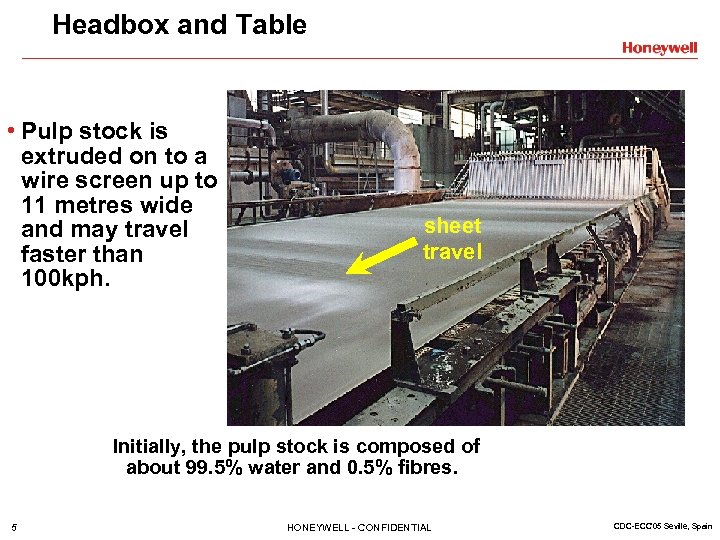
Headbox and Table • Pulp stock is extruded on to a wire screen up to 11 metres wide and may travel faster than 100 kph. sheet travel Initially, the pulp stock is composed of about 99. 5% water and 0. 5% fibres. 5 HONEYWELL - CONFIDENTIAL CDC-ECC'05 Seville, Spain
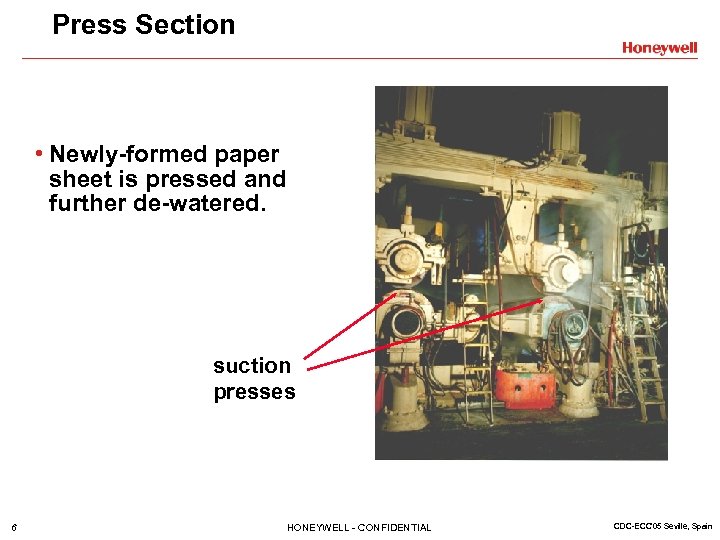
Press Section • Newly-formed paper sheet is pressed and further de-watered. suction presses 6 HONEYWELL - CONFIDENTIAL CDC-ECC'05 Seville, Spain
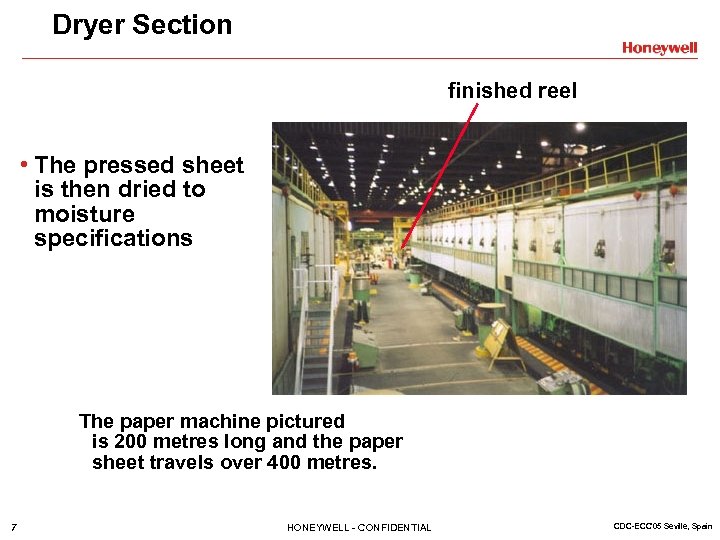
Dryer Section finished reel • The pressed sheet is then dried to moisture specifications The paper machine pictured is 200 metres long and the paper sheet travels over 400 metres. 7 HONEYWELL - CONFIDENTIAL CDC-ECC'05 Seville, Spain
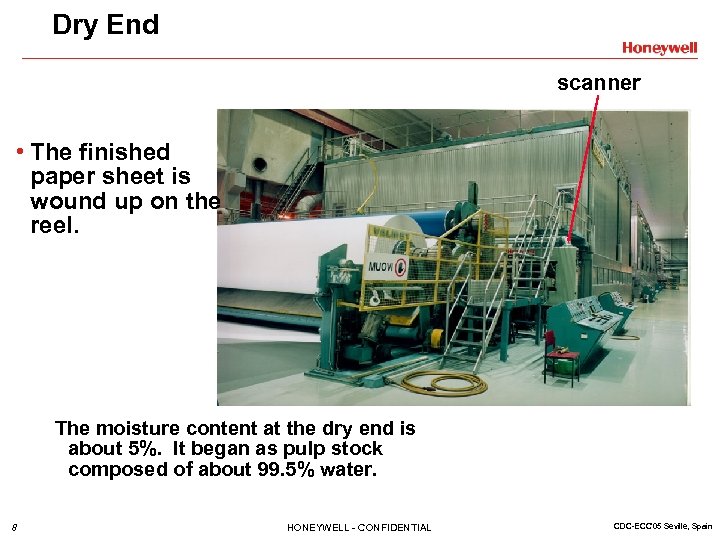
Dry End scanner • The finished paper sheet is wound up on the reel. The moisture content at the dry end is about 5%. It began as pulp stock composed of about 99. 5% water. 8 HONEYWELL - CONFIDENTIAL CDC-ECC'05 Seville, Spain
Control Objectives • Properties of interest: - weight - moisture content - caliper (thickness of sheet) - coating & misc. • Regulation problem: to maintain paper properties as close to targets as possible. • Variance is a measure of the product quality. 9 HONEYWELL - CONFIDENTIAL CDC-ECC'05 Seville, Spain
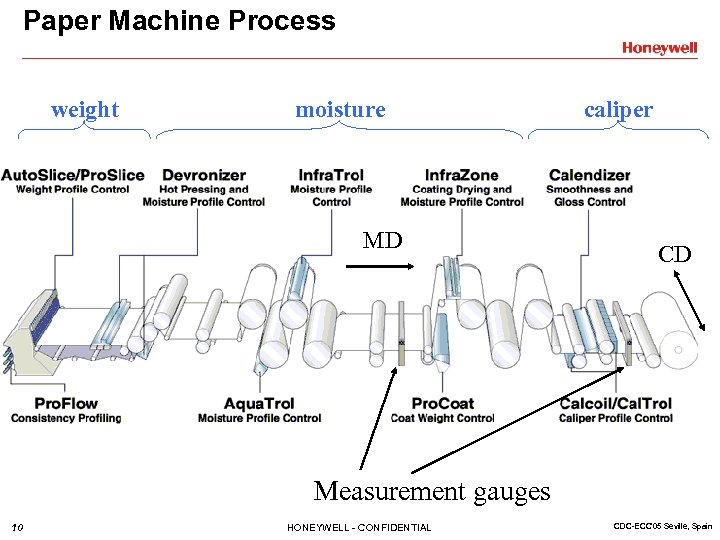
Paper Machine Process weight moisture MD caliper CD Measurement gauges 10 HONEYWELL - CONFIDENTIAL CDC-ECC'05 Seville, Spain
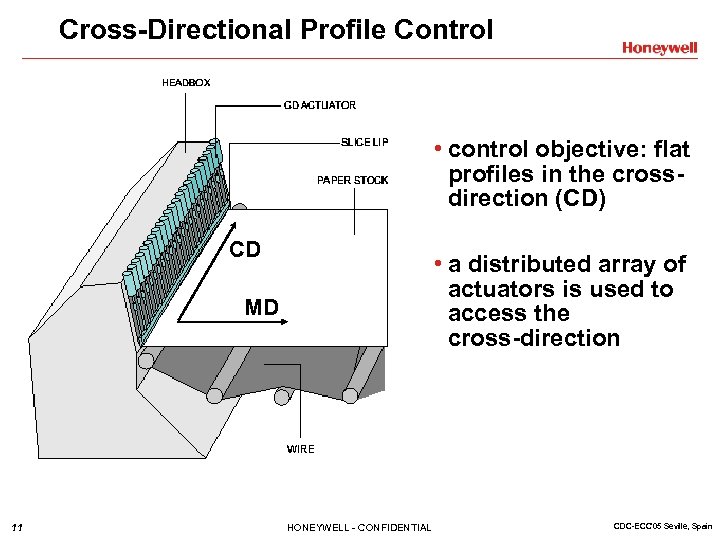
Cross-Directional Profile Control • control objective: flat profiles in the crossdirection (CD) CD • a distributed array of actuators is used to access the cross-direction MD 11 HONEYWELL - CONFIDENTIAL CDC-ECC'05 Seville, Spain
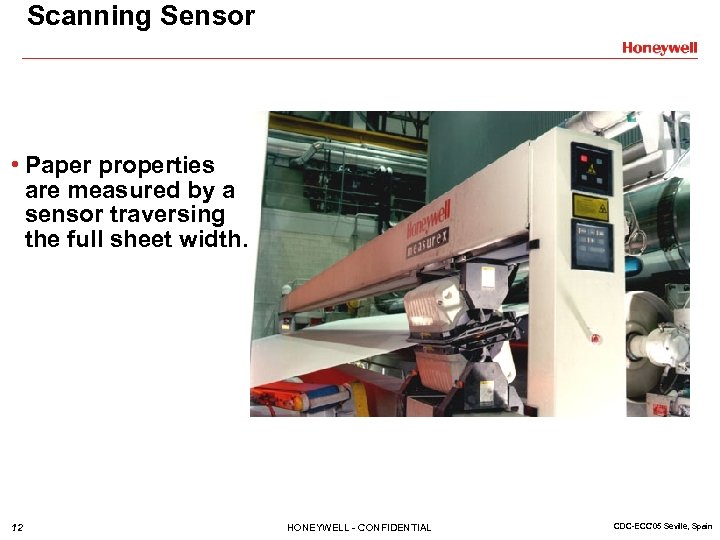
Scanning Sensor • Paper properties are measured by a sensor traversing the full sheet width. 12 HONEYWELL - CONFIDENTIAL CDC-ECC'05 Seville, Spain
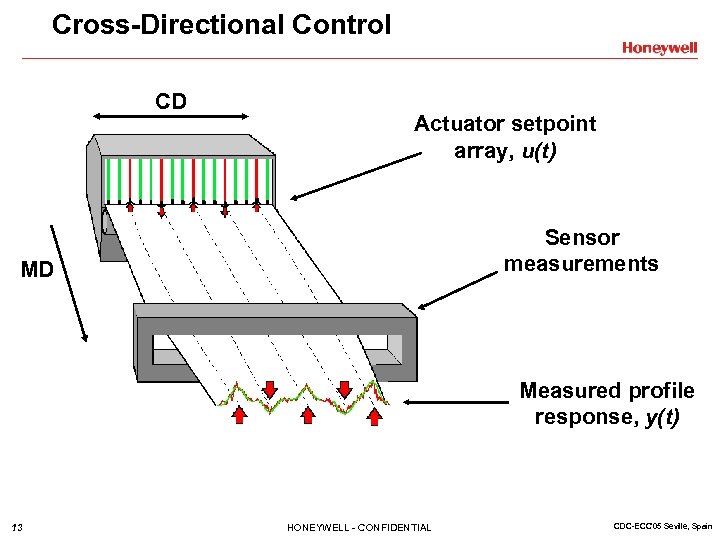
Cross-Directional Control CD Actuator setpoint array, u(t) Sensor measurements MD Measured profile response, y(t) 13 HONEYWELL - CONFIDENTIAL CDC-ECC'05 Seville, Spain
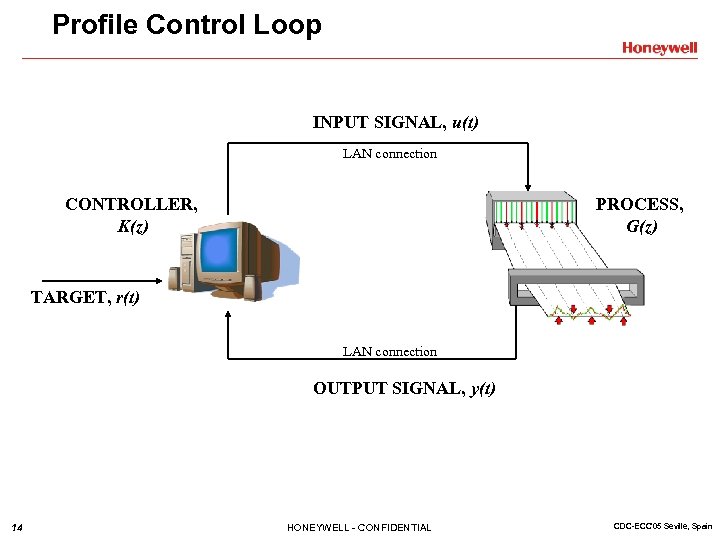
Profile Control Loop INPUT SIGNAL, u(t) LAN connection CONTROLLER, K(z) PROCESS, G(z) TARGET, r(t) LAN connection OUTPUT SIGNAL, y(t) 14 HONEYWELL - CONFIDENTIAL CDC-ECC'05 Seville, Spain
Supercalendering process • Supercalendering is often an off-machine process used in the production of high quality printing papers • The supercalendering objectives are to enhance paper surface properties such as gloss, caliper and smoothness • Typical end products are magazine paper, high end newsprint and label paper 15 HONEYWELL - CONFIDENTIAL CDC-ECC'05 Seville, Spain
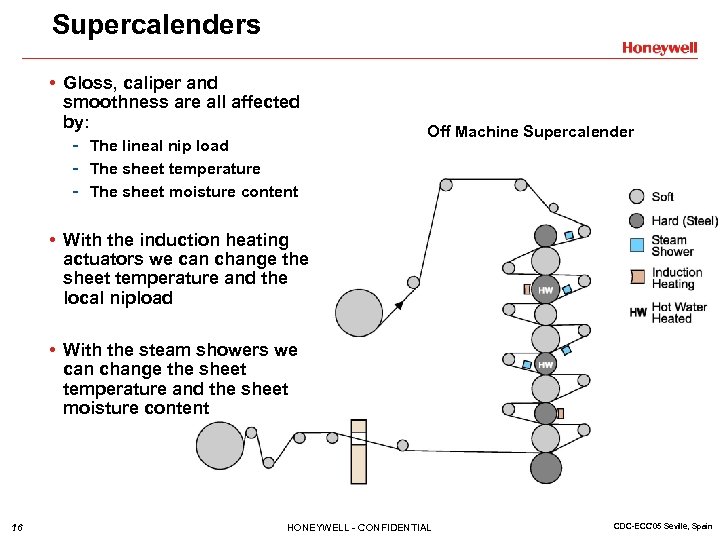
Supercalenders • Gloss, caliper and smoothness are all affected by: - The lineal nip load - The sheet temperature - The sheet moisture content Off Machine Supercalender • With the induction heating actuators we can change the sheet temperature and the local nipload • With the steam showers we can change the sheet temperature and the sheet moisture content 16 HONEYWELL - CONFIDENTIAL CDC-ECC'05 Seville, Spain

Automatic Tuning for Multiple Array Spatially Distributed Processes
Automated Tuning Overview • Control problem - Multi-array cross-directional process models - Industrial model predictive controller configuration • Objectives of automated tuning • Two-dimensional frequency domain • Tuning procedure • Industrial software and examples • Conclusions 18 HONEYWELL - CONFIDENTIAL CDC-ECC'05 Seville, Spain
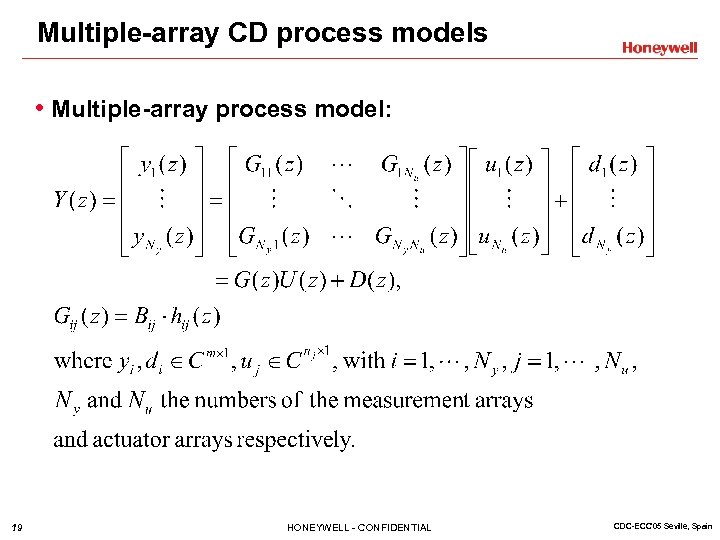
Multiple-array CD process models • Multiple-array process model: 19 HONEYWELL - CONFIDENTIAL CDC-ECC'05 Seville, Spain
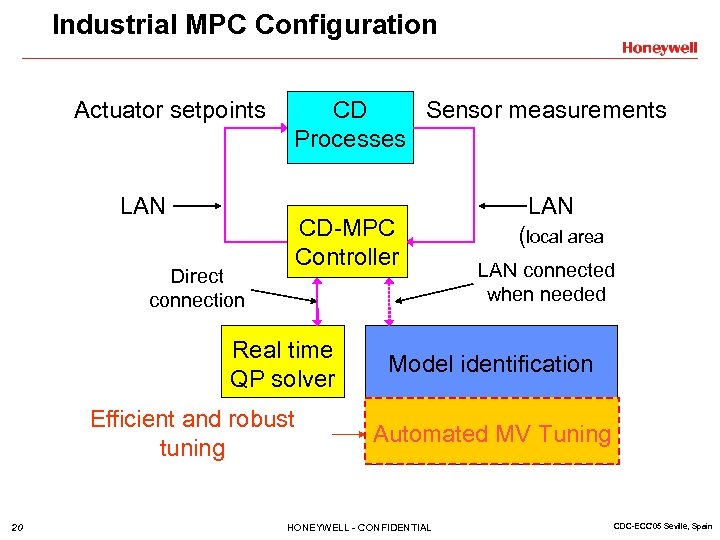
Industrial MPC Configuration Actuator setpoints LAN Direct connection CD Sensor measurements Processes CD-MPC Controller (local area LANnetwork) connected when needed Real time QP solver Trial and robust Efficientand error, Closed-loop simulations tuning 20 LAN Model identification CD-MPC weights and Automated MV Tuning closed-loop prediction HONEYWELL - CONFIDENTIAL CDC-ECC'05 Seville, Spain
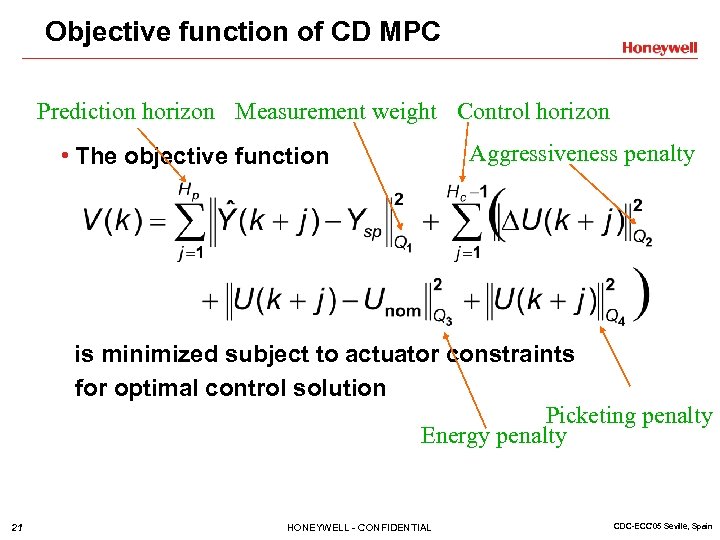
Objective function of CD MPC Prediction horizon Measurement weight Control horizon • The objective function Aggressiveness penalty is minimized subject to actuator constraints for optimal control solution Picketing penalty Energy penalty 21 HONEYWELL - CONFIDENTIAL CDC-ECC'05 Seville, Spain
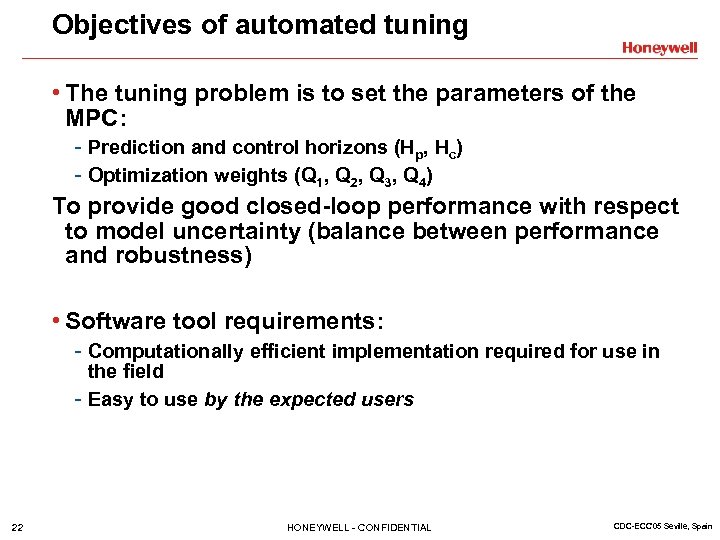
Objectives of automated tuning • The tuning problem is to set the parameters of the MPC: - Prediction and control horizons (Hp, Hc) - Optimization weights (Q 1, Q 2, Q 3, Q 4) To provide good closed-loop performance with respect to model uncertainty (balance between performance and robustness) • Software tool requirements: - Computationally efficient implementation required for use in the field - Easy to use by the expected users 22 HONEYWELL - CONFIDENTIAL CDC-ECC'05 Seville, Spain
Automated Tuning Overview • Control problem - Multi-array cross-directional process models - Industrial model predictive controller configuration • Objectives of automated tuning • Two-dimensional frequency domain • Tuning procedure • Industrial software and examples • Conclusions 23 HONEYWELL - CONFIDENTIAL CDC-ECC'05 Seville, Spain
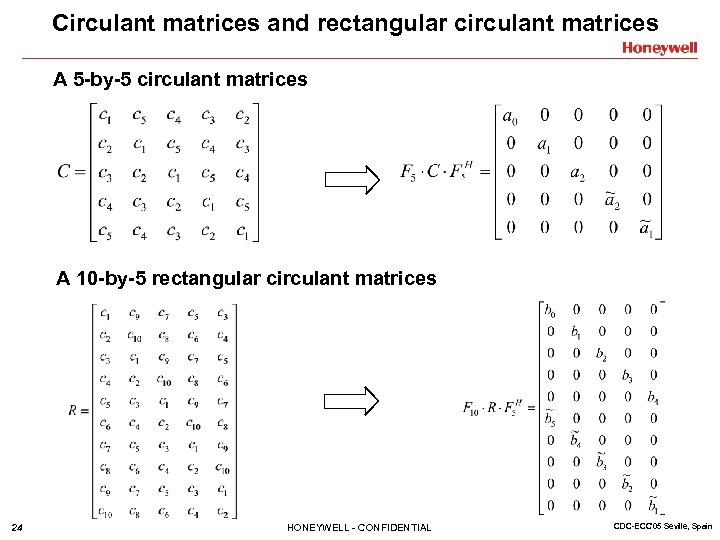
Circulant matrices and rectangular circulant matrices A 5 -by-5 circulant matrices A 10 -by-5 rectangular circulant matrices 24 HONEYWELL - CONFIDENTIAL CDC-ECC'05 Seville, Spain
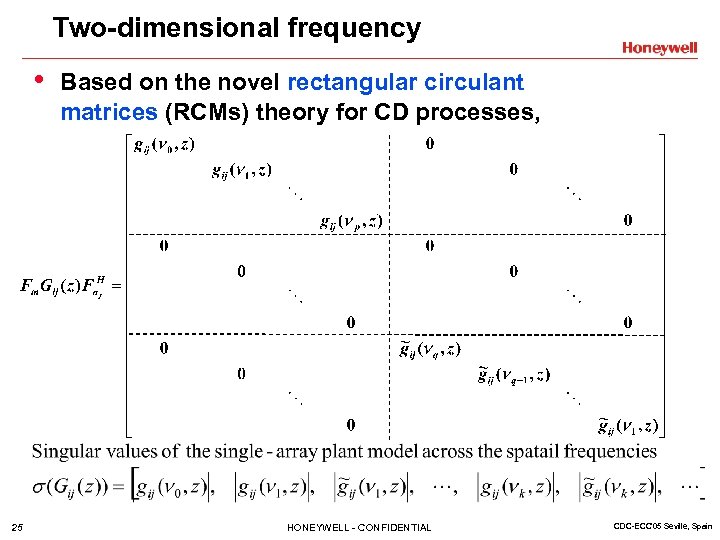
Two-dimensional frequency • 25 Based on the novel rectangular circulant matrices (RCMs) theory for CD processes, HONEYWELL - CONFIDENTIAL CDC-ECC'05 Seville, Spain
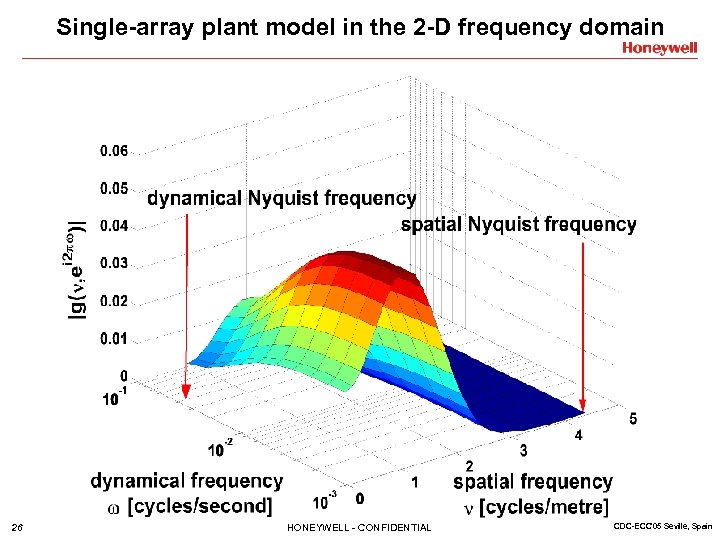
Single-array plant model in the 2 -D frequency domain 26 HONEYWELL - CONFIDENTIAL CDC-ECC'05 Seville, Spain
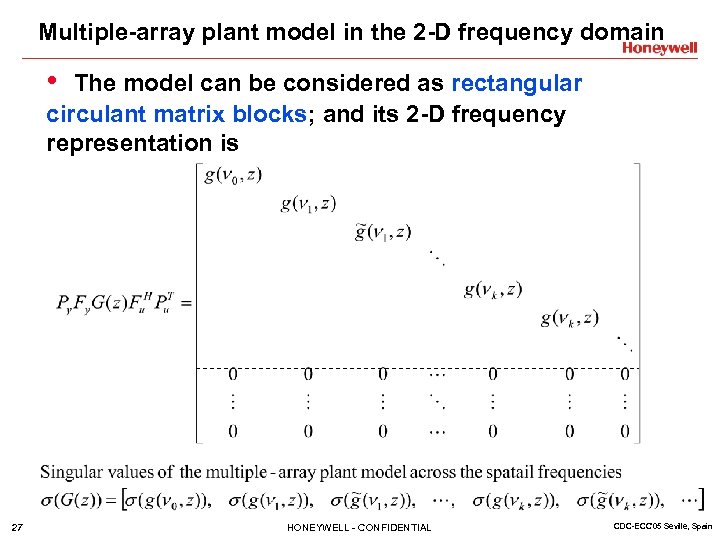
Multiple-array plant model in the 2 -D frequency domain • The model can be considered as rectangular circulant matrix blocks; and its 2 -D frequency representation is 27 HONEYWELL - CONFIDENTIAL CDC-ECC'05 Seville, Spain
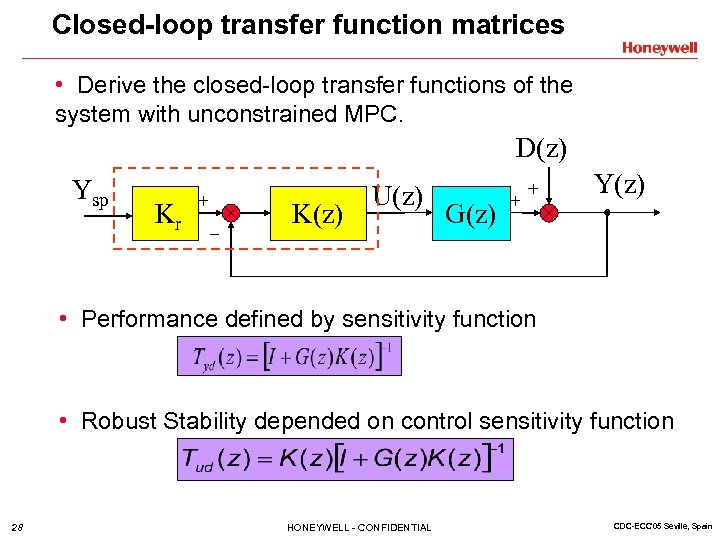
Closed-loop transfer function matrices • Derive the closed-loop transfer functions of the system with unconstrained MPC. D(z) Ysp Kr + _ K(z) U(z) G(z) + + Y(z) • Performance defined by sensitivity function • Robust Stability depended on control sensitivity function 28 HONEYWELL - CONFIDENTIAL CDC-ECC'05 Seville, Spain
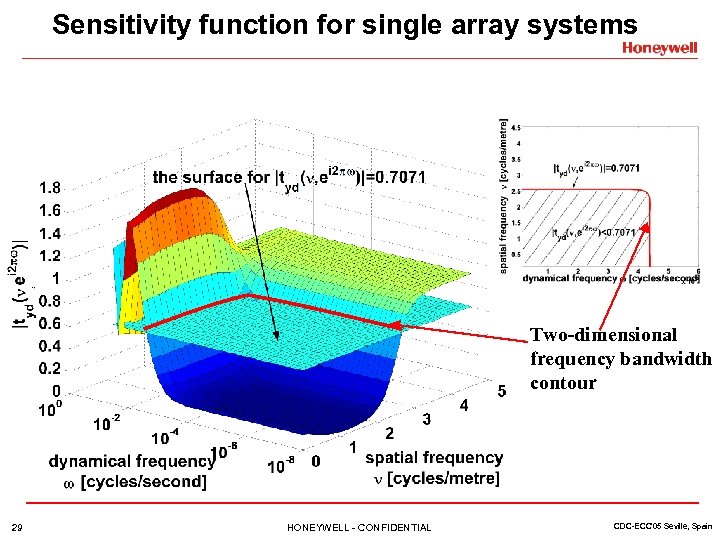
Sensitivity function for single array systems Two-dimensional frequency bandwidth contour 29 HONEYWELL - CONFIDENTIAL CDC-ECC'05 Seville, Spain
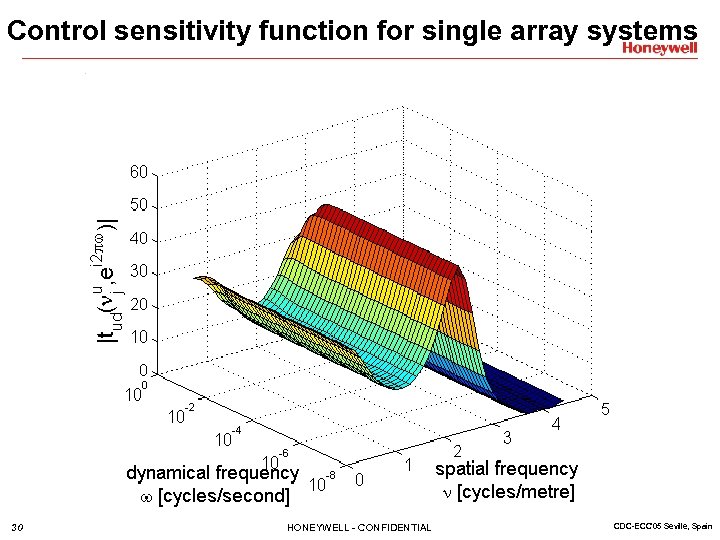
Control sensitivity function for single array systems 30 HONEYWELL - CONFIDENTIAL CDC-ECC'05 Seville, Spain
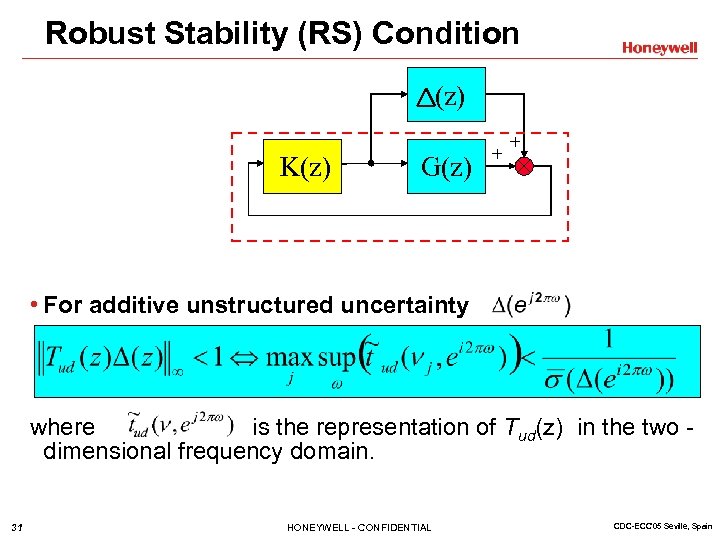
Robust Stability (RS) Condition (z) K(z) G(z) + + • For additive unstructured uncertainty where is the representation of Tud(z) in the two dimensional frequency domain. 31 HONEYWELL - CONFIDENTIAL CDC-ECC'05 Seville, Spain
Automated Tuning Overview • Control problem - Multi-array cross-directional process models - Industrial model predictive controller configuration • Objectives of automated tuning • Two-dimensional frequency domain • Tuning procedure • Industrial software and examples • Conclusions 32 HONEYWELL - CONFIDENTIAL CDC-ECC'05 Seville, Spain
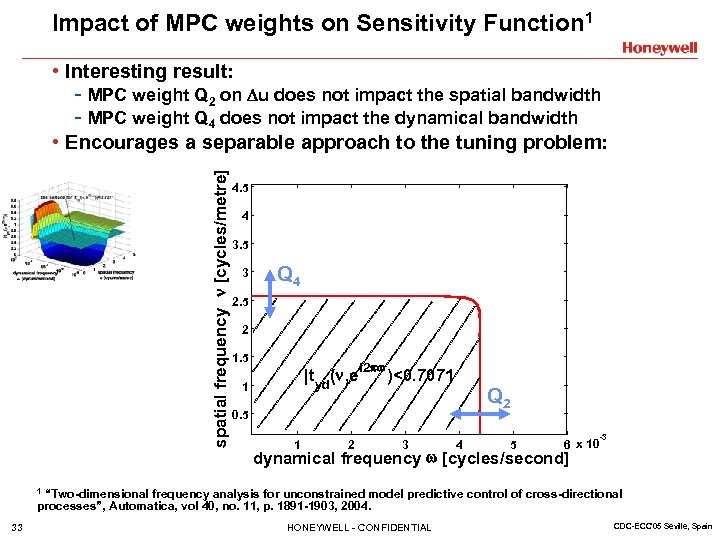
Impact of MPC weights on Sensitivity Function 1 • Interesting result: - MPC weight Q 2 on u does not impact the spatial bandwidth - MPC weight Q 4 does not impact the dynamical bandwidth spatial frequency n [cycles/metre] • Encourages a separable approach to the tuning problem: 4. 5 4 3. 5 3 Q 4 2. 5 2 1. 5 |tyd(n , e 1 i 2 p )<0. 7071 Q 2 0. 5 1 2 3 4 5 -3 6 x 10 dynamical frequency [cycles/second] “Two-dimensional frequency analysis for unconstrained model predictive control of cross-directional processes”, Automatica, vol 40, no. 11, p. 1891 -1903, 2004. 1 33 HONEYWELL - CONFIDENTIAL CDC-ECC'05 Seville, Spain
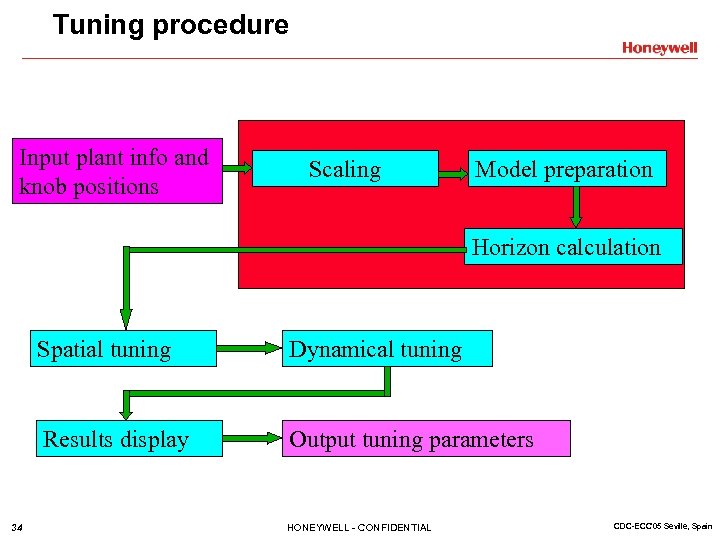
Tuning procedure Input plant info and knob positions Scaling Model preparation Horizon calculation Spatial tuning Results display 34 Dynamical tuning Output tuning parameters HONEYWELL - CONFIDENTIAL CDC-ECC'05 Seville, Spain
Automated Tuning Overview • Control problem - Multi-array cross-directional process models - Industrial model predictive controller configuration • Objectives of automated tuning • Two-dimensional frequency domain • Tuning procedure • Industrial software and examples • Conclusions 35 HONEYWELL - CONFIDENTIAL CDC-ECC'05 Seville, Spain
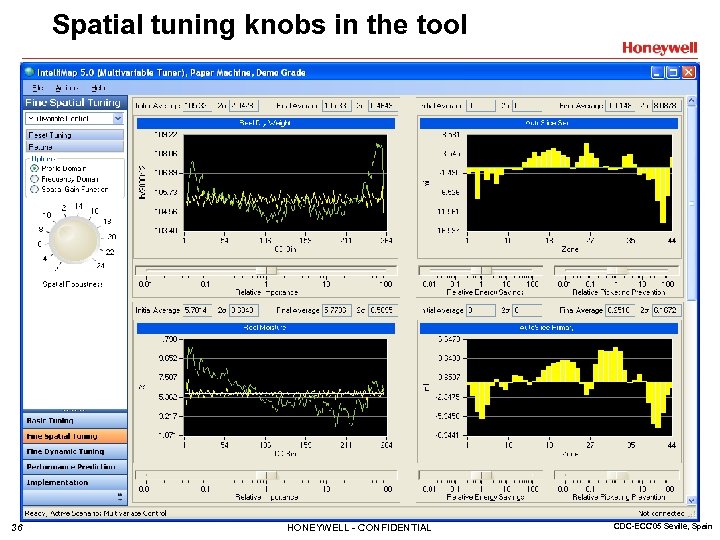
Spatial tuning knobs in the tool 36 HONEYWELL - CONFIDENTIAL CDC-ECC'05 Seville, Spain
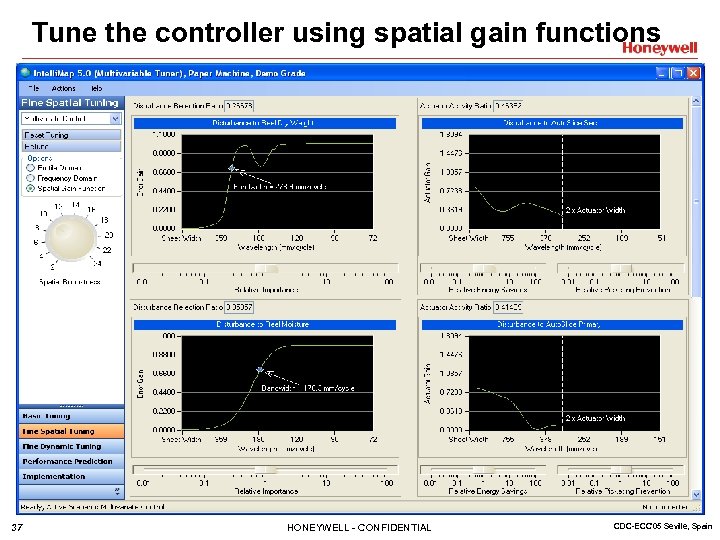
Tune the controller using spatial gain functions 37 HONEYWELL - CONFIDENTIAL CDC-ECC'05 Seville, Spain
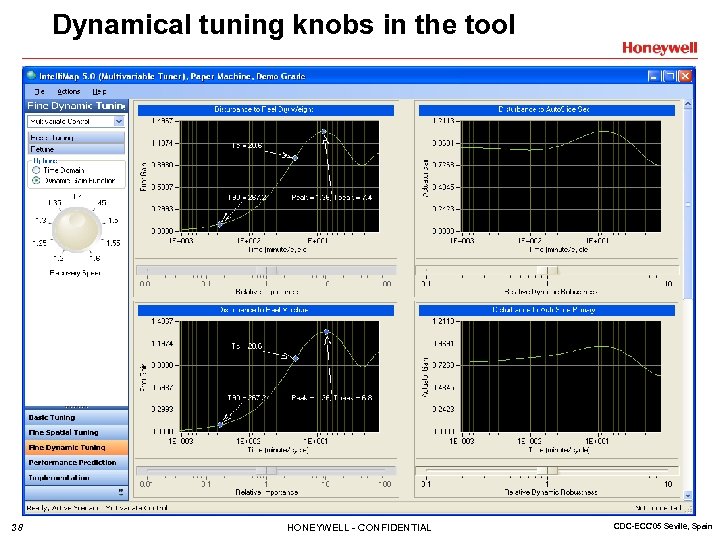
Dynamical tuning knobs in the tool 38 HONEYWELL - CONFIDENTIAL CDC-ECC'05 Seville, Spain
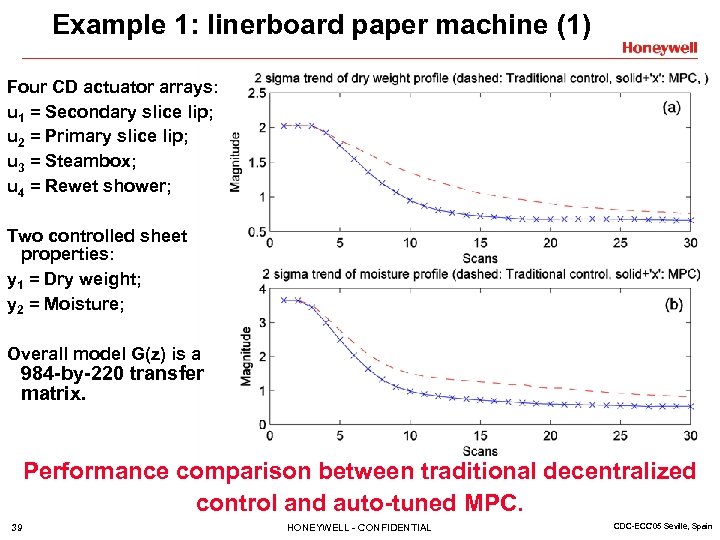
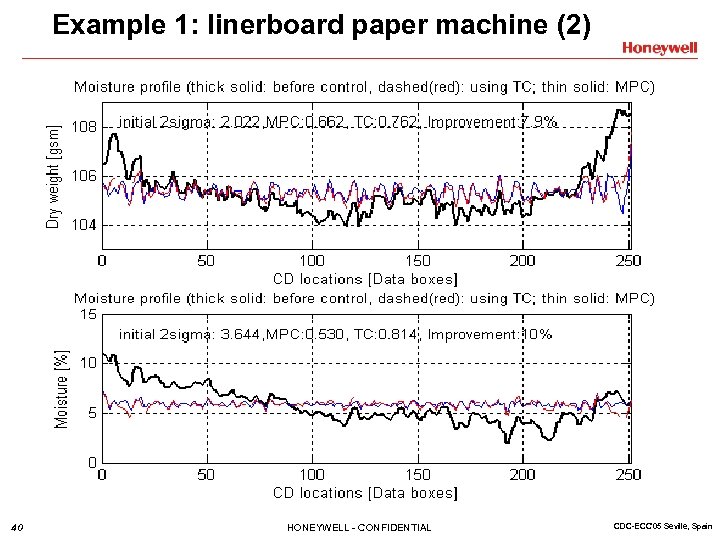
Example 1: linerboard paper machine (1) Four CD actuator arrays: u 1 = Secondary slice lip; u 2 = Primary slice lip; u 3 = Steambox; u 4 = Rewet shower; Two controlled sheet properties: y 1 = Dry weight; y 2 = Moisture; Overall model G(z) is a 984 -by-220 transfer matrix. Performance comparison between traditional decentralized control and auto-tuned MPC. 39 HONEYWELL - CONFIDENTIAL CDC-ECC'05 Seville, Spain
Example 1: linerboard paper machine (2) 40 HONEYWELL - CONFIDENTIAL CDC-ECC'05 Seville, Spain
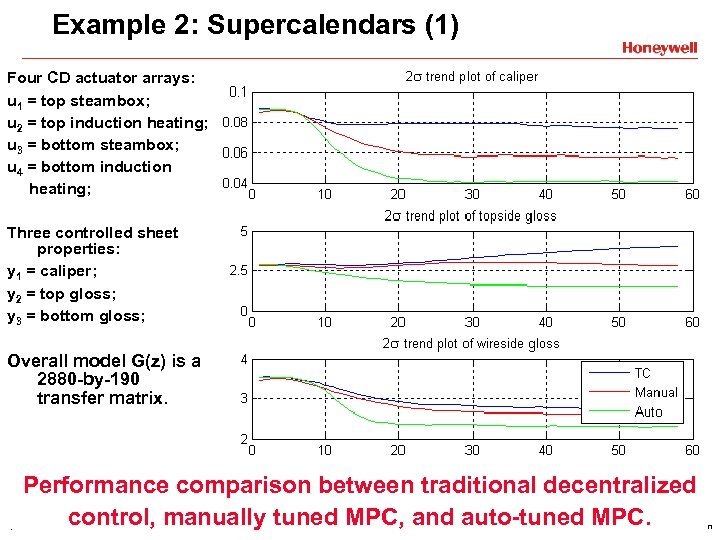
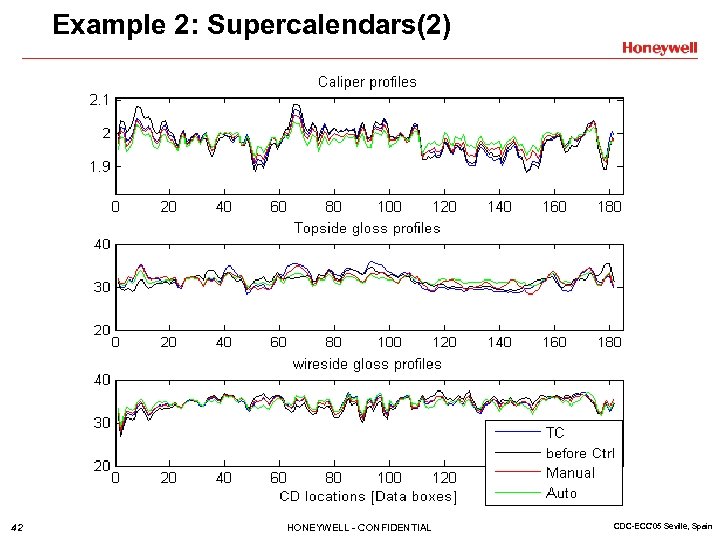
Example 2: Supercalendars (1) Four CD actuator arrays: u 1 = top steambox; u 2 = top induction heating; u 3 = bottom steambox; u 4 = bottom induction heating; Three controlled sheet properties: y 1 = caliper; y 2 = top gloss; y 3 = bottom gloss; Overall model G(z) is a 2880 -by-190 transfer matrix. Performance comparison between traditional decentralized control, manually tuned MPC, and auto-tuned MPC. 41 HONEYWELL - CONFIDENTIAL CDC-ECC'05 Seville, Spain
Example 2: Supercalendars(2) 42 HONEYWELL - CONFIDENTIAL CDC-ECC'05 Seville, Spain
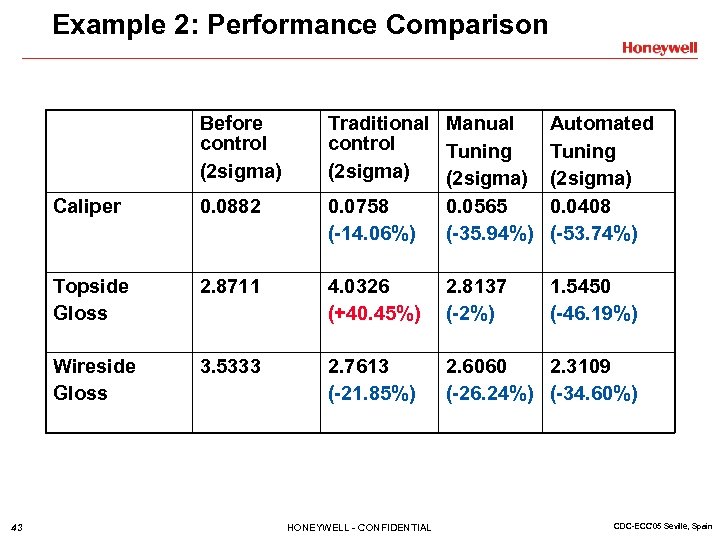
Example 2: Performance Comparison Before control (2 sigma) Traditional Manual control Tuning (2 sigma) 0. 0758 0. 0565 (-14. 06%) (-35. 94%) Automated Tuning (2 sigma) 0. 0408 (-53. 74%) 1. 5450 (-46. 19%) Caliper Topside Gloss 2. 8711 4. 0326 (+40. 45%) 2. 8137 (-2%) Wireside Gloss 43 0. 0882 3. 5333 2. 7613 (-21. 85%) 2. 6060 2. 3109 (-26. 24%) (-34. 60%) HONEYWELL - CONFIDENTIAL CDC-ECC'05 Seville, Spain
Conclusions • A technique was presented for solving an industrial controller tuning problem – multi-array crossdirectional model predictive control. • To be tractable the technique leverages spatiallyinvariant properties of the system. • Implemented in an industrial software tool. • Controller performance was demonstrated for two different processes. 44 HONEYWELL - CONFIDENTIAL CDC-ECC'05 Seville, Spain
Closed-Loop Identification of CD Controller Alignment
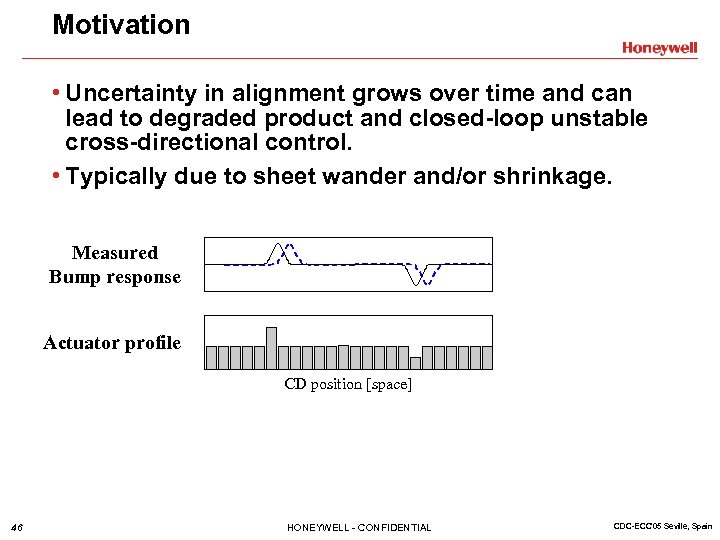
Motivation • Uncertainty in alignment grows over time and can lead to degraded product and closed-loop unstable cross-directional control. • Typically due to sheet wander and/or shrinkage. Measured Bump response Actuator profile CD position [space] 46 HONEYWELL - CONFIDENTIAL CDC-ECC'05 Seville, Spain
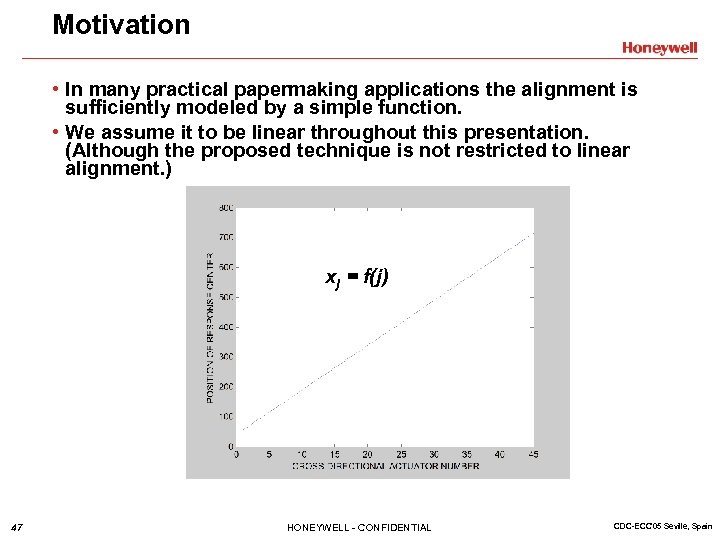
Motivation • In many practical papermaking applications the alignment is sufficiently modeled by a simple function. • We assume it to be linear throughout this presentation. (Although the proposed technique is not restricted to linear alignment. ) xj = f(j) 47 HONEYWELL - CONFIDENTIAL CDC-ECC'05 Seville, Spain

Current and Proposed Solutions 48 HONEYWELL - CONFIDENTIAL CDC-ECC'05 Seville, Spain
Solutions for Identification of Alignment Current Industrial Solutions: - Open-Loop Bumptest - Closed-Loop Probing Proposed Solution: - Closed-loop bumptest 49 HONEYWELL - CONFIDENTIAL CDC-ECC'05 Seville, Spain
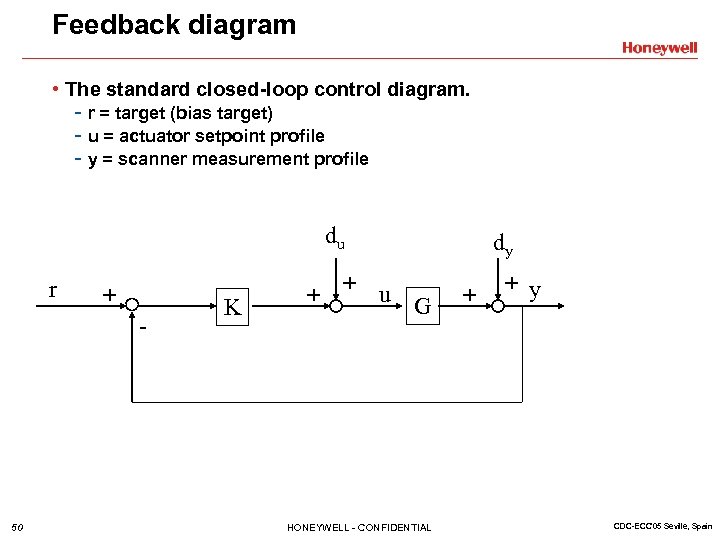
Feedback diagram • The standard closed-loop control diagram. - r = target (bias target) - u = actuator setpoint profile - y = scanner measurement profile du r + - 50 K + + u G HONEYWELL - CONFIDENTIAL dy + + y CDC-ECC'05 Seville, Spain
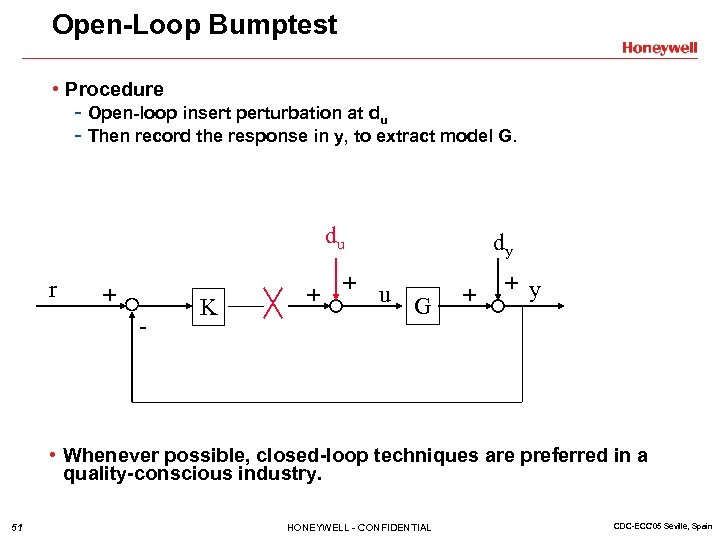
Open-Loop Bumptest • Procedure - Open-loop insert perturbation at du - Then record the response in y, to extract model G. du r + - K + + u G dy + + y • Whenever possible, closed-loop techniques are preferred in a quality-conscious industry. 51 HONEYWELL - CONFIDENTIAL CDC-ECC'05 Seville, Spain
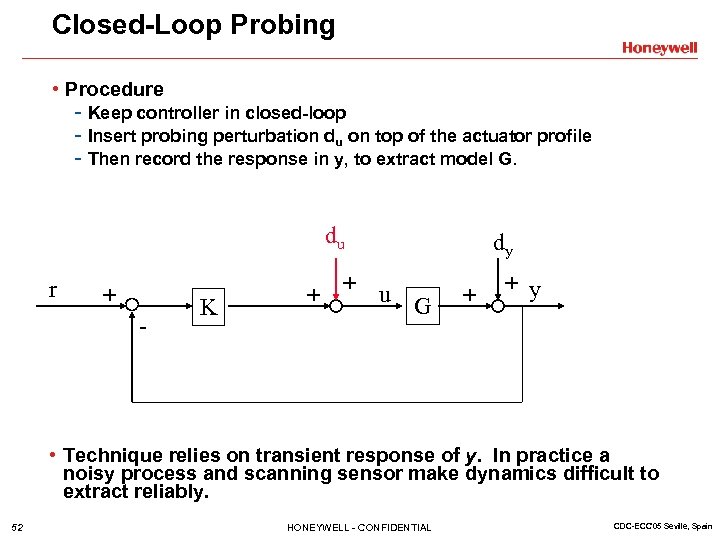
Closed-Loop Probing • Procedure - Keep controller in closed-loop - Insert probing perturbation du on top of the actuator profile - Then record the response in y, to extract model G. du r + - K + + u G dy + + y • Technique relies on transient response of y. In practice a noisy process and scanning sensor make dynamics difficult to extract reliably. 52 HONEYWELL - CONFIDENTIAL CDC-ECC'05 Seville, Spain
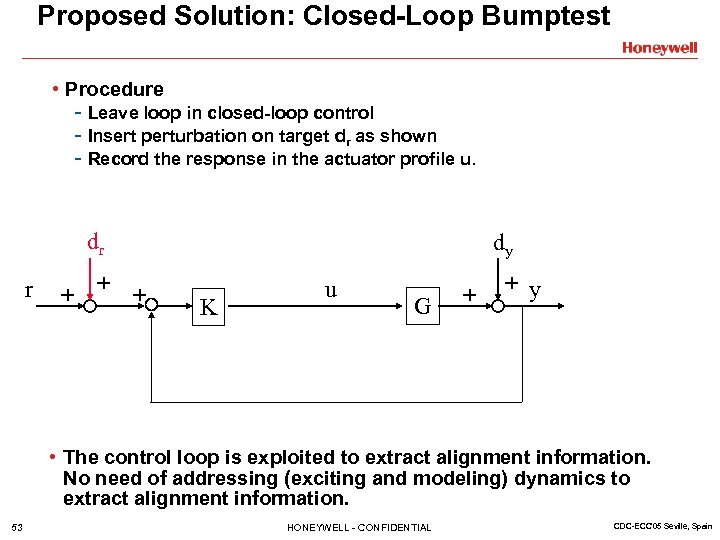
Proposed Solution: Closed-Loop Bumptest • Procedure - Leave loop in closed-loop control - Insert perturbation on target dr as shown - Record the response in the actuator profile u. dr r + + + dy K u G + + y • The control loop is exploited to extract alignment information. No need of addressing (exciting and modeling) dynamics to extract alignment information. 53 HONEYWELL - CONFIDENTIAL CDC-ECC'05 Seville, Spain

Overview of Background Theory 54 HONEYWELL - CONFIDENTIAL CDC-ECC'05 Seville, Spain
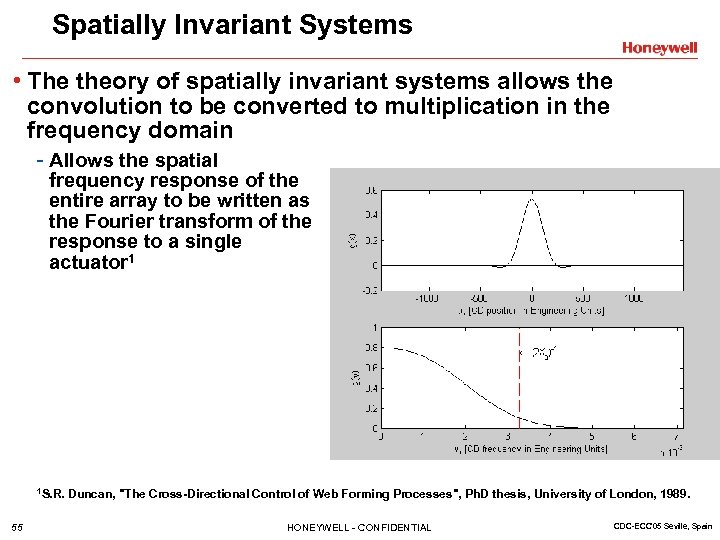
Spatially Invariant Systems • The theory of spatially invariant systems allows the convolution to be converted to multiplication in the frequency domain - Allows the spatial frequency response of the entire array to be written as the Fourier transform of the response to a single actuator 1 1 S. R. 55 Duncan, "The Cross-Directional Control of Web Forming Processes", Ph. D thesis, University of London, 1989. HONEYWELL - CONFIDENTIAL CDC-ECC'05 Seville, Spain
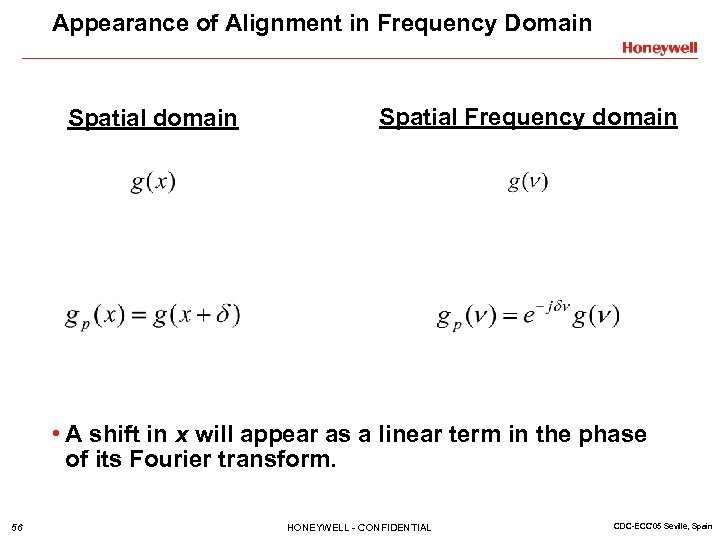
Appearance of Alignment in Frequency Domain Spatial domain Spatial Frequency domain • A shift in x will appear as a linear term in the phase of its Fourier transform. 56 HONEYWELL - CONFIDENTIAL CDC-ECC'05 Seville, Spain
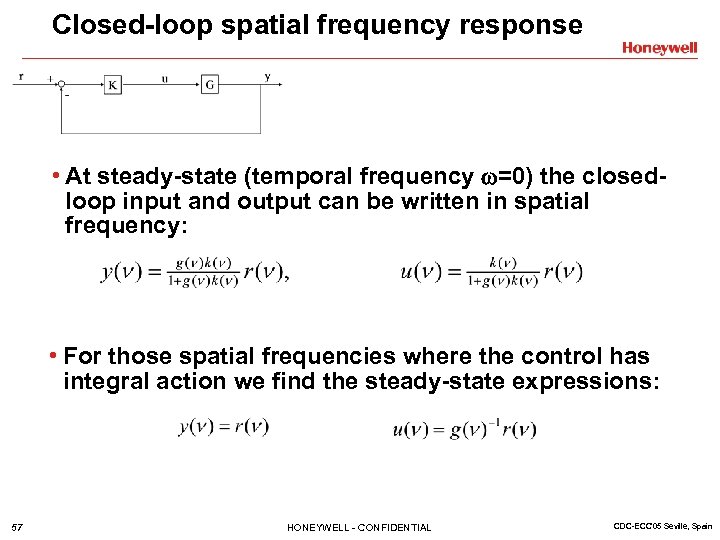
Closed-loop spatial frequency response • At steady-state (temporal frequency =0) the closedloop input and output can be written in spatial frequency: • For those spatial frequencies where the control has integral action we find the steady-state expressions: 57 HONEYWELL - CONFIDENTIAL CDC-ECC'05 Seville, Spain
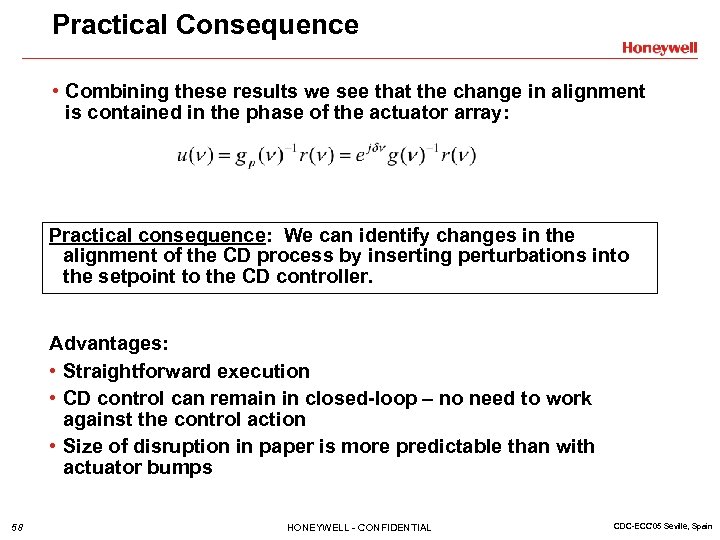
Practical Consequence • Combining these results we see that the change in alignment is contained in the phase of the actuator array: Practical consequence: We can identify changes in the alignment of the CD process by inserting perturbations into the setpoint to the CD controller. Advantages: • Straightforward execution • CD control can remain in closed-loop – no need to work against the control action • Size of disruption in paper is more predictable than with actuator bumps 58 HONEYWELL - CONFIDENTIAL CDC-ECC'05 Seville, Spain

Example 59 HONEYWELL - CONFIDENTIAL CDC-ECC'05 Seville, Spain
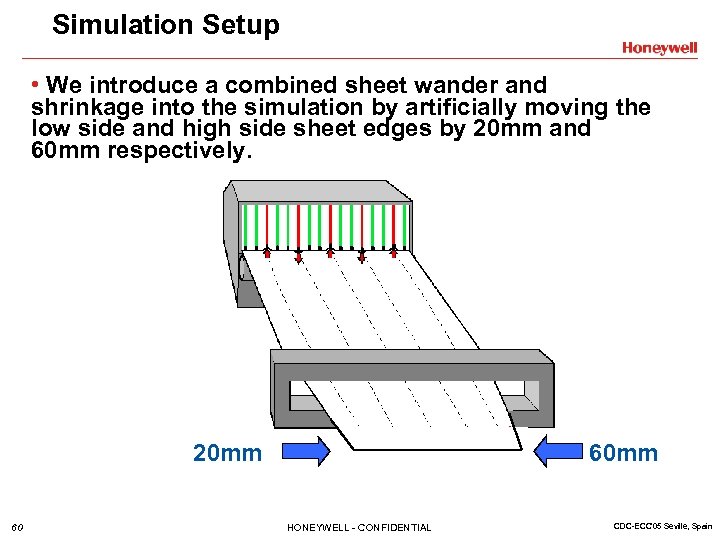
Simulation Setup • We introduce a combined sheet wander and shrinkage into the simulation by artificially moving the low side and high side sheet edges by 20 mm and 60 mm respectively. 20 mm 60 60 mm HONEYWELL - CONFIDENTIAL CDC-ECC'05 Seville, Spain
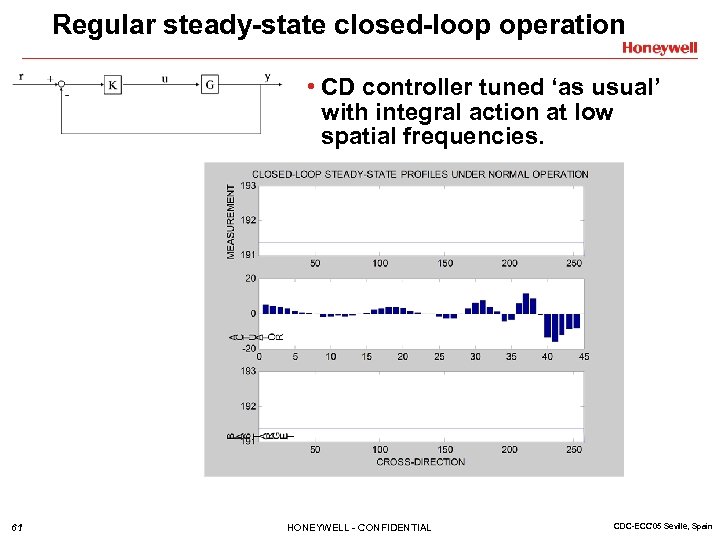
Regular steady-state closed-loop operation • CD controller tuned ‘as usual’ with integral action at low spatial frequencies. 61 HONEYWELL - CONFIDENTIAL CDC-ECC'05 Seville, Spain
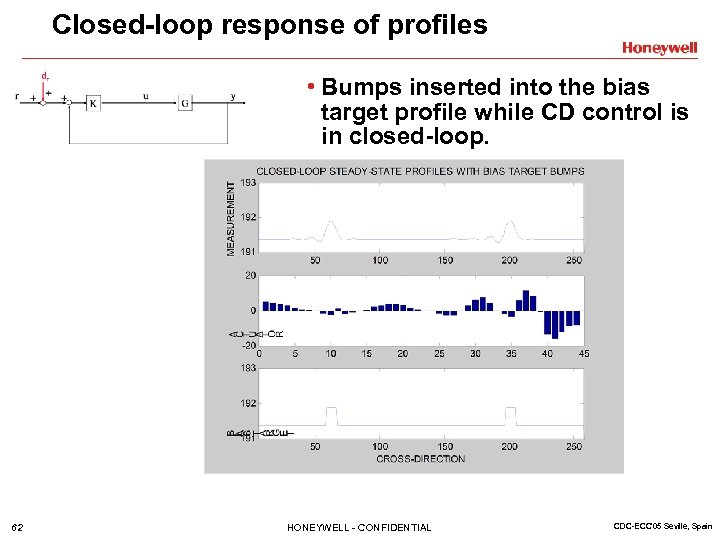
Closed-loop response of profiles • Bumps inserted into the bias target profile while CD control is in closed-loop. 62 HONEYWELL - CONFIDENTIAL CDC-ECC'05 Seville, Spain
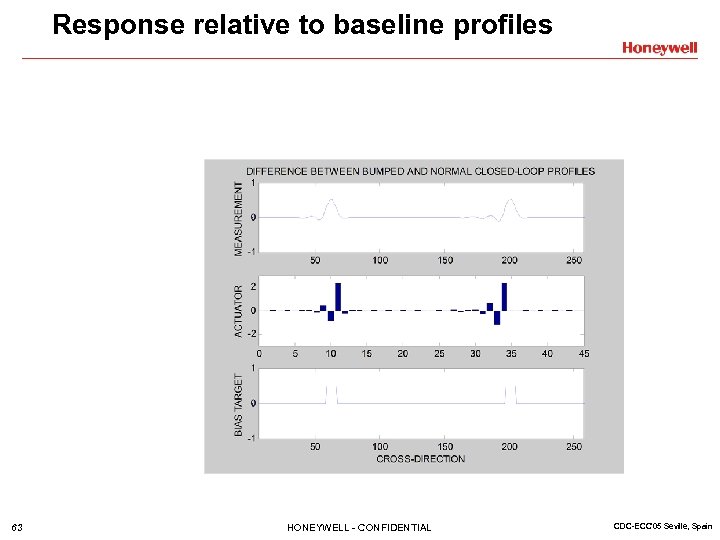
Response relative to baseline profiles 63 HONEYWELL - CONFIDENTIAL CDC-ECC'05 Seville, Spain
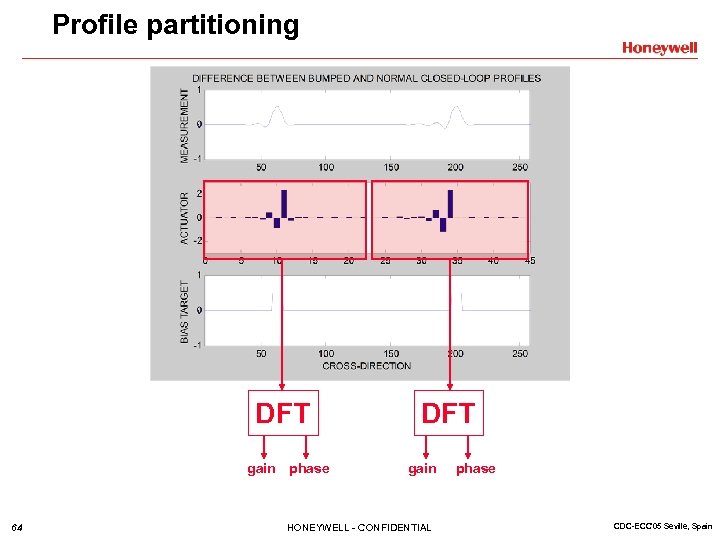
Profile partitioning DFT gain phase 64 DFT gain HONEYWELL - CONFIDENTIAL phase CDC-ECC'05 Seville, Spain
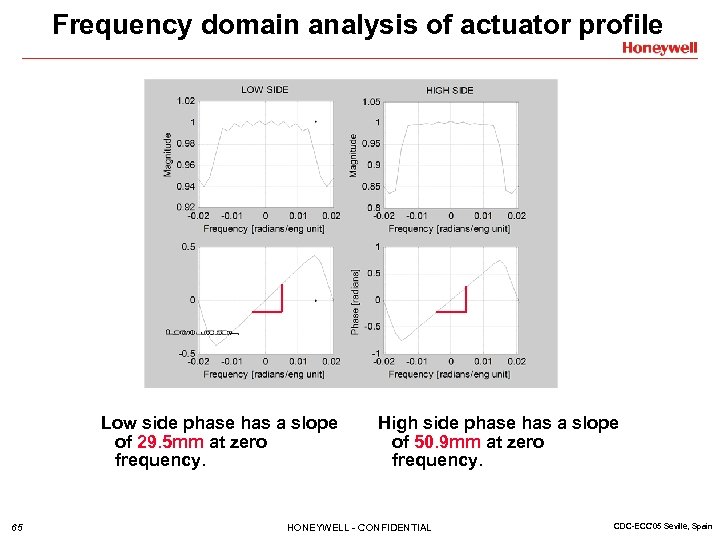
Frequency domain analysis of actuator profile Low side phase has a slope of 29. 5 mm at zero frequency. 65 High side phase has a slope of 50. 9 mm at zero frequency. HONEYWELL - CONFIDENTIAL CDC-ECC'05 Seville, Spain
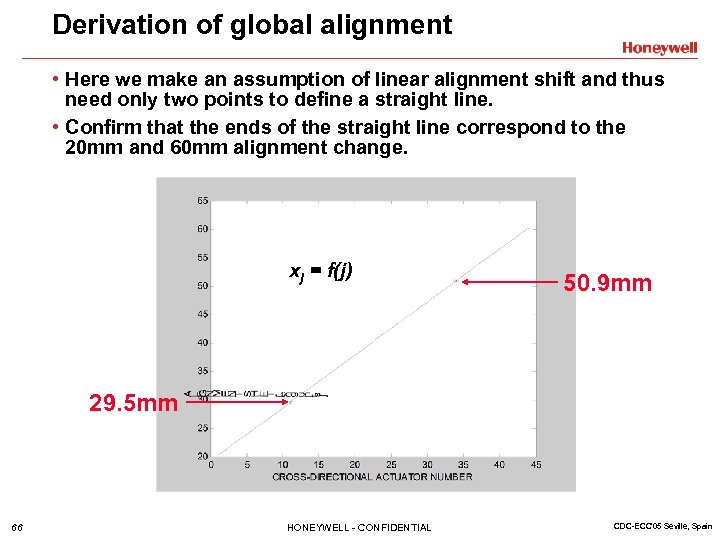
Derivation of global alignment • Here we make an assumption of linear alignment shift and thus need only two points to define a straight line. • Confirm that the ends of the straight line correspond to the 20 mm and 60 mm alignment change. xj = f(j) 50. 9 mm 29. 5 mm 66 HONEYWELL - CONFIDENTIAL CDC-ECC'05 Seville, Spain
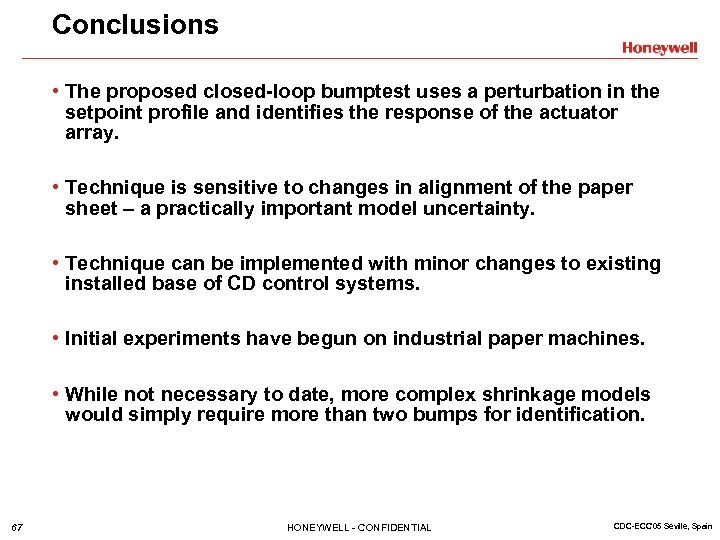
Conclusions • The proposed closed-loop bumptest uses a perturbation in the setpoint profile and identifies the response of the actuator array. • Technique is sensitive to changes in alignment of the paper sheet – a practically important model uncertainty. • Technique can be implemented with minor changes to existing installed base of CD control systems. • Initial experiments have begun on industrial paper machines. • While not necessary to date, more complex shrinkage models would simply require more than two bumps for identification. 67 HONEYWELL - CONFIDENTIAL CDC-ECC'05 Seville, Spain
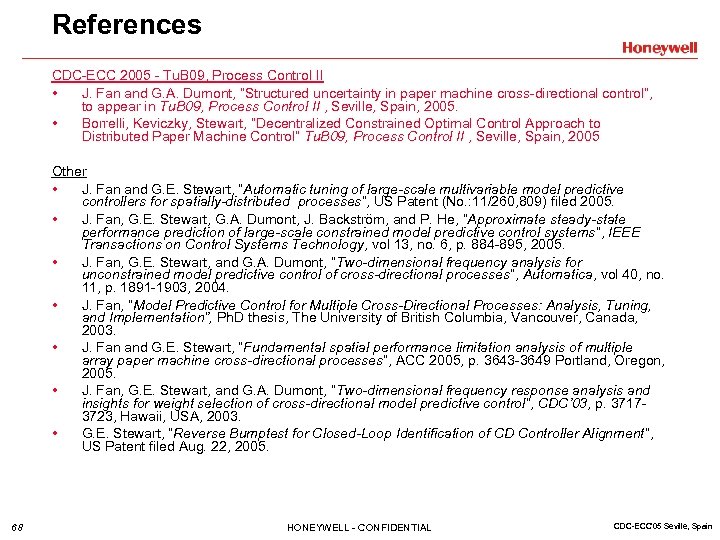
References CDC-ECC 2005 - Tu. B 09, Process Control II • J. Fan and G. A. Dumont, “Structured uncertainty in paper machine cross-directional control”, to appear in Tu. B 09, Process Control II , Seville, Spain, 2005. • Borrelli, Keviczky, Stewart, “Decentralized Constrained Optimal Control Approach to Distributed Paper Machine Control” Tu. B 09, Process Control II , Seville, Spain, 2005 Other • J. Fan and G. E. Stewart, “Automatic tuning of large-scale multivariable model predictive controllers for spatially-distributed processes”, US Patent (No. : 11/260, 809) filed 2005. • J. Fan, G. E. Stewart, G. A. Dumont, J. Backström, and P. He, “Approximate steady-state performance prediction of large-scale constrained model predictive control systems”, IEEE Transactions on Control Systems Technology, vol 13, no. 6, p. 884 -895, 2005. • J. Fan, G. E. Stewart, and G. A. Dumont, “Two-dimensional frequency analysis for unconstrained model predictive control of cross-directional processes”, Automatica, vol 40, no. 11, p. 1891 -1903, 2004. • J. Fan, “Model Predictive Control for Multiple Cross-Directional Processes: Analysis, Tuning, and Implementation”, Ph. D thesis, The University of British Columbia, Vancouver, Canada, 2003. • J. Fan and G. E. Stewart, “Fundamental spatial performance limitation analysis of multiple array paper machine cross-directional processes”, ACC 2005, p. 3643 -3649 Portland, Oregon, 2005. • J. Fan, G. E. Stewart, and G. A. Dumont, “Two-dimensional frequency response analysis and insights for weight selection of cross-directional model predictive control”, CDC’ 03, p. 37173723, Hawaii, USA, 2003. • G. E. Stewart, “Reverse Bumptest for Closed-Loop Identification of CD Controller Alignment”, US Patent filed Aug. 22, 2005. 68 HONEYWELL - CONFIDENTIAL CDC-ECC'05 Seville, Spain
Скачать презентацию Recent Developments in Spatially Distributed Control Systems on
b6125c08765b7411d3dce0c23f227612.ppt