 Скачать презентацию Recent developments in protein crystallisation Andrzej Marek Brzozowski
5cbe8738861baf18fbf8d79a1d8f96dc.ppt
- Количество слайдов: 27



Recent developments in protein crystallisation Andrzej Marek Brzozowski York Structural Biology Laboratory
Dodsonium eleanorae Dodsonium adalbertus (common sp. name: guy) • Highly infectious • No real immediate remedy • Very limited chances of disinfection as virulance factors are easily soluble in ethanol derivatives (esp. virulence factors of D. adalbertus) • Frequent reoccurrence of symptoms They attack and paralyse central nervous system: -making the sufferer unable to have a clear judgement of everyday situations -wiping out the remainings of the free will -cataract-like effect resulting in a total cloudiness of the objectivity -the day-by-day growing amount of confusion and chaos leads to a total acceptance of their vision of the world as the only remedy to survive
However, the main side-effect is that nobody wants to be cured!. . as the prolonged infection creates in the sufferer feelings of his/her uniqness unlimited capabilities, readiness to solve any scientific and life problem, full harmony with the beauty of life, human kind, earth, Universe and beyond
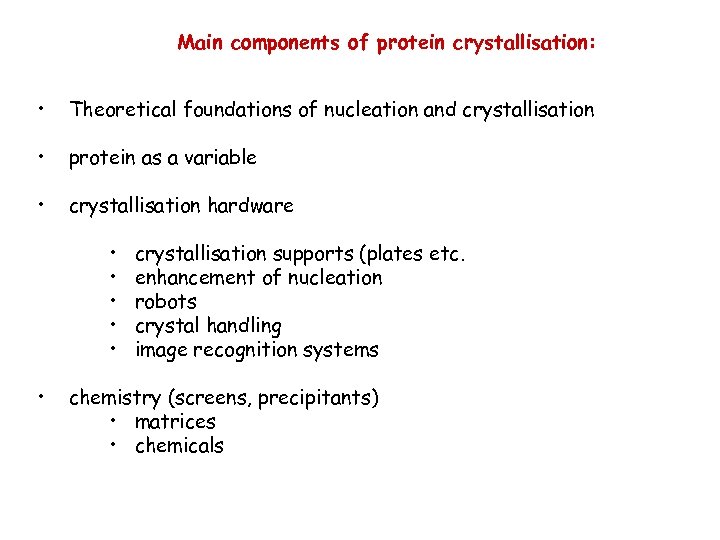
Main components of protein crystallisation: • Theoretical foundations of nucleation and crystallisation • protein as a variable • crystallisation hardware • • • crystallisation supports (plates etc. enhancement of nucleation robots crystal handling image recognition systems chemistry (screens, precipitants) • matrices • chemicals
THEORETICAL FOUNDATIONS OF NUCLEATION AND CRYSTALLISATION
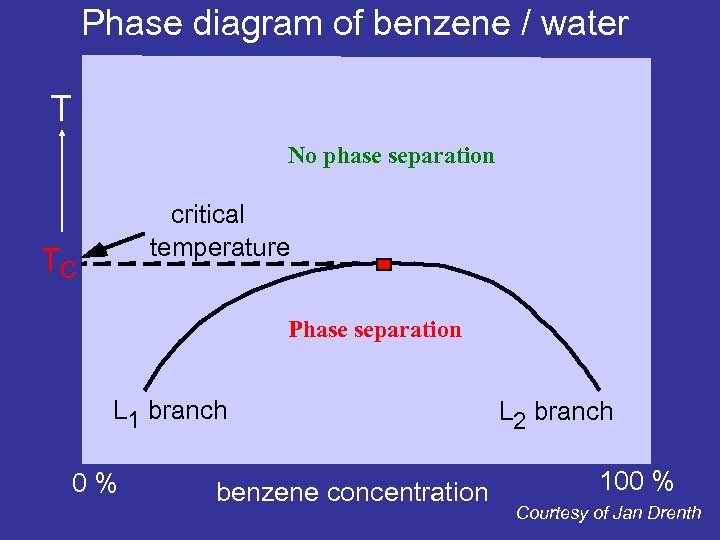
Phase diagram of benzene / water T No phase separation critical temperature Tc Phase separation phase separation L 1 branch 0% benzene concentration L 2 branch 100 % Courtesy of Jan Drenth
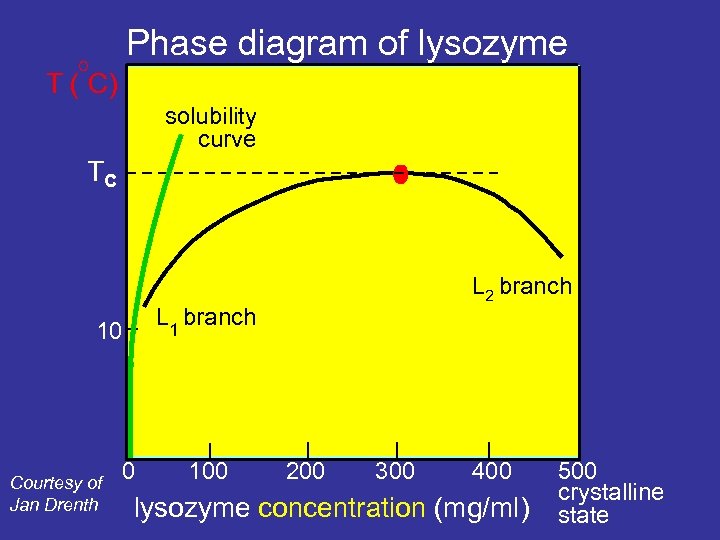
Phase diagram of lysozyme O T ( C) solubility curve Tc L 1 branch 10 Courtesy of Jan Drenth L 2 branch 0 100 200 300 400 lysozyme concentration (mg/ml) 500 crystalline state
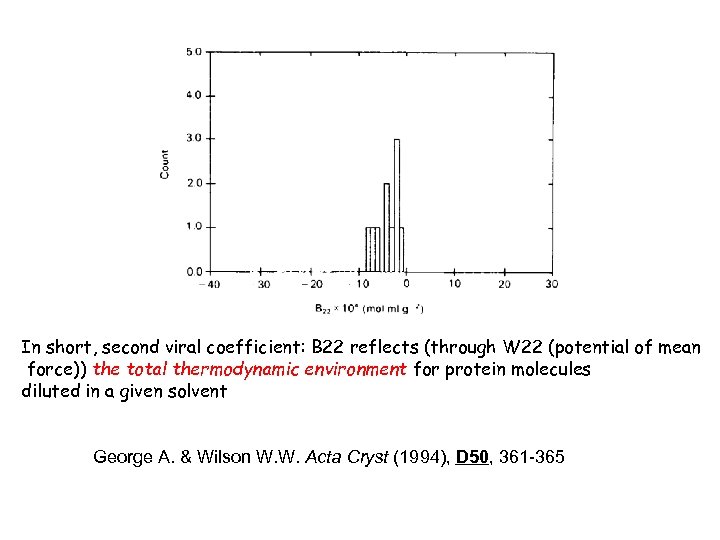
In short, second viral coefficient: B 22 reflects (through W 22 (potential of mean force)) the total thermodynamic environment for protein molecules diluted in a given solvent George A. & Wilson W. W. Acta Cryst (1994), D 50, 361 -365
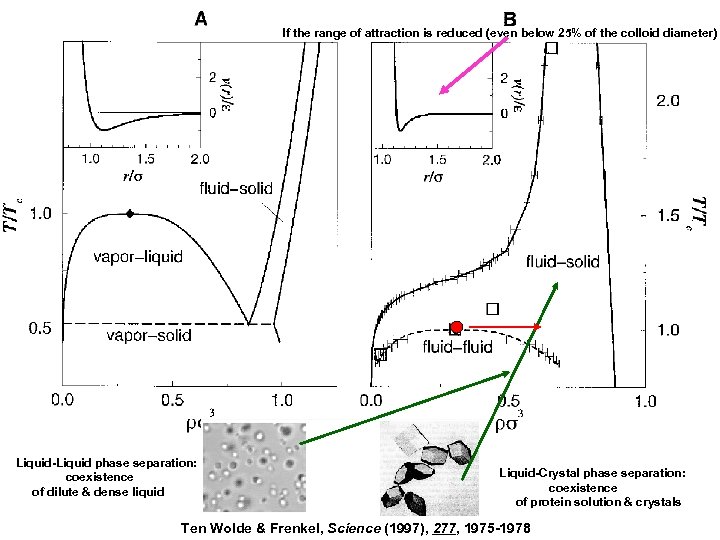
If the range of attraction is reduced (even below 25% of the colloid diameter) Liquid-Liquid phase separation: coexistence of dilute & dense liquid Liquid-Crystal phase separation: coexistence of protein solution & crystals Ten Wolde & Frenkel, Science (1997), 277, 1975 -1978
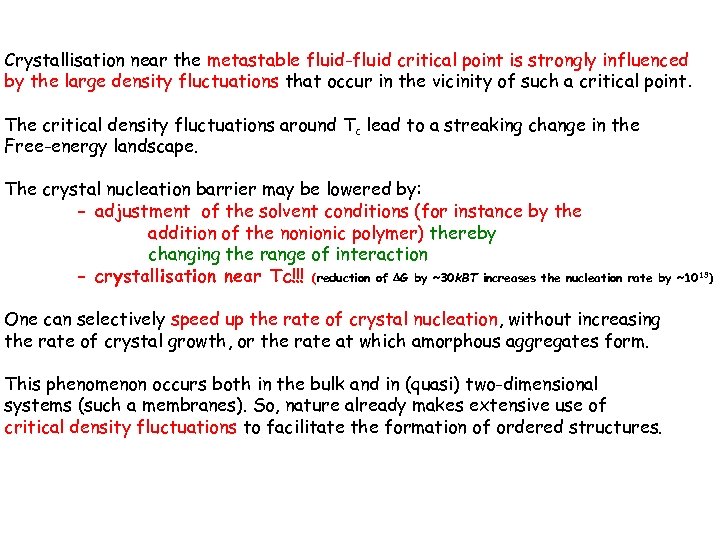
Crystallisation near the metastable fluid-fluid critical point is strongly influenced by the large density fluctuations that occur in the vicinity of such a critical point. The critical density fluctuations around Tc lead to a streaking change in the Free-energy landscape. The crystal nucleation barrier may be lowered by: - adjustment of the solvent conditions (for instance by the addition of the nonionic polymer) thereby changing the range of interaction - crystallisation near Tc!!! (reduction of DG by ~30 k. BT increases the nucleation rate by ~1013) One can selectively speed up the rate of crystal nucleation, without increasing the rate of crystal growth, or the rate at which amorphous aggregates form. This phenomenon occurs both in the bulk and in (quasi) two-dimensional systems (such a membranes). So, nature already makes extensive use of critical density fluctuations to facilitate the formation of ordered structures.
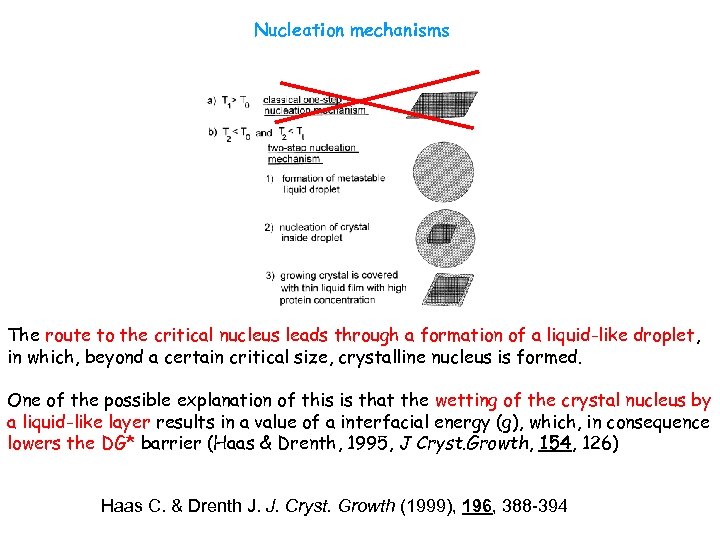
Nucleation mechanisms The route to the critical nucleus leads through a formation of a liquid-like droplet, in which, beyond a certain critical size, crystalline nucleus is formed. One of the possible explanation of this is that the wetting of the crystal nucleus by a liquid-like layer results in a value of a interfacial energy (g), which, in consequence lowers the DG* barrier (Haas & Drenth, 1995, J Cryst. Growth, 154, 126) Haas C. & Drenth J. J. Cryst. Growth (1999), 196, 388 -394
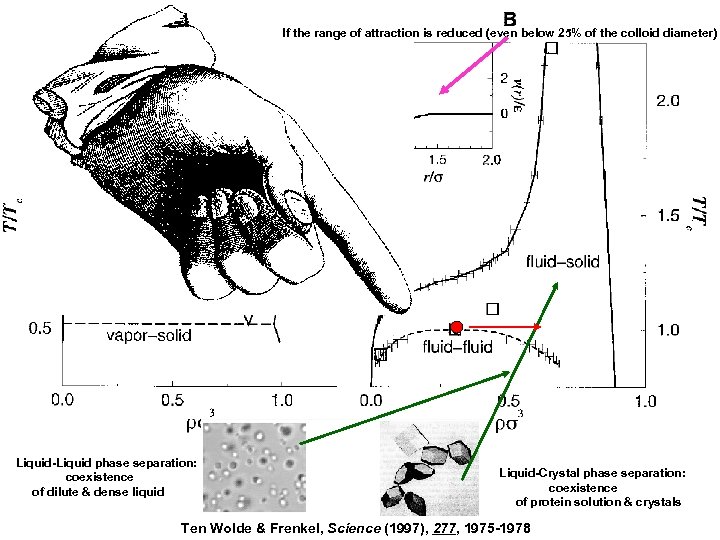
If the range of attraction is reduced (even below 25% of the colloid diameter) Liquid-Liquid phase separation: coexistence of dilute & dense liquid Liquid-Crystal phase separation: coexistence of protein solution & crystals Ten Wolde & Frenkel, Science (1997), 277, 1975 -1978
PROTEIN AS VARIABLE • new expression system (cell free systems) • automation of expression • protein tagging/fusion • protein surface/crystal contacts engineering
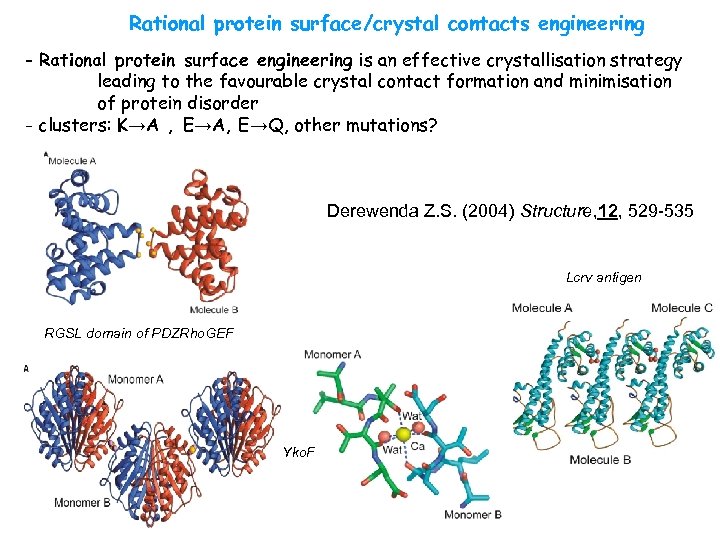
Rational protein surface/crystal contacts engineering - Rational protein surface engineering is an effective crystallisation strategy leading to the favourable crystal contact formation and minimisation of protein disorder - clusters: K→A , E→A, E→Q, other mutations? Derewenda Z. S. (2004) Structure, 12, 529 -535 Lcrv antigen RGSL domain of PDZRho. GEF Yko. F
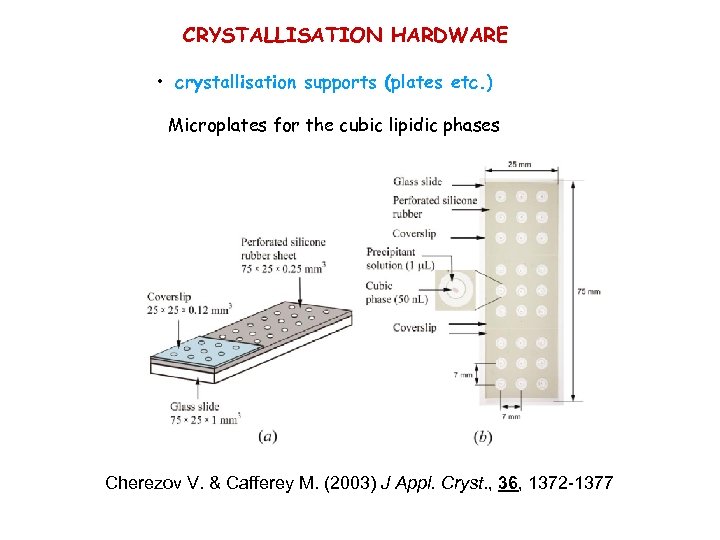
CRYSTALLISATION HARDWARE • crystallisation supports (plates etc. ) Microplates for the cubic lipidic phases Cherezov V. & Cafferey M. (2003) J Appl. Cryst. , 36, 1372 -1377
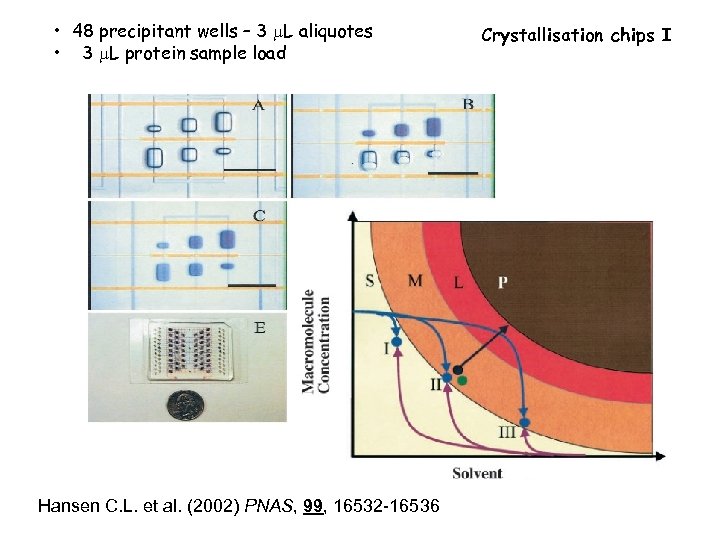
• 48 precipitant wells – 3 m. L aliquotes • 3 m. L protein sample load Hansen C. L. et al. (2002) PNAS, 99, 16532 -16536 Crystallisation chips I
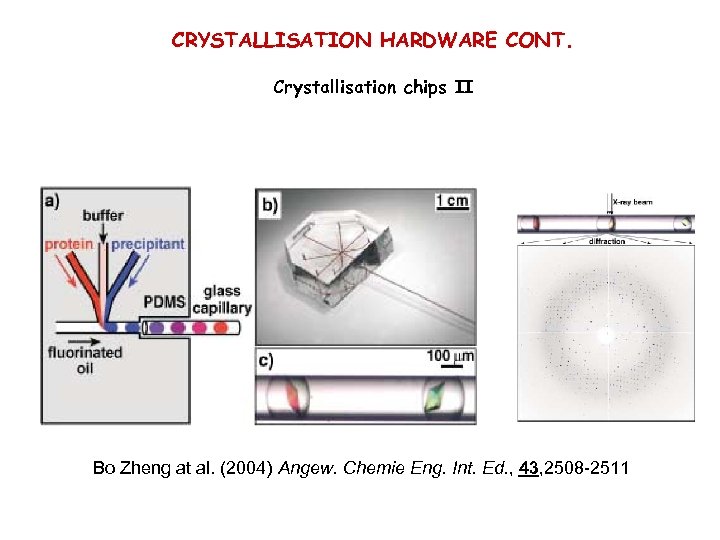
CRYSTALLISATION HARDWARE CONT. Crystallisation chips II Bo Zheng at al. (2004) Angew. Chemie Eng. Int. Ed. , 43, 2508 -2511
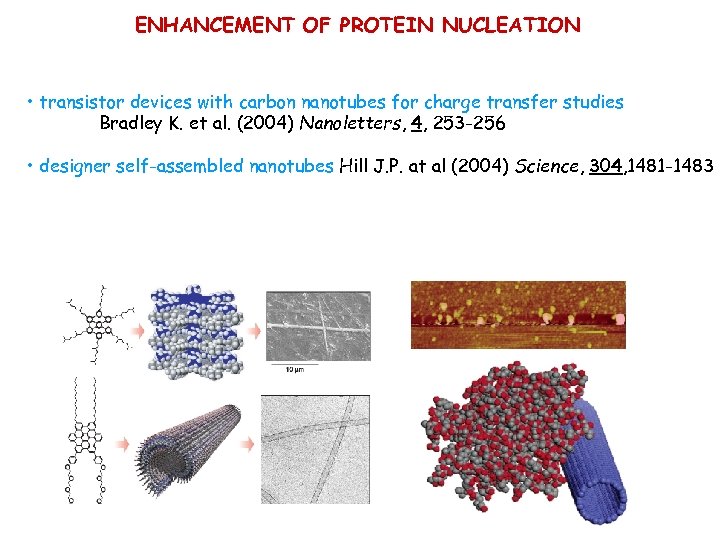
ENHANCEMENT OF PROTEIN NUCLEATION • transistor devices with carbon nanotubes for charge transfer studies Bradley K. et al. (2004) Nanoletters, 4, 253 -256 • designer self-assembled nanotubes Hill J. P. at al (2004) Science, 304, 1481 -1483
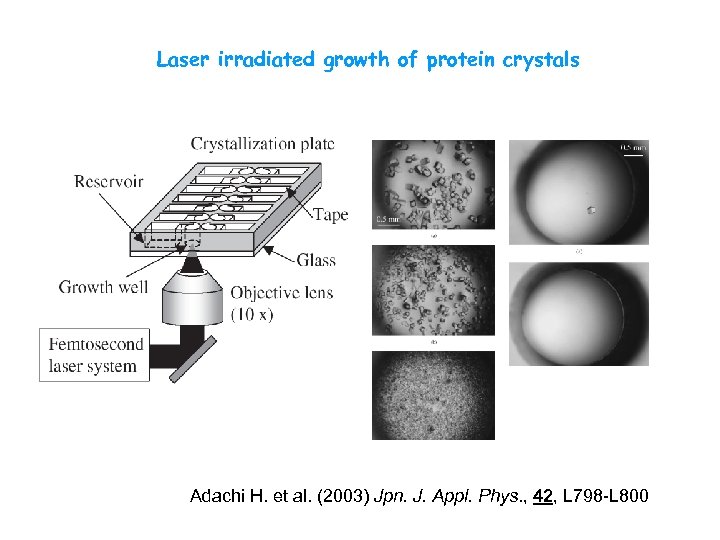
Laser irradiated growth of protein crystals Adachi H. et al. (2003) Jpn. J. Appl. Phys. , 42, L 798 -L 800
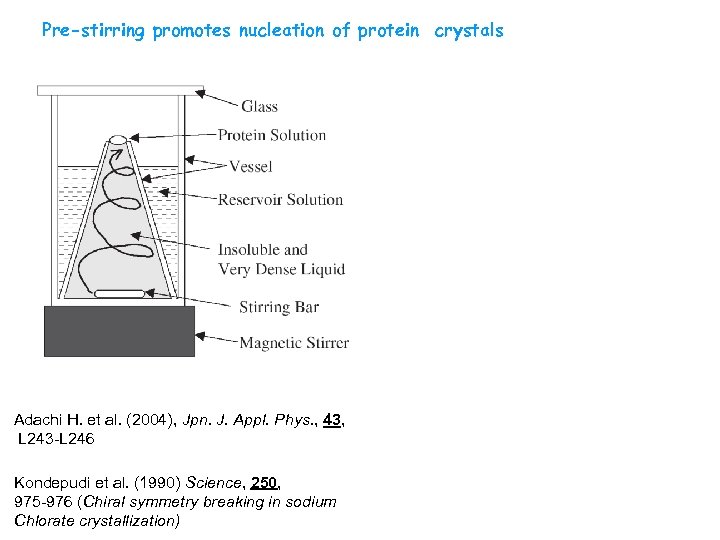
Pre-stirring promotes nucleation of protein crystals Adachi H. et al. (2004), Jpn. J. Appl. Phys. , 43, L 243 -L 246 Kondepudi et al. (1990) Science, 250, 975 -976 (Chiral symmetry breaking in sodium Chlorate crystallization)
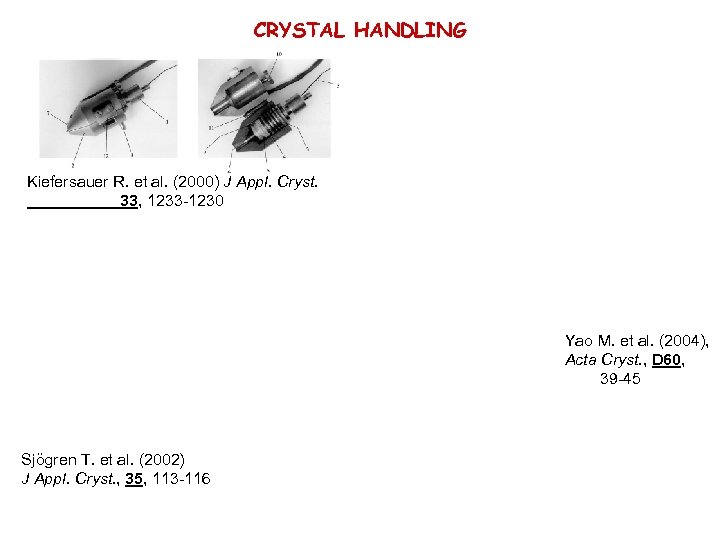
CRYSTAL HANDLING Kiefersauer R. et al. (2000) J Appl. Cryst. 33, 1233 -1230 Yao M. et al. (2004), Acta Cryst. , D 60, 39 -45 Sjögren T. et al. (2002) J Appl. Cryst. , 35, 113 -116
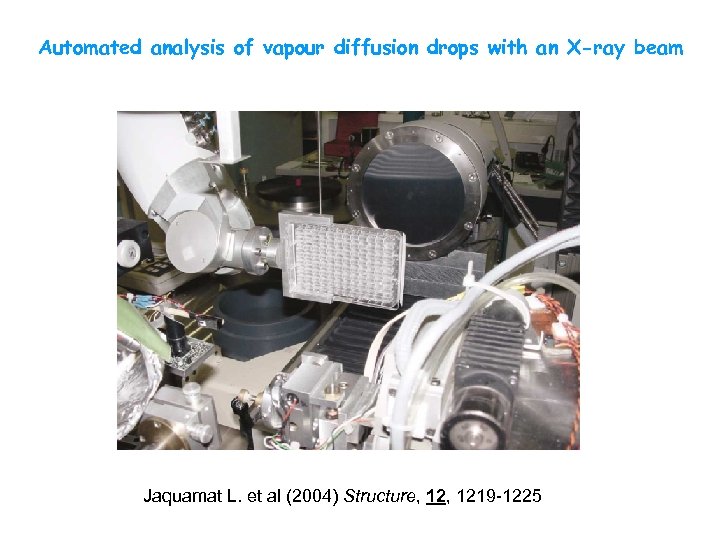
Automated analysis of vapour diffusion drops with an X-ray beam Jaquamat L. et al (2004) Structure, 1219 -1225
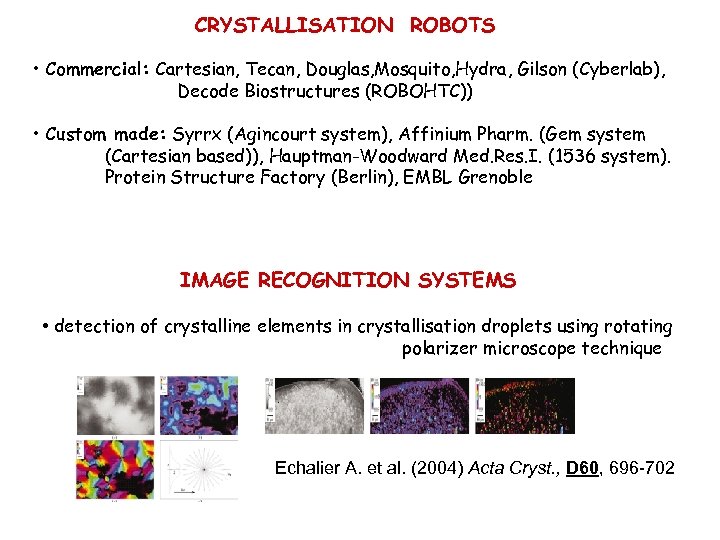
CRYSTALLISATION ROBOTS • Commercial: Cartesian, Tecan, Douglas, Mosquito, Hydra, Gilson (Cyberlab), Decode Biostructures (ROBOHTC)) • Custom made: Syrrx (Agincourt system), Affinium Pharm. (Gem system (Cartesian based)), Hauptman-Woodward Med. Res. I. (1536 system). Protein Structure Factory (Berlin), EMBL Grenoble IMAGE RECOGNITION SYSTEMS • detection of crystalline elements in crystallisation droplets using rotating polarizer microscope technique Echalier A. et al. (2004) Acta Cryst. , D 60, 696 -702
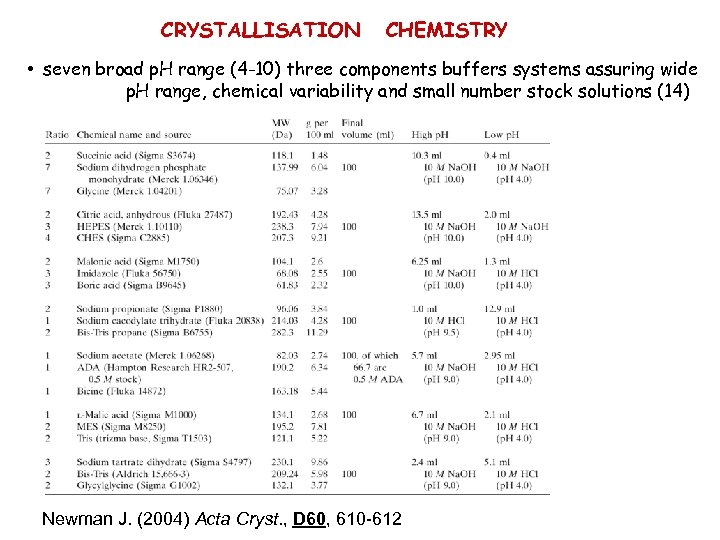
CRYSTALLISATION CHEMISTRY • seven broad p. H range (4 -10) three components buffers systems assuring wide p. H range, chemical variability and small number stock solutions (14) Newman J. (2004) Acta Cryst. , D 60, 610 -612
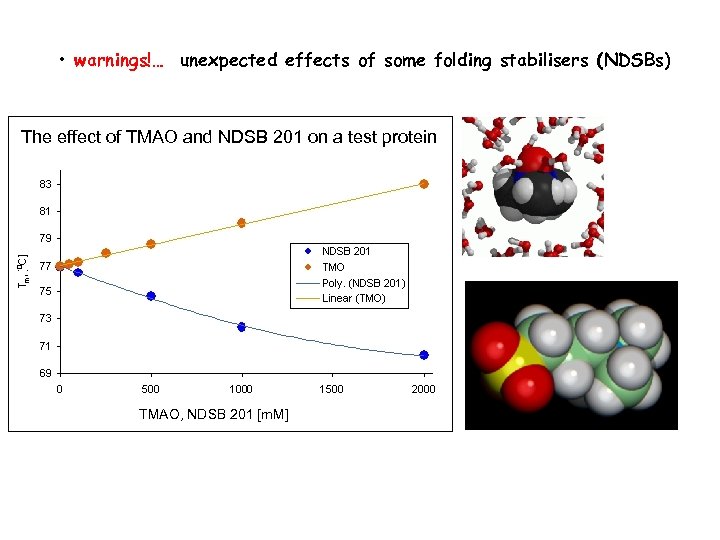
• warnings!… unexpected effects of some folding stabilisers (NDSBs) The effect of TMAO and NDSB 201 on a test protein TMAO, NDSB 201 [m. M]
CONCLUSIONS (if any): • Need for a tighter interface between theoretical studies and experimental science • Innovations in crystal handling could be a new breakthrough in improvement of its quality and diffraction properties • More crystallisation oriented and more universal robots are still required • The chemistry of precipitants, gels, stabilising solutions etc. still has to developed – striking lack of progress in last ~15 years “Please step forward to the rear” (Approximate translation of a request once heard in tram-car in Warsaw. From ‘How to be a Conservative-Liberal-Socialist’ by L. Kolakowski)
ACKNOWLEDGEMENTS Dave Smith Claudine Patteux Wellcome Trust TTP Lab. Tech (Cambridge) Molecular Dimension Ltd. York Structural Biology Laboratory
Скачать презентацию Recent developments in protein crystallisation Andrzej Marek Brzozowski
5cbe8738861baf18fbf8d79a1d8f96dc.ppt