 Скачать презентацию Recap UDP IP with port abstraction
a36cc7510c41a8c528b09f2479c1d0b5.ppt
- Количество слайдов: 32



Recap • UDP: IP with port abstraction • TCP: Reliable, in order, at most once semantics – Sliding Windows – Flow control: ensure client is not overwhelmed • Advertised window from receiver end – Congestion control: ensure network is not overwhelmed • Congestion window from sender end • TCP friendly flows – TCP has no timing requirements 4/598 N: Computer Networks
Quality of Service • Outline – Realtime Applications • Networking with specified delay components – Integrated Services • Per flow Qo. S – Differentiated Services • Qo. S for aggregated traffic 4/598 N: Computer Networks
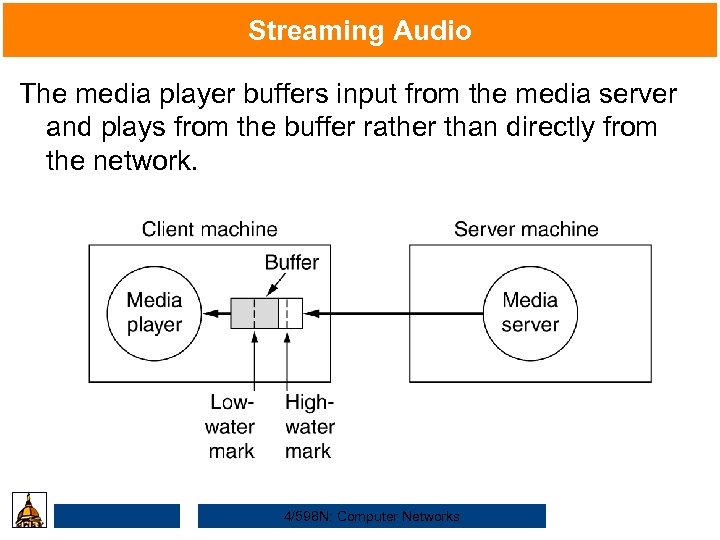
Streaming Audio The media player buffers input from the media server and plays from the buffer rather than directly from the network. 4/598 N: Computer Networks
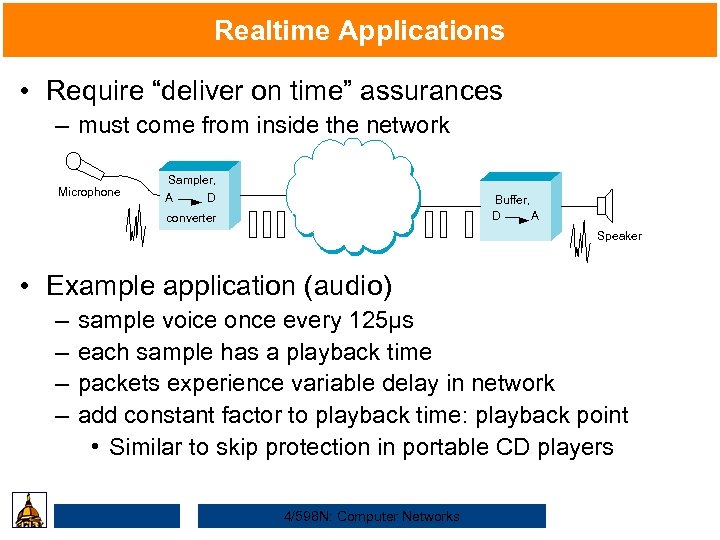
Realtime Applications • Require “deliver on time” assurances – must come from inside the network Microphone Sampler, A D Buffer, D A converter Speaker • Example application (audio) – – sample voice once every 125µs each sample has a playback time packets experience variable delay in network add constant factor to playback time: playback point • Similar to skip protection in portable CD players 4/598 N: Computer Networks
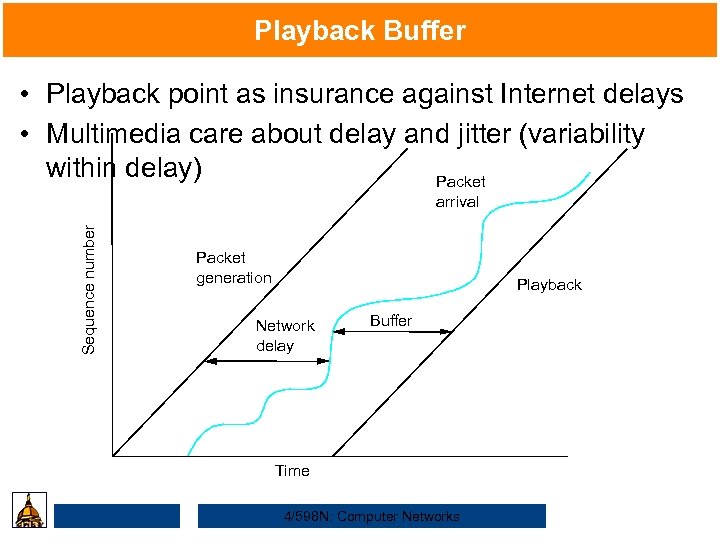
Playback Buffer • Playback point as insurance against Internet delays • Multimedia care about delay and jitter (variability within delay) Packet Sequence number arrival Packet generation Playback Network delay Buffer Time 4/598 N: Computer Networks
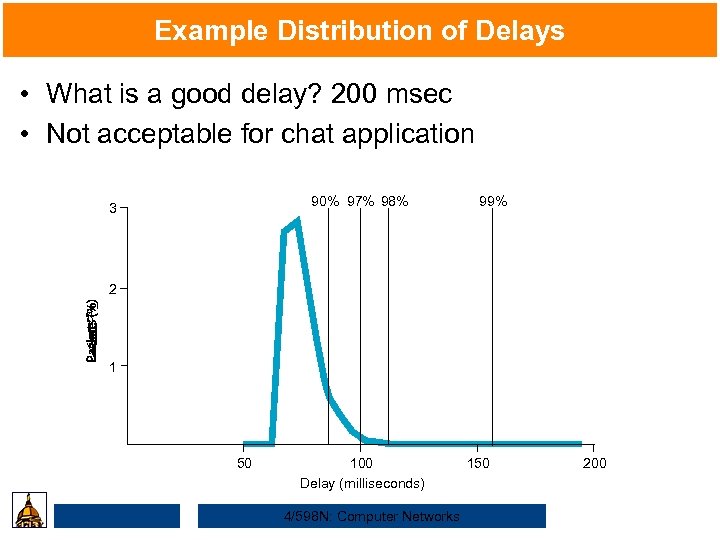
Example Distribution of Delays • What is a good delay? 200 msec • Not acceptable for chat application 90% 97% 98% 3 99% 2 1 50 100 Delay (milliseconds) 4/598 N: Computer Networks 150 200
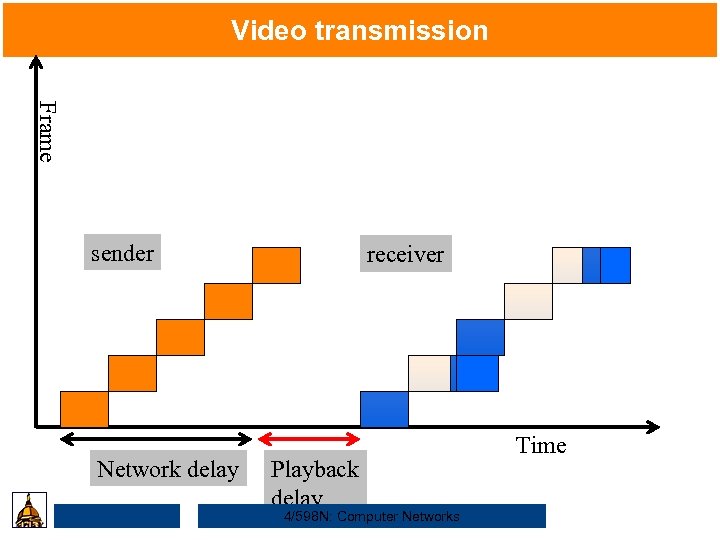
Video transmission Frame sender Network delay receiver Playback delay 4/598 N: Computer Networks Time
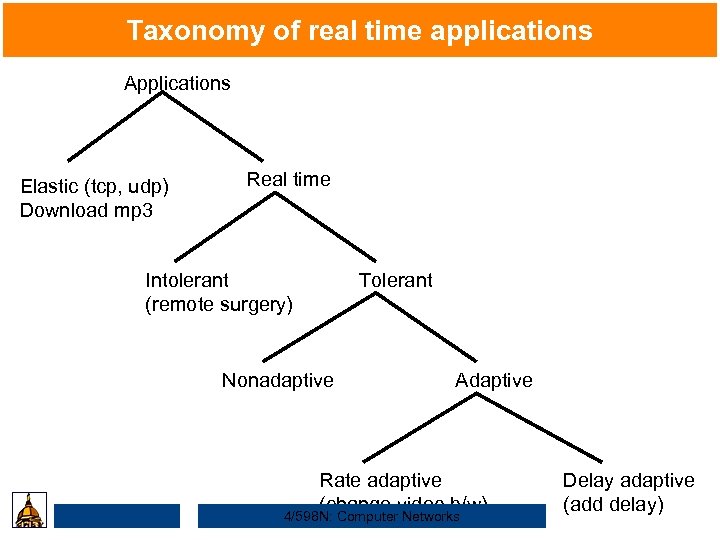
Taxonomy of real time applications Applications Elastic (tcp, udp) Download mp 3 Real time Intolerant (remote surgery) Tolerant Nonadaptive Adaptive Rate adaptive (change video b/w) 4/598 N: Computer Networks Delay adaptive (add delay)
Qo. S Approaches • Fine grained - individual application or flows – Intserv – E. g. for my video chat application • Coarse grained - aggregated traffic – Diffserv – E. g. All traffic from CSE (costs $$) 4/598 N: Computer Networks
Integrated Services • IETF - 1995 -97 time frame • Service Classes – guaranteed – controlled-load (tolerant, adaptive applications) • Simulates lightly loaded link • Mechanisms – – signaling protocol: signals required service admission control: rejects traffic that cannot be serviced Policing: make sure that senders stick to agreement packet scheduling: manage how packets are queued 4/598 N: Computer Networks
Flowspec • Rspec: describes service requested from network – controlled-load: none – guaranteed: delay target • Tspec: describes flow’s traffic characteristics – average bandwidth + burstiness: token bucket filter • token rate r and bucket depth B – must have a token to send a byte – must have n tokens to send n bytes – start with no tokens – accumulate tokens at rate of r per second – can accumulate no more than B tokens 4/598 N: Computer Networks
Per-Router Mechanisms • Admission Control – decide if a new flow can be supported – answer depends on service class – not the same as policing • Packet Processing – classification: associate each packet with the appropriate reservation – scheduling: manage queues so each packet receives the requested service 4/598 N: Computer Networks
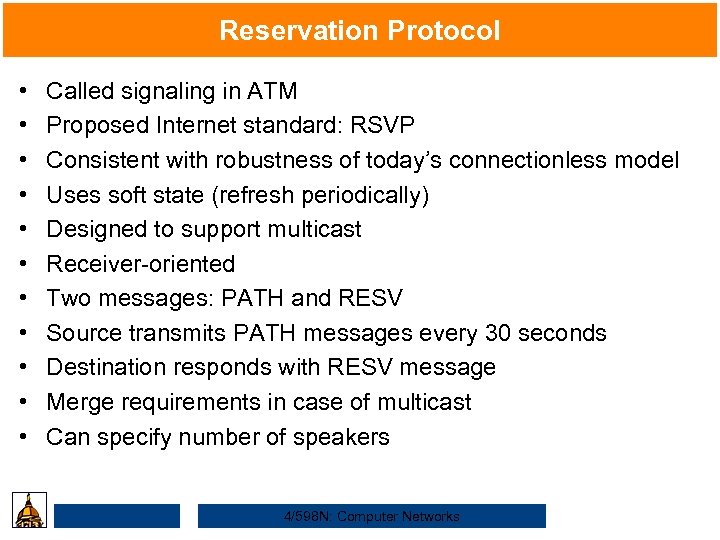
Reservation Protocol • • • Called signaling in ATM Proposed Internet standard: RSVP Consistent with robustness of today’s connectionless model Uses soft state (refresh periodically) Designed to support multicast Receiver-oriented Two messages: PATH and RESV Source transmits PATH messages every 30 seconds Destination responds with RESV message Merge requirements in case of multicast Can specify number of speakers 4/598 N: Computer Networks
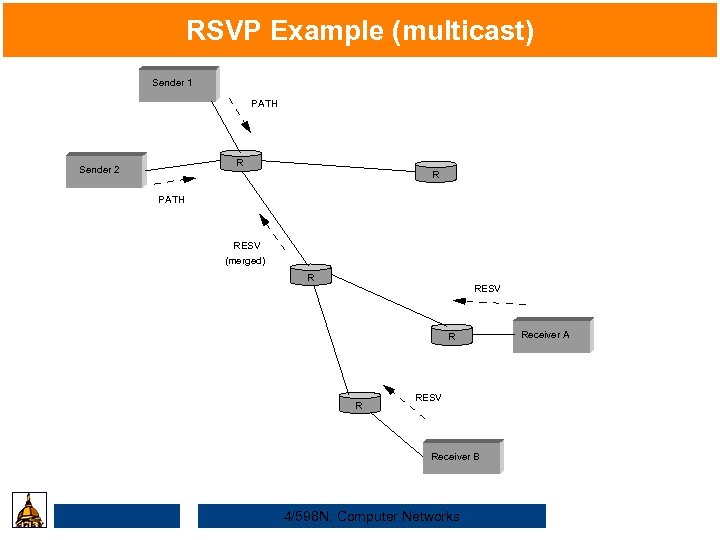
RSVP Example (multicast) Sender 1 PATH R Sender 2 R PATH RESV (merged) R RESV Receiver B 4/598 N: Computer Networks Receiver A
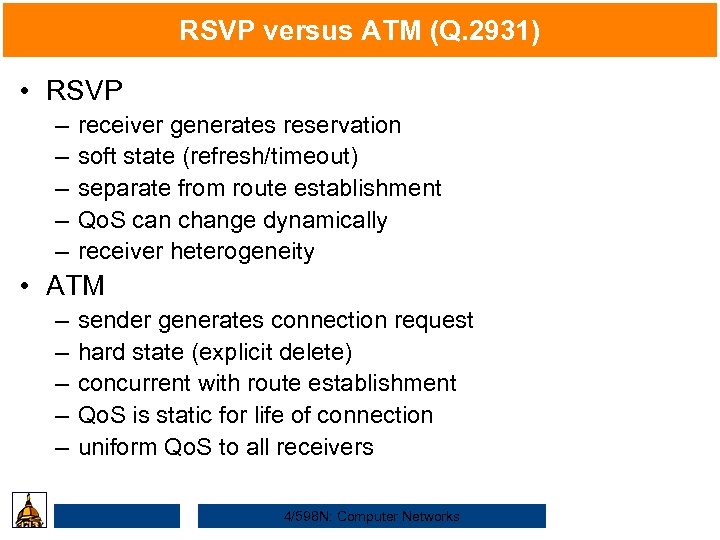
RSVP versus ATM (Q. 2931) • RSVP – – – receiver generates reservation soft state (refresh/timeout) separate from route establishment Qo. S can change dynamically receiver heterogeneity • ATM – – – sender generates connection request hard state (explicit delete) concurrent with route establishment Qo. S is static for life of connection uniform Qo. S to all receivers 4/598 N: Computer Networks
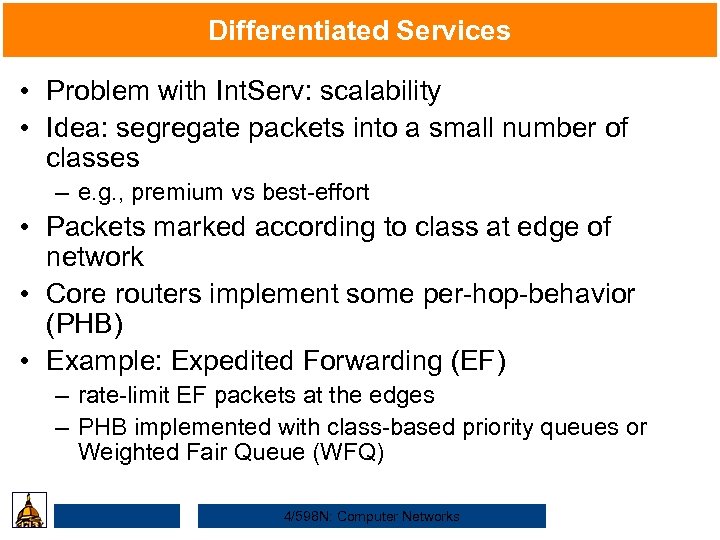
Differentiated Services • Problem with Int. Serv: scalability • Idea: segregate packets into a small number of classes – e. g. , premium vs best-effort • Packets marked according to class at edge of network • Core routers implement some per-hop-behavior (PHB) • Example: Expedited Forwarding (EF) – rate-limit EF packets at the edges – PHB implemented with class-based priority queues or Weighted Fair Queue (WFQ) 4/598 N: Computer Networks
Diff. Serv (cont) • Assured Forwarding (AF) – customers sign service agreements with ISPs – edge routers mark packets as being “in” or “out” of profile – core routers run RIO: RED with in/out 4/598 N: Computer Networks
Chapter 8: Security • Outline – – – Encryption Algorithms Authentication Protocols Message Integrity Protocols Key Distribution Firewalls 4/598 N: Computer Networks
Overview • Cryptography functions – Secret key (e. g. , DES) – Public key (e. g. , RSA) – Message digest (e. g. , MD 5) • Security services – Privacy: preventing unauthorized release of information – Authentication: verifying identity of the remote participant – Integrity: making sure message has not been altered 4/598 N: Computer Networks
Secret Key (DES) 4/598 N: Computer Networks
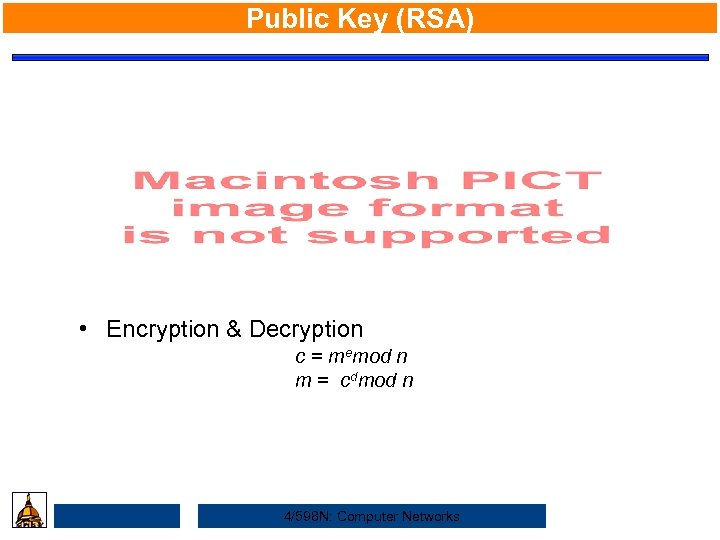
Public Key (RSA) • Encryption & Decryption c = memod n m = cdmod n 4/598 N: Computer Networks
Message Digest • Cryptographic checksum – just as a regular checksum protects the receiver from accidental changes to the message, a cryptographic checksum protects the receiver from malicious changes to the message. • One-way function – given a cryptographic checksum for a message, it is virtually impossible to figure out what message produced that checksum; it is not computationally feasible to find two messages that hash to the same cryptographic checksum. • Relevance – if you are given a checksum for a message and you are able to compute exactly the same checksum for that message, then it is highly likely this message produced the checksum you were given. 4/598 N: Computer Networks
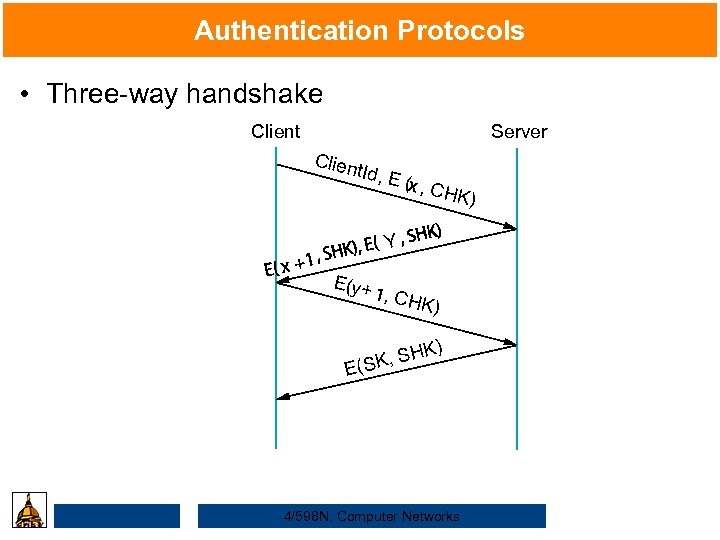
Authentication Protocols • Three-way handshake Client Server Clien t. Id, E ( , C HK) Y E(y + , CHK ) ) HK SK, S E( 4/598 N: Computer Networks
• Trusted third party (Kerberos) 4/598 N: Computer Networks
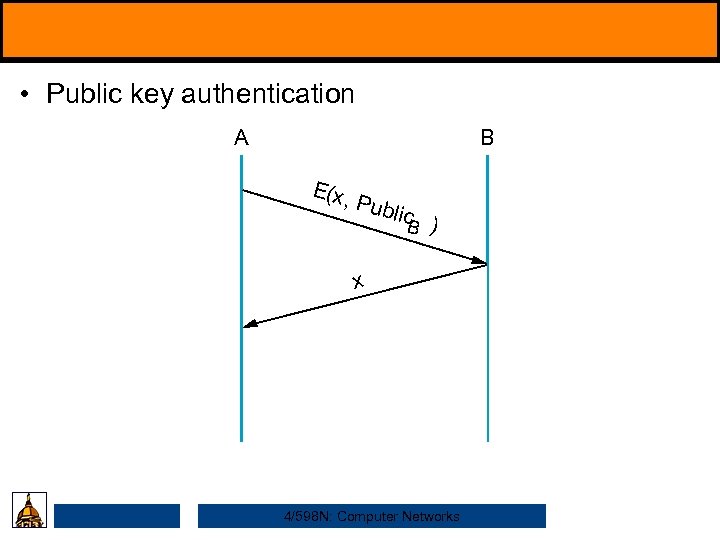
• Public key authentication A B E(x , Pu blic B ) x 4/598 N: Computer Networks
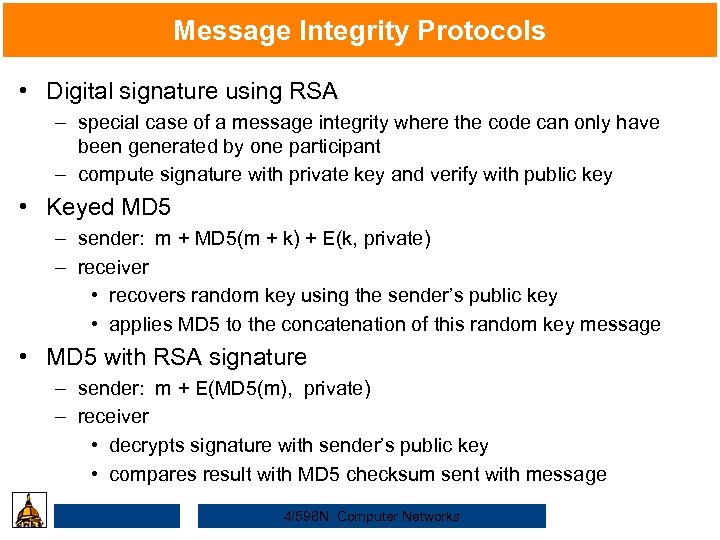
Message Integrity Protocols • Digital signature using RSA – special case of a message integrity where the code can only have been generated by one participant – compute signature with private key and verify with public key • Keyed MD 5 – sender: m + MD 5(m + k) + E(k, private) – receiver • recovers random key using the sender’s public key • applies MD 5 to the concatenation of this random key message • MD 5 with RSA signature – sender: m + E(MD 5(m), private) – receiver • decrypts signature with sender’s public key • compares result with MD 5 checksum sent with message 4/598 N: Computer Networks
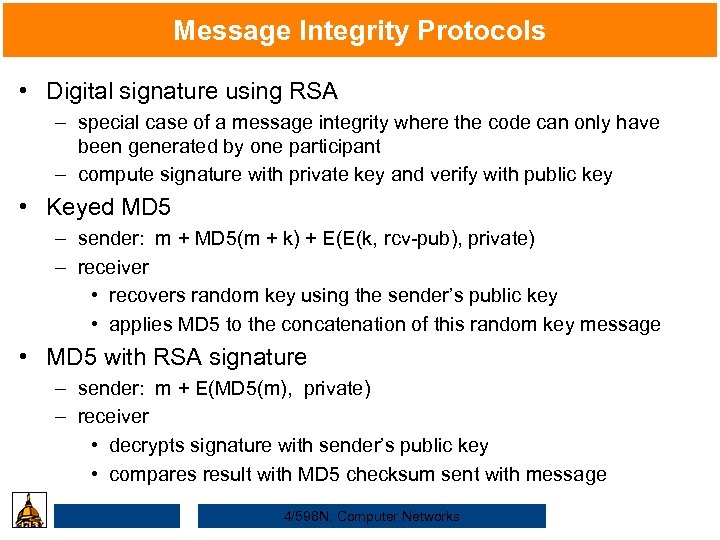
Message Integrity Protocols • Digital signature using RSA – special case of a message integrity where the code can only have been generated by one participant – compute signature with private key and verify with public key • Keyed MD 5 – sender: m + MD 5(m + k) + E(E(k, rcv-pub), private) – receiver • recovers random key using the sender’s public key • applies MD 5 to the concatenation of this random key message • MD 5 with RSA signature – sender: m + E(MD 5(m), private) – receiver • decrypts signature with sender’s public key • compares result with MD 5 checksum sent with message 4/598 N: Computer Networks
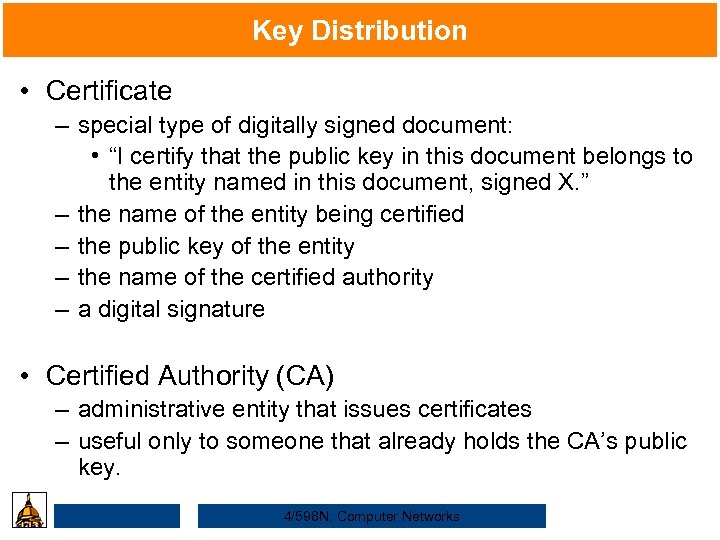
Key Distribution • Certificate – special type of digitally signed document: • “I certify that the public key in this document belongs to the entity named in this document, signed X. ” – the name of the entity being certified – the public key of the entity – the name of the certified authority – a digital signature • Certified Authority (CA) – administrative entity that issues certificates – useful only to someone that already holds the CA’s public key. 4/598 N: Computer Networks
Key Distribution (cont) • Chain of Trust – if X certifies that a certain public key belongs to Y, and Y certifies that another public key belongs to Z, then there exists a chain of certificates from X to Z – someone that wants to verify Z’s public key has to know X’s public key and follow the chain • Certificate Revocation List 4/598 N: Computer Networks
Firewalls • Filter-Based Solution – example ( 192. 13. 14, 1234, 128. 7. 6. 5, 80 ) (*, *, 128. 7. 6. 5, 80 ) – default: forward or not forward? – how dynamic? – stateful 4/598 N: Computer Networks
Proxy-Based Firewalls • Problem: complex policy • Example: web server • Solution: proxy • Design: transparent vs. classical • Limitations: attacks from within 4/598 N: Computer Networks
Denial of Service • Attacks on end hosts – SYN attack • Attacks on routers – Christmas tree packets – pollute route cache • Authentication attacks • Distributed Do. S attacks 4/598 N: Computer Networks
Скачать презентацию Recap UDP IP with port abstraction
a36cc7510c41a8c528b09f2479c1d0b5.ppt