 Скачать презентацию Recall that the absolute value of a number
e99b34f75e504c0d9b4bd67379b7f1eb.ppt
- Количество слайдов: 10



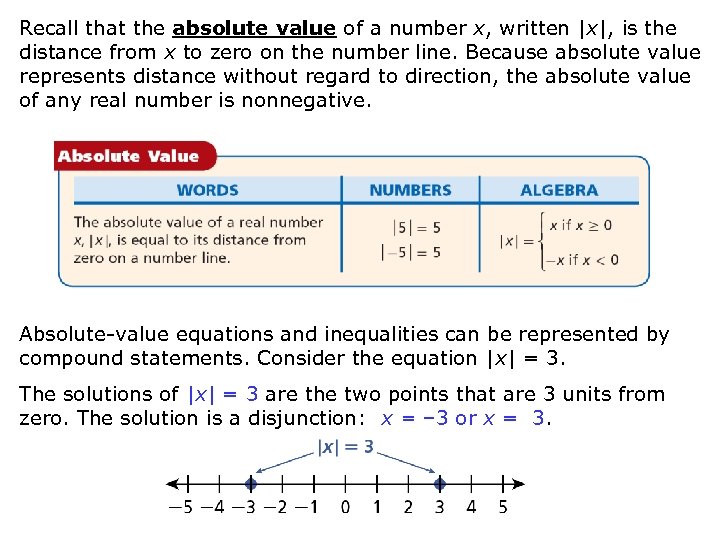
Recall that the absolute value of a number x, written |x|, is the distance from x to zero on the number line. Because absolute value represents distance without regard to direction, the absolute value of any real number is nonnegative. Absolute-value equations and inequalities can be represented by compound statements. Consider the equation |x| = 3. The solutions of |x| = 3 are the two points that are 3 units from zero. The solution is a disjunction: x = – 3 or x = 3.
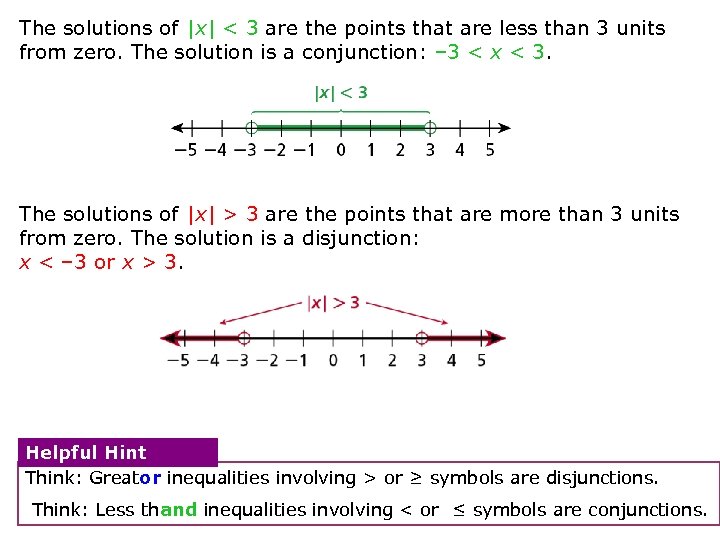
The solutions of |x| < 3 are the points that are less than 3 units from zero. The solution is a conjunction: – 3 < x < 3. The solutions of |x| > 3 are the points that are more than 3 units from zero. The solution is a disjunction: x < – 3 or x > 3. Helpful Hint Think: Greator inequalities involving > or ≥ symbols are disjunctions. Think: Less thand inequalities involving < or ≤ symbols are conjunctions.
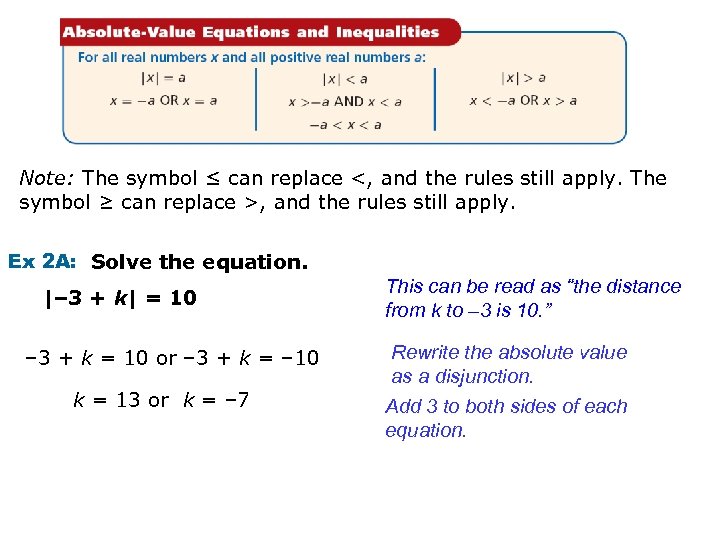
Note: The symbol ≤ can replace <, and the rules still apply. The symbol ≥ can replace >, and the rules still apply. Ex 2 A: Solve the equation. |– 3 + k| = 10 – 3 + k = 10 or – 3 + k = – 10 k = 13 or k = – 7 This can be read as “the distance from k to – 3 is 10. ” Rewrite the absolute value as a disjunction. Add 3 to both sides of each equation.
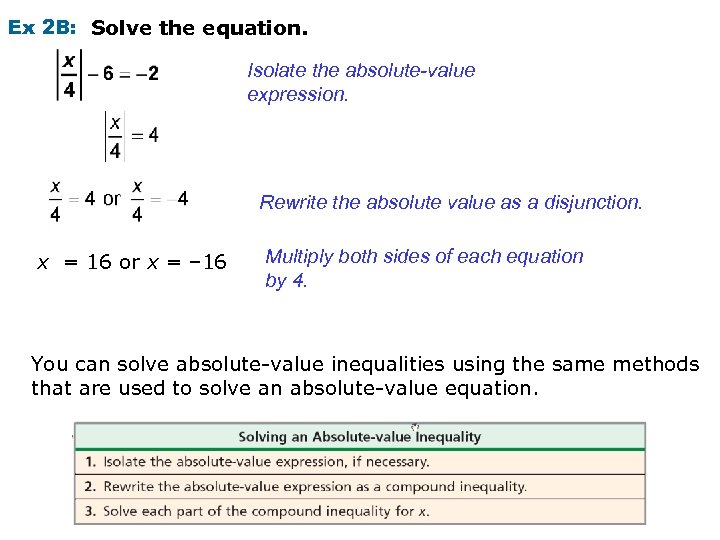
Ex 2 B: Solve the equation. Isolate the absolute-value expression. Rewrite the absolute value as a disjunction. x = 16 or x = – 16 Multiply both sides of each equation by 4. You can solve absolute-value inequalities using the same methods that are used to solve an absolute-value equation.
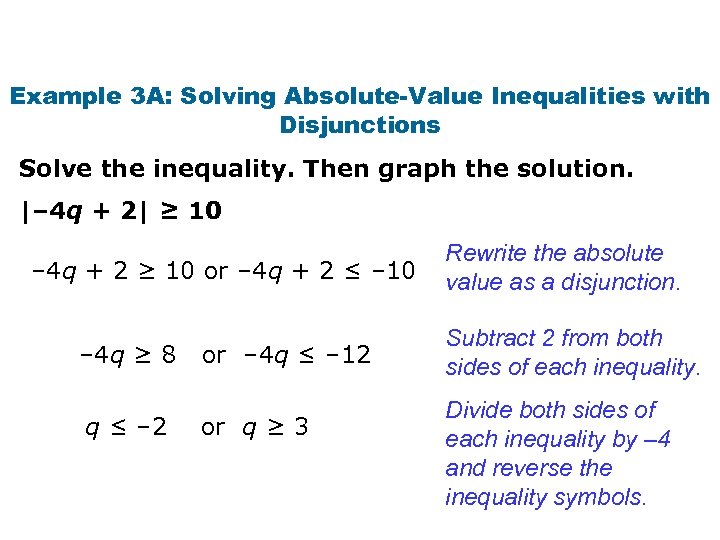
Example 3 A: Solving Absolute-Value Inequalities with Disjunctions Solve the inequality. Then graph the solution. |– 4 q + 2| ≥ 10 – 4 q + 2 ≥ 10 or – 4 q + 2 ≤ – 10 – 4 q ≥ 8 q ≤ – 2 or – 4 q ≤ – 12 or q ≥ 3 Rewrite the absolute value as a disjunction. Subtract 2 from both sides of each inequality. Divide both sides of each inequality by – 4 and reverse the inequality symbols.
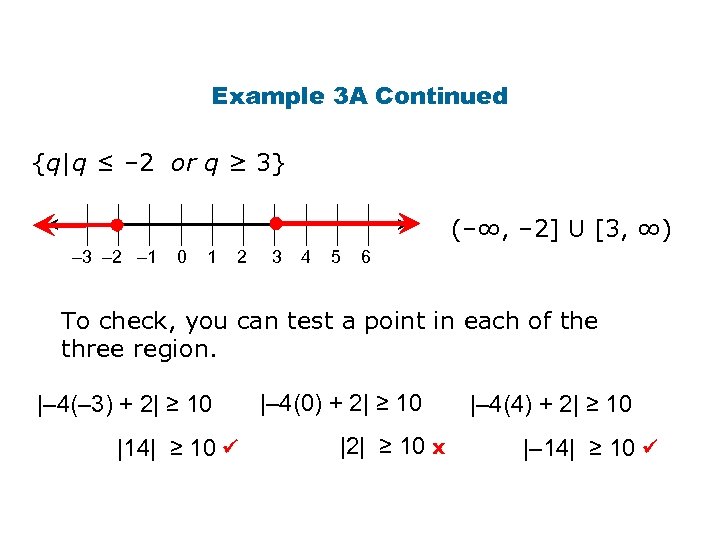
Example 3 A Continued {q|q ≤ – 2 or q ≥ 3} (–∞, – 2] U [3, ∞) – 3 – 2 – 1 0 1 2 3 4 5 6 To check, you can test a point in each of the three region. |– 4(– 3) + 2| ≥ 10 |14| ≥ 10 |– 4(0) + 2| ≥ 10 |2| ≥ 10 x |– 4(4) + 2| ≥ 10 |– 14| ≥ 10
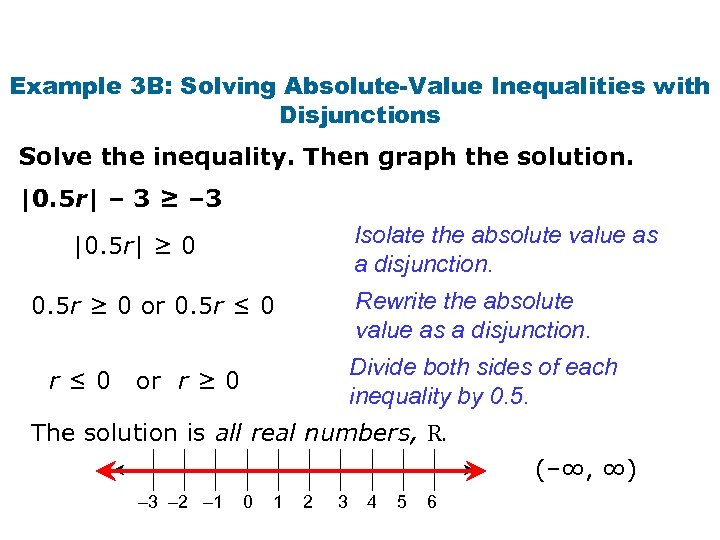
Example 3 B: Solving Absolute-Value Inequalities with Disjunctions Solve the inequality. Then graph the solution. |0. 5 r| – 3 ≥ – 3 Isolate the absolute value as a disjunction. |0. 5 r| ≥ 0 Rewrite the absolute value as a disjunction. 0. 5 r ≥ 0 or 0. 5 r ≤ 0 r≤ 0 Divide both sides of each inequality by 0. 5. or r ≥ 0 The solution is all real numbers, R. (–∞, ∞) – 3 – 2 – 1 0 1 2 3 4 5 6
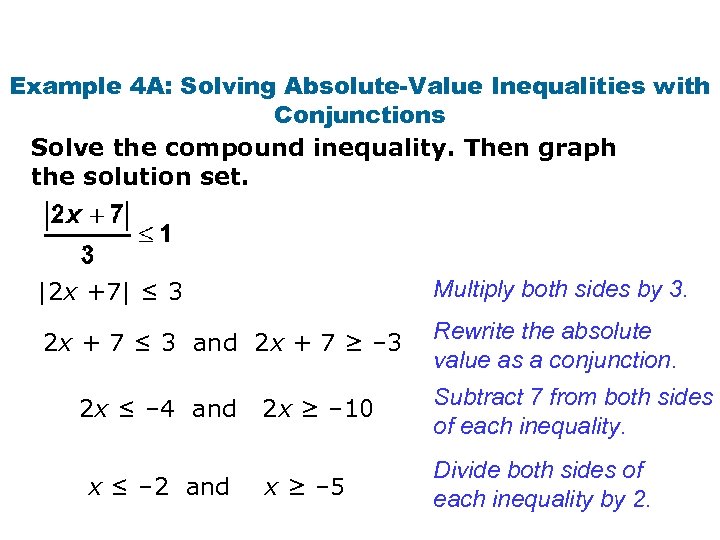
Example 4 A: Solving Absolute-Value Inequalities with Conjunctions Solve the compound inequality. Then graph the solution set. |2 x +7| ≤ 3 Multiply both sides by 3. 2 x + 7 ≤ 3 and 2 x + 7 ≥ – 3 Rewrite the absolute value as a conjunction. 2 x ≤ – 4 and x ≤ – 2 and 2 x ≥ – 10 Subtract 7 from both sides of each inequality. x ≥ – 5 Divide both sides of each inequality by 2.
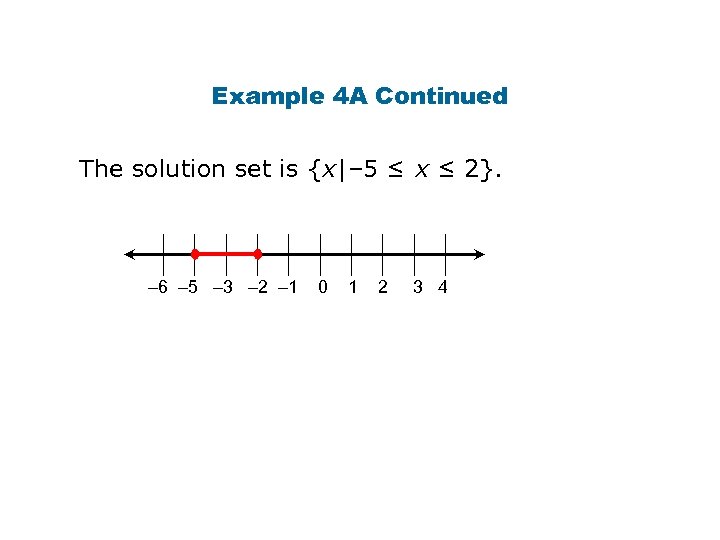
Example 4 A Continued The solution set is {x|– 5 ≤ x ≤ 2}. – 6 – 5 – 3 – 2 – 1 0 1 2 3 4
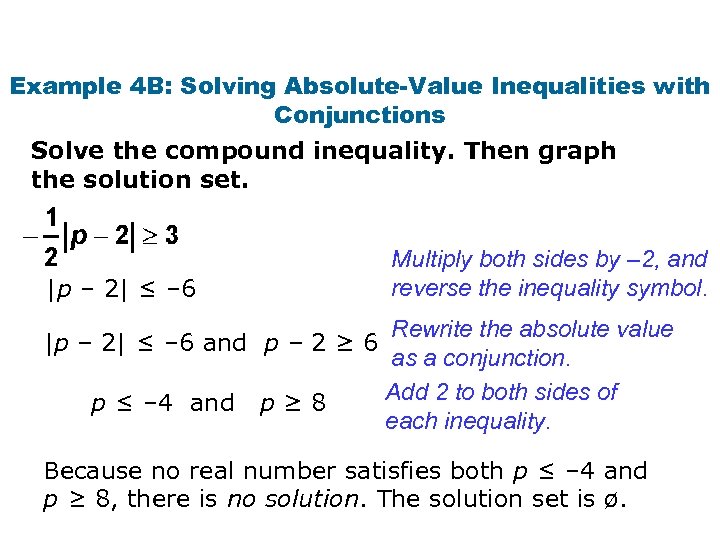
Example 4 B: Solving Absolute-Value Inequalities with Conjunctions Solve the compound inequality. Then graph the solution set. Multiply both sides by – 2, and reverse the inequality symbol. |p – 2| ≤ – 6 and p – 2 ≥ 6 p ≤ – 4 and p≥ 8 Rewrite the absolute value as a conjunction. Add 2 to both sides of each inequality. Because no real number satisfies both p ≤ – 4 and p ≥ 8, there is no solution. The solution set is ø.
Скачать презентацию Recall that the absolute value of a number
e99b34f75e504c0d9b4bd67379b7f1eb.ppt