 Скачать презентацию Realizing Service Dogs Potentials By Rick Creech Educational
4a27aa41bd1bc7427de1699c1d17857a.ppt
- Количество слайдов: 68



Realizing Service Dogs Potentials By Rick Creech Educational Consultant Pennsylvania Training and Technical Assistance Network Harrisburg, PA November 29, 2007
Three Types of Assistance Dogs n GUIDE DOGS for the blind and the visually impaired n HEARING DOGS for the deaf and hard of hearing n SERVICE DOGS for people with disabilities other than those related to vision or hearing
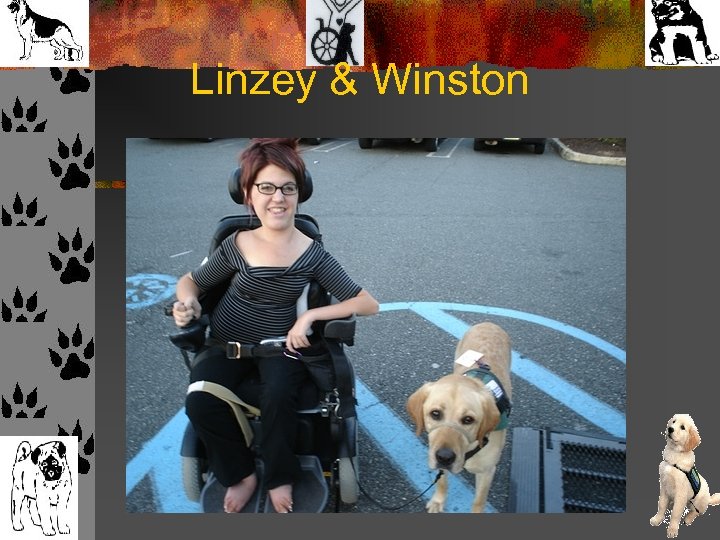
Linzey & Winston
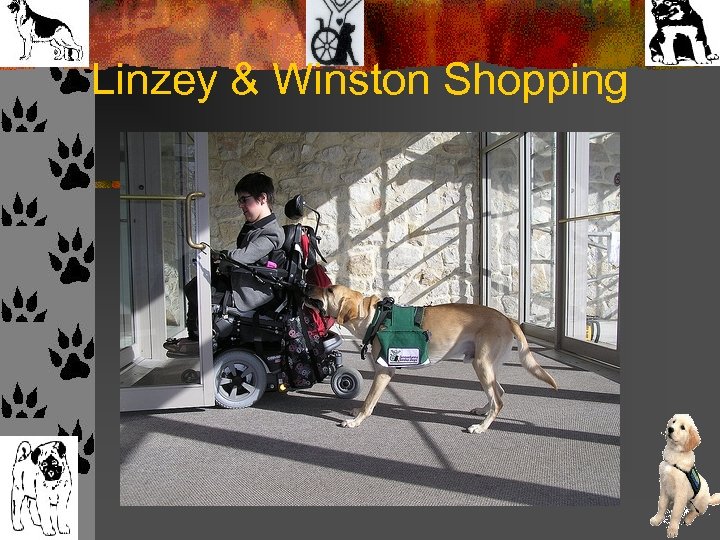
Linzey & Winston Shopping
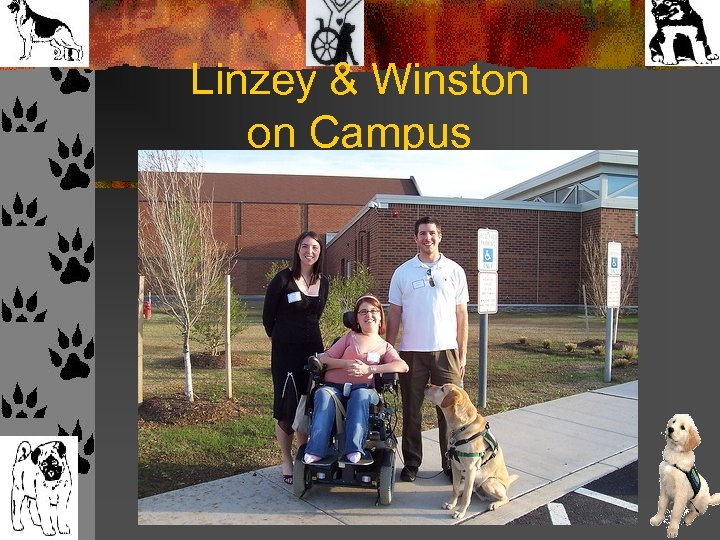
Linzey & Winston on Campus
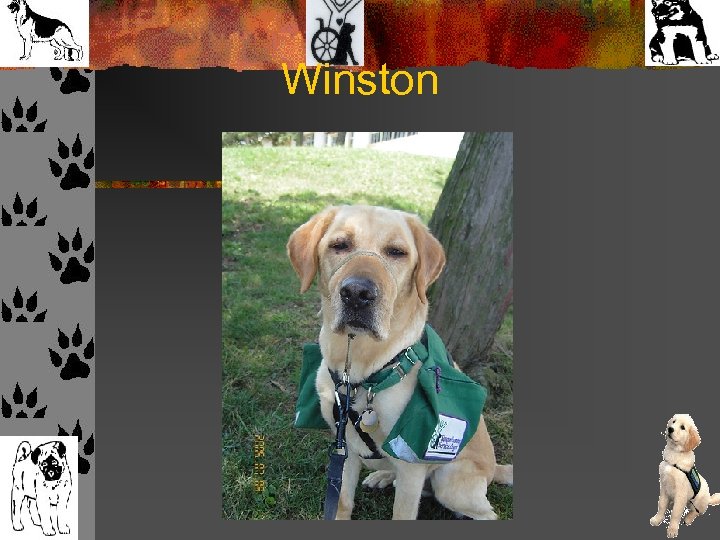
Winston
Typical Tasks for Service Dogs *Retrieval* Dogs retrieve objects as small as a dime from a concrete floor, they can get the cordless phone and bring it to the person, open and retrieve things from cabinets or the refrigerator. They can take items off shelves in stores and help remove clothing from the washer or dryer too. n
Typical Tasks for Service Dogs Cont. *Pulling* Dogs pull a manual wheelchair or retrieve the manual chair for a person, pull a laundry basket to the laundry room or even pull the recycling bin out to the curb with the person right beside the dog giving direction and encouragement. n
Typical Tasks for Service Dogs Cont. n *Dressing* Service dogs can assist with putting clothing on and/or taking clothing off the recipient. Assisting with items such as shoes, socks, jackets are routine activities for many service dogs.
Typical Tasks for Service Dogs Cont. n *Paying Cashiers* Service dogs are trained to stand with their two front feet on higher counters and give cashiers a money purse to assist a recipient in paying for items. The cashier makes the transaction, places the change and receipt in the money purse and gives it back to the service dog that then returns it to the recipient. This skill also comes in handy in banks, hotels and other places with high counters.
Typical Tasks for Service Dogs Cont. n *Opening Doors* Our service dogs can assist their recipients in opening doors. With the assistance of adaptive equipment they can open heavy mall entrance doors, household doors, refrigerator doors and even cabinet doors.
Typical Tasks for Service Dogs Cont. n *Seizure Alert* In order for dogs to consistently alert to seizures, they need regular exposure to seizure activity. Generally, applicants for seizure alert dogs need to be experiencing some form of seizure activity at least once monthly to be considered for this type of dog.
Typical Tasks for Service Dogs Cont. n *Autistic Behavior Supports* Some people with autism can be calmed in stressful situations by service dogs.
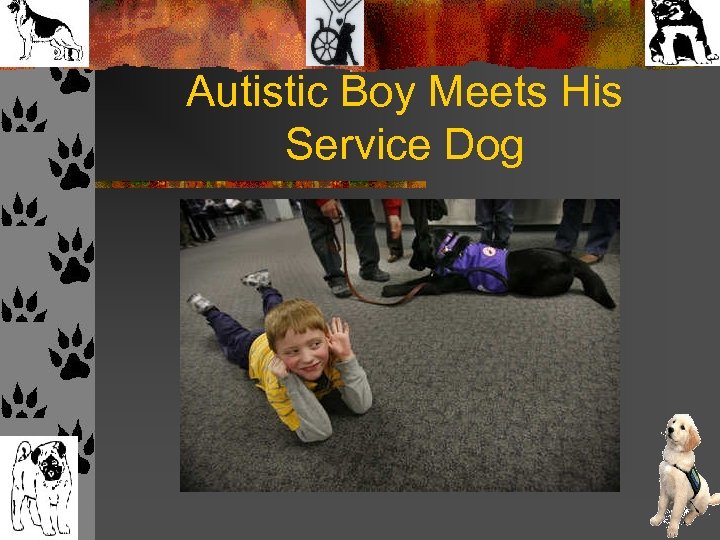
Autistic Boy Meets His Service Dog
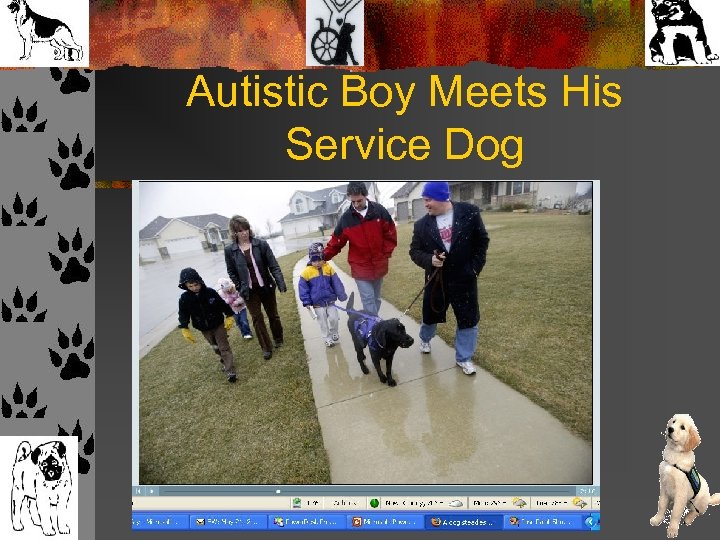
Autistic Boy Meets His Service Dog

Reece Shows Affectation to Pudge
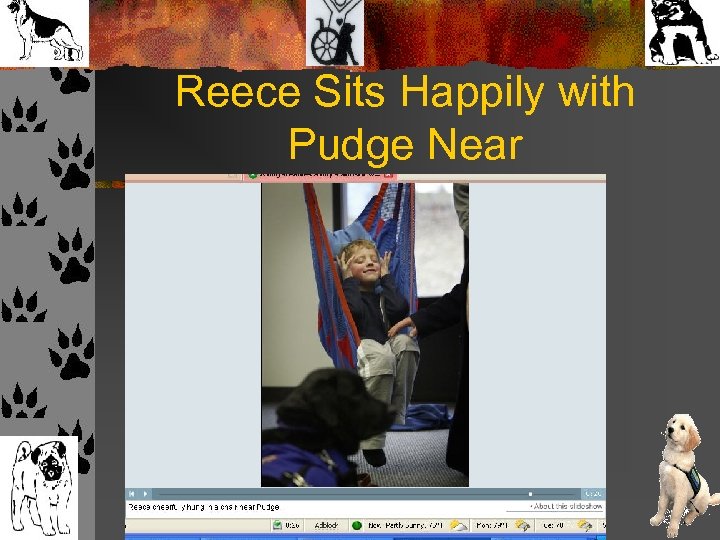
Reece Sits Happily with Pudge Near
Assistance Dogs International, (ADI) n n Assistance Dogs International, Inc. is a coalition of not for profit organizations that train and place Assistance Dogs. The purpose of ADI is to improve the areas of training, placement, and utilization of Assistance Dogs as well as staff and volunteer education.
ADI'S MISSION n n Establish and promote standards of excellence in all areas of Assistance Dog acquisition, training and partnership Facilitate communication and learning among member organizations, Educate the public to the benefits of Assistance Dogs and ADI membership www. adionline. org
Service Dogs and Augmented Communicators n Emergency situations n n n trained to bark and/or go to get someone Push an emergency alert button Get the phone Alert to smoke All the more common service dog tasks
Service Dogs and Augmented Communicators n Giving Commands n Synthetic speech – Not good enough insufficient tonal quality n dogs do not identify words coming from a box as human speech directed to them n n Recorded speech – works if good quality I. E. MP 3 or WAV files n Dog trained using those recorded commands either from communication aid or a cd player n
Service Dogs and Augmented Communicators n Giving Commands n n dog might decide to obey only recorded commands coming out of box (I’m only halfway joking) dog learns distinctive vocal cues series of three rapid grunts = bark n a loud yell = go find help n a loud happy grunt = come to Daddy n a soft crooning grunt = give Daddy kisses n
Service Dogs and Augmented Communicators n Giving Commands n dog learns gross movement cues spastic movements = might need to find help n hand out pushing down = lie down n arm hitting the bed = okay to jump on the bed n n situational cues n dog knows what to do without commands n n going through doors getting in and out of my van
Service Dogs and Augmented Communicators n Service dog makes me healthier n n I have to walk him forces me to go outside thirty to forty-five minutes a day everyday except when it rains would not do otherwise Helps me sleep better by restricting my movements
Service Dogs and Augmented Communicators n A great conversation initiator n n n greatest service – not anticipated initiating conversations is something most augmented communicators find difficult people will initiate sensible conversations
Service Dogs and Augmented Communicators n sensible started conversations instead of what’s your name n how old are you n can you say something n bless you, God will heal you n n n what are proper responses to these – I don’t know can think of some improper responses
Service Dogs and Augmented Communicators n n n Conversation starter is an unusual service to claim for a service dog However, not trivial Offers an area of commonality helps to socialize with strangers and coworkers Best yet, no one asks the dog things that they should be asking me!
Tasks Adapting n n Service dogs adjust to their partner’s inabilities Since I speak through a communication device, “leave its” were a bit difficult n n My service dog, Caulon, and I worked it out When Caulon gets distracted, I grunt, focuses my service dog’s attention on me After passing the “leave it, ” I stop and reward Caulon
Tasks Adapting n n Going through doors little unorthodox SSD teaches n n n stop at the door tell the dog to go through and turn around then tell the dog to back up as the human partner goes through the door OR
Tasks Adapting n n n tells the dog to wait as human partner goes through the door then tell the dog to follow after Too much for me to do with stopping the wheelchair, giving the dog verbal cues what to do, and then getting my wheelchair back into drive
Tasks Adapting n My service dog worked it out n n n we come to a door at a grunt from me, he stops and lets me pass through then he follows however, if I stop at a door he will go on through the door, turn around
Tasks Adapting n n and back up when I go through the door One of the participants n n n beautiful seven-years-old girl born without leg and club hands paired with the largest Labrador Retriever in the class dog was bigger she was unbelievable gentle with her
Tasks Adapting n n Watching this girl leading around that large dog was a beautiful sight He would gently take the treats out of her hands
Tasks Adapting n Entering and exiting a vehicle n n Usually for a person in wheelchair an attendant takes the dog while the person gets on the van and then the dog is given back to its partner same procedure is used on exiting a van However, each situation is different
Tasks Adapting n Entering and exiting a vehicle n n n I have a mini-van with rear entry I drive straight into and out of my van my dog is quite comfortable following me into my van jumping on the seat beside me and then following my chair out of the van no help from an attendant needed
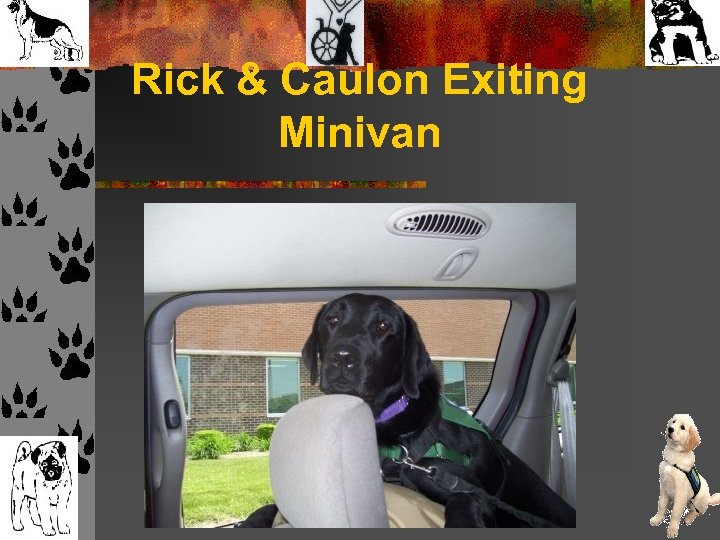
Rick & Caulon Exiting Minivan
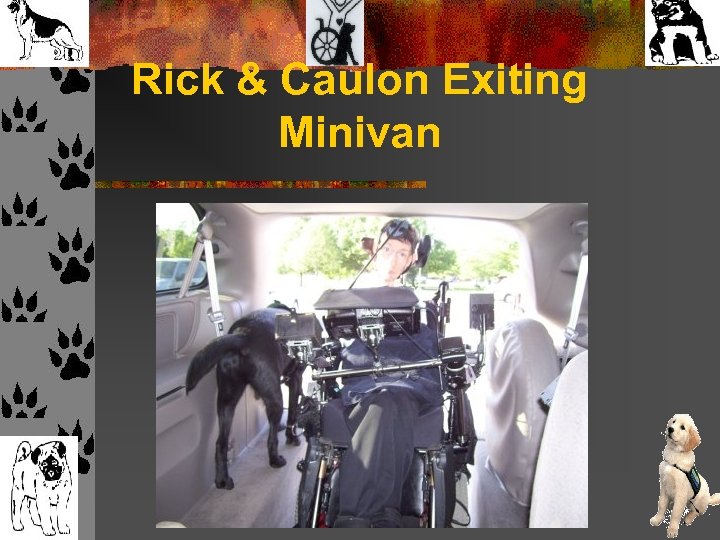
Rick & Caulon Exiting Minivan
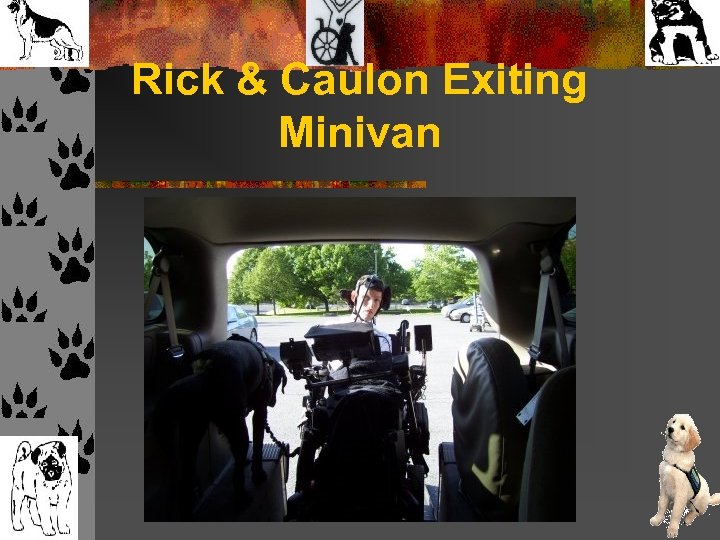
Rick & Caulon Exiting Minivan
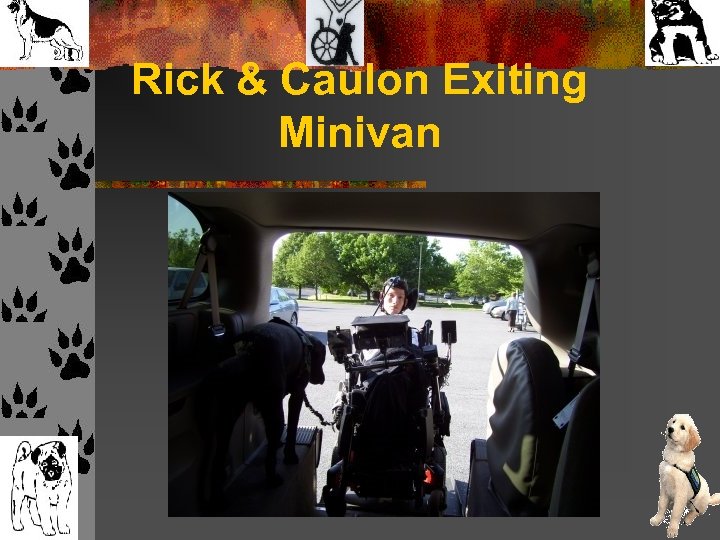
Rick & Caulon Exiting Minivan
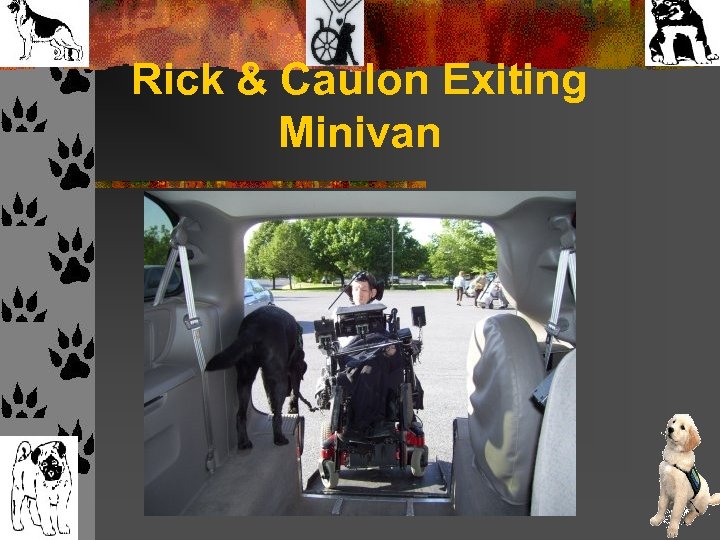
Rick & Caulon Exiting Minivan
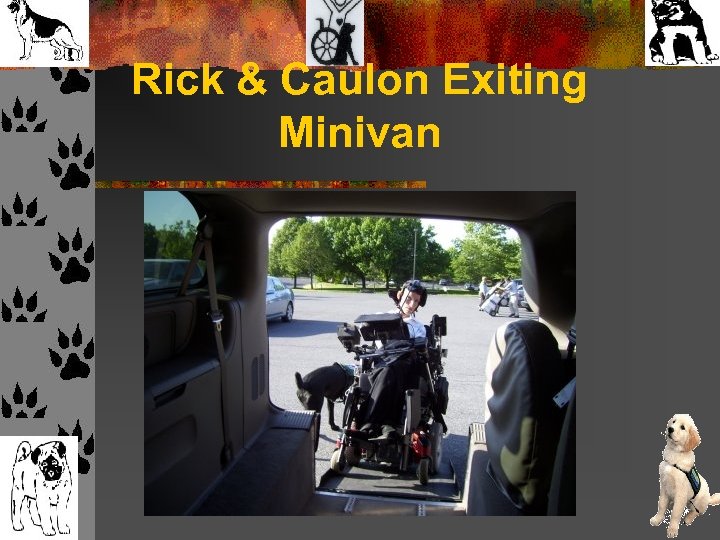
Rick & Caulon Exiting Minivan
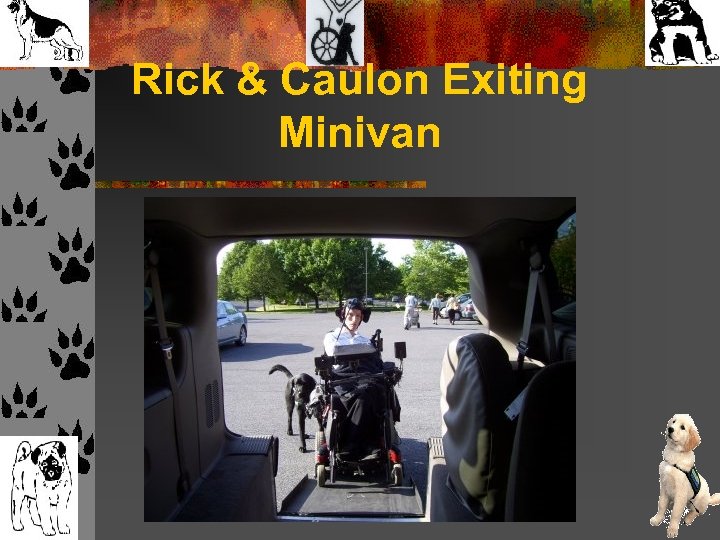
Rick & Caulon Exiting Minivan
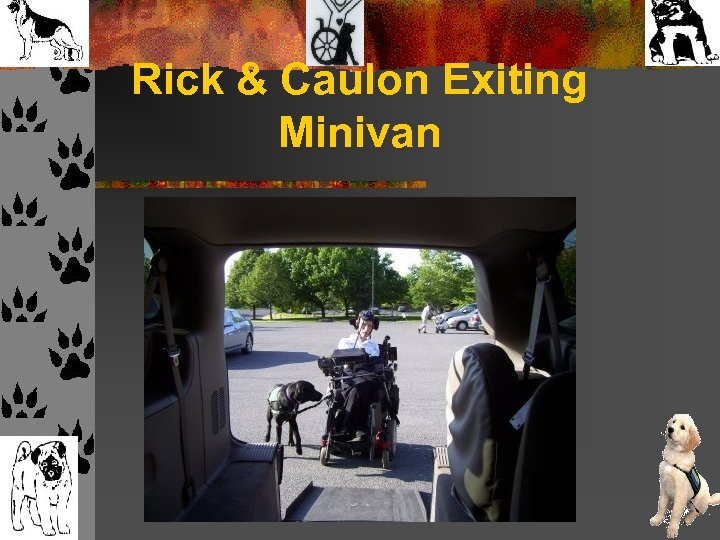
Rick & Caulon Exiting Minivan
Tasks Adapting n n n Most tasks are like this Instructors showed the approved way then the human and the dog partners find the way that works for them
Assistance Dogs International, (ADI) n n Assistance Dogs International, Inc. is a coalition of not for profit organizations that train and place Assistance Dogs. The purpose of ADI is to improve the areas of training, placement, and utilization of Assistance Dogs as well as staff and volunteer education.
Federal Laws Concerning Training Service Dogs n n No minimum standards No registration or a certification required Dog considered service dog if it performs any task for someone with disabilities No requirements about who can train service dogs
ADI'S Minimum Standards For Training Service Dogs n These are intended to be minimum standards for all service dog centers that want to be affiliated with Assistance Dogs International, (ADI).
ADI'S Minimum Standards For Training Service Dogs n n 1. A minimum of one hundred twenty (120) hours of training over a period of no less than six (6) months, must take place under the supervision of a program's trainer. During that time at least thirty (30) hours of regularly scheduled training must be devoted to field trips and public exposure. 2. Basic obedience skills the dogs must master with voice and/or hand signals are: sit, stay come, down, heel and off leash recall.
ADI'S Minimum Standards For Training Service Dogs n n 3. The dog must show social behavior skills of no aggression, no inappropriate barking, no biting, no snapping/growling, no inappropriate jumping on strangers, no begging and no sniffing of people. 4. The service dog must be trained to perform at least three physical tasks.
ADI'S Minimum Standards For Training Service Dogs n 5. The training time with the person with disabilities prior to placement must be a minimum of no less than 60 hours. This is both public and private. All graduates must be given a solid education in appropriate behavior of the team. The dog should stay as invisible as possible and not interfere with people.
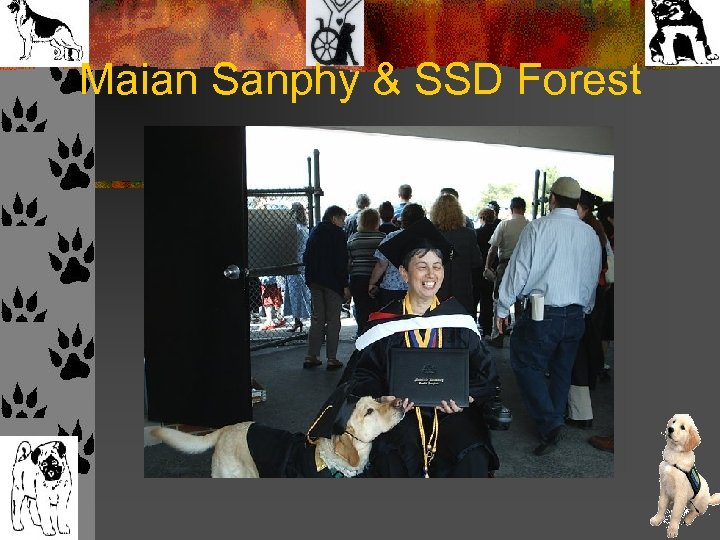
Maian Sanphy & SSD Forest
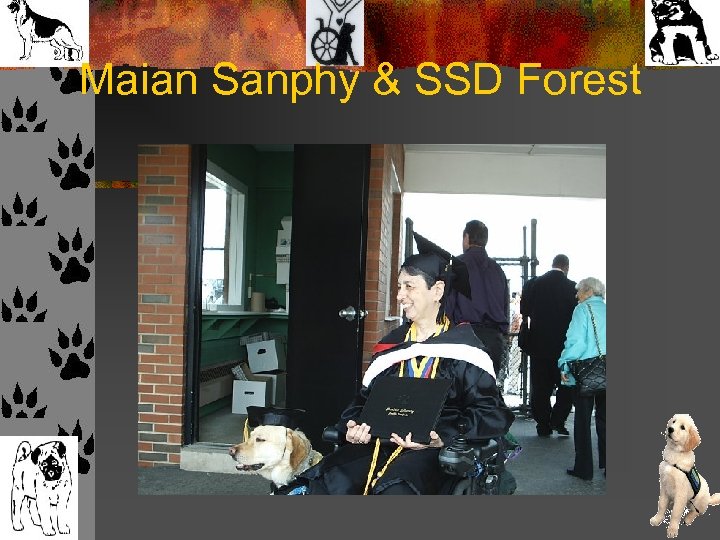
Maian Sanphy & SSD Forest
Pennsylvania’s Law Concerning Service Animals n Under Pennsylvania law, individuals with disabilities who use guide or support animals or trainers of such animals are entitled to equal opportunity in all aspects of employment, as well as equal access to and treatment in all public accommodations, and any housing accommodation or commercial property without discrimination.
Pennsylvania’s Law Concerning Service Animals n If you have further questions about service animals or other requirements of the ADA, you may call the U. S. Department of Justice's tollfree ADA Information Line at 800 -514 -0301 (voice) or 800 -514 -0383 (TDD). In addition, you may call the Pennsylvania Office of Attorney General at (717) 787 -0822 or the Pennsylvania Human Relations Commission at (717) 787 -4410.
What Employers and Schools Need to Know n An employer or a school must consider a service dog a reasonable accommodation and make certain accommodations for a service dog
What Employers and Schools Need to Know Using a Service Animal at Work: • Allow the employee with a disability to bring his or her service animal to work. • Allow the employee to take leave in order to participate in individualized service animal training. • Provide the employee with a private/enclosed workspace.
What Employers and Schools Need to Know Using a Service Animal at Work: • Provide the employee with an office space near a door and/or out of high traffic areas. • Establish an accessible path of travel that is barrier-free. • Allow equal access to employee break rooms, lunchrooms, rest rooms, meeting rooms, and services provided/sponsored by the employer.
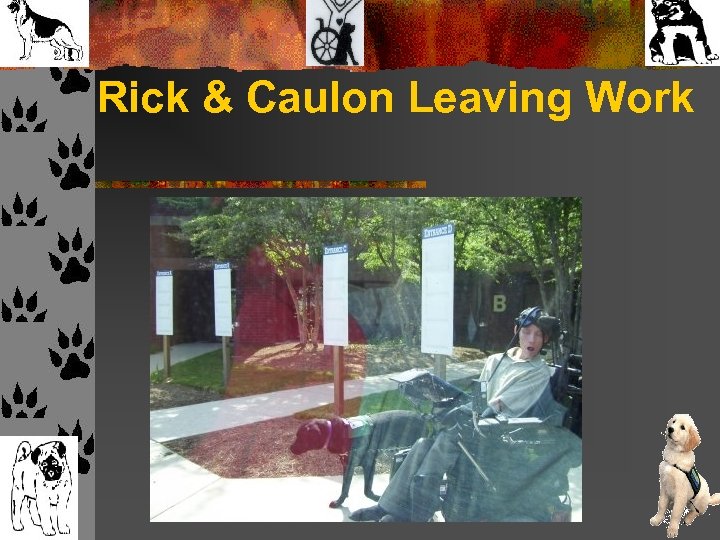
Rick & Caulon Leaving Work
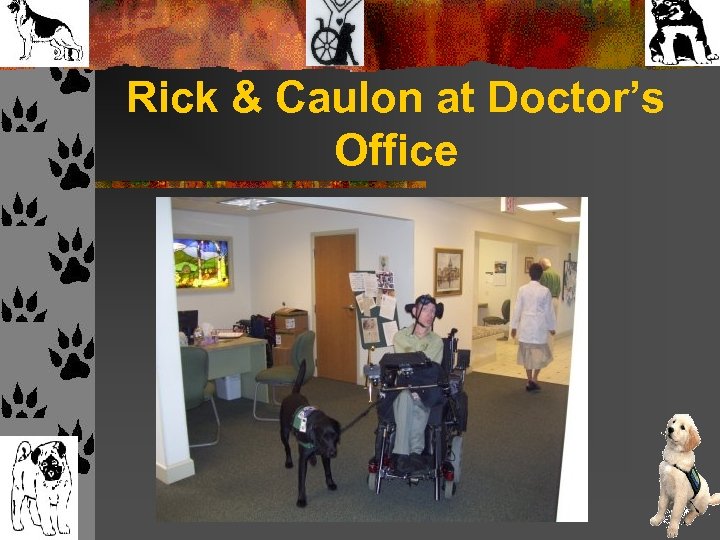
Rick & Caulon at Doctor’s Office
Summary n Having a service dog carries with it a lot of responsibilities n financial n n n foods treats fencing vet bills beds
Summary n Having a service dog carries with it a lot of responsibilities n Daily care n n feeding grooming exercising Major new responsibilities for someone with disabilitating conditions
Summary n n These responsibilities can be very empowering in themselves They are responsible for the needs and care of a living being other than themselves n n n might be a totally new experience instead of being taking care of they become the care providers
Summary n That, in itself, is a service from the dogs to the human partners n n n a person’s sense of worth is strongly tied to the responsibilities a person perceived as having a service dog is to help its human partner do certain things but in other things, the service dog totally depends upon its human partner
Summary n n n The dependency on the human partner might be more beneficial to the human partner than all the tasks the service dog could possibly perform Dependency on others is a road leading to helplessness having another depend on you is the road to self-actualization
References n n “A miracle dog for Reece, ” By Maria Elena Baca, Star Tribune, May 18, 2007; www. startribune. com/diversions/story/ 1190543. html Assistance Dogs International, Inc. , www. adionline. org
References n n n Canine Partners For Life (CPL), www. k 94 life. org International Association of Assistance Dog Partners (IAADP), www. iaadp. org/index. html The Guide Horse Foundation, www. guidehorse. org/law_penn. htm
References n n Susquehanna Service Dogs, www. keystonehumanservices. org/ssd/ ssd. php Service Animal Related Job Accommodations, Job Accommodation Network; PO Box 6080 Morgantown, WV 26506 -6080, www. jan. wvu. edu
References n “Commonly Asked Questions about Service Dogs in Places of Business, ” Pennsylvania Office of Attorney General: www. attorneygeneral. gov
Скачать презентацию Realizing Service Dogs Potentials By Rick Creech Educational
4a27aa41bd1bc7427de1699c1d17857a.ppt