 Скачать презентацию Real-time Parity Feedback John Hansknecht Riad Suleiman
3ce5a6b3e6140cc01eef922a4bad2202.ppt
- Количество слайдов: 12



Real-time Parity Feedback John Hansknecht & Riad Suleiman April 28, 2009
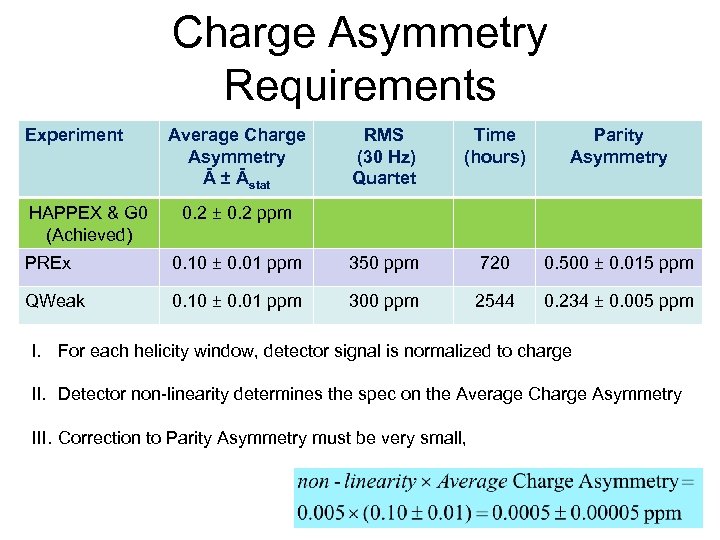
Charge Asymmetry Requirements Experiment HAPPEX & G 0 (Achieved) Average Charge Asymmetry Ā ± Āstat RMS (30 Hz) Quartet Time (hours) Parity Asymmetry 0. 2 ± 0. 2 ppm PREx 0. 10 ± 0. 01 ppm 350 ppm 720 0. 500 ± 0. 015 ppm QWeak 0. 10 ± 0. 01 ppm 300 ppm 2544 0. 234 ± 0. 005 ppm I. For each helicity window, detector signal is normalized to charge II. Detector non-linearity determines the spec on the Average Charge Asymmetry III. Correction to Parity Asymmetry must be very small,
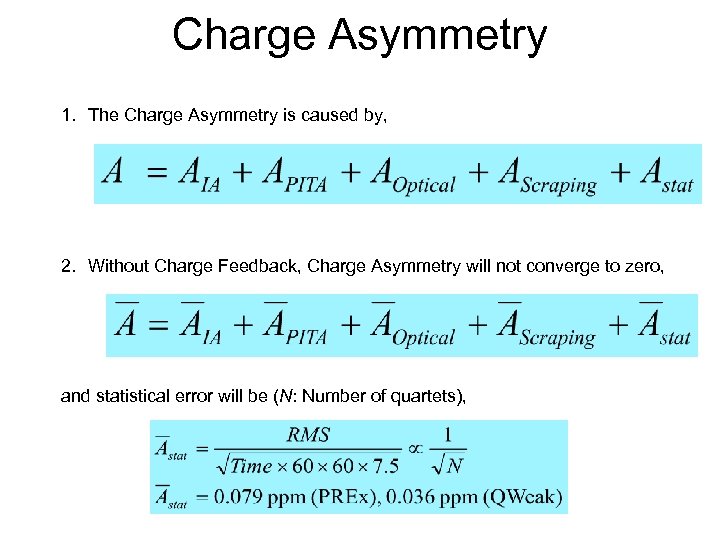
Charge Asymmetry 1. The Charge Asymmetry is caused by, 2. Without Charge Feedback, Charge Asymmetry will not converge to zero, and statistical error will be (N: Number of quartets),
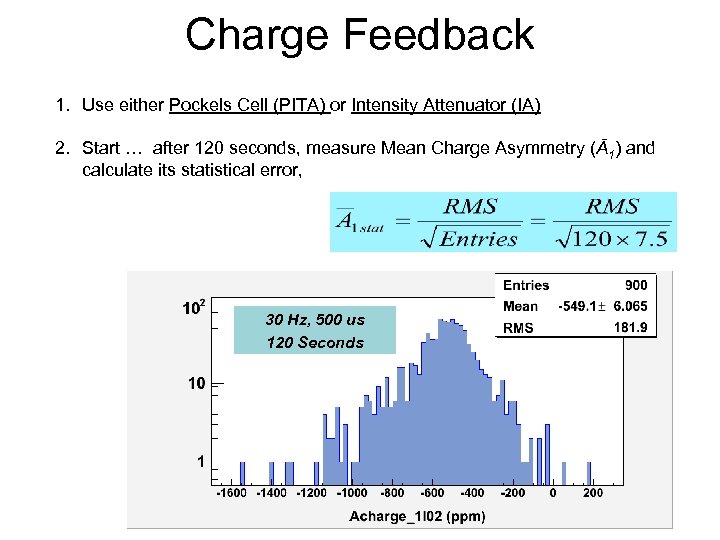
Charge Feedback 1. Use either Pockels Cell (PITA) or Intensity Attenuator (IA) 2. Start … after 120 seconds, measure Mean Charge Asymmetry (Ā1) and calculate its statistical error, 30 Hz, 500 us 120 Seconds
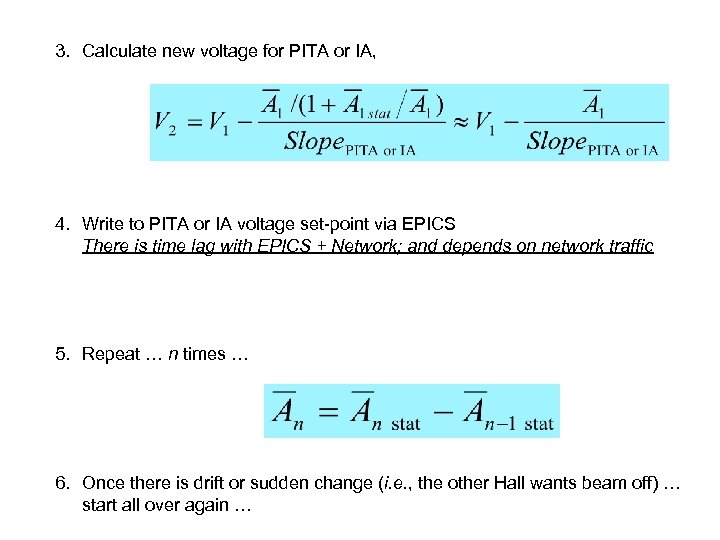
3. Calculate new voltage for PITA or IA, 4. Write to PITA or IA voltage set-point via EPICS There is time lag with EPICS + Network; and depends on network traffic 5. Repeat … n times … 6. Once there is drift or sudden change (i. e. , the other Hall wants beam off) … start all over again …
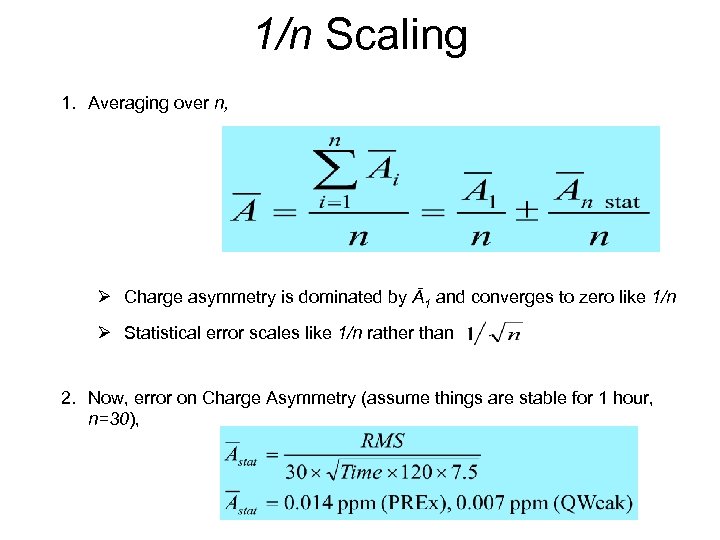
1/n Scaling 1. Averaging over n, Ø Charge asymmetry is dominated by Ā1 and converges to zero like 1/n Ø Statistical error scales like 1/n rather than 2. Now, error on Charge Asymmetry (assume things are stable for 1 hour, n=30),
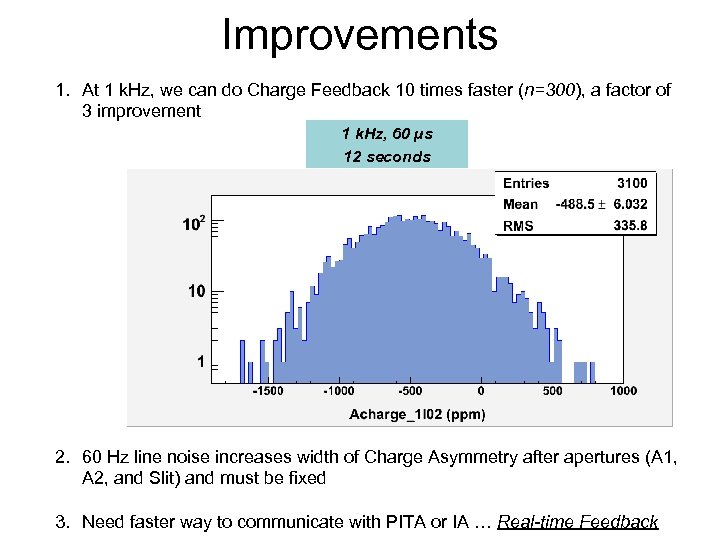
Improvements 1. At 1 k. Hz, we can do Charge Feedback 10 times faster (n=300), a factor of 3 improvement 1 k. Hz, 60 µs 12 seconds 2. 60 Hz line noise increases width of Charge Asymmetry after apertures (A 1, A 2, and Slit) and must be fixed 3. Need faster way to communicate with PITA or IA … Real-time Feedback
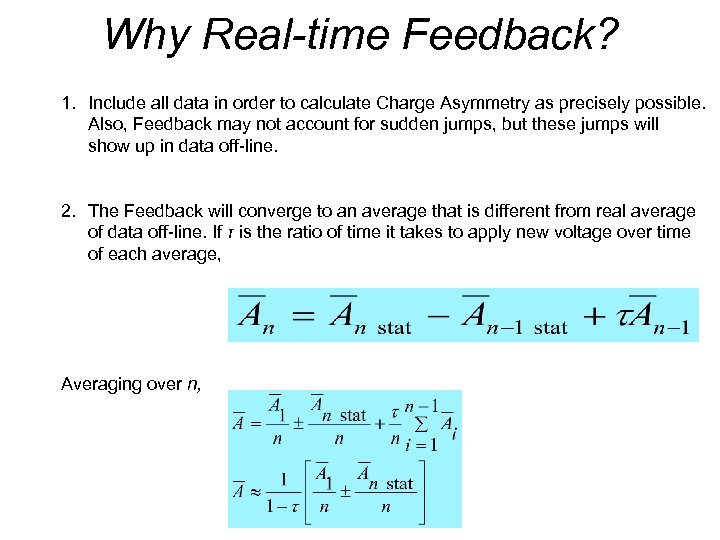
Why Real-time Feedback? 1. Include all data in order to calculate Charge Asymmetry as precisely possible. Also, Feedback may not account for sudden jumps, but these jumps will show up in data off-line. 2. The Feedback will converge to an average that is different from real average of data off-line. If τ is the ratio of time it takes to apply new voltage over time of each average, Averaging over n,
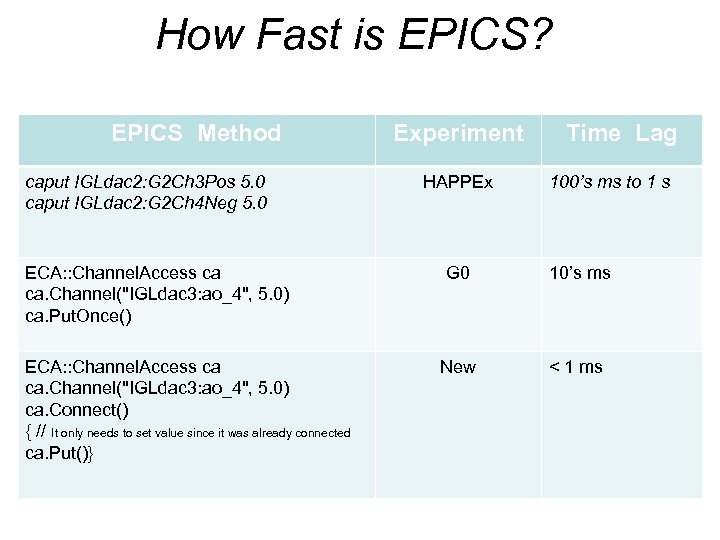
How Fast is EPICS? EPICS Method caput IGLdac 2: G 2 Ch 3 Pos 5. 0 caput IGLdac 2: G 2 Ch 4 Neg 5. 0 ECA: : Channel. Access ca ca. Channel("IGLdac 3: ao_4", 5. 0) ca. Put. Once() ECA: : Channel. Access ca ca. Channel("IGLdac 3: ao_4", 5. 0) ca. Connect() { // It only needs to set value since it was already connected ca. Put()} Experiment HAPPEx Time Lag 100’s ms to 1 s G 0 10’s ms New < 1 ms

New Requirements
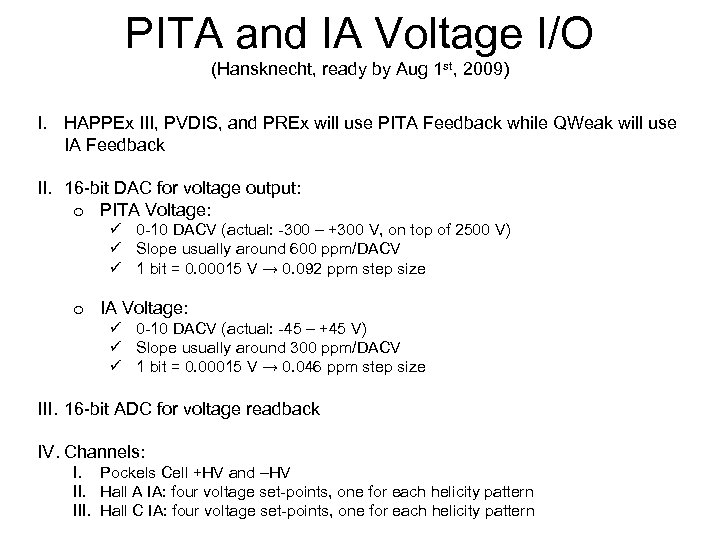
PITA and IA Voltage I/O (Hansknecht, ready by Aug 1 st, 2009) I. HAPPEx III, PVDIS, and PREx will use PITA Feedback while QWeak will use IA Feedback II. 16 -bit DAC for voltage output: o PITA Voltage: ü 0 -10 DACV (actual: -300 – +300 V, on top of 2500 V) ü Slope usually around 600 ppm/DACV ü 1 bit = 0. 00015 V → 0. 092 ppm step size o IA Voltage: ü 0 -10 DACV (actual: -45 – +45 V) ü Slope usually around 300 ppm/DACV ü 1 bit = 0. 00015 V → 0. 046 ppm step size III. 16 -bit ADC for voltage readback IV. Channels: I. Pockels Cell +HV and –HV II. Hall A IA: four voltage set-points, one for each helicity pattern III. Hall C IA: four voltage set-points, one for each helicity pattern
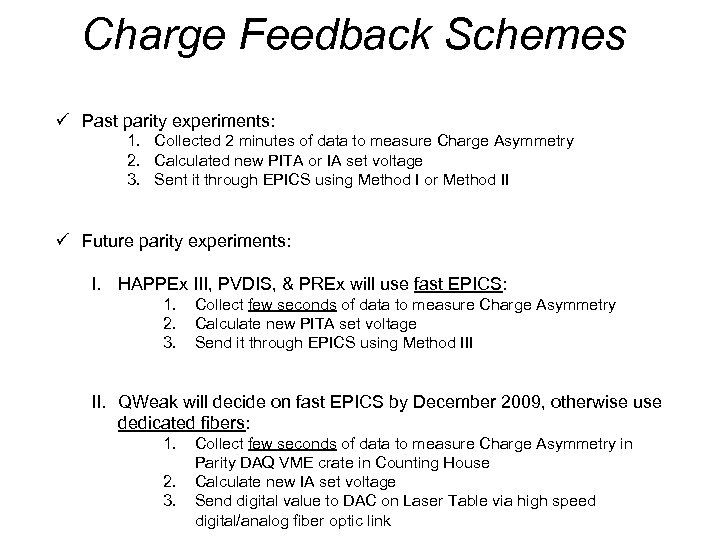
Charge Feedback Schemes ü Past parity experiments: 1. Collected 2 minutes of data to measure Charge Asymmetry 2. Calculated new PITA or IA set voltage 3. Sent it through EPICS using Method I or Method II ü Future parity experiments: I. HAPPEx III, PVDIS, & PREx will use fast EPICS: 1. 2. 3. Collect few seconds of data to measure Charge Asymmetry Calculate new PITA set voltage Send it through EPICS using Method III II. QWeak will decide on fast EPICS by December 2009, otherwise use dedicated fibers: 1. 2. 3. Collect few seconds of data to measure Charge Asymmetry in Parity DAQ VME crate in Counting House Calculate new IA set voltage Send digital value to DAC on Laser Table via high speed digital/analog fiber optic link
Скачать презентацию Real-time Parity Feedback John Hansknecht Riad Suleiman
3ce5a6b3e6140cc01eef922a4bad2202.ppt