


 Скачать презентацию Real Time Operating Systems Michael Thomas Date Date
8b321892ec0e51566fd5db7e90467b93.ppt
- Количество слайдов: 34
 Real Time Operating Systems Michael Thomas Date: Date Rev. 1. 00
 Objective Identify embedded programming models Understand basic RTOS definitions and concepts Points to consider when you “Buy or roll your own” 2
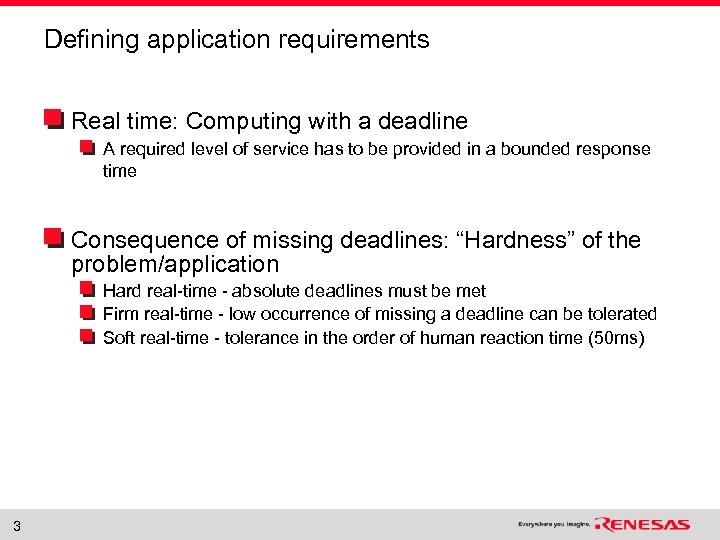 Defining application requirements Real time: Computing with a deadline A required level of service has to be provided in a bounded response time Consequence of missing deadlines: “Hardness” of the problem/application Hard real-time - absolute deadlines must be met Firm real-time - low occurrence of missing a deadline can be tolerated Soft real-time - tolerance in the order of human reaction time (50 ms) 3
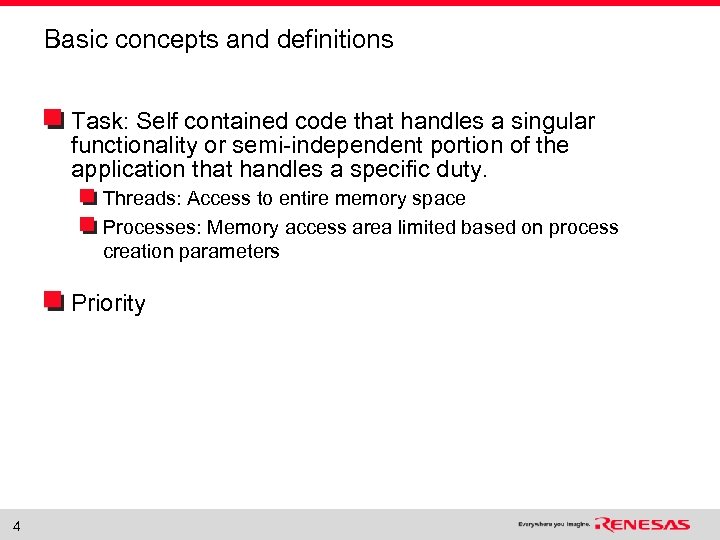 Basic concepts and definitions Task: Self contained code that handles a singular functionality or semi-independent portion of the application that handles a specific duty. Threads: Access to entire memory space Processes: Memory access area limited based on process creation parameters Priority 4
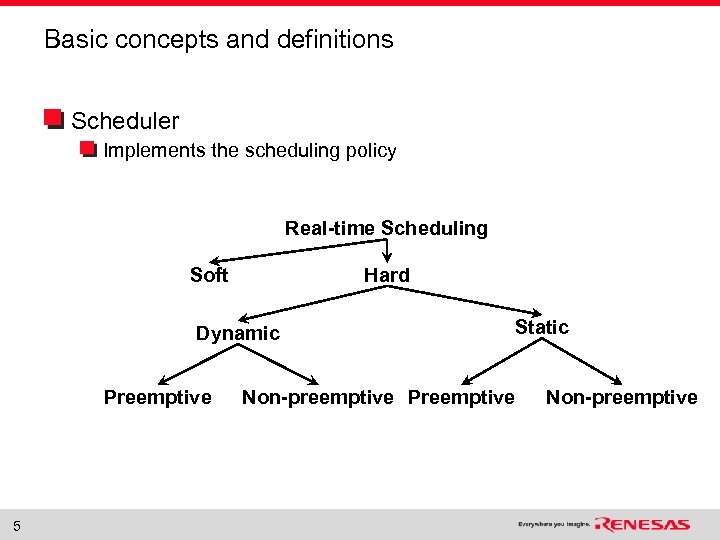 Basic concepts and definitions Scheduler Implements the scheduling policy Real-time Scheduling Soft Hard Dynamic Preemptive 5 Static Non-preemptive Preemptive Non-preemptive
 Basic concepts and definitions Determinism Exact time taken for each thread to execute is a constant Kernel (Scheduler + Memory management + IPC + Synchronization) primitives Kernel latency (microkernel, picokernel etc) Kernel space 6
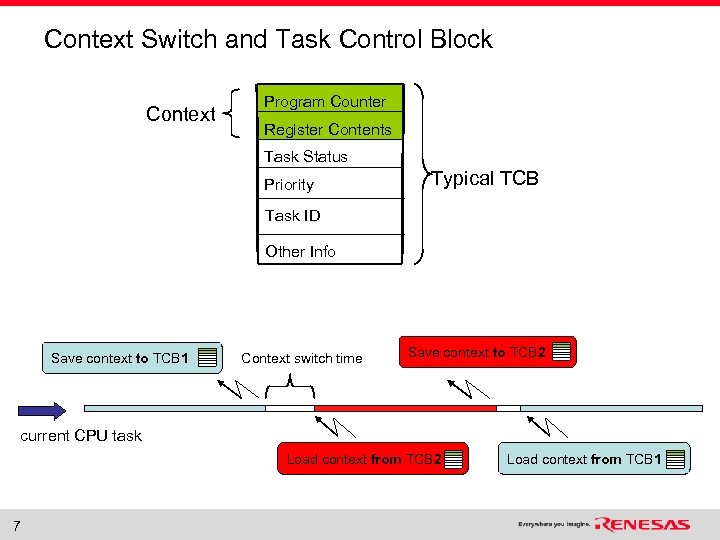 Context Switch and Task Control Block Context Program Counter Register Contents Task Status Priority Typical TCB Task ID Other Info Save context to TCB 1 Context switch time Save context to TCB 2 current CPU task Load context from TCB 2 7 Load context from TCB 1
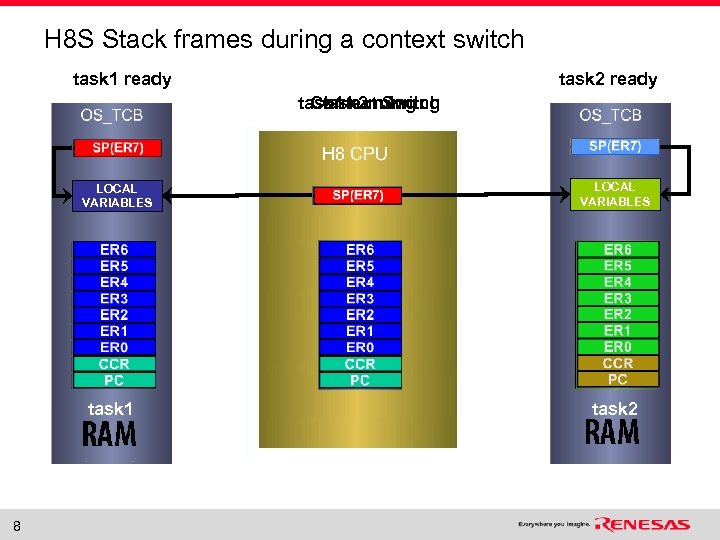 H 8 S Stack frames during a context switch task 1 ready task 2 ready task 1 running Context Switch task 2 running LOCAL VARIABLES task 1 8 LOCAL VARIABLES task 2
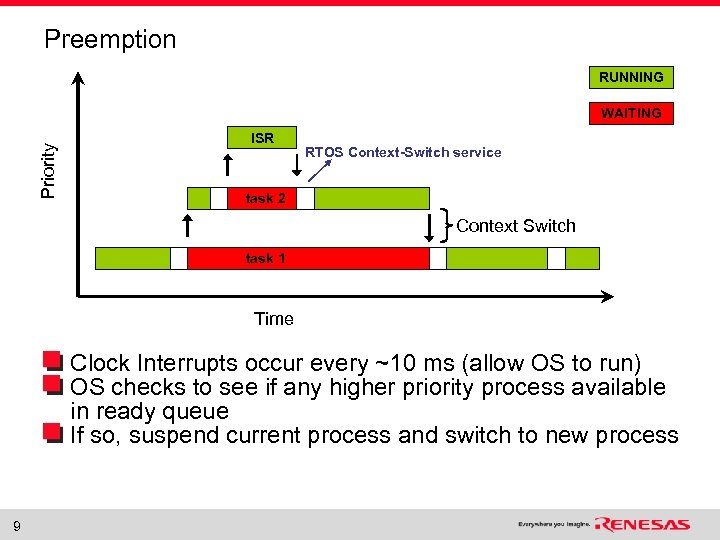 Preemption RUNNING Priority WAITING ISR RTOS Context-Switch service task 2 Context Switch task 1 Time Clock Interrupts occur every ~10 ms (allow OS to run) OS checks to see if any higher priority process available in ready queue If so, suspend current process and switch to new process 9
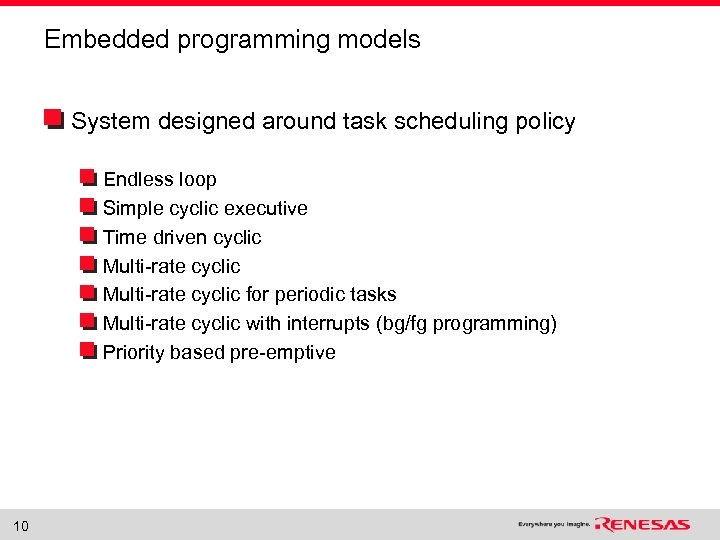 Embedded programming models System designed around task scheduling policy Endless loop Simple cyclic executive Time driven cyclic Multi-rate cyclic for periodic tasks Multi-rate cyclic with interrupts (bg/fg programming) Priority based pre-emptive 10
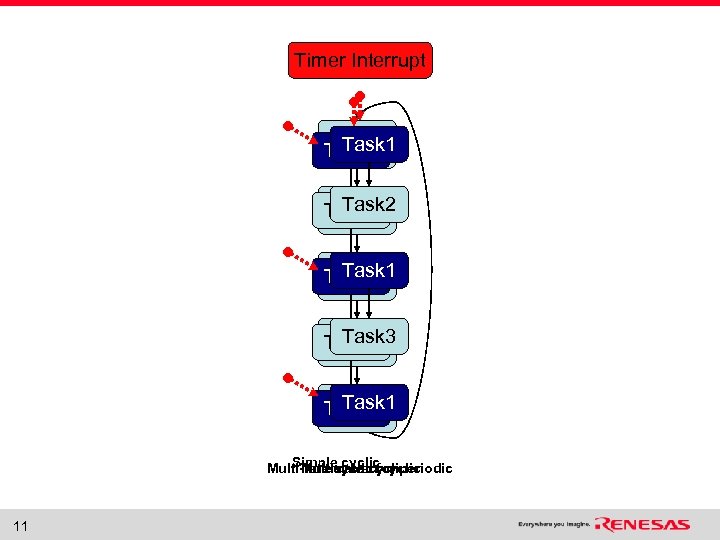 Timer Interrupt Task 1 Task 2 Task 3 Task 1 Task 3 Task 4 Task 5 Task 1 Task 5 Simpledriven cyclic Multi-rate cyclic for periodic Time cyclic Multi-rate cyclic 11
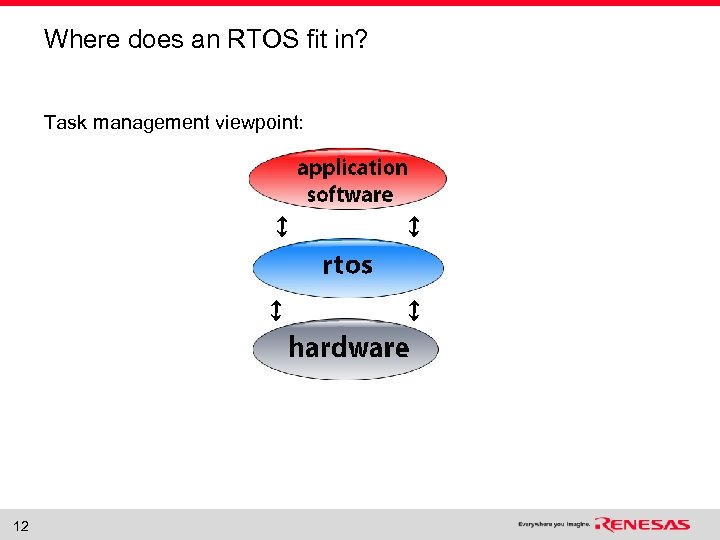 Where does an RTOS fit in? Task management viewpoint: 12
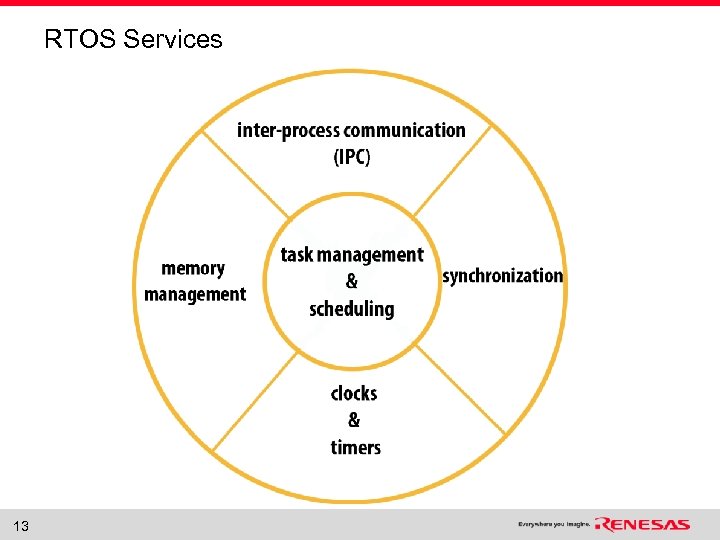 RTOS Services 13
 Task Management & Scheduling Task is considered as a scheduling unit which implements a function OS services that collectively move tasks from one state to another Provide context switching services Task parameters like deadline, period, priority etc need to be specified 14
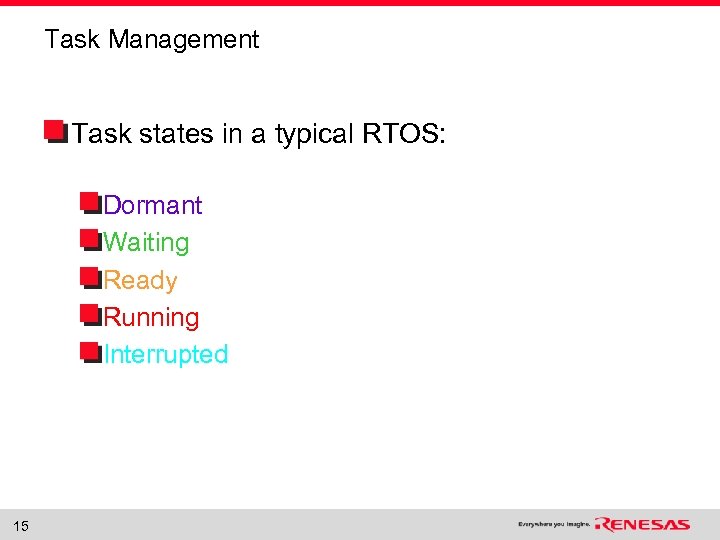 Task Management Task states in a typical RTOS: Dormant Waiting Ready Running Interrupted 15
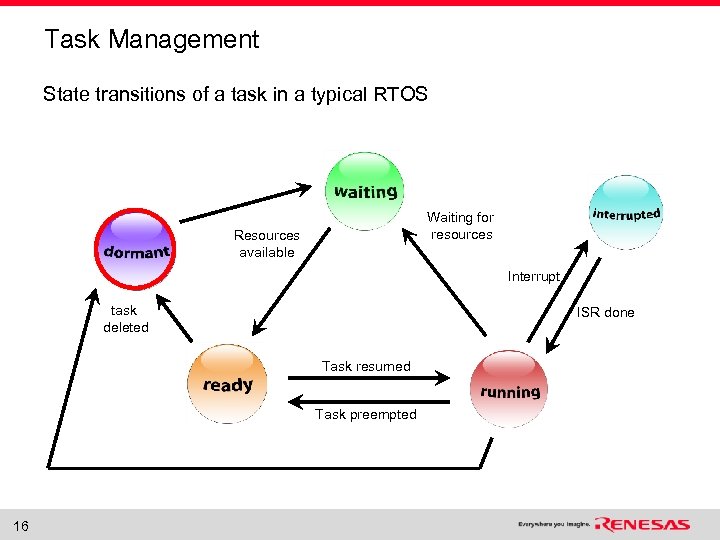 Task Management State transitions of a task in a typical RTOS Waiting for resources Resources available Interrupt task deleted ISR done Task resumed Task preempted 16
 Scheduler and Scheduling Policy Scheduling algorithms generate a feasible execution sequence based on task priority task deadlines resource requirements Round Robin Earliest deadline First (EDF) Maximum Urgency First (MUF) Priority Ceiling Protocol (Resource based) 17
 Interrupt Handling RTOS Independent Interrupts ISR preempts the RTOS and runs Used for events that require accurate timing • RTOS Dependant Interrupts: ISR is run within the RTOS • RTOS should allow lower level ISR to be pre-empted by higher level ISR (RTOS Dependant Interrupts) • ISR must complete as quickly as possible. • Both Dependant and Independent ISRs can exist in one system 18
 Clocks and Timers Tick timer Decides granularity of system. System response time limited by tick timer Eg: 50 microsec motor control interrupt cannot be handled by a 1 millisec tick timer OS. Timer primitives Allow user to specify “Run task every x unit of time” during task creation. eg: scan keyboard 19
 Synchronization primitive used to provide: Mutual exclusion: Critical sections not accessed simultaneously Conditional synchronization: Ensure tasks run in a specific order • Synchronization constructs: Mutex (Binary semaphore) Semaphore (Counting semaphore) 20
 Synchronization and Semaphores Two tasks and single buffer Producer task and consumer task Consumer task to wait till producer task is done with buffer. Synchronization and data integrity achieved by using a semaphore to lock access to buffer. Issues: Deadlocks Priority Inversion: Low priority thread obtains a lock that blocks a higher priority thread 21
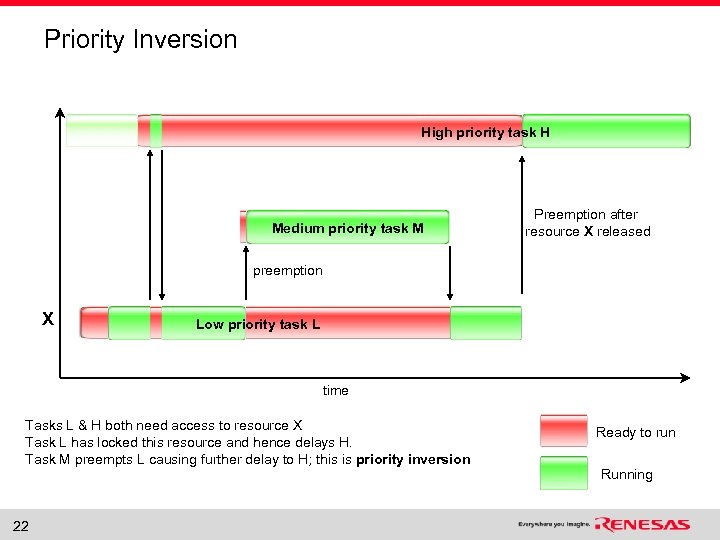 Priority Inversion High priority task H Medium priority task M Preemption after resource X released preemption X Low priority task L time Tasks L & H both need access to resource X Task L has locked this resource and hence delays H. Task M preempts L causing further delay to H; this is priority inversion 22 Ready to run Running
 Inter Task Communication Primary requirements/characteristics: Non-blocking communication Bounded latency Asynchronous communication Shared Memory Mailbox/Message Queues 23
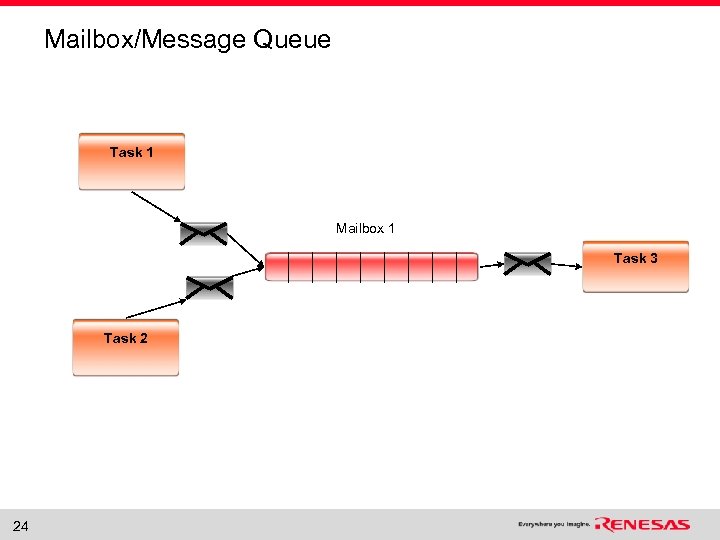 Mailbox/Message Queue Task 1 Mailbox 1 Task 3 Task 2 24
 Memory Management Unit (MMU) Handles Virtual memory operations. Memory protection esp. in process based OS Dynamic memory allocation Heap; non-fragmenting memory allocation techniques “Pool” allocation mechanism 25
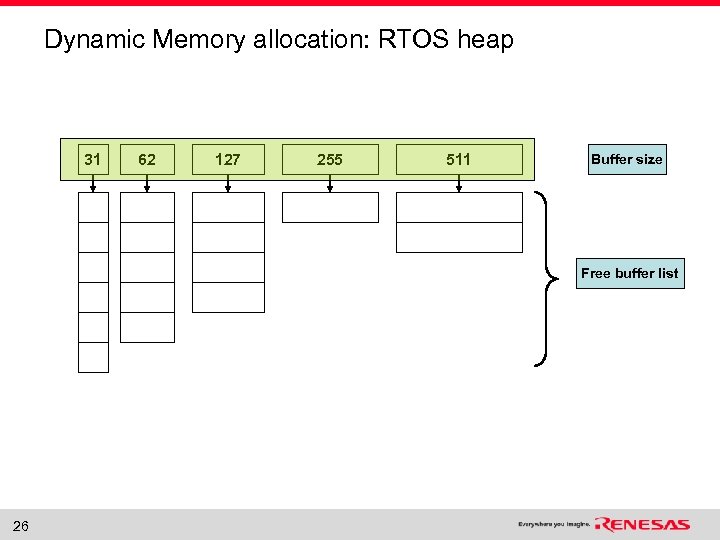 Dynamic Memory allocation: RTOS heap 31 62 127 255 511 Buffer size Free buffer list 26
 RTOS classification based on architecture Soft, Firm and Hard real-time Pre-emptive, Non pre-emptive Thread based, Process based Scheduling policy: RM, EDF, RR, MUF etc Dynamic, Static Cost structure 27
 RTOS aware debugging Standard source level debugging not sufficient in multithreaded/multitasking environment. Potential bugs: Data corruption due to improper synchronization Deadlock Starvation Stack Overflow Memory leaks RTOS-aware debuggers provide tools that help detect such conditions for quicker debugging. Extra windows showing state of all tasks (running, waiting etc), including buffers currently used by each task, semaphores used etc. 28
 Buy vs Roll your Own Factors: Cost Structure. Support and documentation Scalability Portability Debugging tools Testing 29
 Buy vs Roll your Own Cost Structure. Royalty per product/ one time payment Overall development, debugging, testing and support resources for in-house tool usually far outweigh investing in a commercial RTOS Support and documentation Insufficient documentation Small team responsible for R&D and maintenance Commercial RTOSes are well documented with good support 30
 Buy vs Roll your Own Scalability In-house tools are usually designed to meet exact specifications so it might be a good fit Commercial vendors allow significant customization of the kernel (in some cases a GUI for this purpose), so the notion of too much overhead code is unfounded Some commercial vendors also provide source code to allay engineer fears of “I cant see the code so I don’t know what’s going on” 31
 Buy vs Roll your Own Portability Porting an in-house solution to different hardware will require significant re-investment of time and resources Commercial vendors have ports for all major hardware targets and will usually port to others as well Debugging tools have to be developed/ported for in house RTOS; usually takes 4 x time needed to develop the RTOS Commercial vendors have readily available debuggers and will port over desired features in most cases 32
 Buy vs Roll your Own Testing In-house testing; takes 10 x development time to properly test RTOS Commercial RTOSes are sufficiently tested and have also been used by many customers so most bugs will have been ironed out. 33
 Objectives: Recap Identify embedded programming models Understand basic RTOS definitions and concepts Points to consider when you “Buy or roll your own” 34