


 Скачать презентацию Real Option Framework to Value Network Architecture and
30b6a10c555544158b70797787a88efc.ppt
- Количество слайдов: 35
 Real Option Framework to Value Network Architecture and Network Neutrality Mark Gaynor Boston University Saint Louis University (summer 2009) mgaynor@bu. edu Workshop III: Beyond Internet MRA: Networks of Networks Institute for Pure and Applied Mathematics (IPAM) © Mark Gaynor 11/05/08 - IPAM 1
 Motivation § What is the value of: § end-2 -end architecture § Efficient centralized Vs flexible distributed architectures § Network Neutrality § It depends on market uncertainty! § It is important to know what users want § If you know and others don’t, then you can win big if market uncertainty is high © Mark Gaynor 11/05/08 - IPAM 2
 Talk Outline § § § Real Options Approach Market Uncertainty Network Architecture A simple real options model What is network neutrality Model applied to network neutrality § Link the excepted ARPU to market uncertainty © Mark Gaynor 11/05/08 - IPAM 3
 Traditional networks metrics § What are traditional methodologies good for § If I know what users want § What if we don’t understand what users want? § What services, with what features? § How much will they pay for them? § Does uncertainty imply more value to network neutrality § Real options value uncertainty and choice © Mark Gaynor 11/05/08 - IPAM 4
 Why “real options” § Options theory models uncertainty, flexibility and choice § Options illustrate how to limit risk, without capping gain – a good design principle § Real options extends theory of options to non-financial assets § Building IT infrastructure, modularity in computer systems, modularity and staged development of IT standards § Real options illustrate when flexibility is worth more than efficiency © Mark Gaynor 11/05/08 - IPAM 5
 Options and Real Options § Classic call option § Pay something today, to buy a stock in the future, at today’s price § This limits risk, without capping gain, unlike owning the stock § Real Options § Pharmaceutical development, power plants, …. . § Limit loss without capping gain © Mark Gaynor 11/05/08 - IPAM 6
 Management Structure and Experimentation § What is Experimentation § Features in devices and services § Distributed management structure is easy to experiment with § Don’t need permission § Don’t need to change network infrastructure § A bad experiment only affects a few users § Centralized management makes experimentation hard § Need to change network infrastructure § Need to ask permission § Many users affected with bad experiment © Mark Gaynor 11/05/08 - IPAM 7
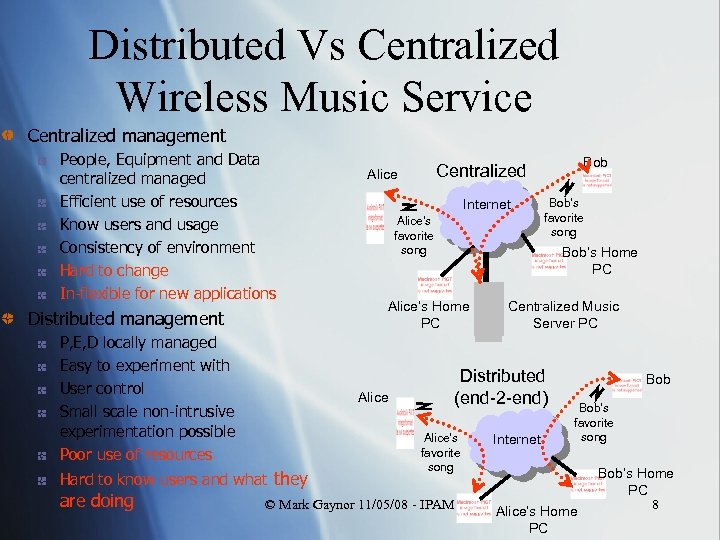 Distributed Vs Centralized Wireless Music Service Centralized management People, Equipment and Data centralized managed Efficient use of resources Know users and usage Consistency of environment Hard to change In-flexible for new applications Distributed management P, E, D locally managed Easy to experiment with User control Small scale non-intrusive experimentation possible Poor use of resources Hard to know users and what they are doing Internet Alice’s favorite song Bob’s Home PC Alice Bob Centralized Alice Centralized Music Server PC Distributed (end-2 -end) Alice’s favorite song © Mark Gaynor 11/05/08 - IPAM Internet Bob’s favorite song Alice’s Home PC Bob’s Home PC 8
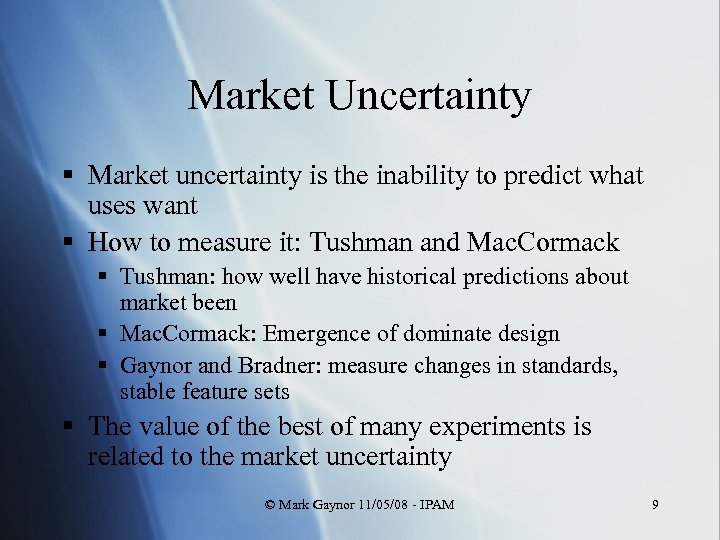 Market Uncertainty § Market uncertainty is the inability to predict what uses want § How to measure it: Tushman and Mac. Cormack § Tushman: how well have historical predictions about market been § Mac. Cormack: Emergence of dominate design § Gaynor and Bradner: measure changes in standards, stable feature sets § The value of the best of many experiments is related to the market uncertainty © Mark Gaynor 11/05/08 - IPAM 9
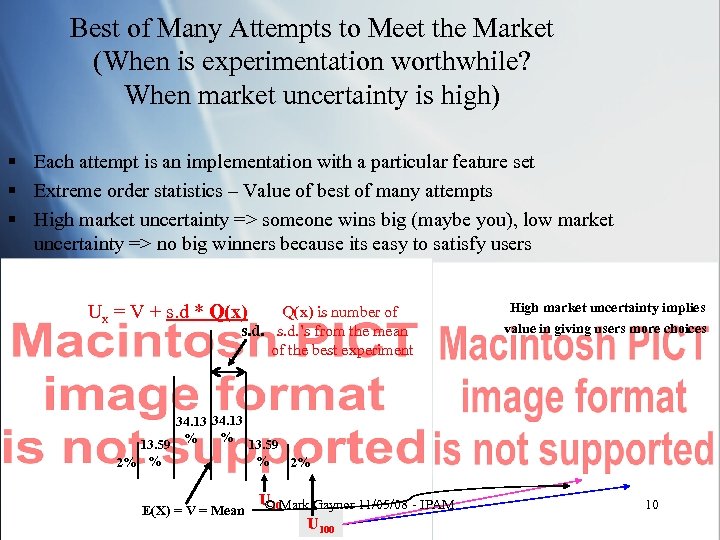 Best of Many Attempts to Meet the Market (When is experimentation worthwhile? When market uncertainty is high) § Each attempt is an implementation with a particular feature set § Extreme order statistics – Value of best of many attempts § High market uncertainty => someone wins big (maybe you), low market uncertainty => no big winners because its easy to satisfy users Ux = V + s. d * Q(x) is number of s. d. ’s from the mean of the best experiment High market uncertainty implies value in giving users more choices 34. 13 % 13. 59 % 2% 2% % E(X) = V = Mean U 10 Mark Gaynor 11/05/08 - IPAM © U 100 10
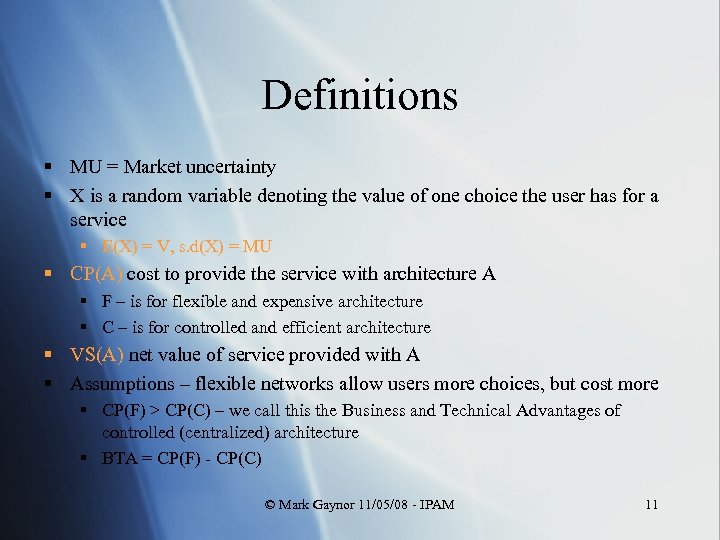 Definitions § MU = Market uncertainty § X is a random variable denoting the value of one choice the user has for a service § E(X) = V, s. d(X) = MU § CP(A) cost to provide the service with architecture A § F – is for flexible and expensive architecture § C – is for controlled and efficient architecture § VS(A) net value of service provided with A § Assumptions – flexible networks allow users more choices, but cost more § CP(F) > CP(C) – we call this the Business and Technical Advantages of controlled (centralized) architecture § BTA = CP(F) - CP(C) © Mark Gaynor 11/05/08 - IPAM 11
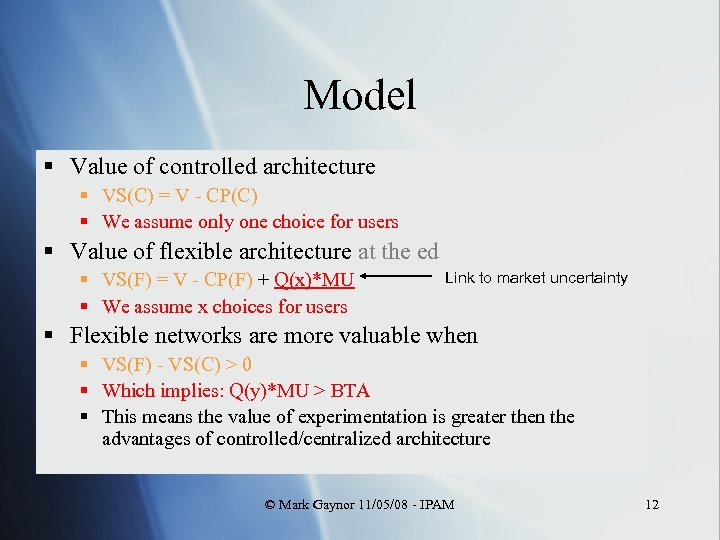 Model § Value of controlled architecture § VS(C) = V - CP(C) § We assume only one choice for users § Value of flexible architecture at the ed § VS(F) = V - CP(F) + Q(x)*MU § We assume x choices for users Link to market uncertainty § Flexible networks are more valuable when § VS(F) - VS(C) > 0 § Which implies: Q(y)*MU > BTA § This means the value of experimentation is greater then the advantages of controlled/centralized architecture © Mark Gaynor 11/05/08 - IPAM 12
 Results Q(x)*MU Q(y)*MU = Cost Differential © Mark Gaynor 11/05/08 - IPAM 13
 Learning and evolution © Mark Gaynor 11/05/08 - IPAM 14
 Email Case Study § Different ways to manage email § Centralized web-based (hotmail) compared to distributed ISP (Po. P) § Shift to centralized in 1996 § Low MU because of dominate design, stable standards § Market uncertainty is likely cause of this shift § Technology or regulation can’t explain this shift © Mark Gaynor 11/05/08 - IPAM 15
 Voice Case Study § Distributed PBX compared to centralized Centrex § Shift to centralized in 1996 § Low MU because good market predictions, stable feature set § Market uncertainty is likely cause of this shift § Technology or regulation can’t explain this shift © Mark Gaynor 11/05/08 - IPAM 16
 Network Neutrality § Users can use their bandwidth for anything they want, in any way they want (Tim Berners Lee) § The network does not bias traffic to and from users based on its content, source, or destination § Does not bias traffic to the disadvantage of the end user § A network service provider offering Vo. IP can not give lower Qo. S to a competing Vo. IP service provider in a neutral network © Mark Gaynor 11/05/08 - IPAM 17
 Network Neutrality or Not § Some say neutrality will not promote investment in network infrastructure § Some say non-neutrality will not promote innovation in devices, applications, and services § How does uncertainty fit into this © Mark Gaynor 11/05/08 - IPAM 18
 Openness in 700 MHz Spectrum § Google wanted in the 700 MHz C block: § “Open applications: consumers should be able to download and utilize any software applications, content, or services they desire; § Open devices: consumers should be able to utilize a handheld communications device with whatever wireless network they prefer; § Open services: third parties (resellers) should be able to acquire wireless services from a 700 MHz licensee on a wholesale basis, based on reasonably nondiscriminatory commercial terms; and § Open networks: third parties (like internet service providers) should be able to interconnect at a technically feasible point in a 700 MHz licensee's wireless network. “ - http: //googlepublicpolicy. blogspot. com/2007/07/promise-of-open-platforms-in-upcoming. html § FCC wants: § Any device and application § Carriers want their devices, applications, services, and no wholesale network pricing! © Mark Gaynor 11/05/08 - IPAM 19
 Architecture Vs Neutrality § Centralized networks such as the PSTN and Cellular are easy to control and do not promote network neutrality § But, then can be neutral if the central manager allows it § Distributed networks such as the Internet promote neutral network § But, it is possible for ISPs to bias traffic § The PSTN has grown more distributed, and the Internet has become more centralized © Mark Gaynor 11/05/08 - IPAM 20
 End-2 -end Vs Neutrality § True e-2 -e networks are by definition neutral § The “old Internet” was e-2 -e § The “new Internet” is not e-2 -e § The ISP may filter and bias traffic to and from users § The ISP may filter and bias traffic to and from other ISPs © Mark Gaynor 11/05/08 - IPAM 21
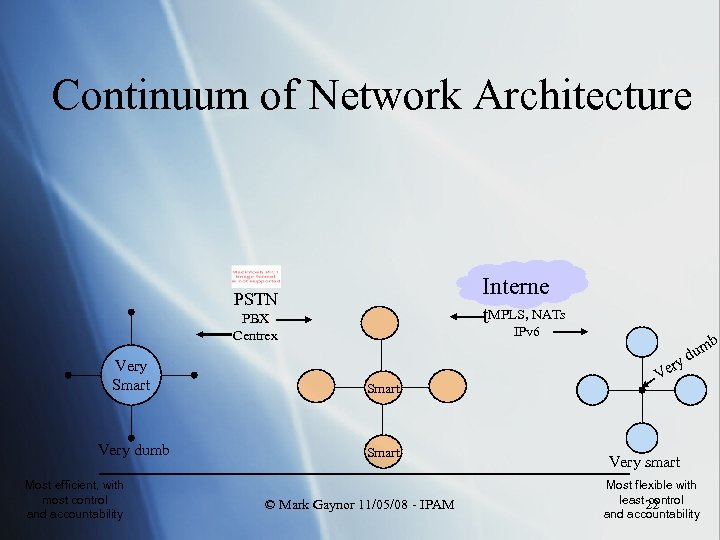 Continuum of Network Architecture Interne t. MPLS, NATs PSTN PBX Centrex IPv 6 Very Smart Very dumb Smart Most efficient, with most control and accountability © Mark Gaynor 11/05/08 - IPAM ery V b um d Very smart Most flexible with least 22 control and accountability
 Neutrality Model - Assumptions and Notation § A neutral network has a single provider for all transport, content, and services § A non-neutral network has a single transport provider and many content/service providers § The Transport provider offers a service bundle (voice, video, email) including transport and its pick of content/services § The costs of a neutral and non-neutral network is the same to build and manage § We believe the non-neutral network is more expensive, which strengthens our argument § The network has N users © Mark Gaynor 11/05/08 - IPAM 23
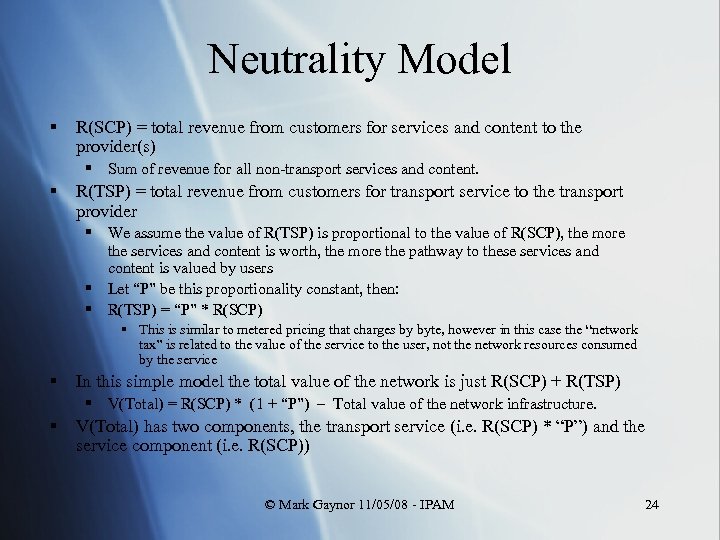 Neutrality Model § R(SCP) = total revenue from customers for services and content to the provider(s) § Sum of revenue for all non-transport services and content. § R(TSP) = total revenue from customers for transport service to the transport provider § We assume the value of R(TSP) is proportional to the value of R(SCP), the more the services and content is worth, the more the pathway to these services and content is valued by users § Let “P” be this proportionality constant, then: § R(TSP) = “P” * R(SCP) § This is similar to metered pricing that charges by byte, however in this case the “network tax” is related to the value of the service to the user, not the network resources consumed by the service § In this simple model the total value of the network is just R(SCP) + R(TSP) § V(Total) = R(SCP) * (1 + “P”) – Total value of the network infrastructure. § V(Total) has two components, the transport service (i. e. R(SCP) * “P”) and the service component (i. e. R(SCP)) © Mark Gaynor 11/05/08 - IPAM 24
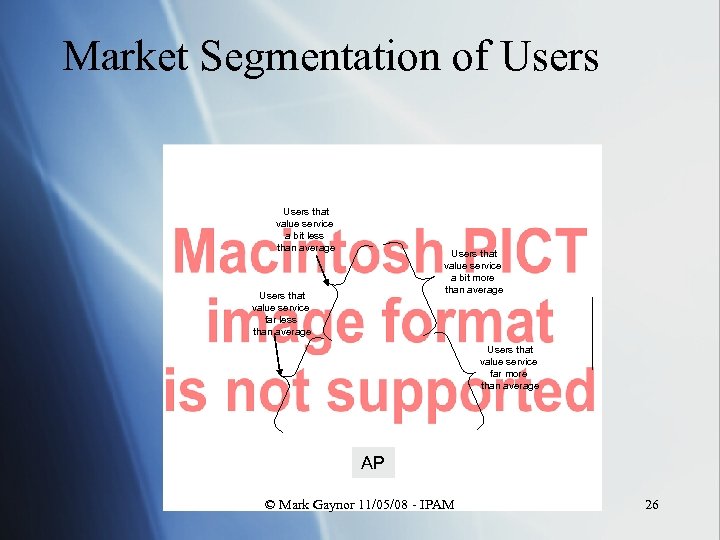
 Expected Average Revenue Per User (ARPU) § Users will pay more for what they like better! § Nobody really knows what users want for content and services § Nobody knows what users will pay for what content § There is a limit! § Price to get 50% of users in uncertain markets = Average Price (AP) © Mark Gaynor 11/05/08 - IPAM 25
 Market Segmentation of Users that value service a bit less than average Users that value service a bit more than average Users that value service far less than average Users that value service far more than average AP © Mark Gaynor 11/05/08 - IPAM 26
 Simulation of Value of Choice Best Service/Content/Application Provider © Mark Gaynor 11/05/08 - IPAM 27
 Value of Non-Neutral Network (No Market Uncertainty) § In this case, R(SCP) = the number of subscribers, times the fixed price. The fixed price with no market uncertainty is just “AP” the mean of the no longer random variable describing the value of a set of services selected by the service provider § R(SCP) = “N” * “AP” § V(Total) = “N” * “AP” * (1 + “P”) © Mark Gaynor 11/05/08 - IPAM 28
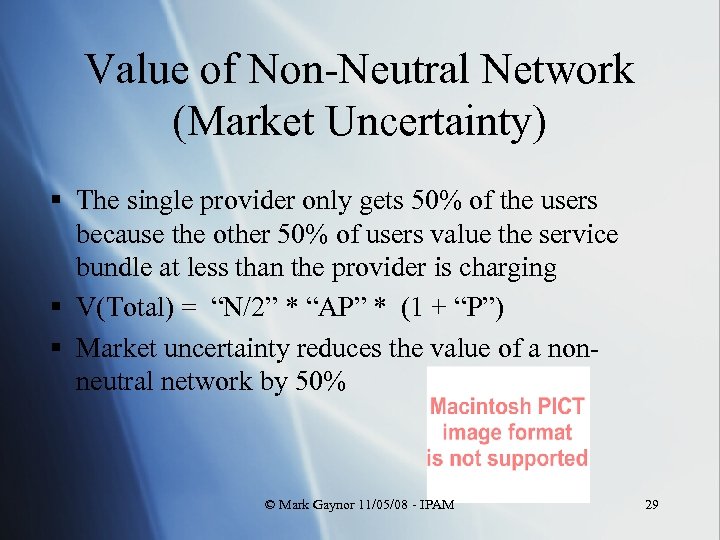 Value of Non-Neutral Network (Market Uncertainty) § The single provider only gets 50% of the users because the other 50% of users value the service bundle at less than the provider is charging § V(Total) = “N/2” * “AP” * (1 + “P”) § Market uncertainty reduces the value of a nonneutral network by 50% © Mark Gaynor 11/05/08 - IPAM 29
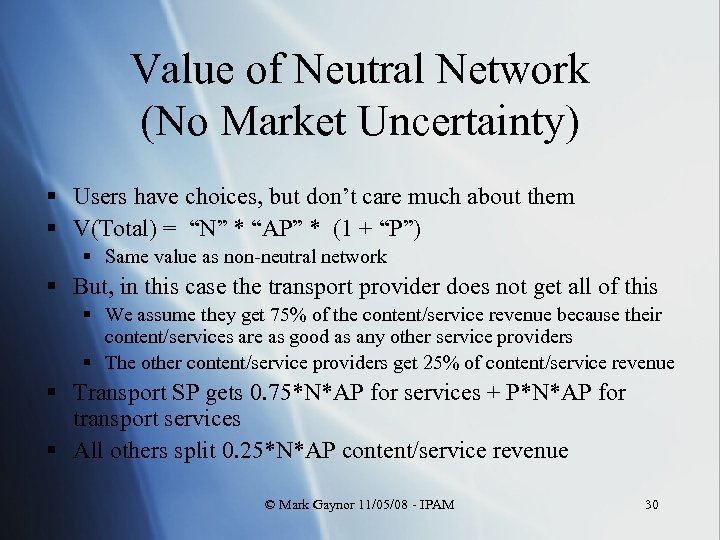 Value of Neutral Network (No Market Uncertainty) § Users have choices, but don’t care much about them § V(Total) = “N” * “AP” * (1 + “P”) § Same value as non-neutral network § But, in this case the transport provider does not get all of this § We assume they get 75% of the content/service revenue because their content/services are as good as any other service providers § The other content/service providers get 25% of content/service revenue § Transport SP gets 0. 75*N*AP for services + P*N*AP for transport services § All others split 0. 25*N*AP content/service revenue © Mark Gaynor 11/05/08 - IPAM 30
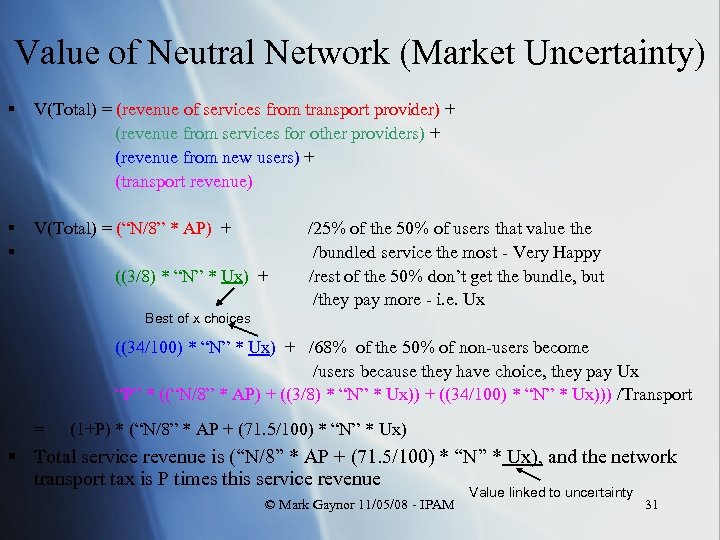 Value of Neutral Network (Market Uncertainty) § V(Total) = (revenue of services from transport provider) + (revenue from services for other providers) + (revenue from new users) + (transport revenue) § § V(Total) = (“N/8” * AP) + ((3/8) * “N” * Ux) + /25% of the 50% of users that value the /bundled service the most - Very Happy /rest of the 50% don’t get the bundle, but /they pay more - i. e. Ux Best of x choices ((34/100) * “N” * Ux) + /68% of the 50% of non-users become /users because they have choice, they pay Ux “P” * ((“N/8” * AP) + ((3/8) * “N” * Ux)) + ((34/100) * “N” * Ux))) /Transport = (1+P) * (“N/8” * AP + (71. 5/100) * “N” * Ux) § Total service revenue is (“N/8” * AP + (71. 5/100) * “N” * Ux), and the network transport tax is P times this service revenue © Mark Gaynor 11/05/08 - IPAM Value linked to uncertainty 31
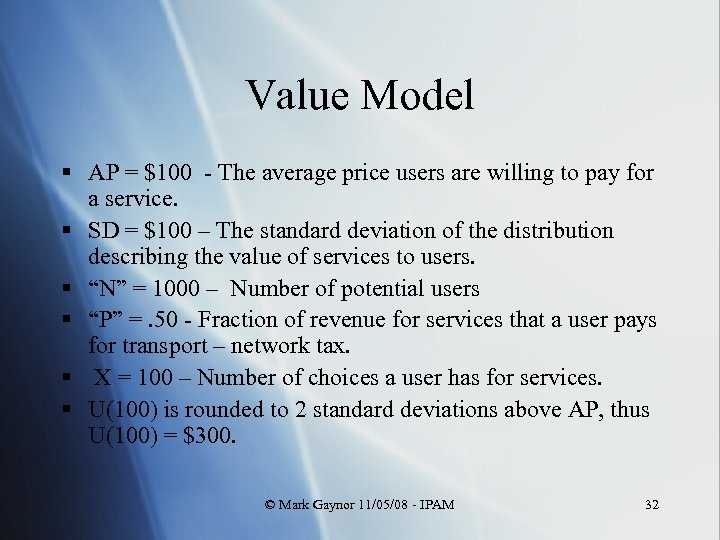 Value Model § AP = $100 - The average price users are willing to pay for a service. § SD = $100 – The standard deviation of the distribution describing the value of services to users. § “N” = 1000 – Number of potential users § “P” =. 50 - Fraction of revenue for services that a user pays for transport – network tax. § X = 100 – Number of choices a user has for services. § U(100) is rounded to 2 standard deviations above AP, thus U(100) = $300. © Mark Gaynor 11/05/08 - IPAM 32
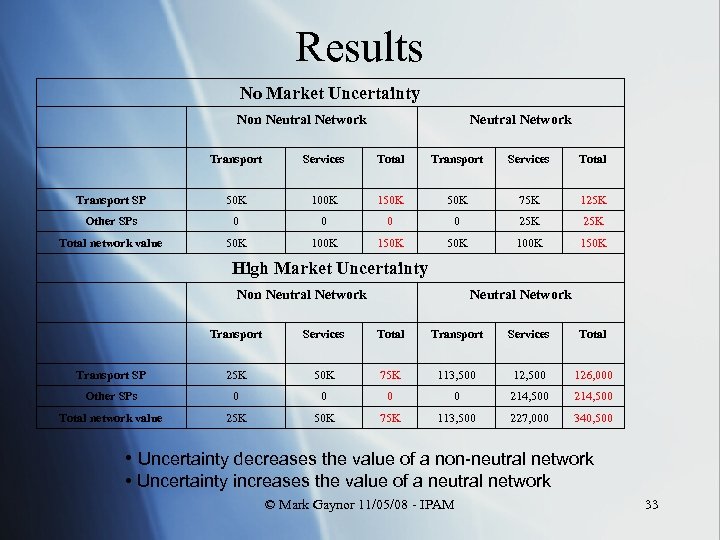 Results No Market Uncertainty Non Neutral Network Transport Services Total Transport SP 50 K 100 K 150 K 75 K 125 K Other SPs 0 0 25 K Total network value 50 K 100 K 150 K High Market Uncertainty Non Neutral Network Transport Services Total Transport SP 25 K 50 K 75 K 113, 500 126, 000 Other SPs 0 0 214, 500 Total network value 25 K 50 K 75 K 113, 500 227, 000 340, 500 • Uncertainty decreases the value of a non-neutral network • Uncertainty increases the value of a neutral network © Mark Gaynor 11/05/08 - IPAM 33
 Conclusion § Real options provide a way to model uncertainty § Our model illustrates the tradeoffs between: market uncertainty, the advantages of control and central management, and the number of experiments § It shows that neutral networks generate more total revenue (transport + services) in uncertain markets § The question changes from neutrality or not, to how to split the bigger pie § Suggestions for what next © Mark Gaynor 11/05/08 - IPAM 34
 Acknowledgements § My thesis advisor H. T. Kung § Carliss Baldwin and Marco Iansiti from Harvard Business School § Scott Bradner © Mark Gaynor 11/05/08 - IPAM 35