


 Скачать презентацию Real Estate Private Restrictions on Ownership What
49da374ae4922990d83b7ab9e14073d7.ppt
- Количество слайдов: 21
 Real Estate: Private Restrictions on Ownership
 What are Encumbrances? • Are restrictions and limitations on the fee simple ownership rights that generally run with the land – Private – Public
 Private Encumbrances • • • Covenants, conditions, restrictions Liens Easements Profit a prendre Adverse possession Encroachments
 Covenants, Conditions, Restrictions (CC &Rs) • Are private encumbrances that limit the way a property owner can use a property • Deed Restrictions – Created by developer – i. e. land across from Central Baptist Church in College Station
 What is a Lien? • Is a claim on a property as either security for a debt or fulfillment of some monetary charge or obligation – i. e. mortgage on property to borrow money • Voluntary Lien – Placed on property by owner • i. e. mortgage • Involuntary Lien – Protect the interest of persons who have valid claims against the owner of real property • i. e. unpaid taxes, lawsuit
 Liens • Specific Liens – Created to protect creditors using a particular parcel of real estate as security for repayment. 2 types: 1. Mortgages • • • Mortgagor (gives property rights, i. e. homeowner), Mortgagee (receives property rights, i. e. bank) Foreclosure 2. Mechanics’ Liens (aka construction lien) • General Liens – Placed on all of the property that might be owned by an individual, including any real estate • i. e. judgment lien, income tax lien (involves judicial sale)
 What is an Easement? • Easement • Is a right given to one party by a landowner to use the land in a specified manner • i. e. utility, oil & gas, ranch access • 2 types of Easements 1. Easement Appurtenant 2. Easement in Gross
 2 Types of Easements 1. Easement Appurtenant – Exists when an easement is legally connected to an adjoining property • • Dominant Estate (Benefits from Easement) Servient Estate (Burdened by Easement 2. Easement in Gross – Only has servient estate (no Dominant Estate) • i. e. Utility company, not adjoining property, benefits from easement
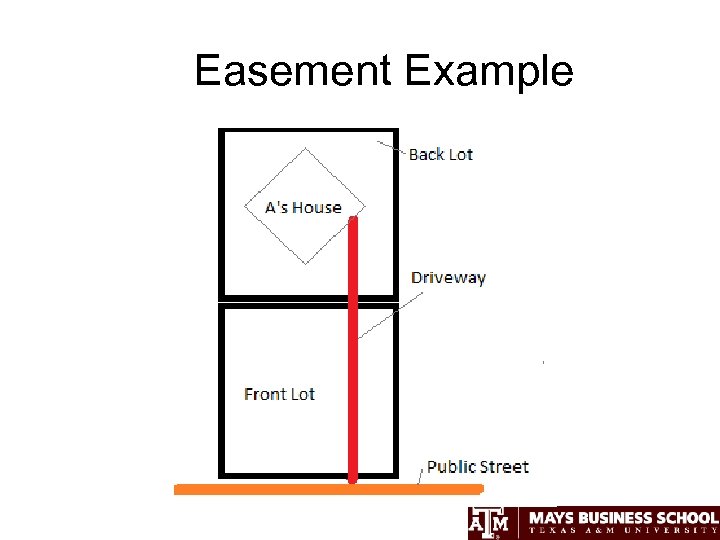 Easement Example
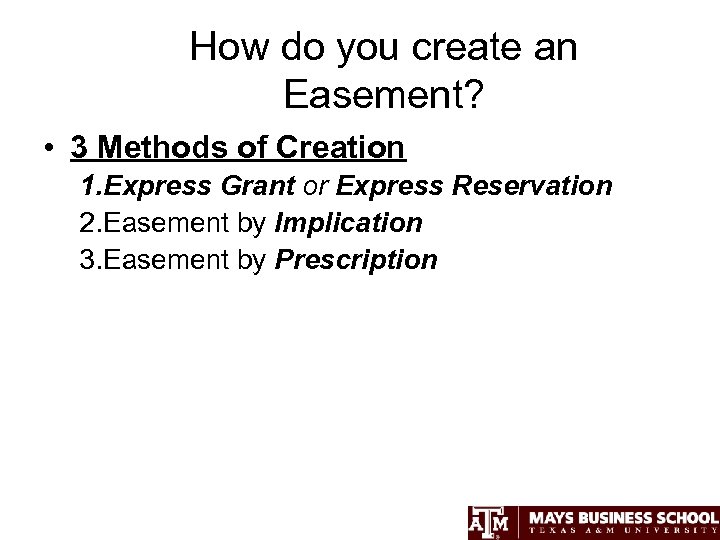 How do you create an Easement? • 3 Methods of Creation 1. Express Grant or Express Reservation 2. Easement by Implication 3. Easement by Prescription
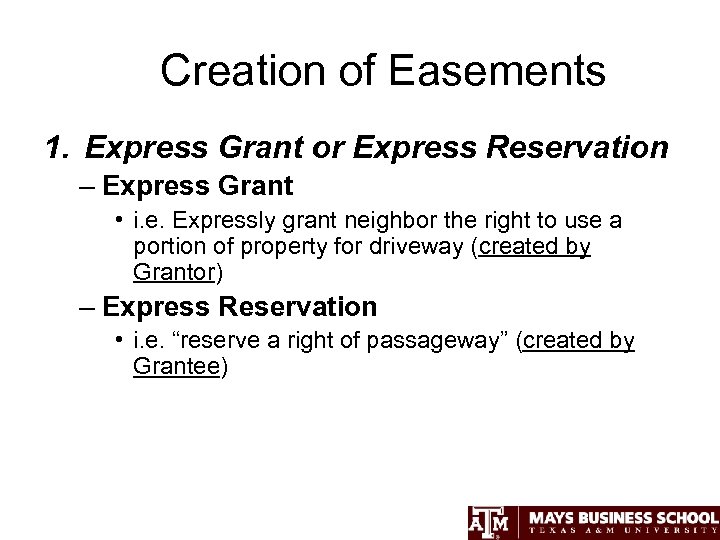 Creation of Easements 1. Express Grant or Express Reservation – Express Grant • i. e. Expressly grant neighbor the right to use a portion of property for driveway (created by Grantor) – Express Reservation • i. e. “reserve a right of passageway” (created by Grantee)
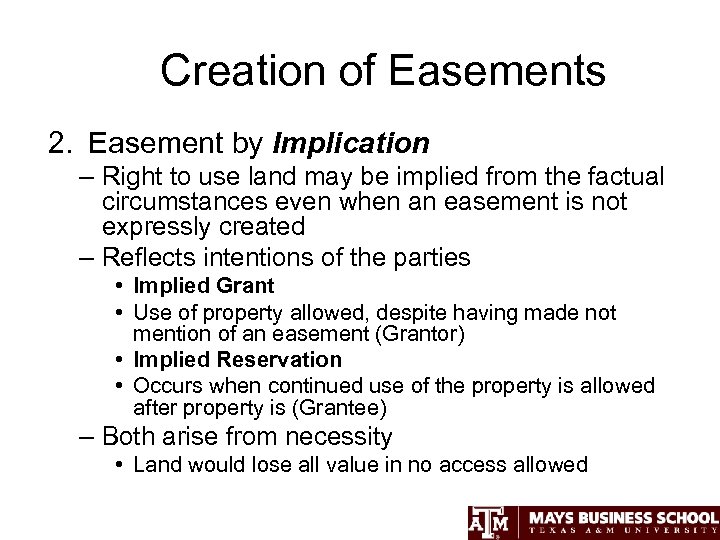 Creation of Easements 2. Easement by Implication – Right to use land may be implied from the factual circumstances even when an easement is not expressly created – Reflects intentions of the parties • Implied Grant • Use of property allowed, despite having made not mention of an easement (Grantor) • Implied Reservation • Occurs when continued use of the property is allowed after property is (Grantee) – Both arise from necessity • Land would lose all value in no access allowed
 Creation of Easements 3. Easement by Prescription – May be created when someone other than the owner uses the land “openly, hostilely, and continuously” for a statutory time period. • Usually between 7 to 20 years, uninterrupted – Lesson: • Never let anyone use property w/out permission • Interrupt property use at intervals
 Nature of Easements • “Permanent in nature” – Easements “run with the land” • Easement is not a “license” – Licenses are revocable
 Termination of Easements • Agreement • Merger • Abandonment
 Termination of Easements • Agreement – Parties affected by easement may expressly agree to terminate their respective rights in the easement • Must be written • Can be costly, and have time restrictions • Merger – Merger of dominant and servient estate can terminate easement • i. e. Servient estate could purchase dominant estate’s parcel
 Termination of Easements • Abandonment – If the benefited party does not exercise his or her rights to use the servient estate over an extended period of time
 Conservation Easement • A type of “Negative Easement” (vs. “Affirmative Easement”) – Prevents specific uses of the real estate by the owner • i. e. protects land from being developed. Preserves natural area
 Profit a Prendre • Is a nonpossessory interest in real property that permits the holder to remove part of the soil or produce of the land – i. e. minerals, soil, produce, animals
 Encroachment • Is an unauthorized invasion or intrusion of a fixture, a building, or other improvement onto another person’s property – i. e. fence cuts across adjoining property • If not confronted, other party may claim legal right to adverse possession
 Adverse Possession • Allows individuals to acquire title to land they do not own because they have openly possessed it for a statutory period of time • “Squatter’s Rights” -- http: //www. youtube. com/watch? v=z 2 S 9 b 40 ITNM – Actual and exclusive • i. e. building a house on land or farming land – Open and notorious, hostile, & continuous • Same as prescriptive easement – “Claim of Right • Adverse possessor must have a basis for believing he/she owns property