


 Скачать презентацию Real Estate Investment Trusts REITs Real Estate
b528dbc0685ec5f77a69449982d80eb2.ppt
- Количество слайдов: 22
 Real Estate Investment Trusts (REITs) & Real Estate Operating Companies (REOCs) 1
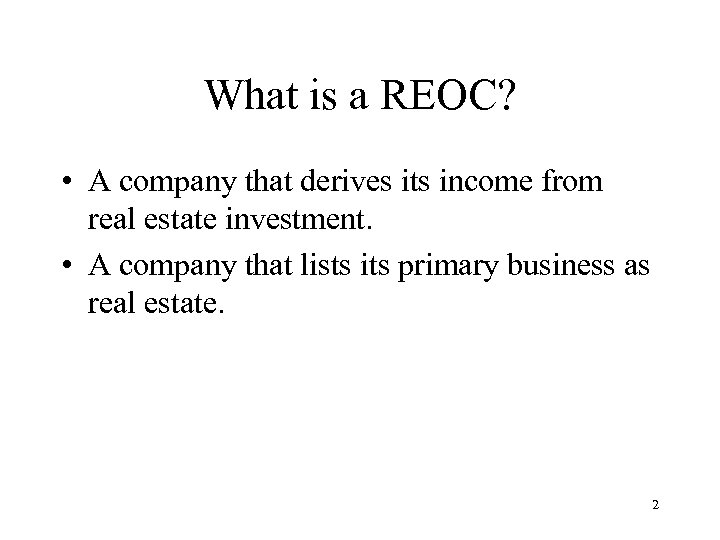 What is a REOC? • A company that derives its income from real estate investment. • A company that lists its primary business as real estate. 2
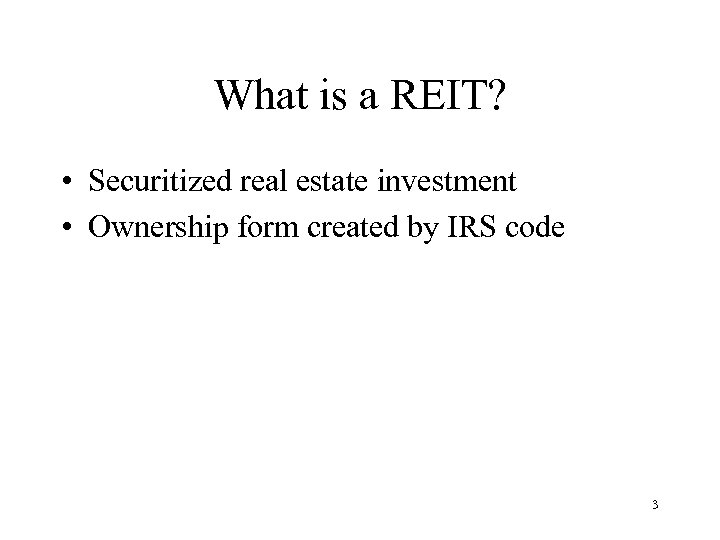 What is a REIT? • Securitized real estate investment • Ownership form created by IRS code 3
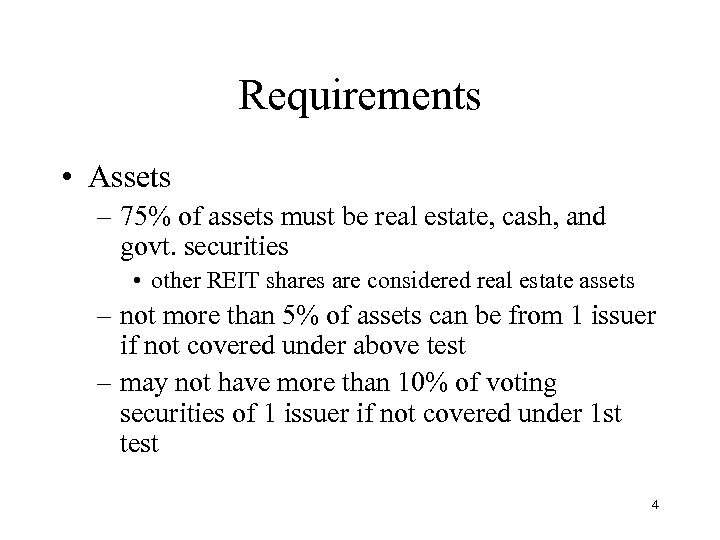 Requirements • Assets – 75% of assets must be real estate, cash, and govt. securities • other REIT shares are considered real estate assets – not more than 5% of assets can be from 1 issuer if not covered under above test – may not have more than 10% of voting securities of 1 issuer if not covered under 1 st test 4
 Requirements • Income – 95% of gross income must be from dividends, interest, rents, or gains from sale of certain assets (real estate, cash, or govt securities). – 75% of gross income must be derived from rents, interest on mortgages, gains from sale of certain assets, or income from other REITs 5
 Requirements • Income – No more than 30% of gross income can be derived from • sale or disposition of securities held less than 6 months • sale or disposition of real estate held for less than 4 years, except those involving foreclosures. • properties held for sale in the normal course of business (anti-dealer provision) 6
 Requirements • REIT Modernization Act of 1999 (effective 2001) – REITs allowed to own 100% of a Taxable REIT Subsidiary (TRS). TRS can provide services to REIT tenants and others (previously, this was not allowed). Debt and rental payments from TRS to REIT are limited to ensure that the TRS actually pays income taxes. 7
 Requirements • Distribution – must distribute 90% of all taxable income to investors • mandates fairly low retained earnings policy • has important implications for firm size – Note: prior to 2001, minimum distribution requirement was 95%. 8
 Requirements • Management – REIT managers must be passive • REIT trustees, directors or employees may not actively engage in managing or operating REIT properties (includes providing service and collecting rents from tenants). • Managers may set policy: rental terms, choose tenants, sign leases, make decisions about properties. 9
 Requirements • Anti-concentration rule – 5 or fewer entities may not own 50% or more of the outstanding shares – Exceptions: • ‘look-through’ provision for US pension funds • UPREIT structure (umbrella partnership) 10
 Tax Treatment • Accelerated depreciation is allowed for determining taxable income • 40 year asset life required for calculating income available for distribution to investors 11
 REIT Types • Equity • Mortgage • Hybrid 12
 Equity REITs • Blank Check – does not disclose investments to shareholders prior to acquisition. • Specified Trusts – purchase a specific property (Rockerfeller Center Properties) • Mixed Trusts – invests in both blank check and specific properties 13
 Equity REITs • Leveraged v. Unleveraged • Finite-life v. Nonfinite-life – finite-life is self-liquidating 14
 Equity REITs • Closed-End v. Open-End – closed-end protect shareholders from future dilution • Exchange Trusts – tax-free exchange of property for shares in the REIT 15
 Equity REITs • Developmental-Joint Venture – funds construction costs – lower cost of capital for developer 16
 Mortgage REITs • Invests in mortgages – earn the spread between costs of funds and mortgage loan rates 17
 REIT Benefits • invest in a diversified RE portfolio managed by professionals • higher liquidity 18
 REIT Disadvantages • possible conflicts of interests between sponsor and REIT shareholders 19
 21
21
 UPREIT • REIT formed by consolidating limitedpartnerships • partnerships allocated REIT shares based on appraised value of partnership property 22
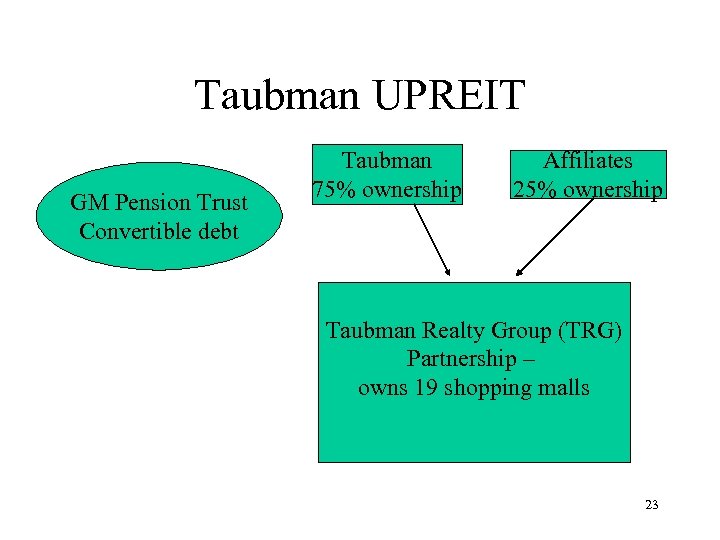 Taubman UPREIT GM Pension Trust Convertible debt Taubman 75% ownership Affiliates 25% ownership Taubman Realty Group (TRG) Partnership – owns 19 shopping malls 23