


 Скачать презентацию Real Estate Finance rd Edition Today 3 Doris
23367614e3c2dc60678005071966e07d.ppt
- Количество слайдов: 88
 Real Estate Finance rd Edition Today, 3 Doris S. Barrell 1
 Course Objectives o Define basics of real estate finance o Review government Influences o Discuss current issues in lending o Describe conventional and government loan programs o Calculate monthly mortgage payments o Examine special financing alternatives 2
 Basics of Real Estate Finance o Financing Instruments o Primary Market o Secondary Market 3
 Financing Instruments o. Note o. Mortgage o. Deed of Trust 4
 The Note o Signed Legal document o States terms and conditions for repayment of the loan o Accompanied by either a mortgage or a deed of trust “I. O. U. ” 5
 The Mortgage o Pledges real property as security for debt o Creates a mortgage lien on property o Requires judicial foreclosure in case of default 6
 The Deed of Trust o Establishes real property as security for debt o Conveys title rights to trustee o Trustee has power of sale o Lender named as beneficiary o Does not required court action to foreclose 7
 The Transaction o. Note + Mortgage or ü Deed of Trust 8
 The Primary Market o Sources of funding o Broker or Banker? o Origination and Processing 9
 Sources of Funding o. Commercial Banks o. Savings Associations o. Credit Unions 10
 Commercial Banks o Originally for short-term loans o Active today in mortgage lending 11
 Savings Associations o. Originally called Savings & Loan o. Historically primary source of mortgage lending o. Also referred to as “thrifts” 12
 Credit Unions o Newcomer to mortgage financing o Provide service to members o Greatly expanding 13
 Mortgage Broker or Banker? Mortgage Broker Mortgage Banker o Originates loan o Matches borrower o Uses own money with investor o Paid by “finder fee” o Continues to service o PLUS: has wide o PLUS: qualifying range of loan products loan standards are set, underwriting flexible 14
 Origination & Processing o. Prequalified? o. Preapproved? 15
 Members of the Team o. Loan Officer o. Appraiser o. Processor o. Underwriter o. Closing Department o. Settlement Attorney or Agent 16
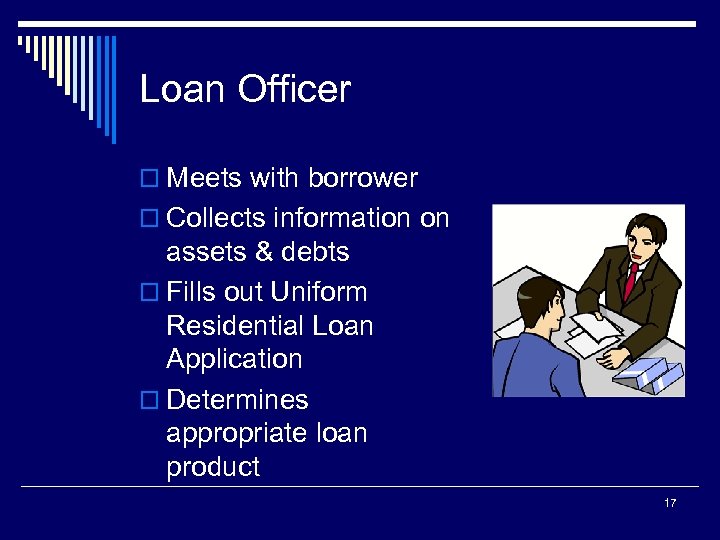 Loan Officer o Meets with borrower o Collects information on assets & debts o Fills out Uniform Residential Loan Application o Determines appropriate loan product 17
 Appraiser o Appraisal is ordered by the lender o Appraisal paid for by borrower at time of application o Appraisal establishes value to substantiate the loan 18
 Processor o Receives application from loan officer, appraisal, and credit report o Collects and verifies all information o Prepares case file for submission to underwriter o Stays in contact with borrower 19
 Underwriter o Approves or denies the loan o May set conditions 20
 Lender Closing Department o Prepares financing documents o Submits file to settlement attorney or title company closing agent 21
 Settlement (or Closing) Attorney or title company agent o Prepares deed to convey title o Prepares HUD-1 Statement o Conducts title search o Acquires title insurance for lender and purchaser o Ensures all terms of contract are met 22
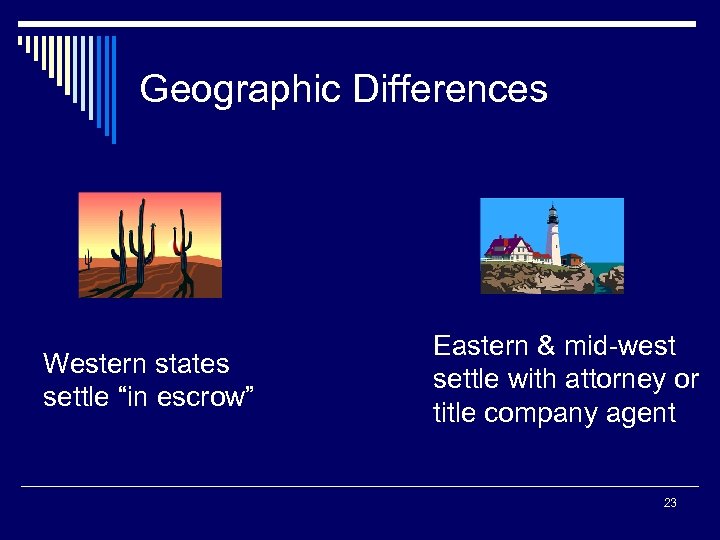 Geographic Differences Western states settle “in escrow” Eastern & mid-west settle with attorney or title company agent 23
 Secondary Market o. Fannie Mae o. Freddie Mac o. Ginnie Mae 24
 Fannie Mae o Originally chartered as Federal National Mortgage Association (FNMA) o Created in 1938 to purchase FHA loans o Extended to VA loans after WWII o Totally stockholder owned since 1968 o Purchases both government and conventional loans o Sells mortgage-backed securities 25
 Freddie Mac o Originally chartered as Federal Home Loan Mortgage Corporation (FHLMC) o Chartered in 1970 to purchase conventional loans o Today purchases government and conventional loans o Sells marketable securities o Under general oversight by HUD 26
 Ginnie Mae o Government National Mortgage Association o Created as spin-off from Fannie Mae in 1968 o Guarantees mortgage-backed securities based on FHA and VA mortgage loans 27
 Private Investors o Insurance Companies o Pension Funds o Individual Investors o REMIC – Real Estate Mortgage Investment Conduit 28
 Private Investors o Life Insurance o Pension Funds o REMICs o Individuals 29
 Government Influences o The Federal Reserve o Federal Home Loan Banks o Department of the Treasury o National Credit Union Administration o Dept. of Housing and Urban Development 30
 The Federal Reserve o Controls flow of money into the economy n n n Discount Rate Reserves Open Market o Supervises commercial banks 31
 Federal Home Loan Bank o Established in 1932 to supervise savings associations o 12 District banks (like the “Fed”) o Federal Home Loan Bank Board abolished in 1989 o Supervision of savings associations given to OTS o Provides reserves and secondary market for its members 32
 Department of the Treasury Office of the Comptroller of Currency (OCC) Office of Thrift Supervision (OTS) Federal Deposit Insurance Corporation (FDIC) 33
 National Credit Union Administration (NCUA) o Independent federal agency o Charters and supervises federal credit unions o Operates National Credit Union Share Insurance Fund (NCUSIF) o Insures savings in all federal and many state chartered credit unions 34
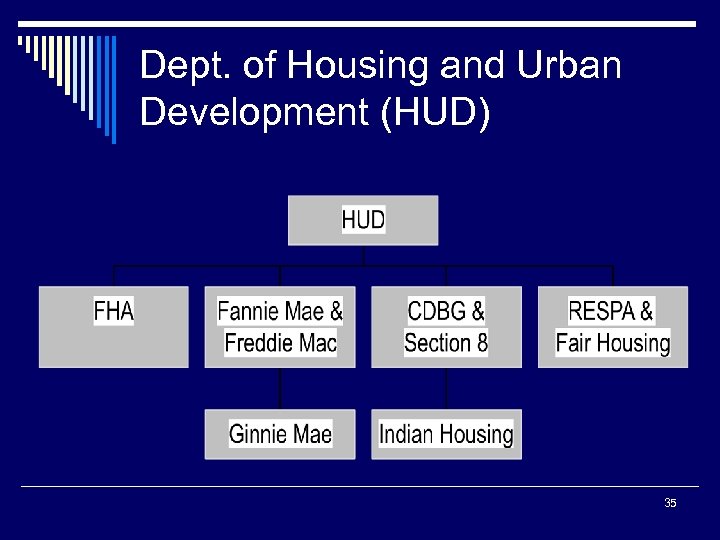 Dept. of Housing and Urban Development (HUD) 35
 Congressional Acts Fair Housing Act of 1968 Equal Credit Opportunity Act (ECOA) 36
 Congressional Acts o. Real Estate Settlement Procedures Act (RESPA) 37
 Congressional Acts o. Truth-in-Lending Act (TILA) Requires disclosure of all cost of credit Annual Percentage Rate (APR) must be shown Regulation Z affects advertising o. Community Reinvestment Act (CRA) Requires bank’s commitment to community 38
 Congressional Acts o. Taxpayer Relief Act of 1997 Sale of personal residence o $500, 000 capital gains tax exemption for couple ($250, 000 for single) o Must have occupied 2 out of past 5 yrs. o Can be taken every 2 years o No buy-up required 39
 Congressional Acts o. Taxpayer Relief Act of 1997 Sale of Investment Property o Capital Gain tax on profit reduced to 15% o Depreciation recapture at 25% o Hold for 12 months 40
 Current Issues in Mortgage Lending o The Subprime Crisis o Foreclosure Rates Increase o Importance of Credit Score o Required Homeowner Insurance 41
 The Subprime Crisis o Extreme growth o Declining housing market o New affordable lending options o Predatory Lending Concerns 42
 Foreclosures Increase o Who’s hurting? o Who’s to blame? o Who can help? 43
 Lender Workout Options o Foreclosure Presale o Short Sale o Deed in Lieu o Reinstatement o Forbearance o Refinancing 44
 Sources of Help o Consumer Credit Counseling Service o Non-profit organizations o 888 -995 -HOPE o www. HOPENOW. com 45
 Credit Scoring o. Equifax o. Experian o(Trans. Union o. FICO 46
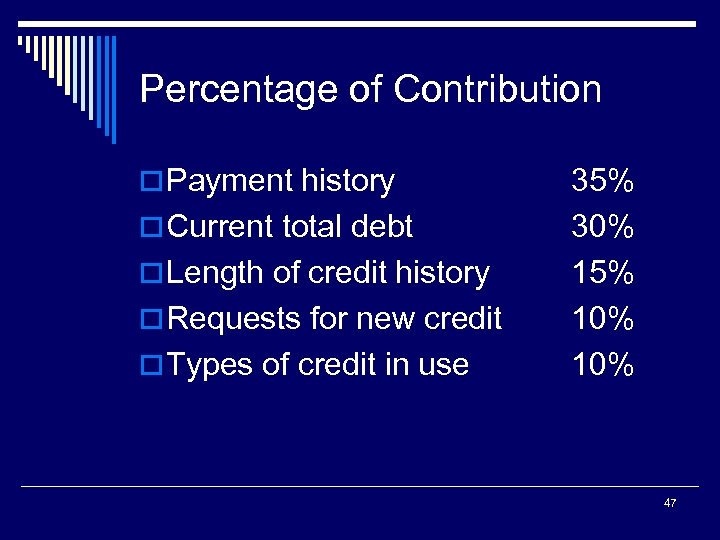 Percentage of Contribution o Payment history o Current total debt o Length of credit history o Requests for new credit o Types of credit in use 35% 30% 15% 10% 47
 Factors That Lower Score o. Late payments o. Too many credit cards o. Excessive potential credit o. Maxed-out cards o. Liens, judgments, foreclosure o. Multiple inquiries 48
 Ways to Improve Score o Pay bills on time o Reduce number of credit cards o Refuse preapproved credit cards o Refuse increased loan limits o Correct errors on credit reports 49
 Required Homeowner Insurance Disaster impact Accelerating rates Flood Insurance 50
 Conventional Mortgage Loans o Standard Conforming Loans o Affordable Loan Products o Non-conforming Loans o Adjustable Rate Mortgage (ARM) o Growing Equity Mortgage (GEM) 51
 Standard Conforming Loans Guidelines established by Fannie Mae and Freddie Mac Made homeownership possible for more people 52
 Original Guidelines o Maximum loan amount – set annually o Minimum down payment – 5% o Qualifying ratios – 28/36 o Reserves – 2 months o Private mortgage insurance required o Non-assumable o No pre-payment penalty 53
 Private Mortgage Insurance o Protects the lender o Required with less than 20% down o Payment can be made upfront, financed or paid in monthly increments o Legislation mandates removal of PMI when 78% LTV reached o Ways to avoid PMI 54
 Ways to Avoid PMI o Lender-paid PMI n Lender charges slightly higher rate with no PMI payment o Combined lst & 2 nd mortgage (trust) n 80 -10 -10 n 80 -15 -5 n 80 -20 55
 Affordable Loan Products o Fannie Mae Mortgage Solutions n Biweekly Mortgage n Expanded Approval™ n Flexible 97 and Flex 100™ n My. Community Mortgage™ 56
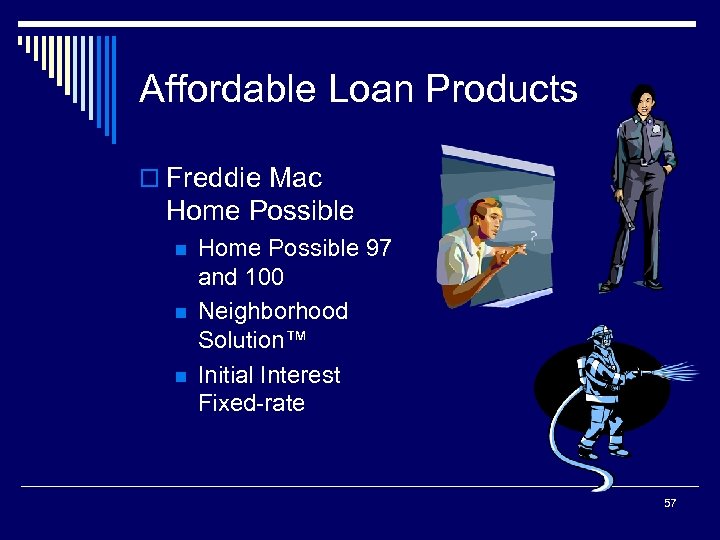 Affordable Loan Products o Freddie Mac Home Possible n n n Home Possible 97 and 100 Neighborhood Solution™ Initial Interest Fixed-rate 57
 Non-conforming Loans o Loans which do not conform to Fannie Mae/Freddie Mac guidelines o Guidelines set by lender o Loans exceeding conventional limits are called “jumbos” 58
 Special Community Programs o Attract essential workers into community o Encourage low & moderate income first- time homebuyers o Help to move from subsidized housing o Promote revitalization 59
 Adjustable Rate Mortgages o Index o Margin o Note Rate o Initial Rate o Adjustment period o Caps o Assumable o Convertable 60
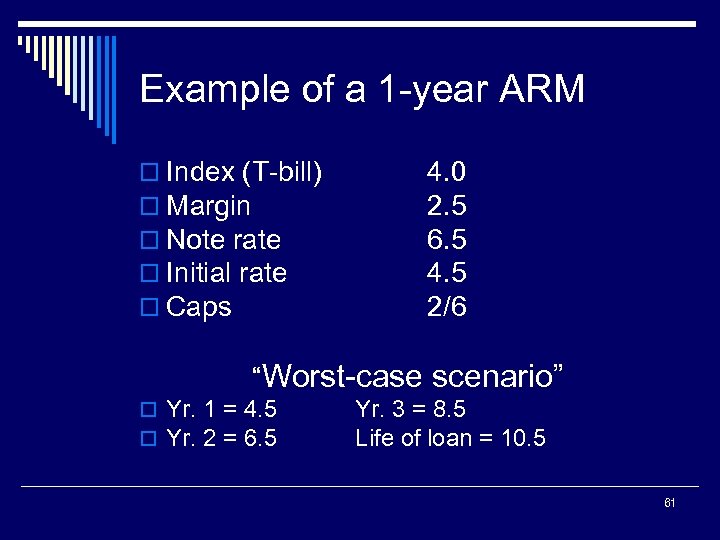 Example of a 1 -year ARM o Index (T-bill) o Margin o Note rate o Initial rate o Caps 4. 0 2. 5 6. 5 4. 5 2/6 “Worst-case scenario” o Yr. 1 = 4. 5 o Yr. 2 = 6. 5 Yr. 3 = 8. 5 Life of loan = 10. 5 61
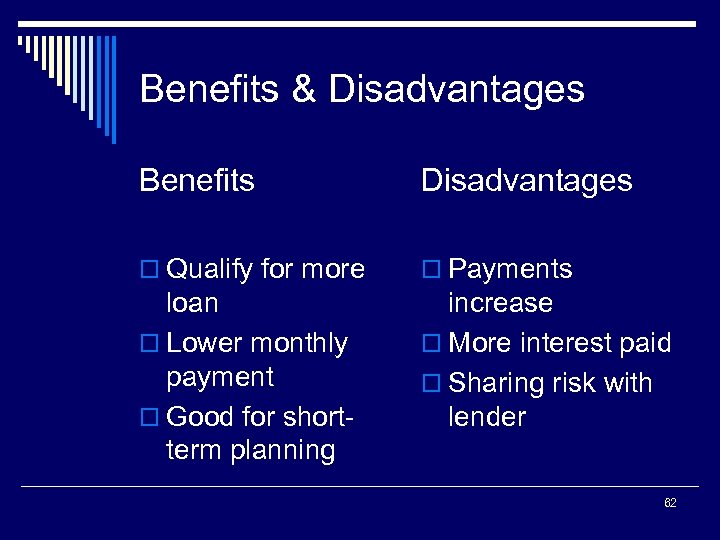 Benefits & Disadvantages Benefits Disadvantages o Qualify for more o Payments loan o Lower monthly payment o Good for shortterm planning increase o More interest paid o Sharing risk with lender 62
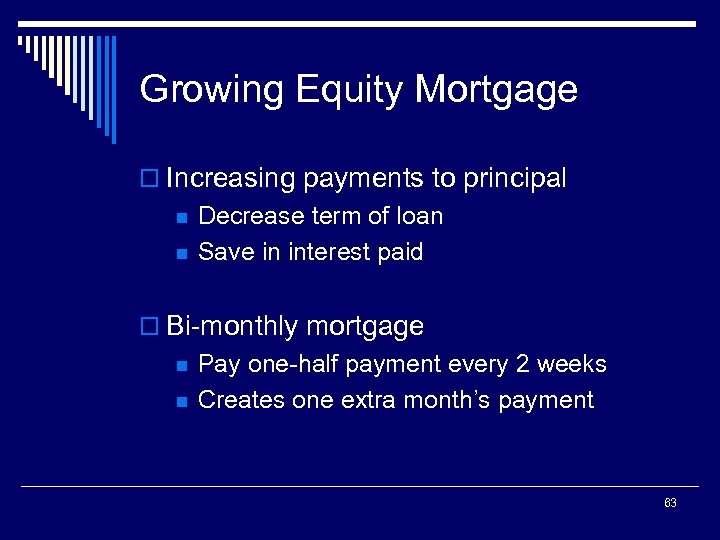 Growing Equity Mortgage o Increasing payments to principal n n Decrease term of loan Save in interest paid o Bi-monthly mortgage n n Pay one-half payment every 2 weeks Creates one extra month’s payment 63
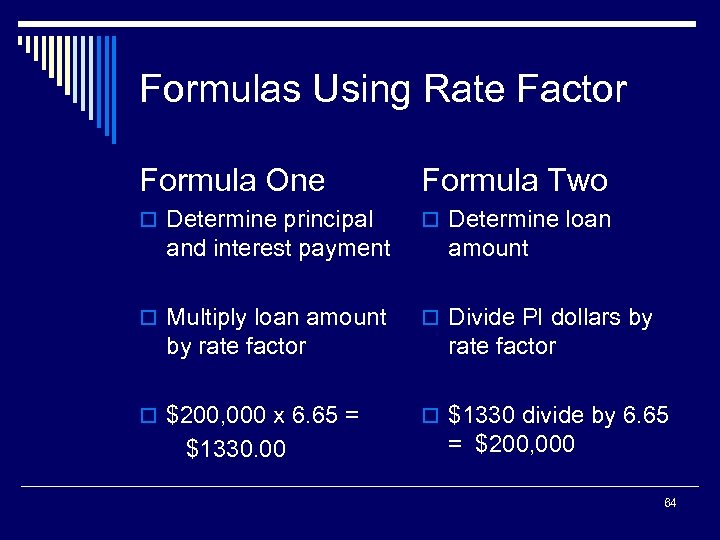 Formulas Using Rate Factor Formula One Formula Two o Determine principal o Determine loan and interest payment o Multiply loan amount by rate factor o $200, 000 x 6. 65 = $1330. 00 amount o Divide PI dollars by rate factor o $1330 divide by 6. 65 = $200, 000 64
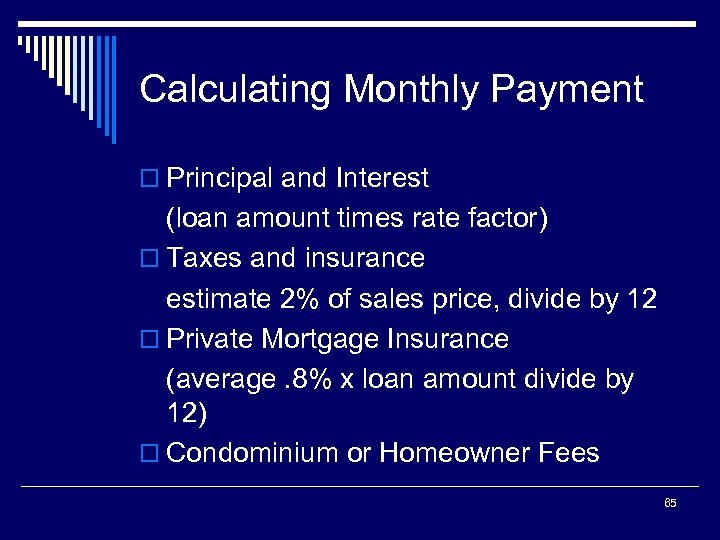 Calculating Monthly Payment o Principal and Interest (loan amount times rate factor) o Taxes and insurance estimate 2% of sales price, divide by 12 o Private Mortgage Insurance (average. 8% x loan amount divide by 12) o Condominium or Homeowner Fees 65
 Case Study #1 – The Browns o Annual income o o ($30, 000 + $25, 000) Debts ($300) Savings ($5, 000 plus $5, 000 gift) Interest rate - 7. 5%, 30 yr loan Qualifying ratios – 28/36 66
 Case Study #2 - Greenberg o Income - $36, 000 o Debts - $335 o Savings - $3, 000 o 7% interest, 30 yr. o 33/38 ratios 67
 Case Study #3 - Gonzalezs o Income - $70, 000 o Debts - $ 500 o Savings - $15, 000 o 8%, 30 yr loan o 33/38 ratios o 8%, 15 yr loan 68
 Government Insured or Guaranteed Loans o Federal Housing Administration (FHA) o Dept. of Veterans Affairs (VA) o State or Local Programs 69
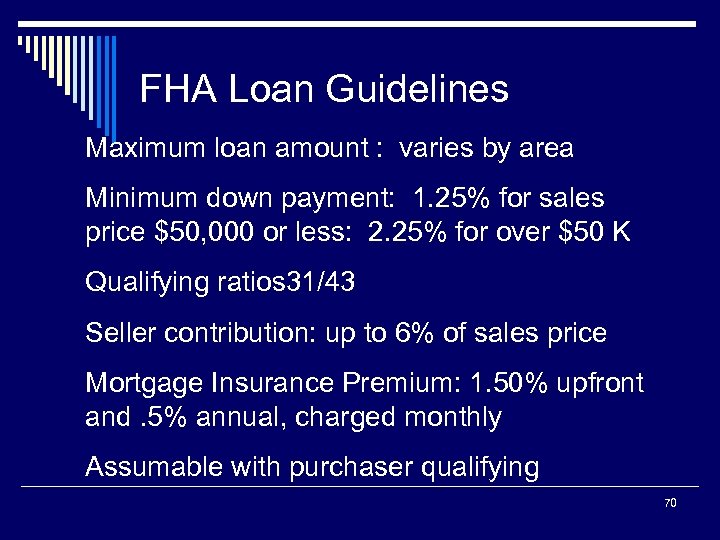 FHA Loan Guidelines Maximum loan amount : varies by area Minimum down payment: 1. 25% for sales price $50, 000 or less: 2. 25% for over $50 K Qualifying ratios 31/43 Seller contribution: up to 6% of sales price Mortgage Insurance Premium: 1. 50% upfront and. 5% annual, charged monthly Assumable with purchaser qualifying 70
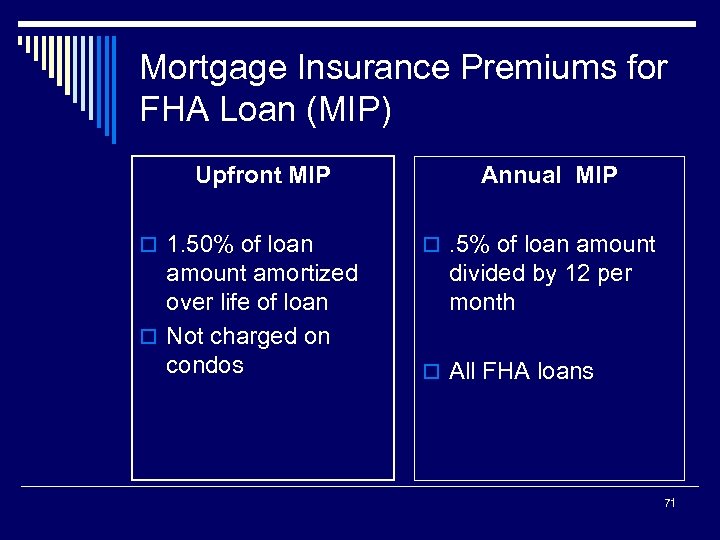 Mortgage Insurance Premiums for FHA Loan (MIP) Upfront MIP o 1. 50% of loan amount amortized over life of loan o Not charged on condos Annual MIP o. 5% of loan amount divided by 12 per month o All FHA loans 71
 Compensating Factors o Low long-term debts o Large down payment o Minimal credit use o Excellent job history o History of making equal or greater payments than new PITI o Additional potential income 72
 Special FHA Programs o FHA/VA 203(h) – disaster relief o FHA/ARM 251 (1/5 caps) o Officer, Teacher Next Door o Housing Choice Voucher (formerly Section 8) 73
 FHA 203(k) Rehab Loan Finance both purchase and rehab costs 97% LTV of projected value Paid in “draws” Minimum $5, 000 in rehab cost Owner-occupant only 74
 Calculate FHA monthly payment o Principal & Interest Loan amount x rate factor o Taxes & Insurance n Estimate 2% of sales price divided by 12 o Mortgage Insurance n Upfront: 1. 50% of loan amount financed n Annual: . 5% of loan amount divided by 12 o Condo or Homeowner fee n 75
 VA Loans o Certificate of Eligibility n 90 days in wartime n 180 days service before l 980 n 2 yrs. Service since 1980 n 6 yrs for reservists & National Guard o Entitlement set by VA n 25% of current Fannie/Freddie loan limit o Top 25% of loan guaranteed n Bank lends 5 times entitlement 76
 VA loan Guidelines o Maximum loan amount: 4 times VA entitlement o Minimum down payment: 0 o Qualifying ratio: just 41 o Funding fee: similar to PMI or MIP o Seller contribution: unlimited o Assumable with buyer qualification o Certificate of Reasonable Value: appraisal 77
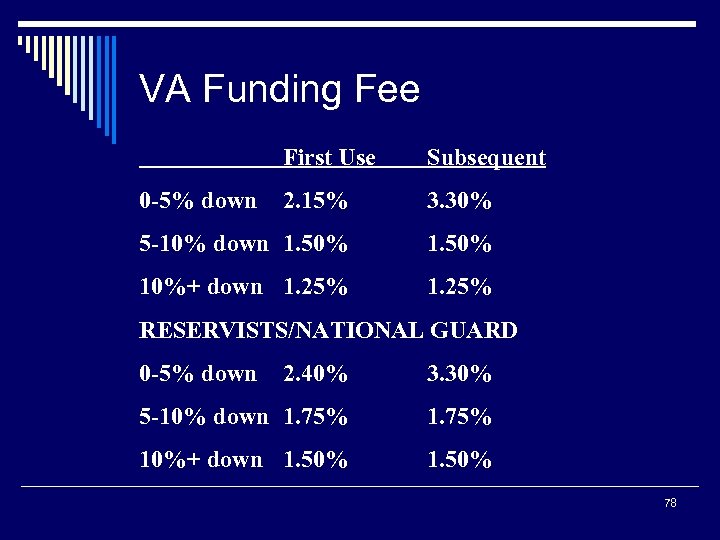 VA Funding Fee First Use Subsequent 2. 15% 3. 30% 5 -10% down 1. 50% 10%+ down 1. 25% 0 -5% down RESERVISTS/NATIONAL GUARD 0 -5% down 2. 40% 3. 30% 5 -10% down 1. 75% 10%+ down 1. 50% 78
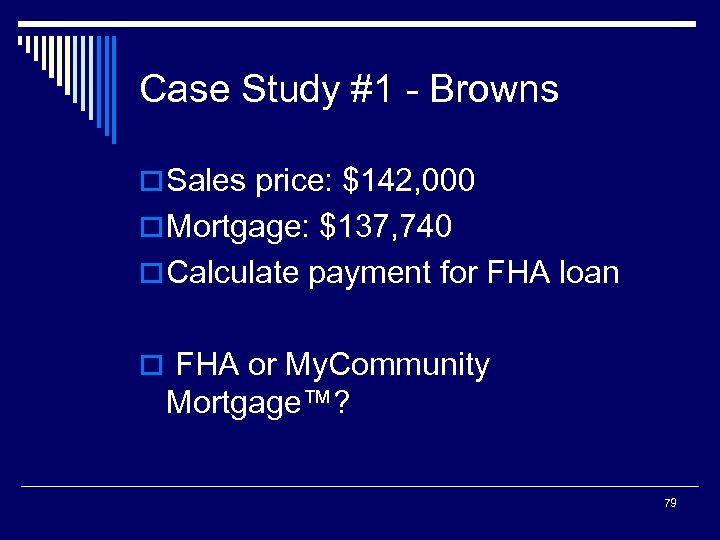 Case Study #1 - Browns o Sales price: $142, 000 o Mortgage: $137, 740 o Calculate payment for FHA loan o FHA or My. Community Mortgage™? 79
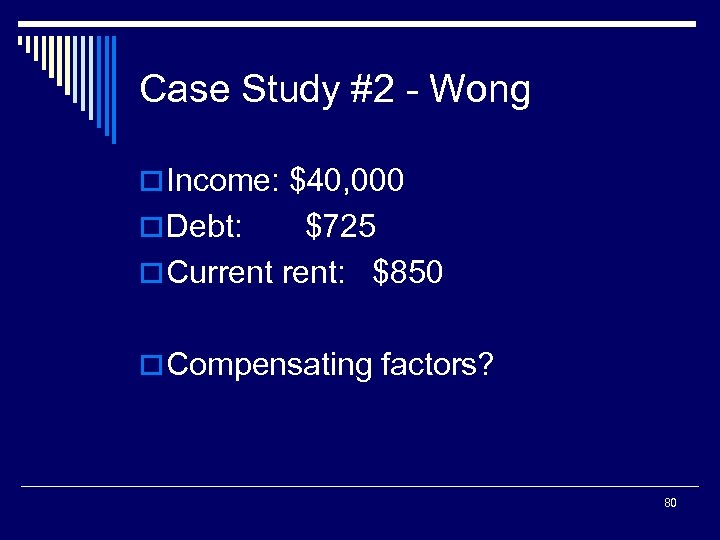 Case Study #2 - Wong o Income: $40, 000 o Debt: $725 o Current: $850 o Compensating factors? 80
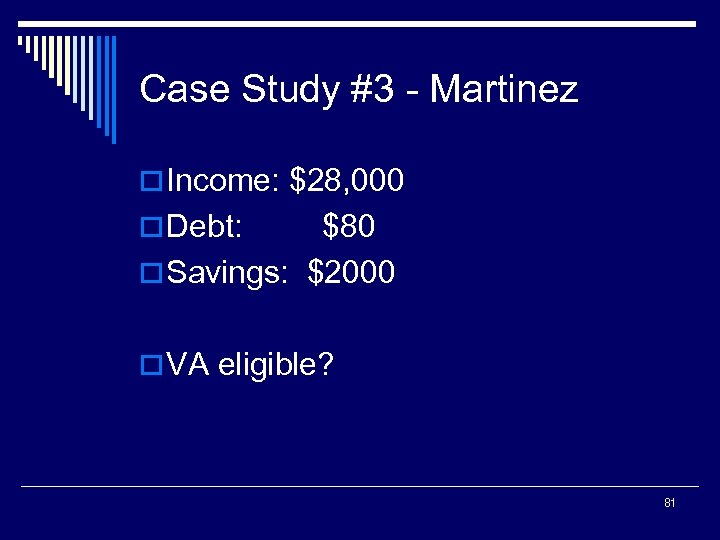 Case Study #3 - Martinez o Income: $28, 000 o Debt: $80 o Savings: $2000 o VA eligible? 81
 Special Financing Alternatives o Seller Financing o Low/Doc or No/Doc Loans o Loans for Self-employed o Alternative Sources of Cash o Reverse Annuity Mortgage 82
 Seller Financing o First or Second Mortgage (Trust) o Lease- Purchase Option 83
 Lease-Purchase Option o Non-refundable deposit o Sales price established o Accelerated rent with credit back o Liability for repairs o Delayed settlement o Financing arranged 60 days prior to settlement 84
 Loans for Self-Employed o The Problem! o Solutions n Low/doc loan n Tax returns n Profit & Loss n Balance sheet 85
 Alternate Sources of Cash o Gift o CD, Stocks, Bonds o IRA o 401(k) 86
 Reverse Annuity Mortgage o Payments to owner based on equity in home o Benefit to elderly needing cash n Lump sum n Payments n Line of Credit 87
 Available RAM Programs o Private lender o FHA Home Equity Conversion Mortgage (HECM) o Fannie Mae Home. Keeper® 88