


 Скачать презентацию Ready Set Go Training for New Evaluation Personnel
91c06ef338d4a58c9e1656d008862545.ppt
- Количество слайдов: 102
 Ready, Set, Go: Training for New Evaluation Personnel Debbie Buchanan Region One ESC April 7, 2011 Provided by the Texas Education Agency Statewide Leadership: Evaluation Network 1
 or… “I have the job, now what do I do? ” Provided by the Texas Education Agency Statewide Leadership: Evaluation Network 2
 Acknowledgement n n Training materials for this session were developed in collaboration with the Texas Education Agency Statewide Leadership: Evaluation Network Each Education Service Center representative to the Evaluation Network has the full set of training materials (binder and CD). Provided by the Texas Education Agency Statewide Leadership: Evaluation Network 3
 Ground Norms n Participate actively q q n n Ask questions Share insights and experiences Listen to one another Help one another Please turn communication devices to silent mode Take care of yourself Provided by the Texas Education Agency Statewide Leadership: Evaluation Network 4
 Training Objectives Participants will q q Integrate current knowledge with practical application for job success Learn tools and techniques to make the job a success Examine important issues including compliance with legal mandates Develop expertise in utilizing resources for student evaluation Provided by the Texas Education Agency Statewide Leadership: Evaluation Network 5
 Agenda n n n Overview The Job Legal Evaluation IEP Meetings Resources Provided by the Texas Education Agency Statewide Leadership: Evaluation Network 6
 Most Important Information Today n n n New Eligibility Requirements Observations RTI FIEs that include intervention strategies. WE Need to Be Needed!!! Provided by the Texas Education Agency Statewide Leadership: Evaluation Network 7
 Overview Provided by the Texas Education Agency Statewide Leadership: Evaluation Network 8
 The Job n Job description q q n Sample job descriptions Defining your job Relationship to other evaluation professionals Provided by the Texas Education Agency Statewide Leadership: Evaluation Network 9
 Where Do I Begin? n n Read through the list Place a by areas you are not familiar with Discuss with tablemates Note areas for follow-up Provided by the Texas Education Agency Statewide Leadership: Evaluation Network 10
 Getting Started n n Suggestions for Getting Started Not a Rule, Not a Regulation…But Some Good Advice! Provided by the Texas Education Agency Statewide Leadership: Evaluation Network 11
 Managing Workload/Caseload n Caseload q n the number of students who are provided direct services by the school-based service provider Workload q q includes the caseload and all activities required and performed by the schoolbased service provider Provided by the Texas Education Agency Statewide Leadership: Evaluation Network 12
 You Can’t Make a Plan Without a Planner! n A good planner will help q q q Manage time Organize activities Record events Free working memory Access resources Provided by the Texas Education Agency Statewide Leadership: Evaluation Network 13
 Reflecting on Your Practice n n Resume, Vita, and/or Portfolio Professional Development Professional Standards Certification/Licensure Requirements Provided by the Texas Education Agency Statewide Leadership: Evaluation Network 14
 Legal Provided by the Texas Education Agency Statewide Leadership: Evaluation Network 15
 The Special Ed Type Quiz n A director called and asked about a student who was struggling in school. The director said, “He’s not doing very well and we’re concerned about him but we don’t know what to do with him. We’ve looked into all of our special programs and he doesn’t seem to qualify. We’ve studied the rules and regulations and consulted with every expert available. Do you have any suggestions? Provided by the Texas Education Agency Statewide Leadership: Evaluation Network
 And I responded with… n Well…. it sounds to me like you thought the kid might be E. D. , L. D. , O. H. I. due to A. D. D. or A. D. H. D. , M. R. , or T. B. I. I’m sure you did want to come up with an I. E. P. so that you could provide F. A. P. E. in the L. R. E. and thus comply with I. D. E. A. I expect you considered O. T. , P. T. and all sorts of A. T. D’s. I’m guessing you’ve already looked at the D. O. E. , O. C. R. and T. E. A. guidelines and probably also thought about making A. Y. P. under N. C. L. B. with a H. Q. teacher. Finally, you F. I. E’d him, you A. R. D’d, and 504’d him and D. N. Q’d him. I’d say the K. I. D. is O. U. T. Provided by the Texas Education Agency Statewide Leadership: Evaluation Network
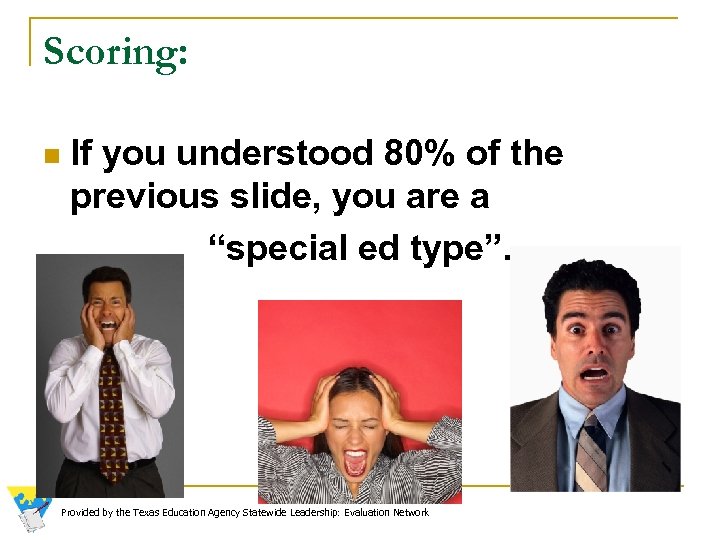 Scoring: n If you understood 80% of the previous slide, you are a “special ed type”. Provided by the Texas Education Agency Statewide Leadership: Evaluation Network
 Today We Will Talk “Lawyer” Provided by the Texas Education Agency Statewide Leadership: Evaluation Network
 Top Ten Statements That Make Attorneys Cringe n 10. I have 21 other students in my class besides Johnny. I don’t have time to give him the attention he needs. Besides, I teach literature. You can’t modify Hamlet. n 9. I won’t be able to do that. My schedule is full already. n 8. I’m sorry Ms. Smith, we don’t have P. T. , O. T. , or content mastery at this campus. Provided by the Texas Education Agency Statewide Leadership: Evaluation Network
 n 7. Our superintendent will have to approve that. n 6. I guess everyone in the ARD meeting knows me. I’m Ms. Crumley, Johnny’s teacher and this is my attorney, Ms. Landshark from the firm of Macon Bigbucs and Lovinit P. C. n 5. She’s not eligible for that room. Only the ED child is eligible for that placement. Provided by the Texas Education Agency Statewide Leadership: Evaluation Network
 n 4. I’m sorry, we don’t place aides with any students. We don’t have the money. n 3. Our ESY program is 4 weeks for three hours a day. n 2. I’m sorry that you and the students have to barricade yourselves behind your desks everyday because of Johnny’s attacks, but we’re stuck with this inclusion thing. Provided by the Texas Education Agency Statewide Leadership: Evaluation Network
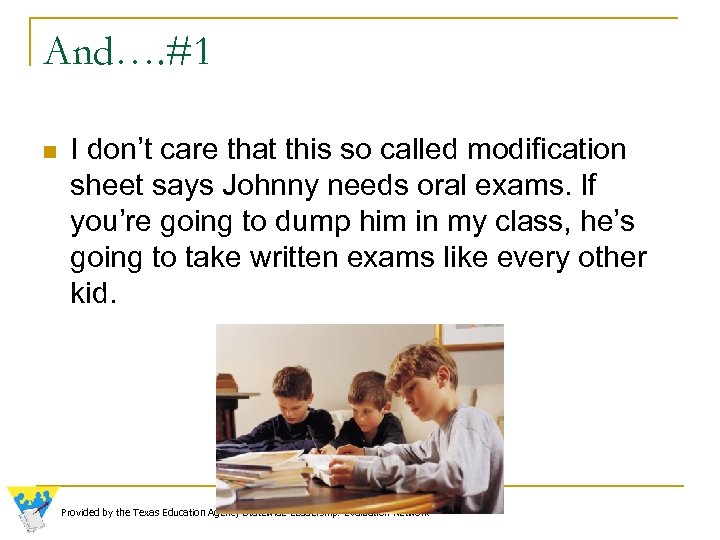 And…. #1 n I don’t care that this so called modification sheet says Johnny needs oral exams. If you’re going to dump him in my class, he’s going to take written exams like every other kid. Provided by the Texas Education Agency Statewide Leadership: Evaluation Network
 Times Have Changed n n n Internet Advocacy Broadened IDEA Provided by the Texas Education Agency Statewide Leadership: Evaluation Network
 ARD does not stand for “Anguish, Remorse and Denial” The ARD meeting is the critical vehicle for school/parent communication. How the meeting is conducted speaks volumes about the professionalism and caring of the school district. n n It is essential that the meeting have strong leadership. Provided by the Texas Education Agency Statewide Leadership: Evaluation Network
 #1 Defense Have Strong Leadership At Your ARD Meetings Provided by the Texas Education Agency Statewide Leadership: Evaluation Network
 The ARDC needs a strong leader. n A strong leader sets the tone for the meeting, establishes and enforces “ground rules” for productive discussion, makes sure that all voices are heard, all issues are addressed, and that decisions are made in an orderly fashion. Provided by the Texas Education Agency Statewide Leadership: Evaluation Network
 The Leader: n n Does not have to be the leading expert on special education law in your district. Must have good people skills and good communication skills. Should have a good, basic understanding of what ARDC meetings are about. Does not have to know the details of federal of state regulations. Provided by the Texas Education Agency Statewide Leadership: Evaluation Network
 The most logical person to serve as ARDC leader is: n The administrative representative of the school. q (iii) a representative of the local education agency who— n n n (I) is qualified to provide, or supervise the provision of, specially designed instruction to meet the unique needs of children with disabilities; (II) is knowledgeable about the general curriculum; and (III) is knowledgeable about the availability of resources of the local education agency; 20 U. S. C. 1414(d)(1)(B)(iv). Provided by the Texas Education Agency Statewide Leadership: Evaluation Network
 In too many school districts: n The educational diagnostician is called on to play too many roles at the ARDC meeting. n The diag. is frequently required to: q q fill out all the paperwork, lead the discussion, establish rapport with the parents etc. Provided by the Texas Education Agency Statewide Leadership: Evaluation Network
 Two Parties n While there are many people around the table at an ARDC meeting, there are only two parties – the parent (or adult student) and the school. n The administrative representative is the logical leader for the school and for the meeting as a whole. Provided by the Texas Education Agency Statewide Leadership: Evaluation Network
 Who Should Attend the ARD Meeting n n n Parent Special Ed Teacher Regular Ed Teacher Diagnostician LEA Representative Other Staff – Optional depending on the circumstances q OT, PT, Speech, Vision, Transition, Nurse, Others? ? ? Provided by the Texas Education Agency Statewide Leadership: Evaluation Network
 IEP Team Attendance (Section 614(d)(1)(B) and (C)) n A member of the IEP team may be excused if: q q q If parent and LEA agree (member’s area of the curriculum or related services is not being modified or discussed in the meeting). If parent and LEA agree and the member submits, in writing to the parent and IEP team, input into the development of the IEP prior to the meeting. A parents agreement (attendance not necessary) and consent (excusal) must be in writing. Provided by the Texas Education Agency Statewide Leadership: Evaluation Network
 Actual Wording n Not less than one regular education teacher of the child (if the child is, or may be, participating in the regular education environment); n Not less than one special education teacher of the child, or where appropriate, not less than one special education provider of the child; Provided by the Texas Education Agency Statewide Leadership: Evaluation Network
 Controlling the Meeting Keeping the Peace n n Use an agenda Stop chasing rabbits Let parents speak Insist on professionalism q q q No coke cans/drinks No food pr sack lunches Appropriate attire Provided by the Texas Education Agency Statewide Leadership: Evaluation Network
 Perception is Everything n n Use Plain English Avoid Negative Body Language Pen and Ink Choose Words Carefully q q Hurry up Idle Chit Chat Provided by the Texas Education Agency Statewide Leadership: Evaluation Network
 Setting the Stage n n n Check and double check recording devices. Cool rooms are best. Allow for plenty of table space. Straight-backed chairs without pads. Consider ADA violations Provided by the Texas Education Agency Statewide Leadership: Evaluation Network
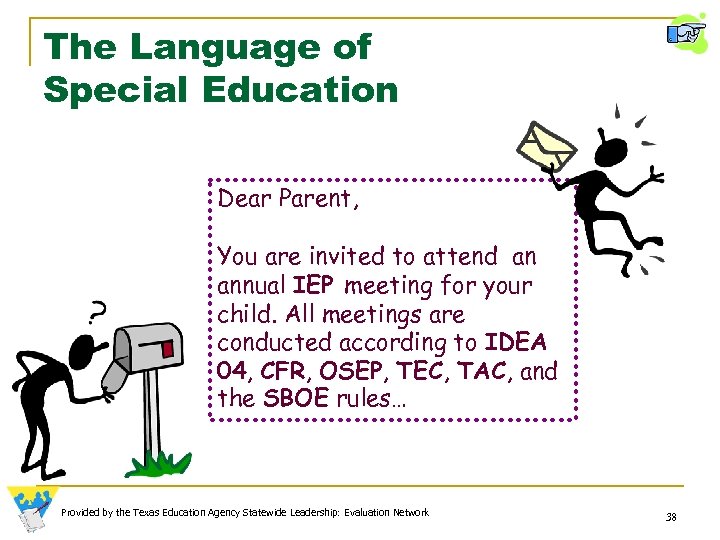 The Language of Special Education Dear Parent, You are invited to attend an annual IEP meeting for your child. All meetings are conducted according to IDEA 04, CFR, OSEP, TEC, TAC, and the SBOE rules… Provided by the Texas Education Agency Statewide Leadership: Evaluation Network 38
 Acronym Mania! Provided by the Texas Education Agency Statewide Leadership: Evaluation Network 39
 Legal Mandates n Federal q q q Individuals with Disabilities Education Improvement Act (IDEA) of 2004 (20 U. S. C. 1400) Code of Federal Regulations (C. F. R. Part 300) Case law No Child Left Behind Act of 2001 (NCLB) Section 504 of the Rehabilitation Act of 1973 Family Educational Rights and Privacy Act of 1974 (FERPA) Provided by the Texas Education Agency Statewide Leadership: Evaluation Network 40
 Legal Mandates n State q q Texas Education Code (TEC) Texas Administrative Code (TAC) State Board of Education Rules Commissioner’s Rules Provided by the Texas Education Agency Statewide Leadership: Evaluation Network 41
 Legal Mandates n Local q q Policies and procedures Operating guidelines Provided by the Texas Education Agency Statewide Leadership: Evaluation Network 42
 n A Resource For Current Information q www. tea. state. tx. us Provided by the Texas Education Agency Statewide Leadership: Evaluation Network 43
 The Legal Framework for the Child. Centered Process n n n Summary of state and federal special education requirements for special education that is web accessible Link to state and federal resources Access glossary of terms q http: //www. esc 18. net/ Provided by the Texas Education Agency Statewide Leadership: Evaluation Network 44
 Procedural Safeguards n Explains specific rights and responsibilities of the parent in the special education process Provided by the Texas Education Agency Statewide Leadership: Evaluation Network 45
 Away Game n“ I always felt that I was at an away game when I was on my home campus. ” Provided by the Texas Education Agency Statewide Leadership: Evaluation Network
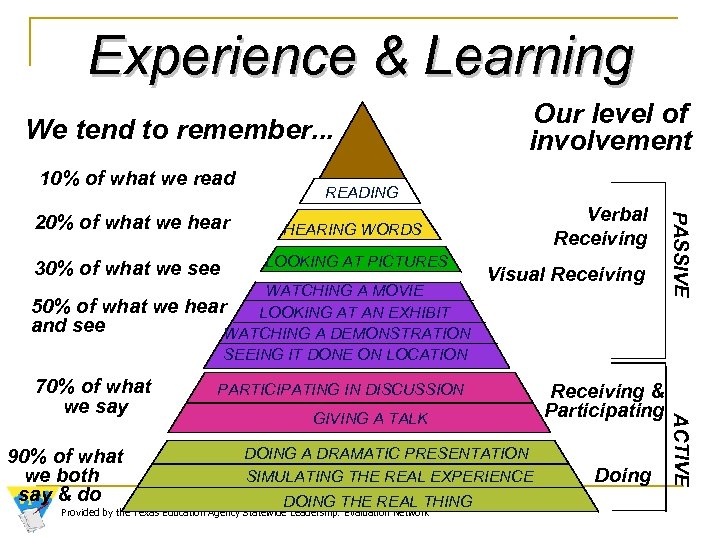 Experience & Learning We tend to remember. . . 10% of what we read Our level of involvement READING 30% of what we see LOOKING AT PICTURES Verbal Receiving HEARING WORDS 50% of what we and see 90% of what we both say & do PARTICIPATING IN DISCUSSION GIVING A TALK DOING A DRAMATIC PRESENTATION SIMULATING THE REAL EXPERIENCE DOING THE REAL THING Provided by the Texas Education Agency Statewide Leadership: Evaluation Network Receiving & Participating Doing ACTIVE 70% of what we say WATCHING A MOVIE hear LOOKING AT AN EXHIBIT WATCHING A DEMONSTRATION SEEING IT DONE ON LOCATION Visual Receiving PASSIVE 20% of what we hear
 How To Accommodate During Lecture n Clock Partners Provided by the Texas Education Agency Statewide Leadership: Evaluation Network
 Provided by the Texas Education Agency Statewide Leadership: Evaluation Network
 The QUESTION n If the president of the USA can no longer occupy the office …. who takes his/her place? List the succession of the inhabitant of the presidential office in order. Provided by the Texas Education Agency Statewide Leadership: Evaluation Network
 Circle the Sage n n 1. President 2. Vice President Who is next? ? ? …. and after that? !? Provided by the Texas Education Agency Statewide Leadership: Evaluation Network
 Circle the Sage n n n Sages stand up. Sages go to different areas of the room. Those needing this information go to the sage closest to you and… Circle the sage. Sages teach their group. Provided by the Texas Education Agency Statewide Leadership: Evaluation Network
 Sage on Stage and a Spin n n Group practices the information Break off into smaller groups of four Number off 1 - 4 Teacher spins the spinner and those with that number stand be ready to answer the questions. Provided by the Texas Education Agency Statewide Leadership: Evaluation Network
 Answer n n n President Vice President Speaker of the House of Representatives President Pro-Tem of the Senate Cabinet Members (starting with the Secretary of State). Provided by the Texas Education Agency Statewide Leadership: Evaluation Network
 With Your 9: 00 partner: q Discuss ways in which you have/could/would implement the strategies of the “clock partner” or “circle the sage” in your full and individual evaluations. Provided by the Texas Education Agency Statewide Leadership: Evaluation Network
 Example Intervention for Comprehension Strategy instruction will help improve (Name)’s reading comprehension. One self-monitoring strategy is a five-step self-questioning technique. The five questions are: 1. Why are you studying this passage? 2. What is the main idea in the paragraph? (Underline) 3. Think of a question about the main idea. 4. What is the answer to your question? 5. Look back at the questions and answers to see how each provides you with more information. n A cue card can be used. (Name)’s responses to the questions should be written so they can be reviewed with corrective feedback by a teacher. Provided by the Texas Education Agency Statewide Leadership: Evaluation Network
 Differentiating Instruction Through Cooperative Learning Provided by the Texas Education Agency Statewide Leadership: Evaluation Network
 ARE YOU LISTENING ? ? Provided by the Texas Education Agency Statewide Leadership: Evaluation Network
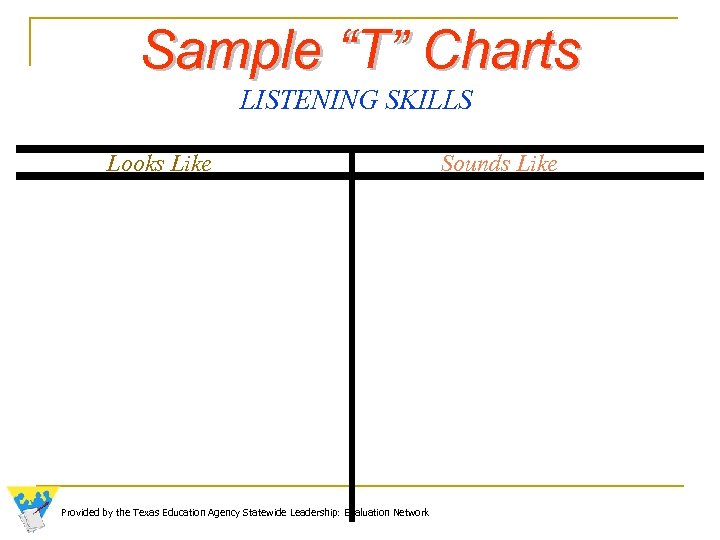 Sample “T” Charts LISTENING SKILLS Looks Like Provided by the Texas Education Agency Statewide Leadership: Evaluation Network Sounds Like
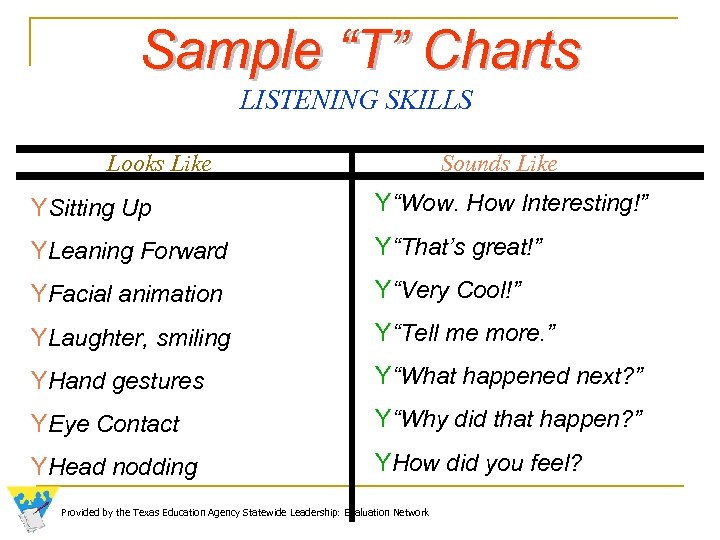 Sample “T” Charts LISTENING SKILLS Looks Like Sounds Like YSitting Up Y“Wow. How Interesting!” YLeaning Forward Y“That’s great!” YFacial animation Y“Very Cool!” YLaughter, smiling Y“Tell me more. ” YHand gestures Y“What happened next? ” YEye Contact Y“Why did that happen? ” YHead nodding YHow did you feel? Provided by the Texas Education Agency Statewide Leadership: Evaluation Network
 Team Stand Share 1. Each team creates a single list using Pairs Compare or other brainstorming structure. 2. All teams stand 3. Teacher chooses a team to share one item from their list. 4. One team member shares one new item from the list, checks it off and passes the paper to the right. 5. On other teams, one member checks their team’s list and either checks off that answer or adds it to their list and then passes the paper to the right. 6. Repeat steps 3 -5. When all ideas on a team’s list are checked off, the whole team sits down. Continue until all teams are sitting down. (Q. List items that confused or confounded you this year about your new job. ) Provided by the Texas Education Agency Statewide Leadership: Evaluation Network
 Call Anytime!!! Debbie Buchanan Senior Education Specialist Region One ESC dbuchanan@esc 1. net (956) 984 -6202 Provided by the Texas Education Agency Statewide Leadership: Evaluation Network
 IDEA 2004: Eligibility n n n n Autism Deaf Blindness Deafness Emotional Disturbance Hearing Impairment Mental Retardation Multiple Disabilities n n n Orthopedic Impairment Other Health Impairment Specific Learning Disability Speech or Language Impairment Traumatic Brain Injury Visual Impairment (including Blindness) and who, by reason thereof, need special education and related services 34 C. F. R. § 300. 8 Provided by the Texas Education Agency Statewide Leadership: Evaluation Network 66
 IDEA 2004: Specific Learning Disability n n n n Oral Expression Listening Comprehension Written Expression Basic Reading Skill Reading Fluency Skills Reading Comprehension Mathematics Calculation Mathematics Problem Solving 34 C. F. R. § 309 Provided by the Texas Education Agency Statewide Leadership: Evaluation Network 67
 Commissioner’s Rules 2007 n Texas Education Agency Special Education Rules and Regulations http: //www. tea. state. tx. us/special. ed/rules/co mm. html q q q Commissioner’s Rules Guidance Document Comments Provided by the Texas Education Agency Statewide Leadership: Evaluation Network 68
 Commissioner's Rules Guidance n n Guidance has been developed on the implementation of the newly adopted Commissioner's rules Specific guidance on rule include q 89. 1011 Referral for Full and Individual Initial Evaluation q 89. 1040 Eligibility Criteria q 89. 1050 The Admission, Review, and Dismissal (ARD) Committee q 89. 1055 Content of the Individualized Education Program (IEP) q 89. 1070 Graduation Requirements q 89. 1096 Provision of Services for Students Placed by their Parents in Private Schools or Facilities q 89. 1131 Qualifications of Special Education, Related Services, and Paraprofessional Personnel Provided by the Texas Education Agency Statewide Leadership: Evaluation Network 69
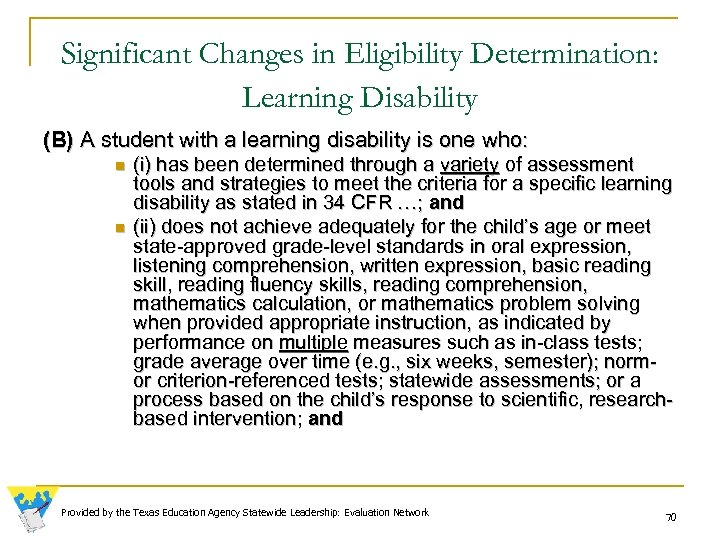 Significant Changes in Eligibility Determination: Learning Disability (B) A student with a learning disability is one who: n n (i) has been determined through a variety of assessment tools and strategies to meet the criteria for a specific learning disability as stated in 34 CFR …; and (ii) does not achieve adequately for the child’s age or meet state-approved grade-level standards in oral expression, listening comprehension, written expression, basic reading skill, reading fluency skills, reading comprehension, mathematics calculation, or mathematics problem solving when provided appropriate instruction, as indicated by performance on multiple measures such as in-class tests; grade average over time (e. g. , six weeks, semester); normor criterion-referenced tests; statewide assessments; or a process based on the child’s response to scientific, researchbased intervention; and Provided by the Texas Education Agency Statewide Leadership: Evaluation Network 70
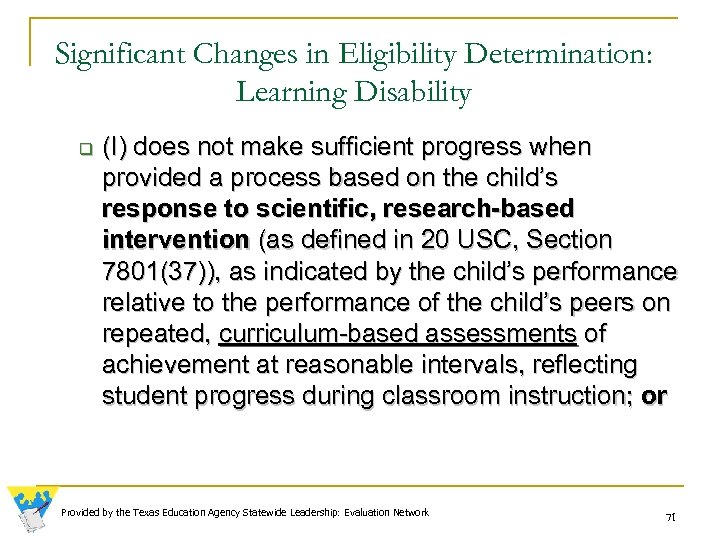 Significant Changes in Eligibility Determination: Learning Disability q (I) does not make sufficient progress when provided a process based on the child’s response to scientific, research-based intervention (as defined in 20 USC, Section 7801(37)), as indicated by the child’s performance relative to the performance of the child’s peers on repeated, curriculum-based assessments of achievement at reasonable intervals, reflecting student progress during classroom instruction; or Provided by the Texas Education Agency Statewide Leadership: Evaluation Network 71
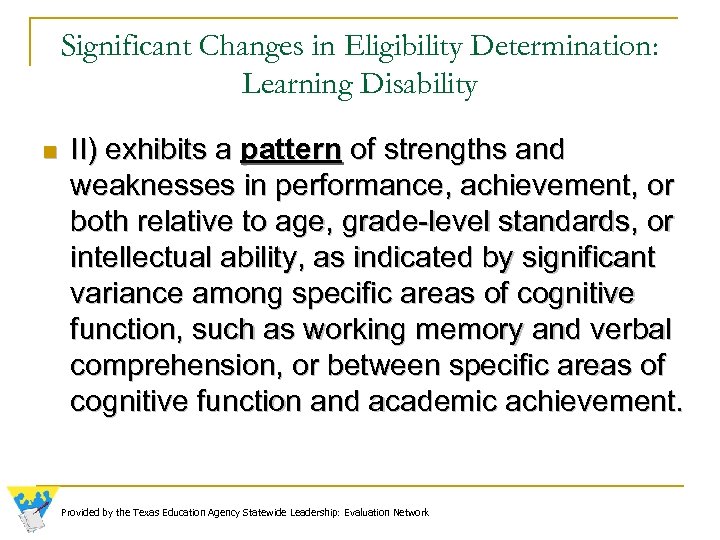 Significant Changes in Eligibility Determination: Learning Disability n II) exhibits a pattern of strengths and weaknesses in performance, achievement, or both relative to age, grade-level standards, or intellectual ability, as indicated by significant variance among specific areas of cognitive function, such as working memory and verbal comprehension, or between specific areas of cognitive function and academic achievement. Provided by the Texas Education Agency Statewide Leadership: Evaluation Network
 How Do We Make Eligibility Determinations for Specific Learning Disabilities? Provided by the Texas Education Agency Statewide Leadership: Evaluation Network 73
 Significant Changes in Eligibility Determination: Mental Retardation A student with mental retardation is one who: n (A) has been determined to have significantly sub-average intellectual functioning as measured by a standardized, individually administered test of cognitive ability in which the overall test score is at least two standard deviations below the mean, when taking into consideration the standard error of measurement of the test; and n (B) concurrently exhibits deficits in at least two of the following areas of adaptive behavior: communication, self-care, home living, social/interpersonal skills, use of community resources, self-direction, functional academic skills, work, leisure, health, and safety Provided by the Texas Education Agency Statewide Leadership: Evaluation Network
 Guidelines for ARD Committees Regarding Testing Requirements for Students: 2 Flowcharts n n n Students entering 9 th during 2008 -2009 must meet requirements of new rule. Students who began completing the Distinguished or Recommended high school program requirements prior to November 2007 are not affected by the rule change. Students who take at least one TAKS-M subjectarea test in grade 11 graduate on the Minimum plan Provided by the Texas Education Agency Statewide Leadership: Evaluation Network
 State Performance Plan n n IDEA 2004 requires each State to develop a six-year performance plan to: q Evaluate the State’s efforts to implement the requirements and purposes of IDEA q Illustrates how the State will continuously improve upon this implementation The Office of Special Education Programs (OSEP) has identified five monitoring priorities and twenty indicators to be included in the SPP For each of the indicators, the State must report progress on measurable and rigorous targets and improvement activities Download from TEA website: http: //www. tea. state. tx. us/special. ed/spp/ Provided by the Texas Education Agency Statewide Leadership: Evaluation Network 76
 Texas Education Agency – Performance Monitoring and Interventions (PMI) n Monitoring is q Using a data-driven performance-based model to observe, evaluate, and report n n q Data integrity Data analysis Student performance Program effectiveness A continuous improvement process Provided by the Texas Education Agency Statewide Leadership: Evaluation Network 77
 PMI & the Evaluator n Indicators q Identification of students for special education n q q q Overidentification Disproportionality/Overrepresentation Recommendations for exiting Statewide Assessment Least Restrictive Environment (LRE) Behavior/Discipline Provided by the Texas Education Agency Statewide Leadership: Evaluation Network 78
 Family Educational Rights and Privacy Act (FERPA) n n n Federal law that protects the privacy of student education records Parents or eligible students have the right to inspect and review education records Schools may disclose records under certain conditions Provided by the Texas Education Agency Statewide Leadership: Evaluation Network 79
 Evaluation Provided by the Texas Education Agency Statewide Leadership: Evaluation Network 80
 Legal Framework: Child Find Framework n No Child Left Behind Act (NCLB) of 2001 q q q n Standards based reform Accountability Adequate yearly progress Individuals with Disabilities Education Improvement Act (IDEA) of 2004 q q Eligibility identification Progress towards annual goals http: //framework. esc 18. net/ Provided by the Texas Education Agency Statewide Leadership: Evaluation Network 81
 Problem Solving Teams n n n Improve student success Target interventions Monitor student progress Support teacher needs Partner with parents Prevent inappropriate referrals Provided by the Texas Education Agency Statewide Leadership: Evaluation Network 82
 What is meant by a Response to Intervention (Rt. I) model? n n Multi-tiered model High quality, research-based instruction in general education setting Screening of academics and behavior of all students to identify individual need General education teachers assume an active role in students assessment Provided by the Texas Education Agency Statewide Leadership: Evaluation Network 83
 What is meant by a Response to Intervention (Rt. I) model? n n Research-based interventions Continuous progress monitoring Data collection to determine individual student needs and interventions' effectiveness Problem solving team process Provided by the Texas Education Agency Statewide Leadership: Evaluation Network 84
 Role of the Evaluator n Campus Problem Solving Teams q q n n Response to Intervention (Rt. I) Progress Monitoring Referral Full Individual Evaluation (FIE) Reevaluation Measure progress toward annual goals Provided by the Texas Education Agency Statewide Leadership: Evaluation Network 85
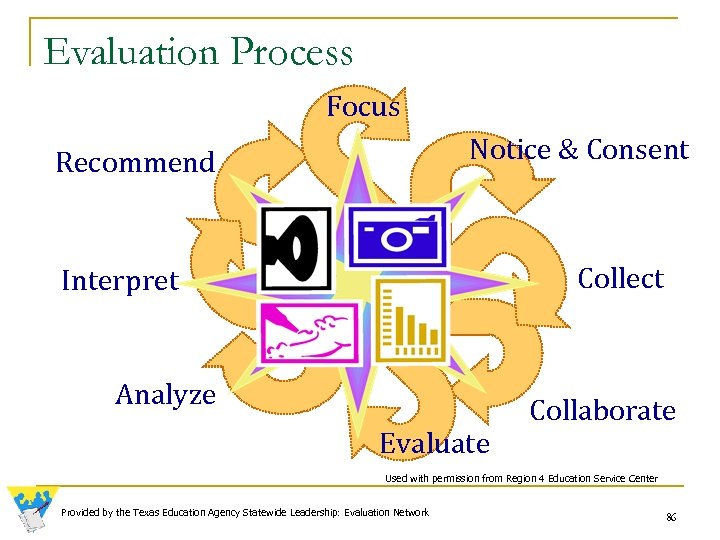 Evaluation Process Focus Notice & Consent Recommend Collect Interpret Analyze Evaluate Collaborate Used with permission from Region 4 Education Service Center Provided by the Texas Education Agency Statewide Leadership: Evaluation Network 86
 Referral n n n n Demographic & background information Educational records Home language survey Vision and hearing screening Health history Documentation of previous research based educational strategies and interventions Parent information Provided by the Texas Education Agency Statewide Leadership: Evaluation Network 87
 Initial Evaluation n Request by parent or public agency Conduct within 60 days of consent Consists of procedures to provide information to determine q q If the child is a child with a disability, and The educational needs of the child C. F. R. § 300. 301 Provided by the Texas Education Agency Statewide Leadership: Evaluation Network 88
 Evaluation Procedures n n n Notice Conduct evaluation Considerations for assessments and other evaluation material Review of existing evaluation data Report C. F. R. § 300. 304, 305 Provided by the Texas Education Agency Statewide Leadership: Evaluation Network 89
 Full Individual Evaluation n Gather information to q q q Make recommendation as to the presence or absence of a disability condition Identify educational need Make recommendations for accommodations, modifications, and instruction Provided by the Texas Education Agency Statewide Leadership: Evaluation Network 90
 Written Report Provided by the Texas Education Agency Statewide Leadership: Evaluation Network 91
 Determination of Eligibility n Upon completion of the evaluation q q A group of qualified professionals and the parent of the child determines whether the child is a child with a disability … and the educational needs of the child; and The public agency provides a copy of the evaluation report and the documentation of determination of eligibility at no cost to the parent 34 C. F. R. § 306(a) Provided by the Texas Education Agency Statewide Leadership: Evaluation Network 92
 A Team is… Provided by the Texas Education Agency Statewide Leadership: Evaluation Network 93
 Reevaluations n Conducted when q q q n Public agency determines that educational or related services warrant Requested by parent or teacher Change of placement may occur including determination that child no longer has disability Frequency C. F. R. § 300. 303, 305 Provided by the Texas Education Agency Statewide Leadership: Evaluation Network 94
 Reevaluation Questions n n Whether child continues to have a disability and the educational needs of the child Present levels of academic and related developmental needs Whether child continues to need special education and related services Whether any additions or modifications to the special education and related services are needed to enable the child to meet measurable annual goals set out in the IEP and to participate as appropriate in the general education curriculum Provided by the Texas Education Agency Statewide Leadership: Evaluation Network
 Individualized Education Program (IEP) Meetings or as we say in Texas – Admission, Review, Dismissal (ARD) Meetings Provided by the Texas Education Agency Statewide Leadership: Evaluation Network 96
 Individualized Education Program (IEP) n n n Written statement of the educational program designed to meet a child's individual needs Every child who receives special education services must have an IEP The IEP has two general purposes q q Set reasonable learning goals State the services that the school district will provide Provided by the Texas Education Agency Statewide Leadership: Evaluation Network 97
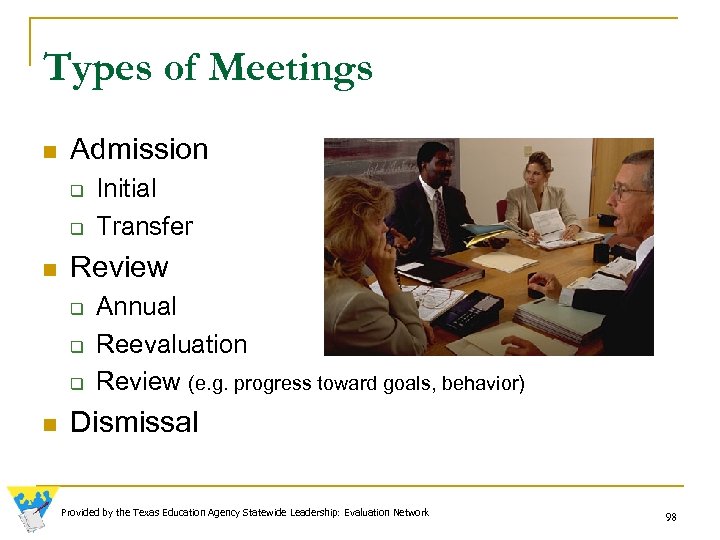 Types of Meetings n Admission q q n Review q q q n Initial Transfer Annual Reevaluation Review (e. g. progress toward goals, behavior) Dismissal Provided by the Texas Education Agency Statewide Leadership: Evaluation Network 98
 IEP Team n n n n Parent Student, if appropriate General Education Teacher Special Education Teacher Public Agency Representative Person who can interpret evaluation Other members as appropriate Provided by the Texas Education Agency Statewide Leadership: Evaluation Network 99
 IEP Agenda Provided by the Texas Education Agency Statewide Leadership: Evaluation Network 100
 IEP Minutes n Tips on Taking Minutes q q Include attendance sheet Show efforts to cooperate with parent Show consideration of each evaluation Document decisions Provided by the Texas Education Agency Statewide Leadership: Evaluation Network 101
 10 Things Not to Say at an ARD n “BUT WE DON’T HAVE A PT, OT, ETC…” (Remember that services are based on the needs of the student. ) n n “WE CAN’T DO THAT---MY SCHEDULE IS FULL ALREADY. ” “IF THIS WERE MY CHILD, I’D…” (Be careful. ) n “SHE’S NOT ELIGIBLE FOR THAT SERVICE DUE TO HER DISABILITY. ” (Services are based on the individual needs of the student. ) n “OUR EYS PROGRAM RUNS FROM JUNE 10 TO JULY 15. ” (EYS should be based on student need. ) n n “WE’VE NEVER DONE IT THAT WAY BEFORE. ” “THE SUPERINTENDENT WILL HAVE TO APPROVE THAT. ” (If something needs to be approved, ask for a fifteen minute recess and get someone there who has that power. ) n “BUT WHAT IF WE GET SUED? ” (Don’t ask at the ARD. You will not be sued individually; usually suit is against the district. ) n n “I DON’T HAVE TIME TO MODIFY FOR ONE STUDENT. IF HE/SHE IS GOING TO BE IN MY CLASSROOM, HE/SHE WILL DO WHAT EVERYONE ELSE DOES. ” “THE REGULAR CLASSROOM IS NOT APPROPRIATE FOR THIS CHILD. ” (You must make reasonable efforts to modify. After you have modified and supplemented for a reasonable amount of time, then you can say, “We find that the regular classroom…”) Reprinted with permission from Jim Walsh, Anderson, Brown, Schulze & Aldridge, P. C. Provided by the Texas Education Agency Statewide Leadership: Evaluation Network 102
 Have a great year! Provided by the Texas Education Agency Statewide Leadership: Evaluation Network 103
 Role of Assessment always has more to do with helping students grow than with cataloging their mistakes. Tomlinson The Differentiated Classroom Provided by the Texas Education Agency Statewide Leadership: Evaluation Network 104
 Contact Information Debbie Buchanan Region One ESC, Edinburg, TX dbuchanan@esc 1. net (956) 984 -6202 Provided by the Texas Education Agency Statewide Leadership: Evaluation Network 105