 Скачать презентацию Ready for First Unit 1 Vocabulary By J
bacbf8f3d6574b342a1b06fbd822d5ed.ppt
- Количество слайдов: 14



Ready for First Unit 1 Vocabulary By J. Collins 2016
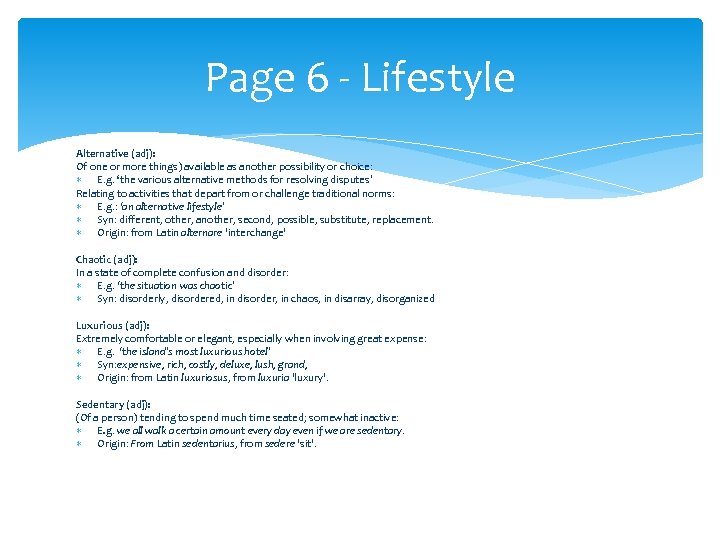
Page 6 - Lifestyle Alternative (adj): Of one or more things) available as another possibility or choice: E. g. ‘the various alternative methods for resolving disputes’ Relating to activities that depart from or challenge traditional norms: E. g. : ‘an alternative lifestyle’ Syn: different, other, another, second, possible, substitute, replacement. Origin: from Latin alternare 'interchange' Chaotic (adj): In a state of complete confusion and disorder: E. g. ‘the situation was chaotic’ Syn: disorderly, disordered, in disorder, in chaos, in disarray, disorganized Luxurious (adj): Extremely comfortable or elegant, especially when involving great expense: E. g. ‘the island’s most luxurious hotel’ Syn: expensive, rich, costly, deluxe, lush, grand, Origin: from Latin luxuriosus, from luxuria 'luxury'. Sedentary (adj): (Of a person) tending to spend much time seated; somewhat inactive: E. g. we all walk a certain amount every day even if we are sedentary. Origin: From Latin sedentarius, from sedere 'sit'.
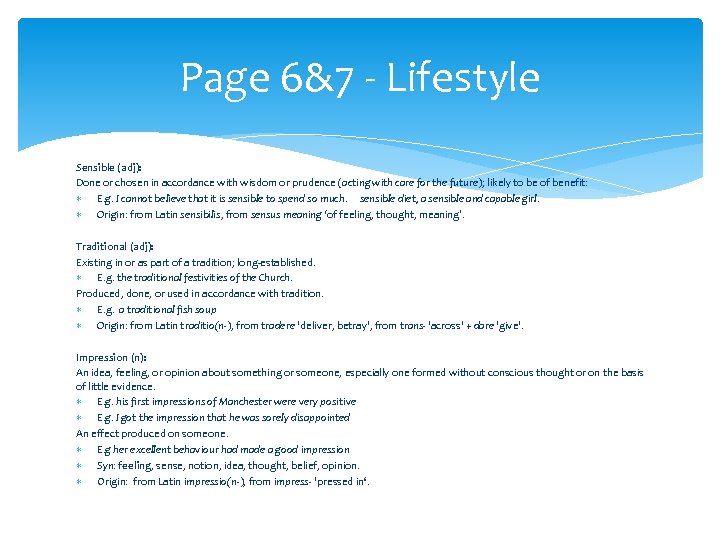
Page 6&7 - Lifestyle Sensible (adj): Done or chosen in accordance with wisdom or prudence (acting with care for the future); likely to be of benefit: E. g. I cannot believe that it is sensible to spend so much. sensible diet, a sensible and capable girl. Origin: from Latin sensibilis, from sensus meaning ‘of feeling, thought, meaning’. Traditional (adj): Existing in or as part of a tradition; long-established. E. g. the traditional festivities of the Church. Produced, done, or used in accordance with tradition. E. g. a traditional fish soup Origin: from Latin traditio(n-), from tradere 'deliver, betray', from trans- 'across' + dare 'give'. Impression (n): An idea, feeling, or opinion about something or someone, especially one formed without conscious thought or on the basis of little evidence. E. g. his first impressions of Manchester were very positive E. g. I got the impression that he was sorely disappointed An effect produced on someone. E. g her excellent behaviour had made a good impression Syn: feeling, sense, notion, idea, thought, belief, opinion. Origin: from Latin impressio(n-), from impress- 'pressed in‘.
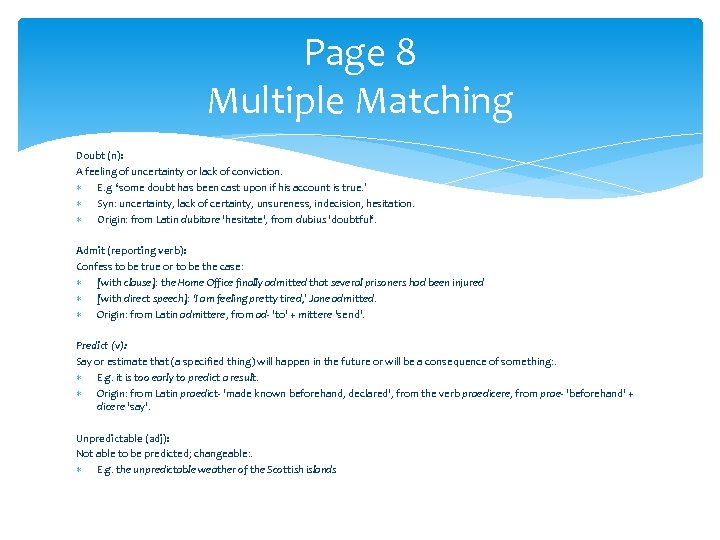
Page 8 Multiple Matching Doubt (n): A feeling of uncertainty or lack of conviction. E. g ‘some doubt has been cast upon if his account is true. ’ Syn: uncertainty, lack of certainty, unsureness, indecision, hesitation. Origin: from Latin dubitare 'hesitate', from dubius 'doubtful‘. Admit (reporting verb): Confess to be true or to be the case: [with clause]: the Home Office finally admitted that several prisoners had been injured [with direct speech]: ‘I am feeling pretty tired, ’ Jane admitted. Origin: from Latin admittere, from ad- 'to' + mittere 'send'. Predict (v): Say or estimate that (a specified thing) will happen in the future or will be a consequence of something: . E. g. it is too early to predict a result. Origin: from Latin praedict- 'made known beforehand, declared', from the verb praedicere, from prae- 'beforehand' + dicere 'say'. Unpredictable (adj): Not able to be predicted; changeable: . E. g. the unpredictable weather of the Scottish islands
Page 8 Multiple Matching Particulary (adv): To a higher degree than is usual or average. E. g. I don’t particularly want to be reminded of that time. Used to single out a subject to which a statement is especially applicable. E. g. the team’s defence is excellent, particularly their two centre backs. So as to give special emphasis to a point; specifically. ‘ he particularly asked that I should help you’. Syn: especially, very, extremely, exceptionally, extraordinarily, extra, amazingly, incredibly, awfully, terribly, really, notably, markedly, decidedly, . Occasion (n): A particular event, or the time at which it takes place: E. g. ‘on one occasion I stayed up until two in the morning’ A special or noteworthy event, ceremony, or celebration. E. g. ‘she was presented with a gold watch to mark the occasion’ Syn: instance, time, moment, juncture, point; event, happening, occurrence, affair, incident, episode. Origin: from Latin occasio(n-) 'juncture, reason', from occidere 'go down, set', from ob- 'towards' + cadere 'to fall'. Realise (v): Become fully aware of (something) as a fact; understand clearly. E. g. he realized his mistake at once. Achieve (something desired or anticipated); fulfil. E. g. ‘it is only now that she is beginning to realize her potential’ Syn: understand, grasp, take in, comprehend, see, recognize, work out
Page 8 & 9 Multiple Matching Rehearse (v): Practise (a play, piece of music, or other work) for later public performance. E. g. ‘we were rehearsing for the school play’ Syn: prepare, practise, try out, read through, sing through, walk through, run through/over, go over. Script (n): Handwriting as distinct from print; written characters. E. g. ‘her neat, tidy script’ The written text of a play, film, or broadcast. Origin: from Latin scriptum, neuter past participle (used as a noun) of scribere 'write'. Ashamed (adj): Embarrassed or guilty because of one’s actions, characteristics, or associations: E. g. ‘you should be ashamed of yourself’. Syn: sorry, guilty, regretful, apologetic; embarrassed, red-faced, humiliated, uncomfortable Unwind (v): Relax after a period of work or tension. E. g. ‘the Grand Hotel is a superb place to unwind’ Syn: relax, loosen up, ease up/off, slow down, de-stress, chill, rest, put one's feet up, take it easy, take time off.
Page 8 Multiple Matching Fair (adj): Treating people equally without favouritism or discrimination. E. g. ‘the group has achieved fair and equal representation for all its members’. Just or appropriate in the circumstances. E. g. to be fair, we shouldn’t yell at him before we hear his side of the story. (Of hair or complexion) light; blonde: E. g. ‘a pretty girl with long fair hair’ Syn: just, equitable, fair-minded, open-minded, honest, upright, honourable, trustworthy; . Variety (n): (a variety of) A number or range of things of the same general class that are distinct in character or quality. E. g. ‘ the centre offers a variety of leisure activities’ A thing which differs in some way from others of the same general class or sort; a type. E. g. fifty varieties of fresh and frozen pasta Unpleasant (adj): Causing discomfort, unhappiness, or revulsion; disagreeable. E. g. an unpleasant smell. (Of a person or their manner) unfriendly and inconsiderate; rude. E. g. when drunk, he could become very unpleasant.
Page 8 Multiple Matching Settle down (Phrasal): Adopt a more steady or secure style of life, especially in a permanent job and home. E. g. ‘one day I will settle down and raise a family’ Convert (v): Change the form, character, or function of something. E. g. He had to covert his Francs to British Pounds. Syn: change, turn, transform, translate Origin: based on Latin convertere 'turn about', from con- 'altogether' + vertere 'turn' Routine (n): A sequence of actions regularly followed. E. g. I settled down into a routine of work and sleep. Dull (adj): Lacking interest or excitement. E. g. your diet doesn’t have to be dull and boring. Lacking brightness, vividness, or sheen: . E. g. his face glowed in the dull lamplight Syn: boring, tedious, tiresome, bland, characterless, featureless, colourless, monotonous, unexciting, uninspiring
Page 8&9 Multiple Matching Conventional (adj): Based on or following what is generally done or believed: E. g. It was his conventional way of thinking that made him stand out. Syn: normal, standard, regular, ordinary, usual, traditional, typical, common. Origin: from Latin conventio(n-) 'meeting, covenant' Solitary (adj): Done or existing alone: . E. g. I live a pretty solitary life Syn: lonely, by oneself/itself, on one's/its own, (all) alone, antisocial, unsociable, withdrawn, reclusive. (Of a place) secluded or isolated (far away from other places or civilisation) E. g. solitary farmsteads. Origin: from Latin solitarius, from solus 'alone'. Personalized (adj): Design or produce (something) to meet someone’s individual requirements: . E. g. ‘the wedding invitations will be personalized to your exact requirements’ Make (something) identifiable as belonging to a particular person, especially by marking it with their name or initials: . E. g. (as adjective personalized) ‘a personalized number plate’ Syn: customize, individualize, give a personal touch to, make distinctive, make to order.
Page 12 – Multiple Matching Spectator (n) A person who watches at a show, game, or other event. E. g. ‘around fifteen thousand spectators came to watch the match on Saturday’. Syn: onlooker, watcher, looker-on, fly on the wall, viewer, observer, witness, eyewitness, bystander. Origin: from Latin spectator, from spectare 'gaze at, observe' Audience (n): The assembled spectators or listeners at a public event such as a play, film, concert, or meeting. E. g. ‘he asked for questions from members of the audience’. The readership of a newspaper, magazine, or book. E. g. ‘the newspaper has a sophisticated audience’. Syn: listeners, viewers, onlookers, concertgoers, theatregoers, patrons / public, following, clientele, patronage, listenership, viewership; followers, fans, devotees, Origin: from Latin audientia, from audire 'hear‘. Competitor (n) A person who takes part in a sporting contest. E. g. ‘two competitors were banned for taking drugs’ An organization or country engaged in commercial or economic competition with others: . E. g. ‘our main business competitors’ Syn: contender, challenger, participant, player, athlete / opponent, adversary, antagonist, enemy, competition, opposition
Page 12 – Multiple Matching Witness (n) A person who sees an event, typically a crime or accident, take place: E. g. ‘police are appealing for witnesses to the accident’ E. g. ‘I was witness to one of the most amazing comebacks in sprinting history’ A person who is present at the signing of a document and signs it themselves to confirm this: . E. g. ‘a marriage certificate is signed in the presence of a witness’ Witness (v): See (an event, typically a crime or accident) happen: E. g. ‘staff who witnessed the murder’. Candidate (n): A person who applies for a job or is nominated for election: E. g. ‘candidates applying for this position should be computer-literate’. E. g. ‘the Green Party candidate’ British A person taking an examination: E. g. ‘an A-level candidate’ Syn: job applicant, job-seeker, interviewee; prospective employee; , nominee, aspirant, possibility, Origin: from Latin candidatus 'white-robed', also denoting a candidate for office (who traditionally wore a white toga), from candidus 'white'
Multiple Matching: Page 12 Host (n): A person who receives or entertains other people as guests. E. g. ‘a dinner-party host’ A person, place, or organization that holds an event to which others are invited: . E. g. ‘Innsbruck once played host to the Winter Olympics’ (Biology) An animal or plant on or in which a parasite or commensal organism lives. Origin: from Latin hospes, hospit- 'host, guest‘. Invigilator (n): Some one who supervises/ watches candidates during an examination. E. g. The Invigilators were constantly moving around the exam room. Origin: from Latin invigilat- 'watched over', from the verb invigilare, from in- 'upon, towards' + vigilare 'watch' (from vigil 'watchful'). Opponent (n): Someone who competes with or opposes another in a contest, game, or argument: E. g. ‘he beat his Republican opponent by a landslide margin’ A person who disagrees with or resists a proposal or practice. E. g. ‘an opponent of the economic reforms’. Syn: adversary, opposer, the opposition, (fellow) competitor, enemy, foe, antagonist, combatant, contender, challenger, critic, dissenter, disputant, objector. Origin: Late 16 th century (denoting a person opening an academic debate by proposing objections to a philosophical or religious thesis): from Latin opponent- 'setting against', from the verb opponere, from ob- 'against' + ponere 'place'.
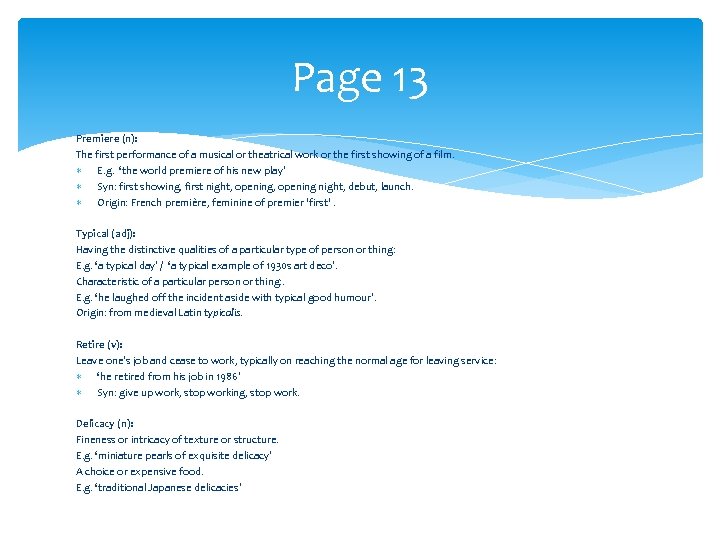
Page 13 Premiere (n): The first performance of a musical or theatrical work or the first showing of a film. E. g. ‘the world premiere of his new play’ Syn: first showing, first night, opening night, debut, launch. Origin: French première, feminine of premier 'first'. Typical (adj): Having the distinctive qualities of a particular type of person or thing: E. g. ‘a typical day’ / ‘a typical example of 1930 s art deco’. Characteristic of a particular person or thing: . E. g. ‘he laughed off the incident aside with typical good humour’. Origin: from medieval Latin typicalis. Retire (v): Leave one’s job and cease to work, typically on reaching the normal age for leaving service: ‘he retired from his job in 1986’ Syn: give up work, stop working, stop work. Delicacy (n): Fineness or intricacy of texture or structure. E. g. ‘miniature pearls of exquisite delicacy’ A choice or expensive food. E. g. ‘traditional Japanese delicacies’
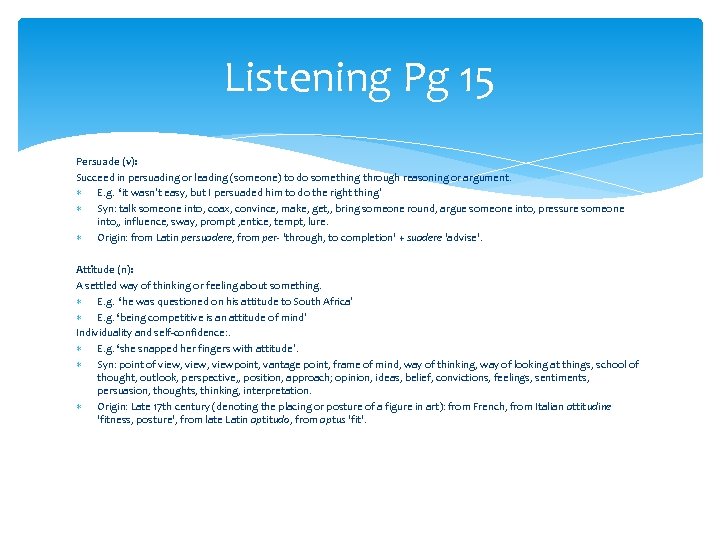
Listening Pg 15 Persuade (v): Succeed in persuading or leading (someone) to do something through reasoning or argument. E. g. ‘it wasn’t easy, but I persuaded him to do the right thing’ Syn: talk someone into, coax, convince, make, get, , bring someone round, argue someone into, pressure someone into, , influence, sway, prompt , entice, tempt, lure. Origin: from Latin persuadere, from per- 'through, to completion' + suadere 'advise'. Attitude (n): A settled way of thinking or feeling about something. E. g. ‘he was questioned on his attitude to South Africa’ E. g. ‘being competitive is an attitude of mind’ Individuality and self-confidence: . E. g. ‘she snapped her fingers with attitude’. Syn: point of view, viewpoint, vantage point, frame of mind, way of thinking, way of looking at things, school of thought, outlook, perspective, , position, approach; opinion, ideas, belief, convictions, feelings, sentiments, persuasion, thoughts, thinking, interpretation. Origin: Late 17 th century (denoting the placing or posture of a figure in art): from French, from Italian attitudine 'fitness, posture', from late Latin aptitudo, from aptus 'fit'.
Скачать презентацию Ready for First Unit 1 Vocabulary By J
bacbf8f3d6574b342a1b06fbd822d5ed.ppt